EINSTEIN, Albert, & Marcel GrossmanBiblio.com
1 506 résultats
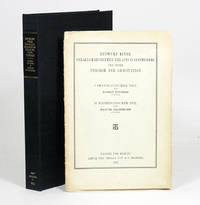
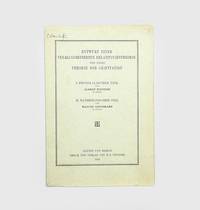
1913188059Leipzig and Berlin: B. G. Teubner 1913. Generalizing relativity First edition of Einstein's early articulation of general relativity his first paper to describe gravity as the curvature of spacetime containing "virtually all the essential features of his general theory of relativity" Norton p. 253. In 1912 Einstein's old school friend Marcel Grossman 1878-1936 secured him a professorship at ETH Zurich where they had both studied as undergraduates. The two men began a collaboration to provide a firmer mathematical foundation to Einstein's concept of gravity as a geometrical property of time and space. The two sections of the Entwurf outline the resulting theory in full complete with gravitational field equations relating the curvature of spacetime to the distribution of mass and energy within it. Einstein contributed the initial section focussing on physical theories while Grossman added the following section developing the more complex mathematical formulae. Michel Janssen editor of the Einstein Papers Project notes that the Entwurf "was published as a separatum in early 1913 and was reprinted the following year in Zeitschrift für Mathematik und Physik" p. 1. The Zeitschrift reprint includes an added section outlining the famed "Hole" argument. An offprint dated 1914 was published with the journal. Provenance: Edward Vermilye Huntington 1874-1952 the American academic who studied the foundations of mathematics at Harvard for 40 years with his signature on the front wrapper. Octavo. Device to title page formulae in the text. Original light green wrappers printed in black. Light rubbing chipping and creasing to wrappers contents clean: a very good copy indeed. Boni 50; Norman 693; Weil 58a. Michael Janssen "Einstein's First Systematic Exposition of General Relativity" 2004; John Norton "How Einstein found his field equations: 1912-1915" Historical Studies in the Physical Sciences vol. 14 no. 2 1984. unknown
191343305Leipzig & Berlin: Teubner 1913. 38pp. 254 x 170 mm. Original printed wrappers chipped. Library stamps. Very good. First separate edition. "After his first discussions with Grossmann Einstein had found the correct starting point for general relativity. The real work could now begin . . . The Einstein-Grossmann paper published in 1913 contains profound physical insight into the nature of measurement some correct general relativistic equations some faulty reasoning and clumsy notation" Pais Subtle is the Lord p. 216. Weil Albert Einstein Bibliography 58. Teubner unknown
19132064Leipzig and Berlin: Teubner 1913. First edition. Original wrappers. Very Good. FIRST EDITION COMMERCIAL OFFPRINT ISSUE of Einstein's breakthrough work on general relativity: the famous "Entwurf" paper. "In this book Einstein and Grossman investigated curved space and curved time as they relate to a theory of gravity. They presented virtually all the elements of the general theory of relativity with the exception of one striking omission: gravitational field equations that were not generally covariant. Einstein soon reconciled himself to this lack of general covariance through the 'hole argument' which sought to establish that generally covariant gravitational field equations would be physically uninteresting. Einstein did not adopt the gravitational field equations until late in 1915 in his final formulations of the general theory. Here Einstein contributed the physics and Grossman the mathematics" Calaprice The Einstein Almanac 40. Weil 59a. Offprint from Zeitschrift für Mathematik und Physik volume 62. Leipzig and Berlin: Teubner 1913. Octavo original wrappers; custom box. Pencil notation on title. Small chips at spine ends. An outstanding copy without any of the cover-foxing so common with this issue. Teubner unknown
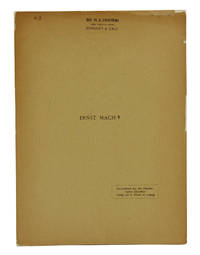
1916140941831Leipzig Germany: S. Hirzel 1916. First separate edition. First separate edition. 4 pp. Illustrated with portrait of August Mach from photograph. Publisher's original printed wrappers. Very Good with some small chips to fragile wrappers faint crease to top of front wrap contents toned with age. This copy belonged to Hans Albert Einstein Albert Einstein’s oldest son with his inkstamp at top of front wrapper; likely a presentation copy from his father. Neatly written at top of front wrapper is "43" and date "14.III.16." OCLC/WorldCat locates four copies two at the University of Toronto one at the Smithsonian Institution and one at the American Philosophical Society. Weil 89.<br /> <br /> <p>Very rare author's offprint stating "Uberreicht vom Verfasser" of the eulogy by Albert Einstein for fellow physicist Ernst Mach as first published in Physikalischen Zeitschrift. A noted scientist in his own right Mach is best known for the concept of "Mach's principle" which asserts that an entity's inertial mass is determined by all the other masses in the universe. Einstein in fact coined the phrase "Mach's principle" and his application of it had major ramifications for the development of his theory of general relativity Einstein in 1918 labeling it one of the "three pillars" of general relativity. S. Hirzel unknown
1995Q-0876544723Pomegranate 1995-09-01. Paperback. New. In shrink wrap. Looks like an interesting title! Pomegranate paperback
1991Q-0876686900Jason Aronson Inc 1991-01-01. Hardcover. New. In shrink wrap. Looks like an interesting title! Jason Aronson, Inc hardcover
1991DADAX0876686900Brand: Jason Aronson Inc 1991-01-01. New Printing. hardcover. New. 6.40x0.85x9.30. Buy with confidence. Excellent Customer Service & Return policy. Brand: Jason Aronson, Inc hardcover
19151200Braunschweig: Friedr. Vieweg & Sohn 1915. 1st Edition. FIRST EDITION FULL BOUND VOLUME OF THE EINSTEIN-DE HAAS EFFECT -- an experimental observation that illustrates the relationship between magnetism and angular momentum and in which a change in the magnetic moment causes the rotation of a free body. In this 1915 paper Albert Einstein and Wander de Haas report that changing the magnetization of a suspended iron rod by applying an external magnetic field leads to mechanical rotation of the rod - a result that still stands as a textbook illustration of the relationship between magnetism and angular momentum. Papers by Planck The Quantum Hypothesis for Molecules with Multiple Degrees of Freedom von Laue Warburg Siegbahn and Born are also present. <br /> <br /> Einstein had long contemplated Ampère's 1820 conjecture that magnetism is caused by the microscopic circular motions of electric charges. In light of this Einstein and de Haas devised an experiment to test not just Ampère's hypothesis but also "Lorentz's theory that the rotating particles are electrons. The aim of the experiment was to measure the torque generated by a reversal of the magnetization of an iron cylinder" Calaprice Einstein Almanac 52. <br /> <br /> In the experiment Einstein and de Haas designed "a magnetic material was suspended with the aid of a thin string inside a magnetic field coil. When the magnetic field was increased by the application of an electric current through the field coil the magnetic material is magnetized. In order to keep the total magnetic moment of the magnetic material constant the latter rotates. This classical Einstein-de Haas effect demonstrates that the spin angular momentum is of the same nature as the angular momentum of rotating bodies as conceived in classical mechanics" Ganzhorn Nature Communications 7 11443 2016. <br /> <br /> Einstein spoke enthusiastically of the experimental results he and de Haas has achieved stating that they had "given firm proof of the existence of Ampère's molecular currents" Pais Subtle is the Lord 245. <br /> <br /> ALSO INCLUDED: Papers by Planck "Die Quantenhypotese für Molekeln mit mehreren Freiheitsgraden" and "Bemerkung über die Entropiekonstante zweiatomiger Gase" as well as a paper by von Laue "Die Einsteinischen Energieschwankungen" CONDITION & DETAILS: Braunschweig: Friedr. Vieweg & Sohn. 8vo. Unobtrusive stamp on front paste down and title page. In-text figures throughout. Tightly bound in leather over marbled paper boards; gilt-lettered and tooled at the slightly faded spine. Unusually beautiful marbled paper edges. Bright and very clean throughout. Near fine. Friedr. Vieweg & Sohn hardcover
191538835Braunschweig Vieweg & Sohn 1915. Contemp. hcalf gilt. Spine with a few scratches and light wear to spine ends. "Verhandlungen der Deutschen Physikalischen Gesellschaft im Jahre 1915. 17. Jahrgang. Im Auftrage der Gesellschaft herausgegeben von Karl Scheel." VI489 pp. textillustr. Einstein/Haas papers: pp. 152-170 a. p. 203 a. p. 420. - Planck paper: pp. 407-418 a. 418-19 a. 438-51. - Laue paper: pp. 198-202. Internally clean and fine. The whole volume offered. <br/><br/><em>All papers first edition. - In the papers by Einstein and Haas prooved the Ampere hypothesis that permanent magnetism is caused by the microscopic circular motions of electric charges. The experimental results was very close to the theoretical value and as such they gave a brilliant proof of the soundness of the hypothesis. </em> unknown
2000Q-0671257501Simon & Schuster 2000-01-01. Hardcover. New. In shrink wrap. Looks like an interesting title! Simon & Schuster hardcover
1987Q-0671638122Fireside 1987-09-15. Paperback. New. New. In shrink wrap. Looks like an interesting title! Fireside paperback
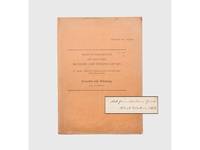
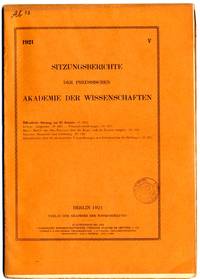
1921176803Berlin: Prussian Academy 1921. One of the scientist's most celebrated mathematical texts inscribed to a colleague First edition rare author's presentation offprint inscribed by Einstein shortly after publication to Professor Friedrich Fritz Behrend 1878-1939 of the Prussian Academy of Sciences where the lecture was first delivered. The paper includes Einstein's celebrated aphorism: "As far as the laws of mathematics refer to reality they are not certain; and as far as they are certain they do not refer to reality." This copy is inscribed in ink on the first page "Mit freundlichen Gruss Albert Einstein. 1. III 21" with a portion of the original address label laid in postmarked 2 March 1921. Einstein and Behrend corresponded in the early 1920s; their relationship was close enough for Behrend to ask Einstein to act as guarantor on a loan in December 1924 a request Einstein politely declined Collected Papers letters 568 and 596. The presentation offprint is distinguished from the trade issue by the printed statement "Überreicht vom Verfasser" on the front cover. Einstein delivered this lecture on the foundations and applications of geometry to the Prussian Academy on 27 January 1921 the year he received the Nobel Prize in Physics. In what DSB describes as a "particularly beautiful lecture" he set out his mature views on the geometrization of physics and relativity the distinction between pure and applied geometry and the priority of empirical over a priori claims. The paper stands as his most considered response to Poincaré's challenge that the universe's geometry could never be proved and it later came to be regarded by logical empiricists as a paradigm-defining text. Quarto 8 pages pp. 123-30. Original orange printed wrappers. With portion of original address label laid in inscribed "Herrn Prof Dr Fritz Behrend Preuss. Akademie der Wissenschaften Unter der Linden 38". Housed in a black quarter morocco solander box with chemise by the Chelsea Bindery. Light central crease from folding partial postmark to rear where address label once affixed: a very good copy. Weil 114. The Collected Papers of Albert Einstein Vol. 14: The Berlin Years Writings & Correspondence April 1923 - May 1925 2015; Thomas Ryckman The Reign of Relativity: Philosophy in Physics 1915-1925 2005. unknown
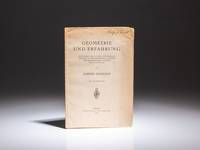
192117649Berlin: Verlag Von Julius Springer 1921. First Trade Edition. Wraps. Very good. The first trade edition of Geometrie Und Erfahrung Geometry and Experience by Albert Einstein from the collection of Einstein's English translator Dr. Wilfrid Perrett. Octavo 20pp. Publisher's original wraps bound with two staples. Light soiling and wear on wraps internally clean. Includes two illustrations advertisements on verso of rear flap. Staples showing rust some wear to edges of original wraps. Weil 115 Schlipp-Shields 143 This copy is signed by Wilfrid Perrett on the front cover. This work first appeared in the Sitzungsberichte der Preussischen Akademie der Wissenschaften accompanied by an "author's offprint" which was bound in orange wrappers. Weil 114. This work is the first separate trade edition. The recipient of this copy Dr. Wilfrid Perrett worked with Dr. George Barker Jeffery to translate many of Einstein's most notable works into English. Perrett was a "distinguished German scholar" and would "overlook the literary side of the work" while Jeffery would oversee the mathematical translations. The two worked together on Das Relativitätsprinzip On the Relativity Principle beginning in 1922 and numerous other works by Einstein over his career. Jammer 113-114. Verlag Von Julius Springer unknown
1921395921921. S.ber. Akad. Wiss. Berl. 1921/ 5. - Berlin 1921 8° pp.103-166 orig. Broschur; unaufgeschnittenes frisches Exemplar. The quite rare first edition and first appearance in print rarely found in this fine condition unopened and in original wrappers! During the early years of the second decade of this century Einstein was also concerned to clarify misconceptions about the theory of relativity and to present his views on natural sciences on a less abstract level. Among the efforts in this direction his particular beautiful lecture on "Geometry and Experience" stands out. At the Prussian Academy's commemorative session honouring Frederick the Great founder of the Academy Einstein delivered this lecture in which he summed up his views on the geometrization of physics and relativity and the relation of mathematics to the external world. Here he gave his famous answer to the puzzling question of why mathematics should be so well adapted to describing the external world: "Insofar as the Laws of Mathematics refer to the external world they are not certain; and insofar as they are certain they do not refer to reality. The lecture was extended to book form. cf. W.Alicke. Weil No.114; Schlipp-Shields No.148 unknown
192146479Berlin Julius Springer 1921. Uncut in orig. printed wrappers. 20 pp. Some marks on the 3 last leaves and on backwrapper probably after a rubberband. <br/><br/><em>First edition. - Weil: 115. - Boni: 122. </em> unknown
192138642Berlin Julius Springer 1921. Uncut in orig. printed wrappers. 20 pp. <br/><br/><em>First edition. - Weil: 115. - Boni: 122. </em> unknown
192132432Berlin: Julius Springer 1921. First Edition. First Edition. Einstein Albert. GEOMETRIE UND ERFAHRUNG. Geometry and Experience PP.121-131. Julius Springer Berlin 1921. Erweiterte Fassung des Festvortrages gehalten an der Preussischen Akademie der Wissenschaften zu Berlin am 27. Januar 1921. 8VO. 20PP. With 2 text illustrations. Original printed cream wrapper. First Edition. Weil 115. HBS52699. At 1921 at the Prussian Acedemy's commemorative session honoring Frederick the Great founder of the Academy Einstein delivered this lecture in which he summed up his views on the geometrization of physics and relativity and the relation of mathematics to the external world. Here he gave his famous answer to the puzzling question of why mathematics should be so well adapted to describing the external world: "Insofar as the Laws of Mathematics refer to the external world they are not certain; and insofar as they are certain they do not refer to reality" D.B.S. Vol. 4 p. 330. A fine copy. This is a mature work of Einstein published when he was 42 years old and in the year he received the Nobel Prize in Physics. Julius Springer unknown
1976Q-0306800462Da Capo Press 1976-08-21. Paperback. New. In shrink wrap. Looks like an interesting title! Da Capo Press paperback
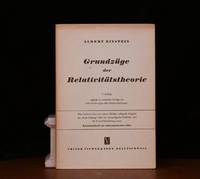
1969__3112590597De Gruyter 1969. Hardcover. New. 5th reprint edition. 172 pages. German language. 5.00x0.56x8.00 inches. De Gruyter hardcover
1970__3112590570De Gruyter 1970. Hardcover. New. 5th reprint edition. 172 pages. German language. 5.00x0.56x8.00 inches. De Gruyter hardcover
195684069Braunschweig: Friedr. Vieweg & Sohn. Fine. 1956. First Edition. Softcover. 8vo . We specialize in fine books in collectible condition. Orders are professionally packaged and shipped promptly. M40 . Friedr. Vieweg & Sohn paperback
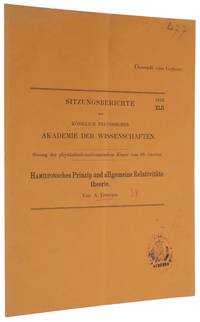
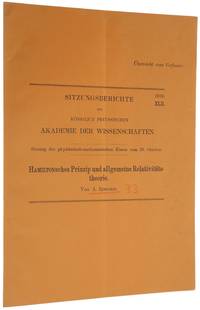
19166409Berlin: Königlichen Akademie der Wissenschaften 1916. First edition. <p>First editions extremely rare author's presentation offprint not to be confused with the much more common trade separate - see below from the library of the great German physicist Arnold Sommerfeld of Einstein's derivation of the field equations of gravitation from a variational principle. This was the first time Einstein had derived the field equations of gravitation in arbitrary coordinates - in his celebrated 1915 papers he derived the equations in generally-covariant form but only in special 'unimodular' coordinates.</p>. THE GRAVITATIONAL EQUATIONS FROM A VARIATIONAL PRINCIPLE. <p>First editions extremely rare author's presentation offprint not to be confused with the much more common trade separate - see below from the library of the great German physicist Arnold Sommerfeld of Einstein's derivation of the field equations of gravitation from a variational principle. This was the first time Einstein had derived the field equations of gravitation in arbitrary coordinates - in his celebrated 1915 papers he derived the equations in generally-covariant form but only in special 'unimodular' coordinates. In the early 19th century William Rowan Hamilton 1805-65 showed that Newton's equations of motion for a classical mechanical system were equivalent to the statement that the 'action' of the system now called the Lagrangian has a stationary value generally a minimum. A first variational approach to the gravitational field equations of general relativity was unsuccessfully sketched by Einstein and Marcel Grossmann in 1913-1914 and subsequently by Einstein himself in 1914 the so-called Entwurf Theory. But Einstein's 1914 theory was invalidated by a misconception related to the physically unjustified requirement of restricting the covariance of the gravitational field equations and by some mathematical errors in a crucial proof in the theory. Between March and May 1915 the Italian mathematician Tullio Levi-Civita 1873-1941 in his private correspondence with Einstein singled out the mathematical flaws of the Entwurf theory setting Einstein back on the path of general covariance which eventually brought him in November 1915 to the correct formulation of the gravitational field equations. Also in November 1915 the great German mathematician David Hilbert 1862-1943 published an article in which he correctly showed that Einstein's gravitational field equations could be obtained from a variational principle at least in the presence of an electromagnetic field. Five days later independently of Hilbert Einstein obtained in the present paper the same results thus obtaining the definitive variational formulation of the field equations. Einstein considered his approach to be more general than Hilbert's as Hilbert had made some hypotheses about matter which Einstein dispensed with Einstein also refused to accept the electromagnetic origin of matter which Hilbert had assumed. In the course of this paper Einstein also proved a special case of Emmy Noether's second theorem on the relation between symmetry and conservation laws which she published in full generality two years later. The only author's presentation offprint listed on RBH is that is the collection of Einstein's son Hans Albert Christie's 2006; it was not in Einstein's own collection of his offprints Christie's 2008.</p> <br /> <p>Provenance: Arnold Sommerfeld 1868-1951 his characteristic numbering in red pencil '34' on front cover; Institut für Theoretische Physik Munich ink stamp on upper cover. "The son of a physician Sommerfeld was educated at the University of Königsberg. After teaching briefly at the universities of Göttingen Clausthal and Aachen he was appointed professor of physics at the University of Münich in 1906. Sommerfeld should have retired in 1936 in favour of his pupil Werner Heisenberg. Opposition from the Nazi party to Heisenberg's appointment prolonged Sommerfeld's tenure and it was not in fact until late 1939 that he finally retired to be succeeded not by Heisenberg but by Wilhelm Müller a Nazi aerodynamicist without a single publication in physics to his credit. Although Sommerfeld and Heisenberg were not Jewish they were regarded by the Nazis as Jewish sympathizers. Sommerfeld however survived the war and returned to his Münich chair in 1945 continuing to work at physics until he died in a car accident in 1951" Oxford Reference. "Arnold Sommerfeld was one of the most distinguished representatives of the transition period between classical and modern theoretical physics. The work of his youth was still firmly anchored in the conceptions of the nineteenth century; but when in the first decennium of the century the flood of new discoveries experimental and theoretical broke the dams of tradition he became a leader of the new movement and in combining the two ways of thinking he exerted a powerful influence on the younger generation. This combination of a classical mind to whom clarity of conception and mathematical rigour are essential with the adventurous spirit of a pioneer are the roots of his scientific success while his exceptional gift of communicating his ideas by spoken and written word made him a great teacher" Max Born p. 275. </p> <br /> <p>"Einstein's first paper on a metric theory of gravity co-authored with his mathematician friend Marcel Grossmann was published as a separatum in early 1913 and was reprinted the following year in Zeitschrift für Mathematik und Physik. Most of the formalism of general relativity as we know it today was already in place in this Einstein-Grossmann theory. Still missing were the generally-covariant Einstein field equations .</p> <br /> <p>"In the fall of 1915 Einstein came to the painful realization that the 'Entwurf' field equations are untenable. Casting about for new field equations he fortuitously found his way back to equations of broad covariance that he had reluctantly abandoned three years earlier . on November 4 1915 presented the rediscovered old equations to the Berlin Academy. He returned a week later with an important modification and two weeks after that with a further modification .</p> <br /> <p>"When it was all over Einstein commented with typical self-deprecation: 'unfortunately I have immortalized my final errors in the academy-papers;' and 'it's convenient with that fellow Einstein every year he retracts what he wrote the year before.' What excused Einstein's rushing into print was that he knew that the formidable Göttingen mathematician David Hilbert was hot on his trail. Nevertheless these hastily written communications to the Berlin Academy proved hard to follow even for Einstein's staunchest supporters such as the Leyden theorists H. A. Lorentz and Paul Ehrenfest . Ehrenfest's queries undoubtedly helped Einstein organize the material of November 1915 for an authoritative exposition of the new theory .</p> <br /> <p>"In March 1916 Einstein sent his new review article 'Die Grundlage der Relativitätstheorie' to Wilhelm Wien editor of the Annalen . In this paper the field equations and energy-momentum conservation are not developed in generally-covariant form but only in special coordinates. Einstein had found the Einstein field equation in terms of these coordinates in November 1915. This part of the review paper is basically a sanitized version of the argument that had led Einstein to these equations in the first place .</p> <br /> <p>"As he was writing his review article he was already considering redoing the discussion of the field equations and energy-momentum conservation in arbitrary coordinates. In November 1916 he published such a generally-covariant account in the Berlin Sitzungsberichte the offered paper. This paper is undoubtedly much more satisfactory mathematically than the corresponding part of the review article but it does not offer any insight into how Einstein actually found his theory.</p> <br /> <p>Reading the offered paper without having read the November 1915 papers and the 1916 review article one easily comes away with the impression that Einstein hit upon the Einstein field equations simply by picking the mathematically most obvious candidate for the gravitational part of the Lagrangian for the metric field namely the Riemann curvature scalar. This is essentially how Einstein himself came to remember his discovery of general relativity. He routinely trotted out this version of events to justify the purely mathematical speculation he resorted to in his work on unified field theory.</p> <br /> <p>"In this paper he derived the generally-covariant field equations from an action principle with the Riemann curvature scalar as the Lagrangian . The present paper fills two important gaps in the review article. First Einstein derived the generally-covariant version of the Bianchi identities which in conjunction with the field equations imply energy-momentum conservation . Second Einstein showed that the identities guaranteeing energy-momentum conservation are a direct consequence of the covariance of the action functional. Einstein had thus in a mathematically impeccable way found a special case of one of Noether's theorems published two years later.</p> <br /> <p>"From a purely mathematical point of view the discussion of the field equations and energy-momentum conservation in the present paper is far more elegant than in the review article. This more elegant treatment however obscures the way in which Einstein found the Einstein field equations. It makes it look as if it was a matter ofpicking the most obvious candidate for the Lagrangian the Riemann curvature scalar at which point everything else fell into place. Ironically this is exactly what Einstein in his later years came to believe himself in part no doubt because it made his successful search for the field equations of general relativity look so similar to his fruitless search for a unified field theory. The clumsier discussion in unimodular coordinates in the review article however may serve as a reminder that-whatever he believed said or wrote about it later on-Einstein only discovered the mathematical high road to the Einstein field equations after he had already found these equations at the end of a poorly paved road through physics. Serving as road signs were Newton's gravitational theory Maxwell's electrodynamics and such key results of special relativity as the law of energy-momentum conservation. Considerations of mathematical elegance played only a subsidiary role" Janssen.</p> <br /> <p>This author's presentation offprint is of extreme rarity and must be distinguished from other so-called 'offprints' of papers from the Berlin Sitzungsberichte many of which are commonly available on the market. The celebrated bookseller Ernst Weil 1919-1981 in the introduction to his Einstein bibliography wrote: "I have often been asked about the number of those offprints. It seems to be certain that there were few before 1914. They were given only to the author and mostly 'Überreicht vom Verfasser' Presented by the Author is printed on the wrapper. Later on I have no doubt many more offprints were made and also sold as such especially by the Berlin Academy." If the term 'offprint' means as we believe it should a separate printing of a journal article given only to the author for distribution to colleagues then 'offprints' were not commercially available. Although there is certainly some truth in Weil's remark in our view it requires clarification and explanation.</p> <br /> <p>Until about 1916 most of Einstein's papers were published in Annalen der Physik; from 1916 until he left Germany for the United States in 1933 most were published in the Berlin Sitzungsberichte. The Sitzungsberichte differed from other journals in which Einstein published in that it made separate printings of its papers commercially available. These separate printings have 'Sonderabdruck' printed on the front wrapper the usual German term for offprint but they are not offprints according to our definition. They were available to anyone; indeed a price list of these 'trade offprints' is printed on the rear wrapper. True author's presentation offprints can be distinguished from these trade separates by the presence of 'Überreicht vom Verfasser' on the front wrapper.</p> <br /> <p>In the period 1916 to 1919 or 1920 the Sitzungsberichte trade separates are themselves rare. After 1919 or 1920 however the trade separates become much more common although the author's presentation offprints are still very rare. The reason for this change is that it was only in 1919 that Einstein became famous among the general public.</p> <br /> <p>It might seem obvious that Einstein's fame dates from 1905 his 'annus mirabilis' in which he published his epoch-making papers on special relativity and the light quantum. However these works did not make him immediately well known even in the physics community - many physicists did not understand or accept his work and it was two or three years before his genius was fully accepted even by his colleagues. Einstein did not secure an academic position until 1908. Among the general public Einstein became well known only in late 1919 following the success of Eddington's expedition to observe the bending of light by the Sun which confirmed Einstein's general theory of relativity. This was front-page news and made Einstein universally famous. See Chapter 16 'The suddenly famous Doctor Einstein' in Pais Subtle is the Lord for an account of these events. Before 1919 the trade separates of Einstein's papers would probably only have been purchased by professional physicists; after 1919 everyone wanted a memento of the famous Dr. Einstein whether or not they understood anything of theoretical physics and the trade separates of his papers were printed and sold in far greater numbers than before to meet the demand. It is telling that when these post-1919 trade separates appear on the market they are often in mint condition - they were never read simply because their owners were unable to understand them.</p> <br /> <p>BRL 90; Weil 88. Born 'Arnold Johannes Wilhelm Sommerfeld 1868-1951' Obituary Notices of Fellows of the Royal Society 8 1952 pp. 275-296. Janssen 'Einstein's First Systematic Exposition of General Relativity' 2004 .</p> <br/> <br/> 8vo 252 x 180 mm pp. 1111-1116. Original orange printed wrappers light vertical crease for posting. Königlichen Akademie der Wissenschaften unknown
19166408Berlin: Königlichen Akademie der Wissenschaften 1916. First edition. <p>First editions extremely rare author's presentation offprint not to be confused with the much more common trade separate - see below from the library of the great German physicist Arnold Sommerfeld of Einstein's derivation of the field equations of gravitation from a variational principle. This was the first time Einstein had derived the field equations of gravitation in arbitrary coordinates - in his celebrated 1915 papers he derived the equations in generally-covariant form but only in special 'unimodular' coordinates.</p>. THE GRAVITATIONAL EQUATIONS FROM A VARIATIONAL PRINCIPLE. <p>First editions extremely rare author's presentation offprint not to be confused with the much more common trade separate - see below from the library of the great German physicist Arnold Sommerfeld of Einstein's derivation of the field equations of gravitation from a variational principle. This was the first time Einstein had derived the field equations of gravitation in arbitrary coordinates - in his celebrated 1915 papers he derived the equations in generally-covariant form but only in special 'unimodular' coordinates. In the early 19th century William Rowan Hamilton 1805-65 showed that Newton's equations of motion for a classical mechanical system were equivalent to the statement that the 'action' of the system now called the Lagrangian has a stationary value generally a minimum. A first variational approach to the gravitational field equations of general relativity was unsuccessfully sketched by Einstein and Marcel Grossmann in 1913-1914 and subsequently by Einstein himself in 1914 the so-called Entwurf Theory. But Einstein's 1914 theory was invalidated by a misconception related to the physically unjustified requirement of restricting the covariance of the gravitational field equations and by some mathematical errors in a crucial proof in the theory. Between March and May 1915 the Italian mathematician Tullio Levi-Civita 1873-1941 in his private correspondence with Einstein singled out the mathematical flaws of the Entwurf theory setting Einstein back on the path of general covariance which eventually brought him in November 1915 to the correct formulation of the gravitational field equations. Also in November 1915 the great German mathematician David Hilbert 1862-1943 published an article in which he correctly showed that Einstein's gravitational field equations could be obtained from a variational principle at least in the presence of an electromagnetic field. Five days later independently of Hilbert Einstein obtained in the present paper the same results thus obtaining the definitive variational formulation of the field equations. Einstein considered his approach to be more general than Hilbert's as Hilbert had made some hypotheses about matter which Einstein dispensed with Einstein also refused to accept the electromagnetic origin of matter which Hilbert had assumed. In the course of this paper Einstein also proved a special case of Emmy Noether's second theorem on the relation between symmetry and conservation laws which she published in full generality two years later. The only author's presentation offprint listed on RBH is that is the collection of Einstein's son Hans Albert Christie's 2006; it was not in Einstein's own collection of his offprints Christie's 2008.</p> <br /> <p>Provenance: Arnold Sommerfeld 1868-1951 his characteristic numbering in red pencil '33' on front cover. "The son of a physician Sommerfeld was educated at the University of Königsberg. After teaching briefly at the universities of Göttingen Clausthal and Aachen he was appointed professor of physics at the University of Münich in 1906. Sommerfeld should have retired in 1936 in favour of his pupil Werner Heisenberg. Opposition from the Nazi party to Heisenberg's appointment prolonged Sommerfeld's tenure and it was not in fact until late 1939 that he finally retired to be succeeded not by Heisenberg but by Wilhelm Müller a Nazi aerodynamicist without a single publication in physics to his credit. Although Sommerfeld and Heisenberg were not Jewish they were regarded by the Nazis as Jewish sympathizers. Sommerfeld however survived the war and returned to his Münich chair in 1945 continuing to work at physics until he died in a car accident in 1951" Oxford Reference. "Arnold Sommerfeld was one of the most distinguished representatives of the transition period between classical and modern theoretical physics. The work of his youth was still firmly anchored in the conceptions of the nineteenth century; but when in the first decennium of the century the flood of new discoveries experimental and theoretical broke the dams of tradition he became a leader of the new movement and in combining the two ways of thinking he exerted a powerful influence on the younger generation. This combination of a classical mind to whom clarity of conception and mathematical rigour are essential with the adventurous spirit of a pioneer are the roots of his scientific success while his exceptional gift of communicating his ideas by spoken and written word made him a great teacher" Max Born p. 275. </p> <br /> <p>"Einstein's first paper on a metric theory of gravity co-authored with his mathematician friend Marcel Grossmann was published as a separatum in early 1913 and was reprinted the following year in Zeitschrift für Mathematik und Physik. Most of the formalism of general relativity as we know it today was already in place in this Einstein-Grossmann theory. Still missing were the generally-covariant Einstein field equations .</p> <br /> <p>"In the fall of 1915 Einstein came to the painful realization that the 'Entwurf' field equations are untenable. Casting about for new field equations he fortuitously found his way back to equations of broad covariance that he had reluctantly abandoned three years earlier . on November 4 1915 presented the rediscovered old equations to the Berlin Academy. He returned a week later with an important modification and two weeks after that with a further modification .</p> <br /> <p>"When it was all over Einstein commented with typical self-deprecation: 'unfortunately I have immortalized my final errors in the academy-papers;' and 'it's convenient with that fellow Einstein every year he retracts what he wrote the year before.' What excused Einstein's rushing into print was that he knew that the formidable Göttingen mathematician David Hilbert was hot on his trail. Nevertheless these hastily written communications to the Berlin Academy proved hard to follow even for Einstein's staunchest supporters such as the Leyden theorists H. A. Lorentz and Paul Ehrenfest . Ehrenfest's queries undoubtedly helped Einstein organize the material of November 1915 for an authoritative exposition of the new theory .</p> <br /> <p>"In March 1916 Einstein sent his new review article 'Die Grundlage der Relativitätstheorie' to Wilhelm Wien editor of the Annalen . In this paper the field equations and energy-momentum conservation are not developed in generally-covariant form but only in special coordinates. Einstein had found the Einstein field equation in terms of these coordinates in November 1915. This part of the review paper is basically a sanitized version of the argument that had led Einstein to these equations in the first place .</p> <br /> <p>"As he was writing his review article he was already considering redoing the discussion of the field equations and energy-momentum conservation in arbitrary coordinates. In November 1916 he published such a generally-covariant account in the Berlin Sitzungsberichte the offered paper. This paper is undoubtedly much more satisfactory mathematically than the corresponding part of the review article but it does not offer any insight into how Einstein actually found his theory.</p> <br /> <p>Reading the offered paper without having read the November 1915 papers and the 1916 review article one easily comes away with the impression that Einstein hit upon the Einstein field equations simply by picking the mathematically most obvious candidate for the gravitational part of the Lagrangian for the metric field namely the Riemann curvature scalar. This is essentially how Einstein himself came to remember his discovery of general relativity. He routinely trotted out this version of events to justify the purely mathematical speculation he resorted to in his work on unified field theory.</p> <br /> <p>"In this paper he derived the generally-covariant field equations from an action principle with the Riemann curvature scalar as the Lagrangian . The present paper fills two important gaps in the review article. First Einstein derived the generally-covariant version of the Bianchi identities which in conjunction with the field equations imply energy-momentum conservation . Second Einstein showed that the identities guaranteeing energy-momentum conservation are a direct consequence of the covariance of the action functional. Einstein had thus in a mathematically impeccable way found a special case of one of Noether's theorems published two years later.</p> <br /> <p>"From a purely mathematical point of view the discussion of the field equations and energy-momentum conservation in the present paper is far more elegant than in the review article. This more elegant treatment however obscures the way in which Einstein found the Einstein field equations. It makes it look as if it was a matter ofpicking the most obvious candidate for the Lagrangian the Riemann curvature scalar at which point everything else fell into place. Ironically this is exactly what Einstein in his later years came to believe himself in part no doubt because it made his successful search for the field equations of general relativity look so similar to his fruitless search for a unified field theory. The clumsier discussion in unimodular coordinates in the review article however may serve as a reminder that-whatever he believed said or wrote about it later on-Einstein only discovered the mathematical high road to the Einstein field equations after he had already found these equations at the end of a poorly paved road through physics. Serving as road signs were Newton's gravitational theory Maxwell's electrodynamics and such key results of special relativity as the law of energy-momentum conservation. Considerations of mathematical elegance played only a subsidiary role" Janssen.</p> <br /> <p>This author's presentation offprint is of extreme rarity and must be distinguished from other so-called 'offprints' of papers from the Berlin Sitzungsberichte many of which are commonly available on the market. The celebrated bookseller Ernst Weil 1919-1981 in the introduction to his Einstein bibliography wrote: "I have often been asked about the number of those offprints. It seems to be certain that there were few before 1914. They were given only to the author and mostly 'Überreicht vom Verfasser' Presented by the Author is printed on the wrapper. Later on I have no doubt many more offprints were made and also sold as such especially by the Berlin Academy." If the term 'offprint' means as we believe it should a separate printing of a journal article given only to the author for distribution to colleagues then 'offprints' were not commercially available. Although there is certainly some truth in Weil's remark in our view it requires clarification and explanation.</p> <br /> <p>Until about 1916 most of Einstein's papers were published in Annalen der Physik; from 1916 until he left Germany for the United States in 1933 most were published in the Berlin Sitzungsberichte. The Sitzungsberichte differed from other journals in which Einstein published in that it made separate printings of its papers commercially available. These separate printings have 'Sonderabdruck' printed on the front wrapper the usual German term for offprint but they are not offprints according to our definition. They were available to anyone; indeed a price list of these 'trade offprints' is printed on the rear wrapper. True author's presentation offprints can be distinguished from these trade separates by the presence of 'Überreicht vom Verfasser' on the front wrapper.</p> <br /> <p>In the period 1916 to 1919 or 1920 the Sitzungsberichte trade separates are themselves rare. After 1919 or 1920 however the trade separates become much more common although the author's presentation offprints are still very rare. The reason for this change is that it was only in 1919 that Einstein became famous among the general public.</p> <br /> <p>It might seem obvious that Einstein's fame dates from 1905 his 'annus mirabilis' in which he published his epoch-making papers on special relativity and the light quantum. However these works did not make him immediately well known even in the physics community - many physicists did not understand or accept his work and it was two or three years before his genius was fully accepted even by his colleagues. Einstein did not secure an academic position until 1908. Among the general public Einstein became well known only in late 1919 following the success of Eddington's expedition to observe the bending of light by the Sun which confirmed Einstein's general theory of relativity. This was front-page news and made Einstein universally famous. See Chapter 16 'The suddenly famous Doctor Einstein' in Pais Subtle is the Lord for an account of these events. Before 1919 the trade separates of Einstein's papers would probably only have been purchased by professional physicists; after 1919 everyone wanted a memento of the famous Dr. Einstein whether or not they understood anything of theoretical physics and the trade separates of his papers were printed and sold in far greater numbers than before to meet the demand. It is telling that when these post-1919 trade separates appear on the market they are often in mint condition - they were never read simply because their owners were unable to understand them.</p> <br /> <p>BRL 90; Weil 88. Born 'Arnold Johannes Wilhelm Sommerfeld 1868-1951' Obituary Notices of Fellows of the Royal Society 8 1952 pp. 275-296. Janssen 'Einstein's First Systematic Exposition of General Relativity' 2004 .</p> <br/> <br/> 8vo 252 x 180 mm pp. 1111-1116. Original orange printed wrappers light vertical crease for posting. Königlichen Akademie der Wissenschaften unknown
199116712Iowa City IA: Iowa Institute of Hydraulic Research University of Iowa 1991. First edition. Trade Paperback Original. Very good. Thin octavo standard size. Slight wear to edges and corners. 112 p. w/ illustrations appendices references. A short joint biography by Roboz Einstein focusing on their marriage and HAE's own achievements in hydraulic engineering. Includes an short biography of HAE's mother Mileva Einstein-Maric by Dord Krstic written at Roboz Einstein's request. <br/><br/> Iowa Institute of Hydraulic Research, University of Iowa paperback
1974Q-0883650819Galahad Books 1974. Hardcover. New. In shrink wrap. Looks like an interesting title! Galahad Books hardcover