Einstein, MaraBiblio.com

2 944 résultats
2012x-0520266528Univ of California Pr 2012. Hardcover. New. 1st edition. 240 pages. 10.00x6.50x1.00 inches. Univ of California Pr hardcover
2012DADAX0520266528University of California Press 2012-04-26. First Edition. hardcover. New. 6.00x0.83x9.00. Buy with confidence. Excellent Customer Service & Return policy. University of California Press hardcover
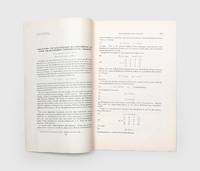
1946858Lancaster: American Physical Society 1946. 1st Edition. FIRST EDITION IN ORIGINAL WRAPS OF SIGNIFICANT CORRECTIONS & ADDITIONS BY EINSTEIN & STRAUS TO AN IMPORTANT PAPER; AS WELL A PAPER BY CHANDRASEKHAR ON THE ORIGIN OF THE SOLAR SYSTEM. <br /> <br /> In 1945 Albert Einstein and Ernst G. Straus introduced their Swiss cheese model of the universe in a paper entitled "The Influence of the Expansion of Space on the Gravitation Fields Surrounding the Individual Stars". Weil 216. The following year they published "Corrections and Additional Remarks to Our Paper" the 1945 paper the paper offered here. <br /> <br /> In early 1945 Einstein returned to long held cosmological questions as he sought to try to understand whether the expansion of the universe caused the solar system to expand as well — or more specifically the influence of the expansion of space on the gravitational field in the neighborhood of a star. Working with Straus the two began studying the effect of inhomogeneities in an expanding model. <br /> <br /> "By the spring of 1945 Einstein and Straus had found a new type of possible universe using Einstein's equations. It described a universe which looked largely like one of the simple expanding universes of Friedmann and Lemaître containing material like galaxies which exerted no pressure. But it has spherical regions removed from it like bubbles in a Swiss cheese. Each empty hole then had a mass placed at its centre. The mass was equal in magnitude to what had been excavated to create the hole. This was a step towards a more realistic universe in which the matter was not smoothly spread with the same density everywhere but gathered up into lumps like galaxies which were spread about in empty space. Barrow The Book of Universes 106-107. <br /> <br /> ALSO INCLUDED: S. Chandrasekhar's "On a New Theory of Weizsäcker on the Origin of the Solar System". In 1945 C. F. v. Weizsäcker proposed a new theory of the origin of the solar system which appeared to merit consideration. Weizsäcker argued "that there would be turbulence in the solar nebula which would give rise to the formation of eddies having angular motion opposite to that of the rotation of the nebula" Abhyankar The Origin BASI 26 339. Weizsäcker's "principal idea was to regard the formation of a planetary system around a star as a possible last stage in the formation of the star itself" Chandrasekhar 1946 94. He believed that "the protoplanets were supposed to have formed at the sites of the ball bearing eddies and the merger of the protoplanets in the same orbit produced the known planets" Abhyankar 343. In the paper offered here the Indian American astrophysicist S. Chandrasekhar challenged Weizsäcker's theory and showed "that there will be a wide spectrum of turbulence with smaller eddies within the larger ones and there would be no regular pattern as suggested by Weizsäcker. Further the life time of the eddies will be too short for the formation of the planets" ibid. In other words Chandrasekhar's work "indicated that the regular pattern of vortices originally postulated by Weizsäcker could not occur but instead must be replaced by a range of eddy sizes" Brush A History of Modern Planetary Physics 14. Chandrasekhar's work led to the abandonment of Weizsäcker's theories. <br /> <br /> INCLUDED: Nobel Prize winner Percy Williams Bridgman's "Recent Work in the Field of High Pressures" pp. 1-94 an important review of work done in the field of high pressure physics between Bridgman's seminal 1930 work and 1946 the year he won the prize and R. Samuel's "The Dissociation Spectra of Covalent Polyatomic Molecules" pp. 103-148. CONDITION & DETAILS: Lancaster: American Physical Society. Complete issue in original wraps. 4to. 10.5 x 8 inches; 263 x 200mm. Very slight wear at the edges of the wraps and head and foot of the spine; small closed tear see images. Bright and clean throughout. Very good condition. American Physical Society paperback
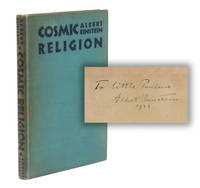
1931021909New York: Covici Friede 1931. First Edition. hardcover. Some pencil markings in text title page and endpapers darkened not really affecting Einstein's inscription; covers a little soiled. Good to Very Good and quite scarce. With a long biographical note and an appreciation by George Bernard Shaw. Subjects include Disarmament Pacifism the Jewish Homeland and more. This copy INSCRIBED and SIGNED by the author with his scarcer full signature on the front endpaper: "To little Pauline/Albert Einstein/1933." An uncommon title to find signed by the man of the century. With a letter of authenticity from James Spence if you need that kind of security blanket. <br/><br/> Covici Friede hardcover
1258001470.Ghardcover. Good. Access codes and supplements are not guaranteed with used items. May be an ex-library book. hardcover
1258113112.Gpaperback. Good. Access codes and supplements are not guaranteed with used items. May be an ex-library book. paperback
0993840124.Gpaperback. Good. Access codes and supplements are not guaranteed with used items. May be an ex-library book. paperback
1934180324Princeton: Princeton University Press 1934. First edition offprint issue of the fourth and final paper on Einstein and Mayer's semi-vectors in which they aimed to incorporate the Dirac equation into the general theory of relativity. This last article "was presented foremost as an exercise with exclusively mathematical appeal" Van Dongen p. 106. Large octavo pp. 7. Disbound from wrappers wire-stitched. Nicks and a handful of short closed tears to extremities: a very good copy. Boni 225; Weil 193. Jeroen van Dongen Einstein's Unification 2010. unknown
190639057Leipzig Johann Ambrosius Barth 1906. Bound in a fine recent hmorocco. Gilt lettering on spine. "Annalen der Physik" Bd. 20 Heft 8 pp. 433-640. The Einstein paper pp. 627-633. <br/><br/><em>First edition of this paper in the periodical form in which Einstein shows that the conservation of mass is a special application of his energy principle E= Mc2 - "Einstein considers a weightless horizontal cylinder filled with electromagnetic radiation and closed to the external world. A certain amount of radiating energy E moves from the left end of the cylinder to the right end transferring a certain amount of momentum due to radiation pressure to the left end which translates the cylinder to the left. When the radiation arrives at the right end the motion stops. We now imagine that a practically massless body absorbs this radiation moves back to the left and deposits it to its original state. Then the body moves back to right end into its original position. Now a complete cycle has taken place the system is back in its original state but the center of mass has moved by a certain amount to the left. This process can be repeated any number of times with the result that a body all by itself without any external forces can change its centre of mass by an arbitrary amount in contradiction to all physical evidence. This conclusion is avoided if we assume that the energy E is associated with the mass M=E/c2 in which case the centre of mass remains permanently at rest in agreement with our ecpectations." Cornelius Lanczos. - Weil: 13. </em> unknown
1015511376.Ghardcover. Good. Access codes and supplements are not guaranteed with used items. May be an ex-library book. hardcover
191514657Leipzig and Berlin: B.G. Teubner 1915. With frontispiece portrait of Minkowski and text figures. Boards spine and corners frayed and cracking. Sammelband containing the original papers on the special and general theories of relativity with a foreword by O. Blumenthal. It is in Minkowski's famous paper Raum und Zeit Space and time that he proposes the concept of time as the fourth dimension and initiates a mathematical study that became the basis of the later development of the theory. Included here is the re-issue of that work by Einstein and Lorentz with notes by A. Sommerfeld published after Minkowski's untimely death along with other papers by the two scientists whose works led to the abandonment of space and time as separate entities. <br /> <br /> Weil 59; see Printing & the Mind of Man 401. B.G. Teubner unknown
20181567230107Triton Museum of Art/ Grand Central Press 2018. Hardcover. Good. Pages can have notes/highlighting. Spine may show signs of wear. ~ ThriftBooks: Read More Spend Less.Dust jacket in acceptable condition. SIGNED and inscribed by the author. Shelf and handling wear to cover and binding with general signs of previous use. Cut to dust jacket. Secure packaging for safe delivery.Dust jacket quality is not guaranteed. Triton Museum of Art/ Grand Central Press hardcover
1941433111941. Offprint from Universidad Nacional de Tucuman Revista Serie A 2 1941. 11-15pp. 270 x 179 mm. Original printed wrappers. Very good. "Address to joint meeting of the American Physics Society and the American Association of Physics Teachers Princeton Dec. 29 1941 under the title: 'Solutions of finite mass of the gravitational equations'" Weil. Weil Albert Einstein Bibliography 208. unknown
194146476Tucuman Argentina 1941. Royal8vo. Orig. printed wrappers. Offprint from "Revista. Universidad Nacional de Tucuman" Series A Matematicas y Fisica Teorica Vol. 2 Diciembre de 1941 Nos 1 y 2. Pp. 11-15. Fine and clean. This copy has belonged to Abraham Pais 1918-2000 - the famous Einstein scholar theoretical physicist and Einsteins collegue at Princeton - and having his name on top of the frontwrapper "A Pais" <br/><br/><em>First edition of a scarce paper in the offprint version. The paper "represents the basis of the one written by the same author in collaboration with Wolfgang Pauli in 1943 in which by following analogous lines the proof of the non-existence of regular particle-type solutions was generalized to the case of cilyndrical geometries in Kaluza-Klein theory Einstein & Pauli 1943. Besides other generalizations were subsequently presented. The non-existence of such solutions in classical unified field theory was undoubtedly an important criterion leading Einstein's investigations."Galvagno and Giribet."In his search for a unified field theory that could undercut quantum mechanics Einstein considered five-dimensional classical Kaluza-Klein theory. He studied this theory most intensively during the years 1938-1943. One of his primary objectives was finding a non-singular particle solution. In the full theory this search got frustrated and in the x5-independent theory Einstein together with Pauli argued it would be impossible to find these structures." Jeroen van Dongen.Weil: 208. - Boni: 243. </em> unknown
194146477Tucuman Argentina 1941. Royal8vo. Orig. printed wrappers. Offprint from "Revista. Universidad Nacional de Tucuman" Series A Matematicas y Fisica Teorica Vol. 2 Diciembre de 1941 Nos 1 y 2. Pp. 11-15. Fine and clean. <br/><br/><em>First edition of a scarce paper in the offprint version. The paper "represents the basis of the one written by the same author in collaboration with Wolfgang Pauli in 1943 in which by following analogous lines the proof of the non-existence of regular particle-type solutions was generalized to the case of cilyndrical geometries in Kaluza-Klein theory Einstein & Pauli 1943. Besides other generalizations were subsequently presented. The non-existence of such solutions in classical unified field theory was undoubtedly an important criterion leading Einstein's investigations."Galvagno and Giribet."In his search for a unified field theory that could undercut quantum mechanics Einstein considered five-dimensional classical Kaluza-Klein theory. He studied this theory most intensively during the years 1938-1943. One of his primary objectives was finding a non-singular particle solution. In the full theory this search got frustrated and in the x5-independent theory Einstein together with Pauli argued it would be impossible to find these structures." Jeroen van Dongen.Weil: 208. - Boni: 243. </em> unknown
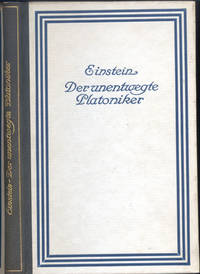
STAN0092Leipzig Kurt Wolff 1918. 1773 Seiten Orig.-Halblederband mit goldgepr. Rückentitel u. Kopfgoldschnitt sehr gut erhalten. Erste Ausgabe. Raabe Autoren 65/4. Eines von 850 Exemplaren. Mit Druckwidmungen für Franz Blei und Marcel Ray. Der Band besteht aus den Erzählungen : Der unentwegte Platoniker; G. F. R. G. Gesellschaft für religiöse Gründungen; Die Mädchen auf dem Dorfe. Leipzig, Kurt Wolff (1918). unknown
0336-02Lpz. Wolff 1918. 177 2 S. OHLdr. mit Kopfgoldschnitt u. Rückengoldpräg. EA. W.- G.² 6; Raabe/Hannich-B. 65.4 - In nur 850 Expl. gedruckt. - Enthält die drei Erzählungen: Der unentwegte Platoniker; G.F.R.G. Gesellschaft für religiöse Gründungen; Die Mädchen auf dem Dorfe. Lpz., Wolff [1918]. unknown
1939240København: J.H. Schultz Forlag 1939. Hardcover. Very Good. Half bound leather and marbled paper boards. Boards rubbed and discolored spine faded. Small tear at bottom edge of half title and title page. Small yellow stain at top corner of page 287 and the following page. J.H. Schultz Forlag hardcover
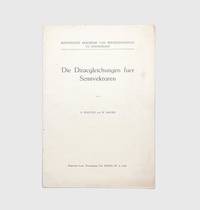
1933180322Amsterdam: Koninklijke Akademie van Wetenschappen 1933. First edition offprint issue of the second of Einstein and Mayer's four classic papers on semi-vectors in which they aimed to incorporate the Dirac equation into the general theory of relativity. "By introducing semi-vectors Einstein wanted to arrive at a mathematically simpler and more general formulation of spinors. The semi-vector generalization of the Dirac equation was thought to give a unified description of charged elementary particles in particular of the electron and proton. In their second semi-vector paper Einstein and Mayer were on the lookout for the most general Dirac system possible for the semivector" Van Dongen pp. 103-11. Large octavo pp. 20. Original cream wrappers front wrapper printed in black. Wire-stitching sometime removed front wrappers lightly soiled: a very good copy. Boni 222; Weil 191. Jeroen van Dongen Einstein's Unification 2010. unknown
1909662931909. Physik. Zschr. 10. - Leipzig Verlag von S. Hirzel 1909 4° XXII 2 1040 pp. mit Textabbildungen und 26 Tafeln Halbleinenband d.Zt.; St.a.Tit. feines Expl. A LANDMARK W. PAULI FIRST EDITION "of this extensive paper given as lecture before the 81st assembly of the "Gesellschaft Deutscher Naturforscher" in Salzburg on 21st September 1909. He spoke on "The Development of Our View of the Nature and Constitution of Radiation" a topic that embraced both relativity and quanta. Among those who attended Einstein's lecture were some of the world's foremost physicists. In Einstein's austere opinion his address regarded strictly as a work of science was of little importance since as he writes to a co-worker it contained nothing new. Einstein was being overmodest. Besides to many in Einstein's audience and it should be born in mind that it was the year after Minkowski's stirring introduction of the concept of the fourth dimension this Lecture came as a revelation. The occasion was important for Einstein too. He had been working for years in a sort of scientific exile and his curiosity as to what great scientists were like in face-to-face discussion was at least as great as their curiosity about him. His confidence in himself was certainly not harmed when he found that he was able to hold his own easily in their company. Moreover at this congress Einstein first met Planck. In addition he made new'lasting friendships leading to a voluminous scientific correspondence. Amongst those attending the congress were Max von Laue Max Born. Arnold Sommerfeld Hasnohrl. Ladenburg. Max von Laue was to be the first to publish in 1911 the first text-book on relativity theory. All of them are present in this issue with scientific papers of their own." Walter Alicke Weil No. 30; Schilpp-Shields No. 30; Hoffmann Einstein p. 93; Alicke Nr. 34 unknown
3499250179.Gperfect. Good. Access codes and supplements are not guaranteed with used items. May be an ex-library book. unknown
H3984Berlin Akademie der Wissenschaften 1914 In: Sitzungsberichte der Königl.Preuss. Akademie der Wissenschaften Band 1914/2. 4to. S. 1030-1095. Anbei weiters: Planck Max: Eine veränderte Formulierung der Quantenhypothese. S.918-923. Schwarzschild K.: 1 Über Diffusion und Absorption in der Sonnenathmosphäre. S.1183-1200. 2 Über die Verschiebungen der Bande bei 3883 A im Sonnenspectrum. S.1201-1213. Halbleinenband der Zeit leicht berieben Bibl.-Nr.am Rücken Original-Broschur miteingebunden unaufgeschnitten gutes Exemplar. unknown
19142124Berlin: Königlichen Akademie der Wissenschaften 1914. FIRST EDITION OFFPRINT. Original wrappers. Fine. FIRST EDITION COMMERCIAL OFFPRINT ISSUE of Einstein's important 1914 paper on the development of general relativity. "In summer 1914 Einstein felt that the new theory general relativity should be presented in a comprehensive review. He also felt that a mathematical derivation of the field equations that would determine them uniquely was still missing. "Both tasks are addressed in a long paper presented in October 1914 to the Prussian Academy for publication in its Sitzungsberichte. It is entitled 'The formal foundation of the general theory of relativity'; here for the first time Einstein gave the new theory of relativity the epithet 'general' in lieu of the more cautious 'generalized' that he had used for the Entwurf" Landmark Writings in Western Mathematics 1640-1940. "According to John Norton 'How Einstein Found His Field Equations' this major review article was intended to convey the full content of the 1913 'Entwurf' theory: 'The principal novelty lies in the mathematical formulation of the theory. Drawing on earlier work with Marcel Grossman Einstein formulated his gravitational field equations using a variation principle. Using this richer mathematical structure Einstein offered a proof purporting to demonstrate that his theory had the maximum covariance compatible with the hole argument; that is covariance under 'justified' transformation between the 'adapted coordinate systems' he had introduced with Grossman'" Calaprice The Einstein Almanac. Offprint from: Sitzungsberichte der Königlich Preussischen Akademie der Wissenschaften XLI 19 November 1914 pp. 1030-1085. Berlin: Königlichen Akademie der Wissenschaften 1914. Octavo original wrappers; custom box. Neat early ownership name on front wrapper. Only the slightest wear; a fine copy. Rare. Königlichen Akademie der Wissenschaften unknown
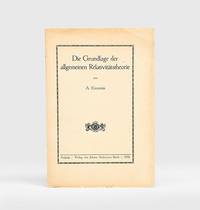
191619266Leipzig: J.A Barth 1916. FIRST SEPARATE EDITION. Original printed wrappers on rippled paper; wrappers and interior soiled and spotted mostly likely with minor water damage. From the library of Einstein protege Dr. Kurt Eisenmann with his siganture and stamps. First separate printing of Einstein’s classic paper. Not an offprint from the Annalen der Physik as is often thought but a completely new setting of type with significant and important additions and revisions including an introduction published here for the first time which was not in the journal issue. <br /> <br /> Printing & the Mind of Man 408; Weil 80a. J.A Barth unknown
1916188045Leipzig: Johann Ambrosius Barth 1916. The foundation of general relativity First separate edition first issue of the work presenting the finalized version of general relativity. The Grundlage was also published in the Annalen der Physik in 1916 but Weil clarifies that the separate publication is now accepted as the earliest published edition of the paper. Einstein had almost finalized the general theory of relativity in 1913. However an error led him to contend that his equations could not be covariant - that they could not be applied without a system of spacetime co-ordinates devised by humans and therefore contextually specific. His first attempt at an overall presentation of the theory as delivered in 1914 was based on this assumption. By 1915 his subsequent reflections had driven him to reapply covariance and in November he published several papers outlining covariant field equations of general relativity. The present work adapts the comprehensive perspective of the 1914 paper with the revised mathematics of the 1915 equations to present "the first systematic exposition of general relativity" Janssen p. 1. Tilman Sauer notes that "in essence Einstein's general theory of relativity of 1916 remains today's accepted theory of the gravitational field" p. 24. This copy includes all the necessary first issue points: the imprint "Druck von Metzger & Wittig in Leipzig. 314" on the title page verso; Ziehen's Die Psychologie as the last title listed in the publisher's advertisement on the rear wrapper; and the imprint "Metzger & Wittig Leipzig" on the rear wrapper. Octavo. Device to title page formulae in the text. Original tan vertically ribbed wrappers printed in black. Light creasing and foxing to otherwise bright wrappers title page remargined at head not affecting text contents crisp: a near-fine copy. Norman 696; Printing and the Mind of Man 408; Weil 80a. Michael Janssen "Einstein's First Systematic Exposition of General Relativity" 2004; Tilman Sauer "Albert Einstein's 1916 Review Article on General Relativity" in Ivor Grattan-Guiness ed. Landmark Writings in Western Mathematics 1640-1940 2004. unknown