Einstein, StanleyBiblio.com

2 944 résultats
0306413787.Ghardcover. Good. Access codes and supplements are not guaranteed with used items. May be an ex-library book. hardcover
20390606-nnew. unknown
20390606like new. unknown
0306413787New. Brand new and still unused unknown
2013DADAX1489908900Springer 2013-05-30. Softcover reprint of the original 1st ed. 1989. paperback. New. 6.10x0.91x9.25. Buy with confidence. Excellent Customer Service & Return policy. Springer paperback
1989SONG0306413787Springer 1989-01-01. 1989. hardcover. Used: Good. 7.00x1.00x10.25. Buy with confidence. Excellent Customer Service & Return policy. Springer hardcover
1989DADAX0306413787Springer 1989-01-01. 1989. hardcover. New. 7.00x1.00x10.25. Buy with confidence. Excellent Customer Service & Return policy. Springer hardcover
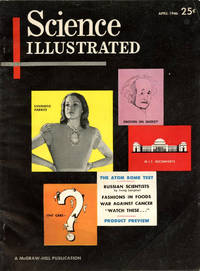
19461576McGraw-Hill 1946. 1st Edition. IN ORIGINAL WRAPPERS THE FIRST PUBLICATION BY EINSTEIN OF THE FAMILIAR EQUATION E=mc2 IN THAT SPECIFIC FORM. Eight months after Hiroshima the editors of Science Illustrated turned to Albert Einstein to explain "the form of the energy that destroyed Hiroshima;" "to explain in his own words what takes place in the operation of his law" Science Illustrated 1 1 pp. 17 April 1946. The editors believed that given the deployment of two nuclear weapons "average citizens" wanted at least a layman's understanding of the mathematical law that enabled atomic explosions so that they were better able to understand the destruction the bombs unleashed ibid.<br /> <br /> <br /> <br /> The mathematical equation or law in question was one Einstein published in 1905 in his Theory of Special Relativity but the form in which it was then written was longer and more complex. In the paper offered here Einstein presents the equation we all now know a shorter more understandable derivation of his equation based upon the law of the conservation of momentum the pressure of radiation and the aberration of light: E = mc2. In layman's terms Einstein also explains the equivalence of mass and energy and discusses the profound ‘urgent' implications of his principle ibid.<br /> <br /> <br /> <br /> In this article Einstein writes: "‘What takes place can be illustrated with the help of our rich man. The atom M is a rich miser who during his life gives away no money energy. But in his will he bequeaths his fortune to his sons M' and M'' on condition that they give to the community a small amount less than one thousandth of the whole estate energy or mass. The sons together have somewhat less than the father had the mass sum M' M'' is somewhat smaller than the mass M of the radioactive atom. But the part given to the community though relatively small is still so enormously large considered as kinetic energy that it brings with it a great threat of evil. Averting that threat has become the most urgent problem of our time" ibid. CONDITION & DETAILS: Complete issue bound in its original wrappers. 4to. pp. 1-128. Very slighy scuffing to the front wrap. There are no address labels. Bright and very clean throughout. McGraw-Hill unknown
1025241401.Ghardcover. Good. Access codes and supplements are not guaranteed with used items. May be an ex-library book. hardcover
191629308Braunschweig Vieweg & Sohn 1916. 8vo. Fine later boards the orig. printed frontwrapper from the Journal pasted on frontcover. Extract from "Verhandlungen d. deutschen Physikalischen Gesellschaft.18. Jahrgang. Nr. 6/7". pp. 173-177 and 1 textillustr. <br/><br/><em>First edition. - Weil No. 82. </em> hardcover
H3999Berlin Akademie der Wissenschaften 1917 In: Sitzungsberichte der Königl.Preuss. Akademie der Wissenschaften Band 1917/2. 4to. S.606-608. Halbleinenband der Zeit leicht berieben Bibl.-Nr.am Rücken Original-Broschur miteingebunden unaufgeschnitten gutes Exemplar. unknown
192146469Berlin Julius Springer 1921. Lex8vo. Orig. printed wrappers. Offprint/Sonderdruck from "Der Festschrift der Kaiser Wilhelm Gesellschaft zur Förderung der Wissenschaften zu ihrem 10jährigen Jubiläum". Pp. 50-52. A small tear to right margin 1 cm otherwise fine and clean. At foot frontwrapper "Nicht im Handel". <br/><br/><em>First edition the offprint issue of this pioneerwork in globular cluster physics."In his paper on M13 Einstein 1921 concluded that the non-luminous mass contributes no higher order of magnitude to the total mass than does the luminous mass.To my knowledge this has been Einstein's only contact with globular clusters. As in other issues his claim still holds."Tom Richtler.Weil:117 - Boni:123. </em> unknown
a105134bBraunschweig 1917 first edition. Vieweg. Hardcover thick octavo. 3/4 brown cloth with black/white marbled boards. 372p. 346p. Einstein article pp. 82-92 . Articles by Max Planck and Max Born as well in same volume. Good plus binding secure; hinges not cracked; lower cover tips worn; wear on top spine end; sseveral old Hugarian library name stamp on end papers and titlepage. no spine numbers no bookplate no pocket. . hardcover
a107696bBraunschweig 1917 first edition. Vieweg. Hardcover octavo. 372p. Einstein article pp. 82-92 . Articles by Max Planck and Max Born as well in same volume. Near Fine. spine and tips black cloth black textured papercovered boards. No owner marks except two small light institute stamps on front end paper and on titlepage. Binding secure; text clean. . hardcover
1906003208Leipzig: J. A. Barth 1906. First Edition. Contemporary Red Cloth. Very Good. J. A. Barth Hardcover
a94586Leipzig 1908 first edition. Hirzel. sm4to. original printed wraps. Einstein article on pp. 216-217. near VG extreme tip on 3 initial pages chipped ; backstrip chipped; text clean; binding secure. . paperback
190838837Leipzig Hirzel 1908. 4to. Contemp. hcalf. Spine gilt. Corners and spine ends with light wear. "Physikalische Zeitschrift. Herausgegeben von E. Riecke und H.Th. Simon. Neunter Jahrgang". XIX928 pp. textillustrations and 8 plates. Einstein paper: pp. 216-217. Internally clean and fine. The whole volume offered. <br/><br/><em>First edition. The volume contains also importent papers by Otto Hahn Lise Meitner Max Planck. </em> unknown
190638892Leipzig 1906. Einstein Albert 1879-1955. 1 Eine neue Bestimmung der Molekuldimensionen. In Ann. d. Physik 4th series 19 1906: 289-306. 2 Zur Theorie der Brownschen Bewegung. In ibid.:371-381. Whole volume 8vo. viii 1080pp. 5 plates. 213 x 143 mm. Original cloth spine faded split in upper half of spine inner hinge cracking. Very good. <p>1 First Edition in Journal Form Revised of Einstein's doctoral thesis ranked by his biographer as being on the same level as his 1905 papers on relativity the light quanta and Brownian motion. In his thesis Einstein presented a new theoretical method for determining molecular radii and Avogadro's number the number of atoms or molecules needed to make up a mass equal to a substance's atomic or molecular weight in grams. The thesis appeared in print in the spring of 1905; in the journal version published at the beginning of 1906 Einstein added a brief appendix containing an improved value of Avogadro's number.</p> <p>Einstein's biographer Abraham Pais wrote of Einstein's thesis as follows: </p> <p>"It is not sufficiently realized that Einstein's thesis is one of his most fundamental papers. Histories and biographies invariably refer to 1905 as the miraculous year because of his article on relativity the light-quantum and Brownian motion. In my opinion the thesis is on a par with the Brownian motion article. In fact in some-not all-respects his results on Brownian motion are by-products of his thesis work emphasis ours. This goes a long way toward explaining why the paper on Brownian motion was received by the Annalen der Physik on May 11 1905 only eleven days after the thesis had been completed.</p> <p>"Three weeks after the thesis was accepted this same journal received a copy of the thesis for publication. It was published only after Einstein supplied a brief addendum in January 1906. . . . As a result of these various delays the thesis appeared as a paper in the Annalen der Physik only after the Brownian motion article had come out in the same journal. This may have helped create the impression in some quarters that the relation between diffusion and viscosity-a very important equation due to Einstein and Sutherland-was first obtained in Einstein's paper on Brownian motion. Actually it first appeared in his thesis . . . ." </p> <p>"Quite apart from the fundamental nature of some results obtained in the thesis there is another reason why this paper is of uncommon interest: it has had more widespread practical applications than any other paper Einstein ever wrote . . . . The thesis dealing with bulk rheological properties of particle suspensions contains results which have an extraordinarily wide range of applications. They are relevant to the construction industry the motion of sand particles in cement mixes to the dairy industry the motion of casein micelles in cow's milk and to ecology the motion of aerosol particles in clouds to mention but a few scattered examples. Einstein might have enjoyed hearing this since he was quite fond of applying physics to practical situations" Pais Subtle is the Lord pp. 89-90. </p> <p>Pais notes that during the period 1970-1974 the 1906 journal version of Einstein's thesis was cited four times more often than his 1916 paper on general relativity and eight times more often than his 1905 paper on light quanta.</p> <p>2 First Edition of Einstein's second paper on Brownian motion containing two further methods for finding Avogadro's number. This was the first of his papers on the subject to include the term "Brownian motion" in the title. Pais pp. 95 98.</p> . unknown
1903003206Leipzig: J.A.Barth 1903. Spine ends lightly rubbed; former owner's ink stamp on title page. First Edition. Contemporary Red Cloth. Very Good. J.A.Barth Hardcover
190338800Leipzig Johann Ambrosius Barth 1903. Contemp. hcloth. Some small nicks to spine. = "Annalen der Physik. Vierte Folge. Band 11. Herausgegeben von Paul Drude.". VIII1144pp. and 6 plates. The Einstein paper: pp. 170-187. Internally fine and clean. <br/><br/><em>First edition of Einsteins fourth paper. In his paper from 1902 Einstein "says in his introduction that nobody has yet succeeded in deriving the conditions of thermal equilibrium and of the second law of thermodynamics from probability considerations although Maxwell and Boltzmann came near to it. Willard Gibbs is not mentioned. In fact Einstein's paper was written in ignorance of Gibbs paper published 1901. In the present paper Einstein builds the theory on another basis not used by Gibbs namely on the consideration of a single system in course of time later called "Zeit-Gesamtheit" time assembly and proves that this is equivalent to a certain virtual assembly of many systems Gibb's micro-canonical assembly.Einstein at once proceeded to apply his theorems to a case of utmost importance namely to systems of a size suited for demonstrating the reality of molecules and the correctness of the kinetic theory of matter."Walter Alicke. - Weil No. 4. </em> hardcover
190347072Leipzig Johann Ambrosius Barth 1903. Contemp. hcloth. Handwritten paperlabel on spine. In: "Annalen der Physik. Vierte Folge. Band 11. Herausgegeben von Paul Drude.". VIII1144pp. and 6 plates. Entire volume offered. The Einstein paper: pp. 170-187. Faint signs of dampstains in outer margins on a few leaves. <br/><br/><em>First edition of Einsteins fourth paper. In his paper from 1902 Einstein "says in his introduction that nobody has yet succeeded in deriving the conditions of thermal equilibrium and of the second law of thermodynamics from probability considerations although Maxwell and Boltzmann came near to it. Willard Gibbs is not mentioned. In fact Einstein's paper was written in ignorance of Gibbs paper published 1901. In the present paper Einstein builds the theory on another basis not used by Gibbs namely on the consideration of a single system in course of time later called "Zeit-Gesamtheit" time assembly and proves that this is equivalent to a certain virtual assembly of many systems Gibb's micro-canonical assembly.Einstein at once proceeded to apply his theorems to a case of utmost importance namely to systems of a size suited for demonstrating the reality of molecules and the correctness of the kinetic theory of matter."Walter Alicke. First edition of Einsteins fourth paper. In his paper from 1902 Einstein "says in his introduction that nobody has yet succeeded in deriving the conditions of thermal equilibrium and of the second law of thermodynamics from probability considerations although Maxwell and Boltzmann came near to it. Willard Gibbs is not mentioned. In fact Einstein's paper was written in ignorance of Gibbs paper published 1901. In the present paper Einstein builds the theory on another basis not used by Gibbs namely on the consideration of a single system in course of time later called "Zeit-Gesamtheit" time assembly and proves that this is equivalent to a certain virtual assembly of many systems Gibb's micro-canonical assembly.Einstein at once proceeded to apply his theorems to a case of utmost importance namely to systems of a size suited for demonstrating the reality of molecules and the correctness of the kinetic theory of matter."Walter Alicke. - Weil No. 4 - Boni No 4. </em> hardcover
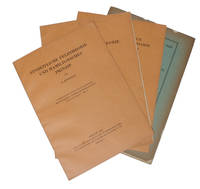
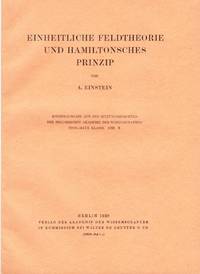
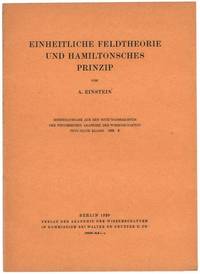
192559960Berlin Königlich Akademie der Wissenschaften 1925-1929. 1. Einheitliche Feldtheorie von Gravitation und Elektrizität. 1925 pp. 414-419. Uncut unopened n the original printed wrappers. missing small parts of spine and upper part of front wrapper detached otherwise fine. Weil 147 / Boni 155.2. Neue Möglichkeit für eine einheitliche Feldtheorie von Gravitation und Elektrizität. Offprint: S. B. preuss. Akad. Wiss. 1928 pp.235-245. In the original yellow wrappers. Very fine and clean. Weil 162/ Boni 175.3. Zur einheitlichen Feldtheorie. Offprint: S. B. preuss. Akad. Wiss. 1929 pp.2-7. In the original yellow wrappers. Very fine and clean. Weil 165/ Boni 183.4. Einheitliche Feldtheorie und Hamiltonsches Prinzip. Offprint: S. B. preuss. Akad. Wiss. 1929 pp.156-159. In the original yellow wrappers. Very fine and clean. Weil 166/ Boni 184. <br/><br/><em>Fine collection three in offprint and one in the original printed wrappers of the four papers that together constitute Einstein's attempt towards creating a unified field theory: "a new theory of space with a view to unification of all forms of activity that fall within the sphere of physics giving them a common explanation" PMM416. The task of unifying nuclear electromagnetic and gravitational force is nowadays by many considered the holy grail of theoretical physics.Maxwell was the first to develop such a theory when he described the forces of electricity and magnetism as the single force electromagnetism. After Einstein had completed his general theory of relativity a field theory for gravitation he turned his attention towards generalizing his theory even further to include Maxwell's theory. Even though Einstein never succeeded in completing this task in the way that he finished his earlier theories he pioneered and explored many areas of this subject."It had been repeatedly observed that Einstein's general theory of relativity necessitated a pluralistic explanation of the universe. In 1925 he announced that he had resolved this difficulty but the announcement was premature. In 1928 he attacked the problem once more only to find that Riemann's conception of space on which the general theory was based would not permit of a common explanation of electromagnetic and gravitational phenomena. In a series of papers the present devoted to the development of 'A Uniform Theory of Gravitation and Electricity' he outlined a new theory of space with a view to unification of all forms of activity that fall within the sphere of physics giving them a common explanation. All that would then remain to complete a scientific unison is the correlation of the organic and inorganic".PMM 416Barchas 586Weil 147 162 165 & 166. </em> unknown
19296551Berlin: Verlag der Akademie der Wissenschaften in Kommision bei Walter de Gruyter U. Co 1929. First separate edition. Fine. 6 pages in printed wraps. <br /><br />Not exactly an "offprint" since the pages are numbered from 1 and the pamphlet is given its own title page this is considered the first separate edition of a paper Einstein published in the periodical of the Prussian Academy. It is considered Einstein's initial effort having established general and special relativity to find a unified theory uniting gravity and electromagnetism a problem he struggled with for his remaining life. Verlag der Akademie der Wissenschaften in Kommision bei Walter de Gruyter U. Co paperback
1928270911928. S.Ber. Akad. Wiss. Berl. 1928/10. - Berlin Verlag der Akademie der Wissenschaften 1929 8° 6 S. orig. Broschur. First Edition; the rare off-print from the "Sitzungsberichte". Weil No.166; Schilpp-Shields No. 227; Alicke No. 143. unknown
192928364Berlin Gruyter & Co. 1929. 4to. Orig. printed orange wrappers. Offprint/Sonderausgabe aus Sitzungsberichten.pp. 1-6. Fine fresh copy. <br/><br/><em>First edition in the rare Offprint now called "Sonderausgabe" instead of "Sonderabdruck" having separate printed title and separate pagination. See Weil: 166 where this is not mentioned.The early Offprints from "Sitzungsberichten." are called "Sonderabdruck" up to Weil No.165 including this. From Weil 166 they are called "Sonderausgabe.". - Before 161 up to 160 the Offprints do not have separate title and pagination the pagination follows the numbering in the periodical. From 166 the Offprint has both separate printed title and pagination. - So Weil Nos 161-165 is still "Abdruck" but with separate title and pagination. These facts are not mentioned in the bibliographies.Weil No. 166. </em> unknown