1 505 résultats
19472187Princeton NJ: Halsman 1947. Photograph. Fine. ONE OF THE MOST FAMOUS IMAGES OF EINSTEIN. Philippe Halsman's now iconic 1947 photograph of Einstein has become not only one of the most celebrated images of Einstein but one of the most recognizable images of the twentieth century. It was used to a 1966 US postage stamp of Einstein and was featured on the cover of Time Magazine honoring Einstein as the "Person of the Century".

 The photographer Halsman in his book Philippe Halsman: A Retrospective explained the circumstances of the photo: I admired Albert Einstein more than anyone I ever photographed not only as the genius who single-handedly had changed the foundation of modern physics but even more as a rare and idealistic human being.
 Personally I owed him an immense debt of gratitude. After the fall of France it was through his personal intervention that my name was added to the list of artists and scientists who in danger of being captured by the Nazis were given emergency visas to the United States.
 After my miraculous rescue I went to Princeton to thank Einstein and I remember vividly my first impression. Instead of a frail scientist I saw a deep-chested man with a resonant voice and a hearty laugh.
 The question of how to capture the essence of such a man in a portrait filled me with apprehension. Finally in 1947 I had the courage to bring on one of my visits my Halsman camera and a few floodlights. After tea I asked for permission to set up my lights in Einstein's study. The professor sat down and started peacefully working on his mathematical calculations. I took a few pictures. Ordinarily Einstein did not like photographers whom he called Lichtaffen light monkeys. But he cooperated because I was his guest and after all he had helped save me.
 Suddenly looking into my camera he started talking. He spoke about his despair that his formula E=mc2 and his letter to President Roosevelt had made the atomic bomb possible that his scientific search had resulted in the death of so many human beings. "Have you read" he asked "that powerful voices in the United States are demanding that the bomb be dropped on Russia now before the Russians have time to perfect their own" With my entire being I felt how much this infinitely good and compassionate man was suffering from the knowledge that he had helped to put in the hands of politicians a monstrous weapon of devastation and death.
 He grew silent. His eyes had a look of immense sadness. There was a question and a reproach in them.
 The spell of this moment almost paralyzed me. Then with an effort I released the shutter of my camera. Einstein looked up and I asked him "So you don't believe that there will ever be peace"
 "No" he answered. "As long as there will be man there will be wars." Silver prints of this photograph have been printed in different sizes over the years. This photograph is an official Halsman silver print with his copyright hand-stamp on the verso measuring approximately 10x13 inches. Princeton NJ. Silver print. Taken 1947; printed 1970s. Image: 13x10 inches 33x25.4 cm. Archivally matted and framed under UV-protecting museum glass to an overall size of 18.5x22 inches. A stunning piece in fine condition. Halsman unknown books
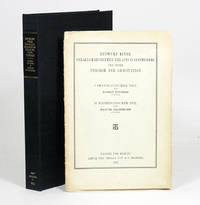
19132064Leipzig and Berlin: Teubner 1913. First edition. Original wrappers. Very Good. FIRST EDITION COMMERCIAL OFFPRINT ISSUE of Einstein's breakthrough work on general relativity: the famous "Entwurf" paper. "In this book Einstein and Grossman investigated curved space and curved time as they relate to a theory of gravity. They presented virtually all the elements of the general theory of relativity with the exception of one striking omission: gravitational field equations that were not generally covariant. Einstein soon reconciled himself to this lack of general covariance through the 'hole argument' which sought to establish that generally covariant gravitational field equations would be physically uninteresting. Einstein did not adopt the gravitational field equations until late in 1915 in his final formulations of the general theory. Here Einstein contributed the physics and Grossman the mathematics" Calaprice The Einstein Almanac 40. Weil 59a. Offprint from Zeitschrift für Mathematik und Physik volume 62. Leipzig and Berlin: Teubner 1913. Octavo original wrappers; custom box. Pencil notation on title. Small chips at spine ends. An outstanding copy without any of the cover-foxing so common with this issue. Teubner unknown books
19132139Zürich: Zürcher & Furrer 1913. First edition offprint. Original wrappers. Very Good. EXTREMELY RARE AUTHOR'S OFFPRINT "Überreicht von den Verfassern" IN ORIGINAL WRAPPERS OF THE FIRST PRINTING OF EINSTEIN AND GROSSMANN'S FURTHER DEVELOPMENT OF THE CRITICAL "ENTWURF" THEORY OF 1913. "Einstein returned from Prague to Zurich in the summer of 1912. He had by then already formulated the fundamental physical principles of the general relativity theory of gravitation and was now searching for their mathematical structure. At the E.T.H. the Swiss Federal Institute of Technology in Zurich where he now returned as professor of theoretical physics Einstein met again his old fiend and former fellow student Marcel Grossmann who was now a professor of mathematics and his colleague. With Grossmann and under his guidance Einstein studied the mathematical literature especially the theory of invariants and the absolute differential calculus of Chirstoffel Ricci Levi-Civita and others. Einstein developed the mathematical structure of his theory jointly with Grossmann and in his celebrated paper on the general theory of relativity in 1916 he acknowledged the help which his friend had given him. It was Grossmann's help which had Einstein said 'spared me not only the study of the relevant mathematical literature but who Grossmann also assisted me in searching for the field equations of gravitation.' This study of mathematical literature and the search for the proper mathematical tools led to several joint papers with Grossmann during Einstein's all too brief stay in Zurich. These papers contained the first attempts toward a generalized theory of relativity using new mathematical tools and gave full expression to Einstein's earlier physical insights" Jagdish The Golden Age of Theoretical Physics. The first of Einstein's papers to present his collaborative work with Grossmann the famous "Entwurf" paper appeared in the summer of 1913; the present paper based on a lecture given on September 9 1913 to the 96th annual meeting of the Swiss Society for Natural Sciences in Frauenfeld provides further details on the new generalized theory of relativity. The published paper contains more mathematics than in the given lecture. Weil 57. OFFPRINT FROM: Vierteljahrsschrift der Naturforschenden Gesellschaft vol. 58 pp. 284-290 Einstein; pp. 291-297 Grossmann. Zürich: Zürcher & Furrer 1913. Octavo original wrappers; custom box. Mild dampstaining to extreme top outer margin away from the text; crease down the center of issue. SCARCE. Zürcher & Furrer unknown books
19171127481917. Rare large etching of Albert Einstein done by well-known artist Erich Buttner. Signed by both Einstein and Buttner. In fine condition. Double matted and framed the entire piece measures 12.25 inches by 15 inches. An exceptional piece. In the 1920s he created a series of portraits of his friends and fellow artists including Lovis Corinth George Grosz Arno Holz and Heinrich Zille. He produced a very fine book of exlibris bookplates in Berlin 1921. This book contains the exlibris of Albert Einstein 1917 probably Einstein's only bookplate. The etching measures 12.5 inches by 9.5 inches. Double matted and framed. The entire piece measures 18.75 inches by 15.75 inches. Hermann Struck was a German Jewish artist known for his etchings. In 1908 Struck published "Die Kunst des Radierens" "The Art of Etching" which became a seminal work on the subject. His students included Marc Chagall Lovis Corinth Jacob Steinhardt Lesser Ury and Max Liebermann. Struck did commissioned portraits of Albert Einstein Ibsen Nietzsche Freud Herzl Oscar Wilde among others. unknown books
19561326923Princeton NJ: Princeton University Press 1956. Fifth Edition. Hardcover. 10mo; pp 166; G/Fair; dark beige spine with brown text; fifth edition including the Relativistic Theory of the Non-Symmetric Field; last edition corrected by Einstein before his death; dust jacket has noticeable sun darkening to exterior; few chips to edges; cloth shows lightly sunned exterior; strong boards; text block has only light foxing to exterior edges; interior clean; illustrated;. 1326923. FP New Rockville Stock. Princeton University Press hardcover books
1913WRCLIT84021Leipzig & Berlin: B.G. Teubner 1913. 289pp. Printed green cloth. Ink name and bookplate on pastedown front free endsheet brittle and detached cloth a bit faded and lightly soiled but a very good copy. First edition in this format of three essays by Lorentz two by Einstein and one by Minkowski with a foreword by Otto Blumenthal. Einstein's two essays "Zur Elektrodynamik bewegter Korper" and "Ist die Tragheit eines Korpers von seinem Enerheinhalt abhangig" were first published in 1905 in ANNALEN DER PHYSIK the first being Einstein's first publication on special relativity. Minkowski's essay "Raum und Zeit" was first published in 1909 see PMM 401. B.G. Teubner hardcover books
200040663NY:: George Braziller. As New. 2000. Hardcover. 0807614173 . Black and white illustrations. A facsimile edition. As new in like slipcase. Still in original shrinkwrap. ; 192 pages . George Braziller, hardcover books
1988S8998Princeton:: Princeton University Press 1988. 1988. 8vo. 166 pp. Printed wrappers. Fine. Fifth edition. ISBN: 069102352 Princeton University Press, (1988). unknown books
194994288NY:: Philosophical Library. Very Good in Very Good dust jacket. 1949. Hardcover. Translated from the German by Alan Harris. First edition thus. Very good in a very good dust jacket. ; 112 pages . Philosophical Library, hardcover books
194926768New York: Philosophical Library 1949. FIRST ABRIDGED EDITION. Originally published in 1933 by Covici-Friede. A fine copy in a fine dust jacket. <br/><br/> Philosophical Library unknown books
1979BL1593New York:: Center for Physics; American Institute of Physics 1979. 1979. Second revised edition. Oblong 8vo. 77 pp. Figs. Printed wrappers; corners creased. Burndy bookplate. Very good. ISBN: 0883182483 Center for Physics; American Institute of Physics, (1979). unknown books
1979BL1592Austin:: University of Texas Press 1979. 1979. Series: The Library Chronicle New Series no. 12. Thin 8vo. 107 pp. Printed wrappers. Four lectures by Loyd S. Swenson C.P. Snow Howard Stein Ilya Prigogine. University of Texas Press, 1979. unknown books
1988S4425In:: American Scientist Vol. 76 No. 2 March-April 1988. 1988. 277 x 211 mm. 4to. 154-158 pp. 4 figs. Pictorial wrappers Einstein and Chaplin. Fine. American Scientist, Vol. 76, No. 2, March-April 1988. unknown books
1994S11423New York:: Warner Books 1994. 1994. Small 8vo. 179 pp. Printed wrappers. Fine. ISBN: 0446670111 Warner Books, (1994). unknown books
193240505Los Angeles: Los ANgeles University of International Relations 1932. First Edition. Quarto 26cm. Pictorial card wrappers; 96pp. Mild external soil; Very Good or better. Includes a translation of Dr. Einstein's 1932 address "World Disarmament" delivered at the World Affairs Dinner in Pasadena February 1 1932. Other contributions Ken Nakazawa and N. Wing Mah on the Sino-Japanese Controversy Bernard Mollenhauer et al. Los ANgeles University of International Relations unknown books
1925321321Buenos Aires: Imprenta y Casa Editora Coni 1925. First Edition. 14 pp. Plate with halftone photograph portrait of Albert Einstein by Witcomb. 8vo. Original printed wrappers. Minor browning at wrapper edges. First Edition. 14 pp. Plate with halftone photograph portrait of Albert Einstein by Witcomb. 8vo. From the Library of Einstein's Eldest Son. This scarce commemorative booklet issued on the occasion of Einstein's visit to the University of Buenos Aires contains a biography and bibliography of Einstein together with a list of Einstein's activities while in Argentina during 1925. This example with provenance to Hans Albert Einstein Albert Einstein's oldest son with his inkstamp at top of front wrapper. OCLC locates only three copies Princeton University the National Library of Israel and Hebrew University in Israel. Imprenta y Casa Editora Coni unknown books
1915432951915. <p>Einstein Albert 1879-1955 and Wander Johann de Haas 1878-1960. Notiz zu unserer Arbeit "Experimenteller Nachweis der Ampèreschen Molekularströme." Offprint from Verhandlungen der Deutschen Physikalischen Gesellschaft 17 1915. 1 sheet p. 420. 228 x 156 mm. Original printed wrappers. Fine copy.</p> <p>First Edition Offprint Issue. In 1915 Einstein and Dutch physicist Wander Johannes de Haas conducted gyromagnetic experiments leading to the discovery of the Einstein-de Haas effect which corresponds to the mechanical rotation induced in a ferromagnetic cylinder suspended inside a coil when an impulse of electric current is sent through the coil. Einstein was very enthusiastic about the experimental results stating that he and de Haas had "given firm proof of the existence of Ampère's molecular currents" quoted in Pais Subtle is the Lord pp. 245-246. Einstein and de Haas published their results in a paper published earlier in 1915 see Weil 73; the present "Notiz" is a response to a communication from American physicist Samuel Jackson Barnett who had begun performing similar experiments in 1909 and obtained results complementing those of Einstein and de Haas. Weil Albert Einstein Bibliography 73n.</p> . unknown books
1932433001932. Offprint from Sitzungsberichte der Preussischen Akademie der Wissenschaften 32 1932. 31pp. 256 x 183 mm. Original printed wrappers a little chipped and darkened small splits in spine. Very good. First edition offprint issue. Einstein's work on semivectors "was stimulated by Ehrenfest's insistence on a better understanding of the relation between single-valued and double-valued representations of the Lorentz group . . . Einstein and Mayer went on to relate semivectors to the Dirac equation and to generalize the formalism to general relativity" Pais Subtle is the Lord pp. 451-452. Weil Albert Einstein Bibliography 186. unknown books
193322015Völkerbund: Internationales Institut für Geistige Zusammenarbeit 1933. Binding separated from wrappers but intact; a very good copy in printed wrappers with French flaps small mark to front cover light discoloration. First Edition. Octavo. Number 600 of 2000 press-numbered copies. Text in German. Völkerbund: Internationales Institut für Geistige Zusammenarbeit unknown books
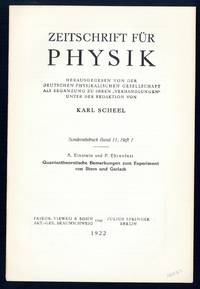
1922432871922. <p>Einstein Albert 1879-1955 and Paul Ehrenfest 1880-1933. Quantentheoretische Bemerkungen zum Experiment von Stern und Gerlach. Offprint from Zeitschrift für Physik 11 1922. 31-34pp. 229 x 155 mm. Original printed self-wrappers. Light toning but fine otherwise. </p> <p>First Edition Offprint Issue. In 1922 the physicists Otto Stern and Walther Gerlach conducted a now-classic experiment in which a beam of silver atoms was streamed through an inharmonious magnetic field in order to observe the atoms' deflection patterns. Rather than a random and continuous distribution as predicted by classical theory the atoms passing through the field were deflected up or down by a specific amount demonstrating that they had intrinsically quantum properties. The Stern-Gerlach experiment corroborated the Bohr-Sommerfeld model of the atom and strongly influenced later developments in 20th century physics. However the experiment also created some serious difficulties for quantum physicists in the period before the rise of the "new" quantum mechanics. </p> <p>Einstein and Ehrenfest addressed one of these difficulties—connected with space quantization—in their joint paper in which </p> <p>"they dealt in particular with the problem of how the orbits of the atom would obtain their discrete directions which they exhibit while passing through the inhomogeneous magnetic field. Under the assumption that the mechanism causing the orientation was provided by the interaction with the radiation field Einstein and Ehrenfest estimated that for a field strength of 10000 G a change in the direction of the orbit would take place in roughly 1011 s; this long time interval would be reduced in the presence of heat radiation at room temperature . . . to about 109 s. How could they asked the experimental situation be explained which implied that the discrete orientations of the orbits in silver atoms were obtained in less than 10-4 s. In order to deal with this evident puzzle Einstein and Ehrenfest proposed two alternatives: first that the silver atoms were always in the states of spatial quantization; second the orientations of the electron orbits arose from an interaction of the atoms with the radiation field which involved much smaller reaction times . . . However they found that both alternatives created considerable difficulties in the understanding of the atomic processes . . . Thus Einstein and Ehrenfest concluded: 'The difficulties mentioned above show how unsatisfactory are both interpretations of the results found by Stern and Gerlach'" Mehra & Rechenberg The Historical Development of Quantum Theory 1 pp. 443-444. </p> <p>Pais Subtle is the Lord p. 328. Weil Albert Einstein Bibliography 121.</p> . unknown books
1923432881923. <p>Einstein Albert 1879-1955 and Paul Ehrenfest 1880-1933. Zur Quantentheorie des Strahlungsgleichgewichts. Offprint from Zeitschrift für Physik 19 1923. 301-306pp. Original printed self-wrappers. 230 x 157 mm. Light toning but very good.</p> <p>First Edition Offprint Issue. In 1916 after publishing his great work on general relativity Einstein returned to the question of blackbody radiation. In November 1916 he wrote to his friend Besso that "a splendid light has dawned on me about the absorption and emission of radiation" quoted in Pais p. 405 one that led him to a new derivation of Planck's radiation law and convinced him of the reality of light-quanta photons. After publishing these results in three papers culminating with the famous "Zur Quantentheorie der Strahlung" 1917 Einstein kept looking for "new ways in which the existence of photons might lead to observable derivations from the classical picture" Pais p. 413. He found none until 1923 when Arthur Compton and Peter Debye independently derived the relativistic kinematics for the scattering of a photon off an electron at rest. The work of Compton and Debye led Wolfgang Pauli to extend Einstein's work of 1917 to the case of radiation in equilibrium with free electrons see Pais p. 414n. "Pauli examined the requirements of detailed balance under Lorentz transformations and found that scattering of light by free electrons must include a term of a form which we would now call stimulated emission . . . Einstein and Ehrenfest then showed that Pauli's results could be obtained by an extension of Einstein's 1917 paper with the unnecessary specialization to discrete energy levels removed . . . The core of Einstein's argument is that the scattering process should be broken into two parts: the absorption of energy from radiation of frequency 1 and the emission of energy as radiation of frequency 2" Lewis p. 42. Lewis "Einstein's derivation of Planck's radiation law" American Journal of Physics 41 1973: 38-44. Pais Subtle is the Lord ch. 21. Weil Albert Einstein Bibliography 138.</p> . unknown books
191343305Leipzig & Berlin: Teubner 1913. 38pp. 254 x 170 mm. Original printed wrappers chipped. Library stamps. Very good. First separate edition. "After his first discussions with Grossmann Einstein had found the correct starting point for general relativity. The real work could now begin . . . The Einstein-Grossmann paper published in 1913 contains profound physical insight into the nature of measurement some correct general relativistic equations some faulty reasoning and clumsy notation" Pais Subtle is the Lord p. 216. Weil Albert Einstein Bibliography 58. Teubner unknown books
1908432171908. <p>Einstein Albert 1879-1955 and Jakob Johann Laub 1884-1962. Über die elektromagnetischen Grundgleichungen für bewegter Körper. Offprint from Annalen der Physik 4th series 26 1908. 532-540pp. 225 x 146 mm. Original printed wrappers. Fine.</p> <p>First Edition Offprint Issue. Einstein's first paper written jointly with a collaborator on the relativistic electrodynamics of ponderable media. "In 1908 Laub wrote works together with Einstein on the basic electromagnetic equations which was aimed to replace the four-dimensional formulation of the electrodynamics by Minkowski by a simpler classical formulation. Both Laub and Einstein discounted the spacetime formalism as too complicated. However it turned out that Minkowski's spacetime formalism was fundamental for the further development of special relativity" Wikipedia. Pais Subtle is the Lord pp. 151 154. Shields 23. Weil 23.</p> . unknown books
199815679Ewing New Jersey U.S.A.: Princeton Univ Pr 1998. First Edition. Trade Paperback. Very Good. First Edition. Original white wrappers mildly soiled with creasing front and rear covers. Clean internally a great reading copy. This is the English translation. Title: The Collected Papers of Albert Einstein: The Berlin Years Correspondence 1914-1918 Volume 8. Trade Paperback. Princeton Univ Pr paperback books
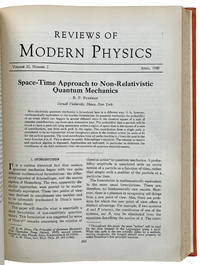
1948S10249Lancaster:: American Physical Society 1948. 1948. Large 8vo. 266 x 205 mm. iv 728 pp. Frontis. port. of Robert Andrews Millikan photos figs. tables. Later orange cloth gilt-stamped spine title; spine faded. Very good. TWO PAPERS FROM THE TWO GIANTS OF 20TH CENTURY PHYSICS AS THEY WERE ORIGINALLY PUBLISHED IN ONE COLLECTED VOLUME. Einstein's "Generalized Theory of Gravitation" is considered the last principal work issued by the 20th Century's premiere scientist. Schilpp-Shields. <br /><br /> Einstein: "A new presentation. . . which constitutes a certain progress in clarity as compared with previous presentations." from the Introduction. Feynman: "At first Feynman's fundamental article RMP 1948 did not arouse much interest among theoretical physicists who were not familiar with Feynman's new approach to doing quantum mechanics. As Feynman recalled: 'At the Shelter Island Conference. . . they asked me if I would explain my path-integral method for doing quantum mechanics so I did. I must have been preparing the manuscript for my paper RMP 1948 so that everything was organized and I explained it. It's hard to pay attention to some new idea and they didn't pay much attention to it.' However nowadays Feynman's RMP 1948 paper is one of the most well-known and widely cited papers; it is one of the cornerstones of modern theoretical physics." Mehra. <br /><br /> "It is a curious historical fact that modern quantum mechanics began with two quite different mathematical formulations: the differential equation of Schroedinger and the matrix algebra of Heisenberg. . . This paper will describe what is essentially a third formulation of non-relativistic quantum theory. This formulation was suggested by some of Paul Dirac's remarks concerning the relation of classical action to quantum mechanics. A probability amplitude is associated with an entire motion of a particle as a function of time rather than simply with a position of the particle at a particular time." from the Introduction. Provenance: David Middleton b. 1920 noted pioneer in the field of statistical communication theory last name gilt-stamped on spine. Einstein: Boni-Russ-Laurence 258; Schilpp-Shields 308 also see p. 758; Wasson Nobel Prize Winners p. 289-294; Weil 222 marked with asterisk by Weil. Feynman: Gleick Genius: The Life and Science of Richard Feynman p. 249; Mehra The Beat of a Different Drum: The Life and Science of Richard Feynman p. 200; Wasson Nobel Prize Winners p. 316-319. American Physical Society, 1948. hardcover books