Einstein AlbertABAA

187 résultats
1907432971907. <p>Einstein Albert 1879-1955. Berichtigung zu meiner Arbeit: "Die Plancksche Theorie der Strahlung etc." Offprint from Annalen der Physik 22 1907. Single sheet p. 800. Unbound as issued. 223 x 145 mm. Lower corner lightly creased but very good.</p> <p>First Edition Rare Offprint Issue. Einstein's important correction to his paper on specific heats "Die Plancksche Theorie der Strahlung und die Theorie der spezifischen Wärme" 1907; see Weil 15 which "made clear for the first time that quantum concepts have a far more general applicability" Pais p. 394. "Einstein initially believed that his oscillating lattice points in a three-dimensional crystal lattice were electrically charged ions. A few months later he published a correction to his paper in which he observed that this was an unnecessary assumption . . . Einstein's correction freed the quantum rules in passing one might say from any specific dependence on electromagnetism" Pais p. 396. Pais Subtle is the Lord pp. 394-396. Weil 15n.</p> . unknown books
190638892Leipzig 1906. Einstein Albert 1879-1955. 1 Eine neue Bestimmung der Molekuldimensionen. In Ann. d. Physik 4th series 19 1906: 289-306. 2 Zur Theorie der Brownschen Bewegung. In ibid.:371-381. Whole volume 8vo. viii 1080pp. 5 plates. 213 x 143 mm. Original cloth spine faded split in upper half of spine inner hinge cracking. Very good. <p>1 First Edition in Journal Form Revised of Einstein's doctoral thesis ranked by his biographer as being on the same level as his 1905 papers on relativity the light quanta and Brownian motion. In his thesis Einstein presented a new theoretical method for determining molecular radii and Avogadro's number the number of atoms or molecules needed to make up a mass equal to a substance's atomic or molecular weight in grams. The thesis appeared in print in the spring of 1905; in the journal version published at the beginning of 1906 Einstein added a brief appendix containing an improved value of Avogadro's number.</p> <p>Einstein's biographer Abraham Pais wrote of Einstein's thesis as follows: </p> <p>"It is not sufficiently realized that Einstein's thesis is one of his most fundamental papers. Histories and biographies invariably refer to 1905 as the miraculous year because of his article on relativity the light-quantum and Brownian motion. In my opinion the thesis is on a par with the Brownian motion article. In fact in some-not all-respects his results on Brownian motion are by-products of his thesis work emphasis ours. This goes a long way toward explaining why the paper on Brownian motion was received by the Annalen der Physik on May 11 1905 only eleven days after the thesis had been completed.</p> <p>"Three weeks after the thesis was accepted this same journal received a copy of the thesis for publication. It was published only after Einstein supplied a brief addendum in January 1906. . . . As a result of these various delays the thesis appeared as a paper in the Annalen der Physik only after the Brownian motion article had come out in the same journal. This may have helped create the impression in some quarters that the relation between diffusion and viscosity-a very important equation due to Einstein and Sutherland-was first obtained in Einstein's paper on Brownian motion. Actually it first appeared in his thesis . . . ." </p> <p>"Quite apart from the fundamental nature of some results obtained in the thesis there is another reason why this paper is of uncommon interest: it has had more widespread practical applications than any other paper Einstein ever wrote . . . . The thesis dealing with bulk rheological properties of particle suspensions contains results which have an extraordinarily wide range of applications. They are relevant to the construction industry the motion of sand particles in cement mixes to the dairy industry the motion of casein micelles in cow's milk and to ecology the motion of aerosol particles in clouds to mention but a few scattered examples. Einstein might have enjoyed hearing this since he was quite fond of applying physics to practical situations" Pais Subtle is the Lord pp. 89-90. </p> <p>Pais notes that during the period 1970-1974 the 1906 journal version of Einstein's thesis was cited four times more often than his 1916 paper on general relativity and eight times more often than his 1905 paper on light quanta.</p> <p>2 First Edition of Einstein's second paper on Brownian motion containing two further methods for finding Avogadro's number. This was the first of his papers on the subject to include the term "Brownian motion" in the title. Pais pp. 95 98.</p> . unknown books
1907433121907. Offprint from "Zeitschrift für Elektrochemie" 1907. Single sheet pp. 41-42. 287 x 206 mm. Chipped several marginal tears some toning. Fair. First edition offprint issue. "In 1907 Einstein published a paper entitled 'Theoretical Observations on the Brownian Motion' in which he considered the instantaneous velocity of a Brownian particle. Einstein showed that by measuring this quantity one could prove that 'the kinetic energy of the motion of the center of gravity of a particle is independent of the size and nature of the particle and independent of the nature of its environment.' This is one of the basic tenets of statistical mechanics known as the equipartition theorem. However Einstein concluded that due to the very rapid randomization of the motion the instantaneous velocity of a Brownian particle would be impossible to measure in practice. "Einstein: The Formative Years. unknown books
1923432881923. <p>Einstein Albert 1879-1955 and Paul Ehrenfest 1880-1933. Zur Quantentheorie des Strahlungsgleichgewichts. Offprint from Zeitschrift für Physik 19 1923. 301-306pp. Original printed self-wrappers. 230 x 157 mm. Light toning but very good.</p> <p>First Edition Offprint Issue. In 1916 after publishing his great work on general relativity Einstein returned to the question of blackbody radiation. In November 1916 he wrote to his friend Besso that "a splendid light has dawned on me about the absorption and emission of radiation" quoted in Pais p. 405 one that led him to a new derivation of Planck's radiation law and convinced him of the reality of light-quanta photons. After publishing these results in three papers culminating with the famous "Zur Quantentheorie der Strahlung" 1917 Einstein kept looking for "new ways in which the existence of photons might lead to observable derivations from the classical picture" Pais p. 413. He found none until 1923 when Arthur Compton and Peter Debye independently derived the relativistic kinematics for the scattering of a photon off an electron at rest. The work of Compton and Debye led Wolfgang Pauli to extend Einstein's work of 1917 to the case of radiation in equilibrium with free electrons see Pais p. 414n. "Pauli examined the requirements of detailed balance under Lorentz transformations and found that scattering of light by free electrons must include a term of a form which we would now call stimulated emission . . . Einstein and Ehrenfest then showed that Pauli's results could be obtained by an extension of Einstein's 1917 paper with the unnecessary specialization to discrete energy levels removed . . . The core of Einstein's argument is that the scattering process should be broken into two parts: the absorption of energy from radiation of frequency 1 and the emission of energy as radiation of frequency 2" Lewis p. 42. Lewis "Einstein's derivation of Planck's radiation law" American Journal of Physics 41 1973: 38-44. Pais Subtle is the Lord ch. 21. Weil Albert Einstein Bibliography 138.</p> . unknown books
1925321321Buenos Aires: Imprenta y Casa Editora Coni 1925. First Edition. 14 pp. Plate with halftone photograph portrait of Albert Einstein by Witcomb. 8vo. Original printed wrappers. Minor browning at wrapper edges. First Edition. 14 pp. Plate with halftone photograph portrait of Albert Einstein by Witcomb. 8vo. From the Library of Einstein's Eldest Son. This scarce commemorative booklet issued on the occasion of Einstein's visit to the University of Buenos Aires contains a biography and bibliography of Einstein together with a list of Einstein's activities while in Argentina during 1925. This example with provenance to Hans Albert Einstein Albert Einstein's oldest son with his inkstamp at top of front wrapper. OCLC locates only three copies Princeton University the National Library of Israel and Hebrew University in Israel. Imprenta y Casa Editora Coni unknown books
192225530Braunschweig & Berlin Germany: Friedr. Vieweg & Sohn/Julius Springer 1922 1923 1924. First Edition. Hardcover. Very Good. Alexander Alexandrovich Friedmann 1888-1925 was a Russian mathematician and physicist who built upon Einstein's theory of relativity and further expanded his own theories that the universe has both homogeneous looks the same from every location and isotropic looks the same in every direction. The following articles expand upon these theories: "Über die Krümmung des Raumes" "On the Curvature of Space" by Alexander Friedmann Zeitschrift für Physik 10 pp. 377-386 1922. "Notiz du der Arbeit von A. Friedmann ‘Über die Krümmung des Raumes'" "Note on the work of A. Friedmann ‘On the Curvature of Space'" by Albert Einstein Zeitschrift für Physik 16 p. 228 1923. "Über die Möglichkeit einer Welt mit konstanter negativer Krümmung des Raumes" "On the possibility of a world with constant negative curvature of space" by Alexander Friedmann Zeitschrift für Physik 21 pp. 326-332 1924. Volume 10: iv 413 pp. 8vo; Volume 16: iv 409 1 pp. 8vo; Volume 21: iv 382 pp 8vo. Each volume is ex-library with brown patterned paper boards lighter brown cloth spines and corner tips; gold embossed titling to spine. Library stamps within including stamps on title page of each volume very clean with card pocket remaining on the rear pastedown of each volume. All text in German. Friedr. Vieweg & Sohn/Julius Springer hardcover books
1923170926001New York: Dodd Mead and Company 1923. First Edition. Hardcover. Good. First American edition. 216 pp. Blue cloth with spine label. Near Fine in Fair original dust jacket. Book itself in unusually nice shape. Bookplate on paste down. Faint stain to spine label light foxing to cloth. Dust jacket price intact on spine $4.00; rubbing; spine panel missing a number of chips dampstained; masking tape on verso as well as a bit of archival mending tissue; chips missing along edges especially at top edge. Scarce in jacket nonetheless. An influential collection of papers on relativity with many contributions from Einstein as well as three other leading physicists and mathematicians of the early 20th Century. Includes notes by A. Sommerfeld. Dodd, Mead and Company hardcover books
193410579New York: Covici Friede Publishers 1934. First American Edition. Cloth. Fine/near fine. The first American edition of The World As I See It by Albert Einstein. Octavo xvi 2 19- 290pp. Light gray buckram title stamped in silver on spine. First edition with no additional printings mentioned on copyright page. Top edge yellow. A fine copy likely never read insignificant bump to top edge of spine. In publisher's near fine dust jacket $2.50 retail price on front flap faint toning to spine light rubbing to bottom edge of spine an exceptionally bright example. Boni Russ & Laurence 357a An exceptionally bright example. First published in 1934 as Mein Weltbild this copy is the first American edition translated into English by Alan Harris. It is divided into five topic areas: Scientific Judaism Germany 1933 Politics and Pacifism and The World as I see it. An abridged edition was released in 1949 by the Philosophical Library of New York. Covici Friede Publishers unknown books
1938180902007New York: Simon and Schuster 1938. First Edition. Hardcover. Very Good. First edition first printing. Previous owner signature of Albert K. Chapman to front free end paper. Chapman served as the president of the Eastman Kodak Company from 1952-1960 then as chairman until he retired in 1967.Publisher's navy blue cloth binding stamped in gilt. Near Fine with a small scuff to front cover. In a Very Good dust jacket with price intact moderate rubbing and edge wear and a slightly toned spine panel. Simon and Schuster hardcover books
1908140937838Leipzig: Johann Ambrosius Barth 1908. First Edition. Very Good. First edition scarce author's offprint ''Uberreicht von den Verfassern'' essentially a presentation copy of the article for the authors' use. One of a small unspecified number perhaps 25-50 of copies thus also printed in the journal Annalen der Physik Vierte Folge Band 26; very few survive. 532-540 pp. Original cream-colored wrappers. In German. Very Good with chips in brittle front and back double-sided wraps tear along entire back wrap repaired with clear tape on verso; contents fine. No foxing. The first separate publication of the paper "On the Fundamental Electromagnetic Equations for Moving Bodies" by Einstein then still a patent clerk and Laub. Johann Ambrosius Barth unknown books
191344851Leipzig & Berlin: Teubner 1913. 38pp. 254 x 170 mm. Original printed wrappers chipped. Library stamps ownership inscription. Very good. First separate edition. "After his first discussions with Grossmann Einstein had found the correct starting point for general relativity. The real work could now begin . . . The Einstein-Grossmann paper published in 1913 contains profound physical insight into the nature of measurement some correct general relativistic equations some faulty reasoning and clumsy notation" Pais Subtle is the Lord p. 216. Weil Albert Einstein Bibliography 58. Teubner unknown books
19191857Berlin: Königlich Akademie der Wissenschaften 1919. First Edition. Fine. FIRST EDITION IN ORIGINAL WRAPPERS of one of Einstein's major papers on the modification of general relativity and the beginning of his unified field theory. "As so often the case in relativity the story of quantum gravity begins with Einstein himself. Soon after the final formulation of general relativity he pointed out the need for a quantum modification of the theory. In "Do Gravitational Fields Play an Essential Role in the Structure of the Elementary Particles of Matter" he began to speculate whether gravitation plays a role in the atomistic structure of matter: There are reasons for thinking that the elementary formations which go to make up the atom are held together by gravitational forces. The above reflections show the possibility of a theoretical construction of matter out of the gravitational field and the electromagnetic field alone. "In order to construct such a model of an 'elementary particle' Einstein shows that it is necessary to modify the original gravitational field equations. The major interest of this paper is that his attention now shifted from possible quantum modifications of general relativity to the search for a unified theory of the electromagnetic and gravitational fields on the basis of which he hoped to explain the structure of matter. Quantum effects are to be derived from such a theory rather than postulated ad hoc. Einstein remained committed to this approach for the rest of his life: the search for a 'natural' mathematical extension of the general theory in the hope that such a theory would somehow explain the quantization of matter and energy" Iyer and Bhawal Black Holes Gravitational Radiation and the Universe. IN: Sitzungsberichte der Preussischen Akademie der Wissenschaften Vol XX pp. 349-356. Berlin: Akademie der Wissenschafter 1919. Octavo original wrappers; custom box. A tiny bit of edgewear. A FINE COPY. Königlich Akademie der Wissenschaften unknown books
1911432921911. <p>Einstein Albert 1879-1955. Berichtigung zu meiner Arbeit: "Eine neue Bestimmung der Moleküldimensionen." Offprint from Annalen der Physik 34 1911. 591-592pp. 224 x 146 mm. Original printed wrappers a little chipped splint in lower spine. Light toning but very good.</p> <p>First Edition Offprint Issue. Einstein's correction to his formula for the viscosity coefficient = 1 a key equation in his 1905 doctoral thesis in which he had presented a new theoretical method for determining molecular radii and Avogadro's number. In 1910 Jacques Bacelin a pupil of French physicist Jean-Baptiste Perrin obtained experimental results indicating a possible error in Einstein's formula. "That prompted Einstein after an unsuccessful attempt to find an error to ask his student and collaborator Ludwig Hopf to check his calculations and arguments . . . Hopf did find an error in the dissertation namely in the derivatives of some velocity components and obtained for a corrected coefficient 2.5 . . .In early 1911 Einstein submitted his correction for publication and recalculated Avogadro's number. He obtained a value of 6.56 x 10²³ per mole a value that is close to those derived from kinetic theory and Planck's black-body radiation theory" Duplantier pp. 216-217. Duplantier "Brownian motion ‘diverse and undulating'" in Einstein 1905-2005: Poincaré Seminar 2005 pp. 201-293. Pais Subtle is the Lord p. 92. Weil Albert Einstein Bibliography 41.</p> . unknown books
191343305Leipzig & Berlin: Teubner 1913. 38pp. 254 x 170 mm. Original printed wrappers chipped. Library stamps. Very good. First separate edition. "After his first discussions with Grossmann Einstein had found the correct starting point for general relativity. The real work could now begin . . . The Einstein-Grossmann paper published in 1913 contains profound physical insight into the nature of measurement some correct general relativistic equations some faulty reasoning and clumsy notation" Pais Subtle is the Lord p. 216. Weil Albert Einstein Bibliography 58. Teubner unknown books
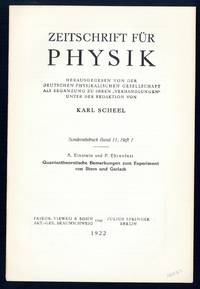
1922432871922. <p>Einstein Albert 1879-1955 and Paul Ehrenfest 1880-1933. Quantentheoretische Bemerkungen zum Experiment von Stern und Gerlach. Offprint from Zeitschrift für Physik 11 1922. 31-34pp. 229 x 155 mm. Original printed self-wrappers. Light toning but fine otherwise. </p> <p>First Edition Offprint Issue. In 1922 the physicists Otto Stern and Walther Gerlach conducted a now-classic experiment in which a beam of silver atoms was streamed through an inharmonious magnetic field in order to observe the atoms' deflection patterns. Rather than a random and continuous distribution as predicted by classical theory the atoms passing through the field were deflected up or down by a specific amount demonstrating that they had intrinsically quantum properties. The Stern-Gerlach experiment corroborated the Bohr-Sommerfeld model of the atom and strongly influenced later developments in 20th century physics. However the experiment also created some serious difficulties for quantum physicists in the period before the rise of the "new" quantum mechanics. </p> <p>Einstein and Ehrenfest addressed one of these difficulties—connected with space quantization—in their joint paper in which </p> <p>"they dealt in particular with the problem of how the orbits of the atom would obtain their discrete directions which they exhibit while passing through the inhomogeneous magnetic field. Under the assumption that the mechanism causing the orientation was provided by the interaction with the radiation field Einstein and Ehrenfest estimated that for a field strength of 10000 G a change in the direction of the orbit would take place in roughly 1011 s; this long time interval would be reduced in the presence of heat radiation at room temperature . . . to about 109 s. How could they asked the experimental situation be explained which implied that the discrete orientations of the orbits in silver atoms were obtained in less than 10-4 s. In order to deal with this evident puzzle Einstein and Ehrenfest proposed two alternatives: first that the silver atoms were always in the states of spatial quantization; second the orientations of the electron orbits arose from an interaction of the atoms with the radiation field which involved much smaller reaction times . . . However they found that both alternatives created considerable difficulties in the understanding of the atomic processes . . . Thus Einstein and Ehrenfest concluded: 'The difficulties mentioned above show how unsatisfactory are both interpretations of the results found by Stern and Gerlach'" Mehra & Rechenberg The Historical Development of Quantum Theory 1 pp. 443-444. </p> <p>Pais Subtle is the Lord p. 328. Weil Albert Einstein Bibliography 121.</p> . unknown books
1915432951915. <p>Einstein Albert 1879-1955 and Wander Johann de Haas 1878-1960. Notiz zu unserer Arbeit "Experimenteller Nachweis der Ampèreschen Molekularströme." Offprint from Verhandlungen der Deutschen Physikalischen Gesellschaft 17 1915. 1 sheet p. 420. 228 x 156 mm. Original printed wrappers. Fine copy.</p> <p>First Edition Offprint Issue. In 1915 Einstein and Dutch physicist Wander Johannes de Haas conducted gyromagnetic experiments leading to the discovery of the Einstein-de Haas effect which corresponds to the mechanical rotation induced in a ferromagnetic cylinder suspended inside a coil when an impulse of electric current is sent through the coil. Einstein was very enthusiastic about the experimental results stating that he and de Haas had "given firm proof of the existence of Ampère's molecular currents" quoted in Pais Subtle is the Lord pp. 245-246. Einstein and de Haas published their results in a paper published earlier in 1915 see Weil 73; the present "Notiz" is a response to a communication from American physicist Samuel Jackson Barnett who had begun performing similar experiments in 1909 and obtained results complementing those of Einstein and de Haas. Weil Albert Einstein Bibliography 73n.</p> . unknown books
19132139Zürich: Zürcher & Furrer 1913. First edition offprint. Original wrappers. Very Good. EXTREMELY RARE AUTHOR'S OFFPRINT "Überreicht von den Verfassern" IN ORIGINAL WRAPPERS OF THE FIRST PRINTING OF EINSTEIN AND GROSSMANN'S FURTHER DEVELOPMENT OF THE CRITICAL "ENTWURF" THEORY OF 1913. "Einstein returned from Prague to Zurich in the summer of 1912. He had by then already formulated the fundamental physical principles of the general relativity theory of gravitation and was now searching for their mathematical structure. At the E.T.H. the Swiss Federal Institute of Technology in Zurich where he now returned as professor of theoretical physics Einstein met again his old fiend and former fellow student Marcel Grossmann who was now a professor of mathematics and his colleague. With Grossmann and under his guidance Einstein studied the mathematical literature especially the theory of invariants and the absolute differential calculus of Chirstoffel Ricci Levi-Civita and others. Einstein developed the mathematical structure of his theory jointly with Grossmann and in his celebrated paper on the general theory of relativity in 1916 he acknowledged the help which his friend had given him. It was Grossmann's help which had Einstein said 'spared me not only the study of the relevant mathematical literature but who Grossmann also assisted me in searching for the field equations of gravitation.' This study of mathematical literature and the search for the proper mathematical tools led to several joint papers with Grossmann during Einstein's all too brief stay in Zurich. These papers contained the first attempts toward a generalized theory of relativity using new mathematical tools and gave full expression to Einstein's earlier physical insights" Jagdish The Golden Age of Theoretical Physics. The first of Einstein's papers to present his collaborative work with Grossmann the famous "Entwurf" paper appeared in the summer of 1913; the present paper based on a lecture given on September 9 1913 to the 96th annual meeting of the Swiss Society for Natural Sciences in Frauenfeld provides further details on the new generalized theory of relativity. The published paper contains more mathematics than in the given lecture. Weil 57. OFFPRINT FROM: Vierteljahrsschrift der Naturforschenden Gesellschaft vol. 58 pp. 284-290 Einstein; pp. 291-297 Grossmann. Zürich: Zürcher & Furrer 1913. Octavo original wrappers; custom box. Mild dampstaining to extreme top outer margin away from the text; crease down the center of issue. SCARCE. Zürcher & Furrer unknown books
19132064Leipzig and Berlin: Teubner 1913. First edition. Original wrappers. Very Good. FIRST EDITION COMMERCIAL OFFPRINT ISSUE of Einstein's breakthrough work on general relativity: the famous "Entwurf" paper. "In this book Einstein and Grossman investigated curved space and curved time as they relate to a theory of gravity. They presented virtually all the elements of the general theory of relativity with the exception of one striking omission: gravitational field equations that were not generally covariant. Einstein soon reconciled himself to this lack of general covariance through the 'hole argument' which sought to establish that generally covariant gravitational field equations would be physically uninteresting. Einstein did not adopt the gravitational field equations until late in 1915 in his final formulations of the general theory. Here Einstein contributed the physics and Grossman the mathematics" Calaprice The Einstein Almanac 40. Weil 59a. Offprint from Zeitschrift für Mathematik und Physik volume 62. Leipzig and Berlin: Teubner 1913. Octavo original wrappers; custom box. Pencil notation on title. Small chips at spine ends. An outstanding copy without any of the cover-foxing so common with this issue. Teubner unknown books
1923108095Princeton University Press 1923. 1st Edition. Hardcover. Very Good/Very Good. First edition with Published 1922 on copyright page and 1923 on title page very good in the very rare dust jacket which had some wear and chips. Short tear at bottom of rear free endpaper. Housed in a custom-made collector's slipcase. Princeton University Press hardcover books
1923171111001Princeton: Princeton University Press 1923. First Edition. Hardcover. Very Good. First American edition first printing. Near Fine with slight fade to spine cloth gilt stamping very sharp on front cover. Previous owner bookplate to front paste down with patch of abrasion at nearby gutter. Pages toned with several hinges just slightly over-opened. In a Very Good dust jacket with a large chip and tear at the top of the spine toning to spine and edges and several small edge tears. A very nice copy in the scarce dust jacket. Princeton University Press hardcover books
19312331Lancaster: Physical Review 1931. First Edition. Original wrappers. Fine. FIRST EDITION FIRST PRINTING IN ORIGINAL WRAPPERS of Einstein's paper outlining a thought experiment to suggest that the uncertainty principle requires the acknowledgement of an indeterminate past. "To Heisenberg at the 1920's only the prediction of the future was important and the mathematical theory assisted him to calculate the probability of the end-state given the initial state: the description of the intermediate development of the system between two objectively recorded or recordable states did not seem to correspond to physical reality. <br /> <br /> "On the other hand Einstein as a critic of quantum physics did not admit Heisenberg's standpoint especially that the indeterminacy principle does not refer to the past. In the paper 'Knowledge of Past and Future in Quantum Mechanics' 1931 Einstein proposed an imaginary experiment in which 'the possibility of describing the past path of one particle would lead to predictions as to the future behavior of a second particle of a kind not allowed in the quantum mechanics.' So Einstein concluded that 'the principle of the quantum mechanics must involve an indeterminacy in the description of past events which is analogous to the indeterminacy in the prediction of future events.'<br /> <br /> "This should be understood in the context of Einstein's argument against the 'completeness' of quantum physics just in the same way that the purpose of the EPR argument 1935 was to show that the 'completeness' of quantum physics would lead to absurdity. In other words Einstein did not positively assert the existence of indeterminate past events but only intended to deduce it as the necessary conclusion of the 'completeness' of quantum physics.<br /> <br /> "The problem of the 'indeterminate' past re-appeared about fifty years later in J. A. Wheeler's discussion of the 'delayed-choice' experiment. This experiment is not an imaginary but an actual one which uses one particle say photon instead of two particles in Einstein's case.<br /> <br /> "After confirming the fact that what we can say of past events is decided by delayed choices made in the near past and now Wheeler discusses the possibility that the phenomena called into being by the present decision can reach backward in time even to the earliest days of the universe. He says:<br /> <br /> 'To use other language we are dealing with an elementary act of creation. It reaches into the present from billions of years in the past. It is wrong to think of the past as "already existing" in all detail. The "past" is theory. The past has no existence except as it is recorded in the present. By deciding what questions our quantum registering equipment shall put in the present we have an undeniable choice in what we have the right to say about the past.'<br /> <br /> "The interpretation of the indeterminacy principle will be altered if we accept the concept of the past indeterminacy. Heisenberg originally considered this principle as the limit of the exactitude of two incommensurable quantities at the simultaneous measurement. But the indeterminacy of past events which have not been recorded have a connection not with their simultaneous measurability but rather with the definability of their historic routes. That the definition of the past route or history of a particle depends on the present choice of an experimenter is the meaning of the 'indeterminate past'" Yutaka Tanaka "The 'Individuality of a Quantum Event". Weil 178.<br /> <br /> IN: Physical Review pp. 780-781 Vol. 37 No. 6 March 15 1931. Octavo original wrappers; custom box. Only slight wear to wrappers. A rare fine copy in original wrappers without any library stamps. Physical Review unknown books
1906432891906. <p>Einstein Albert 1879-1955. Über eine Methode zur Bestimmung des Verhältnisses der transversalen und longitudinalen Masse des Elektrons. Offprint from Annalen der Physik 21 1906. 583-586pp. 223 x 145 mm. Original printed wrappers chipped spine splitting minor spotting. Light toning but very good.</p> <p>First Edition Rare Offprint Issue. In his landmark 1905 paper on special relativity Einstein used the velocity-dependent concepts of transverse and longitudinal mass for the moving electron these terms have now been replaced with the concept of relativistic mass first defined by Lewis and Tolman in 1909. In the present paper Einstein proposed an experimental method for determining the ratio of the transverse to the longitudinal mass and invited experimentalists to verify his special theory of relativity. Einstein later abandoned velocity-dependent mass concepts stating in 1948 that "it is better to introduce no other mass concept than the ‘rest mass' m" quoted in L. B. Okun "The concept of mass" Physics Today 1989: 31-36. Lavenda A New Perspective on Relativity pp. 7-8. Weil Albert Einstein Bibliography 14. </p> . unknown books
1908432171908. <p>Einstein Albert 1879-1955 and Jakob Johann Laub 1884-1962. Über die elektromagnetischen Grundgleichungen für bewegter Körper. Offprint from Annalen der Physik 4th series 26 1908. 532-540pp. 225 x 146 mm. Original printed wrappers. Fine.</p> <p>First Edition Offprint Issue. Einstein's first paper written jointly with a collaborator on the relativistic electrodynamics of ponderable media. "In 1908 Laub wrote works together with Einstein on the basic electromagnetic equations which was aimed to replace the four-dimensional formulation of the electrodynamics by Minkowski by a simpler classical formulation. Both Laub and Einstein discounted the spacetime formalism as too complicated. However it turned out that Minkowski's spacetime formalism was fundamental for the further development of special relativity" Wikipedia. Pais Subtle is the Lord pp. 151 154. Shields 23. Weil 23.</p> . unknown books
19461827Princeton: Estate of Fred Stein 1946. Limited Edition. no binding. Fine. STUNNING LARGE GELATIN SILVER LIMITED EDITION PHOTOGRAPH; one of the most iconic images of the 20th century. One of only 450 in the edition. "In 1946 when Albert Einstein was in residence at Princeton University Fred Stein was granted ten minutes of the great man's time to take a portrait. After the time was up Einstein's secretary came in to usher Stein out. However Einstein insisted that he stay saying that their discussion was too interesting to cut short. The secretary came back repeatedly but the visit extended to two hours. The resulting portrait by Fred Stein pictures a deep intelligence engaged in thought. It became an iconic image and one of the most famous photographs ever taken of Albert Einstein" Dawn Freer "Fred Stein: A Retrospective". Printed later 1994 on behalf of the Fred Stein estate by Stein's son Peter Stein: "Printed and archivally processed by a master printer under Peter Stein's supervision and to his approval and matched as closely as possible to his father's vintage prints." Fred Stein website. Size: image 10.5 x 14 in.; with matte 16 x 20 in. Number 38/450. Limitation and "Albert Einstein Princeton 1946" on the front of the original matte beneath the photo; signed by Peter Stein and with stamp "Estate of Fred Stein" and "Authorised Estate print" on verso of matte. Estate of Fred Stein unknown books
19152125Berlin: Verlag der Königlichen Akademie der Wissenschaften 1915. First edition. Original wrappers. Fine. FIRST PRINTING IN ORIGINAL WRAPPERS IN FINE CONDITION of Einstein's famous November 4 1915 paper introducing his new version of general relativity. By autumn 1915 Einstein experienced a "crisis" in his work on his gravitational equations and the general theory of relativity forcing him to abandon several key elements of his earlier work. In October 1915 "Einstein shifted his focus from the physical strategy which emphasized his feel for the basic principles of physics and returned to a greater reliance on a mathematical strategy which made use of the Riemann and Ricci tensors. 'Einstein's reversal' writes John Norton 'parted the waters and led him from bondage into the promised land of general relativity'. "The result was an exhausting four-week frenzy during which Einstein wrestled with a succession of tensors equations corrections and updates that he rushed to the Prussian Academy in a flurry of four Thursday lectures. It climaxed with the triumphant revision of Newton's universe at the end of November 1915" Isaacson. In this November 4th paper and lecture On the General Theory of Relativity Einstein presented "to the plenary session of the Prussian Academy a new version of general relativity" explaining "that he had 'completely lost confidence' in the equations he proposed in October 1914. His answers were still not entirely right. There was still one flaw a much smaller one which he eliminated three weeks later. But the road lay open. He was lyrical. 'No one who has really grasped it can escape the magic of this new theory'" Pais. Three weeks later - on November 25 1915 - Einstein did indeed eliminate the flaw and "presented to the physics-mathematics section of the Prussian Academy of Sciences a paper in which 'finally the general theory of relativity is closed as a logical structure'. The work is done" Pais. See: Isaacson Einstein pp. 211-221 and Pais Subtle is the Lord pp.250-261. Note: Einstein's November 11 paper was titled "Zur allgemeinen Relativitatstheorie II" but rather than a continuation or advancement of the November 4 paper it was a step backwards introducing a serious mistake that he would correct by November 25. IN: Sitzungsberichte der Königlich Preussischen Akademie der Wissenschaften. Berlin: Verlag der Königlichen Akademie der Wissenschaften 1915. Vol. 44. 778-786. Quarto original wrappers; custom box. A fine copy. RARE. Verlag der Königlichen Akademie der Wissenschaften unknown books