Einstein AlbertABAA
187 résultats
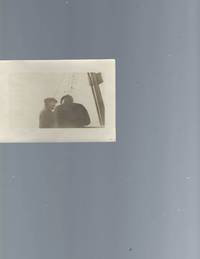
6866Einstein Albert. Nobel Prize winning physicist. Vintage Signed Photo. A sepia candid photo of Einstein talking to another man Signed by Einstein on the blank verso in ink "Albert Einstein". Photo is aprox 3.5 in x 5 in and verso is a blank postcard as it was fashionable in the 1930's. Einstein wears a cap and is in profile the other man has his back to us. They are both wearing winter overcoats and are having a conversation outdoor by what seems to be a boat mass. This unique candid shot seems to be taken on one of Einstein many trips aboard vessels in the 1930's. Einstein said on a boat he was oblivious to everything else in the world and once wrote "A cruise in the sea is an excellent opportunity for maximum calm and reflection on ideas from a different perspective." The signature is very clean and dark and in very good condition. unknown books
19142124Berlin: Königlichen Akademie der Wissenschaften 1914. FIRST EDITION OFFPRINT. Original wrappers. Fine. FIRST EDITION COMMERCIAL OFFPRINT ISSUE of Einstein's important 1914 paper on the development of general relativity. "In summer 1914 Einstein felt that the new theory general relativity should be presented in a comprehensive review. He also felt that a mathematical derivation of the field equations that would determine them uniquely was still missing. "Both tasks are addressed in a long paper presented in October 1914 to the Prussian Academy for publication in its Sitzungsberichte. It is entitled 'The formal foundation of the general theory of relativity'; here for the first time Einstein gave the new theory of relativity the epithet 'general' in lieu of the more cautious 'generalized' that he had used for the Entwurf" Landmark Writings in Western Mathematics 1640-1940. "According to John Norton 'How Einstein Found His Field Equations' this major review article was intended to convey the full content of the 1913 'Entwurf' theory: 'The principal novelty lies in the mathematical formulation of the theory. Drawing on earlier work with Marcel Grossman Einstein formulated his gravitational field equations using a variation principle. Using this richer mathematical structure Einstein offered a proof purporting to demonstrate that his theory had the maximum covariance compatible with the hole argument; that is covariance under 'justified' transformation between the 'adapted coordinate systems' he had introduced with Grossman'" Calaprice The Einstein Almanac. Offprint from: Sitzungsberichte der Königlich Preussischen Akademie der Wissenschaften XLI 19 November 1914 pp. 1030-1085. Berlin: Königlichen Akademie der Wissenschaften 1914. Octavo original wrappers; custom box. Neat early ownership name on front wrapper. Only the slightest wear; a fine copy. Rare. Königlichen Akademie der Wissenschaften unknown books
1916140940031Leipzig: Verlag von Johann Ambrosius Barth 1916. First Edition. Near Fine. First edition. Annalen der Physik Band 48 No. 7. total pp. 769-880 with Einstein's paper "Die Grundlage der allgemeinen Relativitätstheorie" on pp. 769-822. "Druck von Metzger & Wittig in Leipzig" to foot of pp. 880. Finely bound without wraps opens directly to p. 769 in marbled boards with brown leather spine lettered in gilt with contents lightly toned else Fine. Also contains papers by Otto Stern W. Wein R. Hirsch and H. Lussem. Text in German. The first printing of Einstein's General Theory of Relativity and a continuation of his ideas of first set forth in a 1905 paper on special relativity. General relativity refines Newton's laws of gravity describing it as a geometric property of space and time applying it to the universe. Verlag von Johann Ambrosius Barth unknown books
19052103Leipzig: Johann Ambrosius Barth 1905. First edition. Contemporary morocco over marbled boards. Very Good. FIRST PRINTING of Albert Einstein's groundbreaking 1905 paper the introduction and derivation of the most famous equation in modern physics: E=mc2. "A few months after first publishing the theory of relativity Einstein discovered something that particularly intrigued him; the relation between inertial mass and energy. He wrote to Conrad Habicht during the summer of 1905: 'One more consequence of the paper on electrodynamics has also occurred to me. The principle of relativity in conjunction with Maxwell's equations requires that mass be a direct measure of the energy contained in a body; light carries mass with it. A noticeable decrease of mass should occur in the case of radium. The argument is amusing and seductive but for all I know the Lord might be laughing over it and leading me around by the nose'" Stachel Einstein's Miraculous Year. Einstein continued to work late into the summer on this "amusing and seductive" problem before proving the mass-energy relationship that would become known throughout the world as the simple and elegant E=mc2. Received by Annalen der Physik on September 27 Einstein's derivation and proof of his most famous equation was a dramatic contribution to his annus mirabilis of 1905. Weil 10. Note: In this paper and others until 1912 Einstein used the symbol "L" for energy in his equations and wrote the formula in the form: Mass= L/c2. In: Annalen der Physik Vierte Folge Volume 18 part 13 pages 639-41. Leipzig: Barth 1905. Octavo contemporary half-morocco over marbled boards. The whole volume 18 offered complete with volume halt-title title and contents. Some scuffing to spine of binding; text exceptionally fine. A rare copy in a contemporary binding with no institutional stamps. Johann Ambrosius Barth unknown books
19482327Princeton NJ: np 1948. framed. Fine. ONE OF THE MOST CELEBRATED IMAGES OF EINSTEIN SIGNED BY MASTER PHOTOGRAPHER YOUSUF KARSH. On February 11 1948 Yousuf Karsh perhaps the most accomplished portrait photographer of his generation visited The Institute for Advanced Study in Princeton to fulfill a dream of his: to photograph Albert Einstein. As he later explained: "Among the tasks that life as a photographer had set me a portrait of Albert Einstein had always seemed a 'must' - not only because this greatest refugee of our century has been accounted by all the world as the most outstanding scientist since Newton but because his face in all its rough grandeur invited and challenged the camera." Karsh: Beyond the Camera David Travis ed. "At Princeton's Institute for Advanced Study I found Einstein a simple kindly almost childlike man too great for any of the postures of eminence. One did not have to understand his science to feel the power of his mind or the force of his personality" official Karsh website. "Awed before this unique intellect I yet ventured to ask Einstein his views on human immortality. He mused for a moment and then replied 'What I believe of immortality There are two kinds. The first lives in the imagination of people and is thus an illusion. There is a relative immortality which may conserve the memory of an individual for some generations. But there is only one true immortality on a cosmic scale ant that is the immortality of the cosmos itself. There is no other.' "He spoke of these ultimate mysteries as calmly as he might a student's question about mathematics - with such an air of quiet confidence indeed that I found his answer profoundly disturbing to one who held other views. Knowing him to be an accomplished violinist I turned the conversation and asked if there were any connection between music and mathematics. 'In art he said 'and in the higher ranges of science there is a feeling of harmony which underlies all endeavour. There is no true greatness in art or science without that sense of harmony. He who lacks it can never be more than a great technician in either field.' "Was he optimistic about the future harmony of mankind itself He appeared to ponder deeply and remarked in graver tones: 'Optimistic No. But if mankind fails to find a harmonious solution than there will be disaster on a dimension beyond anyone's imagination.' To what source should we look for the hope of the world's future 'To ourselves' said Einstein. He spoke sadly yet serenely as one who had looked into the universe far past mankind's small affairs. In this humor my camera caught him. the portrait of a man who had traveled beyond hope or despair." Yousuf Karsh Regarding Heroes. Opening quote from: Colin Naylor ed. Contemporary Photographers. Silver print. Photo taken Princeton 1948. Printed later. Signed by Karsh in full beneath the image on photographer's mount. With Karsh's original calling "card" - a 4x10 inch cardboard slip - included. Image: 8x9 inches. Framed to an overall size of 12x15 inches. Fine condition. np unknown books
19361198491936. Rare typed letter signed by Albert Einstein. One page typescript text in German. The letter is dated 19 June 1936 and addressed to Dr. Hugo Bergman Hebrew University Jerusalem and reads: Lieber Herr Bergmann: Ueberbringer dieses Briefes ist "Seine amerikanische Heiligkeit" Rabbi Silberfeld von Newark New Jersey ein guter Bekannter von mir. Zuhause aller Wege kundig nicht aber in Palaestina. Es ware lieb von Ihnen wenn Sie ihm ein paar Winke gaben damit er sich dort zurechtfindet. Herzlich grusst Sie Ihr "A. Einstein." This translates as: Dear Mr. Bergmann: The bearer of this letter is "His American Holiness" Rabbi Silberfeld of Newark New Jersey a good friend of mine. At home he knows all the ways but not in Palestine. It would be nice of you if you gave him a few hints. yours "A. Einstein." Einstein's close personal friend Rabbi Julius Silberfeld was the rabbi of Temple B'nai Abraham in Newark New Jersey from 1902 to 1939. After it became clear that he could not return to Germany with Hitler's rise to power during his 1933 visit to the United States Einstein resided in England and Belgium for several months before returning to the U.S. where he accepted a position at the Institute for Advanced Study in Princeton New Jersey noted for having become a refuge for scientists fleeing Nazi Germany. It was here that he likely met and formed a close bond with Rabbi Silberfeld. The recipient of the letter Hugo Bergmann was the first rector of the Hebrew University of Jerusalem between 1935 and 1938 which Einstein was instrumental in establishing in 1925 and was among its first Board of Governors. The letter is in near fine condition with a small paper clip imprint. Desirable with noted provenance. Albert Einstein developed the general theory of relativity one of the two pillars of modern physics alongside quantum mechanics. Einstein's work is also known for its influence on the philosophy of science. Einstein is best known in popular culture for his mass-energy equivalence formula E = mc2 which has been dubbed "the world's most famous equation". He received the 1921 Nobel Prize in Physics for his "services to theoretical physics" in particular his discovery of the law of the photoelectric effect a pivotal step in the evolution of quantum theory David Bodanis. unknown books
19472187Princeton NJ: Halsman 1947. Photograph. Fine. ONE OF THE MOST FAMOUS IMAGES OF EINSTEIN. Philippe Halsman's now iconic 1947 photograph of Einstein has become not only one of the most celebrated images of Einstein but one of the most recognizable images of the twentieth century. It was used to a 1966 US postage stamp of Einstein and was featured on the cover of Time Magazine honoring Einstein as the "Person of the Century".

 The photographer Halsman in his book Philippe Halsman: A Retrospective explained the circumstances of the photo: I admired Albert Einstein more than anyone I ever photographed not only as the genius who single-handedly had changed the foundation of modern physics but even more as a rare and idealistic human being.
 Personally I owed him an immense debt of gratitude. After the fall of France it was through his personal intervention that my name was added to the list of artists and scientists who in danger of being captured by the Nazis were given emergency visas to the United States.
 After my miraculous rescue I went to Princeton to thank Einstein and I remember vividly my first impression. Instead of a frail scientist I saw a deep-chested man with a resonant voice and a hearty laugh.
 The question of how to capture the essence of such a man in a portrait filled me with apprehension. Finally in 1947 I had the courage to bring on one of my visits my Halsman camera and a few floodlights. After tea I asked for permission to set up my lights in Einstein's study. The professor sat down and started peacefully working on his mathematical calculations. I took a few pictures. Ordinarily Einstein did not like photographers whom he called Lichtaffen light monkeys. But he cooperated because I was his guest and after all he had helped save me.
 Suddenly looking into my camera he started talking. He spoke about his despair that his formula E=mc2 and his letter to President Roosevelt had made the atomic bomb possible that his scientific search had resulted in the death of so many human beings. "Have you read" he asked "that powerful voices in the United States are demanding that the bomb be dropped on Russia now before the Russians have time to perfect their own" With my entire being I felt how much this infinitely good and compassionate man was suffering from the knowledge that he had helped to put in the hands of politicians a monstrous weapon of devastation and death.
 He grew silent. His eyes had a look of immense sadness. There was a question and a reproach in them.
 The spell of this moment almost paralyzed me. Then with an effort I released the shutter of my camera. Einstein looked up and I asked him "So you don't believe that there will ever be peace"
 "No" he answered. "As long as there will be man there will be wars." Silver prints of this photograph have been printed in different sizes over the years. This photograph is an official Halsman silver print with his copyright hand-stamp on the verso measuring approximately 10x13 inches. Princeton NJ. Silver print. Taken 1947; printed 1970s. Image: 13x10 inches 33x25.4 cm. Archivally matted and framed under UV-protecting museum glass to an overall size of 18.5x22 inches. A stunning piece in fine condition. Halsman unknown books
1916432941916. <p>Einstein Albert 1879-1955. Ein einfaches Experiment zum Nachweis der Ampèreschen Molekularströme. Offprint from Verhandlung der Deutschen Physikalischen Gesellschaft 18 1916. 173-177pp. 230 x 157 mm. Original printed wrappers. Fine copy.</p> <p>First Edition Offprint Issue. In 1915 Einstein and Dutch physicist Wander Johannes de Haas conducted gyromagnetic experiments leading to the discovery of the Einstein-de Haas effect which corresponds to the mechanical rotation induced in a ferromagnetic cylinder suspended inside a coil when an impulse of electric current is sent through the coil. Einstein was very enthusiastic about the experimental results stating that he and de Haas had "given firm proof of the existence of Ampère's molecular currents" quoted in Pais Subtle is the Lord pp. 245-246. After his collaboration with de Haas ended Einstein published the present paper on the Einstein-de Haas effect proposing a new experimental method for determining gyromagnetism. The Einstein-de Haas effect is now known to reveal a relationship between magnetism angular momentum and electron spin; however this was not understood at the time as electron spin was not discovered until the 1920s. Weil Albert Einstein Bibliography 82.</p> . unknown books
191667998EinsteinÃs Theory of Relativity in Original Wrappers EINSTEIN Albert. Die Grundlage der allgemeinen Relativit‰tstheorie. Sonderdruck aus den Annalen der Physik Band 49 1916. Leipzig: Verlag von Johann Ambrosius Barth 1916. First separate printing with significant additions and revisions to the edition printed in the Annalen der Physik. With printerÃs imprint ìDruck von Metzger & Witting in Leipzigî on the verso of the title and the shorter imprint ìMetzger & Witting Leipzigî on the back wrapper. Octavo 9 1/2 x 6 3/8 inches; 240 x 160 mm. 64 pp. Original tan printed wrappers. Some light browning around the edges of the wrappers. Overall an excellent copy with none of the spine erosion or soiling usually found with this fragile item. ìThe authorized version of EinsteinÃs general theory of relativity. The theoryÃs impact upon twentieth-century science and thought can hardly be overstatedî Norman Library 695 describing the first printing. ìThis separate edition is printed on good strong paper the wrappers are of strong material too.and it is described now as ëthe original editionà of this classic paperî Weil. Grolier/Horblit 26c describing the first printing. Norman Library 696. Printing and the Mind of Man 408. Weil 80a. HBS 67998. $7500 Verlag von Johann Ambrosius Barth unknown books
1930019304Havana Cuba: not published 1930. Book. Very good- condition. Unbound. Signed by Authors. First Edition. Folio - over 12 - 15" tall. A page from the guest book register of the Hebrew College in Havana Cuba signed by Albert Einstein. On his journey to America the scientist stopped in Havana for a little over a day. In addition to touring the island and meeting dignitaries Einstein first traveled to the Jewish community and specifically the "Colegio Hebrew del Centro Israelita de Cuba" during his 30 hour visit to Cuba which started on December 19 1930. The double-sided guest book page has 16 entries dating from September 12 1929 to March 9 1931. Some of the visitors who signed the guest book were from the island but several were from the USA. Most of the American visitors were fellow Zionists and/or helped to raise funds for various Jewish causes. The Director of the Hebrew College at that time as identified on the sheet is Dr. Juan del Valle. The page was folded and has numerous paper clip creases and rust stains a few small perforations from staples and has moderate soiling and wear. Included is also a small loose contemporary newsprint photograph of Einstein from a Spanish language newspaper. The entries in chronological order as best as could be transcribed are: 09/12/29 O. Lopez as Inspector Auxilier; 11/14/29 Oscar Lopez giving address as 177 Enrique Villuendas; lengthy handwritten comment in Spanish by O. Lopez; 12/12/29 Dr. Abraham Coralnik 1883-1937 of New York - lengthy handwritten comment in English by Coralnik who was Editor of "The Day" a Yiddish NY newspaper; No date n.d. Emanuel Celler 1888-1981 Brooklyn politician; n.d Morris Fishman - 2252 Gladstone Detroit MI - Vice President of the Detroit Life Insurance Company and fundraiser/spokesperson for United Jewish Campaign including funds for United Hebrew Schools; n.d. Nathan Borin - 3008 Cortland Av Detroit MI - businessman and president of coal dealer partnership Borin Brothers Company; n.d. Mrs. Yenchyl - 1209 Tuilnyame; n.d. Rabbi Louis J. Victor Eppstein - Havana; n.d. Rabbi I. Edward Kiev - NYC 1905-1975 - Head Librarian Hebrew Union College 02/07/30 Oscar Lopez; 06/12/30 Simon Eisenberg - S.A. de los Banes; 06/12/30 Herman Chervony - Havana - member of the Board of "Centro Israelita de Cuba" which was formed in 1925; 12/19/30 A. Einstein - Berlin; 12/12/31 Oscar Gutierrez - Biela 91; 03/09/31 Franco Goires - Monte 163 Alto - Inspector Auxilier. Protected in a Lucite frame. The paper measures 11.75 inches height by 9 inches width. not published Paperback books
19321864np: np 1932. First edition. nb. UNPUBLISHED CANDID PHOTOGRAPHS OF EINSTEIN AND LETTERS BY WILLIAM HUBBARD OFFERING AN INTIMATE VIEW OF THE SCIENTIST ON VACATION. On March 2 1932 at the height of his career and world fame Albert Einstein and his wife Elsa set off on a vacation to their German homeland departing from Los Angeles on the M. S. San Francisco. Another passenger aboard the ship was the renowned music scholar William Lines Hubbard. Famous in his own right Hubbard was the music critic for the Chicago Tribune and author of a definitive 11-volume work on the history of opera published 1908. Accompanying Hubbard was his companion Julia Reid their cabins adjacent to that of the Einstein's. As was the practice during this era Hubbard kept detailed journals and letters of his travel experiences. This collection from the estate of Hubbard contains the following items:
 1. Three unpublished small black-and-white and sepia photographs. The first photograph 4.5" x 2.5" pictures Einstein his wife Elsa the Ship's Captain Hubbard the tall figure and three other of the ship's passengers dated 3/14/32. The second photograph 3.5" x 3.25" is an outstanding full front image of Einstein his wife Elsa and the ship's Captain. The final photograph 4.5" x 2.5" is a full frontal image of Einstein and his wife Elsa both seated in deck chairs with the ship's Captain standing behind.
 2. Typed letter dated March 22 1932 written while sailing through the South Atlantic. Six pages typed front and back on two pieces folded of the ship's original stationary approx. 7.5x11 in. Excerpts on Einstein include:

 Of our Six Passengers two are Prof. Einstein and wife. They are proving very delightful companions-- sincere unaffected and jolly. At first they were very reserved and merely bowed and smiled and "Guten-Morgan-ed" when entering and leaving the dining room but when they had become rested and saw that none of the rest of us planned to intrude they came forward and have been very genial. She is a great talker but talks interestingly. He walks deck smoking his stubby black pipe or whistling cheerily his gray hair blowing in the breeze. Each forenoon and sometimes in the afternoon he goes to the piano and plays for half hour or so. Plays in that satisfying manner peculiar to a man to whom music is a comfort and who thinks musically. It is in no wise brilliant playing but it is throughly enjoyable to hear. The rest of the time he sits in his steamer chair or in his cabin reading or thinking. On the 14th he had his 53rd birthday and the Capt had ordered from La Libertad Salvador where we had taken cargo the day before large bunches of easter and tiger lilies which in the morning were on the Einstein table together with a birthday cake the ship's cook had made and countless cards and letters which friends had sent. It was all a complete surprise to them both and their happiness was childlike in its spontaneity and sincerity. It was heart warming to watch them. They seem to appreciate being left to themselves and not being lionized. It is the third time they have come through the canal on these boards an they enjoy it to the full.
 3. Typed letter dated April 1 1932 written while entering the English Channel. Seven pages on two approx. 8.5x11in sheets folded of the ship's original stationary. Excerpts on Einstein include: 

We had good fun watching for crocodiles along the banks as we came up the cut and Prof Einstein was especially gleeful when he discovered one. Professor Einstein loves the roung sic weather and has reveled in it. He and the Mme are proving very delightful fellow passengers. She is very chatty but chats interestingly and he struts up and down deck smoking his stubby pipe or whistling like a jolly kid his white hair blowing in the breeze. We have some talks occasionally and he yesterday when he saw the copy of Living Philosophies which I had given me sic before I left San Diego and in which his article is the first took the book and autographed his picture and wrote in remembrance of the happy days on board the San Francisco. I don't think I told you of his birthday which occurred on the 14 of March the day before we reached the Canal. The Capt came to know if it and when the Einsteins came to their table at breakfast they found it decorated with three huge vases of Easter and Tiger lilies which the Capt had secured in La Libertad. The cook had made a gorgeously decorated Torte-- one of the filled and frosted German cakes-- and there were letters and telegrams from friends which had been sent in the Capt's care. It was a complete surprise to the Einsteins and they were like two happy kiddies. It was gladdening to watch their simple and keen enjoyment. Later we had pieces of the Torte which were a bit of muchness for breakfast but which of course we ate. 
4. Typed letter dated April 24 1932 written in Merano Italy. Six pages on five 5.5x7in sheets. 

While recalling a cargo transfer on the M. S. San Fransisco Hubbard writes: The Einsteins were especially enthusiastic and we had a great fun over the boss of the unloading. He was a huge and tremendously rotund gent wearing a soft felt hat and a short overcoat the buttons of which seemed fated to "bust off" at any moment. His chief employment seemed to be running about from side to side of the dock into the warehouse and out again clambering onboard and then clambering off and all the time shouting orders at the top of his voice and gesticulating wildly. Einstein had been reading the "Living Philosophies" which I had loaned him and was especially curious concerning Mencken and how he happened to be included in the great ones in the book. I gave him an outline of Mr. M's greatness and assured him that the book cold sic well largely on account of M being included. All of which amused the Einsteins greatly. So when this wild boss hove into sight that morning and began his excited directing Mrs E said "there is Mister Mencken" and thus he remained so long as we were in Rotterdam. The Einsteins were starting early the next morning for Berlin so they went about 9 pm to the custom house and had their 16 packages bundles and gifts examined. Frau Professor had a funny story to tell of their experience with the 150 pound bag of coffee that had been presented them in Salvador. 


5. An official passenger list from the M. S. San Francisco printed on the ship's original stationary 4.75" x 8.25" dated March 2 1932. With "Professor Albert Einstein" and "Mrs. Albert Einstein" shown under the list of cabin passengers going from Los Angeles to Bremen.


 6. A postcard depicting Hubbard's profile in black and white 3.45" x 5.45".

 All items in very good condition letters with wear and soiling at folds and housed in a custom cloth presentation folder. RARE FIRST-HAND TESTIMONY REVEALING THE PERSONALITY OF EINSTEIN IN RELAXED AND INFORMAL MOMENTS. np unknown books
192010340London: Methuen & Co. LTD 1920. First Edition. Cloth. Near fine. First English edition of Albert Einstein's Special & General Theory of Relativity in publisher's scarce dust jacket. Octavo xiii 3 138pp. 8pp ads. Red cloth title in gilt on spine stamped on cover. "First Published in 1920" statement on copyright page. A few leaves are unopened along the top edge. Light even toning throughout. Front hinge starting to separate but text block stable. Previous ownership inscription on front endpaper. Housed in custom brown leather clamshell lined in tan cloth title in gilt on spine. In publisher's original dust jacket expert restoration to spine and hinges remnants of tape repair to spine exceptionally scarce. First published in German in 1916 this copy is the first English translation of Relativity with the aim of giving "an exact insight into the theory of relativity to those readers who from a general scientific and philosophical point of view are interested in the theory but who are not conversant with the mathematical apparatus of theoretical physics." - Albert Einstein. The first American edition was published later the same year. Methuen & Co. LTD unknown books
1923958901923. Etch bust of Albert Einstein done by well-known artist Hermann Struck. Signed by both Einstein and Struck numbered 49/150. In fine condition. Double matted and framed the entire piece measures 12.25 inches by 15 inches. An exceptional piece. Hermann Struck was a German Jewish artist known for his etchings. In 1908 Struck published "Die Kunst des Radierens" "The Art of Etching" which became a seminal work on the subject. His students included Marc Chagall Lovis Corinth Jacob Steinhardt Lesser Ury and Max Liebermann. Struck did commissioned portraits of Albert Einstein Ibsen Nietzsche Freud Herzl Oscar Wilde among others. unknown books
1952510461952. Black and white silver gelatin photograph of Albert Einstein. Signed "A Einstein 52." Group portrait showing Einstein standing between Talmudic scholar Tamar de Sola Pool and Hadassah National President Rebecca Beldner Shulman at his Princeton home in June of 1952 during a celebration marking the commencement of building of the Hadassah-Hebrew University Medical Center in Jerusalem. The photograph measures 8 inches by 10 inches. Double matted and framed. The entire piece measures 13.5 inches by 15.5 inches. An exceptional photograph of Einstein rare and desirable signed. Albert Einstein developed the general theory of relativity one of the two pillars of modern physics alongside quantum mechanics. Einstein's work is also known for its influence on the philosophy of science. Einstein is best known in popular culture for his mass-energy equivalence formula E = mc2 which has been dubbed "the world's most famous equation". He received the 1921 Nobel Prize in Physics for his "services to theoretical physics" in particular his discovery of the law of the photoelectric effect a pivotal step in the evolution of quantum theory David Bodanis. unknown books
1921874301921. Etched portrait of Albert Einstein by well-known Polish-American Jewish artist Lionel S. Reiss. Signed by both Einstein and Reiss. In fine condition. Double matted and framed the entire piece measures 13.5 inches by 16.5 inches. An exceptional piece. Polish-American Jewish painter Lionel S. Reiss immigrated with his parents to the United States in 1898 at the age of four joining the ranks of other Eastern European Jews fleeing their native countries at the start of the 20th century. His family settled in New York's Lower East Side where Reiss would ultimately spend the majority of his life and become an established portraitist particularly known for his intimate portraits of Jewish people. In 1938 Reiss published his book My Models Were Jews in which he argued against the idea of a singular "Jewish Ethnicity" and that the Jewish people were rather a cultural group composed of a number of significantly diverse communities. unknown books
1952720911952. Black and white silver gelatin photograph of Albert Einstein. Signed "A Einstein 52." Full-length group portrait showing Albert Einstein standing with Hadassah National President Rebecca Beldner Shulman and others at his Princeton home in June of 1952 during a celebration marking the commencement of building of the Hadassah-Hebrew University Medical Center in Jerusalem. The photograph measures 8 inches by 9.5 inches. The entire piece measures 19 inches by 20.5 inches. An exceptional piece. Albert Einstein developed the general theory of relativity one of the two pillars of modern physics alongside quantum mechanics. Einstein's work is also known for its influence on the philosophy of science. Einstein is best known in popular culture for his mass-energy equivalence formula E = mc2 which has been dubbed "the world's most famous equation". He received the 1921 Nobel Prize in Physics for his "services to theoretical physics" in particular his discovery of the law of the photoelectric effect a pivotal step in the evolution of quantum theory David Bodanis. unknown books
1949110472Evanston: Library of Living Philosophers 1949. Signed limited first edition number 711 of 760 copies signed and dated "Albert Einstein '49." Octavo original brown cloth top edge gilt. The book is in fine condition in the rare original dust jacket which is in very good condition. Edited by Paul Arthur Schilpp. Frontispiece portrait of Einstein by Yousef Karsh. Rare and desirable in this condition. Written by the man considered the "Person of the Century" by Time magazine this is not a glimpse into Einstein's personal life but an extension and elaboration into his thinking on science. Two of the great theories of the physical world were created in the early 20th century: the theory of relativity and quantum mechanics. Einstein created the theory of relativity and was also one of the founders of quantum theory. Here Einstein describes the failure of classical mechanics and the rise of the electromagnetic field the theory of relativity and of the quanta. "The greatest physicist of the 20th century" PMM 408. Library of Living Philosophers hardcover books
19162364Braunschweig: Druck und Verlag von Friedr Vieweg and Son 1916. First edition. Original wrappers. Very Good. FIRST PRINTING IN ORIGINAL WRAPPERS OF ONE OF EINSTEIN'S MAJOR WORKS: HIS FIRST PAPER ON THE DERIVATION OF PLANK'S LAW AND PROVIDING THE THEORETICAL BASIS FOR THE LASER. "Einstein commended the 'unparalleled boldness' of Planck's derivation of 1900 meaning not only the problem itself but also the fact that it was based on assumptions that were not entirely free of contradictions. Einstein now succeeded in the first of two papers in eliminating that flaw. More interesting than the derivation itself was the general character of his methods. Einstein proceeded from Niels Bohr's basic--and by then well tested--assumption that the electrons within an atom occupy a number of discrete energy states and are able through emission or absorption of radiation to pass from one of those states to another. Added to this was an assumption of thermodynamic equilibrium between radiation field and atom as well as a consideration of the 'classical' limiting case at high temperatures--and there was Planck's formula. This brief argument. also covers emission stimulated by the radiation field; thus the formulas already by implication contain the theory of the laser though it was to take nearly half a century to be realized" Folsing Albert Einstein 389. Weil 85. The "implication" containing the theory of the laser was more fully developed in his companion paper "On the Quantum Theory of Radiation" published a few weeks later. In the first paper Einstein wrestled with the concept that the atomic emission of radiation could be a directed process; in the second paper he convincingly demonstrates that this is indeed the case. IN: Verhandl. D. Deutch. Phys. Ges. Vol 18 pp. 318-323. Braunschweig: Druck und Verlag von Friedr. Vieweg and Son 1916. Octavo original wrappers; housed in custom half leather chemise. One thread literally resewn on wrappers a little creasing and soiling. A beautiful copy. RARE IN ORIGINAL WRAPPERS. Druck und Verlag von Friedr Vieweg and Son unknown books
192478904London: Methuen & Company 1924. First edition of this classic account of Born's analysis and interpretation of Einstein's theory of relativity. Octavo original cloth frontispiece of Einstein. Signed by Max Born on the verso of the frontispiece. Translated by Henry L. Brose. Very good in a very good dust jacket. Housed in a custom half morocco clamshell box. First editions are uncommon signed examples rare. Einstein's Theory of Relativity is a book in which one great mind explains the work of another great mind in terms comprehensible to the layman is a significant achievement. This is such a book. Max Born was awarded the Nobel Prize in 1954 and was one of the world's great physicists: in this work he analyzes and interprets the theory of Einsteinian relativity. The result is undoubtedly the most lucid and insightful of all the books that have been written to explain the revolutionary theory that marked the end of the classical and the beginning of the modern era of physics. Born follows a quasi-historical method of presentation. The book begins with a review of the classical physics covering such topics as origins of space and time measurements geometric axioms Ptolemaic and Copernican astronomy concepts of equilibrium and force laws of motion inertia mass momentum and energy Newtonian world system absolute space and absolute time gravitation celestial mechanics centrifugal forces and absolute space laws of optics the corpuscular and undulatory theories speed of light wave theory Doppler effect convection of light by matter electrodynamics including magnetic induction electromagnetic theory of light electromagnetic ether electromagnetic laws of moving bodies electromagnetic mass and the contraction hypothesis. Born then takes up his exposition of Einstein's special and general theories of relativity discussing the concept of simultaneity kinematics Einstein's mechanics and dynamics relativity of arbitrary motions the principle of equivalence the geometry of curved surfaces and the space-time continuum among other topics. Born then points out some predictions of the theory of relativity and its implications for cosmology and indicates what is being sought in the unified field theory. This work steers a middle course between vague popularizations and complex scientific presentations. This is a careful discussion of principles stated in thoroughly acceptable scientific form yet in a manner that makes it possible for the reader who has no scientific training to understand it. Only high school algebra has been used in explaining the nature of classical physics and relativity and simple experiments and diagrams are used to illustrate each step. The layman and the beginning student in physics will find this an immensely valuable and usable introduction to relativity. Methuen & Company hardcover books
19511234181951. Rare silver gelatin print inscribed by the father of modern physics Albert Einstein. Inscribed by Einstein on the lower margin of the photograph "To Mr. Satoru Yamano A. <span class="match">Einstein</span>. 51." In near fine condition. Double matted and framed. The entire piece measures 11.5 inches by 10.5 inches. Perhaps best known for the development of his mass-energy equivalence formula E = mc2 German born theoretical physicist Albert Einstein's surname has practically become synonymous with the term 'genius' in modern popular culture. Einstein received the Nobel Peace Prize in 1921 for his "services to theoretical physics" which included his development of the general theory of relativity and contributions to the development of quantum theory the two pillars of modern physics. unknown books
192426006<p>"<i>I'm working a lot but not managing to come up with the real thing. Science is a difficult profession. Sometimes I'm glad that you chose a practical vocation where one doesn't have to search for four-leaf clovers.</i>"</p> <b>ALBERT EINSTEIN.</b>Autograph Letter Signed "<i>Papa</i>" to his son Hans Albert Einstein March 7 1924 Berlin Germany. In German. 1 p.<p><b><br /></b></p><p><b>Complete Translation</b></p><p> <i>7.III.24</i></p><p><i>Dear Albert</i></p><p> <i>My research projects of the past few years are completely inappropriate for a popular lecture and then I generally dread public appearances of such a kind. That's why I unfortunately have to decline the talk this time too. The Fr 45000 I designated for the down payment of the house purchase; and I invested another Fr 45000 which is supposed to belong to you that is Mama. I hope you'll find a suitable little home.</i></p><p> <i>I'm probably going to be staying in Zurich for a bit on the trip back from Naples; on the trip there only briefly. There's no question of it being official; the main thing for me is to be with you for a while. I don't have much time because I'm supposed to go to Kiel in May.</i></p><p> <i>In any case I'm very happy about seeing you all again soon. I'm working a lot but not managing to come up with the real thing. Science is a difficult profession. Sometimes I'm glad that you chose a practical vocation where one doesn't have to search for four-leaf clovers.</i></p><p> <i>Looking forward to a happy reunion! Best regards to the three of you from your</i></p><p> <i>Papa.</i></p><p><b>Historical Background</b></p><p>Einstein's Theory of Relativity published in 1915 describes gravity as a curved geometric property of spacetime. Though <i>E</i>=<i>mc</i>2 captures the theory for which he is most remembered he never won the Nobel Prize in Physics. Rather in 1922 he won for his 1905 explanation of the photoelectric effect.</p><p>In 1914 Albert and Mileva Marić-Einstein separated and she and their sons returned to Zurich. When they divorced in 1919 they agreed that any Nobel Prize money he might win would go to Mileva for the children. He won the Nobel Prize for Physics in 1922.</p><p>In May 1924 two months after this letter Marić purchased a building in Zurich and moved into the third floor apartment. In 1930 she purchased two more buildings but when the worldwide economic crisis reached Switzerland many tenants could not afford their rent; she lost the two additional buildings to foreclosure in 1936. Einstein had invested the remaining prize money in America in Marić's name. He lost much of that due to the Great Depression but he ultimately paid Marić more than he received from the prize.</p><p>Einstein also mentions to his nineteen-year-old son his plans to travel to Naples in May. He would attend the fifth International Congress of Philosophy with his theory of relativity scheduled to be "an object of particular discussion." First organized in 1900 the Congress was a global meeting held every few years under the auspices of the International Federation of Philosophical Societies. It was interrupted by both World Wars but reconvened in 1948 and has been held every five years since in locations throughout the world.</p><p>Einstein also planned to go to Kiel Germany to stay and work with Hermann Anschütz-Kaempfe 1872-1931 a German art historian and inventor. Kaempfe pioneered gyro compasses for ships and submarines.</p><p>From the 1920s until his death in 1955 the most elusive clover for which Einstein searched was a unified field theory. Einstein tried to meld together general relativity and electromagnetism. This would describe a single field in which all forces are mediated and the properties of all particles could be deduced.</p><p><b>Albert Einstein</b> 1879-1955 was born in the Kingdom of Wurttemberg in the German Empire to non-observant Ashkenazi Jewish parents. In 1894 the family moved to Italy. Einstein graduated from the Swiss Federal Polytechnic in Zürich in 1900. In 1903 he married Mileva Marić 1875-1948 with whom he had two sons. In 1905 he received a Ph.D. from the University of Zürich. From 1908 to 1932 he taught at a series of universities in Switzerland the Austrian Empire and the German Empire. As a theoretical physicist he published ground-breaking papers as early as 1905 and developed the theory of relativity including the mass–energy equivalence formula <i>E</i>=<i>mc</i>2. Albert and Mileva divorced in 1919. That same year he married Elsa Löwenthal. In 1922 he received the Nobel Prize in Physics for the discovery of the photoelectric effect. In January 1933 when Adolph Hitler came to power Einstein was visiting the U.S. and remained here In 1939 he signed a letter to President Franklin D. Roosevelt warning that Germany could develop a nuclear bomb thus inspiring the "Manhattan project." He became a U.S. citizen in 1940. After the war he became known for efforts to further world peace. At the Institute for Advanced Study in Princeton N.J. from 1933 until his death in 1955 he worked to develop a unified field theory and to refute the accepted interpretation of quantum physics. Considered the father of modern physics and one of the most prolific intellects of history Einstein published more than 300 scientific papers and over 150 non-scientific works.</p><p><b>Hans Albert Einstein</b> 1904-1973 was born in Bern Switzerland to Albert Einstein and Mileva Marić. Hans followed both parents in studying at ETH the Swiss Federal Institute of Technology in Zurich graduating with a degree in civil engineering in 1926. In 1927 he married Frieda Knecht and they had four children two of whom died very young. In 1936 Hans earned a doctor of technical science degree. At his father's advice he left Switzerland in 1938 to escape the Nazi threat. He settled in Greenville South Carolina and worked for the U.S. Department of Agriculture studying sediment transport. In 1943 he transferred to the California Institute of Technology and in 1947 he accepted a position teaching hydraulic engineering at the University of California Berkeley. He became a full professor and eventually professor emeritus winning several research awards and fellowships.</p> books
19492403Evanston IL: The Library of Living Philosophers Inc 1949. Signed Limited First Edition. Original leatherette. Fine. THE MAGNIFICENT SIGNED LIMITED FIRST EDITION ONE OF ONLY 760 COPIES SIGNED BY EINSTEIN. AN OUTSTANDING COPY IN ORIGINAL SLIPCASE. The seventh volume in "The Library of Living Philosophers" series Albert Einstein: Philosopher-Scientist is a tribute volume with essays by some of the most important scientists of the era reflecting on the importance of Einstein's work. Contributors include: Wolfgang Pauli Louis de Broglie Max Born Arnold Sommerfeld Georges Lemaitre Kurt Gödel and many more. Of special note is the essay by Niels Bohr "Discussion with Einstein on Epistemological Problems in Atomic Physics" which gives Bohr's perspective of the famous Einstein-Bohr debates. As Paul Schilpp notes in his Preface "These recollections of conversations with Einstein on the epistemological aspects of physical science would never have come into being were it not for the peculiar nature of this series."<br /> <br /> Also included as a first chapter is Einstein's important "Autobiographical Notes" in German and English and a final chapter by Einstein entitled "Remarks to the Essays Appearing in this Collective Volume". The "Autobiographical Notes" is the "closest Einstein ever came to writing an autobiography" Pais. <br /> <br /> With frontispiece portrait of Einstein by Yousef Karsh. Number 349 of the 760. Evanston IL: The Library of Living Philosophers Inc. 1949. Thick octavo approx. 6.75x9.75x1.75 original publisher's leatherette with gilt image of Einstein's signature on front board bevelled edges top edge gilt pages uncut; original slipcase. Housed in beautiful custom box by noted book artist Sjoerd Hofstra. Tiny bumps to spine ends some light wear to slipcase edges as usual. <br /> <br /> AN OUTSTANDING COPY OF AN ESSENTIAL EINSTEIN ITEM. The Library of Living Philosophers, Inc unknown books
1930110352New York: Albert & Charles Boni 1930. First edition of this Einstein biography written by Rudolf Kayser a German literary historian and husband to Albert Einstein's stepdaughter Ilse under the pseudonym Anton Reiser. Octavo original cloth frontispiece of Einstein. Signed and dated by Einstein on the front free endpaper in the year of publication "Albert Einstein New York 1930." In near fine condition. Housed in a custom half morocco clamshell box. Albert Einstein developed the general theory of relativity one of the two pillars of modern physics alongside quantum mechanics. Einstein's work is also known for its influence on the philosophy of science. Einstein is best known in popular culture for his mass-energy equivalence formula E = mc2 which has been dubbed "the world's most famous equation". He received the 1921 Nobel Prize in Physics for his "services to theoretical physics" in particular his discovery of the law of the photoelectric effect a pivotal step in the evolution of quantum theory David Bodanis. Albert & Charles Boni hardcover books
19171127481917. Rare large etching of Albert Einstein done by well-known artist Erich Buttner. Signed by both Einstein and Buttner. In fine condition. Double matted and framed the entire piece measures 12.25 inches by 15 inches. An exceptional piece. In the 1920s he created a series of portraits of his friends and fellow artists including Lovis Corinth George Grosz Arno Holz and Heinrich Zille. He produced a very fine book of exlibris bookplates in Berlin 1921. This book contains the exlibris of Albert Einstein 1917 probably Einstein's only bookplate. The etching measures 12.5 inches by 9.5 inches. Double matted and framed. The entire piece measures 18.75 inches by 15.75 inches. Hermann Struck was a German Jewish artist known for his etchings. In 1908 Struck published "Die Kunst des Radierens" "The Art of Etching" which became a seminal work on the subject. His students included Marc Chagall Lovis Corinth Jacob Steinhardt Lesser Ury and Max Liebermann. Struck did commissioned portraits of Albert Einstein Ibsen Nietzsche Freud Herzl Oscar Wilde among others. unknown books
1949140941460Evanston IL: The Library of Living Philosophers Inc 1949. First Edition; Signed Limited Issue. Near Fine. First edition signed limited issue; copy #362 of a 760 signed by Albert Einstein. Bound in publisher's brown morocco-grain cloth over bevel-edged boards stamped in gilt. Near Fine with slight darkening to spine and trivial rubbing to crown. Endsheets faintly browned. In a Near Fine publisher's original slipcase with light sunning and wear at edges. A fantastic copy signed by the iconic physicist whose name in synonymous with genius. The Library of Living Philosophers, Inc unknown books


