187 résultats
193090431New York: Albert & Charles Boni 1930. First edition of this Einstein biography written by Rudolf Kayser a German literary historian and husband to Albert Einstein's stepdaughter Ilse under the pseudonym Anton Reiser. Octavo original cloth frontispiece of Einstein. Inscribed by Albert Einstein with an original poem on the front free endpaper in German which translates as "It is <span class="match">a</span> curious f<span class="match">a</span>te to be objectified <span class="match">a</span>live. Think with humor while re<span class="match">a</span>ding. <span class="match">A</span>. Einstein." From the library of <span class="match">A</span>lex<span class="match">a</span>ndre <span class="match">a</span>nd C<span class="match">a</span>therine B<span class="match">a</span>rj<span class="match">a</span>nsky with her ownership signature to the verso of the front panel and notation below Einstein's inscription "S.S. 'Belgenl<span class="match">a</span>nd' New-York 14/XII/30." Russian sculptress Catherine Barjansky her celebrated cellist husband and Einstein were all close friends of King Albert I and Queen Elisabeth of Belgium. Barjansky described her experiences creating the now famed and very intimate sculptural portraits of Elizabeth and Albert in her 1947 joint memoir with her husband Portraits with Backgrounds. Catherine had an international career living at times in Rome <span class="hps">Berlin</span> <span class="hps">New York</span> <span class="hps">Vienna Paris</span> and <span class="hps">Brussels. </span>Einstein w<span class="match">a</span>s in New York <span class="match">a</span>t the time he inscribed the present volume h<span class="match">a</span>ving <span class="match">a</span>rrived <span class="match">a</span>bo<span class="match">a</span>rd the Belgenl<span class="match">a</span>nd three d<span class="match">a</span>ys e<span class="match">a</span>rlier. Einstein travelled aboard the Belgenland several times. He was on the ship in March 1933 intending to return home to Germany when he learned the alarming news that the Nazis had ransacked his summer cottage in Caputh. He soon decided it was too dangerous to return to Germany and when the ship docked in <span class="match">A</span>ntwerp Belgium he immedi<span class="match">a</span>tely reported to the Germ<span class="match">a</span>n consul<span class="match">a</span>te in Brussels where he turned in his Germ<span class="match">a</span>n p<span class="match">a</span>ssport <span class="match">a</span>nd renounced his citizenship. Einstein returned to <span class="match">A</span>meric<span class="match">a</span> in October beginning <span class="match">a</span> new life <span class="match">a</span>s <span class="match">a</span> member of the f<span class="match">a</span>culty of Princeton University's Institute for <span class="match">A</span>dv<span class="match">a</span>nced Study. In near fine condition. A complex and desirable association. Albert Einstein developed the general theory of relativity one of the two pillars of modern physics alongside quantum mechanics. Einstein's work is also known for its influence on the philosophy of science. Einstein is best known in popular culture for his mass-energy equivalence formula E = mc2 which has been dubbed "the world's most famous equation". He received the 1921 Nobel Prize in Physics for his "services to theoretical physics" in particular his discovery of the law of the photoelectric effect a pivotal step in the evolution of quantum theory David Bodanis. Albert & Charles Boni hardcover books
19341478Princeton: np 1934. 1st Edition. No Binding. Very Good. AN IMPORTANT SIGNED LETTER in English by Einstein revealing his reservations of associating with communism even in the fight against fascism. Written from Princeton NJ to Professor Albert Sprague Coolidge of Harvard University and dated February 16 1934 the letter reads: My dear Professor Coolidge: I had an opportunity of meeting personally Lord Marley and has sic very favorably impressed by his personality. It became known to me that he sympathizes with the Russian Government i.g. with the Russian communist party and that the committee for which he is active is influenced by communists. The problem as to the attitude which is advisable to be taken towards this committee is rather complicated. On the one hand the world-wide danger of fascism makes it necessary that all enemies of fascism cooperate; on the other hand an action which has communist leanings might endanger that fight since the important task undertaken in defense of culture and civilization may be linked up with interests of a political party. I myself have severed my connections with the committee which with my permission had used my name up to the end of last year. It seems to me advisable to take an attitude as follows: to help their action against fascism but not to identify oneself with the committee. Very truly yours signed A. Einstein P.S. I wish you would be good enough to use this strictly confidentially. In 1934 Lord Baron Marley Dudley Leigh Aman toured the United States to raise funds for his association the World Committee for the Victims of German Fascism. Marley through his committee was "passionately advocating a scheme for which he was to become an international figurehead - resettlement of oppressed German and Polish Jews in the Jewish Autonomous Region" in Siberia. He published a book "The Brown Book of the Hitler Terror and the Burning of the Reichstag sponsored by the World Committee and with an Introduction written by Lord Marley himself which was the first popular exposé of what was happening in Hitler's Germany. It documented the destruction of political parties trade unions and universities book-burning and the building of concentration camps. "At a fundraising dinner held in his honour in New York in February 1934 where Einstein presumably met him just before writing this letter Marley opened the Brown Book and 'speaking quietly declaring that he did not intend to harrow' read aloud to his audience of 600 American Jews some of the collected evidence of Nazi repressions. Here were documentary records of what was happening in Germany - a substantiation of the brutality that hitherto had had no distinct form in the mind of the American Jewish public. What before had been the subject of a growing fear mingled with disbelief was now being presented as hard fact and supported with detailed evidence. The New York Times 8 February 2005 reports the audience being 'startled' by the disclosures and the night ending with $3500 raised for the World Committee" The Jewish Quarterly No. 198. Einstein was correct to be suspicious of Marley's activities for it was later determined that the "World Committee" was indeed a Communist front; Einstein writing here to Coolidge in 1934 was prescient about the motives of the committee. This letter in addition to underscoring Einstein's passionate stance against fascism is particularly important as documentary evidence of Einstein's caution about having any dealings with communism especially considering that the U.S. FBI worried about Einstein's political leanings kept a file on Einstein that grew to 1427 pages. Princeton NJ: February 16 1934. One 8.5 x 11 in. page. Envelope folds minor spotting. An outstanding letter with important and revealing content. np unknown books
1949125016Evanston: Library of Living Philosophers 1949. Signed limited edition of Einstein's singular autobiography. Octavo original brown cloth top edge gilt original glassine and slipcase. One of 760 numbered copies signed and dated "Albert Einstein '49" this is number 458. Fine in the rare original glassine which is in near fine condition and in the original slipcase which is in fine condition. Housed in the original publisher's cardboard. An absolute pristine example which has been stored in the original cardboard box since publication. Edited by Paul Arthur Schilpp. Frontispiece portrait of Einstein by Yousuf Karsh. Rare and desirable in this condition particularly scarce in the original glassine and original box. Written by the man considered the "Person of the Century" by Time magazine this is not a glimpse into Einstein's personal life but an extension and elaboration into his thinking on science. Two of the great theories of the physical world were created in the early 20th century: the theory of relativity and quantum mechanics. Einstein created the theory of relativity and was also one of the founders of quantum theory. Here Einstein describes the failure of classical mechanics and the rise of the electromagnetic field the theory of relativity and of the quanta. "The greatest physicist of the 20th century" PMM 408. Library of Living Philosophers hardcover books
19502131Princeton: np 1950. First edition. Very Good. EINSTEIN RESPONDS TO A STUDENT EXPLAINING A CENTRAL TENET OF RELATIVITY. The schoolboy David Cumberland had answered a test question saying that vertical lines are parallel; his answer however was marked as incorrect by his teacher on the grounds that the lines would converge at the earth's center. After Cumberland insisted he was correct the teacher made a deal with him: if he could find an authority that would support his claim his grade would be changed. Cumberland apparently quite an enterprising young student wrote to Einstein asking if vertical lines are indeed parallel and Einstein in the present letter responded using relativity theory to provide support for the student's test answer: October 28 1950 Mr. David Cumberland 924 S.E. 2nd Str. Fort Lauderdale FL Dear Sir: The concept "vertical" has meaning only with respect to the earth and cannot be used beyond that context. But there is the other concept lines vertical to an euclidian plane. Those lines are parallel. Sincerely yours signed A. Einstein Albert Einstein. One of the central components of relativity is that our understanding of space and time is subject to the relevant frame of reference. In this letter Einstein uses relativity - namely a shift in the frame of reference - to prove that boy's answer can be interpreted to be correct. Upon showing his teacher Einstein's letter the boy's grade was indeed raised. One 8.5x11 inch sheet of Institute for Advanced Study letterhead. Usual folds; some water spots to page not affecting text. A WONDERFUL LETTER SHOWING A VERY HUMAN SIDE OF EINSTEIN AND EXPLAINING A BASIC CONCEPT OF RELATIVITY. np unknown books
19314675JHollywood 1931. An unusually large image 11†x 14†taken on January 8 1931 when Einstein and his wife visited Hollywood. The image shows Albert Einstein and Film Mogul Carl Laemmle Senior Founder of Universal Pictures. The photograph is a striking informal image of these two noted Jewish leaders and fellow German emigres chatting on a studio sound stage at Universal City with Mrs. Einstein visible in the background. The photograph is inscribed and signed by Albert Einstein to the head of Universal’s publicity department John LeRoy Johnston who had sent this photograph of Einstein with his boss Laemmle to Einstein to sign. Einstein has written in white ink: “Fur Kohn Johnston - Albert Einsteinâ€. Tipped to the verso is a typed note written in German from Johnston on his printed Universal Pictures stationery to Professor Einstein asking him to inscribe the photograph. Many photograph portraits of Einstein are rather stuffy affairs and a number look like police lineups when he appeared in public and met famous people and dignitaries. This is a striking image of the two men conversing. A historic and excellent photograph and the finest piece from his visit to Hollywood to ever appear on the market. unknown books
19532270Princeton NJ: np 1953. First edition. custom folder. Very Good. TOWARDS THE END OF HIS LIFE EINSTEIN WRITES TO ONE OF HIS FRIENDS FROM THE PATENT OFFICE CONCERNING ONE OF THE CENTRAL STRUGGLES OF HIS SCIENTIFIC LIFE. COMMENTING ON THE WORK OF DIRAC EINSTEIN ADMITS THAT ALTHOUGH HE "CAN'T TAKE A STATISTICAL FOUNDATION OF PHYSICS SERIOUSLY" HE FINDS IT "DIFFICULT TO MOVE BEYOND IT". Background: Einstein's struggle with accepting a strictly statistical quantum theory has been one of the most discussed and debated topics of twentieth-century physics. When introduced to the statistically-based quantum mechanics of Heisenberg Born and Jordan in 1926 Einstein famously wrote to Max Born that "Quantum mechanics is certainly imposing. But an inner voice tells me that it is not yet the real thing. The theory says a lot but does not really bring us any closer to the secret of the 'old one.' I at any rare am convinced that He is not playing at dice." Einstein letter to Born from 4 December 1926. From the onset "Einstein regarded the quantum theory as descriptively incomplete. What he meant was that in typical cases the probabilistic assertions provided by the theory for an individual quantum system do not exhaust all the relevant and true physical assertions about the system. Put briefly according to Einstein the typical statistical story told by quantum theory is not the whole story." Arthur Fine "What is Einstein's Statistical Interpretation or Is It Einstein for Whom Bell's Theorem Tolls". Einstein's discomfort with the new theory haunted him for the next three decades and his challenges to the theory were the cause of some of the most fertile and defining moments of modern science notably the celebrated "Bohr-Einstein debates" begun at the Fifth Solvay Conference 1927 and his monumentally influential "EPR" paper of 1935 "Can Quantum-Mechanical Description of Physical Reality Be Considered Complete" written with Boris Podolsky and Nathan Rosen. As late as 1949 in his "Reply to Criticisms" published in Albert Einstein: Philosopher-Scientist Einstein notes that Born and Wolfgang Pauli in their contributions to the volume "deprecate the fact that I reject the basic idea of contemporary statistical quantum theory insofar as I do not believe that this fundamental concept will provide a useful basis for the whole of physics" and spends the majority of the essay explaining his position and distinguishing between his acceptance of the model for "ensembles of systems" while still rejecting it for an "individual physical system". The letter: Dated September 12 1953 and written to his old colleague at the patent office in Bern Joseph Sauter the letter translated from the original German reads in full: Dear Mr. Sauter If I am able to I will gladly assist Mr. Keberle. I have heard of you often from my old friend Besso and I have also received a manuscript which deals critically with handwritten Dirac's presentation of the statistical approach to quantum theory. I have not been able to judge it myself because it is simply impossible for me to take a statistical foundation of physics seriously. But I have to admit that it is difficult to move beyond it. Yours sincerely signed A. Einstein. Albert Einstein. The recipient Joseph Sauter worked with Einstein at the Bern Patent office during the years he was developing the ideas for his revolutionary papers of 1905. "Among his colleagues at the Patent Office Einstein discovered one with similar scientific interests-Dr. Josef Sauter a French-Swiss who had also studied at the Polytechnic and who had been Professor Weber's chief assistant for a while. Sauter like Einstein tried to fill the gaps in the Polytechnic's syllabus by private study so that Einstein was able to discuss with him Maxwell's thermodynamics and Helmholtz's and Hertz's theoretical concepts. The two also discussed Einstein's publications on thermodynamics with the result that Sauter discovered a mistake in them which Einstein accepted 'without being the least upset.' Fifty years later Einstein recalled 'that I had a lot of discussions with Sauter about. my thermal-statistical papers'. At least as important as his help with the 'rewriting and amending' were Sauter's connections with scientific circles in Bern to which he soon introduced his new colleague." Albrecht Fölsing Albert Einstein. Edouard Keberle mentioned in the first line by Einstein was a Bulgarian physicist who at the time of the letter had just left the Institute of Theoretical Physics in Bern over a publication dispute. Not long after this letter - in early 1954 - Keberle accepted a post at the Midwest Research Institute in Kansas City. It is unclear if Einstein helped him in any way to get this position. Michele Besso - also mentioned in this letter - was Einstein's close lifelong friend. What prompts Einstein to declare that "it is simply impossible for me to take a statistical foundation of physics seriously" is the mention of a manuscript on the work of Paul Dirac. Philosophically Dirac was almost the opposite of Einstein - he had no interest in probing the interpretations of quantum theory wryly noting in his paper "The Inadequacies of Quantum Field Theory" that "The interpretation of quantum mechanics has been dealt with by many authors and I do not want to discuss it here. I want to deal with more fundamental things." It is revealing in this letter that although Einstein re-states his objection to a statistical basis of quantum theory he has doubts about his position admitting - less than two years before his death - that he still has difficulty moving beyond it. Typed Letter Signed. Princeton NJ: September 12 1953. One 8.5x11 inch sheet with Einstein's embossed Mercer Street address at top. Custom silk presentation folder. With original mailing envelope with postmarks. A few small smudges usual folds; fine condition. ONE OF EINSTEIN'S FINAL STATEMENTS ON ONE OF THE CENTRAL TENETS OF HIS SCIENTIFIC PHILOSOPHY. np unknown books
68215Typed Letter Signed and Annotated by Einstein Discussing Quantum Theory and the Principle of General Relativity EINSTEIN Albert 1879-1955. Typed letter signed "A. Einstein" to Mr. Daniel M Lipkin. Princeton New Jersey July 5th 1952. 1 page Quarto 11 x 8 1/2 inches; 279 x 217 mm. On stationary for the Institute for Advanced Study School of Mathematics. As well as the signature the letter contains a few ink notations including an equation. Also with the corresponding transmittal envelope. With one horizontal middle crease and two vertical creases as expected with a letter. Overall about fine. This 1952 typed letter signed and annotated by Einstein is to Daniel Lipkin an engineer and a former student of his friend David Bohm at Princeton regarding some equations he had sent to Einstein for comment. Einstein discusses that he has reason to belive that the "present quantum theory inspite sic of it's many successes is far from the truth." "Mr. Daniel M. Lipkin 4925 Rubicam Str. Philadelphia 44 Pa. Dear Mr. Lipkin: It is of course an obstacle for the testing of the theory that it is practically impossible to operate with the solution of the equations g i k. l § 0 -1 with respect to the T. Your point of view to try to operate on the basis of certain lines analogous to the geodetical line seem to me not appropriate for reasons of principles. A relativistic theory of the total field should according to my opinion cannot admit singularities. Particles concentrated in a point can therefore not be used in such theory. For this reason I do not believe that any lines should play a fundamental role. The conviction that only solutions without any singularities can claim physical meaning creates a tremendous difficulty because there are for non-linear differential equationsóas far as I knowóno methods to find them out systematically or even to find general theorems. I too have many reasons to believe that the present quantum theory inspite sic of its many successes is far from the truth. This theory reminds me a little of the system of delusion of an exceedingly intelligent paranoiac concocted of incoherent elements of thought. As you also seem to believe I believe it impossible to get a real insight without satisfying from the start the principle of general relativity. I feel however by no means sure that my own approach is the right one. I do also not believe that the de Broglie-Bohm's approach is very hopeful. It leads f.i. to the consequence that a particle belonging to a standing wave has no speed. This is contrary to the well-founded conviction that a nearly free particle should approximately behave according to classical mechanics. Sincerely yours A. Einstein Albert Einstein" "Daniel Lipkin a Bronx New York native who as a self-described "awestruck 15 year-old high school student" first wrote to Einstein in 1944 and continued his correspondence with the physicist after completing his studies at Princeton 1946-1949 under Einstein's friend David Bohm. Lipkin went on to work as an electrical engineer working for Sperry Univac designing early computers and later at American Electronic Laboratories. Lipkin letter to the editor American Journal of Physics 1981 p. 619; Obit. Philadelphia Inquirer 29 June 2009." From Christie's. HBS 68215. $35000 1952 unknown books
19302349np: np 1930. First edition. Fine. EINSTEIN ON THE CONCEPT OF PEACE: A POWERFUL AUTOGRAPH STATEMENT IN EXCEPTIONALLY LARGE FORMAT. 
. Translated from the original German:<br /> <br /> "No person has the moral right to call himself a Christian or Jew so long as he is prepared to engage in systematic murder at the command of an authority or allow himself to be used in any way in the service of war or the preparation for it."<br /> <br /> Starting in 1925 the French Academy began sending large 11.5x16.5 sheets to important scientists writers and intellectuals asking them to write on the sheet a statement on the concept of peace for possible inclusion in an anthology. The World League for Peace later released a limited edition of prints from the submissions under the title Pax Mundi: livre d'or de la paix. This is Einstein's unique manuscript submission. <br /> <br /> A highly unusual format with exceptionally large Einstein signature 2.25 in / 6 cm of an important Einstein statement consistent with his life-long dedication to pacifism. <br /> <br /> c.1925-1930. One large folio page 11.5 x 16.5 inches. In German. Fine condition. np unknown books
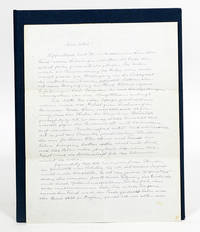
19371984Princeton: np 1937. First Edition. Very Good. AN EXTRAORDINARY LETTER BY EINSTEIN TO HIS SON OFFERING LIFE ADVICE AND DISCUSSING FREUD SHAKESPEARE AND SCHILLER. Addressed to his son Eduard "Tetel" Einstein and signed "Papa" the letter written in ink on both sides of one sheet reads in full translated from the original German: 

Dear Tetel

 I hope by now you've received Freud's lectures from Vienna. I've read most of them myself in the past. They really made me admire the Author but they didn't convince me that his theories were correct. 

I must admit however that based on my personal experiences my conviction about those theories is weakening -- I feel now that he was onto something at least in regards to the main theses. I would have written to you sooner but work is keeping me very busy. Even though they say that the work of a single person will not have much of an impact in the big picture it does not diminish the passion in which we pursue our interests and that is a good thing. 

 Although personal illusions may bring warmth and joy into one's life when young they don't last a lifetime. Life would be bleak if the work and the passion for discovery did not exist. In my free time I am currently reading Schiller's poems which I have neglected since my youth. 

They feel a bit pompous but at the same time they are enthralling in their choice of words and grammar. I am really happy that I picked them up again. 

I would have liked to send you another book on the top of the Freud but didn't know which one to send -- especially because I don't get a lot of German writings anymore.

 When I have some extra free time after finishing Schiller I really want to start reading Shakespeare everything from him I can get my hands on. If you like to read it too perhaps we could discuss it at some later time
 

 Albert is a real delight -- he has been traveling up and down the country for the past 6 weeks and will have seen and experienced many interesting things. I really hope he has followed my advice and kept a journal but I am not holding high hopes. When it comes to talking and writing he seems to be chronically constipated. With my warmest regards

 Papa Einstein's life advice underscoring one of his core beliefs: Einstein often stated that his main goal in life was the quest for truth no matter how difficult and painstaking the quest. He advises Eduard in this letter that it is the pursuit and the work in attaining the goal that brings satisfaction and sustains one throughout life even if "the work of a single person will not have much of an impact in the big picture". This he notes is critical to understand after the illusions of youth have succumbed to reality. Einstein Eduard and Freud: Eduard Einstein nicknamed "Tete" or "Tetel" born in 1910 was the second son of Albert and his first wife Mileva. From an early age he became enamored with the teachings of Freud even hanging a picture of famous psychiatrist on his bedroom wall. By the age of twenty he was diagnosed with schizophrenia and consequently was institutionalized several times throughout his life. Einstein's views of Freud's teachings were somewhat more nuanced than those of his son. Initially Einstein did not show much interest in Freud's theories and after their first meeting in 1927 Freud famously remarked "He understands as much about psychology as I do about physics." Over the years however Einstein began studying Freud's works. After corresponding with Freud somewhat regularly throughout the 1930s and even collaborating with him on a project sponsored by the League of Nations "Why War" 1932 Einstein began to move from a deep skepticism to - as indicated in this letter - a growing acceptance. By 1936 - just before this letter was written - Einstein sent birthday greetings to Freud acknowledging: "Until recently I could only apprehend the speculative power of your train of thought together with its enormous influence on the Weltanschauung of the present era without being in a position to form a definite opinion about the amount of truth it contains. Not long ago however I had the opportunity of hearing about a few instances not very important in themselves which in my judgment exclude any other interpretation than that provided by the theory of repression. I was delighted to come across them since it is always delightful when a great and beautiful conception proves to be consonant with reality." 
In this letter to Eduard Einstein admits to Eduard that he now believes Freud "was onto something at least in regards to the main theses." Einstein Shakespeare Schiller: Einstein's fondness for music is well-known but not as much has been recorded about his literary tastes. It is not surprising and has been previously documented that Einstein had a fondness for the great German poet Schiller but we can find no other references to Shakespeare by Einstein in any other letters or manuscripts. His words to Eduard "I really want to start reading Shakespeare everything from him I can get my hands on" imply that Einstein has recently "discovered" Shakespeare and is excited at the discovery. 
Note: Although the letter is not dated we can assume that it was written late November - December in 1937 when Einstein's son Albert was visiting the United States a trip he refers to in the letter. Princeton: November - December 1937. One 8.5x11 inch leaf written on both sides. In German. Usual folds otherwise fine. A LONG REMARKABLE AND REVEALING LETTER UNITING THE INTELLECTUAL GIANTS EINSTEIN FREUD AND SHAKESPEARE AND SHARING ONE OF HIS CORE BELIEFS WITH HIS SON. np unknown books
192625045<p><b>ALBERT EINSTEIN.</b>Autograph Correspondence Card Signed to Michele Besso May 1 1926 Berlin. In German. 1 p. 4¼ x 5⅞ in. </p><b>Complete Translation</b><p><i> 1 May 1926</i></p><p><i>Dear Michele</i></p><p><i> I read that paper</i><i>right away at the time but I don't think that anything more profound lies behind it. There is naturally a rough connection between a decrease in volume and energy and from here one can try to come nearer to the empirical phenomena by introducing further parameters. But this happens in such a way that neither rhyme nor reason can be made of it. It is very reminiscent of Traube. Using such apothecary's methods one cannot reveal any of God's secrets I think. Schrödinger did a couple of wonderful studies on quantum rules Ann d Physik.</i> <i>That has the scent of a deeper truth. Let it be explained to you.</i></p><p><i> I'm coming to Switzerland in July. End of July is LN meeting in Geneva.</i> <i>Then I'm going somewhere in the mountains with Tete. So I'll visit you or else we can meet.</i></p><p><i> Warm regards also to Anna and Vero your</i></p><p><i> Albert</i></p><p><b>Historical Background</b></p><p>Early in 1926 Michele Besso sent Einstein an early draft of a paper by Swiss chemist Gottfried Beck on quantum mechanics. Beck had initially submitted the paper to the Swiss scientific journal <i>Helvetica Chemica Acta</i> which rejected it as too speculative. On April 25 1926 Besso wrote to Einstein about Beck's paper. After discussing the details he writes "This surely is an amusing thing; I was surprised that you didn't write me anything about it. Here too reality is once again simpler than the theoretical conceptions would lead one to expect."</p><p>Three months later Einstein wrote to Besso regarding Beck's paper: "it is obviously particularly painful to use the quantum condition together with the equations of motion here because the validity of the latter appears to be irreconcilable with the validity of the former." Einstein was skeptical that Beck's equation "has any reality left within it in the face of quanta. I vigorously doubt it." However Einstein found the construction of the left side of the equation "surely contains a deeper truth." Einstein declared to Besso "I cannot make myself glue two things together like the left- and right-hand sides of this equation that have nothing to do with each other logico-mathematically."</p><p><b>Michele Besso</b> 1873-1955 was born in Zurich Switzerland into an Italian Jewish family. He was a close friend of Albert Einstein when they worked together at the Federal Polytechnic Institute in Zurich and at the patent office in Bern where Einstein helped Besso get a job. Besso met his future wife Anna Winteler through Einstein in June 1897. In 1898 their son Vero was born in Winterthur Switzerland. Einstein referred to Besso as "the best sounding board in Europe" for scientific ideas. Besso died in Geneva just over one month before Einstein died in Princeton New Jersey.</p><p><b>Johann Gottfried Beck</b> 1900-1992 received his Ph.D. in chemistry from the University of Bern in December 1925. He worked as an assistant to Heinrich Zangger at the Institute for Forensic Medicine at the University of Zurich.</p><p><b>Isidor Traube</b> 1860-1943 was born in Hanover the son of a wealthy German-Jewish merchant. He received his doctorate in organic chemistry in 1882. He founded capillary chemistry and conducted advanced research on liquids helping to define the concepts of surface tension and critical temperature. In 1882 he joined the faculty of Technische Hochshule in Berlin and became a professor of chemistry there in 1900. Unacceptable to National Socialists Traube was barred from his laboratory and he left Germany in 1934. Through the aid of British colleagues he was provided with a laboratory at the University of Edinburgh. During his long career he was a persistent and stubborn controversialist in opposition to various theories.</p><p><b>Erwin Schrödinger</b> 1887-1961 was born in Vienna Austria. He was a commissioned officer in the Austrian fortress artillery during World War I. After the war he advanced through the academic ranks to become a full professor in 1921 in Breslau now Wroclaw Poland. That year he moved to the University of Zurich and in 1927 to the Friedrich Wilhelm University in Berlin. He received the Nobel Prize in Physics in 1933 and left Germany as he opposed the Nazis. After brief positions in a number of places he settled in Dublin Ireland in 1940 where he remained until retiring in 1955. During his career Schrödinger developed a number of fundamentals of quantum theory including the wave equation. He also published many works in various fields of physics. Although Schrödinger was an atheist he believed his scientific work was an approach to the godhead in a metaphorical sense.</p><p><b>Eduard Einstein</b> 1910-1965 was born in Zürich Switzerland to Albert and Mileva Marić Einstein. In 1914 his parents separated and his mother returned to Zürich with Eduard and older brother Hans Albert who were both deeply affected. Eduard was interested in music art and poetry. Unlike his father Eduard was a good student. He had started to study medicine and psychiatry but in 1930 was diagnosed with schizophrenia. He was first institutionalized in 1932; it is not clear if his treatment particularly electroconvulsive therapy did more good than harm. Albert fondly referred to Eduard as "Tete" for <i>petit</i> and they corresponded regularly but never saw each other after a heart-breaking final visit in 1933. Marić and Eduard's Swiss citizenship undoubtedly saved Eduard from Aktion T4 the Nazi euthanasia program and perhaps both of them from the Holocaust. His mother cared for Eduard until her death in 1948 and Eduard thereafter lived mostly at a psychiatric clinic in Zurich where he died from a stroke in 1965.</p> books
19432376Princeton NJ: np 1943. First edition. nb. Fine. EINSTEIN OFFERS STRONG AND PRESCIENT WORDS OF ENCOURAGEMENT TO THE LEADER OF THE NAACP IN THE FIGHT AGAINST RACISM AND SEGREGATION IN THE UNITED STATES. Background: Einstein's fight against racial discrimination in the United States: The imperative "to protect the rights of the individual. was Einstein's most fundamental political tenet. Individualism and freedom were necessary for creative art and science to flourish. Personally politically and professionally he was repulsed by any restraints. "That is why he remained outspoken about racial discrimination in America. As a Jew who had grown up in Germany Einstein was acutely sensitive to such discrimination. 'The more I feel an American the more this situation pains me' he wrote in an essay called 'The Negro Question' for the January 1946 issue of Pageant magazine. 'I can escape the feeling of complicity in it only by speaking out.'" Isaacson Albert Einstein 505. Even more directly in his 1946 commencement speech to Lincoln University the first degree-granting Historically Black College and University HBCU in the United States Einstein strongly denounced segregation as "an American tradition which is uncritically handed down from one generation to the next" noting that "There is separation of colored people from white people in the United States. That separation is not a disease of colored people. It is a disease of white people. I do not intend to be quiet about it." This remarkable letter - from 1943 -Â is one of the earliest examples of his interest in condemning racism in the United States. The letter: Dated 22 September 1943 and handwritten on his embossed Mercer Street Princeton letterhead Einstein writes in English to Walter F. White the enormously influential African-American civil rights leader who led the NAACP from 1929-1955 praising him for his work and revealing his own awareness of and frustrations with racism and prejudice in America. The text reads in full: Dear Mr. White: I have been quite impressed by the address you delivered some years ago at a meeting of the Princeton Branch of the National Association for the Advancement of Colored People. I know how hard it is to awaken the conscience even of good-hearted and well-meaning people when deep rooted prejudices are in the way. It is a great work indeed which you are doing relentlessly for the betterment of the living conditions of our Colored fellow-citizens for justice and for the accomplishment of national unity of the American people. With sincere respect and kind wishes Yours Albert Einstein ------------- On April 28 1940 White was the keynote speaker at "an inter-racial meeting sponsored by the Princeton branch of the National Association for the Advancement of Colored People" where his topic was "What Happens to Democracy When It Encounters the Color Line." Princeton Herald April 26 1940. At the time Princeton did not admit African Americans and the community was debating the question of whether or not to end segregation at the university. Princeton in fact did not admit its first African-American student until the fall of 1947. Einstein -Â writing in 1943 -Â notes that he heard White speak "some years ago". Something clearly must have deeply impressed Einstein about White's speech for him to write this thoughtful letter to White over three years after the event. Note: In addition to its content this apparently unpublished letter is also remarkable for being one of the very few letters Einstein hand-wrote in English during this period as German was still very much his preferred tongue. Princeton: September 22 1943. One page on Einstein's embossed Mercer Street Princeton letterhead 7.25x10 in visible handsomely matted and framed with a photograph of Einstein. Fine condition. np unknown books
188024284<p><i><b>A unique and important artifact of his childhood.</b></i></p> <b>ALBERT EINSTEIN.</b>Ephemera. Set of Anker-Steinbaukasten children's building blocks by F. Ad. Richter & Cie. Rudolstadt Germany c.1880s. Approximately 160 composite quartz sand chalk and linseed oil blocks in red limestone and slate gray in various sizes and shapes together with three or more sets of building plans all contained in two wooden boxes with printed Anker-Steinbaukasten labels.<p>Einstein spent his childhood building "complicated structures" with these Anker-Steinbaukasten blocks. Accepting his later theory that "Imagination is more important than knowledge" the toys that encouraged his imagination became building blocks for the most important scientific theories of the last millennium.</p><p>His sister Maja Winteler-Einstein describing his childhood recalled that "The games he played … were very characteristic of Albert's capacities. These were mostly puzzles fretsaw work the erection of complicated structures with the well-known Anker building blocks and above all the construction of multi-storied card castles with which he filled his leisure." "Beitrag für sein Lebensbild" in <i>The collected papers of Albert Einstein</i>. ed. John Stachel. Volume 1: The early years. 1879-1902. Princeton University Press 1987 p.lix. Translated from German.</p><p>Based on the work of German educator Friedrich Froebel who created the concept of kindergarten these composite stone blocks were a popular toy of the 1880s and 1890s. The blocks were designed to help develop childrens' tactile senses and manual dexterity and also to stimulate imagination creativity and three-dimensional perception. Fellow scientist J. Robert Oppenheimer as well as architects Frank Lloyd Wright and Walter Gropius are among the geniuses who are known to have played with Anker blocks. </p><p><b>Provenance</b></p><p>The set had passed by direct descent from Albert Einstein to the consignor from whom we acquired the blocks at Christie's London on July 13 2016. </p><p><b>Condition</b></p><p>A few blocks chipped and worn with original instructions and boxes worn soiled and defective.</p><p><b>Albert Einstein </b>1879-1955 was a German-Swiss born theoretical physicist internationally recognized as one of the greatest physicists of all time. He enunciated the general theory of Relativity with law explaining the relationship between the speed of light and its consequence the equivalence of mass and energy E=MC2. For his work in theoretical physics—largely for his 1905 paper on photons and photo-electricity—Einstein was awarded the Nobel Prize for Physics announced in November 1922 retroactive for 1921. Working on a unified field theory he then attempted to explain gravitation and electromagnetism within one set of laws. With the expulsion of Jewish scholars from Germany after Hitler's rise to power Einstein joined the Institute for Advanced Study in Princeton New Jersey 1933 which became the most celebrated research center in the world. In 1939 he signed a letter written to President Franklin Roosevelt warning him of the possibility of Germany developing a nuclear bomb. He urged the U.S. to begin uranium research thus beginning the top secret "Manhattan Project." Later at Princeton he tried to develop a unified field theory and to refute the accepted interpretation of quantum physics both unsuccessfully. Einstein received U.S. citizenship in 1940. <br /></p> books