1 505 résultats
1949140941460Evanston IL: The Library of Living Philosophers Inc 1949. First Edition; Signed Limited Issue. Near Fine. First edition signed limited issue; copy #362 of a 760 signed by Albert Einstein. Bound in publisher's brown morocco-grain cloth over bevel-edged boards stamped in gilt. Near Fine with slight darkening to spine and trivial rubbing to crown. Endsheets faintly browned. In a Near Fine publisher's original slipcase with light sunning and wear at edges. A fantastic copy signed by the iconic physicist whose name in synonymous with genius. The Library of Living Philosophers, Inc unknown books
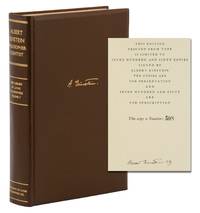
1949140948474Evanston Illinois: The Library of Living Philosophers Inc 1949. Signed Limited First Edition. Near Fine. First edition. Number 508 of a limited 760 copies signed and dated by Albert Einstein. 777 pp. Bound in publisher's brown leatherette stamped in gilt; top edge gilt; lacking the glassine dust jacket and slipcase. Text in English and German. Near Fine with very faint tidemark to edge of half-title frontisportrait and title page. A collection of critical essays devoted to the theoretical physicist by twenty-five eminent scholars and scientists with Einstein's remarks. Published on Einstein's 70th birthday the work has contributions by noted contemporaries such as Max Born Kurt Godel and Wolfgang Pauli. The Library of Living Philosophers, Inc unknown
1949250705Evanston: Library Of Living Philosophers 1949. First Limited edition. Hardcover. fine /no glassine. Karsh frontis photos facs. Octavo publisher's green cloth bevelled edges in a custom-made clamshell cloth box with morocco spine labels <br/><br/>Numbered copy 161 of only 760 numbered copies. Autographed: "Albert Einstein 49." Contains Einstein's own "Autobiographical Notes bi-lingual text German & English" and "Remarks to the Essays Appearing in this Collective Volume". Includes a Bibliography of Einstein's writings to 1949. At least 6 of the 25 contributors to this volume were awarded the Nobel Prize in Science. The contributors include Niels Bohr "Discussion with Einstein on Epistemological Problems in Atomic Physics" Kurt Godel F.S.C. Northrop Wolfgang Pauli etc. Illustrated with Yousuf Karsh's frontispiece portrait of Einstein photos facsimiles. Boni BIBLIOGRAPHICAL CHECKLIST 512. Library Of Living Philosophers hardcover
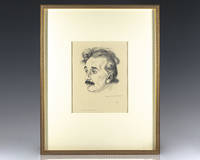
19231272041923. Lithograph portrait of "the father of modern physics" Albert Einstein by well-known artist Hermann Struck. Signed by Einstein "Albert Einstein 1923" and Struck "Herman Struck 138/150". In fine condition. Matted and framed the entire piece measures 19.75 inches by 15.5 inches. An exceptional piece. Hermann Struck was a German Jewish artist known for his etchings. In 1908 Struck published "Die Kunst des Radierens" "The Art of Etching" which became a seminal work on the subject. His students included Marc Chagall Lovis Corinth Jacob Steinhardt Lesser Ury and Max Liebermann. Struck did commissioned portraits of Albert Einstein Ibsen Nietzsche Freud Herzl Oscar Wilde among others. unknown
19171127481917. Rare large etching of Albert Einstein done by well-known artist Erich Buttner. Signed by both Einstein and Buttner. In fine condition. Double matted and framed the entire piece measures 12.25 inches by 15 inches. An exceptional piece. In the 1920s he created a series of portraits of his friends and fellow artists including Lovis Corinth George Grosz Arno Holz and Heinrich Zille. He produced a very fine book of exlibris bookplates in Berlin 1921. This book contains the exlibris of Albert Einstein 1917 probably Einstein's only bookplate. The etching measures 12.5 inches by 9.5 inches. Double matted and framed. The entire piece measures 18.75 inches by 15.75 inches. Hermann Struck was a German Jewish artist known for his etchings. In 1908 Struck published "Die Kunst des Radierens" "The Art of Etching" which became a seminal work on the subject. His students included Marc Chagall Lovis Corinth Jacob Steinhardt Lesser Ury and Max Liebermann. Struck did commissioned portraits of Albert Einstein Ibsen Nietzsche Freud Herzl Oscar Wilde among others. unknown books
1923958901923. Etch bust of Albert Einstein done by well-known artist Hermann Struck. Signed by both Einstein and Struck numbered 49/150. In fine condition. Double matted and framed the entire piece measures 12.25 inches by 15 inches. An exceptional piece. Hermann Struck was a German Jewish artist known for his etchings. In 1908 Struck published "Die Kunst des Radierens" "The Art of Etching" which became a seminal work on the subject. His students included Marc Chagall Lovis Corinth Jacob Steinhardt Lesser Ury and Max Liebermann. Struck did commissioned portraits of Albert Einstein Ibsen Nietzsche Freud Herzl Oscar Wilde among others. unknown
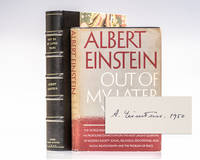
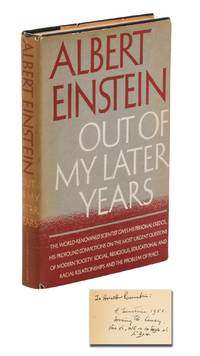
1950149463New York: Philosophical Library 1950. First edition of Einstein's collection of social science-related articles addresses and speeches. Octavo original cloth. Boldly signed by Einstein on the front free endpaper in the year of publication "A. Einstein. 1950." Near fine in a very good dust jacket. Housed in a custom half morocco clamshell box by the Harcourt Bindery. Out of My Later Years is Einsteins collection of essays considering everything that interests him as a scientist philosopher and humanitarian. Einsteins essays share how one of the greatest minds of all time interprets the changing world of his time. Philosophical Library hardcover
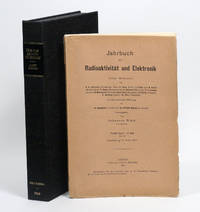
19082507Leipzig: S. Hirzel 1908. First edition. original wrappers. Very Good. THE BIRTH OF GENERAL RELATIVITY: FIRST PRINTING IN RARE ORIGINAL WRAPPERS OF ONE ONE EINSTEIN'S MOST IMPORTANT PAPERS; containing the beginning of general relativity the derivations of the equivalence principle gravitational redshift and the gravitational bending of light. "Einstein's road to general relativity began in November 1907 when he was struggling against a deadline to finish an article for a science yearbook explaining his special theory of relativity. Two limitations of that theory still bothered him: it applied only to uniform constant-velocity motion. and it did not incorporate Newton's theory of gravity. <br /> <br /> "'I was sitting in a chair in the patent office at Bern when all of a sudden a thought occurred to me' he recalled. 'If a person falls freely he will not feel his own weight.' That realization which 'startled' him launched him on an arduous eight-year effort to generalize his special theory of relativity and 'impelled me toward a theory of gravitation.' Later he would call it 'the happiest though in my life.'<br /> <br /> "The tale of the falling man has become an iconic one and in some accounts it actually involves a painter who fell from the roof of an apartment building near the patent office. Einstein refined his thought experiment so that the falling man was in an enclosed chamber such as an elevator in free fall above the earth. In this falling chamber at least until it crashed the man would feel weightless. Any objects he emptied from his pocket and let loose would float alongside him.<br /> <br /> "Looking at it another way Einstein imagined a man in an enclosed chamber floating in deep space 'far removed from stars and other appreciable masses.' He would experience the same perceptions of weightlessness. 'Gravitation naturally does not exist for this observer. He must fasten himself with strings to the floor otherwise the slightest impact against the floor will cause him to rise slowly towards the ceiling.'<br /> <br /> "Then Einstein imagined that a rope was hooked onto the roof of the chamber and pulled up with a constant force. 'The chamber together with the observer then begin to move "upwards" with a uniformly accelerated motion.' The man inside will feel himself pressed to the floor. 'He is then standing in the chest in exactly the same way as anyone stands in a room of a house on our earth. The man in the chamber will come to the conclusion that he and the chest are in a gravitational field. Just then however he discovers the hook in the middle of the lid of the chest and the rope which is attached to it and he consequently comes to the conclusion that the chamber is suspended at rest in the gravitational field.'<br /> <br /> Einstein observed that inertial mass always equals gravitational mass and through his thought experiments concluded that "From this correspondence it follows that it is impossible to discover by experiment whether a given system of coordinates is accelerated or whether. the observed effects are due to a gravitational field."<br /> <br /> "Einstein called this 'the equivalence principle.' The local effects of gravity and of acceleration are equivalent. <br /> <br /> "In 1907 working against the deadline imposed by the Yearbook of Radioactivity and Electronics Einstein tacked on a fifth section to his article on relativity that sketched out his new ideas. He also came up with many predictions that could be tested including that light should be bent by gravity and that the wavelength of light emitted from a source with a large mass such as the sun should increase slightly in what has become known as the gravitational redshift. <br /> <br /> "It would take Einstein another eight years until November 1915 to work out the fundamentals of this theory and find the math to express it. Then it would take another four years before the most vivid of his predictions the extent to which gravity would bend light was verified by dramatic observations. But at least Einstein now had a vision one that started him on the road toward one of the most elegant and impressive achievements in the history of physics: the general theory of relativity" Isaacson Einstein 145-49. <br /> <br /> Weil in his bibliography also notes that "On p.443 are probably the first explicit statements both of the equivalence of inertial and gravitational mass and of the equation for mass in terms of energy now regarded as the theoretical basis for the release of atomic energy." Weil 21. <br /> <br /> Although Einstein submitted the paper on 4 December 1907 it wasn't published until the January 22 issue of the Jarbuch. Note: There was a very short "Correction" in a subsequent issue not included here.<br /> <br /> IN: Jahrbuch der Radioactivität under Electronik Vierter Band - 4. Heft No. 16 pp. 411-462. Leipzig: S. Hirzel 1908. Octavo original wrappers; handsome custom box. Light wear to wrappers and split to spine; text fine with Einstein paper largely unopened. <br /> <br /> AN EXTREMELY RARE COPY IN ORIGINAL WRAPPERS OF ONE OF EINSTEIN'S MOST IMPORTANT PAPERS. S. Hirzel unknown
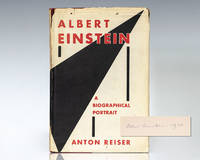
1930138499New York: Albert & Charles Boni 1930. First edition of this Einstein biography written by Rudolf Kayser a German literary historian and husband to Albert Einstein's stepdaughter Ilse under the pseudonym Anton Reiser. Octavo original cloth frontispiece of Einstein. Signed and dated by Einstein in the year of publication on the front free endpaper "Albert Einstein 1930." Near fine in a very good dust jacket. Rare signed and in the original dust jacket. Albert Einstein developed the general theory of relativity one of the two pillars of modern physics alongside quantum mechanics. Einstein's work is also known for its influence on the philosophy of science. Einstein is best known in popular culture for his mass–energy equivalence formula E = mc2 which has been dubbed "the world's most famous equation". He received the 1921 Nobel Prize in Physics for his "services to theoretical physics" in particular his discovery of the law of the photoelectric effect a pivotal step in the evolution of quantum theory David Bodanis. Albert & Charles Boni hardcover
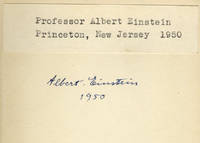
194932820624Original yellow cloth. Near fine dust jacket supplied from another copy. Early typed slip stating "Professor Albert Einstein / Princeton New Jersey 1950" mounted to top of front free endpaper. Light soiling. Very good <p><b>Signed and dated 1950 by Albert Einstein</b> on the front free endpaper.</p><p>This is the English translation of Einstein's <i>Mein Weltbild</i> first published in German in 1934 and then in English as <i>The World As I See It</i>in the same year. This abridged edition of 1949 omits the scientific essays preserving the extensive essays concerning philosophy religion Judaism economics current events government politics war and peace.</p> Philosophical Library hardcover
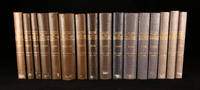
1922692L1Berlin: Akademie der Wissenchaften 1922-38. Cloth. Very Good Indeed. 10.5" by 7.5". None. A scarce complete run of the Akademie der Wissenschaften's publications from the year 1922-38 which contain twenty-six first editions of Einstein's lectures held at the Prussian Academy 1922-38. Containing 26 first editions of Einstein's lectures held at the Prussian Academy 1922-38 some library ink stamps some toning occasional fraying and one or two closed tears bound with original printed wrappers uniform cloth spines slightly faded and with remnants of paper labels at foot large 8vo Comprising of the following works by Einstein: 1. Zur Theorie der Lichtfortpflanzung in dispergierenden Medien 1922 pp. 18-22; 2. Bemerkung zu der Abhandlung von E. Trefftz: Das statische Gravitationsfeld zweier Massenpunkte in der Einsteinschen Theorie 1922 pp. 448-449; 3. Zur allemeinen Relativitätstheorie 1923 pp. 32-38; 4. Bemerkung zu meiner Arbeit "Zur allgemeinen Relativitätstheorie" 1923 pp. 76-77; 5. Zur affinen Feldtheorie 1923 pp. 137-140; 6. Bietet die Feldtheorie Moeglichkeiten fuer die Loesung des Quantenproblems 1923 pp. 359-364; 7. Quantentheorie des einatomigen idealen Gases 1924 pp. 261-267; 8. Quantentheorie des einatomigen idealen Gases. Zweite Abhandlung 1925 pp. 3-25; 9. Einheitliche Feldtheorie von Gravitation und Elektrizität 1925 pp.414-419; 10. Über die Interferenzeigenschaften des durch Kanalstrahlen emittierten Lichtes 1926 pp. 334-340; 11. With J. Grommer: Allgemeine Relativitätstheorie und Bewegungsgesetz 1927 pp.2-13; 12. Zu Kaluzas Theorie des Zusammenhanges von Gravitation und Elektrizität. Erste Mitteilung 1927 pp. 23-25; 13. Zu Kaluzas Theorie des Zusammenhanges von Gravitation und Elektrizität. Zweite Mitteilung 1927 pp. 26-30; 14. Allgemeine Relativitätstheorie und Bewegungsgesetz 1927 pp. 235-245; 15. Reimann-Geometrie mit Aufrechterhaltung des Begriffes des Fernparallelis-mus 1928 pp. 217-221; 16. Neue Möglichkeit für Eine Einheitliche Feldtheorie von Gravitation und Elektrizität 1928 pp. 224-227; 17. Zur einheitlichen Feldtheorie 1929 pp. 2-7; 18. Einheitlichen Feldtheorie 1929 pp. 2-7; 19. Die Kompatabilität der Feldgleichungen in der einheitlichen Feldtheorie 1930 pp. 18-23; 20. With Walter. Mayer: Zwei Strenge Statische Losungen der Feldgleichungen der Einheitlichen Feldtheorie 1930 pp. 110-120; 21. Zur Theorie der Raeume mit Riemann-Metrik und Fernparallelismus 1930 pp. 401-402; 22. Die Kompatibilitaet der Feldgleichungen in der einheitlichen Feldtheorie 1930 pp. 18-23; 23. Zum Kosmologischen Problem der allgemeinen Relativitaetstheorie 1931 pp. 235-237; 24. Systematische Untersuchung über kompatible Feldgleichungen welche in einem Riemannschen Raume mit Fern-Parallelismus gesetzt werden können 1931 pp. 257-265; 25. Einheitliche Theorie von Gravitation und Elektrizitaet 2. Abhandlung 1932 pp. 130-137; 26. Semi-Vektoren und Spinoren 1932 pp. 522-550. Einstein is known for developing the theory of relativity which is one of the two pillars of modern physics. His work greatly influenced the philosophy of science and for producing the world's most famous equation 'E= mc2'. He won the Nobel Prize in Physics in 1921 for his services to theoretical physics and for his discovery of the law of the photoelectric effect. The papers to this work include Einstein's papers on Bose-Einstein condensation the phenomenon that causes bosons to become a superfluid at low temperatures. There is also Einstein's two part commentary on Kaluza's theory involving field equations in five-dimensional space. These papers are from the Royal Prussian Academy of Sciences which was first established in 1700. In uniform full cloth bindings. With the original paper wraps bound in. Externally all volumes are very smart. Light fading to the spine. Light shelfwear to the joints. Small split to the front joint of 1929 volume. A few marks to the tail of spines with evidence of library label removal. Internally all volumes are firmly bound. Institutional stamp to the verso of original wraps bound in for the Bodleian Library with their cancellation stamps. Repair to the front wrap of 1928 wrap. Minor chips to the occasional extremity. Pages are slightly age toned to edges due to paper used. Otherwise pages are very clean. Very Good Indeed Akademie der Wissenchaften hardcover
192426006<p>"<i>I'm working a lot but not managing to come up with the real thing. Science is a difficult profession. Sometimes I'm glad that you chose a practical vocation where one doesn't have to search for four-leaf clovers.</i>"</p> <b>ALBERT EINSTEIN.</b>Autograph Letter Signed "<i>Papa</i>" to his son Hans Albert Einstein March 7 1924 Berlin Germany. In German. 1 p.<p><b><br /></b></p><p><b>Complete Translation</b></p><p> <i>7.III.24</i></p><p><i>Dear Albert</i></p><p> <i>My research projects of the past few years are completely inappropriate for a popular lecture and then I generally dread public appearances of such a kind. That's why I unfortunately have to decline the talk this time too. The Fr 45000 I designated for the down payment of the house purchase; and I invested another Fr 45000 which is supposed to belong to you that is Mama. I hope you'll find a suitable little home.</i></p><p> <i>I'm probably going to be staying in Zurich for a bit on the trip back from Naples; on the trip there only briefly. There's no question of it being official; the main thing for me is to be with you for a while. I don't have much time because I'm supposed to go to Kiel in May.</i></p><p> <i>In any case I'm very happy about seeing you all again soon. I'm working a lot but not managing to come up with the real thing. Science is a difficult profession. Sometimes I'm glad that you chose a practical vocation where one doesn't have to search for four-leaf clovers.</i></p><p> <i>Looking forward to a happy reunion! Best regards to the three of you from your</i></p><p> <i>Papa.</i></p><p><b>Historical Background</b></p><p>Einstein's Theory of Relativity published in 1915 describes gravity as a curved geometric property of spacetime. Though <i>E</i>=<i>mc</i>2 captures the theory for which he is most remembered he never won the Nobel Prize in Physics. Rather in 1922 he won for his 1905 explanation of the photoelectric effect.</p><p>In 1914 Albert and Mileva Marić-Einstein separated and she and their sons returned to Zurich. When they divorced in 1919 they agreed that any Nobel Prize money he might win would go to Mileva for the children. He won the Nobel Prize for Physics in 1922.</p><p>In May 1924 two months after this letter Marić purchased a building in Zurich and moved into the third floor apartment. In 1930 she purchased two more buildings but when the worldwide economic crisis reached Switzerland many tenants could not afford their rent; she lost the two additional buildings to foreclosure in 1936. Einstein had invested the remaining prize money in America in Marić's name. He lost much of that due to the Great Depression but he ultimately paid Marić more than he received from the prize.</p><p>Einstein also mentions to his nineteen-year-old son his plans to travel to Naples in May. He would attend the fifth International Congress of Philosophy with his theory of relativity scheduled to be "an object of particular discussion." First organized in 1900 the Congress was a global meeting held every few years under the auspices of the International Federation of Philosophical Societies. It was interrupted by both World Wars but reconvened in 1948 and has been held every five years since in locations throughout the world.</p><p>Einstein also planned to go to Kiel Germany to stay and work with Hermann Anschütz-Kaempfe 1872-1931 a German art historian and inventor. Kaempfe pioneered gyro compasses for ships and submarines.</p><p>From the 1920s until his death in 1955 the most elusive clover for which Einstein searched was a unified field theory. Einstein tried to meld together general relativity and electromagnetism. This would describe a single field in which all forces are mediated and the properties of all particles could be deduced.</p><p><b>Albert Einstein</b> 1879-1955 was born in the Kingdom of Wurttemberg in the German Empire to non-observant Ashkenazi Jewish parents. In 1894 the family moved to Italy. Einstein graduated from the Swiss Federal Polytechnic in Zürich in 1900. In 1903 he married Mileva Marić 1875-1948 with whom he had two sons. In 1905 he received a Ph.D. from the University of Zürich. From 1908 to 1932 he taught at a series of universities in Switzerland the Austrian Empire and the German Empire. As a theoretical physicist he published ground-breaking papers as early as 1905 and developed the theory of relativity including the mass–energy equivalence formula <i>E</i>=<i>mc</i>2. Albert and Mileva divorced in 1919. That same year he married Elsa Löwenthal. In 1922 he received the Nobel Prize in Physics for the discovery of the photoelectric effect. In January 1933 when Adolph Hitler came to power Einstein was visiting the U.S. and remained here In 1939 he signed a letter to President Franklin D. Roosevelt warning that Germany could develop a nuclear bomb thus inspiring the "Manhattan project." He became a U.S. citizen in 1940. After the war he became known for efforts to further world peace. At the Institute for Advanced Study in Princeton N.J. from 1933 until his death in 1955 he worked to develop a unified field theory and to refute the accepted interpretation of quantum physics. Considered the father of modern physics and one of the most prolific intellects of history Einstein published more than 300 scientific papers and over 150 non-scientific works.</p><p><b>Hans Albert Einstein</b> 1904-1973 was born in Bern Switzerland to Albert Einstein and Mileva Marić. Hans followed both parents in studying at ETH the Swiss Federal Institute of Technology in Zurich graduating with a degree in civil engineering in 1926. In 1927 he married Frieda Knecht and they had four children two of whom died very young. In 1936 Hans earned a doctor of technical science degree. At his father's advice he left Switzerland in 1938 to escape the Nazi threat. He settled in Greenville South Carolina and worked for the U.S. Department of Agriculture studying sediment transport. In 1943 he transferred to the California Institute of Technology and in 1947 he accepted a position teaching hydraulic engineering at the University of California Berkeley. He became a full professor and eventually professor emeritus winning several research awards and fellowships.</p> books
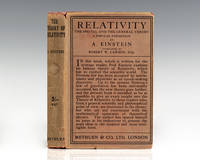
192478904London: Methuen & Company 1924. First edition of this classic account of Born's analysis and interpretation of Einstein's theory of relativity. Octavo original cloth frontispiece of Einstein. Signed by Max Born on the verso of the frontispiece. Translated by Henry L. Brose. Very good in a very good dust jacket. Housed in a custom half morocco clamshell box. First editions are uncommon signed examples rare. Einstein's Theory of Relativity is a book in which one great mind explains the work of another great mind in terms comprehensible to the layman is a significant achievement. This is such a book. Max Born was awarded the Nobel Prize in 1954 and was one of the world's great physicists: in this work he analyzes and interprets the theory of Einsteinian relativity. The result is undoubtedly the most lucid and insightful of all the books that have been written to explain the revolutionary theory that marked the end of the classical and the beginning of the modern era of physics. Born follows a quasi-historical method of presentation. The book begins with a review of the classical physics covering such topics as origins of space and time measurements geometric axioms Ptolemaic and Copernican astronomy concepts of equilibrium and force laws of motion inertia mass momentum and energy Newtonian world system absolute space and absolute time gravitation celestial mechanics centrifugal forces and absolute space laws of optics the corpuscular and undulatory theories speed of light wave theory Doppler effect convection of light by matter electrodynamics including magnetic induction electromagnetic theory of light electromagnetic ether electromagnetic laws of moving bodies electromagnetic mass and the contraction hypothesis. Born then takes up his exposition of Einstein's special and general theories of relativity discussing the concept of simultaneity kinematics Einstein's mechanics and dynamics relativity of arbitrary motions the principle of equivalence the geometry of curved surfaces and the space-time continuum among other topics. Born then points out some predictions of the theory of relativity and its implications for cosmology and indicates what is being sought in the unified field theory. This work steers a middle course between vague popularizations and complex scientific presentations. This is a careful discussion of principles stated in thoroughly acceptable scientific form yet in a manner that makes it possible for the reader who has no scientific training to understand it. Only high school algebra has been used in explaining the nature of classical physics and relativity and simple experiments and diagrams are used to illustrate each step. The layman and the beginning student in physics will find this an immensely valuable and usable introduction to relativity. Methuen & Company hardcover
19492403Evanston IL: The Library of Living Philosophers Inc 1949. Signed Limited First Edition. Original leatherette. Fine. THE MAGNIFICENT SIGNED LIMITED FIRST EDITION ONE OF ONLY 760 COPIES SIGNED BY EINSTEIN. AN OUTSTANDING COPY IN ORIGINAL SLIPCASE. The seventh volume in "The Library of Living Philosophers" series Albert Einstein: Philosopher-Scientist is a tribute volume with essays by some of the most important scientists of the era reflecting on the importance of Einstein's work. Contributors include: Wolfgang Pauli Louis de Broglie Max Born Arnold Sommerfeld Georges Lemaitre Kurt Gödel and many more. Of special note is the essay by Niels Bohr "Discussion with Einstein on Epistemological Problems in Atomic Physics" which gives Bohr's perspective of the famous Einstein-Bohr debates. As Paul Schilpp notes in his Preface "These recollections of conversations with Einstein on the epistemological aspects of physical science would never have come into being were it not for the peculiar nature of this series."<br /> <br /> Also included as a first chapter is Einstein's important "Autobiographical Notes" in German and English and a final chapter by Einstein entitled "Remarks to the Essays Appearing in this Collective Volume". The "Autobiographical Notes" is the "closest Einstein ever came to writing an autobiography" Pais. <br /> <br /> With frontispiece portrait of Einstein by Yousef Karsh. Number 349 of the 760. Evanston IL: The Library of Living Philosophers Inc. 1949. Thick octavo approx. 6.75x9.75x1.75 original publisher's leatherette with gilt image of Einstein's signature on front board bevelled edges top edge gilt pages uncut; original slipcase. Housed in beautiful custom box by noted book artist Sjoerd Hofstra. Tiny bumps to spine ends some light wear to slipcase edges as usual. <br /> <br /> AN OUTSTANDING COPY OF AN ESSENTIAL EINSTEIN ITEM. The Library of Living Philosophers, Inc unknown books
1950140948403New York: Philosophical Library 1950. First Edition. Near Fine/Near Fine. First edition first printing. Signed by Albert Einstein on the front free endpaper and dated the year of publication. Above and beneath Einstein's signature Rabbi Irving Levey has inscribed this book to former owner Harold Rosenstein and written two lines of Hebrew that translate to "A day that is exceptionally good 19 Kislev 5711." According to Rosenstein's grandson Einstein's signature was procured by Rabbi Levey who lead temple at the Jewish Center at Princeton from 1949-51. Levey and Einstein and worked together on issues relating to the then-newly formed State of Israel. <p>vi 282 pp. Bound in publisher's blue cloth stamped in gilt. Near Fine with light rubbing to corners and spine ends offsetting at endsheets. In a Near Fine unclipped dust jacket with toning light edge wear small stain to rear flap. <p>The iconic theoretical physicist's second collection of essays covering the years 1934-1950 surrounding his personal convictions around religious and humanitarian issues in the wake and aftermath of WWII. Boni 515. Philosophical Library unknown
1920131697London: Methuen and Co 1920. First edition of the scientist's ground breaking work. Octavo original red cloth frontispiece of the author and with five diagrams. Near fine in the rare original dust jacket with loss of section of rear panel and flap. Tape repairs to verso. Translated by Robert W. Lawson. Scarce in the original dust jacket. Housed in a custom half morocco clamshell box by the Harcourt Bindery. It can hardly be disputed that the theories put forth in this book are among the most important in the history of modern science. "The imprint of Einstein's work on the different areas of physical science is so large and varied" writes Gerald Holton in a recent assessment "that a scientist who tries to trace it would be hard put to know where to start" Simmons The Scientific 100. Methuen and Co hardcover
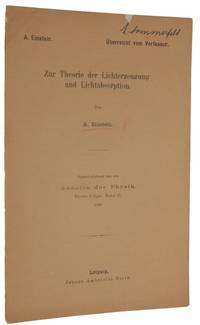
19066413Leipzig: Johann Ambrosius Barth 1906. First edition. <p>First edition a very rare author's presentation offprint with 'Überreicht vom Verfasser' from the library of the eminent German physicist Arnold Sommerfeld of this important sequel to Einstein's revolutionary 1905 paper introducing the light-quantum hypothesis</p> <p>- the foundation of quantum theory. In this follow- up work Einstein further develops the implications of his light-quantum hypothesis arguing that Max Planck's black-body radiation law implicitly relies on the same assumption: that light itself consists of discrete quanta of energy.</p>. <p>EINSTEIN ON HIS LIGHT-QUANTUM HYPOTHESIS</p> . <p>First edition very rare author's presentation offprint "Überreicht vom Verfasser" from the library of the great German physicist Arnold Sommerfeld of this brilliant follow-up to Einstein's landmark 1905 paper on the photoelectric effect for which he was awarded the 1921 Nobel Prize in physics. "Thomas Kuhn has argued that it is not to Planck in 1900 but to Einstein in 1905 that we owe the origins of quantum theory" Cassidy. In the 1905 paper 'On a heuristic point of view concerning the production and transformation of light' Einstein had explained the photoelectric effect-the emission of electrons from a metal when irradiated by light-by making the revolutionary proposal that light rather than consisting of continuous waves was instead made up of discrete particles of energy "light quanta" which transferred their entire payload of energy to an electron on impact. In the 1905 paper Einstein made use of Planck's formula for blackbody radiation which had introduced the concept of energy quantization. "In a companion paper published in 1906 offered here Einstein exposed appeal to the quantum as fundamentally counter to the ethos of classical physics: 'the theoretical bases on which Planck's radiation theory rests are different from those of Maxwell's theory'. Planck had not initially intended to quantify light-radiation itself but Einstein demonstrated that his own 'light-quantum hypothesis' was implicit in Planck's earlier work" Honner p. 31. "At first Einstein believed that the light-quantum hypothesis was merely 'heuristic': light behaved only as if it consisted of discontinuous quanta . In his 1906 paper Einstein used his statistical mechanics to demonstrate that when light interacts with matter Planck's entire formula can arise only from the existence of light quanta-not from waves" Cassidy. As Einstein stated when he published the 1905 paper "Planck's theory of radiation seemed to me in a certain respect the antithesis of my own. New considerations which are presented in section 1 of this paper demonstrated to me however that the theoretical bases on which Planck's radiation theory rests are different from those of Maxwell's theory and of electron theory. The difference furthermore is precisely that Planck's theory implicitly makes use of the light-quantum hypothesis" p. 199 of the present paper translation from Kuhn p. 182. Later in the paper p. 203 Einstein is forced to make the following assumption: "Although Maxwell's theory is not applicable to elementary resonators the average energy of such a resonator in a radiation field is the same as that which one would compute from Maxwell's theory". "That statement marks the emergence of the basic paradox of the old quantum theory. The theory has recourse to both Maxwell's equations and those of classical mechanics but its further formulation is incompatible with one or both of those classical theories. Other physicists were to exploit the resulting inconsistency as an argument against any form of quantum discontinuity and Einstein himself was deeply disturbed by it . But neither he nor anyone else was successful in finding a classical resolution of the quantum paradox. When two decades later Bohr and others found a way to resolve it Einstein was unable to accept their fundamentally non-classical interpretation" Kuhn pp. 184-185. RBH lists 4 other copies: in the offprint collections of Einstein himself Christie's June 17 2008 lot 100 Richard Green Christie's June 17 2008 lot 101 Hans Albert Einstein Christie's June 14 2006 lot 264 and Harvey Plotnick Christie's October 4 2002 lot 105. This copy was presented by Einstein to one of the leading physicists of the time surely hoping to make himself known in the scientific world when he was still a technical expert in the Swiss Patent Office.</p> <br /> <p>Provenance: Arnold Sommerfeld 1868-1951 his signature and characteristic numbering in red pencil '8' on front cover. "The son of a physician Sommerfeld was educated at the University of Königsberg. After teaching briefly at the universities of Göttingen Clausthal and Aachen he was appointed professor of physics at the University of Münich in 1906. Sommerfeld should have retired in 1936 in favour of his pupil Werner Heisenberg. Opposition from the Nazi party to Heisenberg's appointment prolonged Sommerfeld's tenure and it was not in fact until late 1939 that he finally retired to be succeeded not by Heisenberg but by Wilhelm Müller a Nazi aerodynamicist without a single publication in physics to his credit. Although Sommerfeld and Heisenberg were not Jewish they were regarded by the Nazis as Jewish sympathizers. Sommerfeld however survived the war and returned to his Münich chair in 1945 continuing to work at physics until he died in a car accident in 1951" Oxford Reference. "Arnold Sommerfeld was one of the most distinguished representatives of the transition period between classical and modern theoretical physics. The work of his youth was still firmly anchored in the conceptions of the nineteenth century; but when in the first decennium of the century the flood of new discoveries experimental and theoretical broke the dams of tradition he became a leader of the new movement and in combining the two ways of thinking he exerted a powerful influence on the younger generation. This combination of a classical mind to whom clarity of conception and mathematical rigour are essential with the adventurous spirit of a pioneer are the roots of his scientific success while his exceptional gift of communicating his ideas by spoken and written word made him a great teacher" Max Born p. 275. </p> <br /> <p>"Einstein started to study black-body radiation well before 1905. Mach's Wärmelehre which Einstein read in 1897 or shortly thereafter contains two chapters on thermal radiation culminating in a discussion of Kirchhoff's work. Kirchhoff showed that the energy emission spectrum of a perfectly black body defined as one absorbing all incident radiation at a given temperature is a universal function of the temperature and wavelength. He inferred that equilibrium thermal radiation in a cavity with walls maintained at a certain temperature behaves like radiation emitted by a black body at the same temperature. </p> <br /> <p>"H. F. Weber Einstein's physics professor at the ETH attempted to determine the universal black-body radiation function. He made measurements of the energy spectrum and proposed an empirical formula for the distribution function . anticipating Wien's formulation of the displacement law for black-body radiation. Weber described his work in a course at the ETH given during the winter semester of 1898-1899 for which Einstein registered. </p> <br /> <p>"By March 1899 Einstein had started to think seriously about the problem of radiation. In the spring of 1901 he was closely following Planck's work on black-body radiation. Originally Planck had hoped to explain irreversibility by studying electromagnetic radiation but came to recognize that this could not be done without introducing statistical elements into the argument. In a series of papers published between 1897 and 1900 Planck utilized Maxwell's electrodynamics to develop a theory of thermal radiation in interaction with one or more identical charged harmonic oscillators within a cavity. He was only able to account for the irreversible approach to thermal equilibrium by employing methods analogous to those Boltzmann used in kinetic theory. Planck introduced the notion of 'natural' that is maximally disordered radiation which he defined in analogy with Boltzmann's definition of molecular chaos . </p> <br /> <p>"Planck calculated the average energy of an oscillator by making assumptions about the entropy of the oscillators that enabled him to derive Wien's law for the blackbody spectrum which originally seemed well supported by the experimental evidence. But by the turn of the century new observations showed systematic deviations from Wien's law for large values of temperature. </p> <br /> <p>"Planck in 1900 presented a new energy density distribution formula that agreed closely with observations over the entire spectrum . this expression now known as Planck's law or Planck's formula involves a new constant h later called Planck's constant. To derive this formula Planck calculated the entropy of the oscillators using what Einstein later called 'the Boltzmann principle': S = k log W where S is the entropy of a macroscopic state of the system the probability of which is W and k is 'Boltzmann's constant'. Following Boltzmann Planck took W proportional to the number of 'complexions' or possible microconfigurations of the system corresponding to its state. He calculated this number by dividing the total energy of the state into a finite number of elements of equal magnitude and counting the number of possible ways of distributing these energy elements among the individual oscillators. If the size of the energy elements is set equal to hv where v is the frequency of the oscillators an expression for the entropy of an oscillator results that leads to Planck's formula .</p> <br /> <p>"In the 1905 paper Einstein showed that the expression for the volume dependence of the entropy of radiation at a given frequency is similar in form to that of the entropy of an ideal gas. He concluded that 'monochromatic radiation of low density behaves thermodynamically as though it consisted of quanta of energy which are independent of one another' . Einstein opened the paper by pointing out the 'fundamental formal distinction' between current theories of matter in which the energy of a body is represented as a sum over a finite number of degrees of freedom and Maxwell's theory in which the energy is a continuous spatial function having an infinite number of degrees of freedom. He suggested that the inability of Maxwell's theory to give an adequate account of radiation might be remedied by a theory in which radiant energy is distributed discontinuously in space. Einstein formulated 'the light quantum hypothesis' that the energy of a light ray emitted from a point is not continuously distributed over an ever increasing space but consists of a finite number of energy quanta which are localized at points in space which move without dividing and which can only be produced and absorbed as complete units . Einstein asserted that Planck's derivation implicitly assumes quantization of the energies of charged oscillators" Papers pp. 134-142.</p> <br /> <p>"In 1905 Einstein could not make sense of Planck's derivation of Planck's law. In fact he seems to have deliberately avoided any reference to Planck's law in his reasoning . The following year Einstein ceased to avoid Planck's law as he discovered a new way to justify Planck's formal steps toward this law. If a resonator of frequency ν can only emit or absorb full light quanta Einstein reasoned then its energy can only be an integral multiple of hν and Planck's characterization of the complexions for a set of resonators receives a dynamical justification. The only remaining difficulty is that Planck's derivation of the relation between the average energy of a resonator and the spectral density of radiation becomes void. Einstein expressed the need of a new derivation based on some quantized dynamics for the interaction between matter and radiation. Ten years elapsed however before he filled the gap" Janssen & Lehner p. 126. </p> <br /> <p>In the final section of this paper Einstein gives a new application of his 'heuristic principle' to the explanation of the 'Volta effect' - that when two different metals are placed in contact a potential difference between them is observed.</p> <br /> <p>BRL 12; Weil 12. Shields "Writings of Albert Einstein" in Albert Einstein: Philosopher-Scientist 1948 pp. 689-758 no. 13; also included in Shields' "Chronological list of principal works" on p. 757. The Cambridge Companion to Einstein Janssen & Lehner eds. 2014. The Collected Papers of Albert Einstein Vol. 2: The Swiss Years: Writings 1900-1909. Born 'Arnold Johannes Wilhelm Sommerfeld 1868-1951' Obituary Notices of Fellows of the Royal Society 8 1952 pp. 275-296.</p> <br /> <p>Cassidy "Einstein on the Photoelectric Effect." Einstein: Image and Impact. American Institute of Physics n.d. Honner The Description of Nature 1988. Kuhn Black-Body Theory and the Quantum Discontinuity 1894-1912 1978. Pais Subtle is the Lord 1982.</p> <br/> <br/> 8vo 222 x 144 mm pp. 199-206. Original printed wrappers small chip from upper edge of front wrapper. Johann Ambrosius Barth unknown
1930110352New York: Albert & Charles Boni 1930. First edition of this Einstein biography written by Rudolf Kayser a German literary historian and husband to Albert Einstein's stepdaughter Ilse under the pseudonym Anton Reiser. Octavo original cloth frontispiece of Einstein. Signed and dated by Einstein on the front free endpaper in the year of publication "Albert Einstein New York 1930." In near fine condition. Housed in a custom half morocco clamshell box. Albert Einstein developed the general theory of relativity one of the two pillars of modern physics alongside quantum mechanics. Einstein's work is also known for its influence on the philosophy of science. Einstein is best known in popular culture for his mass-energy equivalence formula E = mc2 which has been dubbed "the world's most famous equation". He received the 1921 Nobel Prize in Physics for his "services to theoretical physics" in particular his discovery of the law of the photoelectric effect a pivotal step in the evolution of quantum theory David Bodanis. Albert & Charles Boni hardcover books
1930110352New York: Albert & Charles Boni 1930. First edition of this Einstein biography written by Rudolf Kayser a German literary historian and husband to Albert Einstein's stepdaughter Ilse under the pseudonym Anton Reiser. Octavo original cloth frontispiece of Einstein. Signed and dated by Einstein on the front free endpaper in the year of publication "Albert Einstein New York 1930." In near fine condition. Housed in a custom half morocco clamshell box. Albert Einstein developed the general theory of relativity one of the two pillars of modern physics alongside quantum mechanics. Einstein's work is also known for its influence on the philosophy of science. Einstein is best known in popular culture for his mass–energy equivalence formula E = mc2 which has been dubbed "the world's most famous equation". He received the 1921 Nobel Prize in Physics for his "services to theoretical physics" in particular his discovery of the law of the photoelectric effect a pivotal step in the evolution of quantum theory David Bodanis. Albert & Charles Boni hardcover
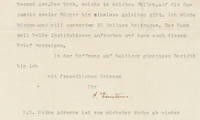
19413262211/9/41. <blockquote><p>A generous demonstration by Einstein of his loyalty to friends and belief in the importance of music</p></blockquote><p>Dr. Theodor Rosenheim was a physician at the famed Medical University Clinic of the Charité in Germany in the 1880s. He was primarily concerned with the physiology and pathology of the digestive tract. He published an early textbook on the “Pathologie und Therapie der Krankheiten des Verdauungsapparatesâ€. Rosenheim was one of the first in Germany to describe and publish on ulcerative colitis. He was intensively involved in the technical development of esophagoscopy and gastroscopy which at that time were only possible with rigid instruments. The Rosenheim line which was named after him described the largest diagonal diameter of the gastric percussion figure.</p><p>Rosenheim was appointed professor extraordinarius at Berlin University in 1921. He also founded a polyclinic and a private sanatorium for stomach and intestinal patients. He was well respected in Berlin and his private practice developed successfully with a large circle of patients including Albert Einstein.</p><p>Theodor’s wife was Hedwig Rosenheim and their daughter Kate was a hero of the Holocaust. She helped several thousand children from Jewish families to escape from Germany. She personally accompanied the legendary Kindertransporte to England among other places. She travelled to the USA in 1936 to negotiate directly with the aid organizations there. She then returned to Germany to actively continue the aid campaigns. Theodor died in 1939. Käte Rosenheim was able to flee Berlin together with her 72-year-old mother Hedwig Rosenheim on January 23 1941. They reached Havana Cuba via France Spain and Portugal. From there they were able to continue to New York where they arrived on April 1 1941.</p><p>Albert Einstein was an accomplished violinist and music lover who was inspired by music in his scientific work. He often said that he would have been a musician if he hadn't pursued science. Another music lover was Hedwig Rosenheim. She had escaped Germany without her possessions especially her precious musical instruments. Upon arrival in the United States she contacted the old family friend Albert Einstein hoping he could help her get a flute either for herself or another escapee one who may have agreed to look for her. Einstein was sympathetic and rose to the occasion. He even contributed some of his personal funds to secure the flute.</p><p><strong>Typed letter signed</strong> his vacation house in Knollwood at Saranac Lake N.Y. September 11 1941 to his old friend Mrs. Hedwig Rosenheim in New York City.<em> “ The matter of i.e. the quest for the flute shall not fail. First one should know what the committee is giving out – or loaning. Second there is the Hebrew Free Loan Society 108 Second Ave. New York which in such cases provides interest-free loans in exchange for the backing of two guarantors. I will serve as a guarantor and contribute 20 dollars on top of that. The man should visit both institutions and can show this letter. In the hope of receiving a positive report soon I remain with warm greetings your A. Einstein.â€</em> <em>“PS. Starting next week my address will again be in Princeton.â€</em> The committee he referred may have been the American Jewish Joint Distribution Committee though there were others as well.</p><p>It shows a lot about Einstein - his generosity his continued concern for old friends who had escaped from Germany and love for music - that he volunteered to make a personal financial contribution to obtaining the flute.</p><p><img class=""alignnone wp-image-25018 size-post-window"" src=""https://cdn.raabcollection.com/wp-content/uploads/20231204144051/Folder-site-11-1600x1327.jpg"" alt="""" width=""1600"" height=""1327"" /></p> unknown
19511234181951. Rare silver gelatin print inscribed by the father of modern physics Albert Einstein. Inscribed by Einstein on the lower margin of the photograph "To Mr. Satoru Yamano A. <span class="match">Einstein</span>. 51." In near fine condition. Double matted and framed. The entire piece measures 11.5 inches by 10.5 inches. Perhaps best known for the development of his mass-energy equivalence formula E = mc2 German born theoretical physicist Albert Einstein's surname has practically become synonymous with the term 'genius' in modern popular culture. Einstein received the Nobel Peace Prize in 1921 for his "services to theoretical physics" which included his development of the general theory of relativity and contributions to the development of quantum theory the two pillars of modern physics. unknown books
1952720911952. Rare original black and white silver gelatin photograph of Albert Einstein. Signed "A Einstein 52." Full-length group portrait showing Albert Einstein standing with Hadassah National President Rebecca Beldner Shulman and others at his Princeton home in June of 1952 during a celebration marking the commencement of building of the Hadassah-Hebrew University Medical Center in Jerusalem. The photograph measures 8 inches by 9.5 inches. Double matted and framed. The entire piece measures 19 inches by 20.5 inches. An exceptional piece. Albert Einstein developed the general theory of relativity one of the two pillars of modern physics alongside quantum mechanics. Einstein's work is also known for its influence on the philosophy of science. Einstein is best known in popular culture for his mass–energy equivalence formula E = mc2 which has been dubbed "the world's most famous equation". He received the 1921 Nobel Prize in Physics for his "services to theoretical physics" in particular his discovery of the law of the photoelectric effect a pivotal step in the evolution of quantum theory David Bodanis. unknown
192478904London: Methuen & Company 1924. First edition of this classic account of Born's analysis and interpretation of Einstein's theory of relativity. Octavo original cloth frontispiece of Einstein. Signed by Max Born on the verso of the frontispiece. Translated by Henry L. Brose. Very good in a very good dust jacket. Housed in a custom half morocco clamshell box. First editions are uncommon signed examples rare. Einstein's Theory of Relativity is a book in which one great mind explains the work of another great mind in terms comprehensible to the layman is a significant achievement. This is such a book. Max Born was awarded the Nobel Prize in 1954 and was one of the world's great physicists: in this work he analyzes and interprets the theory of Einsteinian relativity. The result is undoubtedly the most lucid and insightful of all the books that have been written to explain the revolutionary theory that marked the end of the classical and the beginning of the modern era of physics. Born follows a quasi-historical method of presentation. The book begins with a review of the classical physics covering such topics as origins of space and time measurements geometric axioms Ptolemaic and Copernican astronomy concepts of equilibrium and force laws of motion inertia mass momentum and energy Newtonian world system absolute space and absolute time gravitation celestial mechanics centrifugal forces and absolute space laws of optics the corpuscular and undulatory theories speed of light wave theory Doppler effect convection of light by matter electrodynamics including magnetic induction electromagnetic theory of light electromagnetic ether electromagnetic laws of moving bodies electromagnetic mass and the contraction hypothesis. Born then takes up his exposition of Einstein's special and general theories of relativity discussing the concept of simultaneity kinematics Einstein's mechanics and dynamics relativity of arbitrary motions the principle of equivalence the geometry of curved surfaces and the space-time continuum among other topics. Born then points out some predictions of the theory of relativity and its implications for cosmology and indicates what is being sought in the unified field theory. This work steers a middle course between vague popularizations and complex scientific presentations. This is a careful discussion of principles stated in thoroughly acceptable scientific form yet in a manner that makes it possible for the reader who has no scientific training to understand it. Only high school algebra has been used in explaining the nature of classical physics and relativity and simple experiments and diagrams are used to illustrate each step. The layman and the beginning student in physics will find this an immensely valuable and usable introduction to relativity. Methuen & Company hardcover books
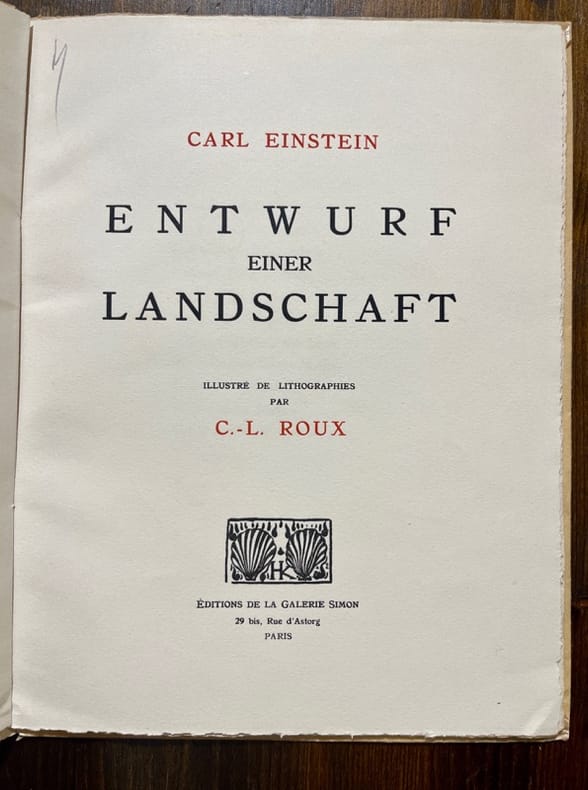
193018547Paris, Éditions de la Galerie Simon, 1930. Grand in-4 broché, couverture imprimée. Chemise en demi-box noir, étui (Honegger).
1952720911952. Black and white silver gelatin photograph of Albert Einstein. Signed "A Einstein 52." Full-length group portrait showing Albert Einstein standing with Hadassah National President Rebecca Beldner Shulman and others at his Princeton home in June of 1952 during a celebration marking the commencement of building of the Hadassah-Hebrew University Medical Center in Jerusalem. The photograph measures 8 inches by 9.5 inches. The entire piece measures 19 inches by 20.5 inches. An exceptional piece. Albert Einstein developed the general theory of relativity one of the two pillars of modern physics alongside quantum mechanics. Einstein's work is also known for its influence on the philosophy of science. Einstein is best known in popular culture for his mass-energy equivalence formula E = mc2 which has been dubbed "the world's most famous equation". He received the 1921 Nobel Prize in Physics for his "services to theoretical physics" in particular his discovery of the law of the photoelectric effect a pivotal step in the evolution of quantum theory David Bodanis. unknown books