EINSTEIN AlbertBiblio.com
2 944 résultats
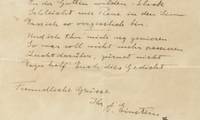
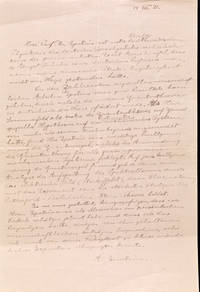
19211206201921. Signed. EINSTEIN Albert. Autograph letter signed. No place August 14 1921. Single sheet of cream lined paper measuring 7-1/2 by 11 inches; p. 1. $35000.Rare heartfelt autograph letter of recommendation written and signed by Einstein in German enthusiastically recommending his friend and colleague physicist Prof. Dr. Paul Epstein for an academic position.The autograph letter dated ""14 VIII 21"" written entirely in Einstein's hand reads translated from the original German: ""Prof. Dr. Epstein is certainly one of the most prominent living theoretical physicists of the German-speaking world. Without a doubt he would have been appointed to a German professorship a long time ago had his Russian nationality not stood in the way. Among Epstein's numerous original scientific papers two findings which advanced the modern quantum theory in crucial ways should be noted. After Mr. Sommerfeld as the first physicist who on the basis of special hypotheses had applied the quantum theory to a certain mechanical system of more than one degree of freedom Mr. Epstein discovered an important generalization of the quantum principle which established the application of the quantum theory for all quasi-periodic mechanical systems. Based on that general application of the quantum principle he then provided an analysis of the splitting of spectral lines in the electrical field Stark effect the accordance of which with the experiment provides one of the strongest supports for the Rutherford-Bohr atomic theory. I would like to add that I have also come to appreciate Mr. Epstein in personal interactions as a human being and that I had the pleasure of attending several scientific lectures given by him which enabled me to convince myself of his competence in delivering clearly understandable oral exposition. / A. Einstein.""Einstein and Epstein were friends and longtime correspondents who shared an interest in physics Judaism and the founding of Israel. Paul Epstein was a Russian-American mathematical physicist. He remains best known for his contributions to the development of quantum mechanics. Indeed he was one of a select group that included Lorentz Einstein Minkowski Thomson Rutherford Sommerfeld Röntgen von Laue Bohr de Broglie Ehrenfest and Schwarzschild. Born in Warsaw then part of Imperial Russia Epstein was brought up solidly middle class. He later stated that his mother recognized his potential at the age of four and predicted his future as a mathematician. Epstein studied mathematics and physics for his entire university career eventually earning a degree from the Imperial University of Moscow. He then went on to earn a Ph.D. at the Technical University of Munich in 1914 concentrating on a problem in the theory of diffraction of electromagnetic waves. However the outbreak of World War I rendered Epstein an enemy alien in Germany. Sommerfeld intervened on his behalf and he was allowed to stay as a private citizen and continue his research. In 1916 Epstein published an important paper explaining the Stark Effect using the Bohr-Sommerfeld quantum theory. After the war Epstein went to Leiden and worked as an assistant for Lorentz and Ehrenfest. In 1921the year this letter was writtenEpstein was recruited by Robert Millikan to join the physicists at the California Institute of Technology. Epstein accepted the position and stayed there for the rest of his career publishing extensively on quantum theory. Epstein was something of polymath and worked in numerous areas outside of quantum theory including work on air resistance the settling of gasses the theory of vibration and the absorption of sound. He was an avid supported of Freudian psychoanalysis including as one of the founding members of the Psychoanalytic Study Group that later merged with the Los Angeles Institute for Psychoanalysis. Epstein was also notably anti-communist and worried about the threat of nationalism.The areas of study mentioned in Einstein's letter of recommendation all came together to help form the science behind atomic and hydrogen bombs though neither Einstein nor Epstein anticipated quite where the science was headed in 1921. The letter mentions the Stark effect which is the shifting and splitting of spectral lines of atoms and molecules due to the presence of an external electric field. It is analogous to the Zeeman effect in which a magnetic field is the influence. The Rutherford-Bohr model presented in 1913 is a system consisting of a small dense nucleus surrounded by orbiting electronssomewhat like the Solar System but with electrostatic forces instead of gravity. The Bohr model came to be recognized as a relatively primitive model of the hydrogen atom compared to the valence shell atom model. However because of its simplicity and the correct results it generates for certain systems it is still commonly used to introduce students to quantum mechanics.Overall this letter provides valuable insight into the scientific world during the height of Einstein's international career right when he first began traveling abroad and meeting fellow scientists internationally. The letter reflects Einstein's importance in the community and is a testament to Epstein's ability as a physicist. Original mailing creases. Fine condition. unknown
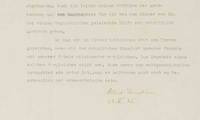
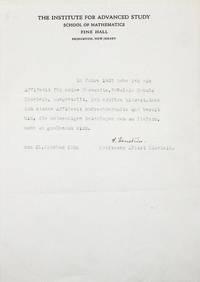
19532270<p>Princeton NJ: np 1953. First edition. custom folder. Very Good. TOWARDS THE END OF HIS LIFE EINSTEIN WRITES TO ONE OF HIS FRIENDS FROM THE PATENT OFFICE CONCERNING ONE OF THE CENTRAL STRUGGLES OF HIS SCIENTIFIC LIFE.<br /><br />COMMENTING ON THE WORK OF DIRAC EINSTEIN ADMITS THAT ALTHOUGH HE "CAN'T TAKE A STATISTICAL FOUNDATION OF PHYSICS SERIOUSLY" HE FINDS IT "DIFFICULT TO MOVE BEYOND IT". Background:<br /><br />Einstein's struggle with accepting a strictly statistical quantum theory has been one of the most discussed and debated topics of twentieth-century physics. When introduced to the statistically-based quantum mechanics of Heisenberg Born and Jordan in 1926 Einstein famously wrote to Max Born that "Quantum mechanics is certainly imposing. But an inner voice tells me that it is not yet the real thing. The theory says a lot but does not really bring us any closer to the secret of the 'old one.' I at any rare am convinced that He is not playing at dice." Einstein letter to Born from 4 December 1926.<br /><br />From the onset "Einstein regarded the quantum theory as descriptively incomplete. What he meant was that in typical cases the probabilistic assertions provided by the theory for an individual quantum system do not exhaust all the relevant and true physical assertions about the system. Put briefly according to Einstein the typical statistical story told by quantum theory is not the whole story." Arthur Fine "What is Einstein's Statistical Interpretation or Is It Einstein for Whom Bell's Theorem Tolls". <br /><br />Einstein's discomfort with the new theory haunted him for the next three decades and his challenges to the theory were the cause of some of the most fertile and defining moments of modern science notably the celebrated "Bohr-Einstein debates" begun at the Fifth Solvay Conference 1927 and his monumentally influential "EPR" paper of 1935 "Can Quantum-Mechanical Description of Physical Reality Be Considered Complete" written with Boris Podolsky and Nathan Rosen.<br /><br />As late as 1949 in his "Reply to Criticisms" published in Albert Einstein: Philosopher-Scientist Einstein notes that Born and Wolfgang Pauli in their contributions to the volume "deprecate the fact that I reject the basic idea of contemporary statistical quantum theory insofar as I do not believe that this fundamental concept will provide a useful basis for the whole of physics" and spends the majority of the essay explaining his position and distinguishing between his acceptance of the model for "ensembles of systems" while still rejecting it for an "individual physical system".<br /><br />The letter:<br /><br />Dated September 12 1953 and written to his old colleague at the patent office in Bern Joseph Sauter the letter translated from the original German reads in full:<br /><br />Dear Mr. Sauter<br /><br />If I am able to I will gladly assist Mr. Keberle.<br /><br />I have heard of you often from my old friend Besso and I have also received a manuscript which deals critically with handwritten Dirac's presentation of the statistical approach to quantum theory. I have not been able to judge it myself because it is simply impossible for me to take a statistical foundation of physics seriously. But I have to admit that it is difficult to move beyond it.<br /><br />Yours sincerely <br /><br />signed A. Einstein.<br />Albert Einstein.<br /><br />The recipient Joseph Sauter worked with Einstein at the Bern Patent office during the years he was developing the ideas for his revolutionary papers of 1905. "Among his colleagues at the Patent Office Einstein discovered one with similar scientific interests-Dr. Josef Sauter a French-Swiss who had also studied at the Polytechnic and who had been Professor Weber's chief assistant for a while. Sauter like Einstein tried to fill the gaps in the Polytechnic's syllabus by private study so that Einstein was able to discuss with him Maxwell's thermodynamics and Helmholtz's and Hertz's theoretical concepts. The two also discussed Einstein's publications on thermodynamics with the result that Sauter discovered a mistake in them which Einstein accepted 'without being the least upset.' Fifty years later Einstein recalled 'that I had a lot of discussions with Sauter about. my thermal-statistical papers'. At least as important as his help with the 'rewriting and amending' were Sauter's connections with scientific circles in Bern to which he soon introduced his new colleague." Albrecht Fölsing Albert Einstein. <br /><br />Edouard Keberle mentioned in the first line by Einstein was a Bulgarian physicist who at the time of the letter had just left the Institute of Theoretical Physics in Bern over a publication dispute. Not long after this letter - in early 1954 - Keberle accepted a post at the Midwest Research Institute in Kansas City. It is unclear if Einstein helped him in any way to get this position.<br /><br />Michele Besso - also mentioned in this letter - was Einstein's close lifelong friend.<br /><br />What prompts Einstein to declare that "it is simply impossible for me to take a statistical foundation of physics seriously" is the mention of a manuscript on the work of Paul Dirac. Philosophically Dirac was almost the opposite of Einstein - he had no interest in probing the interpretations of quantum theory wryly noting in his paper "The Inadequacies of Quantum Field Theory" that "The interpretation of quantum mechanics has been dealt with by many authors and I do not want to discuss it here. I want to deal with more fundamental things."<br /><br />It is revealing in this letter that although Einstein re-states his objection to a statistical basis of quantum theory he has doubts about his position admitting - less than two years before his death - that he still has difficulty moving beyond it. <br /><br />Typed Letter Signed. Princeton NJ: September 12 1953. One 8.5x11 inch sheet with Einstein's embossed Mercer Street address at top. Custom silk presentation folder. With original mailing envelope with postmarks. A few small smudges usual folds; fine condition.<br /><br />ONE OF EINSTEIN'S FINAL STATEMENTS ON ONE OF THE CENTRAL TENETS OF HIS SCIENTIFIC PHILOSOPHY.</p> np
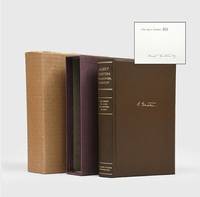
1949179026Evanston Illinois: The Library of Living Philosophers Inc. 1949. A superb survival First edition signed limited issue number 555 of 760 copies signed and dated by Einstein. The book and slipcase are in fine condition and they are housed in the elusive original cardboard packaging which is numbered to match the limitation. This is the first copy that we have handled in its original packaging. Issued on his 70th birthday this handsomely produced volume includes the first appearance in print of Einstein's autobiography specially written for the book and itself an important scientific contribution. In addition to the autobiographical notes in which Einstein famously describes the awakening of his scientific curiosity when shown a compass as a child the book presents a series of essays on Einstein's work and achievements by 25 of his contemporaries including Niels Bohr Max Born Kurt Gödel and Wolfgang Pauli. Several of these have become seminal papers in their own right: "Bohr's account of his discussion with Einstein has been called 'one of the great masterpieces of modern scientific reporting'" Jammer p. 136 and Gödel's "appears to be the only published piece by him that deals with philosophical issues not directly concerned with mathematics" Feferman p. 199. A bibliography of Einstein's writings is also included. This copy is accompanied by correspondence between a former owner George Pratt of Portland Oregon and the Open Court Publishing Company who issued the Library of Living Philosophers series from 1959 onwards. Pratt's name is written in ink on the cardboard packaging. Primarily dated between 1974 and 1975 the typed letters mostly supplied in photocopy detail Pratt's successful verification of Einstein's signature. They include testimony from R. F. Gehner a representative of the George Banta Publishing Company printer of the series in which Gehner recounts personally delivering 760 copies of Philosopher-Scientist to Einstein and observing him sign them. A portion of the original glassine jacket is also present in the envelope. Octavo. Portrait frontispiece after Yousuf Karsh and plate facsimile of Einstein's handwriting and portrait in his studio with the editor. Original brown morocco-grain cloth over bevelled boards spine lettered and ruled in gilt gilt facsimile of Einstein's signature to front board top edge gilt others untrimmed. With original brown card slipcase and the original cardboard packaging the latter annotated "no. 555". Housed in a brown quarter morocco solander box by the Chelsea Bindery. All in fine condition. Weil Appendix p. 41. Solomon Feferman introductory note to Gödel's Collected Works vol. 2 1990; Max Jammer The Philosophy of Quantum Mechanics 1974. hardcover
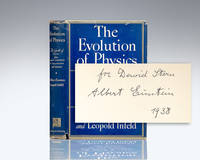
1938146188Cambridge: Cambridge University Press 1938. First edition of this classic work which traces the development of ideas in physics. Octavo original blue cloth. Presentation copy inscribed by the author in the year of publication on the second free endpaper "For David Stern Albert Einstein 1938." Fine in a near dust jacket with a few small closed tears. Trade editions signed by Einstein are scarce. Upon publication The Saturday Review of Literature praised Evolution of Physics as "masterly Einstein and Infelds book should do much to spread an understanding and appreciation one of the great dramas in the evolution of human thought." Cambridge University Press hardcover
19532270Princeton NJ: np 1953. First edition. custom folder. Very Good. TOWARDS THE END OF HIS LIFE EINSTEIN WRITES TO ONE OF HIS FRIENDS FROM THE PATENT OFFICE CONCERNING ONE OF THE CENTRAL STRUGGLES OF HIS SCIENTIFIC LIFE. COMMENTING ON THE WORK OF DIRAC EINSTEIN ADMITS THAT ALTHOUGH HE "CAN'T TAKE A STATISTICAL FOUNDATION OF PHYSICS SERIOUSLY" HE FINDS IT "DIFFICULT TO MOVE BEYOND IT". Background: Einstein's struggle with accepting a strictly statistical quantum theory has been one of the most discussed and debated topics of twentieth-century physics. When introduced to the statistically-based quantum mechanics of Heisenberg Born and Jordan in 1926 Einstein famously wrote to Max Born that "Quantum mechanics is certainly imposing. But an inner voice tells me that it is not yet the real thing. The theory says a lot but does not really bring us any closer to the secret of the 'old one.' I at any rare am convinced that He is not playing at dice." Einstein letter to Born from 4 December 1926. From the onset "Einstein regarded the quantum theory as descriptively incomplete. What he meant was that in typical cases the probabilistic assertions provided by the theory for an individual quantum system do not exhaust all the relevant and true physical assertions about the system. Put briefly according to Einstein the typical statistical story told by quantum theory is not the whole story." Arthur Fine "What is Einstein's Statistical Interpretation or Is It Einstein for Whom Bell's Theorem Tolls". Einstein's discomfort with the new theory haunted him for the next three decades and his challenges to the theory were the cause of some of the most fertile and defining moments of modern science notably the celebrated "Bohr-Einstein debates" begun at the Fifth Solvay Conference 1927 and his monumentally influential "EPR" paper of 1935 "Can Quantum-Mechanical Description of Physical Reality Be Considered Complete" written with Boris Podolsky and Nathan Rosen. As late as 1949 in his "Reply to Criticisms" published in Albert Einstein: Philosopher-Scientist Einstein notes that Born and Wolfgang Pauli in their contributions to the volume "deprecate the fact that I reject the basic idea of contemporary statistical quantum theory insofar as I do not believe that this fundamental concept will provide a useful basis for the whole of physics" and spends the majority of the essay explaining his position and distinguishing between his acceptance of the model for "ensembles of systems" while still rejecting it for an "individual physical system". The letter: Dated September 12 1953 and written to his old colleague at the patent office in Bern Joseph Sauter the letter translated from the original German reads in full: Dear Mr. Sauter If I am able to I will gladly assist Mr. Keberle. I have heard of you often from my old friend Besso and I have also received a manuscript which deals critically with handwritten Dirac's presentation of the statistical approach to quantum theory. I have not been able to judge it myself because it is simply impossible for me to take a statistical foundation of physics seriously. But I have to admit that it is difficult to move beyond it. Yours sincerely signed A. Einstein. Albert Einstein. The recipient Joseph Sauter worked with Einstein at the Bern Patent office during the years he was developing the ideas for his revolutionary papers of 1905. "Among his colleagues at the Patent Office Einstein discovered one with similar scientific interests-Dr. Josef Sauter a French-Swiss who had also studied at the Polytechnic and who had been Professor Weber's chief assistant for a while. Sauter like Einstein tried to fill the gaps in the Polytechnic's syllabus by private study so that Einstein was able to discuss with him Maxwell's thermodynamics and Helmholtz's and Hertz's theoretical concepts. The two also discussed Einstein's publications on thermodynamics with the result that Sauter discovered a mistake in them which Einstein accepted 'without being the least upset.' Fifty years later Einstein recalled 'that I had a lot of discussions with Sauter about. my thermal-statistical papers'. At least as important as his help with the 'rewriting and amending' were Sauter's connections with scientific circles in Bern to which he soon introduced his new colleague." Albrecht Fölsing Albert Einstein. Edouard Keberle mentioned in the first line by Einstein was a Bulgarian physicist who at the time of the letter had just left the Institute of Theoretical Physics in Bern over a publication dispute. Not long after this letter - in early 1954 - Keberle accepted a post at the Midwest Research Institute in Kansas City. It is unclear if Einstein helped him in any way to get this position. Michele Besso - also mentioned in this letter - was Einstein's close lifelong friend. What prompts Einstein to declare that "it is simply impossible for me to take a statistical foundation of physics seriously" is the mention of a manuscript on the work of Paul Dirac. Philosophically Dirac was almost the opposite of Einstein - he had no interest in probing the interpretations of quantum theory wryly noting in his paper "The Inadequacies of Quantum Field Theory" that "The interpretation of quantum mechanics has been dealt with by many authors and I do not want to discuss it here. I want to deal with more fundamental things." It is revealing in this letter that although Einstein re-states his objection to a statistical basis of quantum theory he has doubts about his position admitting - less than two years before his death - that he still has difficulty moving beyond it. Typed Letter Signed. Princeton NJ: September 12 1953. One 8.5x11 inch sheet with Einstein's embossed Mercer Street address at top. Custom silk presentation folder. With original mailing envelope with postmarks. A few small smudges usual folds; fine condition. ONE OF EINSTEIN'S FINAL STATEMENTS ON ONE OF THE CENTRAL TENETS OF HIS SCIENTIFIC PHILOSOPHY. np unknown books
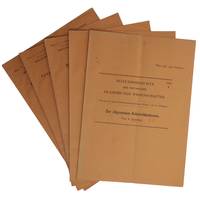
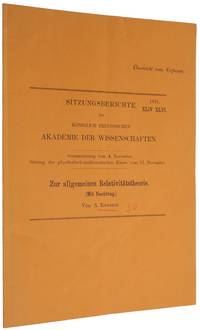
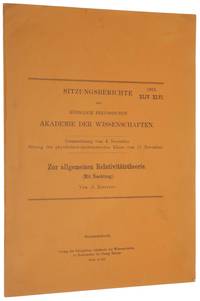
19236416Berlin: Akademie der Wissenschaften 1923. First edition. <p>First edition extremely rare author's presentation offprints "Überreicht vom Verfasser" from the library of the great German physicist Arnold Sommerfeld of Einstein's most important early publications on unified field theory. Einstein's work on unified field theory was inspired by James Clerk Maxwell's success in finding a unified theory of electricity and magnetism one of the greatest achievements of nineteenth-century physics. Einstein's contributions in this area represent about a quarter of his entire research output and half his scientific production after 1920. Such presentation offprints were issued in very small numbers unlike the commercially available separate printings which are common on the market.</p>. UNIFIED FIELD THEORY. <p>First edition extremely rare author's presentation offprints "Überreicht vom Verfasser" not to be confused with the much more common trade separates - see below from the library of the great German physicist Arnold Sommerfeld of Einstein's most important early publications on unified field theory. Einstein's work on unified field theory was inspired by James Clerk Maxwell's success in finding a unified theory of electricity and magnetism one of the greatest achievements of nineteenth-century physics which showed that light was a form of electromagnetic wave and made possible modern inventions such as radio television and the telephone. Einstein's contributions in this area represent about a quarter of his entire research output and half his scientific production after 1920. Although he was ultimately unsuccessful a similar vision was realized in the decades after his death in the construction of the 'standard model' a unified theory of electromagnetism with the weak and strong nuclear forces which were unknown in Einstein's time and efforts to incorporate gravity into the model continue to this day. 'Zur allgemeinen Relativitätstheorie' written on board ship during his return journey from Japan "gives us insight into the workings of Einstein's mind as it searched for a unified theory of gravitation and electromagnetism a search that would dominate his thinking for the rest of his life" Collected Papers 13 p. lxxvii. 'Einheitliche Feldtheorie von Gravitation und Elektrizität' was the first paper to use the term 'Unified Field Theory' in its title. In its opening paragraph Einstein wrote: "After incessant search during the last two years I now believe I have found the true solution" Pais Subtle is the Lord p. 343. The half-dozen papers Einstein had already written on unified field theory were reactions to the ideas of others such as Eddington Kaluza and Weyl; it was in this paper that Einstein put forward the first original approach of his own. "His theory rested in major part on the following arithmetical coincidence. In one of the customary ways of describing electromagnetism 6 field quantities are used. The metrical tensor of general relativity has a certain symmetry. Remove that symmetry and it will automatically contain not 10 but 16 field quantities. Use 10 combinations of these for gravitation and there will be 6 left over - just the number of field quantities with which to represent electromagnetism" Hoffmann Einstein p. 225. In 1928 Einstein embarked upon a new approach to a unified field theory involving what he called 'distant parallelism.' This was introduced in 'Riemann-Geometrie mit Aufrechterhaltung des Begriffes des Fernparallelismus' and 'Neue Möglichkeit für eine einheitliche Feldtheorie von Gravitation und Elektrizität.' By early 1929 he had solved the main problems involved in writing down field equations for his unified theory and presented his solution in 'Zur einheitlichen Feldtheorie'. "Einstein did propose in this last paper a set of field equations but added that 'further investigations will have to show whether these will give an interpretation of the physical qualities of space'. His attempt to derive his equations from a variational principle had to be withdrawn. Nevertheless in 1929 he had 'hardly any doubt' that he was on the right track" Pais p. 346. "Within three days the first printing of the journal offprint i.e. the commercial separate-a thousand copies-sold out and another thousand copies were soon printed. Soon thereafter Nature's News and Views section published a more accessible account of the work including a quote by Einstein: 'Now but only now we know that the force which moves electrons in their ellipses about the nuclei of atoms is the same force which moves our earth in its annual course about the sun and is the same force which brings to us the rays of light and heat which make life possible upon this planet.' With Einstein's 50th birthday approaching his new idea rapidly caught fire at least in the popular press. The New York Times published almost a dozen articles that year about distant parallelism rivaling its coverage of the 1919 eclipse results" Halpern. "In this frenzied unscientific atmosphere Einstein's new theory was hailed in the press as an outstanding scientific advance. Yet Einstein had stated in his article that it was still tentative; and soon he found he had to abandon it" Hoffman p. 226. Only paper III was present in the collection of presentation offprints of Einstein's son Hans Albert Christie's 2006 and in Einstein's own collection Christie's 2008; and no other copies of any of the offprints with "Überreicht vom Verfasser" can be identified on RBH. Similarly although several copies of each offprint can be found in institutional collections it is unclear how many are presentation offprints as the library records do not mention "Überreicht vom Verfasser".</p> <br /> <p>Provenance: Arnold Sommerfeld 1868-1951 his ink stamp on the front cover of III-V and characteristic numbering in red pencil on each - 40 45 47 48 49. "The son of a physician Sommerfeld was educated at the University of Königsberg. After teaching briefly at the universities of Göttingen Clausthal and Aachen he was appointed professor of physics at the University of Münich in 1906. Sommerfeld should have retired in 1936 in favour of his pupil Werner Heisenberg. Opposition from the Nazi party to Heisenberg's appointment prolonged Sommerfeld's tenure and it was not in fact until late 1939 that he finally retired to be succeeded not by Heisenberg but by Wilhelm Müller a Nazi aerodynamicist without a single publication in physics to his credit. Although Sommerfeld and Heisenberg were not Jewish they were regarded by the Nazis as Jewish sympathizers. Sommerfeld however survived the war and returned to his Münich chair in 1945 continuing to work at physics until he died in a car accident in 1951" Oxford Reference. "Arnold Sommerfeld was one of the most distinguished representatives of the transition period between classical and modern theoretical physics. The work of his youth was still firmly anchored in the conceptions of the nineteenth century; but when in the first decennium of the century the flood of new discoveries experimental and theoretical broke the dams of tradition he became a leader of the new movement and in combining the two ways of thinking he exerted a powerful influence on the younger generation. This combination of a classical mind to whom clarity of conception and mathematical rigour are essential with the adventurous spirit of a pioneer are the roots of his scientific success while his exceptional gift of communicating his ideas by spoken and written word made him a great teacher" Max Born p. 275. </p> <br /> <p>"Einstein's early work on the unification program after the completion of the theory of general relativity was by and large a reaction to approaches advanced by others. This is the case for the first geometrization of the electromagnetic field proposed in 1918 by Hermann Weyl; for the first exploration of a five-dimensional theory suggested by Theodor Kaluza in 1919; and for the first attempt to base a unified field theory on the concept of the affine connection rather than on the metric field as advanced by Arthur Eddington in 1921" Sauer pp. 289-90.</p> <br /> <p>Weyl 1885-1955 had introduced a new geometrical object into the theory that he called a "length connection" and he used it to establish a link between the geometrical structure given by the length connection and the electromagnetic field. Einstein was initially enthusiastic about Weyl's idea calling it "a first-class stroke of genius" but quickly found a serious objection to it showing that it implied that the wavelength of light emitted by a radiating atom would depend on the prehistory of that atom contrary to observation. Nevertheless in March 1921 Einstein elaborated on Weyl's theory in his paper 'Uber eine naheliegende Ergänzung des Fundamentes der allgemeinen Relativitätstheorie.'</p> <br /> <p>Another idea to which Einstein responded was put forward as early as 1919 by Theodor Kaluza 1885-1954 at the time Privatdozent in mathematics at the University of Königsberg; he introduced the concept of a fifth dimension to the underlying space-time manifold of general relativity and attempted to represent the electromagnetic field in terms of the additional components of the metric tensor. Einstein showed that for the equation of motion of an electron Kaluza's theory predicted that the influence of the gravitational field was larger by many orders of magnitude than any reasonable physical interpretation would allow for. Nevertheless Einstein later encouraged Kaluza to publish his idea and Einstein and Jakob Grommer 1879-1933 published a response to it in 1923 'Beweis der Nichtexistenz eines überall regulären zentrisch symmetrischen Feldes nach der Feld-Theorie von Kaluza'.</p> <br /> <p>A third approach toward a unified field theory was advanced most notably by Eddington 1882-1944 in the early twenties and was also taken up by Einstein. The idea was to base the theory on the concept of an affine connection as the fundamental mathematical quantity rather than on the metric tensor. The associated Ricci curvature of spacetime is not then in general a symmetric tensor and Eddington suggested that the anti-symmetric part of the curvature could be identified with the electromagnetic field the symmetric part being the usual metric. Eddington did not however provide the field equations that would determine the affine connection a problem Einstein addressed in 'Zur allgemeinen Relativitätstheorie' paper I. Einstein identified the symmetrized part of the Ricci tensor with the 'natural' metric of the theory and like Eddington he linked the antisymmetrized Ricci tensor to the electromagnetic field. Einstein's criticism of Eddington's approach focused on Eddington's failure to provide field equations that determine all forty connection coefficients and the derivation of such field equations became the focal point of the published paper. Lastly Einstein explicitly introduced a scale factor λ that mediates between the scale of the 'natural' metric defined by the Ricci tensor and that of the physical metric. </p> <br /> <p>"With Einstein's response to Weyl Kaluza and Eddington in the early twenties we find him reacting to approaches that had been advanced by others . The first original approach put forward by Einstein himself was published in a paper of 1925 paper II in which also the term 'unified field theory' appeared for the first time in a title. In that paper he explored a metric-affine approach i.e. he took both a metric tensor field and a linear affine connection at the same time as fundamental variables. Both connection and metric were assumed to be asymmetric. Parallel transport then again defines a Ricci tensor and a Riemann curvature scalar and Einstein defined tentative field equations in terms of a variational principle taking the Riemann scalar as a Lagrangian just as in standard general relativity. As regards the interpretation of the mathematical objects he tried to associate the gravitational and electromagnetic fields with the symmetric and anti-symmetric parts of the metric field. In his attempt to recover the known cases he could show that the metric was symmetric for the purely gravitational case and the usual compatibility condition for the Levi-Civita connection can be recovered. Maxwell's equations could be recovered in the limit of weak gravitational fields but only in a slightly different form that is not entirely equivalent to the original equations.</p> <br /> <p>"The basic problem of this approach seems to have been that Einstein did not know how to go on from here. Dealing with both an asymmetric metric tensor and an asymmetric connection opened up a vast field of possibilities inherent in the mathematical framework and many familiar results of the theory of Riemannian geometry no longer held. In particular verifying the existence of non-singular spherically symmetric charge distributions posed a formidable challenge. It was also unclear how to explicitly investigate the non-vacuum case beyond the first order approximation of weak gravitational fields. Einstein did not pursue this approach any longer in print but he did take it up once more twenty years later as his final approach toward a unified field theory working on it until his death" Sauer pp. 293-5.</p> <br /> <p>"At some point in May 1928 while convalescing at home in Berlin Einstein had an idea for what he thought was 'an entirely new way of realizing the general theory of relativity and that may be groundbreaking.' Key to this new approach was the notion of a field of mutually orthogonal normal vectors defined on the space-time manifold. This was a so-called n-Bein-Feld or in more modern terminology for n = 4 a field of tetrads. Such a theory admits the definition of a natural notion of distant parallelism by identifying vectors on this orthonormal frame field. Two vectors at distant points of the manifold are parallel by definition if they are represented by the same vector of the orthonormal frames at the respective points. The manifold also carries a Riemannian metric which can be expressed in terms of the tetrad field. Since the tetrad field determines the metric field but not the other way around the tetrads provide more degrees of freedom which Einstein hoped could be put to use to provide a representation of the electromagnetic field. </p> <br /> <p>"At Einstein's request on 7 June 1928 Max Planck presented a brief note on this 'Riemannian Geometry Retaining the Concept of Distant Parallelism' paper III to the Prussian Academy for publication in its Proceedings. Since Einstein was not sure at the time whether the notion of Fernparallelismus that is distant parallelism or teleparallelism and its associated geometric concepts were known in the mathematical literature he asked Planck to inquire among his mathematician colleagues whether any of this was known before submitting the paper for publication. Planck did not find the occasion to do as requested but nevertheless submitted the paper. </p> <br /> <p>"Only a week later Einstein realized how to put the geometry of distant parallelism to use for his project of a unified theory of both the gravitational and the electromagnetic fields. The idea was to postulate a variational principle for an invariant action integral that depended on the tetrad field as the dynamical variable. </p> <br /> <p>"From this perspective the problem presented itself as a fairly well-defined mathematical problem but posed difficulties of interpretation in terms of physical concepts. From the mathematical side the required invariance of the variational integral created a clearly defined problem. One needed to identify all possible invariants that can be constructed from the tetrads as well as a combination of these invariants that would be suitable as a Lagrangian for the variational integral. Second variation with respect to the tetrad field would produce differential equations that had to be associated with the known field equations of gravitation and electromagnetism in certain limiting cases. Third solutions for the differential equations had to be found. Finally Einstein later would become interested in finding identities that would be satisfied by the tetrads by virtue of general covariance or that might be postulated to derive field equations. As far as the physical interpretation was concerned the metric field would take on its old role as in the general theory namely corresponding to the gravitational field. But the electromagnetic field also had to be identified with quantities occurring in the geometric framework. </p> <br /> <p>"As a first step Einstein identified the relevant possible invariants to be constructed from the tetrads. He also realized that in addition to the possibility of constructing a metric-compatible Levi-Civita connection from the metric as well as the associated notion of parallel transport the tetrad field allowed the definition of another connection with its notion of parallelism. In contrast to the Levi-Civita connection the teleparallel connection is asymmetric and describes a geometry that has vanishing Riemann curvature. Instead it is characterized by the nonvanishing of a tensorial quantity constructed from the teleparallel connection that is now known as the torsion tensor. Taking the mathematical expression of torsion a third-rank tensor Einstein tentatively identified its contraction with the electromagnetic four-potential. And settling on what seemed to be the simplest invariant to be taken as a basis for a tentative field theory Einstein succeeded in deriving to first approximation in the field components both the gravitational field equations of general relativity as well as an equivalent version of the Maxwell equations. </p> <br /> <p>"Again a brief note on this work was presented by Planck to the Academy on 14 June 1928 and was published in July under the title 'New Possibility for a Unified Field Theory of Gravitation and Electricity' paper IV. These two notes mark the beginning of a search for a unified field theory in this teleparallel framework that would preoccupy Einstein for the next two or three years .</p> <br /> <p>"The new approach to unified field theory opened the possibility of finding solutions to long-standing problems and work along these lines continued with intense phases of calculation and collaboration partly done when Einstein withdrew from public life and spent extended periods of time in secluded residences in Scharbeutz and Gatow or later in Caputh. However in mid-December 1928 difficulties in working out the consequences of the new differential equations had piled up to such a point that Einstein reconsidered the basis of their derivation by means of Hamilton's principle. On 13 December he wrote to his collaborator Chaim Herman Müntz that he had a 'simple bold idea that will throw Hamilton's principle overboard'. Instead of trying to recover the Maxwell equations in some acceptable limit he would now 'put the cart before the horse' and 'choose the field equations in such a way that I can be certain that they will lead to the Maxwell equations'. But yet again things turned out to be more difficult and for a few days in late December he reverted to the 'old Hamilton method once again'. But over the New Year's break on another retreat in Gatow Einstein gave up again on the variational approach and derived field equations based instead on some identities. On 27 December he wrote to Müntz: 'EUREKA!' convinced that he had found a solution that was 'so splendid nothing nicer could be imagined'. </p> <br /> <p>"The new progress was written up in a brief paper completed by 5 January 1929. Einstein was exhausted but happy about this new paper 'lying finished in front of me compressed into seven pages under the title 'Unified Field Theory'.' To his son Eduard he wrote on the same day that he was 'very happy' because he had 'more or less completed my life's work'. The paper was submitted on 10 January 1929 for publication in the Prussian Academy's Proceedings and appeared under the somewhat less assertive title 'On Unified Field Theory' paper V. </p> <br /> <p>"When published the paper made a big splash in the press and received much public attention. A press release appeared in the New York Times on 11 January and reports followed on 12 January in the German and international press. The paper was reprinted in a record number of copies and Einstein wrote a popular exposition English translations of which appeared in the London Times and the New York Times as well as in the Observatory. In Britain Nature contacted Einstein for a copy in order to report on it a request that Einstein diverted to Eddington. The latter informed Einstein a little later about the craze that his latest publication had stirred in London where 'one of our great Department Stores in London Selfridges has pasted up in its window your paper six pages pasted up side-by-side so that passers-by can read it all through. Large crowds gather round to read it!'. </p> <br /> <p>"The paper is indeed a rather technical brief note as Einstein soon pointed out and 'no occasion for anybody to be excited about it' as there will be 'only a few mathematicians who will be inclined to read it'. In a letter to Karl Kerkhof he admitted that he himself might carry some responsibility for the excitement since he 'may have alluded to it in speaking with one or another of my friends'. Among them was Hans Reichenbach who reported on the new approach in a column in the Vossische Zeitung before Einstein's printed paper was actually issued and thereby caused a deep rift between them. In any case it soon became clear that the brief paper would not be the last word on the theory. Already the published version carried an addendum in which Einstein indicated a simpler way of looking at things" Collected Papers 16 pp. lxiv-lxix.</p> <br /> <p>"Einstein soon was to learn that the mathematical concept of distant parallelism was by no means new and had already been explored by mathematicians notably by Roland Weitzenböck and Élie Cartan. While immediately acknowledging the priority of others as far as the mathematics was concerned Einstein nevertheless held high hopes for his idea of formulating a unified field theory within this structure. For him the critical question was to find a field equation for the components of the dynamical tetrad fields. Each field of tetrads defines a metric tensor field. But the converse is not true since the metric tensor components can only fix ten of the sixteen components of a tetrad. The additional six degrees of freedom are just what would be needed so he thought to accommodate the six degrees of freedom of the Maxwell field in a unified description of gravitation and electromagnetism. </p> <br /> <p>"The story of the distant parallelism approach can be told largely as a story of attempts to find and justify a uniquely determined set of field equations for the tetrad components with the demand that solutions of those field equations be given a sensible physical interpretation. The distant parallelism approach in this respect shows a number of marked similarities with Einstein's search for general relativistic field equations of gravitation in the years 1912-15. In 1912 it had been the introduction of the metric tensor into the theory that had started Einstein's research and existing mathematical theorems had to be adapted to the theory. In 1928 it was the tetrad fields that allowed the investigation of a non-Euclidean geometry of vanishing curvature and similarly Einstein was made aware of existing mathematical results by mathematician colleagues. In both cases Einstein's research quickly focussed on finding a set of field equations for the dynamical variables and in both cases it was difficult to satisfy all heuristic requirements. In response to these difficulties Einstein changed back and forth between two different and complementary strategies each starting from one particular set of heuristic postulates. In both episodes Einstein at one point settled on a set of field equations that was justified more by physical considerations rather than by mathematical soundness. In both cases Einstein continued to work out consequences of the field equations as well as continued to find a satisfactory mathematical justification for these equations. And finally the demise of both theories came about by a combination of realizing more and more shortcomings of the theory and by discovering that an alternative approach promised to be more successful. However while in 1915 the more successful theory that Einstein substituted for his earlier so-called Entwurf theory was the final version of general relativity the successor approach to the distant parallelism episode turned out to be yet another attempt at a unified field theory" Sauer pp. 296-7.</p> <br /> <p>These author's presentation offprints are of extreme rarity and must be distinguished from other so-called 'offprints' of papers from the Berlin Sitzungsberichte many of which are commonly available on the market. The celebrated bookseller Ernst Weil 1919-1981 in the introduction to his Einstein bibliography wrote: "I have often been asked about the number of those offprints. It seems to be certain that there were few before 1914. They were given only to the author and mostly 'Überreicht vom Verfasser' Presented by the Author is printed on the wrapper. Later on I have no doubt many more offprints were made and also sold as such especially by the Berlin Academy." If the term 'offprint' means as we believe it should a separate printing of a journal article given only to the author for distribution to colleagues then 'offprints' were not commercially available. Although there is certainly some truth in Weil's remark in our view it requires clarification and explanation.</p> <br /> <p>Until about 1916 most of Einstein's papers were published in Annalen der Physik; from 1916 until he left Germany for the United States in 1933 most were published in the Berlin Sitzungsberichte. The Sitzungsberichte differed from other journals in which Einstein published in that it made separate printings of its papers commercially available. These separate printings have 'Sonderabdruck' printed on the front wrapper the usual German term for offprint but they are not offprints according to our definition. They were available to anyone; indeed a price list of these 'trade offprints' is printed on the rear wrapper. True author's presentation offprints can be distinguished from these trade separates by the presence of 'Überreicht vom Verfasser' on the front wrapper.</p> <br /> <p>In the period 1916 to 1919 or 1920 the Sitzungsberichte trade separates are themselves rare. After 1919 or 1920 however the trade separates become much more common although the author's presentation offprints are still very rare. The reason for this change is that it was only in 1919 that Einstein became famous among the general public.</p> <br /> <p>It might seem obvious that Einstein's fame dates from 1905 his 'annus mirabilis' in which he published his epoch-making papers on special relativity and the light quantum. However these works did not make him immediately well known even in the physics community - many physicists did not understand or accept his work and it was two or three years before his genius was fully accepted even by his colleagues. Einstein did not secure an academic position until 1908. Among the general public Einstein became well known only in late 1919 following the success of Eddington's expedition to observe the bending of light by the Sun which confirmed Einstein's general theory of relativity. This was front-page news and made Einstein universally famous. See Chapter 16 'The suddenly famous Doctor Einstein' in Pais Subtle is the Lord for an account of these events. Before 1919 the trade separates of Einstein's papers would probably only have been purchased by professional physicists; after 1919 everyone wanted a memento of the famous Dr. Einstein whether or not they understood anything of theoretical physics and the trade separates of his papers were printed and sold in far greater numbers than before to meet the demand. It is telling that when these post-1919 trade separates appear on the market they are often in mint condition - they were never read simply because their owners were unable to understand them.</p> <br /> <p>I. BRL 140; Weil 131. II. BRL 155; Weil 147. III. BRL 174; Weil 161. IV. BRL 175; Weil 162. V. BRL 183; Weil 165 cf. PMM 416. Born 'Arnold Johannes Wilhelm Sommerfeld 1868-1951' Obituary Notices of Fellows of the Royal Society 8 1952 pp. 275-296. Halpern 'Albert Einstein celebrity physicist' Physics Today 1 April 2019 pp. 38-45. Sauer 'Einstein's unified field theory program' Chapter 9 in: The Cambridge Companion to Einstein Janssen & Lehner eds. 2014.</p> <br/> <br/> 8vo 252 x 180 mm pp. 334-340; 341-351. Original printed wrappers portion of ink postmark stamp on lower cover just into text of publisher's advertisements light vertical crease for posting. Akademie der Wissenschaften unknown
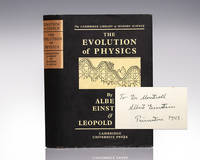
1938150250Cambridge: Cambridge University Press 1938. First edition of this classic work which traces the development of ideas in physics. Octavo original blue cloth. Presentation copy inscribed by Albert Einstein on the half-title page "To Dr. Montrell Albert Einstein Princeton 1943." Near fine in a near fine price-clipped dust jacket. On publication The Saturday Review of Literature praised Evolution of Physics as "masterly Einstein and Infelds book should do much to spread an understanding and appreciation one of the great dramas in the evolution of human thought." Cambridge University Press hardcover
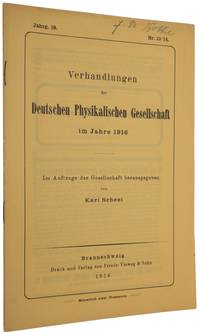
19156406Berlin: Königlichen Akademie der Wissenschaften 1915. First edition. <p>First editions very rare offprint issue of the first two papers published in November 1915 that document Einstein's final formulation of the general theory of relativity - the culmination of nearly a decade of theoretical work. These papers represent a turning point not only in Einstein's career but in the history of modern physics. Delivered to the Prussian Academy on 4 and 11 November 1915 they contain the essential framework and mathematical formalism of the completed theory preceding the famous final paper of 25 November by just days. Collectively the November papers form the core of Einstein's definitive breakthrough. "In the half century and more of Einstein's work in science one discovery stands above all as his greatest achievement. It is his general theory of relativity" Norton.</p>. <p>EINSTEIN'S COMPLETION OF THE GENERAL THEORY OF RELATIVITY</p> . <p>First editions extremely rare author's presentation offprint not to be confused with the much more common trade separate - see below from the library of the great German physicist Arnold Sommerfeld of the first two of the papers published in November 1915 that document Einstein's final version of the general theory of relativity. "In the half century and more of Einstein's work in science one discovery stands above all as his greatest achievement. It is his general theory of relativity" Norton. "There was difficulty reconciling the Newtonian theory of gravitation with its instantaneous propagation of forces with the requirements of special relativity; and Einstein working on this difficulty was led to a generalization of relativity - which was probably the greatest scientific discovery that was ever made" Dirac quoted in Chandrasekhar p. 3. Einstein's special theory of relativity 1905 showed that the laws of physics are the same in all inertial i.e. non-accelerating frames of reference. It was then natural to ask whether it was possible to extend this principle of relativity to the more general case of frames of reference in arbitrary states of motion. This problem became linked to a theory of gravitation with Einstein's 'equivalence principle' of 1907 according to which the effects of gravity are locally equivalent to those of accelerated motion. Einstein's first steps towards a geometrical theory of gravitation were taken in August 1912 when his friend Marcel Grossmann provided the necessary mathematical tools. "Some time between August 10 and August 16 it became clear to Einstein that Riemannian geometry is the correct mathematical tool for what we now call general relativity theory. The impact of this abrupt realization was to change his outlook on physics and physical theory for the rest of his life" Pais p. 210. The resulting 'Entwurf' theory 1913 had much in common with the final theory of 1915 but based on a fallacious argument Einstein abandoned the requirement that the theory should be 'generally-covariant' i.e. that arbitrary frames of reference should be allowed. "After three years of fruitless peregrinations the revelation came to Einstein that he had been constantly on the wrong track although in 1913 he had been so near to the right solution" Lanczos p. 211. On November 4 1915 he presented to a plenary session of the Prussian Academy a new version of general relativity 'Zur allgemeinen Relativitätstheorie' "based on the postulate of covariance with respect to transformations with determinant 1" and stated that he had "completely lost confidence" in the 'Entwurf' equations. On November 18 he published his calculation of the precession of the perihelion of Mercury based on the new theory: its agreement with observation confirmed that the theory was correct the Entwurf theory predicted half the observed value of the precession.</p> <br /> <p>Provenance: Arnold Sommerfeld 1868-1951 his characteristic numbering in red pencil '30' on front cover. "The son of a physician Sommerfeld was educated at the University of Königsberg. After teaching briefly at the universities of Göttingen Clausthal and Aachen he was appointed professor of physics at the University of Münich in 1906. Sommerfeld should have retired in 1936 in favour of his pupil Werner Heisenberg. Opposition from the Nazi party to Heisenberg's appointment prolonged Sommerfeld's tenure and it was not in fact until late 1939 that he finally retired to be succeeded not by Heisenberg but by Wilhelm Müller a Nazi aerodynamicist without a single publication in physics to his credit. Although Sommerfeld and Heisenberg were not Jewish they were regarded by the Nazis as Jewish sympathizers. Sommerfeld however survived the war and returned to his Münich chair in 1945 continuing to work at physics until he died in a car accident in 1951" Oxford Reference. "Arnold Sommerfeld was one of the most distinguished representatives of the transition period between classical and modern theoretical physics. The work of his youth was still firmly anchored in the conceptions of the nineteenth century; but when in the first decennium of the century the flood of new discoveries experimental and theoretical broke the dams of tradition he became a leader of the new movement and in combining the two ways of thinking he exerted a powerful influence on the younger generation. This combination of a classical mind to whom clarity of conception and mathematical rigour are essential with the adventurous spirit of a pioneer are the roots of his scientific success while his exceptional gift of communicating his ideas by spoken and written word made him a great teacher" Max Born p. 275. </p> <br /> <p>"In June 1905 while still a patent examiner in Bern Einstein submitted his famous work on the electrodynamics of moving bodies to the Annalen der Physik. This work contained his special theory of relativity in which he asserted the equivalence of all inertial frames of reference as a fundamental postulate of physics. The question which then naturally arose was whether it was possible to extend this principle of relativity to the more general case of frames of reference in arbitrary states of motion. But he could find no workable basis for such an extension until he tried to incorporate gravitation into his new special theory of relativity for a review article in 1907 'Uber das Relativitätsprinzip und die ausdemselben gezogenen Folgerungen' Jahrbuch der Radioaktivitat und Elektronik 4 1907 411-62. The difficulties of this task led him to a new principle later to be called the 'principle of equivalence.'</p> <br /> <p>"On the basis of the fact that all bodies fall alike in a gravitational field Einstein postulated the complete physical equivalence of a homogeneous gravitational field and a uniform acceleration of the frame of reference. This extended the principle of relativity to the case of uniform acceleration. It also foreshadowed the problem whose complete solution would lead him to his general theory of relativity: the construction of a relativistically acceptable theory of gravitation based on the principle of equivalence" Norton p. 258.</p> <br /> <p>One application of the equivalence principle proved crucial to the subsequent development of his ideas on general relativity. Einstein considered an observer standing on a rotating disc - a non-inertial accelerating reference frame. According to special relativity measuring rods aligned with the circumference of the disc will contract due to their motion whereas measuring rods positioned along the radius of the disc will not. Hence the ratio of the circumference of the disc to its diameter will be less than π. "The spatial geometry for the rotating observer is therefore non-euclidean. Invoking the equivalence principle Einstein concluded that this will be true for an observer in a gravitational field as well. This then is what first suggested to Einstein that gravity should be represented by curved space-time. </p> <br /> <p>"To describe curved space-time Einstein turned to Gauss's theory of curved surfaces a subject he vaguely remembered from his student days at the ETH in Zürich. He had learned it from the notes of his classmate Marcel Grossmann. Upon his return to his alma mater as a full professor of physics in 1912 Einstein learned from Grossmann now a colleague in the mathematics department of the ETH about the extension of Gauss's theory to spaces of higher dimension by Riemann and others. Riemann's theory provided Einstein with the mathematical object with which he could unify the effects of gravity and acceleration: the metric field" Janssen p. 65.</p> <br /> <p>The first product of this collaboration was the Entwurf einer verallgemeinerten Relativitätstheorie und einer Theorie der Gravitation published before the end of June 1913 which contained many of the essential features of the final general theory of relativity; most importantly it introduced the 'metric' of space-time. In Minkowski's formulation of special relativity 1908 the most important quantity is the 'world function' of two events which determines the metric and causal structure of space-time. If these events have coordinates x y z t and x' y' z' t' in some inertial reference frame the world function is:</p> <br /> <p>c2t' - t2 - x' - x2 - y' - y2 - z' - z2</p> <br /> <p>where c is the speed of light. Its crucial property is that it depends only on the two events and not on the choice of inertial reference frame - in other words it is unchanged 'invariant' when x y z t and x' y' z' t' are both subjected to any Lorentz transformation. Einstein and Grossmann began with the world function in differential form:</p> <br /> <p>ds2 = c2dt2 - dx2 - dy2 - dz2</p> <br /> <p>If we now subject x y z t to an arbitrary coordinate transformation not necessarily a Lorentz transformation this takes the general form</p> <br /> <p>ds2 = g11dx12 g12dx1dx2 . ;</p> <br /> <p>the collection of quantities gμν which in general depend on the coordinates x1 x2 x3 x4 is called the metric. Based on analogy with Newton's theory Einstein expected that the gravitational equations should be of the form</p> <br /> <p>Gμν = Tμν</p> <br /> <p>where Gμν is a purely geometric quantity constructed solely from the metric gμν and its derivatives up to the second order and the 'stress-energy tensor' Tμν contains the information about the matter that is producing the gravitational field including energy density momentum fluxes and stresses. The question was: what exactly should Gμνbe</p> <br /> <p>Einstein and Grossmann found that generally covariant equations did not seem to be compatible with energy-momentum conservation or reduce to the equations of Newtonian gravitational theory for weak static fields both essential requirements of the correct theory. Einstein therefore decided to settle in the 'Entwurf' for equations with very limited covariance - instead of arbitrary changes in coordinates only linear ones were allowed. The restricted covariance of the 'Entwurf' field equations continued to bother him until in late August 1913 he convinced himself that such restrictions are unavoidable by means of the infamous "hole argument" first published as an addendum to the reprint of the 'Entwurf' article in Zeitschrift für Physik in January 1914. This ingenious argument showed correctly that if the gravitational equations were generally covariant the metric gμν would not be uniquely determined by the matter distribution i.e. by Tμν. He concluded incorrectly that this implied that general covariance must be ruled out the hole argument does not work if only linear coordinate transformations are allowed. The appropriate analogy is with electromagnetism: the metric is analogous to the scalar and vector potentials of electromagnetism and it was well known certainly to Einstein that these potentials are not uniquely determined by the charges and currents producing the electromagnetic field. </p> <br /> <p>That the 'Entwurf' theory was incorrect was made clear by Einstein's attempt in collaboration with Michele Besso another former classmate to explain the motion of the perihelion of Mercury. In 1859 Urbain Jean Joseph Le Verrier had observed the 'precession' of Mercury's orbit: this orbit is an ellipse but the ellipse is not fixed in space but slowly rotates. From early on in his search for a new relativistic theory of gravitation Einstein had been interested in the problem of Mercury's perihelion. In a letter to his friend Conrad Habicht in 1907 Einstein had already expressed his hope that such a theory would explain the anomalous advance of Mercury's perihelion. Besso visited Einstein in Zürich in June 1913 and the two men calculated the precession expected on the basis of the 'Entwurf' theory. Disappointingly it was only about half the observed anomaly. </p> <br /> <p>Einstein left Zürich in March 1914 to take up a professorship in Berlin which was to be his home until December 1932. He made no further progress on the gravitational equations until the summer of 1915 although a detailed exposition of the 'Entwurf' theory was published in October 1914 in which Einstein maintained the need for restricted covariance and even claimed that this determined the gravitational Lagrangian uniquely. "Einstein still believed in the 'old' theory as late as July 1915 between July and October he found objections to that theory and his final version was conceived and worked out between late October and November 25 . What made Einstein change his mind between July and October Letters to Sommerfeld and Lorentz show that he had found at least three objections against the old theory: 1 its restricted covariance did not include uniform rotations 2 the precession of the perihelion of Mercury came out too small by a factor of about 2 and 3 his proof of October 1914 of the uniqueness of the gravitational Lagrangian was incorrect. Einstein got rid of all these shortcomings in a series of four brief articles offered here .</p> <br /> <p>"On November 4 Einstein presented to the plenary session of the Prussian Academy a new version of general relativity 'based on the postulate of covariance with respect to transformations with determinant 1'. He began this paper by stating that he had 'completely lost confidence' in the equations proposed in October 1914. At that time he had given a proof of the uniqueness of the gravitational Lagrangian. He had realized meanwhile that this proof 'rested on misconception' and so he continued 'I was led back to a more general covariance of the field equations a requirement which I had abandoned only with a heavy heart in the course of my collaboration with my friend Grossmann three years earlier' .</p> <br /> <p>"Einstein and Grossmann had concluded that the gravitational equations could be invariant under linear transformations only and Einstein's justification for this restriction was based on the belief that the gravitational equations ought to determine the gμν uniquely a point he continued to stress in October 1914. In his new paper he finally liberated himself from this three-year-old prejudice. That is the main advance on November 4. His answers were still not entirely right. There was still one flaw a much smaller one which he eliminated three weeks later. But the road lay open. He was lyrical. 'No one who has really grasped it can escape the magic of this new theory.'</p> <br /> <p>"The remaining flaw was of course Einstein's unnecessary restriction to unimodular transformations. The reasons which led him to introduce this constraint were not deep I believe. He simply noted that this restricted class of transformations permits simplifications of the tensor calculus . The new equations are a vast improvement over the Einstein-Grossmann equations and cure one of the ailments he had diagnosed only recently: unimodular transformations do include rotations with arbitrarily varying angular velocities. In addition he proved that the new equations can be derived from a variational principle and that the conservation laws are satisfied" Pais pp. 250-252.</p> <br /> <p>On November 11 he submitted a 'Nachtrag' to his paper of a week earlier. "Einstein proposes a scheme that is even tighter than the one of a week earlier. Not only shall the theory be invariant with respect to unimodular transformations . but more strongly it shall satisfy the condition that the determinant of the matrix gμν is equal to minus one . During the next two weeks Einstein believed that this new condition had brought him closer to general covariance . One week later he remarked that 'no objections of principle' can be raised against it" ibid. pp. 252-253. Norton p. 309 points out that Einstein had in fact made a significant advance in this paper: namely he had finally found generally covariant field equations that reduced to the Newtonian equations in the weak field limit" ibid. p. 253.</p> <br /> <p>On November 18 still retaining the restrictions of his paper of a week earlier Einstein presented in 'Erklarung der Perihelbewegung des Merkur aus der allgemeinen Relativitätstheorie'"two of his greatest discoveries. Each of these changed his life. The first result was that his theory explains . quantitatively . the secular rotation of the orbit of Mercury discovered by Le Verrier . without the need of any special hypothesis. This discovery was I believe by far the strongest emotional experience in Einstein's scientific life perhaps in all his life. Nature had spoken to him. He had to be right. 'For a few days I was beside myself with joyous excitement'. Later he told Fokker that his discovery had given him palpitations of the heart. What he told de Haas is even more profoundly significant: when he saw that his calculations agreed with the unexplained astronomical observations he had the feeling that something actually snapped in him .</p> <br /> <p>"Einstein's discovery resolved a difficulty that was known for more than sixty years. Urbain Jean Joseph Le Verrier had been the first to find evidence for an anomaly in the orbit of Mercury and also the first to attempt to explain this effect . In 1859 he found that the perihelion of Mercury advances by thirty-eight seconds per century due to 'some as yet unknown action on which no light has been thrown . a grave difficulty worthy of attention by astronomers'" ibid. pp. 253-254. A more accurate measurement of 43 seconds was made by Simon Newcomb in 1882 and this was precisely the value predicted by the new theory. </p> <br /> <p>The prediction of the bending of light in a gravitational field was treated only briefly in 'Erklarung der Perihelbewegung des Merkur aus der allgemeinen Relativitätstheorie' probably because no accurate measurement of it had been made so this prediction could not be confirmed at the time. Einstein had realised in 1907 based on the equivalence principle that some bending of light should occur but he believed that the effect was too small to be observed. In 1911 he realized that the effect could be detected for starlight grazing the sun during a total eclipse and found that the amount of bending in that case is 0''.87 - this value could in fact have been computed by Newton from his law of gravitation and his corpuscular theory of light. In 3 Einstein discovered that general relativity implies a bending of light by the sun equal to 1".74 twice the Newtonian value. This factor of 2 set the stage for a confrontation between Newton and Einstein.</p> <br /> <p>"It was not until May 1919 that two British expeditions obtained the first useful photographs and not until November 1919 that their results were formally announced . In March 1917 the Astronomer Royal Sir Frank Watson Dyson drew attention to the excellence of the star configuration on May 29 1919 an eclipse date for measuring the alleged deflection . Two expeditions were mounted one to Sobral in Brazil led by Andrew Crommelin from the Greenwich Observatory and one to Principe Island off the coast of Spanish Guinea led by Eddington. Before departing Eddington wrote 'The present eclipse expeditions may for the first time demonstrate the weight of light i.e. the Newton value; or they may confirm Einstein's weird theory of non-Euclidean space; or they may lead to a result of yet more far-reaching consequences - no deflection' . The expeditions returned. Data analysis began. According to a preliminary report by Eddington to the meeting of the British Association held in Bournemouth on September 9-13 the bending of light lay between 0''.87 and double that value. Word reached Lorentz. Lorentz cabled Einstein . Then came November 6 1919 the day on which Einstein was canonized" Pais 304-305. At a joint meeting of the Royal Society and the Royal Astronomical Society on that date Dyson concluded his remarks with the statement "'After a careful study of the plates I am prepared to say that they confirm Einstein's prediction. A very definite result has been obtained that light is deflected in accordance with Einstein's law of gravitation'" ibid. p. 305. </p> <br /> <p>Three remarks may be made on the speed with which after eight years of struggle Einstein completed these final papers on his theory. The first is that Einstein had come very close to the correct gravitational equations in the second half of 1912 - they are recorded in his 'Zurich notebook' - but he discarded them because of his arguments against general covariance as we have seen. Once he no longer believed in these arguments he could return to the work carried out in the Zurich notebook and complete it. The second is that the detailed calculations in 3 relating to Mercury's perihelion were in fact very similar to those he had carried out with Besso in 1913 and so required relatively little extra effort. The final point is that Einstein was in competition with the great Göttingen mathematician David Hilbert.</p> <br /> <p>This author's presentation offprint is of extreme rarity and must be distinguished from other so-called 'offprints' of papers from the Berlin Sitzungsberichte many of which are commonly available on the market. The celebrated bookseller Ernst Weil 1919-1981 in the introduction to his Einstein bibliography wrote: "I have often been asked about the number of those offprints. It seems to be certain that there were few before 1914. They were given only to the author and mostly 'Überreicht vom Verfasser' Presented by the Author is printed on the wrapper. Later on I have no doubt many more offprints were made and also sold as such especially by the Berlin Academy." If the term 'offprint' means as we believe it should a separate printing of a journal article given only to the author for distribution to colleagues then 'offprints' were not commercially available. Although there is certainly some truth in Weil's remark in our view it requires clarification and explanation.</p> <br /> <p>Until about 1916 most of Einstein's papers were published in Annalen der Physik; from 1916 until he left Germany for the United States in 1933 most were published in the Berlin Sitzungsberichte. The Sitzungsberichte differed from other journals in which Einstein published in that it made separate printings of its papers commercially available. These separate printings have 'Sonderabdruck' printed on the front wrapper the usual German term for offprint but they are not offprints according to our definition. They were available to anyone; indeed a price list of these 'trade offprints' is printed on the rear wrapper. True author's presentation offprints can be distinguished from these trade offprints by the presence of 'Überreicht vom Verfasser' on the front wrapper as in the present offprint.</p> <br /> <p>In the period 1916 to 1919 or 1920 the Sitzungsberichte trade offprints are themselves rare: for example RBH list only three 'offprints' of Einstein's famous 1917 Sitzungsberichte paper 'Kosmologische Betrachtungen zur allgemeinen Relativitätstheorie' the auction records do not distinguish between trade and author's presentation offprints. After 1919 or 1920 however the trade offprints become much more common although the author's presentation offprints are still very rare. The reason for this change is that it was only in 1919 that Einstein became famous among the general public.</p> <br /> <p>It might seem obvious that Einstein's fame dates from 1905 his 'annus mirabilis' in which he published his epoch-making papers on special relativity and the light quantum. However these works did not make him immediately well known even in the physics community - many physicists did not understand or accept his work and it was two or three years before his genius was fully accepted even by his colleagues. Among the general public Einstein became well known only in late 1919 following the success of Eddington's expedition to observe the bending of light by the Sun which confirmed Einstein's general theory of relativity. This was front-page news and made Einstein universally famous. See Chapter 16 'The suddenly famous Doctor Einstein' in Pais Subtle is the Lord for an account of these events. Before 1919 the trade offprints of Einstein's papers would probably only have been purchased by professional physicists; after 1919 everyone wanted a memento of the famous Dr. Einstein whether or not they understood anything of theoretical physics and the trade offprints of his papers were printed and sold in far greater numbers than before to meet the demand. It is telling that when these post-1919 trade offprints appear on the market they are often in mint condition - they were never read simply because their owners were unable to understand them.</p> <br /> <p>In our view Einstein's author's presentation offprints are rare from any journal and any period though of course some are rarer than others. Before 1919 or 1920 the Sitzungsberichte trade offprints are also rare although not are rare as the author's presentation offprints; after 1919 or 1920 the trade offprints are much more common.</p> <br /> <p>BRL 74; Weil 75; Born 'Arnold Johannes Wilhelm Sommerfeld 1868-1951' Obituary Notices of Fellows of the Royal Society 8 1952 pp. 275-296. Chandrasekhra 'The general theory of relativity: Why "It is probably the most beautiful of all existing theories" Journal of Astrophysics 5 1984 pp. 3-11; Eisenstaedt The Curious History of Relativity 2006; Janssen 'Of pots and holes: Einstein's bumpy road to general relativity' Annalen der Physik 14 Supplement 2005 pp. 58-85; Lanczos Einstein Decade: 1905-1915 1974; Norton 'How Einstein found his field equations: 1912-1915' Historical Studies in the Physical Sciences 14 1984 pp. 253-316; Pais Subtle is the Lord 1982.</p> <br/> <br/> Large 8vo 252 x 180mm pp. 778-786; 799-801. Original printed wrappers light vertical crease from posting. Königlichen Akademie der Wissenschaften unknown
36130<blockquote><p>In the poem he apologizes for leaving Von Neumann’s party early and incurring the wrath of his wife calling himself a “thick skinned fool†and a “clumsy bullâ€</p><p> </p><p>Einstein urges Von Neumann not to be angry that “regret creeps at the memory†and that he is filled with dismay</p><p> </p><p>This is a real rarity and is the only poem by Einstein that we have ever carried; it has been in a private collection for a generation</p></blockquote><p>embedhttps://vimeo.com/1180595880share=copy&fl=sv&fe=ci/embed</p><p> </p><p>John Von Neumann was a mathematician physicist computer scientist and engineer who in 1933 Von Neumann accepted a tenured professorship at the Institute for Advanced Study in Princeton. This was also where Albert Einstein worked so the two were colleagues. Von Neumann had perhaps the widest coverage of any mathematician of his time integrating pure and applied sciences and making major contributions to many fields including mathematics physics economics computing and statistics. He was a pioneer in building the mathematical framework of quantum physics and the digital computer. His analysis of the structure of self-replication preceded the discovery of the structure of DNA. During World War II Von Neumann worked on the Manhattan Project. Before and after the war he consulted for many organizations including the Office of Scientific Research and Development the U.S. Army’s Ballistics Research Laboratory and the Oak Ridge National Laboratory. At the 1950s he chaired a number of Defense Department committees. He was also a member of the influential Atomic Energy Commission in charge of all atomic energy development in the country.</p><p>Von Neumann and Einstein shared a similar cultural background but had different personalities and differed in work style sometimes creating friction. Working just a few offices down from each other Einstein was exceptionally irked by the loud music that often emanated from Von Neumann’s office. In time Einstein would admire Von Neumann’s intellect but be critical of both his work and style; and Von Neumann would become envious of Einstein. Colleagues considered von Neumann's mind faster and more acute while viewing Einstein's understanding as deeper more original and more foundational to physical reality. In summary while von Neumann may have had more raw lightning-fast processing power Einstein had a greater depth in understanding the universe.</p><p>Von Neumann was socially active within the local academic community. He was a renowned high-energy party host in Princeton known as a ""bon vivant"" who loved socializing loud music and dancing. His parties were frequent and often featured fine wine off-color jokes and a mix of academic and social guests. Among his guests was Albert Einstein. It is said that Von Neumann could attend parties until the early hours of the morning and then deliver a lecture at 8:30 am. Whereas Von Neumann was known for social parties Einstein was more of an introvert who actively embraced solitude and tended to avoid displays of luxury.</p><p><strong>Autograph manuscript signed</strong> being a poem in German Princeton no date to Von Neumann and his wife apologizing for his bad behavior at their cocktail party.<em> “Dear Neumanns The following Knittel traditional German poem of rhyming couplets known for their humorous or satirical nature verses should help you forgive my clumsiness:</em></p><p><em>“You thick skinned fool you clumsy bull</em><br /><em>So rang the scold in my ear so full</em><br /><em>Which met me once down the stairs</em><br /><em>As I made my way to the cars.</em></p><p><em>""And she was right I swear</em><br /><em>The lady of the gentle sex so fair</em><br /><em>That I did neglect the Neumanns</em><br /><em>As I took off without any plans</em></p><p><em>""I now shudder thinking back</em><br /><em>At the wild looks of the spouse’s attack</em><br /><em>Regret creeps at the memory</em><br /><em>That I should so forgetful be.</em></p><p><em>""And I am filled with such dismay</em><br /><em>Such a thing will never do again or say</em><br /><em>Laugh it off but anger not</em><br /><em>May this poem help a lot.</em></p><p><em>""Yours truly A. Einsteinâ€</em></p><p>This provides a fascinating window into how Einstein saw his relationship with Von Neumann and the strain it was under as well as on Einstein’s own behavior calling himself a “thick skinned fool you clumsy bullâ€.</p><p>This is a real rarity and is the only poem by Einstein that we have ever carried.</p><p><img class=""alignnone wp-image-25018 size-post-window"" src=""https://cdn.raabcollection.com/wp-content/uploads/20231204144051/Folder-site-11-1600x1327.jpg"" alt=""historical memorabilia dealer"" width=""1600"" height=""1327"" /></p> unknown
19351383623/05/1935. <blockquote><p style=""text-align: left;"">He prophesizes however that the road ahead for the Jews will be “arduous and very painfulâ€</p></blockquote><p>The Institute for Advanced Study in Princeton New Jersey was founded in 1930 by educator Abraham Flexner with funding from department store magnate Louis Bamberger. Flexner first recruited noted mathematicians from Princeton University to join the Institute then broadened its scope by including established scholars in economics politics and humanistic studies. In 1932 Flexner offered Einstein a faculty position at the Institute. Einstein’s decision was effected by historical events as in January 1933 Adolf Hitler became Chancellor of Germany. Soon after Einstein made the decision to resign from his Berlin position give up his German citizenship and accept the position in Princeton. The ocean liner Westmoreland which carried Einstein at age 54 to what would become his new home country arrived in New York Harbor on October 17 1933.</p><p><img class=""alignnone size-full wp-image-24695"" src=""https://cdn.raabcollection.com/wp-content/uploads/20231204145639/einsteinsig.gif"" alt="""" width=""1920"" height=""1080"" /></p><p>Einstein found the Institute and life in the United States congenial so in April 1934 just six months after his arrival Einstein announced that he was staying in Princeton indefinitely and assuming a permanent full-time status at the Institute. He would remain in the United States the rest of his life. Meanwhile he was very much a celebrity and was invited to the White House to meet with the Roosevelts. He politely declined saying he did not want to call attention to himself a position that German Jews had become accustomed to adopting during the rise of Naziism. However the First Lady Eleanor Roosevelt intervened writing Einstein directly requesting his presence. So Einstein and his wife Elsa arrived at the White House on January 24 1934 had dinner and spent the night. President Roosevelt was able to converse with them in passable German. Among other things they discussed Roosevelt’s marine prints and Einstein’s love for sailing. On learning that the Einsteins had decided to stay in the United States Roosevelt suggested that the Einsteins should accept the offer of some Congressmen to have a special bill passed on their behalf that he would sign granting them citizenship so that they would not have to endure the five year waiting period. The Einsteins declined the President’s generous suggestion saying they wanted to be treated like any other applicant for American citizenship. Because the Einsteins had not been sure of their ultimate destination and declared themselves as visitors instead of immigrants when they arrived in October 1933 this meant that they would need to leave the U.S. and return again to declare intention to seek citizenship.</p><p>The United Jewish Appeal UJA planned a fund-raising dinner in Einstein’s honor for May 28 1935. This was exactly the time the Einsteins had set aside to leave the country to perfect their citizenship so he was forced to decline the invitation. He did however provide them with a statement that was received by the UJA on <span class=""aBn"" tabindex=""0"" data-term=""goog_1737904750""><span class=""aQJ"">May 25</span></span> the very day the Einsteins stepped onboard the Queen Mary to travel to British-owned Bermuda for a few days to satisfy the formalities. The royal governor was there to greet them when they arrived in Hamilton and he recommended the island’s two best hotels. Einstein found them stuffy and pretentious. As they walked through town he saw a modest guest cottage and that is where they ended up.</p><p><img class=""alignnone wp-image-32085 size-post-window"" src=""https://cdn.raabcollection.com/wp-content/uploads/20240908143641/Einstein-May-23-1935-1-1600x968.jpg"" alt="""" width=""1600"" height=""968"" /></p><p><strong>Typed statement signed</strong> in German Princeton May 23 1935 time stamped as received on <span class=""aBn"" tabindex=""0"" data-term=""goog_1737904751""><span class=""aQJ"">May 25</span></span> to be read at the UJA dinner and issued to the press accordingly. It takes the moral high ground but warns of great dangers ahead. <em>â€Unfortunately because of non-deferrable obligations I can only express in writing my recognition and gratitude for the assistance provided to the many unfortunate people by the dinner on the <span class=""aBn"" tabindex=""0"" data-term=""goog_1737904752""><span class=""aQJ"">28th of May.</span></span> We can gain consolation in this critical time if we compare the moral standard of our friends and our enemies with each other. The result of such a comparison shows us that our way for world history can be considered the better one even if at times it is arduous and very painful.â€</em> Our research indicates that this important statement is unpublished as the dinner was postponed and it was never released to the press.</p><p>But even this moving and forceful statement was not enough for the event organizers. Learning that Einstein could not attend they postponed the dinner. Instead the $50-a-plate dinner for the benefit of the UJA arranged by that organization and the Council of Jewish Organizations was held in New York City on <span class=""aBn"" tabindex=""0"" data-term=""goog_1737904753""><span class=""aQJ"">June 26</span></span> with Einstein in attendance. About 1000 people attended the banquet at which Einstein spoke. In his speech Einstein returned to the same theme of morality as in the above statement saying that the ""moral disintegration and intensified national egoism"" of the times requires all Jews to strengthen their ranks to preserve Jewry. Of foremost importance he said was the upbuilding of the settlement in Palestine. On <span class=""aBn"" tabindex=""0"" data-term=""goog_1737904754""><span class=""aQJ"">June 28</span></span> the UJA announced it was using the proceeds from the dinner to aid German refugees in New York City by allocating funds to local agencies equipped to care for the refugees.</p><p>Einstein reentered the U.S. from Bermuda on June 3 1935. On January 15 1936 the Einsteins submitted their declaration of intention to become citizens of the United States.</p><p><img class=""alignnone wp-image-25018 size-post-window"" src=""https://cdn.raabcollection.com/wp-content/uploads/20231204144051/Folder-site-11-1600x1327.jpg"" alt="""" width=""1600"" height=""1327"" /></p> unknown
190519259Leipzig: Johann Ambrosius Barth 1905. FIRST EDITION. Line-block and halftone text illustrations one folding table 3 halftone plates 1 collotype plate. Contemporary cloth-backed marbled boards title and date in gilt on spine; an excellent copy with the small stamp of the University of Basel on the fly-leaf preserved in a clamshell box. First edition journal issues of three important early papers by Einstein. In the first paper “Einstein suggested that light be considered a collection of independent particles of energy which he called ‘light quanta.’ Such a hypothesis he argued would provide an answer to the problem of black-body radiation where classical theories had failed and would also explain several puzzling properties of fluorescence photoionization and the photoelectric effect†Norman. It was for this paper together with one of the photoelectric effect “Zur theorie der Lichterzeugung und Lichtabsorption†published in 1906 that Einstein was awarded the Nobel Prize in Physics in 1921.<br /> <br /> The second paper proved according to Einstein himself that “according to the molecular theory of heat bodies of dimensions of the order of 1/1000 mm. suspended in liquid experience apparent random movement due to the thermal Brownian molecular movement quoted by R.W. Clark Einstein New York 1984 p. 87. Experimental verification of the predictions made in this paper contributed to proving the physical reality of molecules.<br /> <br /> The third paper on the electodynamics of moving bodies was Einstein’s first statement of the special theory of relativity. In it he argued that all motion is relative to the inertial system in which it is measured and that matter and energy are equivalent. As he himself remarked “it modifies the theory of space and time.â€<br /> <br /> I: Weil 6; Norman 689; II: Weil 8 Norman 690; III: Weil 9 Dibner Heralds of Science 167; Grolier/Horblit 26b Norman 691A. Johann Ambrosius Barth unknown
2034512/12/30. <blockquote><p>We obtained this photograph directly from the Guard heirs and it has never before been offered for sale</p></blockquote><p>In December 1930 Albert Einstein visited America for the second time. It was originally intended as merely a two-month working visit as a research fellow at the California Institute of Technology but Einstein’s popularity made the trip headline news. After arriving in New York City Einstein was taken to various places and events including Chinatown a lunch with the editors of The New York Times and a performance of Carmen at the Metropolitan Opera on December 12 where Einstein an opera buff who revered Mozart Bach and other great composers was cheered by the audience on his arrival.</p><p>William Guard was engaged by the Manhattan Opera Company as a press representative upon its organization in 1906. Upon the company's dissolution he took a similar position with the Metropolitan Opera remaining with the company until his death in 1932. Einstein met Guard at his office on his visit to the Met.</p><p><img class=""alignnone wp-image-26178 size-post-window"" src=""https://cdn.raabcollection.com/wp-content/uploads/20231204133729/Einstein-Opera-1-e1673307039907-1600x1193.jpg"" alt="""" width=""1600"" height=""1193"" /></p><p>Newspapers reported on December 14 1930: “Einstein Theory Defined in Sentenceâ€. “At last Prof. Einstein has hit upon a one sentence definition of relativity which anyone can understand. He was chatting recently in the office of William Guard factotum of the Metropolitan Opera. ‘Professor’ said Guard ‘I have a definition of your relativity theory and I would like to know if it is correct.’ The Professor smiled. There are presumed to be only a handful of wise men in the entire world who are able to understand it. ‘My definition is this’ said Guard. ‘There is no hitching post in the universe—so far as we know.’ Einstein laughed and nodded assent vigorously.â€</p><p>A spectacular 8 by 10 inch <strong>photograph</strong> of Einstein <strong>inscribed</strong> and presented by the great scientist to Guard on his visit to the Met: <em>""Mr. William J. Guard / A. Einstein / 12. XII.30.â€</em> We obtained this photograph directly from the Guard heirs and it has never before been offered for sale.</p> unknown
19166164Braunschweig: Druck und Verlag von Friedr. Vieweg and Son 1916. First edition. <p>First edition complete journal issue in original printed wrappers inscribed by Einstein to fellow Nobel Laureate Walther Bothe. "This work represents a major step forward in quantum theory" Calaprice p. 297. It introduced the concept of stimulated emission of radiation the theoretical basis for the laser; it also contained a new derivation of Planck's radiation law which provided as a by-product a justification of the frequency rule forming the basis of Bohr's theory of atomic spectra.</p>. DISCOVERY OF STIMULATED EMISSION OF RADIATION<br /> THE PRINCIPLE OF THE LASER<br /> INSCRIBED BY EINSTEIN TO A FELLOW NOBEL LAUREATE. <p>First edition complete journal issue in original printed wrappers inscribed by Einstein to fellow Nobel Laureate Walther Bothe. "This work represents a major step forward in quantum theory" Calaprice p. 297. It introduced the concept of stimulated emission of radiation the theoretical basis for the laser; it also contained a new derivation of Planck's radiation law which provided as a by-product a justification of the frequency rule forming the basis of Bohr's theory of atomic spectra. "According to Albert Einstein when more atoms occupy a higher energy state than a lower one under normal temperature equilibrium it is possible to force atoms to return to an unexcited state by stimulating them with the same energy as would be emitted naturally" Britannica. This is 'stimulated emission.' "To claim that Einstein almost invented the laser would be an exaggeration but the laser's underlying mechanism stimulated emission of radiation was a creation of his radiation theory" Kleppner pp. 32-33. "During the summer of 1916 less than a year after he had completed the general theory of relativity Einstein made a new major contribution to the quantum theory. The two papers he wrote then deal with the quantum theory of radiation by arguments that do not depend on the classical electromagnetic theory as had all earlier treatments of Planck's radiation law . When Einstein returned to the radiation problem in 1916 the quantum theory had undergone a major change. Niels Bohr's papers had opened a new and fertile domain for the application of quantum concepts - the explanation of atomic structure and atomic spectra. In addition Bohr's work and its generalizations by Arnold Sommerfeld and others constituted a fresh approach to the foundations of the quantum theory of matter" DSB. In this paper "Einstein considers a system of atoms in equilibrium with an external radiation field. An atom can change its internal energy state by absorbing or emitting radiation. Einstein introduces three basic assumptions about these exchanges of energy between matter and field. First the probability of absorption of radiation is proportional to the radiation density. Second there are two kinds of emission processes: one - spontaneous - following a law like that of radioactive decay; the other - stimulated - induced by the radiation field and with probability proportional to the radiation density. Third at equilibrium the atoms are distributed among their internal states according to the Boltzmann distribution law. From these assumptions Planck's law follows in a simple way. Einstein was very pleased with his derivation which he characterized in a letter to Besso: 'An amazingly simple derivation of Planck's formula I should like to say the derivation.' As a bonus from his derivation Einstein found that the energy difference between two internal energy states of the atom had to be equal to hv with v the frequency of the radiation absorbed or emitted in transitions between these two states thus confirming one of the postulates of Niels Bohr's theory of spectra" Papers 6 xxiii-xxiv. "Einstein meant the second part of this study a proof of the oriented character of the emission process to be his most essential contribution to quantum radiation theory this second paper was published later in 1916 as 'Zür Quantentheorie der Strahlung'. Instead Bohr gave more importance to the new deduction of the blackbody law; for this deduction reinforced the basic assumptions of his atomic theory and completed them with a statistical description of radiation processes" Darrigol p. 120. </p> <br /> <p>Provenance: Inscribed by Einstein on front wrapper "für. Dr Bothe" i.e. Walther Bothe 1891-1957. "In 1929 in collaboration with W. Kolhörster Bothe introduced a new method for the study of cosmic and ultraviolet rays by passing them through suitably arranged Geiger counters and by this method demonstrated the presence of penetrating charged particles in the rays and defined the paths of individual rays. For his discovery of the 'method of coincidence' and the discoveries subsequently made by it which laid the foundations of nuclear spectroscopy Bothe was awarded jointly with Max Born the Nobel Prize in Physics 1954" .</p> <br /> <p>While Einstein commended Planck's epoch-making derivation of his radiation law in 1900 which ushered in the quantum era he had also noted its limitations. Einstein also saw inconsistencies in Planck's derivation of his law. For Einstein this inconsistency was no reason to reject Planck's quantum theory but it was a reason to study the foundations of traditional radiation theory and if needed revise them. </p> <br /> <p>"As Einstein had noted in 1906 Planck's derivation of the Rayleigh-Jeans law</p> <br /> <p>uν = 8πν2/c3 kT</p> <br /> <p>between average resonator energy uν and radiation spectrum ν only applied to classical resonators T is the temperature k is Boltzmann's constant. A new quantum-theoretical picture of the interaction between matter and radiation was needed. Einstein found it in the summer of 1916 after the completion of his general theory of gravitation left him more time for quantum meditation.</p> <br /> <p>"The new picture presumably emerged from a combination of three elements: Einstein's derivation of the law of photochemical equivalence his analogy between quantum states and chemical species and Niels Bohr's theory of atomic spectra. According to Bohr atoms and molecules can only exist in a series of quantum states S0 S1 . . . Sn . . . with well-defined energies E0 E1 . . . En . . . Their interaction with radiation occurs through quantum jumps with characteristic values of the frequency of the emitted or absorbed radiation. Regarding the quantum states as chemical species and remembering his photochemical reasoning Einstein knew that he could derive Wien's law by balancing the absorption process Sn hν → Sn1 with the emission process Sn1 → Sn hν and by making the probability of the first reaction proportional to the density of radiation at frequency ν. Something in this reasoning needed to be altered in order to get Planck's law instead of Wien's. </p> <br /> <p>"At this point Einstein appealed to an analogy between classical and quantum theory. According to classical theory an oscillating dipole spontaneously emits radiation whether or not radiation is initially present in its surroundings. When external radiation encounters this dipole it may either be absorbed if the phase of the incoming wave agrees with that of the oscillator or it may be amplified in the contrary case. In the quantum theory of radiation Einstein similarly admitted the existence of three kinds of processes: spontaneous emission Ausstrahlung absorption negative Einstrahlung and stimulated emission positive Einstrahlung. The modern terminology is Bohr's. For the probability per time unit of the respective sorts of quantum jump Einstein assumed the forms</p> <br /> <p>Anm ÏνBnm ÏνBmn</p> <br /> <p>where n is the upper quantum state m the lower one and Ïν is the density of radiation at the frequency ν.</p> <br /> <p>"Einstein did not say much on the nature of the probabilities he thus introduced. He only commented that his theory had the weakness to leave to chance the instant and direction of the spontaneous emission of light. He also noted the similarity between spontaneous emission and radioactive decay. Undoubtedly he would have preferred a theory in which the emission and absorption probabilities were deduced from an underlying deterministic theory. He nonetheless expressed his 'full trust in the present way of reasoning'. The probabilistic description of the interaction was a natural counterpart of the discrete character of quantum states: if a quantum system evolves mostly through quantum jumps then the probability of a quantum jump obviously is the main quantity of physical interest. Instead of speculating on the precise timing and fine structure of the jumps Einstein proceeded to show what could be done by means of the new probability coefficients.</p> <br /> <p>"At thermal equilibrium Einstein reasoned statistical mechanics requires the number of atoms in a quantum state n to be proportional to exp−En /kT. The kinetic equilibrium between the atoms and surrounding radiation further requires that the number of quantum jumps from m to n should be equal to the number of reverse jumps:</p> <br /> <p>ÏνBnm exp−Em /kT = ÏνBnm Anm exp−En /kT.</p> <br /> <p>In the high temperature limit for which Ïν → ∞ this condition gives</p> <br /> <p>Bnm = Bmn.</p> <br /> <p>Therefore the equilibrium value uν of the density Ïν is given by</p> <br /> <p>uνexpEn − Em/kT - 1 = Anm / Bnm.</p> <br /> <p>According to a thermodynamic theorem by Wien uν/ν3 must be a function of ν/T only. Hence En − Em must be proportional to ν. Einstein thus derived Bohr's strange frequency rule ΔE = hν with complete generality and without recourse to any of the empirical laws of spectra. He then required the expression of uν to agree with the Rayleigh-Jeans law in the low-frequency limit. The outcome was Planck's law as well as the relation</p> <br /> <p>Anm / Bnm = 8Ï€hν3/c3</p> <br /> <p>between Einstein's two probability coefficients .</p> <br /> <p>"Einstein's new theory of radiation is now remembered for the introduction of stimulated emission which famously permitted the conception of masers and lasers. For Einstein and for his contemporaries the importance of these memoirs lay elsewhere. First Einstein filled an important gap in the derivation of Planck's law by means of a simple statistical description of radiation processes. Second he corroborated two basic assumptions of Bohr's atomic theory: the existence of stationary states and the frequency rule. In this regard it should be emphasized that before Einstein's and Sommerfeld's contributions of 1916 Bohr believed that his frequency rule only applied to strictly periodic systems. For instance he regarded the Zeeman effect as a violation of this rule. Einstein's new considerations established its complete generality" Darrigol in Cambridge Companion to Einstein pp. 134-136.</p> <br /> <p>"The implication of Einstein's theory of stimulated emission was that if one arranges for a large number of atoms to be in identical excited states a stray photon of the right energy can stimulate one atom to emit another photon which stimulates another. and all the atoms release their excess energy in a sudden cascade. What's more the photon released by stimulated emission will be in phase - coherent - with the one that stimulated it and so all the light produced in the cascade will be coherent.</p> <br /> <p>"In 1955 American physicist Charles Townes of Columbia University in New York an expert in molecular spectroscopy and his co-workers showed how stimulated emission could be used to make a device for generating or amplifying microwaves which they called a maser microwave amplified stimulated emission of radiation. Three years later Townes and Arthur Schawlow explained how to extend the idea to visible and infrared frequencies to make an 'optical maser' - in effect the laser.</p> <br /> <p>"They proposed using ordinary incoherent light to pump atoms into an excited state setting up the 'population inversion' in which the atoms are primed to return to their ground state by emitting photons. And their design used an optical cavity - basically two mirrors between which photons would bounce - to trap the emitted photons while they stimulated more emission. The device they explained would generate 'extremely monochromatic single-wavelength and coherent light'. Theodore Maiman of the Hughes Research Laboratories in Malibu California described such a device using a ruby crystal already used for masers as the lasing medium in 1960" 'A century ago Einstein sparked the notion of the laser' Physics World History Blog 31 August 2017.</p> <br /> <p>Weil 85. Calaprice An Einstein Encyclopedia 2015. Darrigol From c-numbers to q-numbers 1992. Kleppner 'Rereading Einstein on radiation' Physics Today 58 2005 pp. 30-33. Pais Subtle is the Lord 1982.</p> <br/> <br/> 8vo 228 x 154 mm pp. 315-332. Original printed wrappers. A fine copy. Druck und Verlag von Friedr. Vieweg and Son unknown
1931146050New York: The MacMillan Company 1931. First edition of this volume of Einstein's speeches and letters concerning his views on Zionism. Octavo original cloth. Boldly signed and dated in the year of publication on the front free endpaper "Albert Einstein 1931." Near fine with light toning to the endpapers in the scarce original dust jacket which is in good condition with some wear. Translated and edited with an introduction by Leon Simon. Exceptionally rare signed. Einstein was a prominent supporter of both Labor Zionism and efforts to encourage Jewish-Arab cooperation. He supported the creation of a Jewish national homeland in the British mandate of Palestine but was opposed to the idea of a Jewish state "with borders an army and a measure of temporal power." In a letter to Jawaharlal Nehru dated June 13 1947 he asserted "Long before the emergence of Hitler I made the cause of Zionism mine because through it I saw a means of correcting a flagrant wrong.The Jewish people alone has for centuries been in the anomalous position of being victimized and hounded as a people though bereft of all the rights and protections which even the smallest people normally has.Zionism offered the means of ending this discrimination." Einstein's speeches lectures and letters concerning Zionism were first published in 1930 by The Soncino Press and eleven of these essays were later collected in The World as I See It published in 1933 which Einstein dedicated "to the Jews of Germany". The MacMillan Company hardcover
51-1799Berlin: Circa 1917. Etching on Old Japanese Paper. 30 x 23 cm. on sheet size 40 x 32 cm.Light foxing and folds in the margins.Signed in pencil by Büttner lower right and by Einstein lower left. Indistinct pencil annotations above Einstein’s’ signature.Provenance: A Berkeley academic family.Porträt von Albert Einstein. Radierung auf Bütten. Rechts unten von Erich Büttner links unten von Albert Einstein signiert.At the beginning of the years Einstein suffers from various illnesses among other things from a liver disease and a stomach ulcer. His cousin Elsa takes care of him. It will last several years until he recovers completely. He writes a work on cosmology with the cosmologic term which shall guarantee a limited universe. He will refer to this cosmologic term later as his “biggest idiocyâ€. He takes over the management of the Kaiser Wilhelm Institute for Physics on October 1. Berlin: Circa 1917. unknown
19542625423/02/1954. <blockquote><p>An increasingly uncommon letter of Einstein on the role of religions philosophy peace and the dangers of the atomic age that he helped usher in</p></blockquote><p><img class=""alignnone wp-image-26334 size-post-window"" src=""https://cdn.raabcollection.com/wp-content/uploads/20231204132831/Einstein-Feb-28-1954-1-e1674939062835-1600x216.jpg"" alt="""" width=""1600"" height=""216"" /></p><p>Albert Einstein believed that wars stood in the way of human progress and he was a lifelong pacifist though he did not believe in pacifism at any price or in all situations. He was also an active promoter of world peace from the days of World War I right up to his death in 1955. In fact one of his last acts before his death was to add his signature to a statement of nine scientists warning that the world risked universal annihilation unless the institution of war was abolished. Knowing his stance people from all over the world appealed to him to assist various causes consistent with these beliefs and to give statements supporting individuals and groups that did so.</p><p>Einstein was also not a member or follower of any organized religion. He considered himself a Jew but was not a practicing Jew. And as for the Christian churches he felt that it “since Constantine has always favored the authoritarian State as long as the State allows the Church to baptize and instruct the masses"". Their conduct in the years up to World War II was worse than disappointing he thought as they made the devil’s bargain - the evil compromise - with the Hitler regime. Einstein addressed this saying “Since when can one make a pact with Christ and Satan at the same time"" He added ""The Church has always sold itself to those in power and agreed to any bargain in return for immunity…If I were allowed to give advice to the Churches I would tell them to begin with a conversion among themselves and to stop playing power politics.†This idea of an evil compromise or devil's pact is central to his feelings about organized religion.</p><p>There was one exception to his criticism of religions - the Quakers. Their community aims at purifying the Christian world and generating social reform by creating direct experience with God without intervention of clergy or other expressions of church. The Quakers greatly influenced science and industry and their community is noted for the pursuit of peace and non-violence. Thus Einstein’s views fit into their belief system. “If I were not a Jew I would be a Quaker†he once wrote. Speaking to a Quaker gathering in 1938 he said ""With admiration and respect I have seen in the course of many years how successfully and selflessly the Society of Friends has worked in the entire world to lessen human suffering and to make the teachings of Christ apply to real life. Everyone who is concerned about a better lot and a more dignified stature for humanity owes deep gratitude to the Society of Friends. This Society is an admirable testimony against the assertion that every organization by its very nature kills the spirit which has called it into life.â€</p><p><img class=""alignnone wp-image-26335 size-post-window"" src=""https://cdn.raabcollection.com/wp-content/uploads/20231204132818/Einstein-Feb-28-1954-2-e1674939294283-1600x653.jpg"" alt="""" width=""1600"" height=""653"" /></p><p>In 1949 the Australian pathologist Alton R. Chapple who was a Quaker wrote to Einstein in the then-current climate of concern regarding the perils of the atomic age for ""a few words of leadership and hope"". Einstein responded stressing the necessity for moral courage by the individual. He said that power is often in the hands of power-loving persons who know very little restrictions when it comes to the realization of their ambitious goals; and answering negatively the question whether self-restraint on what “productive thinkers and explorers†research might not prevent further development of means of mass destruction. He gave three main reasons: 1 The already existing means of destruction are effective enough to bring about total destruction; 2 People really devoted to the progress of knowledge concerning the physical world like Faraday or Rutherford have never worked for practical goals let alone military goals. And nobody could know in advance what kind of application might be developed on the basis of their discoveries; and 3 People of technical skill are so numerous and so dependent economically that they cannot be expected to refuse employment offered them by the state or private industry even if they were able to clearly recognize that their work will lead to disaster on a world-wide scale. He concluded that hope can only be based on the intellectual and moral independence of a sufficient number of people since “honesty and courage of the individual to stand up for his convictions on every occasion is the only essential thingâ€.</p><p>Chapple wrote Einstein again in 1954 about the Quakers and a perceived contradiction that Chapple discerned in the 1949 letter thinking that Einstein stated that he does not expect people to refuse to work in research that generates knowledge for the means of mass destruction. Einstein responded to Chapple giving a virtual primer on his world view and opinions on how a religion and religious individuals could live a moral life and contribute something valuable to society and the cause of peace. This he felt the Quakers did.</p><p><strong>Typed letter signed</strong> on his blind-embossed letterhead Princeton February 23 1954 to Alton Chapple in Australia illuminating Einstein’s judgment and standards of conduct. <em>“Thank you for your letter of February 16th. I consider the Society of Friends the religious community which has the highest moral standards. As far as I know they have never made evil compromises and are always guided by their conscience. In international life especially their influence seems to me to be very beneficial and effective.</em></p><p><em>“There seems to me to be no contradiction in my remarks in my former letter to you. The rules applying to a moral elite can not be expected to be followed by the rank and file.â€Â </em></p><p>So here Einstein praises those religions with “the highest moral standardsâ€. He especially lays out the need for them and for individuals to avoid “evil†compromises and to always be guided by conscience. If an individual does these things or a dedicated group like the Quakers they will gain influence that is both beneficial and effective. Einstein does stand by his statement in the 1949 letter maintaining that from his experience moral elites lead and that those in rank and file don’t necessarily follow that lead. In a sense he is saying that an ethical elite exercising leadership has the best chance of saving the world.</p><p>An increasingly uncommon letter of Einstein on philosophy peace the role of religions and religious individuals and the dangers of the atomic age that he helped usher in.</p><p><img class=""alignnone wp-image-25018 size-post-window"" src=""https://cdn.raabcollection.com/wp-content/uploads/20231204144051/Folder-site-11-1600x1327.jpg"" alt="""" width=""1600"" height=""1327"" /></p> unknown
225685/5/33. <blockquote><p>Germany as an island of intellectuals is no longer possible he writes blaming the fall of his country and exile of his colleagues on poor education a vestige of Bismarck</p><p> </p><p><em>""I am almost collapsing under all my responsibilities."" </em></p><p> </p><p>A glimpse into the tragic end to the scientific flowering of pre-Nazi Germany along with Einstein's explanation for why it all happened</p><p> </p><p>A rare letter from a brief but consequential period in Einstein's life: after he left Germany but before he arrived in America</p></blockquote><p>Einstein had long been a revered scientist and member of the Prussian Academy of Sciences and was employed by Berlin University. At the beginning of March 1932 he returned to Germany from a visit to the United States where he had discussed heading the soon-to-open Institute for Advanced Study in Princeton New Jersey. He determined to accept and to spend half the year in Berlin and half the year in Princeton. But that year the Nazis were on the rise. It was becoming increasingly obvious to Einstein that his life was in danger. A Nazi organization published a magazine with Einstein’s picture and the caption “Not Yet Hanged†on the cover. There was even a price on his head.</p><p>In December 1932 Einstein again left Germany to be a visiting professor at CalTech in Pasadena California. When Hitler was appointed German chancellor on January 30 1933 the physicist had just arrived in New York on his way to California to lecture on his theory of relativity. Nazi persecution of Jews in Germany was now open swift and often violent. Prominent Jews were denounced by Nazi officials attacked in the media and subjected to violence and arrest. As a vocal opponent of Nazism and a staunch advocate of pacifism Einstein was a particularly attractive target. Fortunately at the time Hitler came to power Einstein was already in the United States. Nonetheless the Nazis publicly agitated against Einstein as a symbol of “Jewish degeneracy†and accused him of spreading “atrocity propaganda.†In February and March 1933 the Gestapo repeatedly raided his family’s apartment in Berlin.</p><p>Despite his own March 15 1933 declaration of self-imposed exile from Nazi Germany as well as warnings from friends that it was too dangerous to return Einstein and his wife decided to travel back to Germany intending to visit their summer cottage. At the end of March they arrived in Antwerp on the SS Belgenland owned by the shipping company Red Star Line. There they learned that Nazis had ransacked their cottage in Caputh at which point they decided that re-entering Germany was unwise.</p><p>In April 1933 Einstein discovered that the new German government had passed laws barring Jews from holding any official positions including teaching at universities. Thousands of Jewish scientists were suddenly forced to give up their university positions and their names were removed from the rolls of institutions where they were employed. Einstein was now without a permanent home unsure where he would live and work and equally worried about the fate of countless other scientists still in Germany. He rented a house in De Haan Belgium where he lived for a few months. In late July 1933 he went to England for about six weeks where he was introduced to Winston Churchill. Einstein asked Churchill to help bring Jewish scientists out of Germany. British historian Martin Gilbert notes that Churchill responded immediately and sent his friend physicist Frederick Lindemann to Germany to seek out Jewish scientists and place them in British universities. In October 1933 Einstein returned to the US and took up his position at the Institute for Advanced Study. He had already revoked his German citizenship in Brussels and handed in his notice at Berlin University. He would never return to Germany.</p><p>Michele Angelo Besso was a Swiss/Italian engineer. A Sephardic Jew by birth he was a close friend of Einstein during his years at the Federal Polytechnic Institute in Zurich and then at the patent office in Bern where Einstein helped him to get a job. Einstein called Besso ""the best sounding board in Europe"" for scientific ideas. In Einstein's original paper on special relativity he ended the paper stating ""In conclusion let me note that my friend and colleague M. Besso steadfastly stood by me in my work on the problem here discussed and that I am indebted to him for many a valuable suggestion.""</p><p>After his resignation in 1890 Otto von Bismarck was venerated as unified Germany’s founding father not only during the remaining twenty-eight years of the monarchy but also albeit less emphatically in the Weimar Republic in Nazi Germany and in the Federal Republic. Throughout Germany numerous Bismarck statues are testament to the admiration. Hamburg has three. His memorialisation even went beyond Germany; the capital of the US state of North Dakota for example is named after him. Einstein was evidently not a proponent of the erstwhile unifier of Germany. As Einstein wrote of Bismarck’s influence ""The characteristic feature of this mentality is that people place the importance of what Bertrand Russell so tellingly terms “naked power†far above all other factors which affect the relations between peoples. The Germans misled by Bismarck’s successes in particular underwent just such a transformation of their mentality—in consequence of which they were entirely ruined in less than a hundred years.""</p><p>In this letter he encourages Besso to let him have his suggestions for saving Hermann Weyl from the regime – through substituting him for Einstein on a proposed trip to Spain would seem disastrously tactless. He sends his regards to Anna Besso with the rueful remark that the German example bodes ill for an intellectual utopia which she had proposed. Weyl would go on work with him at Princeton.</p><p>These two men were among Einstein's closest friends and colleague - Jewish or closely tied to Jewish relatives. He is rushing to get them out.</p><p><strong>Typed letter signed</strong> in German Le Coq-sur-mer Belgium May 5th 1933 to Besso. <em>""Dear Michele! I was not affected personally but just about everybody else who is kind of close to me was. Bismarck’s dismal education policy is wreaking havoc again with the German people.</em></p><p><em>""I would love to follow your suggestion regarding Weyl if I saw any possibility at all especially since I am almost collapsing under all my responsibilities. Even the slightest attempt to replace me with someone else in Spain would without a doubt be perceived as extremely upsetting. Have you not thought of that</em></p><p><em>""Rushed greetings to you Albert.""</em></p><p>He writes a postscript: <em>""Greetings to Anna from me and tell her she can judge herself based on the current German conditions what her concept of 'island of intellectuals' would look like.""<br /></em></p><p>In July 1933 upon Einstein’s request a committee of 51 American artists intellectuals and political leaders came together to form the International Relief Association. Among them were the philosopher John Dewey the writer John Dos Passos and the theologian Reinhold Niebuhr. Other prominent citizens including First Lady Eleanor Roosevelt soon joined the effort. Its mission as The New York Times reported on July 24 1933 was to “assist Germans suffering from the policies of the Hitler regime.â€</p><p>But Einstein did much more. He tried to persuade political leaders in the United States and Europe to take action to help the Jewish populations at risk particularly those of his colleagues in Germany's scientific community which was very hard hit. He worked tirelessly to help Jewish refugees escape the Nazis and to find them places of refuge and employment. Many immigrants to the United States during the mid to late 1930s were Jewish between 1939 and 1940 more than half of all immigrants were Jews most of them refugees fleeing persecution in Europe.</p><p><img class=""alignnone wp-image-22732 size-post-window"" src=""https://cdn.raabcollection.com/wp-content/uploads/20231204162353/Folder-site-1600x1327.jpg"" alt="""" width=""1600"" height=""1327"" /></p> unknown
15022446215/02/1933. <blockquote><p>He revises the typescript of his interview with the War Resisters League of which he was Honorary Chairman and calls out William Randolph Hearst and the head of the press and film empire in Germany who aided Hitler’s rise</p><p> </p><p>On philosophy: “The intellect without the emotions is insignificantâ€; On racism: “The main thing is that minority groups should be allowed security in the community.†They ought to be “accepted with friendliness as equal membersâ€</p><p> </p><p>On the press: He criticizes William Randolph Heart by name but says “The freedom of the press is necessary despite all the dangers or abuse that come with it.â€.</p><p> </p><p>On pacifism and peace keeping: “A pacifist is one who believes in his heart that to go to war is beneath the dignity of a human being†“Society needs some form of organization for security and protection in international life†and “An international police force…is almost absolutely necessary as one step toward achieving peace. Force when used by an impartial third party to achieve law and order it's not contrary to pacifismâ€.</p><p> </p><p>This document has never previously been offered for sale and was acquired by us from the family that has had it all this time</p></blockquote><p>Einstein was well known as a pacifist until Hitler’s rise to power. In 1930 on his second visit to America he joined the War Resisters League and accepted the office of Honorary Chairman. Einstein spoke to the organization that year saying “True pacifists must publicly declare in time of peace that they will not take up arms under any circumstances… even if only 2% of those assigned to perform military service should announce their refusal to fight governments would be powerless they would not dare send such a large number of people to jail.†The league then issued a pamphlet “Einstein on War Resistance†that was widely read and discussed.</p><p>Meanwhile back in Germany the rising Nazi movement found a convenient target in Einstein and relativity branding the latter “Jewish physics†and sponsoring conferences and book burnings to denounce Einstein and his theories. The Nazis even enlisted other physicists to denounce Einstein; “One Hundred Authors Against Einstein†was published in 1931. When asked to comment on this denunciation of relativity by so many scientists Einstein replied that to defeat relativity one did not need the word of 100 scientists just one fact.</p><p><img class=""alignnone wp-image-24605 size-post-window"" src=""https://cdn.raabcollection.com/wp-content/uploads/20231204150044/Einstein-Feb-15-1933-3-1-1600x209.jpg"" alt="""" width=""1600"" height=""209"" /></p><p>In December 1932 Einstein decided to leave Germany. The reason: it became obvious to him that his life was in danger. A Nazi organization published a magazine with Einstein’s picture and the caption “Not Yet Hanged†on the cover. There was even a price on his head. In January 1933 Einstein came to the United States to serve at the California Institute of Technology in Pasadena California as a visiting professor. The appointment of Adolf Hitler as chancellor took effect late that month and Einstein decided he would not return to his home in Germany where he had been a professor at the Berlin Academy of Sciences. He would instead return to Europe and assess the situation from there. He and his wife Elsa returned by ship to Belgium in March 1933 to find that that their residences in Germany had been raided numerous times. Einstein accepted the fact that he could not return to Germany and turned in his passport to the German consulate; he also formally renounced his German citizenship. By the summer Einstein learned that his name was on a list of assassination targets. He resided in Belgium for some months and then moved to England for a short period. On October 17 1933 he returned to the US and took up a position at the Institute for Advanced Study at Princeton in New Jersey. And there he remained until his death.</p><p>On February 15 1933 after Hitler had taken power but before Einstein learned that his homes had been raided he granted an interview to the War Resisters League at the home of one of its officials John Dorland. Dorland wanted the interview to be read aloud at the upcoming March 2 meeting of the members in Pasadena. He prepared a five page typescript of the interview and sent it to Einstein to review. As Dorland said in his cover letter to Einstein “Would you be kind enough to read it and if the answers misrepresent you in any detail may we request that you revise it in such particular as we are very anxious to have these correct.†He also asked Einstein's permission to read the interview aloud.</p><p>This is the <strong>original typescript</strong> of the Einstein interview sent to Einstein by Dorland complete with Einstein’s handwritten notations. It is the only such annotated interview of Einstein that we have seen and it covers important topics.</p><p><img class=""alignnone wp-image-24606 size-post-window"" src=""https://cdn.raabcollection.com/wp-content/uploads/20231204150037/Einstein-Feb-15-1933-2-1-1600x247.jpg"" alt="""" width=""1600"" height=""247"" /></p><p>On page one Einstein makes it clear he was not ready to abandon his resistance to war. <em>“The War Resistersâ€</em> he stated at the interview <em>“are doing a fine work. They have done more than any other peace group. A strong organized minority who have declared themselves absolutely against war is very powerful.â€</em> Question from Dorland. <em>“Can we hope to convince everybody†Answer: “Oh no we cannot convince everybody but we do not need to. One strong man is worth much and has great influence Individuals thoroughly convinced and small groups working earnestly are of the utmost value.â€</em> Q: <em>“In trying to arouse interest is it better to appeal to the intellect or the emotionsâ€</em> A: <em>“To both; the intellect without the emotions is insignificant.â€</em></p><p>On page two Einstein states that “<em>Public protests are very valuableâ€</em> as is control over munitions production. <em>“The private munitions business is a great threat to the peace of the world and there should be government control. Public opinion is not yet awake to the atrocities of the munitions firms.â€</em> Then Dorland changes the subject to <em>“race relations.â€</em> Einstein responded <em>“The main thing is that minority groups should be allowed security in the community.â€</em> Then Einstein hand writes in some thoughts. If they are not afforded such security <em>“they should isolate themselves from the rest of society since they are not accepted with friendliness as equal members.â€</em> Then some fascinating free thoughts emerge. Clearly thinking of the Jews in Germany he crosses out <em>“It insecurity is not so badâ€</em> and instead says <em>“They can achieve a healthy existenceâ€</em>. But thinking of the current situation he finishes the thought by adding at least <em>“Up until now!â€</em> He surely had less confidence about the future.</p><p>On page three Einstein discusses the part to be played by international organizations. “<em>The main thing is organization. Disputes will always come but we must have other methods than war for settling them. Society needs some form of organization for security and protection in international life.â€</em> Einstein then writes in <em>“Obligatory court of arbitration. Unconditional obligation of the states to accept their verdicts and enforce them.â€</em> He is then asked which is less threatening to the progress of peace a professional army or universal military conscription. Einstein answers<em> “The professional army is better because then only the professional soldiers become imbued with the military spirit.â€</em> Asked about Japan leaving the League of Nations he hand writes <em>“It is better to let Japan secede from the League of Nations rather than have it the League compromised by a bad compromise.â€</em> Sooner let them go than compromise principles to keep them in. Lastly he is asked for his definition of a pacifist and responds <em>“A pacifist is one who believes in his heart that to go to war is beneath the dignity of a human being.â€</em></p><p><img class=""alignnone wp-image-24607 size-post-window"" src=""https://cdn.raabcollection.com/wp-content/uploads/20231204150030/Einstein-Feb-15-1933-5-1-1600x242.jpg"" alt="""" width=""1600"" height=""242"" /></p><p>On page four Einstein continues by saying that a pacifist <em>“must be active in the prevention of war; that is he must support justice arbitration and conciliation.â€</em> In terms of having some international force enforce the peace Einstein is in favor. <em>“an international police force as suggested by the French is almost absolutely necessary as one step toward achieving peace. Force when used by an impartial third party to achieve law and order it's not contrary to pacifism. This international force would exist only for a transition perhaps 20 years.â€</em> Dorland then asks Einstein <em>“What do you think of the control over public opinion by the pressâ€</em> Einstein in the interview stated it was not good but in this document he elaborated further. <em>“The freedom of the press is necessary despite all the dangers or abuse that come with it. This is the point with the biggest dependence of the peace movement peace work on economic circumstances. Hearst in America and Hugenberg in Germany demonstrate this fact with frightening clarityâ€.</em> Alfred Hugenberg was the head of a press and film empire in Germany who aided Hitler’s rise. Einstein’s comparison of William Randolph Hearst with him is interesting. He clearly feels that the press in the wrong hands motivated by profit and political power was a danger. The next question was <em>“Are religious bodies a power for peaceâ€</em> Einstein’s answer: <em>“Not greatly now.â€</em></p><p>On the final page Einstein states his belief that though no one can change human nature <em>“we can change traditional institutions.â€</em></p><p><img class=""alignnone wp-image-24608 size-post-window"" src=""https://cdn.raabcollection.com/wp-content/uploads/20231204150023/Einstein-Feb-15-1933-4-1-1600x231.jpg"" alt="""" width=""1600"" height=""231"" /></p><p>This document is full of gems: <em>“The intellect without the emotions is insignificantâ€; “The main thing is that minority groups should be allowed security in the community.â€</em> They ought to be <em>“accepted with friendliness as equal membersâ€; “Society needs some form of organization for security and protection in international lifeâ€; “A pacifist is one who believes in his heart that to go to war is beneath the dignity of a human beingâ€; “An international police force…is almost absolutely necessary as one step toward achieving peace. Force when used by an impartial third party to achieve law and order it's not contrary to pacifismâ€</em>; and “<em>The freedom of the press is necessary despite all the dangers or abuse that come with it.â€</em></p><p>This is a great and fascinating rarity. A search of public sale records going back over 40 years turns up only one other example of an Einstein annotated interview nor have we ever had one.</p><p>It wasn’t long in 1933 before the intensity of the threat from Naziism convinced Einstein that only force would be a deterrent a Hitler triumph. He resigned from the War Resisters League later in 1933. To Einstein pacifism became not an absolute concept but one that had to be re-examined depending on the magnitude of the threat.</p><p><img class=""alignnone wp-image-24457 size-post-window"" src=""https://cdn.raabcollection.com/wp-content/uploads/20231204150746/Folder-site-8-1600x1327.jpg"" alt="""" width=""1600"" height=""1327"" /></p> unknown
19314675JHollywood 1931. An unusually large image 11†x 14†taken on January 8 1931 when Einstein and his wife visited Hollywood. The image shows Albert Einstein and Film Mogul Carl Laemmle Senior Founder of Universal Pictures. The photograph is a striking informal image of these two noted Jewish leaders and fellow German emigres chatting on a studio sound stage at Universal City with Mrs. Einstein visible in the background. The photograph is inscribed and signed by Albert Einstein to the head of Universal’s publicity department John LeRoy Johnston who had sent this photograph of Einstein with his boss Laemmle to Einstein to sign. Einstein has written in white ink: “Fur Kohn Johnston - Albert Einsteinâ€. Tipped to the verso is a typed note written in German from Johnston on his printed Universal Pictures stationery to Professor Einstein asking him to inscribe the photograph. Many photograph portraits of Einstein are rather stuffy affairs and a number look like police lineups when he appeared in public and met famous people and dignitaries. This is a striking image of the two men conversing. A historic and excellent photograph and the finest piece from his visit to Hollywood to ever appear on the market. unknown books
1938366717Princeton New Jersey 1938. 7 lines typed in German on letterhead of the Institute for Advanced Study School of Mathematics watermarked Chieftain Bond signed in ink. 4to 9-7/8 x 7-1/8 inches. Old folds. Fine. 7 lines typed in German on letterhead of the Institute for Advanced Study School of Mathematics watermarked Chieftain Bond signed in ink. 4to 9-7/8 x 7-1/8 inches. Im Jahre 1837 habe ich ein Affidavit für meine Verwandte Fräulein Ursula Einstein ausgestellt. Ich erkläre hiermit dass ich dieses Affidavit aufrechterhalte und bereit bin di notwendigen Unterlagen neu zi liefern wenn es gewünscht wird.<br /> den 31. Oktober 1938<br /> signed <br /> Professor Albert Einstein.<br /> <br /> "In the year 1937 I signed an affidavit on behalf of my relative Miss Urusula Einstein. I hereby state that I continue to certify this affidavit is correct and am ready to submit the necessary documents anew if this is requested."<br /> <br /> Albert Einstein 1879-1955 German-born physicist renowned for developing the theory of relativity in papers published in 1905 and 1916 was awarded the Nobel Prize for Physics in 1921 and left Germany in 1933. He was associated with the Institute for Advanced Study at Princeton.<br /> <br /> This statement was almost certainly prepared in connection with efforts to assist his relative in emigrating. In a letter to his sister Maja Winteler-Einstein then resident in Switzerland dated December 1938 Einstein wrote "I am now working as some sort of itinerant relief committee and buckets of letters are coming in . I am helping the Ulm relatives with emigrating". Ursula Einstein born 1916 was able to get out; in 1940 she was a refugee in Port-au-Prince and later reached Brazil. Her younger sister Barbara was not so fortunate. Barbara Einstein born 1918 took her own life in March 1943 after her fiancé Harry Jacob was taken off to the concentration camps.<br /> <br /> A choice Einstein autograph. unknown
19155863Berlin: Königlichen Akademie der Wissenschaften 1915. First edition. <p>First editions very rare offprint of the first two of the papers published in November 1915 that document his final version of the general theory of relativity. "In the half century and more of Einstein's work in science one discovery stands above all as his greatest achievement. It is his general theory of relativity" Norton.</p>. EINSTEIN'S COMPLETION OF THE GENERAL THEORY OF RELATIVITY. <p>First editions very rare offprint of the first two of the papers published in November 1915 that document Einstein's final version of the general theory of relativity. "In the half century and more of Einstein's work in science one discovery stands above all as his greatest achievement. It is his general theory of relativity" Norton. "There was difficulty reconciling the Newtonian theory of gravitation with its instantaneous propagation of forces with the requirements of special relativity; and Einstein working on this difficulty was led to a generalization of relativity - which was probably the greatest scientific discovery that was ever made" Dirac quoted in Chandrasekhar p. 3. Einstein's special theory of relativity 1905 showed that the laws of physics are the same in all inertial i.e. non-accelerating frames of reference. It was then natural to ask whether it was possible to extend this principle of relativity to the more general case of frames of reference in arbitrary states of motion. This problem became linked to a theory of gravitation with Einstein's 'equivalence principle' of 1907 according to which the effects of gravity are locally equivalent to those of accelerated motion. Einstein's first steps towards a geometrical theory of gravitation were taken in August 1912 when his friend Marcel Grossmann provided the necessary mathematical tools. "Some time between August 10 and August 16 it became clear to Einstein that Riemannian geometry is the correct mathematical tool for what we now call general relativity theory. The impact of this abrupt realization was to change his outlook on physics and physical theory for the rest of his life" Pais p. 210. The resulting 'Entwurf' theory 1913 had much in common with the final theory of 1915 but based on a fallacious argument Einstein abandoned the requirement that the theory should be 'generally-covariant' i.e. that arbitrary frames of reference should be allowed. "After three years of fruitless peregrinations the revelation came to Einstein that he had been constantly on the wrong track although in 1913 he had been so near to the right solution" Lanczos p. 211. On November 4 1915 he presented to a plenary session of the Prussian Academy a new version of general relativity 'Zur allgemeinen Relativitätstheorie' "based on the postulate of covariance with respect to transformations with determinant 1" and stated that he had "completely lost confidence" in the 'Entwurf' equations. On November 18 he published his calculation of the precession of the perihelion of Mercury based on the new theory: its agreement with observation confirmed that the theory was correct the Entwurf theory predicted half the observed value of the precession.</p> <br /> <p>"In June 1905 while still a patent examiner in Bern Einstein submitted his famous work on the electrodynamics of moving bodies to the Annalen der Physik. This work contained his special theory of relativity in which he asserted the equivalence of all inertial frames of reference as a fundamental postulate of physics. The question which then naturally arose was whether it was possible to extend this principle of relativity to the more general case of frames of reference in arbitrary states of motion. But he could find no workable basis for such an extension until he tried to incorporate gravitation into his new special theory of relativity for a review article in 1907 'Uber das Relativitätsprinzip und die ausdemselben gezogenen Folgerungen' Jahrbuch der Radioaktivitat und Elektronik 4 1907 411-62. The difficulties of this task led him to a new principle later to be called the 'principle of equivalence.'</p> <br /> <p>"On the basis of the fact that all bodies fall alike in a gravitational field Einstein postulated the complete physical equivalence of a homogeneous gravitational field and a uniform acceleration of the frame of reference. This extended the principle of relativity to the case of uniform acceleration. It also foreshadowed the problem whose complete solution would lead him to his general theory of relativity: the construction of a relativistically acceptable theory of gravitation based on the principle of equivalence" Norton p. 258.</p> <br /> <p>One application of the equivalence principle proved crucial to the subsequent development of his ideas on general relativity. Einstein considered an observer standing on a rotating disc - a non-inertial accelerating reference frame. According to special relativity measuring rods aligned with the circumference of the disc will contract due to their motion whereas measuring rods positioned along the radius of the disc will not. Hence the ratio of the circumference of the disc to its diameter will be less than π. "The spatial geometry for the rotating observer is therefore non-euclidean. Invoking the equivalence principle Einstein concluded that this will be true for an observer in a gravitational field as well. This then is what first suggested to Einstein that gravity should be represented by curved space-time. </p> <br /> <p>"To describe curved space-time Einstein turned to Gauss's theory of curved surfaces a subject he vaguely remembered from his student days at the ETH in Zürich. He had learned it from the notes of his classmate Marcel Grossmann. Upon his return to his alma mater as a full professor of physics in 1912 Einstein learned from Grossmann now a colleague in the mathematics department of the ETH about the extension of Gauss's theory to spaces of higher dimension by Riemann and others. Riemann's theory provided Einstein with the mathematical object with which he could unify the effects of gravity and acceleration: the metric field" Janssen p. 65.</p> <br /> <p>The first product of this collaboration was the Entwurf einer verallgemeinerten Relativitätstheorie und einer Theorie der Gravitation published before the end of June 1913 which contained many of the essential features of the final general theory of relativity; most importantly it introduced the 'metric' of space-time. In Minkowski's formulation of special relativity 1908 the most important quantity is the 'world function' of two events which determines the metric and causal structure of space-time. If these events have coordinates x y z t and x' y' z' t' in some inertial reference frame the world function is:</p> <br /> <p>c2t' - t2 - x' - x2 - y' - y2 - z' - z2</p> <br /> <p>where c is the speed of light. Its crucial property is that it depends only on the two events and not on the choice of inertial reference frame - in other words it is unchanged 'invariant' when x y z t and x' y' z' t' are both subjected to any Lorentz transformation. Einstein and Grossmann began with the world function in differential form:</p> <br /> <p>ds2 = c2dt2 - dx2 - dy2 - dz2</p> <br /> <p>If we now subject x y z t to an arbitrary coordinate transformation not necessarily a Lorentz transformation this takes the general form</p> <br /> <p>ds2 = g11dx12 g12dx1dx2 . ;</p> <br /> <p>the collection of quantities gμν which in general depend on the coordinates x1 x2 x3 x4 is called the metric. Based on analogy with Newton's theory Einstein expected that the gravitational equations should be of the form</p> <br /> <p>Gμν = Tμν</p> <br /> <p>where Gμν is a purely geometric quantity constructed solely from the metric gμν and its derivatives up to the second order and the 'stress-energy tensor' Tμν contains the information about the matter that is producing the gravitational field including energy density momentum fluxes and stresses. The question was: what exactly should Gμνbe</p> <br /> <p>Einstein and Grossmann found that generally covariant equations did not seem to be compatible with energy-momentum conservation or reduce to the equations of Newtonian gravitational theory for weak static fields both essential requirements of the correct theory. Einstein therefore decided to settle in the 'Entwurf' for equations with very limited covariance - instead of arbitrary changes in coordinates only linear ones were allowed. The restricted covariance of the 'Entwurf' field equations continued to bother him until in late August 1913 he convinced himself that such restrictions are unavoidable by means of the infamous "hole argument" first published as an addendum to the reprint of the 'Entwurf' article in Zeitschrift für Physik in January 1914. This ingenious argument showed correctly that if the gravitational equations were generally covariant the metric gμν would not be uniquely determined by the matter distribution i.e. by Tμν. He concluded incorrectly that this implied that general covariance must be ruled out the hole argument does not work if only linear coordinate transformations are allowed. The appropriate analogy is with electromagnetism: the metric is analogous to the scalar and vector potentials of electromagnetism and it was well known certainly to Einstein that these potentials are not uniquely determined by the charges and currents producing the electromagnetic field. </p> <br /> <p>That the 'Entwurf' theory was incorrect was made clear by Einstein's attempt in collaboration with Michele Besso another former classmate to explain the motion of the perihelion of Mercury. In 1859 Urbain Jean Joseph Le Verrier had observed the 'precession' of Mercury's orbit: this orbit is an ellipse but the ellipse is not fixed in space but slowly rotates. From early on in his search for a new relativistic theory of gravitation Einstein had been interested in the problem of Mercury's perihelion. In a letter to his friend Conrad Habicht in 1907 Einstein had already expressed his hope that such a theory would explain the anomalous advance of Mercury's perihelion. Besso visited Einstein in Zürich in June 1913 and the two men calculated the precession expected on the basis of the 'Entwurf' theory. Disappointingly it was only about half the observed anomaly. </p> <br /> <p>Einstein left Zürich in March 1914 to take up a professorship in Berlin which was to be his home until December 1932. He made no further progress on the gravitational equations until the summer of 1915 although a detailed exposition of the 'Entwurf' theory was published in October 1914 in which Einstein maintained the need for restricted covariance and even claimed that this determined the gravitational Lagrangian uniquely. "Einstein still believed in the 'old' theory as late as July 1915 between July and October he found objections to that theory and his final version was conceived and worked out between late October and November 25 . What made Einstein change his mind between July and October Letters to Sommerfeld and Lorentz show that he had found at least three objections against the old theory: 1 its restricted covariance did not include uniform rotations 2 the precession of the perihelion of Mercury came out too small by a factor of about 2 and 3 his proof of October 1914 of the uniqueness of the gravitational Lagrangian was incorrect. Einstein got rid of all these shortcomings in a series of four brief articles offered here .</p> <br /> <p>"On November 4 Einstein presented to the plenary session of the Prussian Academy a new version of general relativity 'based on the postulate of covariance with respect to transformations with determinant 1'. He began this paper by stating that he had 'completely lost confidence' in the equations proposed in October 1914. At that time he had given a proof of the uniqueness of the gravitational Lagrangian. He had realized meanwhile that this proof 'rested on misconception' and so he continued 'I was led back to a more general covariance of the field equations a requirement which I had abandoned only with a heavy heart in the course of my collaboration with my friend Grossmann three years earlier' .</p> <br /> <p>"Einstein and Grossmann had concluded that the gravitational equations could be invariant under linear transformations only and Einstein's justification for this restriction was based on the belief that the gravitational equations ought to determine the gμν uniquely a point he continued to stress in October 1914. In his new paper he finally liberated himself from this three-year-old prejudice. That is the main advance on November 4. His answers were still not entirely right. There was still one flaw a much smaller one which he eliminated three weeks later. But the road lay open. He was lyrical. 'No one who has really grasped it can escape the magic of this new theory.'</p> <br /> <p>"The remaining flaw was of course Einstein's unnecessary restriction to unimodular transformations. The reasons which led him to introduce this constraint were not deep I believe. He simply noted that this restricted class of transformations permits simplifications of the tensor calculus . The new equations are a vast improvement over the Einstein-Grossmann equations and cure one of the ailments he had diagnosed only recently: unimodular transformations do include rotations with arbitrarily varying angular velocities. In addition he proved that the new equations can be derived from a variational principle and that the conservation laws are satisfied" Pais pp. 250-252.</p> <br /> <p>On November 11 he submitted a 'Nachtrag' to his paper of a week earlier. "Einstein proposes a scheme that is even tighter than the one of a week earlier. Not only shall the theory be invariant with respect to unimodular transformations . but more strongly it shall satisfy the condition that the determinant of the matrix gμν is equal to minus one . During the next two weeks Einstein believed that this new condition had brought him closer to general covariance . One week later he remarked that 'no objections of principle' can be raised against it" ibid. pp. 252-253. Norton p. 309 points out that Einstein had in fact made a significant advance in this paper: namely he had finally found generally covariant field equations that reduced to the Newtonian equations in the weak field limit" ibid. p. 253.</p> <br /> <p>On November 18 still retaining the restrictions of his paper of a week earlier Einstein presented in 'Erklarung der Perihelbewegung des Merkur aus der allgemeinen Relativitätstheorie'"two of his greatest discoveries. Each of these changed his life. The first result was that his theory explains . quantitatively . the secular rotation of the orbit of Mercury discovered by Le Verrier . without the need of any special hypothesis. This discovery was I believe by far the strongest emotional experience in Einstein's scientific life perhaps in all his life. Nature had spoken to him. He had to be right. 'For a few days I was beside myself with joyous excitement'. Later he told Fokker that his discovery had given him palpitations of the heart. What he told de Haas is even more profoundly significant: when he saw that his calculations agreed with the unexplained astronomical observations he had the feeling that something actually snapped in him .</p> <br /> <p>"Einstein's discovery resolved a difficulty that was known for more than sixty years. Urbain Jean Joseph Le Verrier had been the first to find evidence for an anomaly in the orbit of Mercury and also the first to attempt to explain this effect . In 1859 he found that the perihelion of Mercury advances by thirty-eight seconds per century due to 'some as yet unknown action on which no light has been thrown . a grave difficulty worthy of attention by astronomers'" ibid. pp. 253-254. A more accurate measurement of 43 seconds was made by Simon Newcomb in 1882 and this was precisely the value predicted by the new theory. </p> <br /> <p>The prediction of the bending of light in a gravitational field was treated only briefly in 'Erklarung der Perihelbewegung des Merkur aus der allgemeinen Relativitätstheorie' probably because no accurate measurement of it had been made so this prediction could not be confirmed at the time. Einstein had realised in 1907 based on the equivalence principle that some bending of light should occur but he believed that the effect was too small to be observed. In 1911 he realized that the effect could be detected for starlight grazing the sun during a total eclipse and found that the amount of bending in that case is 0''.87 - this value could in fact have been computed by Newton from his law of gravitation and his corpuscular theory of light. In 3 Einstein discovered that general relativity implies a bending of light by the sun equal to 1".74 twice the Newtonian value. This factor of 2 set the stage for a confrontation between Newton and Einstein.</p> <br /> <p>"It was not until May 1919 that two British expeditions obtained the first useful photographs and not until November 1919 that their results were formally announced . In March 1917 the Astronomer Royal Sir Frank Watson Dyson drew attention to the excellence of the star configuration on May 29 1919 an eclipse date for measuring the alleged deflection . Two expeditions were mounted one to Sobral in Brazil led by Andrew Crommelin from the Greenwich Observatory and one to Principe Island off the coast of Spanish Guinea led by Eddington. Before departing Eddington wrote 'The present eclipse expeditions may for the first time demonstrate the weight of light i.e. the Newton value; or they may confirm Einstein's weird theory of non-Euclidean space; or they may lead to a result of yet more far-reaching consequences - no deflection' . The expeditions returned. Data analysis began. According to a preliminary report by Eddington to the meeting of the British Association held in Bournemouth on September 9-13 the bending of light lay between 0''.87 and double that value. Word reached Lorentz. Lorentz cabled Einstein . Then came November 6 1919 the day on which Einstein was canonized" Pais 304-305. At a joint meeting of the Royal Society and the Royal Astronomical Society on that date Dyson concluded his remarks with the statement "'After a careful study of the plates I am prepared to say that they confirm Einstein's prediction. A very definite result has been obtained that light is deflected in accordance with Einstein's law of gravitation'" ibid. p. 305. </p> <br /> <p>Three remarks may be made on the speed with which after eight years of struggle Einstein completed these final papers on his theory. The first is that Einstein had come very close to the correct gravitational equations in the second half of 1912 - they are recorded in his 'Zurich notebook' - but he discarded them because of his arguments against general covariance as we have seen. Once he no longer believed in these arguments he could return to the work carried out in the Zurich notebook and complete it. The second is that the detailed calculations in 3 relating to Mercury's perihelion were in fact very similar to those he had carried out with Besso in 1913 and so required relatively little extra effort. The final point is that Einstein was in competition with the great Göttingen mathematician David Hilbert.</p> <br /> <p>Weil 75 76 77; Chandrasekhra 'The general theory of relativity: Why "It is probably the most beautiful of all existing theories" Journal of Astrophysics 5 1984 pp. 3-11; Eisenstaedt The Curious History of Relativity 2006; Janssen 'Of pots and holes: Einstein's bumpy road to general relativity' Annalen der Physik 14 Supplement 2005 pp. 58-85; Lanczos Einstein Decade: 1905-1915 1974; Norton 'How Einstein found his field equations: 1912-1915' Historical Studies in the Physical Sciences 14 1984 pp. 253-316; Pais Subtle is the Lord 1982.</p> <br/> <br/> Large 8vo 253 x 180 mm pp. 778-786 & 799-801. Original printed wrappers. Königlichen Akademie der Wissenschaften unknown
19542832Princeton NJ: np 1954. First edition. nb. Fine. EXTREMELY RARE AND BEAUTIFUL SIGNED PHOTOGRAPH OF EINSTEIN BY FREDERICK PLAUT. SIGNED ON THE IMAGE BY EINSTEIN: "A. Einstein 54". A fine photograph of Einstein in 1954 a year before his death sitting in his Princeton home surrounded by books and holding his pipe gazing slightly away from the camera. <br /> <br /> In his 1964 collection of photographs The Unguarded Moment the photographer Frederick Plaut explains the circumstances of his evocative photo of the elderly Einstein: <br /> <br /> "There must be a moment in every professional photographer's life when he is so in awe of his subject that he can scarcely focus his camera. That moment for me was when I met Albert Einstein at his home in Princeton. Certainly the great man was not formidable; he greeted my wife and me graciously and proceeded to chat with her while I went to work. I remember that she asked him about his music and when he told her that he no longer played his violin she murmured 'That's too bad.' He smiled 'Ah no. It would have been too bad if I went on.' In the final moments of our visit Einstein looked at me very seriously. 'I hope' he said 'you can sell these pictures for a good price.' Astounded I blurted out: 'Oh no Sir. I have nothing to sell. I just wanted to photograph you.' His face clouded. 'Not sell them If I had known that I never would have let you take them.' After we left I realized the significant of a delightful remark attributed to Mrs. Einstein. Someone once asked Mrs. Einstein whether she understood Professor Einstein's theory of relativity. She answered without hesitation 'No but I understand Professor Einstein'" Frederick Plaut The Unguarded Moment A Photographic Interpretation. <br /> <br /> The photographer Frederick Plaut moved to the United States from Europe in 1940. After being "discovered" by the legendary photographer Edward Steichen Plaut soon was invited to exhibit in numerous exhibitions. "At the Museum of Modern Art his photographs have been shown in many exhibitions including: 'The Family of Man' 'Music and Musicians' 'The Exact Instant' and others. Plaut's work has appeared in Time Life Esquire Look Saturday Review Vogue U.S. Camera Modern and Popular Photography andRealities et al" The Unguarded Moment. <br /> <br /> Provenance: Acquired directly from the family of the original recipient Arthur Klein with the original mailing envelope stamped "Jan 27 '54" from The Institute for Advanced Study in Princeton where Einstein was working at the time. Arthur Klein is primarily known for founding with his wife Luce Spoken Arts a highly influential company formed in the 1950s that created and distributed recordings of the works of famous writers and artists usually reading from their own works. <br /> <br /> Princeton NJ: 1954. Silver gelatin print approximately 4.75 x 6.75 inches. With Plaut's studio stamp on verso. Fine condition with Einstein signature - nicely centered at the base of the photograph - particularly strong. As Plaut mentioned in his account of the photographic session he never intended to sell this photograph and it is likely very few of these photos were printed and distributed. <br /> <br /> EXTREMELY RARE: WE CAN FIND NO OTHER EXAMPLE OF THIS PHOTOGRAPH SIGNED BY EINSTEIN. np unknown
191083637Zurich Zurich 1910. Fine. Einstein writes to a friend who introduced him to Carl Jung Zurich Zurich 21 juin 1910 9 x 14 cm une carte postale Autograph postcard signed by Albert Einstein to Ludwig Hopf. 18 lines written verso and recto address also in Einstein's handwriting. Postmarked June 21 1910. Published in The Collected Papers of Albert Einstein Volume 5: The Swiss Years: Correspondence 1902-1914 Princeton University Press 1993 n°218 p. 242. An exceptional and highly aesthetic card from Albert Einstein to ""the friend of the greatest geniuses of his time"" - according to Schrödinger - mathematician and physicist Ludwig Hopf who introduced Einstein to another 20th-century genius: Carl Jung. The master invites his pupil Hopf to a dinner party whose guests include scientist Max Abraham future great rival during Einstein's Zurich years and a fervent opponent of his theory of relativity. The recipient Ludwig Hopf joined Einstein in 1910 as an assistant and student at his physics and kinetic theory seminars at the University of Zürich. They signed two fundamental papers on the statistical aspects of radiation and gave their names to the ""Einstein-Hopf"" velocity-dependent drag force. Their letter exchanges retrace the complex path of Einstein's work on relativity and gravitation bearing witness to their great complicity and Hopf's invaluable contribution to the Master's research. A few months after writing the postcard Hopf even found an error in Einstein's calculations of the derivatives of certain velocity components which Einstein corrected in a paper the following year. They also formed a musical duo Hopf accompanied on the piano the Master's violin performing pieces by great musical geniuses like Bach and Mozart. With this card Einstein invited his pupil and friend Hopf to dinner with Max Abraham at the dawn of a major scientific controversy that would pit them against each other from 1911 onwards. Abraham's theory of special relativity failed to convince Einstein who criticized its lack of observational verification and its failure to predict the gravitational curvature of light. In 1912 their dispute became public through scientific articles. Abraham never acknowledged the validity of Einstein's theory. During their brilliant artistic and intellectual exchanges Hopf undoubtedly succeeded where Freud had failed as he declared to him in a letter: ""I shall break with you if you boast of having converted Einstein to psychoanalysis. A long conversation I had with him a few years ago showed me that analysis was as hermetic to him as the theory of relativity can be to me"" Vienna September 27 1931. As a fervent supporter of psychoanalysis Hopf is known to have introduced the famous psychoanalyst Carl Jung to Einstein. Hopf and his teacher both left for Prague's Karl-Ferdinand University in 1911 where they met writer Franz Kafka and his friend Max Brod in Madame Fanta's salon. With the rise of the Nazi regime the fates of the two theoreticians were plagued by persecution and exile. Einstein first took refuge in Belgium Hopf in Great Britain after his dismissal in 1934 from the University of Aachen because of his Jewish origins. They continued their prolific correspondence in the midst of the turmoil Einstein suggesting to Hopf the opening of a university abroad for exiled German students. Hopf died shortly after his appointment as chair of Mathematics studies at Trinity College Dublin in July 1939. A precious invitation from the great physicist to one of the final dinner gatherings of the ""old school"" of science embodied by Max Abraham on the eve of the publication of the theory of general relativity which would overturn classical conceptions of space and time and propel Science into the 20th century. unknown
19412142520/12/1941. <p>Brigitte Kaufmann was born in Germany but when the Nazis came to power in 1933 she fled to Paris. In France Kaufmann worked as an actress under the name of Brigitte Châtel and translated documents. She met her future husband Alfred Alexander-Katz in Paris and they married in 1939; the following day her husband was taken to an internment camp. He was given the choice of being interned in a labor camp or joining the Foreign Legion and chose the latter. Alexander was then sent to Clermont in Vichy France and the family relocated there.</p><p>Dr. Walter Rudlin was a social science professor at Sarah Lawrence College in New York and actively involved in anti-fascist activities. He was the author of “The Growth of Fascism in Great Britainâ€. In September 1942 he left his position and joined the U.S. Board of Economic Welfare whose chair was Vice President Henry Wallace. His wife Eryl was interested in bringing Jews in Europe out of harm’s way and she knew the Alexander-Katz family.</p><p>So Eryl sought to get Brigitte and her family safely out of Europe to Mexico and sought Einstein’s help. On March 12 1941 Einstein responded noting that Brigitte is his relative. “Thank you very much for your letter of March 11th. I am very gratified indeed to learn that our mutual friends Fred and Brigitte Alexander-Katz have some prospect to receive a visa into Mexico. I am certainly willing to vouch for their reliability and integrity both personal and political. I have known Mrs. Brigitte Alexander-Katz - whose family is related to mine - since she was a little girl. Her husband a very able engineer will certainly be useful to any country which receives him. If you will send me the address of the proper Mexican authority I shall gladly send any letter of recommendation desired.†This was a warm letter indeed expressing true concern and friendship for the Alexander-Katz family.</p><p>On April 3 1941 Einstein again wrote Rudlin noting “Enclosed I am sending you the requested letters in the hope that they may be successful.†But there were delays and no visa so Rudlin wrote Einstein seven months later asking him to take the matter up with the Mexican government.</p><p><strong>Typed letter signed</strong> on his blind-embossed letterhead Princeton December 20 1941 to Mrs. Eryl Rudlin saying that he expects the visa to be granted but does not feel he ought to approach the Mexican government directly. <em>“The Mexican authorities know that I am interested in the case of the Alexander-Katz family; they have kept me informed about the whole development of the matter. I have no doubt that admission to Mexico will be granted as it has been granted to hundreds of people in the same situation. I can give Mr. Alexander-Katz a recommendation but it is out of the question that I ask the Minister of Education to send him an official invitation. I have already done what could be done without intrusion.â€</em></p><p>Despite what he writes here to calm Mrs. Rudlin Einstein might have exerted some gentle pressure on Mexico by contacting the Mexican ambassador to the U.S. Gilberto Bosques; or the Alexander-Katz visas may have already being granted at that moment. The Einstein Archives is silent on this subject. But soon after Einstein soon wrote this letter in 1942 a telegram to the young Alexander-Katz family arrived stating that Einstein and Rudolph Uhlman a lawyer in New York had secured visas through Ambassador Bosques for them to escape to Veracruz Mexico aboard the ship San Thomé.</p><p>In Mexico Brigitte she became a noted author actress director and translator. She became the first woman in Mexico to produce and direct television programs. Speaking five languages she also worked as a translator for UNESCO and Amnesty International. Her daughter Susana and granddaughter Sophie also became actors.</p> unknown
1949125016Evanston: Library of Living Philosophers 1949. Signed limited edition of Einstein's singular autobiography. Octavo original brown cloth top edge gilt original glassine and slipcase. One of 760 numbered copies signed and dated "Albert Einstein '49" this is number 458. Fine in the rare original glassine which is in near fine condition and in the original slipcase which is in fine condition. Housed in the original publisher's cardboard. An absolute pristine example which has been stored in the original cardboard box since publication. Edited by Paul Arthur Schilpp. Frontispiece portrait of Einstein by Yousuf Karsh. Rare and desirable in this condition particularly scarce in the original glassine and original box. Written by the man considered the "Person of the Century" by Time magazine this is not a glimpse into Einstein's personal life but an extension and elaboration into his thinking on science. Two of the great theories of the physical world were created in the early 20th century: the theory of relativity and quantum mechanics. Einstein created the theory of relativity and was also one of the founders of quantum theory. Here Einstein describes the failure of classical mechanics and the rise of the electromagnetic field the theory of relativity and of the quanta. "The greatest physicist of the 20th century" PMM 408. Library of Living Philosophers hardcover books