2 944 résultats
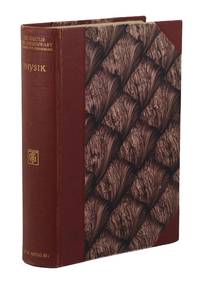
1915140945614Leipzig & Berlin: B.G. Teubner 1915. First edition. First edition. iv viii 762 8 pp. Bound in publisher's three quarter maroon cloth with marbled paper sides gilt spine lettering. Near Fine with rubbing along edges; a few marks to prelims text otherwise free of markings; hint of foxing to edges. Bookplate on paste down. <p>A German-language physics review with the first book publication of two articles by Albert Einstein as well as work by a number of famous physicists of the early 20th century. B.G. Teubner unknown
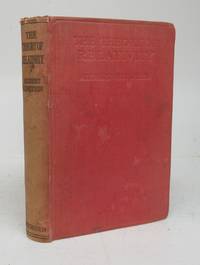
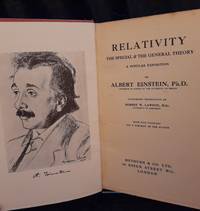
1920134847London: Methuen & Co 1920. First UK Edition. Hardcover. Good. xiii 3 138 2 8 p. 20 cm. 5 diagrams and frontispiece portrait of the author. Red cloth with blank impressing on front black print on spine. Some soiling to covers corners bumped spine faded small tears in spine head. Front pastedown has bookplate for Brenda Mary O'Keefe and small chip to edge. Offsetting to free endpapers. Front hinge cracking internally. A few stains within. 8 p. of Methuen publications listed at rear. <br/><br/>First edition of the authorized translation into English of the "popular exposition" of Einstein's theory of relativity. Includes third appendix on "The Experimental Confirmation of the General Theory of Relativity" written by Einstein specially for this edition at the request of the translator. First published in German in 1916 "Relativity" gives readers an insight into the thought processes of one of the greatest minds of the 20th century. Methuen & Co hardcover
dola813New York: Henry Holt And Company 1920. First American Edition. The English translation contains an additional chapter 'Appendix III The Experimental Confirmation of the General Theory of Relativity.' See Printing and the Mind of Man 408. 8vo. pp. xiii 168. frontis. portrait. biblio. index. cloth spine ends just beginning to fray. Very good copy New York: Henry Holt And Company, 1920 hardcover
193332820627<p>Original wrappers. Price neatly blacked out at lower corner. Tiny chip from back wrapper. Very good.</p><p>FIRST EDITION.</p><p>This scarce collection of Einstein's writings on war and peace was published in 1933 the year the Nazis took power in Germany and the year Einstein left Germany for the United States. In his prefatory note Einstein writes "Mr. Lief the editor Alfred Lief has taken great trouble in collecting utterances of mine having pacifistic content and he presents them with my authorization. … I consider it my duty to confess my pacific conviction publicly. May the seriousness of my purpose be transferred to you my readers! A. Einstein."</p> John Day paperback
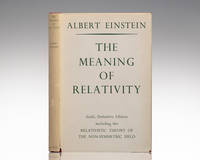
1956149754London: Methuen & Co. Ltd 1956. Sixth edition of Einstein's clear and systematic exposition of the theory of relativity with the ownership stamp on the front and rear pastedowns "Stephen Hawking Newton Institute University of Cambridge Cambridge England." Octavo original cloth. Translated By Edwin Plimpton Adams and Ernest G. Straus. Fine in a very good dust jacket. An exceptional association. In the book Einstein outlines both the special and general theories of relativity explaining their mathematical foundations and physical implications particularly regarding the nature of space time and gravitation. Designed for readers with a background in physics and mathematics the text serves as both a summary of Einstein’s groundbreaking contributions and an accessible guide to the conceptual shifts his theories introduced to modern science. The work remains a significant historical and intellectual document illustrating Einstein’s effort to communicate complex scientific ideas with clarity and precision. Methuen & Co. Ltd hardcover
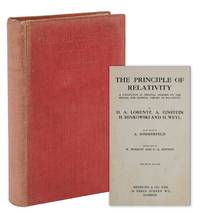
1923140949178London: Methuen & Co 1923. First Edition. Very Good. First British edition first printing. viii 216 8 ads pp. Bound in publisher's red cloth lettered in blind on front board and in gilt on spine; lacking the dust jacket. Very Good with fading light wear and soiling to covers. Evidence of bookplate removal to front pastedown offsetting to free endpapers rear hinge starting. Contents lightly toned with foxing to first and last few pages and textblock edges.<br /> <br /> <p>An influential collection of eleven papers on relativity. Seven are authored by Einstein two by Henrik Lorentz and one each by Hermann Minkowski and Hermann Weyl. The first edition of this translation of Das Relativitaetsprinzip taken from the fourth German edition. Methuen & Co unknown
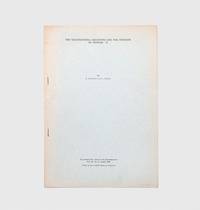
1907433121907. Offprint from "Zeitschrift für Elektrochemie" 1907. Single sheet pp. 41-42. 287 x 206 mm. Chipped several marginal tears some toning. Fair. First edition offprint issue. "In 1907 Einstein published a paper entitled 'Theoretical Observations on the Brownian Motion' in which he considered the instantaneous velocity of a Brownian particle. Einstein showed that by measuring this quantity one could prove that 'the kinetic energy of the motion of the center of gravity of a particle is independent of the size and nature of the particle and independent of the nature of its environment.' This is one of the basic tenets of statistical mechanics known as the equipartition theorem. However Einstein concluded that due to the very rapid randomization of the motion the instantaneous velocity of a Brownian particle would be impossible to measure in practice. "Einstein: The Formative Years. unknown
1906504131906. <p>Einstein Albert 1879-1955. Über eine Methode zur Bestimmung des Verhältnisses der transversalen und longitudinalen Masse des Elektrons. In Annalen der Physik 21 1906. 583-586pp. Figs. Text-illust. 214 x 140 mm. Laid-in item: notecard with penciled notes probably in the hand of Lord Rayleigh. Red cloth gilt spine. Frontis portrait of P. Curie d. 1906. Whole volume: viii 1056pp. 9 plates 5 b/w silver photos 4 folding. Small cut on spine starting approximately two inches from the head and is about three inches in length -very thin- otherwise Very Good. </p> <br /> <br /> <p>First Edition Whole Volume. In his landmark 1905 paper on special relativity Einstein used the velocity-dependent concepts of transverse and longitudinal mass for the moving electron these terms have now been replaced with the concept of relativistic mass first defined by Lewis and Tolman in 1909. In the present paper Einstein proposed an experimental method for determining the ratio of the transverse to the longitudinal mass and invited experimentalists to verify his special theory of relativity. Einstein later abandoned velocity-dependent mass concepts stating in 1948 that "it is better to introduce no other mass concept than the rest mass" quoted in L. B. Okun "The concept of mass" Physics Today 1989: 31-36. Lavenda A New Perspective on Relativity pp. 7-8. </p> <br /> <br /> <p>Weil's Einstein Bibliography no. 14. <br> Boni's Einstein Checklist no. 14</p> <br /> <br /> <p> John William Strutt third Baron Rayleigh Lord Rayleigh 1842-1919 was a british mathematician and physicist; he was one of the very few members of higher nobility who won fame as an outstanding scientist. Rayleigh was born as the son of John James Strutt second Baron and his wife Clara Elizabeth La Touche eldest daughter of Captain Richard Vicars R.E. Lord Rayleigh was awarded the 1904 Nobel Prize in Physics "for his investigations of the densities of the most important gases for his discovery of argon in connection with these studies." Rayleigh provided the first theoretical treatment of the elastic scattering of light by particles much smaller than the light's wavelength now known as "Rayleigh scattering" - a process which notably explains why the sky is blue. He also made extensive contributions to fluid dynamics e.g. the Rayleigh number critereon for the stability of the Taylor-Couette flow etc. Rayleigh also formulated the circulation theory of aerodynamic lift. His derivation of the Rayleigh-Jeans law for classical black body radiation played an important role in the birth of quantum mechanics i.e. the Ultraviolet catastrophe. During the first World War he was president of the United Kingdom government's Advisory Committee for Aeronautics. Notable students of the 3rd Lord Rayleigh include J.J. Thomson 1856-1940 and Sir William Ramsay 1852-1916 who was awarded the Nobel Prize in Chemistry in 1904 "in recognition of his services in the discovery of the elements in air." In 1871 he married Evelyn Balfour sister of the future prime minister the Earl of Balfour and daughter of James Maitland Balfour and his wide Blanche the daughter of the second Marquis of Salisbury. They had three sons the eldest of whom Robert John Strutt 1875-1946 was to become Professor of Physics at Imperial College of Science and Technology London. Strutt inherited the title of fourth Baron Rayleigh after his father's death in 1919. nobelprize.org. </p> <br /> <br /> <br /> <p> Also in this volume: Einthoven Willem 1860-1927. Weitere mitteilungen ueber das saitengalvanometer. Analyse der saitengalvanometrischen kurven. Masse und spannung des quarzfadens und widerstand gegen die fadenbewengung. Erster teil. In Annalen der Physik ser. 4 21 1906. 483-514 pp. <br> Willem Einthoven 1860-1927 was a Dutch doctor and physiologist who won the Nobel Prize in Physiology or Medicine in 1924 "for his discovery of the mechanism of the electrocardiogram" nobelprize.org. </p> . unknown
192919299Berlin: Verlag der Akademia der Wissenschaften in Kommission bei Walter de Gruyter 1929. FIRST EDITION. Original printed orange wrappers; a fine copy unopened and bound into morocco-backed cloth boards spine labeled in gilt. First edition first issue in the rare author’s offprint form with a newly set title-page. One of Einstein’s last important scientific works this publication of the unified field theory caused quite a sensation. It was the first separate printing of one of a series of five papers published between 1925 and 1929 in which Einstein attempted to develop a unified field theory reconciling in a single formula the laws of electromagnetism and gravitation.<br /> <br /> Weil 165; Printing & the Mind of Man 418. Verlag der Akademia der Wissenschaften in Kommission bei Walter de Gruyter unknown
1923432881923. <p>Einstein Albert 1879-1955 and Paul Ehrenfest 1880-1933. Zur Quantentheorie des Strahlungsgleichgewichts. Offprint from Zeitschrift für Physik 19 1923. 301-306pp. Original printed self-wrappers. 230 x 157 mm. Light toning but very good.</p> <p>First Edition Offprint Issue. In 1916 after publishing his great work on general relativity Einstein returned to the question of blackbody radiation. In November 1916 he wrote to his friend Besso that "a splendid light has dawned on me about the absorption and emission of radiation" quoted in Pais p. 405 one that led him to a new derivation of Planck's radiation law and convinced him of the reality of light-quanta photons. After publishing these results in three papers culminating with the famous "Zur Quantentheorie der Strahlung" 1917 Einstein kept looking for "new ways in which the existence of photons might lead to observable derivations from the classical picture" Pais p. 413. He found none until 1923 when Arthur Compton and Peter Debye independently derived the relativistic kinematics for the scattering of a photon off an electron at rest. The work of Compton and Debye led Wolfgang Pauli to extend Einstein's work of 1917 to the case of radiation in equilibrium with free electrons see Pais p. 414n. "Pauli examined the requirements of detailed balance under Lorentz transformations and found that scattering of light by free electrons must include a term of a form which we would now call stimulated emission . . . Einstein and Ehrenfest then showed that Pauli's results could be obtained by an extension of Einstein's 1917 paper with the unnecessary specialization to discrete energy levels removed . . . The core of Einstein's argument is that the scattering process should be broken into two parts: the absorption of energy from radiation of frequency 1 and the emission of energy as radiation of frequency 2" Lewis p. 42. Lewis "Einstein's derivation of Planck's radiation law" American Journal of Physics 41 1973: 38-44. Pais Subtle is the Lord ch. 21. Weil Albert Einstein Bibliography 138.</p> . unknown
192225530Braunschweig & Berlin Germany: Friedr. Vieweg & Sohn/Julius Springer 1922 1923 1924. First Edition. Hardcover. Very Good. Alexander Alexandrovich Friedmann 1888-1925 was a Russian mathematician and physicist who built upon Einstein's theory of relativity and further expanded his own theories that the universe has both homogeneous looks the same from every location and isotropic looks the same in every direction. The following articles expand upon these theories: "Über die Krümmung des Raumes" "On the Curvature of Space" by Alexander Friedmann Zeitschrift für Physik 10 pp. 377-386 1922. "Notiz du der Arbeit von A. Friedmann ‘Über die Krümmung des Raumes'" "Note on the work of A. Friedmann ‘On the Curvature of Space'" by Albert Einstein Zeitschrift für Physik 16 p. 228 1923. "Über die Möglichkeit einer Welt mit konstanter negativer Krümmung des Raumes" "On the possibility of a world with constant negative curvature of space" by Alexander Friedmann Zeitschrift für Physik 21 pp. 326-332 1924. Volume 10: iv 413 pp. 8vo; Volume 16: iv 409 1 pp. 8vo; Volume 21: iv 382 pp 8vo. Each volume is ex-library with brown patterned paper boards lighter brown cloth spines and corner tips; gold embossed titling to spine. Library stamps within including stamps on title page of each volume very clean with card pocket remaining on the rear pastedown of each volume. All text in German. Friedr. Vieweg & Sohn/Julius Springer hardcover books
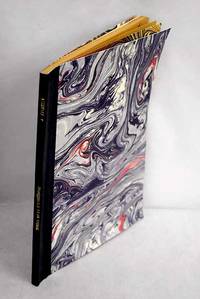
19212545920Madrid. 1921. Hardcover. Cubierta deslucida. Good. 24 cm. 79 p. Encuadernación en tapa dura artesanal con lomo en piel. Einstein Albert 1879-1955. Über die spezielle und die allgemeine Relativitätstheorie. Traducida de la 12ª ed. alemana por F. Lorente de Nó. Imp. de Suc. de S. Peláez. Relatividad Física . Cubierta deslucida. Física.530.12 530 hardcover
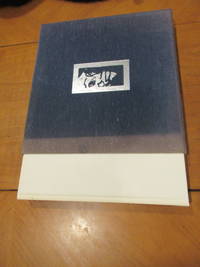
1982059692Harry N. Abrams Inc. 1982. 2nd Edition . Hardcover. Fine/Slipcase. 296 Pp. Beige Cloth Stamped In Silver And In Blind. Second Edition. The Deluxe Issue #57 Of 150 Copies Numbered Signed By Sam Francis And In Special Slipcase Of Thick Tsumugi Silk. Fine With A Few Faint And Tiny Spots Of Foxing Around Fore Edges Of Front And Rear Covers Of Book. Slipcase Shows Fading Of Blue Silk Around Both Ends. <br/> <br/> Harry N. Abrams, Inc. hardcover
1906602Leipzig: Barth 1906. 1st Edition. Hardcover. Fine. FIRST EDITION of two important Einstein papers including one of the two papers on his Noble Prize winning work on the photoelectric effect. On the Theory of Light Production and Light Absorption: A continuation and development of Einstein's revolutionary first paper in 1905 on the photoelectric effect "On a Heuristic Point of View about the Creation and Conversion of Light". "In a companion paper to "On a Heuristic Point." published in 1906 Einstein exposed appeal to the quantum as fundamentally counter to the ethos of classical physics: 'the theoretical bases on which Planck's radiation theory rests are different from those of Maxwell's theory'. Planck had not initially intended to quantify light-radiation itself but Einstein demonstrated that his own 'light-quantum hypothesis' was implicit in Planck's earlier work. In viewing radiation not as a continuous wave but as composed of small packets of energy later called photons Einstein was again shaking the foundations of classical physics" Honner The Description of Nature 31. Particle Physics: One Hundred Years of Discoveries: "Corpuscular-wave dualism for photons. Explanation of the photoelectric effect using the quantum hypothesis of Planck. Nobel prize to A. Einstein awarded in 1921 'for services to Theoretical Physics and especially of he law of the photoelectric effect.'" Weil 12. The Principle of Conservation of Motion of the Center of Gravity and the Inertia of Energy: Einstein's further development of E=mc2. Einstein boldly uses his relationship to insist that the conservation of mass is a special case of the conservation of energy and broadens the law to include not only mechanical but electromagnetic processes as well. Weil 13. IN: Annalen der Physik Vol. 20 pp. 199-206; 627-633. Leipzig: Barth 1906. Octavo modern full green morocco. Rippling to the first few leaves of volume not affecting Einstein papers. Provenance: with library stamp on series title from the prestigious Gmelin Institute after 1996 part of the Max Planck Institute. Very handsomely bound. Barth hardcover books
19212827000Madrid.: S.n. 1921. Paperback. Good. 24 cm. 79 p. Encuadernación en tapa blanda artesanal. Einstein Albert 1879-1955. Über die spezielle und die allgemeine Relativitätstheorie. Traducida de la 12ª ed. alemana por F. Lorente de Nó. Imp. de Suc. de S. Peláez. Relatividad Física . Física.530.12 530 [S.n.]. paperback
1k7854Institut International de Coopèration Intellectuelle Paris 1933. 56 Seiten kartoniert etwas gebräunt und teils unaufgeschnitten. - Text in Englisch/Nr. 797 von 2000 numerrierten Exemplaren - unknown
191376293Leipzig ; Berlin : Teubner 1913. 1st Edition 1st Edition 38 S. ; 25cm Halbleinen [3 Warenabbildungen] 0
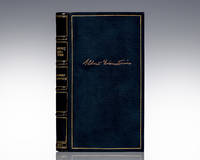
1931150006New York: The MacMillan Company 1931. First edition of this volume of Einstein's speeches and letters concerning his views on Zionism. Octavo bound in full morocco by the Harcourt Bindery with gilt titles and tooling to the spine in five compartments within raised gilt bands gilt ruling to the front and rear panel gilt signature to the front panel gilt inner dentelles stamp-signed by the Harcourt Bindery marbled endpapers all edges gilt. In fine condition. Translated and edited with an introduction by Leon Simon. An exceptional presentation. Einstein was a prominent supporter of both Labor Zionism and efforts to encourage Jewish-Arab cooperation. He supported the creation of a Jewish national homeland in the British mandate of Palestine but was opposed to the idea of a Jewish state "with borders an army and a measure of temporal power." In a letter to Jawaharlal Nehru dated June 13 1947 he asserted "Long before the emergence of Hitler I made the cause of Zionism mine because through it I saw a means of correcting a flagrant wrong.The Jewish people alone has for centuries been in the anomalous position of being victimized and hounded as a people though bereft of all the rights and protections which even the smallest people normally has.Zionism offered the means of ending this discrimination." Einstein's speeches lectures and letters concerning Zionism were first published in 1930 by The Soncino Press and eleven of these essays were later collected in The World as I See It published in 1933 which Einstein dedicated "to the Jews of Germany". The MacMillan Company unknown
1906003208Leipzig: J. A. Barth 1906. First Edition. Contemporary Red Cloth. Very Good. J. A. Barth Hardcover
1920001806<p>London: Methuen & Co. Ltd 1920. 1st Edition . Hardcover. Good. First English Translation. 8vo xiii pp138 complete with b/w frontis portrait of the author and 8 pages of publisher's adverts to rear. hardcover no dust jacket. Publishers red cloth binding with blind-stamped titles to front board and black titles to spine gilt totally rubbed off in good condition with sunning to spine some shelf wear to top & tail of spine and bumping to tips of boards. Inside cracked in a couple of places with front board a little loose but binding still sound and solid with a little yellowing to pages a few discreet notes and sums to page 115-118 with the occasional mark to pages and some spotting to fore edge. Overall a good copy of this scarce 1st edition. <br /><br /></p> Methuen & Co. Ltd hardcover
1940180281Princeton: Princeton University Press 1940. Elucidating the Einstein-Infeld-Hoffman equations First edition offprint issue of Einstein's last major contribution to the general theory of relativity. It formed part of his mathematical investigations into the structure of the theory which he spent the latter part of his life refining. "During the development of the general theory Einstein had intended to hold fast to the conservation of energy and momentum in the usual special relativistic sense as far as possible. At the same time he was driven by other considerations toward the idea that the laws should be generally covariant. These two desires proved mutually incompatible. The problem of the equation of motion of bodies is the following. The 1916 theory had a classical structure in the sense that there were both field equations the curvature of space-time is determined by the mass and motion of bodies in space-time and equation of motion of bodies the world line of small mass is a geodesic. Einstein showed that if matter is represented by a point singularity of the metric field these singularities are located on world lines that are geodesics of space time provided its metric satisfies the equation of general relativity" DSB IV p. 329. The first part of the paper was published in 1938. Large octavo pp. 10. Original wrappers wire-stitched as issued front cover printed in black. Wrappers gently toned: a near-fine copy. Boni 236.1; Weil 205. unknown
188748810Leipzig, Barth, 1887-91. 8vo. No wrappers. 4 papers. In: ""Annalen der Physik und Chemie. Hrsg. von G. Wiedemann"", Neue Folge, Bd. XXX, No. 4, XXXI, No 6, XXXII, No. 11, XLIV, No. 11. - Pp. 545-704 a. 1 plate, pp. 145-336 a. 1 plate, pp. 337-528 a. 1 plate, pp. 385-576 a. 1 plate. With titlepge to vol. XXX, htitlepage to vol. XXXI, titlepage to vol. XXXII and titlepage to vol. XLIV. Titlepages with a stamp and on verso. Planck's papers: pp. 562-582, pp. 189-203, pp. 462-503 and pp. 385-428. Clean copies.
188748810Leipzig Barth 1887-91. 8vo. No wrappers. 4 papers. In: "Annalen der Physik und Chemie. Hrsg. von G. Wiedemann" Neue Folge Bd. XXX No. 4 XXXI No 6 XXXII No. 11 XLIV No. 11. - Pp. 545-704 a. 1 plate pp. 145-336 a. 1 plate pp. 337-528 a. 1 plate pp. 385-576 a. 1 plate. With titlepge to vol. XXX htitlepage to vol. XXXI titlepage to vol. XXXII and titlepage to vol. XLIV. Titlepages with a stamp and on verso. Planck's papers: pp. 562-582 pp. 189-203 pp. 462-503 and pp. 385-428. Clean copies. <br/><br/><em>First appearance of all 4 papers constituting Planck's seminal papers on entropy carrying the general title "On the principles of Increase of Entropy" in which he applied the second law of thermodynamics to chemical problems."His goal was as he said in the first paper of the series to carry further the "grand generalization" of Helmholtz Josiah Willard Gibbs and others: like the first principle of the mechanical heat theory the second the "Carnot-Clausius" principle applies not only to heat phenomena but to all kinds of physical and chemical phenomena; and because the second principle applies not only to reversible processes but also to irreversible or "natural" processes it applies to all processes whatsoever."Jungnickel and McCormach "Intellectual Mastery of Nature vol. 2 pp. 52 ff.What Einstein admired and called Planck's "first great scientific discovery" was the generality of its formulas which contain all that can be derived from pure thermodynamic principles. Einstein referred to the third paper in this series with the title "Gesetze des Eintritts beliebiger thermodynamischer und chemischer Reactionen"Akademie Nos. 8910 and 20. </em> unknown
1944182569London: The Jewish Agency for Palestine 1944. First separate edition of Einstein's appeal for Zionism. Einstein was one of the most prominent international supports of Zionism. He argues Palestine is the only place historically spiritually and culturally tied to the Jewish people. Whereas the Arabs with many homelands the Jews have nowhere else to go. Their claims are rooted not in conquest or nationalism but in justice and survival. The article was originally published in the Princeton Herald earlier that year. This publication prints the article alongside other speeches and letters by Einstein extracted from his 1930 About Zionism. Provenance: Jews' College Library London with their shelf mark to the front wrapper and their stamp to the front wrapper verso. Octavo. Original wrappers. Library markings see note a little creased and spotted. A good copy. unknown
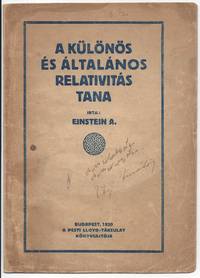
19201870Budapest: A Pesti Lloyd-Társulat Könyvsajtója 1920. First separate edition. Offprint of Természettudományi Közlöny. In publisher’s printed wrappers. Cover chipped at extremities. Restored rear panel replaced with cardboard similar to original. Old ownership inscriptions on front panel. Contemporary notes and underlines throughout in pen and pencil. Pages discolored due to the acidic paper. Overall in good condition. First separate edition. Offprint of Természettudományi Közlöny. In publisher’s printed wrappers. 2 19 1 p. <p><br /> First Hungarian edition of Einstein’s Über die spezielle und allgemeine Relativitätstheorie Braunschweig 1917 published as an extract.<br /> <p><p><br /> Offprint of Természettudományi Közlöny. One of the earliest Hungarian publications of Einstein’s works. <br /> <p>. A Pesti Lloyd-Társulat Könyvsajtója unknown