1 505 résultats
190238799Leipzig Ambrosius Barth 1902. Contemp. hcloth. First hinge broken. = "Annalen der Physik. Vierte Folge. Band 9." VIII1344 pp. and 5 plates. The Einstein Paper: pp. 417-435. Internally clean and fine. The whole volume offered. <br/><br/><em>First edition of Einstein's third paper. - Weil No 3. - The volume contains 2 papers by Max Planck originally published in "Jubelband für H.A. Lorentz" und Jubelband für J. Bosscha: "Ueber die von einem elliptisch schwingenden Ion emitterte und absorbierte Energie;" und "Ueber die Verteilung der Energie zwischen Aether und Materie;" pp. 619-628 und pp. 629-641. </em> hardcover
190947376Braunschweig Friedrich Vieweg und Sohn 1909. 8vo. Bound in contemporary half calf with gilt lettering to spine. In "Verhandlungen der Deutsche Physikalische Gesellschaft" 11 Jahrgang 1909. Reprinted same year in "Physikalische Zeitschrift 10". Bound with "Berichte der Deutschen Physikalischen Gesellschaft" 7 Jahrgang 1909. Capitals and hindges with wear. Internally very fine and clean. Pp. 482-500. Entire volume: 2 749 3 VII 450 pp. <br/><br/><em>First printing of Einstein's famous lecture in which he anticipated the discovery of black-body radiation and famously stated that: "the next phase in the development of theoretical physics will bring us a theory of light which may be regarded as a sort of fusion of the undulatory and emission theories of light" The present paper Pp. 482-3. He furthermore stated that the electromagnetic fields that constitute light will no longer appear to be states of a hypothetical medium but rather independent entities emitted by the sources of light exactly as in the Newtonian emission theory of light. The paper was delivered as a lecture before the 81st assembly of the 'Gesellschaft Deutscher Naturforscher' in Salzburg on 21st September 1909.The occasion was important for Einstein since he for years had been working in scientific exile. Among those who attended Einstein's lecture were some of the world's foremost physicists such as; Max von Laue Max Born Arnold Sommerfeld. All published papers of their own in the present volume. Weil No. 30. </em> unknown
190238799Leipzig, Ambrosius Barth, 1902. Contemp. hcloth. First hinge broken. (=) ""Annalen der Physik. Vierte Folge. Band 9."", VIII,1344 pp. and 5 plates. The Einstein Paper: pp. 417-435. Internally clean and fine. The whole volume offered.
1923433151923. Offprint from Sitzungsberichte der preussischen Akademie der Wissenschaften 1923. 359-364pp. 254 x 184 mm. Original printed wrappers. Very good. First Edition offprint issue. Weil Albert Einstein Bibliography 137. unknown books
1941433111941. Offprint from Universidad Nacional de Tucuman Revista Serie A 2 1941. 11-15pp. 270 x 179 mm. Original printed wrappers. Very good. "Address to joint meeting of the American Physics Society and the American Association of Physics Teachers Princeton Dec. 29 1941 under the title: 'Solutions of finite mass of the gravitational equations'" Weil. Weil Albert Einstein Bibliography 208. unknown books
1921433071921. Offprint from "Der Festschrift der Kaiser Wilhelm Gesellschaft zur Förderung der Wissenschaften zu ihrem 10jährigen Jubiläum" Berlin: Julius Springer 1921. 50-52pp. 260 x 175 mm. Original printed wrappers a little chipped. Very good. First separate edition. Title translation: A simple application of Newton's law of gravitation to globular clusters. Weil Albert Einstein Bibliography 117. unknown books
1938165146Paris 1938. paperback. Pp. 5-19 IN: Zeitschrift fur Freie Deutsche Forschung. Jahrgang 1 Nummer 1. Herausgegeben von der Freien Deutschen Hochschule in Paris. 168p. printed wrappers. Paris Juli 1938.<br/><br/> First number of this scarce short-lived exile publication featuring German & Austrian writers and scholars. Fine.<br/><br/> unknown books
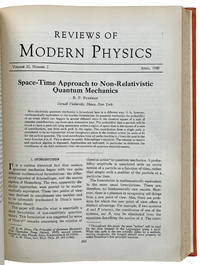
1948S10249Lancaster:: American Physical Society 1948. 1948. Large 8vo. 266 x 205 mm. iv 728 pp. Frontis. port. of Robert Andrews Millikan photos figs. tables. Later orange cloth gilt-stamped spine title; spine faded. Very good. TWO PAPERS FROM THE TWO GIANTS OF 20TH CENTURY PHYSICS AS THEY WERE ORIGINALLY PUBLISHED IN ONE COLLECTED VOLUME. Einstein's "Generalized Theory of Gravitation" is considered the last principal work issued by the 20th Century's premiere scientist. Schilpp-Shields. <br /><br /> Einstein: "A new presentation. . . which constitutes a certain progress in clarity as compared with previous presentations." from the Introduction. Feynman: "At first Feynman's fundamental article RMP 1948 did not arouse much interest among theoretical physicists who were not familiar with Feynman's new approach to doing quantum mechanics. As Feynman recalled: 'At the Shelter Island Conference. . . they asked me if I would explain my path-integral method for doing quantum mechanics so I did. I must have been preparing the manuscript for my paper RMP 1948 so that everything was organized and I explained it. It's hard to pay attention to some new idea and they didn't pay much attention to it.' However nowadays Feynman's RMP 1948 paper is one of the most well-known and widely cited papers; it is one of the cornerstones of modern theoretical physics." Mehra. <br /><br /> "It is a curious historical fact that modern quantum mechanics began with two quite different mathematical formulations: the differential equation of Schroedinger and the matrix algebra of Heisenberg. . . This paper will describe what is essentially a third formulation of non-relativistic quantum theory. This formulation was suggested by some of Paul Dirac's remarks concerning the relation of classical action to quantum mechanics. A probability amplitude is associated with an entire motion of a particle as a function of time rather than simply with a position of the particle at a particular time." from the Introduction. Provenance: David Middleton b. 1920 noted pioneer in the field of statistical communication theory last name gilt-stamped on spine. Einstein: Boni-Russ-Laurence 258; Schilpp-Shields 308 also see p. 758; Wasson Nobel Prize Winners p. 289-294; Weil 222 marked with asterisk by Weil. Feynman: Gleick Genius: The Life and Science of Richard Feynman p. 249; Mehra The Beat of a Different Drum: The Life and Science of Richard Feynman p. 200; Wasson Nobel Prize Winners p. 316-319. American Physical Society, 1948. hardcover books
191450425Leipzig: Johann Ambrosius Barth 1914. 1 Einstein Albert 1879-1955 and A.driaan D.aniël Fokker 1887-1972. Die Nordströmsche Gravitationstheorie vom Standpunkt des absoluten Differentialkalküls. In Annalen der Physik 44 10: 321-328. 2 Born Max 1882-1970. Zur Raumgitter theorie des Diamanten. In Annalen der Physik 44 12: 605-642. 3 Schrödinger Erwin Rudolf Josef Alexander 1887-1961. Zur Dynamik elastisch gekoppelter Punktesysteme. In Annalen der Physik 44 14: 916-934. Leipzig: Johann Ambrosius Barth 1914. </p> <br /> <br /> <p>Whole volume: viii 1272 pp. 22 plates Numbered Taf. I-XXII. Taf. I-IX: b/w/ silver photos; Taf. XI w/ one b/w silver photo; Taf. XII is folding and XIII XIV are b/w silver photos; Taf. XV and XVI are large folding tables; Taf. XVII XVIII XIX b/w/ silv.photos; and Taf.XX--XXII are photographs of X-ray images. Figs. Text-illust. 210 x 140 mm. Red cloth gilt lettering on spine. Very good. Along the margin of p. 802 written in pencil are the words: "Mallock R.S. 1910" probably written in Lord Rayleigh's hand most likely in reference to the title "The dampening of sound by frothy liquids" by A. Mallock in Proc. R.S. Lond ser. A vol. 84: 391-94. London 1911. </p> <br /> <br /> <p> A.D. Fokker 1887-1972 was a Dutch physicist and cousin to aeronautical engineer Anthony Fokker 1890-1939. He was musically inclined having invented the 31EDO pipe organ. He earned his doctorate in 1913 continuing his studies with Albert Einstein Ernest Rutheford 1871-1937 and William Bragg 1862-1942. In his 1913 thesis he derived the Fokker-Planck equation with Max Planck 1858-1947. Fokker made contributions to special relativity and general relativity particularly the effects of the curvature of space-time formally called "geodetic precession". Wikipedia.</p> . Johann Ambrosius Barth unknown
1923433151923. Offprint from Sitzungsberichte der preussischen Akademie der Wissenschaften 1923. 359-364pp. 254 x 184 mm. Original printed wrappers. Very good. First Edition offprint issue. Weil Albert Einstein Bibliography 137. unknown
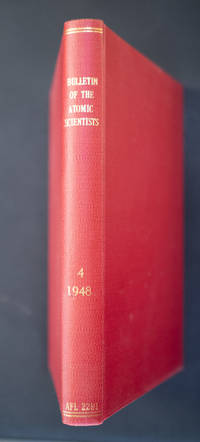
19486625Chicago: The Atomic Scientists of Chicago 1948. Original edition. Ex-library. Very Good. 28 cm; 384 pages. Cloth-bound volume of 12 issues. Duplicate surplus stamp of Library of Congress on front free endpaper. Later owner's stamp on free endleaves blacked out. <br /><br />Lively forum of discussion of various scientific social and political implications of atomic energy as the post-war radioactive dust settled over the Pacific and wherever else open-air tests of atomic weaponry took place. Opens with Einstein's "Plea for International Understanding." Issue #2 features a written debate between Einstein and four Soviet scientists Semyonov Vavilov Frumkin and Ioffe. A scenario describes the potential effect of an atomic bomb on Washington DC. Justice William O. Douglas contributes "Democracy and Communism." Harry Truman presents a "Message to the Atomic Scientists." Other contributors include Cardinal Cushing Thomas E. Dewey Max von Laue and many other scientists and statesmen involved in the post-war debates The Atomic Scientists of Chicago hardcover
1941433111941. Offprint from Universidad Nacional de Tucuman Revista Serie A 2 1941. 11-15pp. 270 x 179 mm. Original printed wrappers. Very good. "Address to joint meeting of the American Physics Society and the American Association of Physics Teachers Princeton Dec. 29 1941 under the title: 'Solutions of finite mass of the gravitational equations'" Weil. Weil Albert Einstein Bibliography 208. unknown
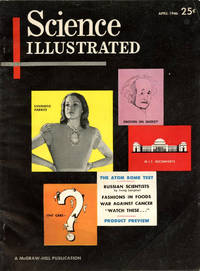
19461576McGraw-Hill 1946. 1st Edition. IN ORIGINAL WRAPPERS THE FIRST PUBLICATION BY EINSTEIN OF THE FAMILIAR EQUATION E=mc2 IN THAT SPECIFIC FORM. Eight months after Hiroshima the editors of Science Illustrated turned to Albert Einstein to explain "the form of the energy that destroyed Hiroshima;" "to explain in his own words what takes place in the operation of his law" Science Illustrated 1 1 pp. 17 April 1946. The editors believed that given the deployment of two nuclear weapons "average citizens" wanted at least a layman's understanding of the mathematical law that enabled atomic explosions so that they were better able to understand the destruction the bombs unleashed ibid.<br /> <br /> <br /> <br /> The mathematical equation or law in question was one Einstein published in 1905 in his Theory of Special Relativity but the form in which it was then written was longer and more complex. In the paper offered here Einstein presents the equation we all now know a shorter more understandable derivation of his equation based upon the law of the conservation of momentum the pressure of radiation and the aberration of light: E = mc2. In layman's terms Einstein also explains the equivalence of mass and energy and discusses the profound ‘urgent' implications of his principle ibid.<br /> <br /> <br /> <br /> In this article Einstein writes: "‘What takes place can be illustrated with the help of our rich man. The atom M is a rich miser who during his life gives away no money energy. But in his will he bequeaths his fortune to his sons M' and M'' on condition that they give to the community a small amount less than one thousandth of the whole estate energy or mass. The sons together have somewhat less than the father had the mass sum M' M'' is somewhat smaller than the mass M of the radioactive atom. But the part given to the community though relatively small is still so enormously large considered as kinetic energy that it brings with it a great threat of evil. Averting that threat has become the most urgent problem of our time" ibid. CONDITION & DETAILS: Complete issue bound in its original wrappers. 4to. pp. 1-128. Very slighy scuffing to the front wrap. There are no address labels. Bright and very clean throughout. McGraw-Hill unknown
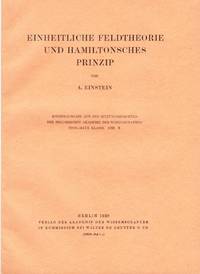
19296551Berlin: Verlag der Akademie der Wissenschaften in Kommision bei Walter de Gruyter U. Co 1929. First separate edition. Fine. 6 pages in printed wraps. <br /><br />Not exactly an "offprint" since the pages are numbered from 1 and the pamphlet is given its own title page this is considered the first separate edition of a paper Einstein published in the periodical of the Prussian Academy. It is considered Einstein's initial effort having established general and special relativity to find a unified theory uniting gravity and electromagnetism a problem he struggled with for his remaining life. Verlag der Akademie der Wissenschaften in Kommision bei Walter de Gruyter U. Co paperback
1938165146Paris 1938. paperback. Pp. 5-19 IN: Zeitschrift fur Freie Deutsche Forschung. Jahrgang 1 Nummer 1. Herausgegeben von der Freien Deutschen Hochschule in Paris. 168p. printed wrappers. Paris Juli 1938.<br/> <br/> First number of this scarce short-lived exile publication featuring German & Austrian writers and scholars. Fine.<br/> <br/> unknown
191850342Leipzig 1918. Prinzipielles zur allgemeinen relativitätstheorie. In Annalen der Physik 55 241-244 pp. Red cloth with gilt lettering on the spine. Bookbinder's embossed stamp of ffep. Whole volume: 632 pp. 1 folding plate. Figs. Text-illust. 210 x 130 mm. Very good. Approximate English translation of title: "On the foundations of the general theory of relativity."</p> <br /> <br /> <p> "Here we are given the first new presentation of the foundations of general relativity since the developments of March 1916 when Einstein gave his first systematic exposition." p. 300. Calaprice Kennefick & Shulmann. An Einstein Encyclopedia. 2015. </p> <br /> <br /> <p>Weil's Einstein Bibliography no. 96. <br> Boni's Checklist no. 100.</p> <br /> <br /> <p>Also in this volume: Born Max 1882-1970. Elektronentheorie des Natürlichen optischen Drehungs vermögens isotroper und anisotroper Flüssigkeiten pp. 175-240. Approximate Eng. translation of title: "Electron theory of the natural optical rotation ability of isotropic and anisotropic liquids". Max Born 1882-1970 was a German physicist and mathematician who was instrumental in the development of quantum mechanics. He also made contributions to solid-state physics and optics as well as supervised a number of notable physicists in the 1920s and 1930s. Born won the 1954 Nobel Prize in Physics "for his fundamental research in quantum mechanics especially in the statistical interpretation of the wave function." In 1919 a chance meeting with Fritz Haber 1868-1934 led to the discussion of how an ionic compound is formed when a metal reacts with a halogen - a process now known as the Born-Haber cycle Wikipedia. </p> . unknown
1945BOOKS 53604 IVery clean sound book apart from small owner's ink stamp front endpaper. Jacket shows wear to the extremities with slight loss affecting the last letter in the author's name but front and back panels quite nice. Not price-clipped. Princeton Univ Press Princeton 1945 1st edition Hardcover Cloth 8vo. i 135pp. Index. Buff cloth gilt. In publisher's jacket. First printing so indicated by "1945" on the title and copyright pages of the second edition. With appendix to the second edition. Princeton Univ Press hardcover
191150424Leipzig: Johann Ambrosius Barth 1911. The Genesis of General Relativity<p>Einstein Albert 1879-1955. 1 Elementare betrachtungen über die thermische molekularbewengung in festen Körpern. In Annalen der Physik 35 9: 679-94 pp. Weil 42. 2 Über den Einfluß der Schwerkraft auf die Ausbreitung des lichtes. In Annalen der Physik 35 10: 898-908 pp. Weil 43. Red cloth gilt spine lettering. Figs. Text-illust. 214 x 140 mm. Whole volume: viii 1040 pp. 6 plates 3 b/w silver photos 1 colorized 2 folding. Very good. </p> <p>Approximate English translations of titles: 1 "Elementary considerations about thermal molecular motion in solid bodies" and 2 "On the influence of gravity on the propagation of light." </p> <br /> <br /> <p>"Einstein returns to his thoughts on gravitation and discusses his ideas on the static gravitational field no. 1 above advancing the "half-shift" prediction of the deflection of light by a massive body such as the Sun. In his early papers on the subject . . . he used two important features: the principle of equivalence and the role of the speed of light. In this paper he takes a broader perspective saying that if a light beam is bent in an accelerating frame of reference then if the theory is correct it must also be besnt by gravity by exactly the equivalent amount." Calaprice An Einstein Encyclopedia.</p> <p>"An important conclusion of this paper is that the velocity of light in a gravitational field is a function of the place. The equation: </p> <p> c = c01 / c2</p> <p> signifies that there exists a relationship between the velocity of light and the gravitational potential; the latter influences the first." Weinstein Einstein's 1912-1913 struggles with Gravitation Theory: Importance of Static Gravitational Fields Theory. </p> <br /> <br /> <p>"Here no. 2 above Einstein continues the work he had begun in 1907 on the specific heat of solids where the heat agitation of solids was reduced to a monochromatic oscillation of the atom and the specific heat was determined based on the quantum treatment of an oscillator in a radiation field. He explains the discrepencies between his formula and the measurements at low temperatures" Calaprice An Einstein Encyclopedia. </p> <br /> <br /> <p>Weil's Einstein Bibliography nos. 42 and 43. Boni's Einstein Checklist nos. 38 39. </p> . Johann Ambrosius Barth unknown
191315188Leipzig Berlin: D. G. Teubner 1913. First edition. Wraps as issued. Very Good. Leipzig: Berlin Teubner 1913. First edition in original yellow wraps. 89 pp. Very good. Small chip at heel of spine else an exceptional copy. Fortschritte der Mathematischen Wissenschaften in Monographien Heft 2 First edition of this pivotal work; 3 articles by Lorentz; the famous 2 articles by Einstein 'Zur Elektrodynamik bewegter Körper' 1905; Minkowski's article 'Raum und Zeit' 1908 in which paper he proposes "the concept of time as the fourth dimension. With new notes by A. Sommerfeld 5 pp and foreword by O. Blumenthal series editor. D. G. Teubner paperback
19751403301975. Signiert. Im Stein monogrammiert. Druck auf Japan. 24,8 x 35,8 cm. Papier: 35 x 44,5 cm.
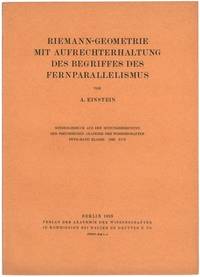
1928270901928. S.Ber. Akad. Wiss. Berl. 1928/17. - Berlin Verlag der Akademie der Wissenschaften 1928 8° 7 S. orig. Broschur. First Edition; the rare off-print from the "Sitzungsberichte". 'The general relativity theory splendidly justified his work. In this mathematical apparatus developed from Riemann's address Einstein found the frame to fit his physicals ideas his cosmology and cosmogeny; and the spirit of Riemann's address was just what physics needed: the metric structure determined by physical data'. -cf. DSB XI 447-456 Riemann Weil No.161; Schilpp-Shields No. 217; Alicke No. 139. unknown
1949041384New York: The Library Of Living Philosophers 1949. 1st Edition 1st Printing. Hardcover. Near Fine/Fair. Xvi 781 Pp. Blue Cloth Gilt. Stated First Edition. First Printing Of Einstein's Autobiography With Text In Both German And English; First Publication Of Major Essays On Einstein And An Important Discussion With Niels Bohr. Book Is Near Fine Gilt Brilliant Lightly Used Previous Owner's Name Under Front Flap. Dust Jacket Priced $8.50 Very Worn Interior And Exterior Clear Tape Reinforcement Along Front Spine Edge Entirely Separated Along Rear Spine Edge Small Chips And Tears With Chipping Removing Part Of Einstein's First Name And Most Of Volume Number On Spine No Other Losses Of Lettering. <br/> <br/> The Library Of Living Philosophers hardcover
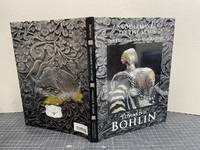
1997091521-KSeattle WA.: University of Washington Press 1997. Book. Illus. by Susan Einstein. Fine. Hardcover. Inscribed by Authors. 1st Edition. 1st. Edition 1997 Black cloth hardcover with silver lettering to the front board and spine 223 page book. Photo illustrated in color plates by Susan Einstein . Edward Bohlin was the Western Leather and Silver designer maker to all the top western actors and studios . Inscribed by James H. Nottage to Los Angeles Mayor Tom Bradley signed on the title page . A very scarce book on this artist and signed by the author to the Mayor of LA. Condition : FINE Size: Folio - over 12 - 15" tall. University of Washington Press Hardcover
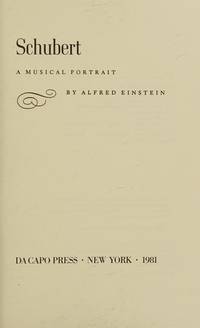
19811BislDb0036New York: Da Capo Press Inc. 1981. Book. Like New. Decorative Hardcover Canvas. © 1981. 8vo or 8° Medium Octavo: 7¾" x 9¾" tall. 343 pp. A rare hard-to-find out-of-print collectible gem! A wonderful copy! An excellent spotlessly clean copy! Clean fresh sharp tight essentially flawless copy with crisp pages clean text and very light shelf wear. No dust jacket. Da Capo Press, Inc. Hardcover
193081582Paris: Calmann Lévy 1930. Fine. Calmann Lévy Paris 1930 22 x 27.50 cm broché First edition of this issue of this important journal dealing notably with archaeology fine arts and ethnography and whose principal editors were Georges Bataille and Carl Einstein. A small tear at the foot of the spine a slight tear without loss at the foot of pages 21-22. Contributions by Heinrich Ehl: ""L'heure de naissance de l'art européen occidental"" Georges Bataille ""La mutilation sacrificielle et l'oreille coupée de Vincent Van Gogh"" Michel Leiris: ""Le ""caput mortuum"" ou la femme de l'alchimiste"" Jean Bourdeillette: ""Franz Xaver Messerschmidt"" Zdenko Reich: ""Le massacre des porcs"" Carl Einstein: ""L'enfance néoloithique Hans Arp"" Jacques Prévert Maurice Leenhardt. Issue illustrated with photographs by Jacques-André Boiffard. Calmann Lévy unknown