1 505 résultats
1951041150New York: Tudor Publishing Company 1951. 2nd Edition 1st Printing. Hardcover. Near Fine/Very Good DJ. Xvi 781 Pp. Blue Cloth Gilt. Second Edition With Bibliography Brought Up To 1951. Contains Einstein's Autobiography With Text In Both German And English; And Major Essays On Einstein Including An Important Discussion With Niels Bohr. Book Is Near Fine Gilt Brilliant Hinges Tight Touch Of Rubbing At Corners Bookplate Of Philosophy Professor David R. Luce And His Name Stamps On Rear Endpapers. Dj With Light Usage A Small Tape Reinforcement To Inside Of Dj At Spine With No Visible Trace On Outside A Few Small Edge Tears And Chips Fading To Spine Panel <br/> <br/> Tudor Publishing Company hardcover
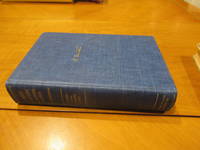
1949041325New York: The Library Of Living Philosophers 1949. 1st Edition 1st Printing. Hardcover. Near Fine/No Jacket. Xvi 781 Pp. Blue Cloth Gilt. Stated First Edition. First Printing Of Einstein's Autobiography With Text In Both German And English; First Publication Of Major Essays On Einstein And An Important Discussion With Niels Bohr. Book Is Near Fine Gilt Brilliant Lightly Used. Short Owner's Last Name On Front Pastedown. Light Browning To Endpapers As Usual. Small Dampstain At Bottom Of Text Block Adjacent To Spine. <br/> <br/> The Library Of Living Philosophers hardcover
1949041384New York: The Library Of Living Philosophers 1949. 1st Edition 1st Printing. Hardcover. Near Fine/Fair. Xvi 781 Pp. Blue Cloth Gilt. Stated First Edition. First Printing Of Einstein's Autobiography With Text In Both German And English; First Publication Of Major Essays On Einstein And An Important Discussion With Niels Bohr. Book Is Near Fine Gilt Brilliant Lightly Used Previous Owner's Name Under Front Flap. Dust Jacket Priced $8.50 Very Worn Interior And Exterior Clear Tape Reinforcement Along Front Spine Edge Entirely Separated Along Rear Spine Edge Small Chips And Tears With Chipping Removing Part Of Einstein's First Name And Most Of Volume Number On Spine No Other Losses Of Lettering. <br/> <br/> The Library Of Living Philosophers hardcover
1969043016New York ./ La Salle Ilk / Cambridge Uk: The Library Of Living Philosophers / Open Court / Cambridge University Press 1969. 3rd Edition 1st Printing. Hardcover. Very Good/Very Good. Xviii 781 Pp. Blue Cloth Gilt. Stated Third Edition Newly Corrected And With Updated Bibliography. Includes Einstein's Autobiography With Text In Both German And English; Major Essays On Einstein; And An Important Discussion With Niels Bohr. Covers Near Fine Gilt Bright No Marks Small Browned Area On Front Free Endpaper From A Loose Clipping About Einstein's Bequests. Dj Clean And Bright Light Chipping And Small Tears At Edges No Loss Of Lettering Or Design. <br/> <br/> The Library Of Living Philosophers / Open Court / Cambridge University Press hardcover
1923958901923. Etch bust of Albert Einstein done by well-known artist Hermann Struck. Signed by both Einstein and Struck numbered 49/150. In fine condition. Double matted and framed the entire piece measures 12.25 inches by 15 inches. An exceptional piece. Hermann Struck was a German Jewish artist known for his etchings. In 1908 Struck published "Die Kunst des Radierens" "The Art of Etching" which became a seminal work on the subject. His students included Marc Chagall Lovis Corinth Jacob Steinhardt Lesser Ury and Max Liebermann. Struck did commissioned portraits of Albert Einstein Ibsen Nietzsche Freud Herzl Oscar Wilde among others. unknown
197978271Interlibrium 1979-01-01. Hardcover. Like New. As new cream colored hardcover #172 of limited edition no jacket as issued. Please email for photos. Interlibrium hardcover
1952720911952. Rare original black and white silver gelatin photograph of Albert Einstein. Signed "A Einstein 52." Full-length group portrait showing Albert Einstein standing with Hadassah National President Rebecca Beldner Shulman and others at his Princeton home in June of 1952 during a celebration marking the commencement of building of the Hadassah-Hebrew University Medical Center in Jerusalem. The photograph measures 8 inches by 9.5 inches. Double matted and framed. The entire piece measures 19 inches by 20.5 inches. An exceptional piece. Albert Einstein developed the general theory of relativity one of the two pillars of modern physics alongside quantum mechanics. Einstein's work is also known for its influence on the philosophy of science. Einstein is best known in popular culture for his mass–energy equivalence formula E = mc2 which has been dubbed "the world's most famous equation". He received the 1921 Nobel Prize in Physics for his "services to theoretical physics" in particular his discovery of the law of the photoelectric effect a pivotal step in the evolution of quantum theory David Bodanis. unknown
1979608620Interlibrium 1979. Catalogue 278 in the Printing and the Progress of Man series; cover soiled/rubbed corners lightly rubbed/bumped spine ends lightly bumped; edges lightly soiled; ffep has erasures; binding tight; cover edges and interior intact and clean except as noted. hardcover. Good. Interlibrium hardcover
194931509Evanston Ill: Library of Living Philosophers 1949 Book Date 1949. 1st Edition. No Binding. Clamshell As New/No Jacket. 1st Edition. No Binding. First Edition Clamshell Case. Albert Einstein. ALBERT EINSTEIN: PHILOSOPHER-SCIENTIST. Edited by Paul Arthur Schilpp. Evanston Ill.: Library of Living Philosophers 1949. First Trade Edition. Superb Custom Fitted Modern Collector's Clamshell Not A Book HAND-CRAFTED by our conservation team each case features a gilt stamped spine title piece & signature cut on the upper cover both on maroon leather. The clamshell case is finished in fine black cloth & black Nuba®. Nuba® is a fine supple & durable covering with a neutral ph that has the feel of velvety soft Italian Nubuck® leather. An excellent Collector's Custom Case for this uncommon Einstein. Other Einstein Cases are readily available. TBCL Web Site photo/link available for OVER 100 generally in-stock titles. Book definitely NOT included. Custom Craft available. Library of Living Philosophers, [1949, Book Date] unknown
1992DADAX0691087601Princeton University Press 1992-05-05. First Edition. hardcover. New. 6.50x0.75x9.75. Buy with confidence. Excellent Customer Service & Return policy. Princeton University Press hardcover
1979309856PRINCETON: PRINCETON UNIVERSITY PRESS. Fine with no dust jacket. 1979. Poster. Promotional POSTER. 17 1/2" X 22 1/2" Fine on a single printed sheet. Splendid illustrated portrait of Einstein on tan-colored paper set against the heading- "The Albert Einstein Centennial 1879-1979." Suitable for framing. . PRINCETON UNIVERSITY PRESS. unknown
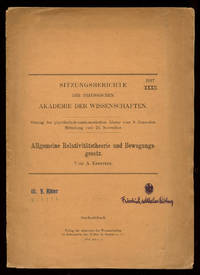
19271663Berlin: Verlag der Akademie der Wiss 1927. 1st Edition. FIRST EDITION OFFPRINT ISSUE IN ORIGINAL PAPER WRAPS VERY GOOD CONDITION. "Einstein and Grommer's work treats the particle as a singularity in the field and attemptss to obtain the equations of motion by imposing conditions on the exterior field in the neighborhood of the singularity" Stachel Einstein from ‘B' to'Z' pp. 507. Weil 155.<br /> <br /> In 1927 Einstein's research "concentrated on a new approach to the problem of the motion of particles in a general field theory" Mehra The Golden Age of Theoretical Physics 997. He presented his work conducted with Jakob Grommer in this report.<br /> <br /> Einstein and Grommer here show that ‘in the case of a pure gravitational field the mechanical behavior of singularities can be derived' a result which in Einstein's opinion ‘opened the possibility to obtain on the basis of the field equations a theory of matter characterized as discontinuities in space' ibid 997; Einstein and Grommer 1927.<br /> <br /> "After Einstein had tried for years to obtain a theory of material particles in a generalized field theory by describing these objects with the help of continuous functions Einstein and Grommer now proposed ‘to consider elementary particles as singular points or singular world lines respectively' motivated by the observation ‘that both the equations of the pure gravitational field and the equations augmented by Maxwell's electromagnetic field possess simple spherically-symmetric solutions which contain a singularity' ibid.<br /> <br /> Finally they arrived at the result: In the approximation of the gravitational field obtained by solving linearized equations the equation of motion for a singularity is completely determined - at least in the case of equilibrium - and corresponds to the law of a geodetic line" ibid. CONDITION & DETAILS: Berlin: Verlag der Akademie der Wiss. Pp. 2-13. Offprint in original wraps. 10 x 7.25 inches; 250 x 181mm. Toning at the edges & bearing the ownership stamp of "Friedrich Wilhelm Ritter" W. F. Ritter 1839-1929. Ritter had a large library. Very good condition. Verlag der Akademie der Wiss paperback
1927433031927. Offprint from Sitzungsberichte der preussischen Akademie der Wissenschaften 1927. 235-245pp. 255 x 183 mm. Original printed wrappers. Fine. On the problem of motion in general relativity theory; a follow-up to his and Grommer's paper of the same title published earlier in 1927. Weil Albert Einstein Bibliography 160. unknown
1927374151927. Offprint from S. preuss. Akad. Wiss. Weil 155. unknown
1921302276Leipzig Felix Meiner 1921. 1921. First edition. 8vo. Foreword by Raymund Schmidt. Articles by Oskar Kraus Friedrich Lepsius Paul F. Lincke Joseph Petzoldt. Text pages numbered 334-500. Original stiff green wrappers printed in black. Very good. Cover title: Zur Relativitatstheorie. Kraus' article entitled: "Fiktion und Hypothese in der Einsteinschen Relativitatstheorie.". 1st Edition. Soft cover. Very Good/No Jacket. Leipzig, Felix Meiner, 1921. paperback
19222081002109000573SPRINGER-VERLAG 1922. Soft Cover. Fine. Number of pages: 15 SPRINGER-VERLAG paperback
19201433Berlin: Julius Springer 1920. 1st Edition. FIRST EDITION IN ORIGINAL WRAPPERS OF EINSTEIN'S LEIDEN LECTURE EXPLAINING AT LENGTH HIS THEORY OF THE ETHER ALONG WITH THOSE OF LORENTZ & MAXWELL. Very good condition. "Einstein's lecture at the University of Leiden on the occasion of his appointment as a visiting professor summarized his current views on the ether and retrospectively looked at the development of his opinions on the physical properties of space" Calaprice The Einstein Almanac 86. <br /> <br /> In this lecture Einstein recanted his earlier denial of the ether writing: "Recapitulating we may say that according to the general theory of relativity space is endowed with physical qualities; in this sense therefore there exists an ether. According to the general theory of relativity space without ether is unthinkable; for in such space there not only would be no propagation of light but also no possibility of existence for standards of space and time measuring-rods and clocks nor therefore any space-time intervals in the physical sense. But this ether may not be thought of as endowed with the quality characteristic of ponderable media as consisting of parts which may be tracked through time. The idea of motion may not be applied to it" Einstein Ather 1920. <br /> <br /> In this lecture Einstein also sought "to reconcile his theory of relativity with his mentor's Lorentz's cherished concept of the aether. Einstein stressed that special relativity took away the last mechanical property of Lorentz's aether: immobility. However he continued that special relativity does not necessarily rule out the aether because the latter can be used to give physical reality to acceleration and rotation. This concept was fully elaborated within general relativity in which physical properties which are partially determined by matter are attributed to space but no substance or state of motion can be attributed to that "aether" aether = curved space-time" Wikipedia. CONDITION & DETAIL: Berlin Julius Springer 1920. Complete in original cream colored wrappers. 8vo. 22 x 15cm. 15pp. Slight toning. Very good condition. <br /> <br /> ITEM: Ather und Relativitätstheorie. Rede gehalten am 5. Mai 1920 an der Reichs-Universität zu Leiden. Julius Springer unknown
1930433061930. Offprint from Mathematische Annalen 102 1930. 685-697pp. Original printed self-wrappers. 233 x 157 mm. Very good apart from small split in lower spine. Weil Albert Einstein Bibliography 171. unknown
19794445103<p>24cm by 18cm 89pp white dustjacket lightly soiled unmarked.</p> Open Court Publishing Company hardcover
1999Q-0812691792Open Court 1999-01-06. Paperback. New. In shrink wrap. Looks like an interesting title! Open Court paperback
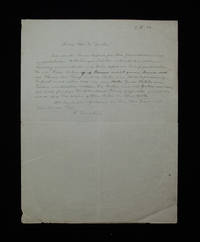
192468960Berlin 1924. Berlin: 1924.<br> <br> Full Description:<br> <br> EINSTEIN Albert. Autograph Letter Signed. Berlin: 9. IX September 1924.<br> <br> Autograph letter signed "A. Einstein" to Mr. Zeisler. One quarto page 11 x 8 1/2 inches; 280 x 217 mm. Manuscript letter on recto verso blank. With one horizontal center crease and one vertical center crease as expected in a letter. A few other light creases. Some minor chipping along edges. A closed split along horizontal crease not affecting manuscript. Overall very good.<br> <br> This letter with text in German is addressed to "Herr Dr. Zeisler" Sigmund Zeisler an German-Jewish U.S. attorney born in Austria. He was known for his defense of radicals in Chicago in the 1880s also known as the Haymarket Affair. His wife was the famous concert pianist Fannie Bloomfield Zeisler. Some unproven sources have said that Zeisler was Einstein's lawyer but regardless it is known that he and Einstein were good friends and had much correspondence over the years. According to "The Collected Papers of Albert Einstein" published by Princeton University Einstein was in correspondence during the 1920s with Zeisler regarding various American investments. According to a letter from Zeisler to Einstein on October 15 1921 "Zeisler had invested $4300 in American shares on Einstein's behalf in October 1921. He subsequently informed Einstein of the accumulated interest." Einstein wrote another letter in April of 1924 asking Zeisler to transfer American investments to his daughter and soon to be son-in-law as a dowery. Zeisler was to ensure the interest was paid on an annual basis to his daughter. In this present letter just six months later Einstein is thanking Zeisler for doing "many good things" and stating that he looks forward to seeing him again in Berlin.<br> <br> Translated by an outside party:<br> <br> "9. IX. 24. Dear Dr Zeisler Many thanks for your friendly and clearly stateed letter. Of course I agree with the offer. I immediately wrote the letter. Since I don;t know the exact address I an sending you the letter and ask that you forward it. It pleases me that we shall see each other again in Berlin. You have done many good things for which I thank you. I know that you have done these things gladly since you are a good person. Regards to you your wife and to your sons. A. Einstein."<br> <br> HBS 68960.<br> <br> $7500. Berlin unknown
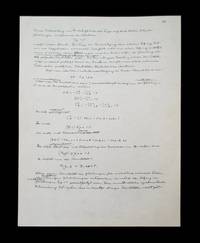
194069509n.p. 1940. n.p.: 1940.<br> <br> Full Description:<br> <br> EINSTEIN Albert. Autograph Manuscript in Pen. n.p. n.d ca: 1940.<br> <br> Autograph manuscript in German in Einstein's hand. Manuscript is on the "Unified Field Theory" and is a draft from his published article "A Generalization of the Relativistic Theory of Gravitation." One quarto page 11 x 8 1/2 inches; 280 x 217 mm. Manuscript in black ink on recto verso blank. With 31 lines of manuscript text in German including over 180 words and eleven equations. Because this is a working document there are numerous revisions on the page. He strikes through and makes additions in eight places. At the top right corner the page is numbered "6" in his hand. Leaf is very lightly toned but generally about fine. It is quite rare to find manuscripts of Einstein works that has been published. Housed in a full morocco clamshell.<br> <br> "A Generalization of the Relativistic Theory of Gravitation" was an article written by Einstein in German and translated into English for publication by his assistant E.G. Straus in approximately 1945. The article was long and so it was divided in two parts. The present leaf comes from Part II and the translated text is on pages 735-736 of the published article.<br> <br> "The published translation appears to follow this original manuscript very closely and without alteration. In this section of his paper Einstein is discussing the field equations for the Hamiltonian operator which plays a central role in the equations of motion for General Relativity and is defined in terms of the metric tensor and its conjugate momenta; and in this particular page of the paper Einstein is here considering the implications of embracing a stronger form of the field equations." University Archives<br> <br> During the course of World War II Einstein came to the conclusion that the General Theory of Relativity was the proper basis for the development of Unified Field Theory; and using this framework he explored the implications of using new and complex forms of number within Unified Field Theory. The publication of this article marked the beginning of Einstein's final approach to Unified Field Theory an approach which Einstein pursued until the end of his life. University Archives .<br> <br> HBS 69509.<br> <br> $45000. n.p. unknown
19432376<p>Princeton NJ: np 1943. First edition. nb. Fine. EINSTEIN OFFERS STRONG AND PRESCIENT WORDS OF ENCOURAGEMENT TO THE LEADER OF THE NAACP IN THE FIGHT AGAINST RACIAL SEGREGATION AND DISCRIMINATION IN THE UNITED STATES. Background: Einstein's fight against racial discrimination in the United States:<br /><br />The imperative "to protect the rights of the individual. was Einstein's most fundamental political tenet. Individualism and freedom were necessary for creative art and science to flourish. Personally politically and professionally he was repulsed by any restraints. <br /><br />"That is why he remained outspoken about racial discrimination in America. As a Jew who had grown up in Germany Einstein was acutely sensitive to such discrimination. 'The more I feel an American the more this situation pains me' he wrote in an essay called 'The Negro Question' for the January 1946 issue of Pageant magazine. 'I can escape the feeling of complicity in it only by speaking out.'" Isaacson Albert Einstein 505. <br /><br />Even more directly in his 1946 commencement speech to Lincoln University the first degree-granting Historically Black College and University HBCU in the United States Einstein strongly denounced segregation as "an American tradition which is uncritically handed down from one generation to the next" noting that "There is separation of colored people from white people in the United States. That separation is not a disease of colored people. It is a disease of white people. I do not intend to be quiet about it." <br /><br />This remarkable letter - from 1943 - is one of the earliest examples of his interest in condemning racism in the United States. <br /><br />The letter:<br /><br />Dated 22 September 1943 and handwritten on his embossed Mercer Street Princeton letterhead Einstein writes in English to Walter F. White the enormously influential African-American civil rights leader who led the NAACP from 1929-1955 praising him for his work and revealing his own awareness of and frustrations with racism and prejudice in America. <br /><br />The text reads in full:<br /><br />Dear Mr. White:<br /><br />I have been quite impressed by the address you delivered some years ago at a meeting of the Princeton Branch of the National Association for the Advancement of Colored People. I know how hard it is to awaken the conscience even of good-hearted and well-meaning people when deep rooted prejudices are in the way. It is a great work indeed which you are doing relentlessly for the betterment of the living conditions of our Colored fellow-citizens for justice and for the accomplishment of national unity of the American people.<br /><br />With sincere respect and kind wishes<br /><br />Yours <br />Albert Einstein<br /><br />-------------<br /><br />On April 28 1940 White was the keynote speaker at "an inter-racial meeting sponsored by the Princeton branch of the National Association for the Advancement of Colored People" where his topic was "What Happens to Democracy When It Encounters the Color Line." Princeton Herald April 26 1940. At the time Princeton did not admit African Americans and the community was debating the question of whether or not to end segregation at the university. Princeton in fact did not admit its first African-American student until the fall of 1947. <br /><br />Einstein - writing in 1943 - notes that he heard White speak "some years ago". Something clearly must have deeply impressed Einstein about White's speech for him to write this thoughtful letter to White over three years after the event.<br /><br />Note: In addition to its content this apparently unpublished letter is also remarkable for being one of the very few letters Einstein hand-wrote in English during this period as German was still very much his preferred tongue. <br /><br />Princeton: September 22 1943. One page on Einstein's embossed Mercer Street Princeton letterhead 7.25x10 in visible handsomely matted and framed with a photograph of Einstein. Fine condition.</p> np
1989Q-0517675773Random House Value Publishing 1989-01-13. Hardcover. New. New. In shrink wrap. Looks like an interesting title! Random House Value Publishing hardcover
191448163Braunschweig Vieweg & Sohn 1914. No wrappers. "Verhandlungen der Deutschen Physikalischen Gesellschaft im Jahre 1914. Hrsg. von Karl Scheel." 16. Jahrgang Nr. 16. Pp. 765- 834. Entire issue offered. With the general titlepage to 16. Jahrg. Titlepage stamped at foot. Einstein paper pp. 820-828. <br/><br/><em>First edition. In this paper "Contributions to quantum theory" two considerations are given which are interrelated by a common goal inasmuch as it is attempted to derive two of the most importent achievementss of quantum theory viz. Planck's radiation law and Nernst's third law of thermodynamics in a new manner. The proofs do not involve Boltzmann's equation and are thus based enterely on macroscopic thermodynamics. They do introduce however the quantum hupothesis. Einstein points out that the alleged 'proofs' which try to derive the theorem of Nernst from the mere fact that the heat capacity of all substances goes to zero at absolute zero temterature are not genuine. Cornelius Lanczos.Weil No 67. </em> unknown