Einstein, AlfredBiblio.com

1 803 résultats
1976Q-0306800462Da Capo Press 1976-08-21. Paperback. New. In shrink wrap. Looks like an interesting title! Da Capo Press paperback
1926700457.Gpaperback. Good. Access codes and supplements are not guaranteed with used items. May be an ex-library book. paperback
1969__3112590597De Gruyter 1969. Hardcover. New. 5th reprint edition. 172 pages. German language. 5.00x0.56x8.00 inches. De Gruyter hardcover
1970__3112590570De Gruyter 1970. Hardcover. New. 5th reprint edition. 172 pages. German language. 5.00x0.56x8.00 inches. De Gruyter hardcover
195684069Braunschweig: Friedr. Vieweg & Sohn. Fine. 1956. First Edition. Softcover. 8vo . We specialize in fine books in collectible condition. Orders are professionally packaged and shipped promptly. M40 . Friedr. Vieweg & Sohn paperback
3540878467.Gpaperback. Good. Access codes and supplements are not guaranteed with used items. May be an ex-library book. paperback
952575Braunschweig Friedr. Vieweg & Sohn 1956. 1. Auflage. Mit 6 Abbildungen. unknown
2008x-3540878467Springer Berlin 2008. Paperback. New. 7th edition. 174 pages. German language. 9.21x6.14x0.47 inches. Springer, Berlin paperback
001728Hard Cover. Publisher: Grosset & Dunlap 1967 Good HB Practical complete answers from students and deans on problems created by academic social emotional & financial pressures. hardcover
952659Written by Albert Einstein for an exhibition in memory of H. A. Lorentz and H. Kamerlingh Onnes in 1953 in Leiden. With a portrait of Lorentz and a photo of Lorentz and Einstein made in Leiden in 1921 by P. Ehrenfest. 8 text pages. Wrappers. unknown
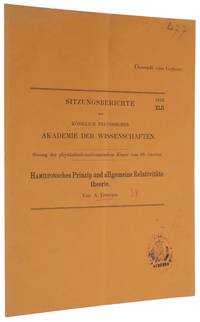
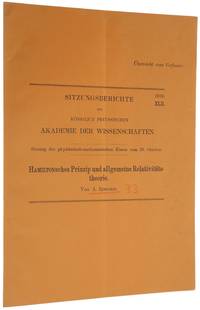
19166409Berlin: Königlichen Akademie der Wissenschaften 1916. First edition. <p>First editions extremely rare author's presentation offprint not to be confused with the much more common trade separate - see below from the library of the great German physicist Arnold Sommerfeld of Einstein's derivation of the field equations of gravitation from a variational principle. This was the first time Einstein had derived the field equations of gravitation in arbitrary coordinates - in his celebrated 1915 papers he derived the equations in generally-covariant form but only in special 'unimodular' coordinates.</p>. THE GRAVITATIONAL EQUATIONS FROM A VARIATIONAL PRINCIPLE. <p>First editions extremely rare author's presentation offprint not to be confused with the much more common trade separate - see below from the library of the great German physicist Arnold Sommerfeld of Einstein's derivation of the field equations of gravitation from a variational principle. This was the first time Einstein had derived the field equations of gravitation in arbitrary coordinates - in his celebrated 1915 papers he derived the equations in generally-covariant form but only in special 'unimodular' coordinates. In the early 19th century William Rowan Hamilton 1805-65 showed that Newton's equations of motion for a classical mechanical system were equivalent to the statement that the 'action' of the system now called the Lagrangian has a stationary value generally a minimum. A first variational approach to the gravitational field equations of general relativity was unsuccessfully sketched by Einstein and Marcel Grossmann in 1913-1914 and subsequently by Einstein himself in 1914 the so-called Entwurf Theory. But Einstein's 1914 theory was invalidated by a misconception related to the physically unjustified requirement of restricting the covariance of the gravitational field equations and by some mathematical errors in a crucial proof in the theory. Between March and May 1915 the Italian mathematician Tullio Levi-Civita 1873-1941 in his private correspondence with Einstein singled out the mathematical flaws of the Entwurf theory setting Einstein back on the path of general covariance which eventually brought him in November 1915 to the correct formulation of the gravitational field equations. Also in November 1915 the great German mathematician David Hilbert 1862-1943 published an article in which he correctly showed that Einstein's gravitational field equations could be obtained from a variational principle at least in the presence of an electromagnetic field. Five days later independently of Hilbert Einstein obtained in the present paper the same results thus obtaining the definitive variational formulation of the field equations. Einstein considered his approach to be more general than Hilbert's as Hilbert had made some hypotheses about matter which Einstein dispensed with Einstein also refused to accept the electromagnetic origin of matter which Hilbert had assumed. In the course of this paper Einstein also proved a special case of Emmy Noether's second theorem on the relation between symmetry and conservation laws which she published in full generality two years later. The only author's presentation offprint listed on RBH is that is the collection of Einstein's son Hans Albert Christie's 2006; it was not in Einstein's own collection of his offprints Christie's 2008.</p> <br /> <p>Provenance: Arnold Sommerfeld 1868-1951 his characteristic numbering in red pencil '34' on front cover; Institut für Theoretische Physik Munich ink stamp on upper cover. "The son of a physician Sommerfeld was educated at the University of Königsberg. After teaching briefly at the universities of Göttingen Clausthal and Aachen he was appointed professor of physics at the University of Münich in 1906. Sommerfeld should have retired in 1936 in favour of his pupil Werner Heisenberg. Opposition from the Nazi party to Heisenberg's appointment prolonged Sommerfeld's tenure and it was not in fact until late 1939 that he finally retired to be succeeded not by Heisenberg but by Wilhelm Müller a Nazi aerodynamicist without a single publication in physics to his credit. Although Sommerfeld and Heisenberg were not Jewish they were regarded by the Nazis as Jewish sympathizers. Sommerfeld however survived the war and returned to his Münich chair in 1945 continuing to work at physics until he died in a car accident in 1951" Oxford Reference. "Arnold Sommerfeld was one of the most distinguished representatives of the transition period between classical and modern theoretical physics. The work of his youth was still firmly anchored in the conceptions of the nineteenth century; but when in the first decennium of the century the flood of new discoveries experimental and theoretical broke the dams of tradition he became a leader of the new movement and in combining the two ways of thinking he exerted a powerful influence on the younger generation. This combination of a classical mind to whom clarity of conception and mathematical rigour are essential with the adventurous spirit of a pioneer are the roots of his scientific success while his exceptional gift of communicating his ideas by spoken and written word made him a great teacher" Max Born p. 275. </p> <br /> <p>"Einstein's first paper on a metric theory of gravity co-authored with his mathematician friend Marcel Grossmann was published as a separatum in early 1913 and was reprinted the following year in Zeitschrift für Mathematik und Physik. Most of the formalism of general relativity as we know it today was already in place in this Einstein-Grossmann theory. Still missing were the generally-covariant Einstein field equations .</p> <br /> <p>"In the fall of 1915 Einstein came to the painful realization that the 'Entwurf' field equations are untenable. Casting about for new field equations he fortuitously found his way back to equations of broad covariance that he had reluctantly abandoned three years earlier . on November 4 1915 presented the rediscovered old equations to the Berlin Academy. He returned a week later with an important modification and two weeks after that with a further modification .</p> <br /> <p>"When it was all over Einstein commented with typical self-deprecation: 'unfortunately I have immortalized my final errors in the academy-papers;' and 'it's convenient with that fellow Einstein every year he retracts what he wrote the year before.' What excused Einstein's rushing into print was that he knew that the formidable Göttingen mathematician David Hilbert was hot on his trail. Nevertheless these hastily written communications to the Berlin Academy proved hard to follow even for Einstein's staunchest supporters such as the Leyden theorists H. A. Lorentz and Paul Ehrenfest . Ehrenfest's queries undoubtedly helped Einstein organize the material of November 1915 for an authoritative exposition of the new theory .</p> <br /> <p>"In March 1916 Einstein sent his new review article 'Die Grundlage der Relativitätstheorie' to Wilhelm Wien editor of the Annalen . In this paper the field equations and energy-momentum conservation are not developed in generally-covariant form but only in special coordinates. Einstein had found the Einstein field equation in terms of these coordinates in November 1915. This part of the review paper is basically a sanitized version of the argument that had led Einstein to these equations in the first place .</p> <br /> <p>"As he was writing his review article he was already considering redoing the discussion of the field equations and energy-momentum conservation in arbitrary coordinates. In November 1916 he published such a generally-covariant account in the Berlin Sitzungsberichte the offered paper. This paper is undoubtedly much more satisfactory mathematically than the corresponding part of the review article but it does not offer any insight into how Einstein actually found his theory.</p> <br /> <p>Reading the offered paper without having read the November 1915 papers and the 1916 review article one easily comes away with the impression that Einstein hit upon the Einstein field equations simply by picking the mathematically most obvious candidate for the gravitational part of the Lagrangian for the metric field namely the Riemann curvature scalar. This is essentially how Einstein himself came to remember his discovery of general relativity. He routinely trotted out this version of events to justify the purely mathematical speculation he resorted to in his work on unified field theory.</p> <br /> <p>"In this paper he derived the generally-covariant field equations from an action principle with the Riemann curvature scalar as the Lagrangian . The present paper fills two important gaps in the review article. First Einstein derived the generally-covariant version of the Bianchi identities which in conjunction with the field equations imply energy-momentum conservation . Second Einstein showed that the identities guaranteeing energy-momentum conservation are a direct consequence of the covariance of the action functional. Einstein had thus in a mathematically impeccable way found a special case of one of Noether's theorems published two years later.</p> <br /> <p>"From a purely mathematical point of view the discussion of the field equations and energy-momentum conservation in the present paper is far more elegant than in the review article. This more elegant treatment however obscures the way in which Einstein found the Einstein field equations. It makes it look as if it was a matter ofpicking the most obvious candidate for the Lagrangian the Riemann curvature scalar at which point everything else fell into place. Ironically this is exactly what Einstein in his later years came to believe himself in part no doubt because it made his successful search for the field equations of general relativity look so similar to his fruitless search for a unified field theory. The clumsier discussion in unimodular coordinates in the review article however may serve as a reminder that-whatever he believed said or wrote about it later on-Einstein only discovered the mathematical high road to the Einstein field equations after he had already found these equations at the end of a poorly paved road through physics. Serving as road signs were Newton's gravitational theory Maxwell's electrodynamics and such key results of special relativity as the law of energy-momentum conservation. Considerations of mathematical elegance played only a subsidiary role" Janssen.</p> <br /> <p>This author's presentation offprint is of extreme rarity and must be distinguished from other so-called 'offprints' of papers from the Berlin Sitzungsberichte many of which are commonly available on the market. The celebrated bookseller Ernst Weil 1919-1981 in the introduction to his Einstein bibliography wrote: "I have often been asked about the number of those offprints. It seems to be certain that there were few before 1914. They were given only to the author and mostly 'Überreicht vom Verfasser' Presented by the Author is printed on the wrapper. Later on I have no doubt many more offprints were made and also sold as such especially by the Berlin Academy." If the term 'offprint' means as we believe it should a separate printing of a journal article given only to the author for distribution to colleagues then 'offprints' were not commercially available. Although there is certainly some truth in Weil's remark in our view it requires clarification and explanation.</p> <br /> <p>Until about 1916 most of Einstein's papers were published in Annalen der Physik; from 1916 until he left Germany for the United States in 1933 most were published in the Berlin Sitzungsberichte. The Sitzungsberichte differed from other journals in which Einstein published in that it made separate printings of its papers commercially available. These separate printings have 'Sonderabdruck' printed on the front wrapper the usual German term for offprint but they are not offprints according to our definition. They were available to anyone; indeed a price list of these 'trade offprints' is printed on the rear wrapper. True author's presentation offprints can be distinguished from these trade separates by the presence of 'Überreicht vom Verfasser' on the front wrapper.</p> <br /> <p>In the period 1916 to 1919 or 1920 the Sitzungsberichte trade separates are themselves rare. After 1919 or 1920 however the trade separates become much more common although the author's presentation offprints are still very rare. The reason for this change is that it was only in 1919 that Einstein became famous among the general public.</p> <br /> <p>It might seem obvious that Einstein's fame dates from 1905 his 'annus mirabilis' in which he published his epoch-making papers on special relativity and the light quantum. However these works did not make him immediately well known even in the physics community - many physicists did not understand or accept his work and it was two or three years before his genius was fully accepted even by his colleagues. Einstein did not secure an academic position until 1908. Among the general public Einstein became well known only in late 1919 following the success of Eddington's expedition to observe the bending of light by the Sun which confirmed Einstein's general theory of relativity. This was front-page news and made Einstein universally famous. See Chapter 16 'The suddenly famous Doctor Einstein' in Pais Subtle is the Lord for an account of these events. Before 1919 the trade separates of Einstein's papers would probably only have been purchased by professional physicists; after 1919 everyone wanted a memento of the famous Dr. Einstein whether or not they understood anything of theoretical physics and the trade separates of his papers were printed and sold in far greater numbers than before to meet the demand. It is telling that when these post-1919 trade separates appear on the market they are often in mint condition - they were never read simply because their owners were unable to understand them.</p> <br /> <p>BRL 90; Weil 88. Born 'Arnold Johannes Wilhelm Sommerfeld 1868-1951' Obituary Notices of Fellows of the Royal Society 8 1952 pp. 275-296. Janssen 'Einstein's First Systematic Exposition of General Relativity' 2004 .</p> <br/> <br/> 8vo 252 x 180 mm pp. 1111-1116. Original orange printed wrappers light vertical crease for posting. Königlichen Akademie der Wissenschaften unknown
19166408Berlin: Königlichen Akademie der Wissenschaften 1916. First edition. <p>First editions extremely rare author's presentation offprint not to be confused with the much more common trade separate - see below from the library of the great German physicist Arnold Sommerfeld of Einstein's derivation of the field equations of gravitation from a variational principle. This was the first time Einstein had derived the field equations of gravitation in arbitrary coordinates - in his celebrated 1915 papers he derived the equations in generally-covariant form but only in special 'unimodular' coordinates.</p>. THE GRAVITATIONAL EQUATIONS FROM A VARIATIONAL PRINCIPLE. <p>First editions extremely rare author's presentation offprint not to be confused with the much more common trade separate - see below from the library of the great German physicist Arnold Sommerfeld of Einstein's derivation of the field equations of gravitation from a variational principle. This was the first time Einstein had derived the field equations of gravitation in arbitrary coordinates - in his celebrated 1915 papers he derived the equations in generally-covariant form but only in special 'unimodular' coordinates. In the early 19th century William Rowan Hamilton 1805-65 showed that Newton's equations of motion for a classical mechanical system were equivalent to the statement that the 'action' of the system now called the Lagrangian has a stationary value generally a minimum. A first variational approach to the gravitational field equations of general relativity was unsuccessfully sketched by Einstein and Marcel Grossmann in 1913-1914 and subsequently by Einstein himself in 1914 the so-called Entwurf Theory. But Einstein's 1914 theory was invalidated by a misconception related to the physically unjustified requirement of restricting the covariance of the gravitational field equations and by some mathematical errors in a crucial proof in the theory. Between March and May 1915 the Italian mathematician Tullio Levi-Civita 1873-1941 in his private correspondence with Einstein singled out the mathematical flaws of the Entwurf theory setting Einstein back on the path of general covariance which eventually brought him in November 1915 to the correct formulation of the gravitational field equations. Also in November 1915 the great German mathematician David Hilbert 1862-1943 published an article in which he correctly showed that Einstein's gravitational field equations could be obtained from a variational principle at least in the presence of an electromagnetic field. Five days later independently of Hilbert Einstein obtained in the present paper the same results thus obtaining the definitive variational formulation of the field equations. Einstein considered his approach to be more general than Hilbert's as Hilbert had made some hypotheses about matter which Einstein dispensed with Einstein also refused to accept the electromagnetic origin of matter which Hilbert had assumed. In the course of this paper Einstein also proved a special case of Emmy Noether's second theorem on the relation between symmetry and conservation laws which she published in full generality two years later. The only author's presentation offprint listed on RBH is that is the collection of Einstein's son Hans Albert Christie's 2006; it was not in Einstein's own collection of his offprints Christie's 2008.</p> <br /> <p>Provenance: Arnold Sommerfeld 1868-1951 his characteristic numbering in red pencil '33' on front cover. "The son of a physician Sommerfeld was educated at the University of Königsberg. After teaching briefly at the universities of Göttingen Clausthal and Aachen he was appointed professor of physics at the University of Münich in 1906. Sommerfeld should have retired in 1936 in favour of his pupil Werner Heisenberg. Opposition from the Nazi party to Heisenberg's appointment prolonged Sommerfeld's tenure and it was not in fact until late 1939 that he finally retired to be succeeded not by Heisenberg but by Wilhelm Müller a Nazi aerodynamicist without a single publication in physics to his credit. Although Sommerfeld and Heisenberg were not Jewish they were regarded by the Nazis as Jewish sympathizers. Sommerfeld however survived the war and returned to his Münich chair in 1945 continuing to work at physics until he died in a car accident in 1951" Oxford Reference. "Arnold Sommerfeld was one of the most distinguished representatives of the transition period between classical and modern theoretical physics. The work of his youth was still firmly anchored in the conceptions of the nineteenth century; but when in the first decennium of the century the flood of new discoveries experimental and theoretical broke the dams of tradition he became a leader of the new movement and in combining the two ways of thinking he exerted a powerful influence on the younger generation. This combination of a classical mind to whom clarity of conception and mathematical rigour are essential with the adventurous spirit of a pioneer are the roots of his scientific success while his exceptional gift of communicating his ideas by spoken and written word made him a great teacher" Max Born p. 275. </p> <br /> <p>"Einstein's first paper on a metric theory of gravity co-authored with his mathematician friend Marcel Grossmann was published as a separatum in early 1913 and was reprinted the following year in Zeitschrift für Mathematik und Physik. Most of the formalism of general relativity as we know it today was already in place in this Einstein-Grossmann theory. Still missing were the generally-covariant Einstein field equations .</p> <br /> <p>"In the fall of 1915 Einstein came to the painful realization that the 'Entwurf' field equations are untenable. Casting about for new field equations he fortuitously found his way back to equations of broad covariance that he had reluctantly abandoned three years earlier . on November 4 1915 presented the rediscovered old equations to the Berlin Academy. He returned a week later with an important modification and two weeks after that with a further modification .</p> <br /> <p>"When it was all over Einstein commented with typical self-deprecation: 'unfortunately I have immortalized my final errors in the academy-papers;' and 'it's convenient with that fellow Einstein every year he retracts what he wrote the year before.' What excused Einstein's rushing into print was that he knew that the formidable Göttingen mathematician David Hilbert was hot on his trail. Nevertheless these hastily written communications to the Berlin Academy proved hard to follow even for Einstein's staunchest supporters such as the Leyden theorists H. A. Lorentz and Paul Ehrenfest . Ehrenfest's queries undoubtedly helped Einstein organize the material of November 1915 for an authoritative exposition of the new theory .</p> <br /> <p>"In March 1916 Einstein sent his new review article 'Die Grundlage der Relativitätstheorie' to Wilhelm Wien editor of the Annalen . In this paper the field equations and energy-momentum conservation are not developed in generally-covariant form but only in special coordinates. Einstein had found the Einstein field equation in terms of these coordinates in November 1915. This part of the review paper is basically a sanitized version of the argument that had led Einstein to these equations in the first place .</p> <br /> <p>"As he was writing his review article he was already considering redoing the discussion of the field equations and energy-momentum conservation in arbitrary coordinates. In November 1916 he published such a generally-covariant account in the Berlin Sitzungsberichte the offered paper. This paper is undoubtedly much more satisfactory mathematically than the corresponding part of the review article but it does not offer any insight into how Einstein actually found his theory.</p> <br /> <p>Reading the offered paper without having read the November 1915 papers and the 1916 review article one easily comes away with the impression that Einstein hit upon the Einstein field equations simply by picking the mathematically most obvious candidate for the gravitational part of the Lagrangian for the metric field namely the Riemann curvature scalar. This is essentially how Einstein himself came to remember his discovery of general relativity. He routinely trotted out this version of events to justify the purely mathematical speculation he resorted to in his work on unified field theory.</p> <br /> <p>"In this paper he derived the generally-covariant field equations from an action principle with the Riemann curvature scalar as the Lagrangian . The present paper fills two important gaps in the review article. First Einstein derived the generally-covariant version of the Bianchi identities which in conjunction with the field equations imply energy-momentum conservation . Second Einstein showed that the identities guaranteeing energy-momentum conservation are a direct consequence of the covariance of the action functional. Einstein had thus in a mathematically impeccable way found a special case of one of Noether's theorems published two years later.</p> <br /> <p>"From a purely mathematical point of view the discussion of the field equations and energy-momentum conservation in the present paper is far more elegant than in the review article. This more elegant treatment however obscures the way in which Einstein found the Einstein field equations. It makes it look as if it was a matter ofpicking the most obvious candidate for the Lagrangian the Riemann curvature scalar at which point everything else fell into place. Ironically this is exactly what Einstein in his later years came to believe himself in part no doubt because it made his successful search for the field equations of general relativity look so similar to his fruitless search for a unified field theory. The clumsier discussion in unimodular coordinates in the review article however may serve as a reminder that-whatever he believed said or wrote about it later on-Einstein only discovered the mathematical high road to the Einstein field equations after he had already found these equations at the end of a poorly paved road through physics. Serving as road signs were Newton's gravitational theory Maxwell's electrodynamics and such key results of special relativity as the law of energy-momentum conservation. Considerations of mathematical elegance played only a subsidiary role" Janssen.</p> <br /> <p>This author's presentation offprint is of extreme rarity and must be distinguished from other so-called 'offprints' of papers from the Berlin Sitzungsberichte many of which are commonly available on the market. The celebrated bookseller Ernst Weil 1919-1981 in the introduction to his Einstein bibliography wrote: "I have often been asked about the number of those offprints. It seems to be certain that there were few before 1914. They were given only to the author and mostly 'Überreicht vom Verfasser' Presented by the Author is printed on the wrapper. Later on I have no doubt many more offprints were made and also sold as such especially by the Berlin Academy." If the term 'offprint' means as we believe it should a separate printing of a journal article given only to the author for distribution to colleagues then 'offprints' were not commercially available. Although there is certainly some truth in Weil's remark in our view it requires clarification and explanation.</p> <br /> <p>Until about 1916 most of Einstein's papers were published in Annalen der Physik; from 1916 until he left Germany for the United States in 1933 most were published in the Berlin Sitzungsberichte. The Sitzungsberichte differed from other journals in which Einstein published in that it made separate printings of its papers commercially available. These separate printings have 'Sonderabdruck' printed on the front wrapper the usual German term for offprint but they are not offprints according to our definition. They were available to anyone; indeed a price list of these 'trade offprints' is printed on the rear wrapper. True author's presentation offprints can be distinguished from these trade separates by the presence of 'Überreicht vom Verfasser' on the front wrapper.</p> <br /> <p>In the period 1916 to 1919 or 1920 the Sitzungsberichte trade separates are themselves rare. After 1919 or 1920 however the trade separates become much more common although the author's presentation offprints are still very rare. The reason for this change is that it was only in 1919 that Einstein became famous among the general public.</p> <br /> <p>It might seem obvious that Einstein's fame dates from 1905 his 'annus mirabilis' in which he published his epoch-making papers on special relativity and the light quantum. However these works did not make him immediately well known even in the physics community - many physicists did not understand or accept his work and it was two or three years before his genius was fully accepted even by his colleagues. Einstein did not secure an academic position until 1908. Among the general public Einstein became well known only in late 1919 following the success of Eddington's expedition to observe the bending of light by the Sun which confirmed Einstein's general theory of relativity. This was front-page news and made Einstein universally famous. See Chapter 16 'The suddenly famous Doctor Einstein' in Pais Subtle is the Lord for an account of these events. Before 1919 the trade separates of Einstein's papers would probably only have been purchased by professional physicists; after 1919 everyone wanted a memento of the famous Dr. Einstein whether or not they understood anything of theoretical physics and the trade separates of his papers were printed and sold in far greater numbers than before to meet the demand. It is telling that when these post-1919 trade separates appear on the market they are often in mint condition - they were never read simply because their owners were unable to understand them.</p> <br /> <p>BRL 90; Weil 88. Born 'Arnold Johannes Wilhelm Sommerfeld 1868-1951' Obituary Notices of Fellows of the Royal Society 8 1952 pp. 275-296. Janssen 'Einstein's First Systematic Exposition of General Relativity' 2004 .</p> <br/> <br/> 8vo 252 x 180 mm pp. 1111-1116. Original orange printed wrappers light vertical crease for posting. Königlichen Akademie der Wissenschaften unknown
H3998Berlin Akademie der Wissenschaften 1915 In: Sitzungsberichte der Königl.Preuss. Akademie der Wissenschaften Band 1916/2. 4to. S.1111-1117. Weitere Berichte von Born M.; Schroeder Tangl Struve u.a. Halbleinenband der Zeit leicht berieben Bibl.-Nr.am Rücken Original-Broschur miteingebunden unaufgeschnitten gutes Exemplar. unknown
199116712Iowa City IA: Iowa Institute of Hydraulic Research University of Iowa 1991. First edition. Trade Paperback Original. Very good. Thin octavo standard size. Slight wear to edges and corners. 112 p. w/ illustrations appendices references. A short joint biography by Roboz Einstein focusing on their marriage and HAE's own achievements in hydraulic engineering. Includes an short biography of HAE's mother Mileva Einstein-Maric by Dord Krstic written at Roboz Einstein's request. <br/><br/> Iowa Institute of Hydraulic Research, University of Iowa paperback
1341653439.Ghardcover. Good. Access codes and supplements are not guaranteed with used items. May be an ex-library book. hardcover
0883650819New. hardcover. New. Satisfaction Guaranteed or your money back. hardcover
1974Q-0883650819Galahad Books 1974. Hardcover. New. In shrink wrap. Looks like an interesting title! Galahad Books hardcover
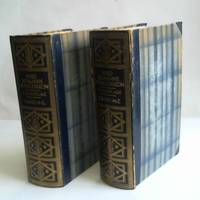
6d275311. Aufl. Max Hesses Verl. Berlin 1929. VII 1079 S./ S. 1090 - S. 2105 mit Noten Halbledereinbände berieben/ bestoßen/ 1 Einbanddeckel gelockert/ 1 Rücken etwas eingerissen. unknown
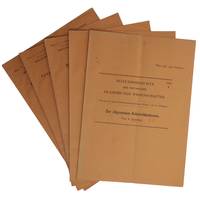
19236416Berlin: Akademie der Wissenschaften 1923. First edition. <p>First edition extremely rare author's presentation offprints "Überreicht vom Verfasser" from the library of the great German physicist Arnold Sommerfeld of Einstein's most important early publications on unified field theory. Einstein's work on unified field theory was inspired by James Clerk Maxwell's success in finding a unified theory of electricity and magnetism one of the greatest achievements of nineteenth-century physics. Einstein's contributions in this area represent about a quarter of his entire research output and half his scientific production after 1920. Such presentation offprints were issued in very small numbers unlike the commercially available separate printings which are common on the market.</p>. UNIFIED FIELD THEORY. <p>First edition extremely rare author's presentation offprints "Überreicht vom Verfasser" not to be confused with the much more common trade separates - see below from the library of the great German physicist Arnold Sommerfeld of Einstein's most important early publications on unified field theory. Einstein's work on unified field theory was inspired by James Clerk Maxwell's success in finding a unified theory of electricity and magnetism one of the greatest achievements of nineteenth-century physics which showed that light was a form of electromagnetic wave and made possible modern inventions such as radio television and the telephone. Einstein's contributions in this area represent about a quarter of his entire research output and half his scientific production after 1920. Although he was ultimately unsuccessful a similar vision was realized in the decades after his death in the construction of the 'standard model' a unified theory of electromagnetism with the weak and strong nuclear forces which were unknown in Einstein's time and efforts to incorporate gravity into the model continue to this day. 'Zur allgemeinen Relativitätstheorie' written on board ship during his return journey from Japan "gives us insight into the workings of Einstein's mind as it searched for a unified theory of gravitation and electromagnetism a search that would dominate his thinking for the rest of his life" Collected Papers 13 p. lxxvii. 'Einheitliche Feldtheorie von Gravitation und Elektrizität' was the first paper to use the term 'Unified Field Theory' in its title. In its opening paragraph Einstein wrote: "After incessant search during the last two years I now believe I have found the true solution" Pais Subtle is the Lord p. 343. The half-dozen papers Einstein had already written on unified field theory were reactions to the ideas of others such as Eddington Kaluza and Weyl; it was in this paper that Einstein put forward the first original approach of his own. "His theory rested in major part on the following arithmetical coincidence. In one of the customary ways of describing electromagnetism 6 field quantities are used. The metrical tensor of general relativity has a certain symmetry. Remove that symmetry and it will automatically contain not 10 but 16 field quantities. Use 10 combinations of these for gravitation and there will be 6 left over - just the number of field quantities with which to represent electromagnetism" Hoffmann Einstein p. 225. In 1928 Einstein embarked upon a new approach to a unified field theory involving what he called 'distant parallelism.' This was introduced in 'Riemann-Geometrie mit Aufrechterhaltung des Begriffes des Fernparallelismus' and 'Neue Möglichkeit für eine einheitliche Feldtheorie von Gravitation und Elektrizität.' By early 1929 he had solved the main problems involved in writing down field equations for his unified theory and presented his solution in 'Zur einheitlichen Feldtheorie'. "Einstein did propose in this last paper a set of field equations but added that 'further investigations will have to show whether these will give an interpretation of the physical qualities of space'. His attempt to derive his equations from a variational principle had to be withdrawn. Nevertheless in 1929 he had 'hardly any doubt' that he was on the right track" Pais p. 346. "Within three days the first printing of the journal offprint i.e. the commercial separate-a thousand copies-sold out and another thousand copies were soon printed. Soon thereafter Nature's News and Views section published a more accessible account of the work including a quote by Einstein: 'Now but only now we know that the force which moves electrons in their ellipses about the nuclei of atoms is the same force which moves our earth in its annual course about the sun and is the same force which brings to us the rays of light and heat which make life possible upon this planet.' With Einstein's 50th birthday approaching his new idea rapidly caught fire at least in the popular press. The New York Times published almost a dozen articles that year about distant parallelism rivaling its coverage of the 1919 eclipse results" Halpern. "In this frenzied unscientific atmosphere Einstein's new theory was hailed in the press as an outstanding scientific advance. Yet Einstein had stated in his article that it was still tentative; and soon he found he had to abandon it" Hoffman p. 226. Only paper III was present in the collection of presentation offprints of Einstein's son Hans Albert Christie's 2006 and in Einstein's own collection Christie's 2008; and no other copies of any of the offprints with "Überreicht vom Verfasser" can be identified on RBH. Similarly although several copies of each offprint can be found in institutional collections it is unclear how many are presentation offprints as the library records do not mention "Überreicht vom Verfasser".</p> <br /> <p>Provenance: Arnold Sommerfeld 1868-1951 his ink stamp on the front cover of III-V and characteristic numbering in red pencil on each - 40 45 47 48 49. "The son of a physician Sommerfeld was educated at the University of Königsberg. After teaching briefly at the universities of Göttingen Clausthal and Aachen he was appointed professor of physics at the University of Münich in 1906. Sommerfeld should have retired in 1936 in favour of his pupil Werner Heisenberg. Opposition from the Nazi party to Heisenberg's appointment prolonged Sommerfeld's tenure and it was not in fact until late 1939 that he finally retired to be succeeded not by Heisenberg but by Wilhelm Müller a Nazi aerodynamicist without a single publication in physics to his credit. Although Sommerfeld and Heisenberg were not Jewish they were regarded by the Nazis as Jewish sympathizers. Sommerfeld however survived the war and returned to his Münich chair in 1945 continuing to work at physics until he died in a car accident in 1951" Oxford Reference. "Arnold Sommerfeld was one of the most distinguished representatives of the transition period between classical and modern theoretical physics. The work of his youth was still firmly anchored in the conceptions of the nineteenth century; but when in the first decennium of the century the flood of new discoveries experimental and theoretical broke the dams of tradition he became a leader of the new movement and in combining the two ways of thinking he exerted a powerful influence on the younger generation. This combination of a classical mind to whom clarity of conception and mathematical rigour are essential with the adventurous spirit of a pioneer are the roots of his scientific success while his exceptional gift of communicating his ideas by spoken and written word made him a great teacher" Max Born p. 275. </p> <br /> <p>"Einstein's early work on the unification program after the completion of the theory of general relativity was by and large a reaction to approaches advanced by others. This is the case for the first geometrization of the electromagnetic field proposed in 1918 by Hermann Weyl; for the first exploration of a five-dimensional theory suggested by Theodor Kaluza in 1919; and for the first attempt to base a unified field theory on the concept of the affine connection rather than on the metric field as advanced by Arthur Eddington in 1921" Sauer pp. 289-90.</p> <br /> <p>Weyl 1885-1955 had introduced a new geometrical object into the theory that he called a "length connection" and he used it to establish a link between the geometrical structure given by the length connection and the electromagnetic field. Einstein was initially enthusiastic about Weyl's idea calling it "a first-class stroke of genius" but quickly found a serious objection to it showing that it implied that the wavelength of light emitted by a radiating atom would depend on the prehistory of that atom contrary to observation. Nevertheless in March 1921 Einstein elaborated on Weyl's theory in his paper 'Uber eine naheliegende Ergänzung des Fundamentes der allgemeinen Relativitätstheorie.'</p> <br /> <p>Another idea to which Einstein responded was put forward as early as 1919 by Theodor Kaluza 1885-1954 at the time Privatdozent in mathematics at the University of Königsberg; he introduced the concept of a fifth dimension to the underlying space-time manifold of general relativity and attempted to represent the electromagnetic field in terms of the additional components of the metric tensor. Einstein showed that for the equation of motion of an electron Kaluza's theory predicted that the influence of the gravitational field was larger by many orders of magnitude than any reasonable physical interpretation would allow for. Nevertheless Einstein later encouraged Kaluza to publish his idea and Einstein and Jakob Grommer 1879-1933 published a response to it in 1923 'Beweis der Nichtexistenz eines überall regulären zentrisch symmetrischen Feldes nach der Feld-Theorie von Kaluza'.</p> <br /> <p>A third approach toward a unified field theory was advanced most notably by Eddington 1882-1944 in the early twenties and was also taken up by Einstein. The idea was to base the theory on the concept of an affine connection as the fundamental mathematical quantity rather than on the metric tensor. The associated Ricci curvature of spacetime is not then in general a symmetric tensor and Eddington suggested that the anti-symmetric part of the curvature could be identified with the electromagnetic field the symmetric part being the usual metric. Eddington did not however provide the field equations that would determine the affine connection a problem Einstein addressed in 'Zur allgemeinen Relativitätstheorie' paper I. Einstein identified the symmetrized part of the Ricci tensor with the 'natural' metric of the theory and like Eddington he linked the antisymmetrized Ricci tensor to the electromagnetic field. Einstein's criticism of Eddington's approach focused on Eddington's failure to provide field equations that determine all forty connection coefficients and the derivation of such field equations became the focal point of the published paper. Lastly Einstein explicitly introduced a scale factor λ that mediates between the scale of the 'natural' metric defined by the Ricci tensor and that of the physical metric. </p> <br /> <p>"With Einstein's response to Weyl Kaluza and Eddington in the early twenties we find him reacting to approaches that had been advanced by others . The first original approach put forward by Einstein himself was published in a paper of 1925 paper II in which also the term 'unified field theory' appeared for the first time in a title. In that paper he explored a metric-affine approach i.e. he took both a metric tensor field and a linear affine connection at the same time as fundamental variables. Both connection and metric were assumed to be asymmetric. Parallel transport then again defines a Ricci tensor and a Riemann curvature scalar and Einstein defined tentative field equations in terms of a variational principle taking the Riemann scalar as a Lagrangian just as in standard general relativity. As regards the interpretation of the mathematical objects he tried to associate the gravitational and electromagnetic fields with the symmetric and anti-symmetric parts of the metric field. In his attempt to recover the known cases he could show that the metric was symmetric for the purely gravitational case and the usual compatibility condition for the Levi-Civita connection can be recovered. Maxwell's equations could be recovered in the limit of weak gravitational fields but only in a slightly different form that is not entirely equivalent to the original equations.</p> <br /> <p>"The basic problem of this approach seems to have been that Einstein did not know how to go on from here. Dealing with both an asymmetric metric tensor and an asymmetric connection opened up a vast field of possibilities inherent in the mathematical framework and many familiar results of the theory of Riemannian geometry no longer held. In particular verifying the existence of non-singular spherically symmetric charge distributions posed a formidable challenge. It was also unclear how to explicitly investigate the non-vacuum case beyond the first order approximation of weak gravitational fields. Einstein did not pursue this approach any longer in print but he did take it up once more twenty years later as his final approach toward a unified field theory working on it until his death" Sauer pp. 293-5.</p> <br /> <p>"At some point in May 1928 while convalescing at home in Berlin Einstein had an idea for what he thought was 'an entirely new way of realizing the general theory of relativity and that may be groundbreaking.' Key to this new approach was the notion of a field of mutually orthogonal normal vectors defined on the space-time manifold. This was a so-called n-Bein-Feld or in more modern terminology for n = 4 a field of tetrads. Such a theory admits the definition of a natural notion of distant parallelism by identifying vectors on this orthonormal frame field. Two vectors at distant points of the manifold are parallel by definition if they are represented by the same vector of the orthonormal frames at the respective points. The manifold also carries a Riemannian metric which can be expressed in terms of the tetrad field. Since the tetrad field determines the metric field but not the other way around the tetrads provide more degrees of freedom which Einstein hoped could be put to use to provide a representation of the electromagnetic field. </p> <br /> <p>"At Einstein's request on 7 June 1928 Max Planck presented a brief note on this 'Riemannian Geometry Retaining the Concept of Distant Parallelism' paper III to the Prussian Academy for publication in its Proceedings. Since Einstein was not sure at the time whether the notion of Fernparallelismus that is distant parallelism or teleparallelism and its associated geometric concepts were known in the mathematical literature he asked Planck to inquire among his mathematician colleagues whether any of this was known before submitting the paper for publication. Planck did not find the occasion to do as requested but nevertheless submitted the paper. </p> <br /> <p>"Only a week later Einstein realized how to put the geometry of distant parallelism to use for his project of a unified theory of both the gravitational and the electromagnetic fields. The idea was to postulate a variational principle for an invariant action integral that depended on the tetrad field as the dynamical variable. </p> <br /> <p>"From this perspective the problem presented itself as a fairly well-defined mathematical problem but posed difficulties of interpretation in terms of physical concepts. From the mathematical side the required invariance of the variational integral created a clearly defined problem. One needed to identify all possible invariants that can be constructed from the tetrads as well as a combination of these invariants that would be suitable as a Lagrangian for the variational integral. Second variation with respect to the tetrad field would produce differential equations that had to be associated with the known field equations of gravitation and electromagnetism in certain limiting cases. Third solutions for the differential equations had to be found. Finally Einstein later would become interested in finding identities that would be satisfied by the tetrads by virtue of general covariance or that might be postulated to derive field equations. As far as the physical interpretation was concerned the metric field would take on its old role as in the general theory namely corresponding to the gravitational field. But the electromagnetic field also had to be identified with quantities occurring in the geometric framework. </p> <br /> <p>"As a first step Einstein identified the relevant possible invariants to be constructed from the tetrads. He also realized that in addition to the possibility of constructing a metric-compatible Levi-Civita connection from the metric as well as the associated notion of parallel transport the tetrad field allowed the definition of another connection with its notion of parallelism. In contrast to the Levi-Civita connection the teleparallel connection is asymmetric and describes a geometry that has vanishing Riemann curvature. Instead it is characterized by the nonvanishing of a tensorial quantity constructed from the teleparallel connection that is now known as the torsion tensor. Taking the mathematical expression of torsion a third-rank tensor Einstein tentatively identified its contraction with the electromagnetic four-potential. And settling on what seemed to be the simplest invariant to be taken as a basis for a tentative field theory Einstein succeeded in deriving to first approximation in the field components both the gravitational field equations of general relativity as well as an equivalent version of the Maxwell equations. </p> <br /> <p>"Again a brief note on this work was presented by Planck to the Academy on 14 June 1928 and was published in July under the title 'New Possibility for a Unified Field Theory of Gravitation and Electricity' paper IV. These two notes mark the beginning of a search for a unified field theory in this teleparallel framework that would preoccupy Einstein for the next two or three years .</p> <br /> <p>"The new approach to unified field theory opened the possibility of finding solutions to long-standing problems and work along these lines continued with intense phases of calculation and collaboration partly done when Einstein withdrew from public life and spent extended periods of time in secluded residences in Scharbeutz and Gatow or later in Caputh. However in mid-December 1928 difficulties in working out the consequences of the new differential equations had piled up to such a point that Einstein reconsidered the basis of their derivation by means of Hamilton's principle. On 13 December he wrote to his collaborator Chaim Herman Müntz that he had a 'simple bold idea that will throw Hamilton's principle overboard'. Instead of trying to recover the Maxwell equations in some acceptable limit he would now 'put the cart before the horse' and 'choose the field equations in such a way that I can be certain that they will lead to the Maxwell equations'. But yet again things turned out to be more difficult and for a few days in late December he reverted to the 'old Hamilton method once again'. But over the New Year's break on another retreat in Gatow Einstein gave up again on the variational approach and derived field equations based instead on some identities. On 27 December he wrote to Müntz: 'EUREKA!' convinced that he had found a solution that was 'so splendid nothing nicer could be imagined'. </p> <br /> <p>"The new progress was written up in a brief paper completed by 5 January 1929. Einstein was exhausted but happy about this new paper 'lying finished in front of me compressed into seven pages under the title 'Unified Field Theory'.' To his son Eduard he wrote on the same day that he was 'very happy' because he had 'more or less completed my life's work'. The paper was submitted on 10 January 1929 for publication in the Prussian Academy's Proceedings and appeared under the somewhat less assertive title 'On Unified Field Theory' paper V. </p> <br /> <p>"When published the paper made a big splash in the press and received much public attention. A press release appeared in the New York Times on 11 January and reports followed on 12 January in the German and international press. The paper was reprinted in a record number of copies and Einstein wrote a popular exposition English translations of which appeared in the London Times and the New York Times as well as in the Observatory. In Britain Nature contacted Einstein for a copy in order to report on it a request that Einstein diverted to Eddington. The latter informed Einstein a little later about the craze that his latest publication had stirred in London where 'one of our great Department Stores in London Selfridges has pasted up in its window your paper six pages pasted up side-by-side so that passers-by can read it all through. Large crowds gather round to read it!'. </p> <br /> <p>"The paper is indeed a rather technical brief note as Einstein soon pointed out and 'no occasion for anybody to be excited about it' as there will be 'only a few mathematicians who will be inclined to read it'. In a letter to Karl Kerkhof he admitted that he himself might carry some responsibility for the excitement since he 'may have alluded to it in speaking with one or another of my friends'. Among them was Hans Reichenbach who reported on the new approach in a column in the Vossische Zeitung before Einstein's printed paper was actually issued and thereby caused a deep rift between them. In any case it soon became clear that the brief paper would not be the last word on the theory. Already the published version carried an addendum in which Einstein indicated a simpler way of looking at things" Collected Papers 16 pp. lxiv-lxix.</p> <br /> <p>"Einstein soon was to learn that the mathematical concept of distant parallelism was by no means new and had already been explored by mathematicians notably by Roland Weitzenböck and Élie Cartan. While immediately acknowledging the priority of others as far as the mathematics was concerned Einstein nevertheless held high hopes for his idea of formulating a unified field theory within this structure. For him the critical question was to find a field equation for the components of the dynamical tetrad fields. Each field of tetrads defines a metric tensor field. But the converse is not true since the metric tensor components can only fix ten of the sixteen components of a tetrad. The additional six degrees of freedom are just what would be needed so he thought to accommodate the six degrees of freedom of the Maxwell field in a unified description of gravitation and electromagnetism. </p> <br /> <p>"The story of the distant parallelism approach can be told largely as a story of attempts to find and justify a uniquely determined set of field equations for the tetrad components with the demand that solutions of those field equations be given a sensible physical interpretation. The distant parallelism approach in this respect shows a number of marked similarities with Einstein's search for general relativistic field equations of gravitation in the years 1912-15. In 1912 it had been the introduction of the metric tensor into the theory that had started Einstein's research and existing mathematical theorems had to be adapted to the theory. In 1928 it was the tetrad fields that allowed the investigation of a non-Euclidean geometry of vanishing curvature and similarly Einstein was made aware of existing mathematical results by mathematician colleagues. In both cases Einstein's research quickly focussed on finding a set of field equations for the dynamical variables and in both cases it was difficult to satisfy all heuristic requirements. In response to these difficulties Einstein changed back and forth between two different and complementary strategies each starting from one particular set of heuristic postulates. In both episodes Einstein at one point settled on a set of field equations that was justified more by physical considerations rather than by mathematical soundness. In both cases Einstein continued to work out consequences of the field equations as well as continued to find a satisfactory mathematical justification for these equations. And finally the demise of both theories came about by a combination of realizing more and more shortcomings of the theory and by discovering that an alternative approach promised to be more successful. However while in 1915 the more successful theory that Einstein substituted for his earlier so-called Entwurf theory was the final version of general relativity the successor approach to the distant parallelism episode turned out to be yet another attempt at a unified field theory" Sauer pp. 296-7.</p> <br /> <p>These author's presentation offprints are of extreme rarity and must be distinguished from other so-called 'offprints' of papers from the Berlin Sitzungsberichte many of which are commonly available on the market. The celebrated bookseller Ernst Weil 1919-1981 in the introduction to his Einstein bibliography wrote: "I have often been asked about the number of those offprints. It seems to be certain that there were few before 1914. They were given only to the author and mostly 'Überreicht vom Verfasser' Presented by the Author is printed on the wrapper. Later on I have no doubt many more offprints were made and also sold as such especially by the Berlin Academy." If the term 'offprint' means as we believe it should a separate printing of a journal article given only to the author for distribution to colleagues then 'offprints' were not commercially available. Although there is certainly some truth in Weil's remark in our view it requires clarification and explanation.</p> <br /> <p>Until about 1916 most of Einstein's papers were published in Annalen der Physik; from 1916 until he left Germany for the United States in 1933 most were published in the Berlin Sitzungsberichte. The Sitzungsberichte differed from other journals in which Einstein published in that it made separate printings of its papers commercially available. These separate printings have 'Sonderabdruck' printed on the front wrapper the usual German term for offprint but they are not offprints according to our definition. They were available to anyone; indeed a price list of these 'trade offprints' is printed on the rear wrapper. True author's presentation offprints can be distinguished from these trade separates by the presence of 'Überreicht vom Verfasser' on the front wrapper.</p> <br /> <p>In the period 1916 to 1919 or 1920 the Sitzungsberichte trade separates are themselves rare. After 1919 or 1920 however the trade separates become much more common although the author's presentation offprints are still very rare. The reason for this change is that it was only in 1919 that Einstein became famous among the general public.</p> <br /> <p>It might seem obvious that Einstein's fame dates from 1905 his 'annus mirabilis' in which he published his epoch-making papers on special relativity and the light quantum. However these works did not make him immediately well known even in the physics community - many physicists did not understand or accept his work and it was two or three years before his genius was fully accepted even by his colleagues. Einstein did not secure an academic position until 1908. Among the general public Einstein became well known only in late 1919 following the success of Eddington's expedition to observe the bending of light by the Sun which confirmed Einstein's general theory of relativity. This was front-page news and made Einstein universally famous. See Chapter 16 'The suddenly famous Doctor Einstein' in Pais Subtle is the Lord for an account of these events. Before 1919 the trade separates of Einstein's papers would probably only have been purchased by professional physicists; after 1919 everyone wanted a memento of the famous Dr. Einstein whether or not they understood anything of theoretical physics and the trade separates of his papers were printed and sold in far greater numbers than before to meet the demand. It is telling that when these post-1919 trade separates appear on the market they are often in mint condition - they were never read simply because their owners were unable to understand them.</p> <br /> <p>I. BRL 140; Weil 131. II. BRL 155; Weil 147. III. BRL 174; Weil 161. IV. BRL 175; Weil 162. V. BRL 183; Weil 165 cf. PMM 416. Born 'Arnold Johannes Wilhelm Sommerfeld 1868-1951' Obituary Notices of Fellows of the Royal Society 8 1952 pp. 275-296. Halpern 'Albert Einstein celebrity physicist' Physics Today 1 April 2019 pp. 38-45. Sauer 'Einstein's unified field theory program' Chapter 9 in: The Cambridge Companion to Einstein Janssen & Lehner eds. 2014.</p> <br/> <br/> 8vo 252 x 180 mm pp. 334-340; 341-351. Original printed wrappers portion of ink postmark stamp on lower cover just into text of publisher's advertisements light vertical crease for posting. Akademie der Wissenschaften unknown
201046545London: Folio Society. 2010. Hardcover. Very Good-. Silver decorated hardback covers in slipcase. There is one page in the book that has some creases and wrinkles at the edges.; 370 pages . Folio Society hardcover
2010102564London:: Folio Society. Fine. 2010. Hardcover. Introduction by David Bodanis. First edition thus. Fine in a fine slipcase. ; 370 pages . Folio Society, hardcover
1968019130Crown Publishers. First Printing. No Statement Of Printing DJ Price Clipped But Exactly Same As First And Came With This Book Publisher's Address As 419 Fourth Avenue On Front And Rear Flaps.Clipped DJ in archival cover edge wear small chips. . Fine. Hardcover. 1st Edition. 1968. Crown Publishers hardcover
201055597Folio Society. Fine. 2010. Hardcover. Fine in fine slipcase. ; 4to 11" - 13" tall . Folio Society hardcover
FORT916434Folio Society. Used - Very Good. In Slipcase Folio Society unknown
PrakashN-9780679601050RANDOM HOUSE. Paperback. New. ENGLISH RANDOM HOUSE paperback