Einstein, AlbertBiblio.com

1 803 résultats
PrakashN-9780679601050RANDOM HOUSE. Paperback. New. ENGLISH RANDOM HOUSE paperback
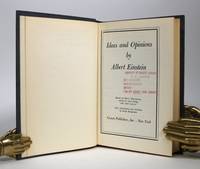
1954016895New York: Crown Publishers Inc 1954. 1st Edition. Hardcover. Near Fine/No Jacket. 8vo. Second printing stated. Orig. blue cloth. v 377 pp. Ex libris stamp of R.A. Javitch with his gift inscription to his brother to ffep. Spine slightly sunned light age toning to interior about fine overall. This volume gathers some of Einstein's most influential writings and speeches across his career as a theoretical physicist. Crown Publishers, Inc hardcover
1995Q-0517884402Crown 1995-06-06. Paperback. New. In shrink wrap. Looks like an interesting title! Crown paperback
1994Q-0679601058Modern Library 1994-06-21. Hardcover. New. In shrink wrap. Looks like an interesting title! Modern Library hardcover
1988Q-0517003937Bonanza Books 1988-12-12. Hardcover. New. New. In shrink wrap. Looks like an interesting title! Bonanza Books hardcover
0756762502.Ghardcover. Good. Access codes and supplements are not guaranteed with used items. May be an ex-library book. hardcover
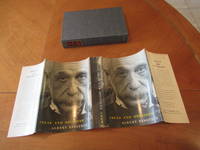
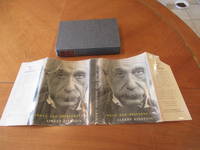
1954042205New York: Crown Publishers 1954. 1st Edition 1st Printing. Hardcover. Fine/Near Fine. Vii 377 Pp. Grey Cloth Spine Lettered In Gilt On Maroon Background. First Edition 1954 First Printing No Statement Of Printing Dj Priced $4.00 Publisher's Address As 49 Fourth Avenue On Front And Rear Flaps. Book Fine Spine Edges Crisp. Former Owner's Verified Signature With August 1954 Date No Other Marks. Dj Near Fine Touch Of Rubbing At Corners 1/4" Closed Tear At Bottom Of Front Spine Edge With Associated Rubbing And Another 1/4" Closed Tear At Top Of Rear Panel. Seldom Seen In This Condition Or Better. <br/> <br/> Crown Publishers hardcover
1954042247New York: Crown Publishers 1954. 1st Edition 1st Printing. Hardcover. Very Good/Good. Vii 377 Pp. Grey Cloth Spine Lettered In Gilt On Maroon Background. First Edition 1954 First Printing No Statement Of Printing Dj Priced $4.00. Book With Gilt Bright Just Slight Wear At Corners But Fraying Along Top And Bottom Edges Of Spine No Marks Aging To Outer Edges Of Page Block. Dj Very Good Small Chips At Corners 1 1/4" V-Chip At Bottom Of Rear Panel Removing 4 Letters In Title And Author's Name No Browning. <br/> <br/> Crown Publishers hardcover
1954044237New York: Crown Publishers 1954. 1st Edition 1st Printing. Hardcover. Near Fine/Very Good. Vii 377 Pp. Grey Cloth Spine Lettered In Gilt On Maroon Background. First Edition 1954 First Printing No Statement Of Printing Dj Price Clipped But Exactly Same As First And Came With This Book Publisher's Address As 419 Fourth Avenue On Front And Rear Flaps. Book Near Fine Spine Edges Bumped No Marks. Dj Good Rubbing At Corners With Small Losses 2 1/2" Closed Tear At Bottom Of Front Spine Edge 3 1/2" Tear Across Top Left Corner Of Rear Panel 1 1/4" Closed Tear Bottom Of Rear Panel No Loss Of Lettering Slight Fading Of Yellow Lettering On Spine Panel. <br/> <br/> Crown Publishers hardcover
1023615037.Ghardcover. Good. Access codes and supplements are not guaranteed with used items. May be an ex-library book. hardcover
0526402873.Gpaperback. Good. Access codes and supplements are not guaranteed with used items. May be an ex-library book. paperback
1104095513.Gpaperback. Good. Access codes and supplements are not guaranteed with used items. May be an ex-library book. paperback
1015982778.Ghardcover. Good. Access codes and supplements are not guaranteed with used items. May be an ex-library book. hardcover
1104107074.Ghardcover. Good. Access codes and supplements are not guaranteed with used items. May be an ex-library book. hardcover
1165381419.Gpaperback. Good. Access codes and supplements are not guaranteed with used items. May be an ex-library book. paperback
Z1-R-028-01463Bibliobazaar. Used - Like New. Used - Like New. Ships from UK in 48 hours or less usually same day.Your purchase helps support Sri Lankan Children's Charity 'The Rainbow Centre'. 100% money back guarantee. We are a world class secondhand bookstore based in Hertfordshire United Kingdom and specialize in high quality textbooks across an enormous variety of subjects. We aim to provide a vast range of textbooks rare and collectible books at a great price. Our donations to The Rainbow Centre have helped provide an education and a safe haven to hundreds of children who live in appalling conditions. We provide a 100% money back guarantee and are dedicated to providing our customers with the highest standards of service in the bookselling industry. Bibliobazaar unknown
19266414Berlin: Akademie der Wissenschaften 1926. First edition. <p>First edition very rare author's presentation offprint extremely rare author's presentation offprint not to be confused with the much more common trade separate - see below from the library of the great German physicist Arnold Sommerfeld of the notorious Einstein/Rupp experiments which demonstrated the wave-theory of light contrary to Einstein's expectations.</p>. SCIENTIFIC FRAUD: THE EINSTEIN-RUPP EXPERIMENTS. <p>First edition extremely rare author's presentation offprint not to be confused with the much more common trade separate - see below from the library of the great German physicist Arnold Sommerfeld of the notorious Einstein/Rupp experiments. "In the fall of 1926 Albert Einstein published the outline of two experiments in the Proceedings of the Berlin Academy. They addressed one of the most urgent questions in physics at the time: the experiments were to show if the emission of light was a process that was extended in time or if instead light emission occurred in an instantaneous act. Of course the first possibility would confirm a traditional oscillator-and-wave-like view whereas the second possibility would cohere well with Einstein's own ideas on light quanta. It is quite surprising that these experiments are so unfamiliar today. Apart from addressing a central question and being proposed by no lesser figure than Einstein they also circulated at a crucial moment in the history of quantum theory. Still the experiments are not mentioned in any of the standard Einstein biographies and there is no substantial treatment of them in histories of the quantum theory . The likely cause for this lack of attention is at least as surprising: the experiments were-supposedly-conducted by Emil Rupp yet a decade later Rupp was exposed as a scientific fraudster; the results obtained by Rupp in close consultation with Einstein and published back-to-back with the latter's theoretical paper were in the end generally believed to have been fabrications" Van Dongen. As Walter Gerlach of Stern-Gerlach fame said in an interview with Thomas Kuhn in 1963 "Rupp in the late twenties early thirties was regarded as the most important and most competent physicist. He did incredible things. . Later it turned out that everything that he had ever published everything was forged. This had gone on for ten years ten years!" Nevertheless "these experiments played a substantial role in developments in 1926. Most importantly they confirmed a wave picture of light when many including Einstein himself initially expected a particle-like instantaneous picture of light emission to be confirmed. After all only a few years before Compton scattering had been shown and as little as a year before the Einstein-Rupp experiments Walther Bothe and Hans Geiger had done the experiments that dismissed the BKS theory. But the experiments of Einstein and Rupp also influenced events in other ways. For instance their initial interpretation was most likely of direct importance for Max Born when he proposed the probabilistic interpretation of the wave function. The experiments further played a role in the thinking of Werner Heisenberg as he formulated his uncertainty relations . these experiments deserve renewed attention and their current obscure status is not warranted by their historical importance" Van Dongen. OCLC locates only three copies two in Switzerland one in Germany but it is unclear which of these if any are author's presentation offprints. The presentation offprint was not present in the collection of Einstein's son Hans Albert Christie's 2006 but it was in Einstein's own collection of his offprints Christie's 2008.</p> <br /> <p>Provenance: Arnold Sommerfeld 1868-1951 his characteristic numbering '46' in red pencil on front cover. "The son of a physician Sommerfeld was educated at the University of Königsberg. After teaching briefly at the universities of Göttingen Clausthal and Aachen he was appointed professor of physics at the University of Münich in 1906. Sommerfeld should have retired in 1936 in favour of his pupil Werner Heisenberg. Opposition from the Nazi party to Heisenberg's appointment prolonged Sommerfeld's tenure and it was not in fact until late 1939 that he finally retired to be succeeded not by Heisenberg but by Wilhelm Müller a Nazi aerodynamicist without a single publication in physics to his credit. Although Sommerfeld and Heisenberg were not Jewish they were regarded by the Nazis as Jewish sympathizers. Sommerfeld however survived the war and returned to his Münich chair in 1945 continuing to work at physics until he died in a car accident in 1951" Oxford Reference. "Arnold Sommerfeld was one of the most distinguished representatives of the transition period between classical and modern theoretical physics. The work of his youth was still firmly anchored in the conceptions of the nineteenth century; but when in the first decennium of the century the flood of new discoveries experimental and theoretical broke the dams of tradition he became a leader of the new movement and in combining the two ways of thinking he exerted a powerful influence on the younger generation. This combination of a classical mind to whom clarity of conception and mathematical rigour are essential with the adventurous spirit of a pioneer are the roots of his scientific success while his exceptional gift of communicating his ideas by spoken and written word made him a great teacher" Max Born p. 275. </p> <br /> <p>"Born in 1898 Rupp began his career in the 1920s studying canal rays beams of positive ions and atoms formed between an anode and cathode the latter punctured with holes or "canals" in a gas discharge tube. When these rays shoot through the canals and into a vacuum chamber the ions rapidly lose and gain charge emitting visible light that becomes less intense at the other end of the canal.</p> <br /> <p>"In his first experiments in the mid-1920s Rupp measured the coherence length of light - the distance over which the light maintains a consistent phase - emitted by hydrogen and mercury atoms in the canal rays. He measured these lengths as 62 centimeters for hydrogen and 15.2 centimeters for mercury. These were blockbuster results: A moving hydrogen atom was expected to stay coherent over a much smaller distance.</p> <br /> <p>"What's more Rupp's extra-long hydrogen canal ray seemed like it could be used to test one of physics' biggest questions at the time: Is light a particle or a wave Einstein had devised experiments to test if light was emitted instantaneously or over time but he needed a light with an extra-long coherence length - and only Rupp had achieved it.</p> <br /> <p>"After reading Rupp's 1926 paper Einstein published his own "Proposal for an Experiment on the Nature of the Elementary Process of Radiation Emission" and reached out to Rupp directly to discuss a collaboration. But because Rupp's boss at Heidelberg University the physicist Philipp Lenard was "a fervent anti-relativist - and anti-Semite" writes van Dongen Einstein chose to forgo a visit to the institution and sent instructions for Rupp to do the experiments on his own.</p> <br /> <p>"There were red flags from the start. In one instance Rupp appeared to have altered the mirrors in his interferometer the instrument he used to study interference just so into an arrangement that would obtain desired outcomes. In another instance when Einstein corrected the settings Rupp reported using for another instrument Rupp chalked the mistake up to a typo. There were other 'alarming discrepancies' in Rupp's calculations van Dongen writes and Einstein's letters show that he pushed back on several occasions. Each time Rupp responded with new results that perfectly explained the oddities Einstein questioned.</p> <br /> <p>"Initially Einstein expected to find that light was emitted instantaneously. But as the collaboration stretched on he began to expect the experiments would confirm the alternative the 'classical' theory. 'One of the reasons for his changing position likely was that that outcome had inadvertently already been corroborated by Rupp' van Dongen writes.</p> <br /> <p>"When Rupp furnished Einstein with a final set of results supporting the classical emission picture Einstein facilitated their publication in the proceedings of the Prussian Academy of Sciences. They were published back-to-back with a paper by Einstein explaining the theory behind the experiments in which Einstein cited Rupp's work. Einstein even helped Rupp draft his paper's abstract.</p> <br /> <p>"The association with Einstein rocketed Rupp to scientific prominence and in 1928 he accepted a position in the research labs of German electronics company AEG 'a kind of counterpart to General Electric' writes MIT physicist Anthony French in his 1999 retrospective of Rupp's case.</p> <br /> <p>"However scientists had begun voicing skepticism about Rupp's canal ray work. Among them were British spectroscopist Robert d'Escourt Atkinson who doubted Rupp's extraordinary coherence lengths and a researcher named Harald Straub who tried and failed to replicate Rupp's measurements in 1930. Rupp came down hard on Straub with a rebuttal sending photographs that supposedly showed his interference fields and forcefully defending his work in the same journal where Straub published his. Straub wrote that he had nothing else to add and the matter appeared settled.</p> <br /> <p>"But Rupp's reputation was bruised in the episode and his letters from the time indicate that his funding at AEG was drying up. He published work on electron scattering then took up experiments with positrons producing them by pounding lithium with protons. In a 1934 paper Rupp claimed to have accelerated protons at potential differences of 500 kV. This was impossible for him to have done - he simply did not have the requisite accelerator in his lab.</p> <br /> <p>"In December 1934 two of Rupp's fellow scientists at AEG brought the glaring problem to the attention of the institute's director who launched an investigation and subsequently fired Rupp. In January 1935 Rupp published the retraction statement appended to his doctor's note claiming he had no knowledge of or control over the fabrications. And later that year experimentalists Walther Gerlach and Eduard Rüchardt published 'On the Coherence Length of Light emitted by Canal Rays' which essentially confirmed that Rupp's early canal ray work was also erroneous. Amid this public humiliation Rupp experienced a nervous breakdown and spent time in a sanatorium. He never worked in physics again.</p> <br /> <p>"Einstein however escaped from the episode unscathed. Historians like van Dongen think his credulousness was an honest mistake underpinned by his desire to see his theories confirmed by experiments. Rupp's work and life are now a footnote but following his downfall it appears that German scientists mentioned his name often. According to French 'for a number of years afterward the word 'geruppt' became an epithet among German physicists to describe questionable work'" Jooss. </p> <br /> <p>This author's presentation offprint is of extreme rarity and must be distinguished from other so-called 'offprints' of papers from the Berlin Sitzungsberichte many of which are commonly available on the market. The celebrated bookseller Ernst Weil 1919-1981 in the introduction to his Einstein bibliography wrote: "I have often been asked about the number of those offprints. It seems to be certain that there were few before 1914. They were given only to the author and mostly 'Überreicht vom Verfasser' Presented by the Author is printed on the wrapper. Later on I have no doubt many more offprints were made and also sold as such especially by the Berlin Academy." If the term 'offprint' means as we believe it should a separate printing of a journal article given only to the author for distribution to colleagues then 'offprints' were not commercially available. Although there is certainly some truth in Weil's remark in our view it requires clarification and explanation.</p> <br /> <p>Until about 1916 most of Einstein's papers were published in Annalen der Physik; from 1916 until he left Germany for the United States in 1933 most were published in the Berlin Sitzungsberichte. The Sitzungsberichte differed from other journals in which Einstein published in that it made separate printings of its papers commercially available. These separate printings have 'Sonderabdruck' printed on the front wrapper the usual German term for offprint but they are not offprints according to our definition. They were available to anyone; indeed a price list of these 'trade offprints' is printed on the rear wrapper. True author's presentation offprints can be distinguished from these trade separates by the presence of 'Überreicht vom Verfasser' on the front wrapper.</p> <br /> <p>In the period 1916 to 1919 or 1920 the Sitzungsberichte trade separates are themselves rare. After 1919 or 1920 however the trade separates become much more common although the author's presentation offprints are still very rare. The reason for this change is that it was only in 1919 that Einstein became famous among the general public.</p> <br /> <p>It might seem obvious that Einstein's fame dates from 1905 his 'annus mirabilis' in which he published his epoch-making papers on special relativity and the light quantum. However these works did not make him immediately well known even in the physics community - many physicists did not understand or accept his work and it was two or three years before his genius was fully accepted even by his colleagues. Einstein did not secure an academic position until 1908. Among the general public Einstein became well known only in late 1919 following the success of Eddington's expedition to observe the bending of light by the Sun which confirmed Einstein's general theory of relativity. This was front-page news and made Einstein universally famous. See Chapter 16 'The suddenly famous Doctor Einstein' in Pais Subtle is the Lord for an account of these events. Before 1919 the trade separates of Einstein's papers would probably only have been purchased by professional physicists; after 1919 everyone wanted a memento of the famous Dr. Einstein whether or not they understood anything of theoretical physics and the trade separates of his papers were printed and sold in far greater numbers than before to meet the demand. It is telling that when these post-1919 trade separates appear on the market they are often in mint condition - they were never read simply because their owners were unable to understand them.</p> <br /> <p>BRL 160; Weil 153. Born 'Arnold Johannes Wilhelm Sommerfeld 1868-1951' Obituary Notices of Fellows of the Royal Society 8 1952 pp. 275-296. French 'The strange case of Emil Rupp' Physics in Perspective 1 1999 pp. 3-21. Joosse 'December 1934: Emil Rupp's research which fooled even Einstein is exposed as fraud' APS News Nov. 14 2023. Van Dongen 'Communicating the Heisenberg uncertainty relations: Niels Bohr complementarity and the Einstein-Rupp experiments' Scientia Danica. Series M Mathematica et physica 1: One Hundred Years of the Bohr Atom Proceedings 2015 pp. 310-343.</p> <br/> <br/> 8vo 252 x 180 mm pp. 334-340; 341-351. Original printed wrappers portion of ink postmark stamp on lower cover just into text of publisher's advertisements light vertical crease for posting. Akademie der Wissenschaften unknown
1997Q-1862041369Houghton Mifflin 1997-09-01. Hardcover. New. New. In shrink wrap. Looks like an interesting title! Houghton Mifflin hardcover
12093961-nnew. unknown
44145211like new. unknown
1025743555.Ghardcover. Good. Access codes and supplements are not guaranteed with used items. May be an ex-library book. hardcover
Q-0486603040Dover Publications 1956-06-01. Paperback. New. In shrink wrap. Looks like an interesting title! Dover Publications paperback
2011Q-1607962853BN Publishing 2011-01-11. Paperback. New. New. In shrink wrap. Looks like an interesting title! BN Publishing paperback
1014054435.Ghardcover. Good. Access codes and supplements are not guaranteed with used items. May be an ex-library book. hardcover
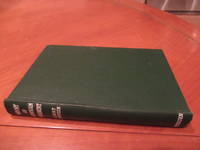
1926043114London: Methuen & Co. 1926. 1st Edition 1st Printing. Hardcover. Fine/No Jacket. Viii 124 Pp. Green Cloth White Spine Lettering. First Printing In Secondary Binding With White Lettering The First Binding Was Lettered In Gilt. Book Used But Still Fine No Rubbing Lettering Complete And Entirely Strong. Spanish Owner's Name With His 1948 Receipt From H. K. Lewin For The Book Laid In Loosely. Lacking The Scarce Dust Jacket. <br/> <br/> Methuen & Co. hardcover