1 803 résultats
1926043474London: Methuen & Co. 1926. 1st Edition 1st Printing. Hardcover. Near Fine/No Jacket. Viii 124 Pp. Green Cloth White Spine Lettering. First Printing In Secondary Binding With White Lettering The First Binding Was Lettered In Gilt. Book Used But Still Near Fine Very Slight Rubbing Lettering Complete With Some Wear Small Areas Of Lightening Of Color On Front Cover Darkening To Lower Corner Of Page "V" First Page Of Preface. No Marks. Lacking The Very Scarce Dust Jacket. <br/> <br/> Methuen & Co. hardcover
1926029292New York: E. P. Dutton and Company 1926. First American Edition 1st Printing. Hardcover. Very Good/Fair DJ. 124 Pp. Brown Cloth Gilt. First American Edition No Date Printing Statement Indicates 1926 British Sheets Were Used. Book Is Somewhat Worn And Has Small Areas Of Fraying At Corners Hinges Solid Small Previous Owner's Name On Front Free Endpaper. Dj Worn Bottom 40% Of Spine Chipped Away But Title And Author Remain Small Edge And Corner Chips. <br/> <br/> E. P. Dutton and Company hardcover
18-4023Munich Germany: Hugo Helbing 1932. . Folio. 12 pp. Soft beige wraps with red lettering. Fair with shaken binding missing pages marginal soiling and edge wear. Black and white plates. Auf Deutsch. Munich, Germany: Hugo Helbing, 1932. paperback
1902003205Leipzig: J. A. Barth 1902. Spine edges lightly rubbed; former owner's ink stamp on title page. First Edition. Contemporary Red Cloth. Very Good. J. A. Barth Hardcover
190249501Leipzig J. A. Barth 1902. 8vo. Bound in contemporary half calf with five raised bands and gilt lettering to spine. In ""Annalen der Physik. Vierte Folge. Band 9.". Entire volume offered. <br/><br/><em>First edition of Einstein's third paper in which he deals with the definitions of temperature and entropy for thermal equilibrium conditions and with the equipartition theorem.The volume contains 2 papers by Max Planck originally published in "Jubelband für H.A. Lorentz" und Jubelband für J. Bosscha: "Ueber die von einem elliptisch schwingenden Ion emitterte und absorbierte Energie;" und "Ueber die Verteilung der Energie zwischen Aether und Materie;" pp. 619-628 und pp. 629-641.Weil No 3. </em> hardcover
190238799Leipzig Ambrosius Barth 1902. Contemp. hcloth. First hinge broken. = "Annalen der Physik. Vierte Folge. Band 9." VIII1344 pp. and 5 plates. The Einstein Paper: pp. 417-435. Internally clean and fine. The whole volume offered. <br/><br/><em>First edition of Einstein's third paper. - Weil No 3. - The volume contains 2 papers by Max Planck originally published in "Jubelband für H.A. Lorentz" und Jubelband für J. Bosscha: "Ueber die von einem elliptisch schwingenden Ion emitterte und absorbierte Energie;" und "Ueber die Verteilung der Energie zwischen Aether und Materie;" pp. 619-628 und pp. 629-641. </em> hardcover
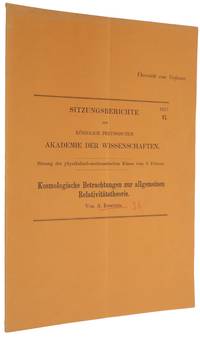
19176411Berlin: W. de Gruyter 1917. First edition. <p>First edition an extremely rare author's presentation offprint from the library of the eminent German physicist Arnold Sommerfeld of the groundbreaking paper that "laid the foundations of modern theories of the universe" O'Raifeartaigh. In this seminal work Einstein first applied the principles of general relativity to cosmology introducing the cosmological constant to allow for a static universe - a pivotal conceptual innovation that shaped modern theoretical physics. "There is little doubt that Einstein's 1917 paper 'Cosmological Considerations in the General Theory of Relativity' constituted a key milestone in 20th-century physics" ibid. This presentation offprint - issued in very limited numbers for private distribution by Einstein himself - is vastly scarcer than the commercially available separate printings which appear more regularly on the market.</p>. <p>LAID THE FOUNDATIONS OF MODERN THEORIES OF THE UNIVERSE</p> . <p>First edition extremely rare author's presentation offprint not to be confused with the more common trade separate - see below from the library of the great German physicist Arnold Sommerfeld of Einstein's 'cosmological constant' paper which "laid the foundations of modern theories of the universe" O'Raifeartaigh. "There is little doubt that Einstein's 1917 paper 'Cosmological Considerations in the General Theory of Relativity' constituted a key milestone in 20th century physics. As the first relativistic model of the universe the paper later known as 'Einstein's Static Universe' or the 'Einstein World' set the foundations of modern theoretical cosmology" O'Raifeartaigh et al. "It is generally agreed that the seeds of a revolution in theoretical cosmology were planted when Einstein completed his general theory of relativity in the fall of 1915. On 25 November he read to the Prussian Academy of Sciences the final communication which contained a consistent set of gravitational equations. One and a half years later in a paper announced on 8 February 1917 Einstein took the revolutionary step of exploring the consequences of his new theory for no less than the entire universe" Kragh p. 8. "The consequence of Einstein's version of Mach's principle is that at infinity the components of the metric tensor should degenerate: for an isotropic field the spatial components become zero whereas the timelike component goes to infinity. It turned out to be impossible to realize these conditions for centrally symmetric static fields. Einstein's way out was to postulate a universe that is spatially finite closed and static with a uniform mass distribution a universe in which no boundary conditions are needed. In order to do so however Einstein had to modify his field equations to include what became known as the 'cosmological constant'" Papers 6 p. xx. Max Born said of Einstein's conception "This suggestion of a finite but unbounded space is one of the greatest ideas about the nature of the worlds which has ever been conceived . It solved the mysterious fact why the system of stars did not disperse and thin out which it would do if space were infinite; it gave a physical meaning to Mach's principle which postulated that the law of inertia should not be regarded as a property of empty space but as an effect of the total system of stars; and it opened the way to the concept of the expanding universe" quoted in Clark p. 270. The 'Einstein world' described a static universe but in 1929 Edwin Hubble demonstrated that the universe is not static but expanding. Soon after Einstein rejected his cosmological constant as unnecessary and compromising the simplicity of his field equations. Nevertheless recent discoveries regarding dark matter and dark energy suggest that the cosmological constant may have a role to play in the explanation of the fact that the expansion of the universe appears to be accelerating. OCLC lists copies of this offprint at American Philosophical Society Burndy Huntington and University of Florida but it is unclear if any of these are author's presentation offprints rather than trade separates. We have been unable to locate any other presentation offprint on RBH - it was not present in the collection of Einstein's son Hans Albert Christie's 2006 nor in Einstein's own collection Christie's 2008. RBH lists only four copies of the trade separate in the last 75 years the last sold at Bonham's in 2022 for $15300.</p> <br /> <p>Provenance: Arnold Sommerfeld 1868-1951 his characteristic numbering '36' in red pencil on front wrapper. "The son of a physician Sommerfeld was educated at the University of Königsberg. After teaching briefly at the universities of Göttingen Clausthal and Aachen he was appointed professor of physics at the University of Münich in 1906. Sommerfeld should have retired in 1936 in favour of his pupil Werner Heisenberg. Opposition from the Nazi party to Heisenberg's appointment prolonged Sommerfeld's tenure and it was not in fact until late 1939 that he finally retired to be succeeded not by Heisenberg but by Wilhelm Müller a Nazi aerodynamicist without a single publication in physics to his credit. Although Sommerfeld and Heisenberg were not Jewish they were regarded by the Nazis as Jewish sympathizers. Sommerfeld however survived the war and returned to his Münich chair in 1945 continuing to work at physics until he died in a car accident in 1951" Oxford Reference. "Arnold Sommerfeld was one of the most distinguished representatives of the transition period between classical and modern theoretical physics. The work of his youth was still firmly anchored in the conceptions of the nineteenth century; but when in the first decennium of the century the flood of new discoveries experimental and theoretical broke the dams of tradition he became a leader of the new movement and in combining the two ways of thinking he exerted a powerful influence on the younger generation. This combination of a classical mind to whom clarity of conception and mathematical rigour are essential with the adventurous spirit of a pioneer are the roots of his scientific success while his exceptional gift of communicating his ideas by spoken and written word made him a great teacher" Max Born p. 275. </p> <br /> <p>"The new relativistic theory of the universe had conceptual roots far back in time especially in problems discussed by Newton in a famous correspondence with the Reverend Richard Bentley in 1692-93 first published as Four letters from Sir Isaac Newton to Doctor Bentley . London 1756. Newton considered the universe as an infinite container with an infinite number of stars but in that case it seemed impossible to define the gravitational force acting upon a body in a definite way. Later scientists sought to resolve the dilemma by keeping to Newton's idea of an infinite space but including a modification of his law of gravitation. In the mid-1890s two German theoreticians Carl von Neumann and Hugo Seeliger suggested independently that the amount of matter in the spatially infinite universe was finite. Although this led to a well-defined gravitational force it also led to a universe which would seem to collapse under the influence of gravitation as realized by Newton. To avoid this consequence Neumann and Seeliger proposed to change Newton's law of gravitation .</p> <br /> <p>"When Einstein attacked the cosmological problem he was much aware of the Newtonian anomaly and earlier attempts to solve it such as that of Neumann and Seeliger. He wrote: 'I shall conduct the reader over the road that I have myself travelled rather a rough and winding road because otherwise I cannot hope that he will take much interest in the result at the end of the journey. The conclusion I shall arrive at is that the field equations of gravitation which I have championed hitherto still need a slight modification so that on the basis of the general theory of relativity those fundamental difficulties may be avoided . which confronted the Newtonian theory.'</p> <br /> <p>"That the road to the cosmological theory had been rough and winding an intellectual tour de force was also what Einstein wrote to his friend the Dutch physicist Paul Ehrenfest. In early February 1917 Einstein told him that the work had exposed him 'to the danger of being confined in a madhouse.' The conceptual problem which Einstein faced was essentially the same as that Newton had struggled with namely to formulate boundary conditions for an infinite space. In December 1916 he argued in a letter to his friend Michele Besso that a homogeneous symmetrical distribution of matter throughout all of infinite space would not be sufficient to produce the stable universe that both he and Besso presupposed. 'Only the closedness of the universe can get rid of this dilemma' he wrote and added that his new idea was 'one of great scientific significance and not a product of my imagination.' Einstein's solution was to circumvent the problem which he could do by conceiving the universe as a spatially closed continuum in accordance with his general theory of relativity: 'If it were possible to regard the universe as a continuum which is finite closed with respect to its spatial dimension we should have no need at all of any such boundary conditions. We shall proceed to show that both the general postulate of relativity and the fact of the small stellar velocities are compatible with the hypothesis of a spatially finite universe; though certainly in order to carry through this idea we need a generalizing modification of the field equations of gravitation.' Einstein thus assumed the universe to be a spatially closed continuum 'spherical' in four dimensions. This model is also referred to as Einstein's 'cylinder' world: with two of the spatial dimensions suppressed the model universe can be pictured as a cylinder where the radius represents the space and the axis the time coordinate. Einstein was also and naturally so guided by the available empirical evidence. This suggested that the universe was indeed spatially finite that it was static and that it contained a finite amount of matter .</p> <br /> <p>"Apart from being influenced by the existing discussion of Newtonian cosmology Einstein was also motivated by the ideas of the famous Austrian physicist and philosopher Ernst Mach. According to Mach's principle proposed in the 1880s the laws of mechanics including the law of inertia should be seen as purely relational namely relative to the universe as a whole. Einstein's version of the principle was rather different; he tended to understand it in the sense that the space-time metric is determined by the masses of the universe and thus that the local dynamics is conditioned by the universe at large. In general Mach's principle is interpreted as the assumption that local inertial frames are determined by some average of the motion of the distant celestial objects. Originally Einstein believed that his relativistic theory of cosmology embodied Mach's principle but in his later years he concluded that the principle could not be harmonized with the general theory of relativity" Kragh pp. 7-9.</p> <br /> <p>"Only a year before publishing the present work Einstein had finally completed his great masterwork a new theory of gravity space and time known as the general theory of relativity. From a scientific point of view it is hardly surprising that Einstein quickly turned his attention to cosmology. A fundamental tenet of the general theory was that the geometric structure of a region of spacetime is not an independent self-determined entity but is determined by mass-energy. In modern notation that idea is expressed as the field equations</p> <br /> <p>Gμν = −κTμν 1</p> <br /> <p>where Gμν is a four-dimensional tensor that describes the geometry of a region of spacetime and Tμνis a four-dimensional tensor that describes the flux of mass-energy within that region the quantity κ is a constant known as the Einstein constant. Once Einstein had completed the theory it was natural for him to ask if general relativity could deliver a consistent model of all of spacetime-a plausible model of the universe as a whole. As he remarked in a letter to the Dutch astronomer Willem de Sitter 'For me though it was a burning question whether the relativity concept can be followed through to the finish or whether it leads to contradictions.'</p> <br /> <p>"Einstein soon found that assuming a universe with a static distribution of matter evidence to the contrary did not emerge until 1929 it was no easy task to obtain a satisfactory solution to the field equations for the case of the universe as a whole. The main difficulty was his insistence that a model of the cosmos should reflect both the principle of relativity which demanded that all frames of reference be equivalent and an assumption he later named Mach's principle-that the inertia of a body is determined entirely by the presence of other masses in the universe.</p> <br /> <p>"The outcome of those deliberations was Einstein's 'Cosmological considerations' paper of 1917. His ingenious breakthrough was to postulate that we inhabit a universe of closed spatial geometry. Relativity could deliver a satisfactory model of the known universe if it was assumed that the cosmos had the geometry of a three-dimensional sphere-unbounded spatially yet finite in content. However the Einstein universe came at a price. In his analysis Einstein found that a nonzero solution to the field equations could be obtained only if a new term was introduced to the equations according to:</p> <br /> <p>Gμν λgμν = −κTμν. 2</p> <br /> <p>To some the new term λgμν known as the 'cosmological constant' term marred the symmetry and simplicity of the original field equations. However general relativity certainly permitted the term; indeed Einstein had noted the possibility of such an extension to the field equations in his original exposition of 1916. Now the cosmological constant found an important application because it allowed a model of the universe that was consistent with Einstein's views on the relativity of inertia .</p> <br /> <p>"Einstein's analysis culminated in a simple relation between the cosmological constant λ the mean density of matter Ï and the radius of the cosmos R according to</p> <br /> <p>λ = κÏ/2= 1/R2. 3</p> <br /> <p>"One puzzling aspect of Einstein's 'Cosmological considerations' paper is that he made no attempt to estimate the size of his model universe from equation 3. After all even a rough approximation of the mean density of matter in the universe could have given some estimate of the cosmic radius R. Instead he merely declared at the end of the paper that the model was logically consistent: 'At any rate this view is logically consistent and from the standpoint of the general theory of relativity lies nearest at hand; whether from the standpoint of present astronomical knowledge it is tenable will not here be discussed' .</p> <br /> <p>"A second puzzle associated with the 'Cosmological considerations' paper is Einstein's failure to consider the stability of his model universe. After all the quantity Ï in equation 3 represented a mean value for the density of matter in the universe; one could expect a variation in that parameter from time to time which raises the question of the stability of the model against such perturbations. Indeed it was later shown that the Einstein universe is highly unstable against perturbations in matter density a slight increase in density would trigger an inexorable contraction while a slight decrease would result in a runaway expansion .</p> <br /> <p>"In 1929 American astronomer Edwin Hubble published the first evidence of a linear relation between the redshifts of the spiral nebulae and their radial distance. Many theorists viewed Hubble's results as evidence of a non-static universe and proposed a variety of relativistic time-varying models of the cosmos. Einstein himself lost little time in abandoning his static cosmology at that point. In the early 1930s he published two distinct models of the expanding universe one of positive spatial curvature and one of Euclidean geometry. In each case he also abandoned the cosmological constant stating that the term was both unsatisfactory it gave an unstable solution and redundant relativity could describe expanding models of the universe without the term .</p> <br /> <p>"Some years later the Russian scientist George Gamow reported in his memoirs that Einstein once described the cosmological constant as his 'biggest blunder' . It is intriguing to think that Einstein might have predicted the expansion of the universe many years before Hubble's observations had he not introduced the cosmological constant. However it must be remembered that Einstein's task in 1917 was to investigate whether relativity could describe the known universe that is a universe that was assumed to be static. If Einstein did make the 'biggest blunder' comment he may have been referring to his failure to notice the instability of his model" O'Raifeartaigh.</p> <br /> <p>"In the latter third of the twentieth century the situation in cosmology began to change dramatically. Theoretical cosmology became more and more closely associated with elementary particle theory and observational cosmology began to accumulate more and more data limiting the possibilities for and influencing the construction of cosmological models. The cosmological constant has had a dramatic rebirth with the accumulating observation evidence that rather than slowing down as current theories had predicted the expansion of the universe is actually accelerating with cosmic time. By an appropriate choice of sign and value for λ cosmological models with this property are easily constructed. The problem is to give a physical explanation for such a choice of λ. One favored explanation as of 2007 is that the λ-term in the field equations is actually the stress-energy-momentum tensor for 'dark energy' a hitherto unobserved component pervading the entire universe. If this explanation stands the test of time it may also turn out that the 'cosmological constant' is not constant but varies with cosmological time!" DSB.</p> <br /> <p>"Today the term cosmological constant has made a dramatic return to the field equations due to the observation of an acceleration in the expansion of the cosmos. It might therefore be argued that Einstein's real blunder was to abandon the term in the 1930s. However such a view is once again somewhat retrospective because evidence of an accelerated expansion was not known to him.</p> <br /> <p>"In recent years the Einstein universe has once more become a topic of interest in theoretical cosmology. In attempts to avoid the well-known problem of a big bang singularity some theorists have become interested in the possibility of a universe that inflates from a static Einstein universe a scenario known as the emergent universe. Whether the emergent universe will offer a plausible consistent description of the early universe is not yet known. But it is intriguing to think that like the cosmological constant the Einstein universe might yet make a dramatic comeback" O'Raifeartaigh.</p> <br /> <p>This author's presentation offprint is of extreme rarity and must be distinguished from other so-called 'offprints' of papers from the Berlin Sitzungsberichte many of which are commonly available on the market. The celebrated bookseller Ernst Weil 1919-1981 in the introduction to his Einstein bibliography wrote: "I have often been asked about the number of those offprints. It seems to be certain that there were few before 1914. They were given only to the author and mostly 'Ãœberreicht vom Verfasser' Presented by the Author is printed on the wrapper. Later on I have no doubt many more offprints were made and also sold as such especially by the Berlin Academy." If the term 'offprint' means as we believe it should a separate printing of a journal article given only to the author for distribution to colleagues then 'offprints' were not commercially available. Although there is certainly some truth in Weil's remark in our view it requires clarification and explanation.</p> <br /> <p>Until about 1916 most of Einstein's papers were published in Annalen der Physik; from 1916 until he left Germany for the United States in 1933 most were published in the Berlin Sitzungsberichte. The Sitzungsberichte differed from other journals in which Einstein published in that it made separate printings of its papers commercially available. These separate printings have 'Sonderabdruck' printed on the front wrapper the usual German term for offprint but they are not offprints according to our definition. They were available to anyone; indeed a price list of these 'trade offprints' is printed on the rear wrapper. True author's presentation offprints can be distinguished from these trade offprints by the presence of 'Ãœberreicht vom Verfasser' on the front wrapper as in the present offprint.</p> <br /> <p>In the period 1916 to 1919 or 1920 the Sitzungsberichte trade offprints are themselves rare: for example RBH list only three 'offprints' of Einstein's famous 1917 Sitzungsberichte paper 'Kosmologische Betrachtungen zur allgemeinen Relativitätstheorie' the auction records do not distinguish between trade and author's presentation offprints. After 1919 or 1920 however the trade offprints become much more common although the author's presentation offprints are still very rare. The reason for this change is that it was only in 1919 that Einstein became famous among the general public.</p> <br /> <p>It might seem obvious that Einstein's fame dates from 1905 his 'annus mirabilis' in which he published his epoch-making papers on special relativity and the light quantum. However these works did not make him immediately well known even in the physics community - many physicists did not understand or accept his work and it was two or three years before his genius was fully accepted even by his colleagues. Among the general public Einstein became well known only in late 1919 following the success of Eddington's expedition to observe the bending of light by the Sun which confirmed Einstein's general theory of relativity. This was front-page news and made Einstein universally famous. See Chapter 16 'The suddenly famous Doctor Einstein' in Pais Subtle is the Lord for an account of these events. Before 1919 the trade offprints of Einstein's papers would probably only have been purchased by professional physicists; after 1919 everyone wanted a memento of the famous Dr. Einstein whether or not they understood anything of theoretical physics and the trade offprints of his papers were printed and sold in far greater numbers than before to meet the demand. It is telling that when these post-1919 trade offprints appear on the market they are often in mint condition - they were never read simply because their owners were unable to understand them.</p> <br /> <p>In our view Einstein's author's presentation offprints are rare from any journal and any period though of course some are rarer than others. Before 1919 or 1920 the Sitzungsberichte trade offprints are also rare although not are rare as the author's presentation offprints; after 1919 or 1920 the trade offprints are much more common.</p> <br /> <p>BRL 96; Weil 92. Clark Einstein: The Life and Times 1971. Kragh Cosmology and Controversy 1996. O'Raifeartaigh O'Keeffe Nahm & Mitton 'Einstein's 1917 Static Model of the Universe: A Centennial Review' The European Physical Journal H 42 2017 pp. 431-74. O'Raifeartaigh 'Albert Einstein and the origins of modern cosmology' Physics Today 3 February 2017 .</p> <br/> <br/> 8vo 252 x 180mm pp. 142-152 1 blank. Original printed orange wrappers light vertical crease for posting small piece of paper adhered to rear wrapper. W. de Gruyter unknown
2330000367.Gpaperback. Good. Access codes and supplements are not guaranteed with used items. May be an ex-library book. paperback
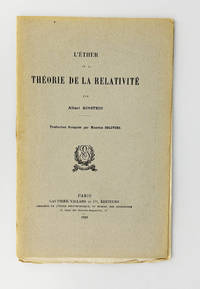
1921009631Paris: Gauthier-Villars 1921 8vo 22.5 cm 16 pp. Uncut in printed wrappers wrappers slightly sunned; ownership entry on the title page. French translation by Maurice Solovine of Einstein's well-known 1920 lecture on the concept of the ether delivered at the University of Leiden. In this brief but influential text Einstein revisits the notion of the ether in light of the general theory of relativity arguing that while the classical mechanical ether must be abandoned the relativistic description of space-time still allows one to speak of a form of 'ether' understood as the physical properties of space itself. A concise and important exposition of Einstein's evolving views on the foundations of relativity.Boni-Russ-Laurence 115.B. Gauthier-Villars paperback
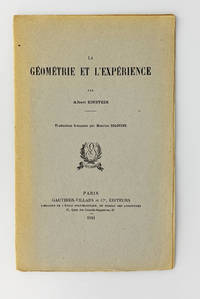
192143310Paris: Gauthier-Villars 1921. 19pp. 228 x 147 mm. Original printed wrappers foxed lower corner chipped. Some toning but very good. French translation by M. Solovine of Einstein's "Geometrie und Erfahrung". Weil 115b. Gauthier-Villars unknown
1921009632Paris: Gauthier-Villars 1921 8vo 22.5 cm 16 pp. Uncut in printed wrappers wrappers slightly sunned; ownership entry on the title page. French translation by Maurice Solovine of Einstein's well-known 1920 lecture on the concept of the ether delivered at the University of Leiden. In this brief but influential text Einstein revisits the notion of the ether in light of the general theory of relativity arguing that while the classical mechanical ether must be abandoned the relativistic description of space-time still allows one to speak of a form of 'ether' understood as the physical properties of space itself. A concise and important exposition of Einstein's evolving views on the foundations of relativity. Boni-Russ-Laurence 122.B. Gauthier-Villars paperback
19211014Paris: Gauthier-Villars 1921. 1st Edition. FIRST FRENCH EDITION OF A 1921 LECTURE BY EINSTEIN ON THE "GEOMETRIZATION OF PHYSICS AND RELATIVITY AND THE RELATION OF MATHEMATICS TO THE EXTERNAL WORLD" Dictionary of Scientific Biography 4 330. WEIL 115b. French translation by Maurice Solovince. <br /> <br /> In the same year in which he won the Nobel Prize 1921 Einstein delivered this paper as a lecture at "a commemorative session of the Prussian Academy of Sciences in honor of Frederick the Great" Calaprice Einstein Almanac 65. In "Geometrie und Erfahrung" Geometry and Experience Einstein advances his theory that space conforms to non-Euclidean principles of geometry -- a corollary of the Theory of Relativity - and as stated generally sums up his views on the "geometrization of physics and relativity and the relation of mathematics to the external world" DSB. <br /> <br /> It is in this lecture that Einstein also provides his famous answer to the puzzling question of why mathematics should be so well adapted to describing the external world: "Insofar as the laws of mathematics refer to the external world they are not certain; and insofar as they are certain they do not refer to reality" ibid. Calaprice put it like this: "He questioned whether human reasoning even without direct experience could lead to an understanding of the properties of real things merely through thought" Calaprice 1921. CONDITION & DETAILS: Paris Gauthier-Villars. 8vo. 9 x 5.75 inches; 225 x 143mm 2 19 1. Two in-text illustrations. Very slight soiling to the front wrap. Minor chipping lower right corner. Bright and clean throughout. See photos. Gauthier-Villars unknown
8493427810.Gpaperback. Good. Access codes and supplements are not guaranteed with used items. May be an ex-library book. paperback
19502946629Buenos Aires.: Emecé. 1950. Hardcover. Cubierta deslucida. Good. 19 cm. 215 p. Encuadernación en tapa dura de editorial. Cubierta deslucida. Física.530.12 530 Emecé. hardcover
19122508Paris: Gauthier-Villars 1912. First edition. Original wrappers custom box. Very Good. RARE FIRST EDITION IN ORIGINAL WRAPPERS OF THE REPORTS FROM THE HISTORIC FIRST SOLVAY CONFERENCE "THE FIRST INTERNATIONAL CONFERENCE IN PHYSICS EVER ORGANIZED" AND A CRITICAL MOMENT IN THE BIRTH OF QUANTUM PHYSICS. In the short time that followed Planck's hypothesis of the universal constant that would bear his name the greatest minds in physics were largely at a loss about how to deal with the bizarre theoretical results that followed let alone the experimental results which confirmed them!. Much of the focus at the time was on black-body radiation including work by Planck himself as well as Lorentz Rayleigh and Jeans. However shortly before the first Solvay conference a young Einstein had also started investigating the related question of materials' specific heat. Kuhn. "The purpose of the first Solvay Conference was thus two-fold: first there was the need to examine whether classical theories molecular-kinetic theory and electrodynamics could in some undiscovered ways provide an explanation of the problem of black-body radiation and of the specific heat of polyatomic substances at low temperatures; secondly to consider phenomena in which the theory of quanta could be successfully used." Mehra.<br /> <br /> Underlying these questions was the more fundamental mystery of how to interpret the existence of the Planck constant. There were two camps both of which were represented at the conference. Planck's took the constant to indicate some fundamental constraint on the radiative processes of emission and absorption. For example "Sommerfeld introduced a version of the quantum hypothesis which he considered to be compatible with classical electrodynamics. He postulated that in 'every purely molecular process' a quantized quantity of action is exchanged." Staumann. Einstein's camp on the other hand took the quantum of action to represent the physicality of a perhaps pseudo-corpuscular theory of energy exchange - his photons of light.<br /> <br /> Although the debates that followed the lectures included in the proceedings did not rise to the famous heated exchange that Einstein would have with Bohr at the 1927 Solvay conference we do see some of the young Einstein's hotheadedness as he opens the debate following Planck's plenary lecture: "What I find strange about the way Mr. Planck applies Boltzmann's equation is that he introduces a state probability W without giving this quantity a physical definition. If one proceeds in such a way then to begin with Boltzmann's equation does not have a physical meaning." As translated by Straumann.<br /> <br /> It would take another 14 years for quantum mechanics to be fully formalized but the first Solvay conference represents a pivotal point in quantum history:<br /> <br /> "During 1911 the situation changed quickly. Articles that applied the quantum to other topics then outnumbered those on blackbody radiation for the first time and some were backed by impressive experimental evidence. In part because of that evidence physicists like Planck and Lorentz who had previously taken the constant h to be characteristic only of the radiation problem began to consider additional areas in which others had earlier staked quantum claims." Kuhn.<br /> <br /> Albert Einstein and the Solvay Conference:<br /> <br /> Among the most renown scientists of the day - including Ernest Rutherford Marie Curie and Max Planck - Einstein made quite an impression. At age 32 he was the second youngest participant in the conference. The youngest was British physicist Frederick Lindemann later to become scientific adviser to Winston Churchill.<br /> <br /> Although "Einstein had already published so many masterpieces none had actually been put to the test and his theories were looked on rather as tours de force than as definitive additions to knowledge. But his pre-eminence among the twelve greatest theoretical physicists of the day was clear to any unprejudiced observer." Frederick Lindemann quoted in Brian.<br /> <br /> References: Headline quote from the Solvay Institute website. Kuhn T. 1978 Black Body Theory and the Quantum Discontinuity 1894-1912. University of Chicago Press. Mehra J. 1975 The Solvay Conferences on Physics: Aspects of the Development of Physics Since 1911. Straumann N. 2011. On the first Solvay Congress in 1911. The European Physical Journal H 363 379-399. Denis Brian Einstein: A Life p.82.<br /> <br /> Paris: Gauthier-Villars 1912. Octavo original wrappers; custom box. Splits to top and bottom joint of upper wrapper two creases to front wrapper. Text in fine condition largely unopened. <br /> <br /> FIRST PRINTINGS IN ORIGINAL WRAPPERS ARE EXTREMELY SCARCE. Gauthier-Villars unknown
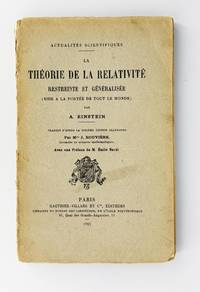
1921009633Paris: Gauthier-Villars 1921 12mo 19 cm XXII 120 pp. Printed wrappers wrappers slightly stained and frayed; small portions of paper missing from the spine; paper toned inside. Early French edition of Einstein's celebrated popular exposition of the theory of relativity intended to make the fundamental ideas of both the special and the general theory accessible to non-specialists. With a preface by the renowned mathematician Émile Borel who emphasizes the scientific importance of Einstein's work and its profound implications for modern physics. Einstein's text explains the essential concepts of space time motion gravitation and the structure of space-time in clear largely non-technical language presenting the empirical and conceptual foundations of relativity to a broad readership. The French translation was prepared by Maurice Solovine one of Einstein's close early collaborators and an important mediator of his ideas to the French-speaking public. Boni-Russ-Laurence 91.B. Gauthier-Villars paperback
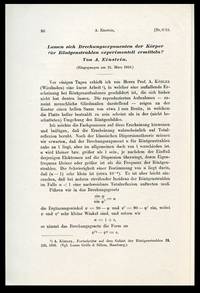
1061Braunschweig: Druck und Vieweg. 1st Edition. FIRST EDITION FULL VOLUME OF THE PAPER IN WHICH EINSTEIN PROVIDES THE FIRST DESCRIPTION OF THE NATURE OF THE REFRACTIVE INDEX FOR X-RAYS here clearly demonstrating that phase contrast effects are significant. <br /> <br /> "Inspired by the presence of fringes at the edges of objects in early X-ray images and by considerations of optical dispersion theory Einstein suggested in 1918 that the real part of the index of refraction for X-rays in matter is slightly less than unity. This was confirmed in 1924 by Larsson et al. in measurements of wavelength-dependent refraction of X-rays by a prism" Hornberger Quantitative Amplitude 1. "A century later most x-ray microscopy and nearly all medical imaging remains based on absorption contrast even though phase contrast offers orders of magnitude improvements in contrast and reduced radiation exposure at multi-keV x-ray energies"ResearchGate November 2015. Weil 104. Note that we offer this paper separately in its original printed wraps. <br /> <br /> ALSO INCLUDED: Einstein's reply to Gehrcke's paper "Über den Äther" also present in this volume pp. 165-169.<br /> <br /> ALSO INCLUDED: Papers by E. Goldstein A. Landé Max Born and J. Petzoldt. CONDITION & DETAILS: Braunschweig: Druck und Vieweg. Full volume. Complete. 4to 9.25 x 6.25 inches; 225 x 150mm. Ex-libris with armorial bookplate on the front pastedown. Bound in brown cloth rubbed at the edges; the cloth has torn at the spine and has been re-glued. Clean throughout. Good . Druck und Vieweg paperback
22953Halbleinen; 136 Seiten dies ist ein regulär ausgesondertes Bibliotheksexemplar aus einer wissenschaftlichen Bibliothek keine Markierungen/Anmerkungen Deckellaminat leicht verletzt von entfernter Rückensignatur das Buch ist ansonsten gut erhalten unknown
1993R3215France: Éditions du Seuil Collection Science ouverte 1993 ÉPUISÉ mais DISPONIBLE. « La correspondance du couple s'étend de 1897 à 1903 peu après leur mariage. Ces lettres révèlent un Einstein peu connu optimiste confiant et heureux malgré les difficultés familiales et professionnelles qu'affronte le jeune couple. Mileva y montre une forte personnalité - « mon égal » dit Einstein qui admire sa maturité affective et intellectuelle. Elle contribuera de façon essentielle aux succès scientifiques d'Einstein.». Couverture souple. Comme neuf. Éditions du Seuil (Collection Science ouverte) paperback
1912011596Leipzig: Johann Ambrosius Barth 1912. In bound volume of Annalen der Physik. Vierte Folge Band 38 pp. 355-69. Volume also includes 1 Einstein "Nachtrag zu meiner Arbeit:: 'Thermodynamische Begrundung des photochemischen Aquivalentgesetzes" pp. 881-84; 2 "Antwort auf eine Bermerkung von J. Stark p. 888; and 3 "Relativitat und Gravitation Erwiderung auf eine Bermerkung von M. Abraham" pp. 1059-64. Paper label on spine top of which is worn; library bookplate; perforated stamp on half-title and title page. First Edition. Library Buckram. Good. Johann Ambrosius Barth Hardcover
1912008413Leipzig: Johann Ambrosius Barth 1912. Small pieces missing from spine; rear wrapper carefully reattached; ink stamp on front wrapper; small piece of paper stuck to first page. . First Edition. Original Printed Wrappers. Good. Johann Ambrosius Barth Paperback
191229311Leipzig Barth 1912. 8vo. Orig. printed wrappers. Backstrip taped. Kept in a cloth-box. In: "Annalen der Physik IV Bd. 38" pp. 355-369 and pp. 443-458. The whole issue present= Bd. 38 Heft 2 pp.249-472. <br/><br/><em>Both papers in first edition and they are considered as the first appearance of a Nonlinear Field Equation for Gravitation. - "Einstein published two remarkable memoirs in 1912 which were efforts to construct a complete theory of gravitation incorporating the equivalence principle. In these memoirs Einstein supposed that the gravitational field can be characterized completely by one function the local speed of light analogous to the Newtonian description where only the gravitational potential appears. By an extraordinary argument he extended the potential equation of Newton.In his second Memoir in 1912 he used the equivalence principle to show the influence of a static gravitational field on electromagnetic and thermal processes." DSB IV p.320 ff. - Weil No. 47 and 48. </em> hardcover
191249779Leipzig Barth1912. 8vo. No wrappers. In: "Annalen der Physik IV Bd. 38" No 7. Pp.249-472 a. 3 plates. Entire issue offered. Einstein's papers: pp. 355-369 and pp. 443-458. Clean and fine. <br/><br/><em>Both papers in first edition and they are considered as the first appearance of a Nonlinear Field Equation for Gravitation. "Einstein published two remarkable memoirs in 1912 which were efforts to construct a complete theory of gravitation incorporating the equivalence principle. In these memoirs Einstein supposed that the gravitational field can be characterized completely by one function the local speed of light analogous to the Newtonian description where only the gravitational potential appears. By an extraordinary argument he extended the potential equation of Newton.In his second Memoir in 1912 he used the equivalence principle to show the influence of a static gravitational field on electromagnetic and thermal processes." DSB IV p.320 ff. - Weil No. 47 and 48. </em> unknown
1954195551954. in German black ink. Signed “A. Einsteinâ€. A poem written by Einstein to his colleague and collaborator Ernst Straus and his son Daniel.<br /> <br /> “Dear Strausse both!<br /> <br /> My best wishes and greetings in poetic form.<br /> <br /> It brings even more happiness<br /> If it has been anticipated for so long<br /> also in one’s circle of friends<br /> the event is doubly appreciated. <br /> <br /> This is what I wish:<br /> Let Daniel be like his father<br /> thoroughly intelligent and not less joyous<br /> so few humans are like that.<br /> <br /> Many - alas - are born<br /> few are chosen<br /> to bring light and joy.<br /> Let such gift be his drive.<br /> <br /> Yours A. Einsteinâ€<br /> <br /> In German “Strauss†means bunch bouquet etc. or ostrich and “Strausse†is plural.<br /> <br /> Ernst G. Straus 1922-1983 was a mathematician who helped found the theories of Euclidean Ramsey theory and of the arithmetic properties of analytic functions. He was Einstein’s assistant and collaborator both at Princeton and afterwards when he moved to become a professor of mathematics at UCLA. His son Daniel is a professor of chemistry at Cal State San Jose. unknown
mon0003991652Blurb 10/17/2025 12:00:01. hardcover. Very Good. 0.3543 9.2126 6.1811. Blurb hardcover