EINSTEIN, ALBERTBiblio.com

1 505 résultats
192552559Berlin Königlich Akademie der Wissenschaften 1925-1929. 1. Einheitliche Feldtheorie von Gravitation und Elektrizität. Offprint: S. B. preuss. Akad. Wiss. 1925 pp.414-419. Original wrappers. Mint. Weil 147 / Boni 155.2. Neue Möglichkeit für eine einheitliche Feldtheorie von Gravitation und Elektrizität. Offprint: S. B. preuss. Akad. Wiss. 1928 pp.235-245. Original wrappers. Mint. Weil 162/ Boni 175.3. Zur einheitlichen Feldtheorie. Offprint: S. B. preuss. Akad. Wiss. 1929 pp.2-7. Original wrappers. Mint. Weil 165/ Boni 183.4. Einheitliche Feldtheorie und Hamiltonsches Prinzip. Offprint: S. B. preuss. Akad. Wiss. 1929 pp.156-159. Original wrappers. Mint. Weil 166/ Boni 184.5. Über den gegenwärtigen Stand der Feldtheorie. In: Festschrift Dr. A. Stodola Zürich Füssli 1929 pp.126-132. Publishers full cloth. Spine slightly faded. Otherwise mint. Weil 168 / Boni 178.All in all a very fine set. <br/><br/><em>Offprint of all four papers and first edition of the final essay constituting Einstein's attempt toward creating a unified field theory: "a new theory of space with a view to unification of all forms of activity that fall within the sphere of physics giving them a common explanation" PMM416. The task of unifying nuclear electromagnetic and gravitational force is nowadays by many considered the holy grail of theoretical physics.Maxwell was the first to develop such a theory when he described the forces of electricity and magnetism as the single force electromagnetism. After Einstein had completed his general theory of relativity a field theory for gravitation he turned his attention towards generalizing his theory even further to include Maxwell's theory. Even though Einstein never succeeded in completing this task in the way that he finished his earlier theories he pioneered and explored many areas of this subject. "It had been repeatedly observed that Einstein's general theory of relativity necessitated a pluralistic explanation of the universe. In 1925 he announced that he had resolved this difficulty but the announcement was premature. In 1928 he attacked the problem once more only to find that Riemann's conception of space on which the general theory was based would not permit of a common explanation of electromagnetic and gravitational phenomena. In a series of papers the present devoted to the development of 'A Uniform Theory of Gravitation and Electricity' he outlined a new theory of space with a view to unification of all forms of activity that fall within the sphere of physics giving them a common explanation. All that would then remain to complete a scientific unison is the correlation of the organic and inorganic".PMM 416Barchas 586 </em> hardcover
193138732Berlin Akademie der Wissenschaften 1931-32. 4to. Both papers with orig. printed orange wrappers. Offprints Sonderausgabe "Sitzungsberichten der Preussischen Akademie der Wissenschaften". 19;10 pp. Fine and clean. <br/><br/><em>First edition. - Weil: 182 and 185. With asteerix denoting major paper. </em> unknown
191350339Leipzig: Johann Ambrosius Barth 1913. <p>Einstein Albert 1879-1955. Einige argumente fur die annahme einer molekularen agitaation beim absoluten nullpunkt. In Annalen der Physik 40 pp.551-560. With: Otto Stern 1888-1969. Red cloth with gilt lettering on the spine. Whole volume: 1056 pp. 1 plate. 210 x 130 mm. A very good copy. </p> <br /> <br /> <p>"Some arguments for the assumption of molecular agitation at absolute zero." In this paper Einstein and Stern show that the quantum theory of solids to give the best agreement with experiments at normal temperatures seems to demand that at absolute zero a residual energy would remain in the solids which they term "zero-point energy." They thus introduced this important concept to physics." p. 292. Calaprice Kennefick & Shulmann. An Einstein Encyclopedia. 2015. </p> <br /> <br /> <p> Otto Stern was a German-American physicist and Nobel Laureate in Physics. He was the second most nominated person for a Nobel Prize with 82 nominations in the years 1925-1945 ultimately winning in 1943 "for his contribution to the development of the molecular rat method and his discovery of the magnetic moment of the proton". In 1912 Stern did his doctoral dissertation in concentrated solutions. After receiving his Ph.D. degree Stern took advantage of his economic independence to join Albert Einstein at Prague. Stern was with Einstein from the spring of 1912 until 1914. </p> <br /> <br /> <p>Weil's Bibliography no. 53. </p> . Johann Ambrosius Barth unknown
1913003231Leipzig: J. A. Barth 1913. Contemporary three-quarter cloth marbled boards. Minor abrasions on front cover. . First Edition. Very Good. J. A. Barth hardcover
191338832Berlin J.A. Barth 1913. Later full cloth. "Annalen der Physik. Vierte Folge. Band 40. Hrsg. von W. Wien und M. Planck." VIII1056 pp. 1 plate. Einstein paper: pp. 551-60. Internally fine and clean. The whole volume offered. <br/><br/><em>First edition. In this paper "Some arguments for the existance of a molecular agitation at the absolute zero point" Einstein derives Planck's radiation law without the usual discontinuity assumptions.The volume contains also papers by W. Pauli Stark Nordström and others. - Weil No 53. </em> hardcover
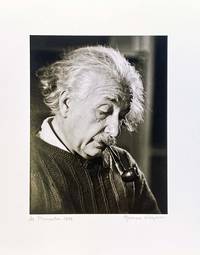
19802611New York: np 1980. First edition. Clamshell box. Fine. EXTREMELY RARE COMPLETE SUITE OF SEVEN LARGE SILVER PRINTS FROM EINSTEIN'S FAMOUS PHOTO SHOOT AT PRINCETON WITH ROMAN VISHNIAC. Each print is signed by Vishniac and dated "At Princeton 1942" in his hand below the image and numbered on the back. "One day Vishniac decided to visit Albert Einstein at Princeton to offer greetings from mutual friends in Berlin. Uninvited he hoped Einstein would pose for a portrait but Einstein had little interest. Vishniac recalled:<br /> <br /> It was a singular experience. An idea had suddenly come to him and the room was filled with the movement of the great man's thought. I waited several minutes and then when I saw that he did not intend to say anything more to me and that he was off in a world of his own I started taking pictures.<br /> <br /> Einstein later admitted that a Vishniac photograph taken that day was his favorite portrait" Encyclopedia of Twentieth-Century Photography. <br /> <br /> Vishniac provided details about this portolfio in a letter to an original recipient the letter is not included here explaining:<br /> <br /> The size of the edition's limitation is uncertain due to my age and only spare time to make them. The most expensive portfolios - Ansel Adams Kertesz - are limited in large numbers I can never measure up - 999 1001 and similar. <br /> <br /> The originality of Portfolio "Einstein" consists of its special character. It is made not to get images but the feeling that you are present during the creativity by the Great Man. All pictures are made with "hidden camera" method.<br /> <br /> The value of this portfolio is great and can hardly be estimated today. <br /> <br /> Princeton/New York: 1942 negatives; 1980 silver prints. Elephant folio clamshell box approx. 17x21 in. housing seven silver prints. Image size: approx. 10.25 x 13.25 in.; with matte 16x20 in. A few minor blemishes to box. Photos in fine condition. RARE. np unknown
190850421Leipzig 1908. <p> 1 Planck Max 1858-1947. Zur dynamik bewegter systeme. In Annalen der Physik 26 6: 1-34 pp. 2 Einstein Albert 1879-1965 and Jakob Laub 1882-1962. Über die elektromagnetischen grundgleichungen für bewegte Körper. In Annalen der Physik 26 8: 532-40 pp. Boni 22 Weil 22. 3 Einstein A. and J. Laub. Über die im elektromagnetischen felde auf ruhende Körper ausgeubten ponderomotorischen Krafte. In Annalen der Physik 26 8: 541-50 pp. Boni 23 Weil 23. Red cloth gilt lettering on spine. Figs. Text-illust. 230 x 141 mm. Whole volume: viii 1032 pp. 8 plates 3 folding 3 b/w silver photos. Spine a little worn but still Very Good. </p> <br /> <br /> <p>Approximate English translations of titles: 1 "On the dynamics of moving systems". 2 "On the fundamental electromagnetic equations for moving bodies;" and 3 "On the ponderomotive forces exerted on bodies at rest in the electromagnetic field." </p> <br /> <br /> <p>"Einstein wrote no. 2 above and "Elementary theory of Brownian motion" in Zeitschrift für Elektrochemie und angewandte physikalische Chemie 14 1908: 235-239 pp. in a three-week period with Jakob Laub his first scientific collaborator to address the problems of formulating relativistically invariant equations for electromagnetic fields in moving media first raised by Hermann Minowski the year before." Calaprice An Einstein Encyclopedia. 2015. A correction to this paper no. 2 was published later in the year in vol. 27 1908: 232 and a supplement for the following year in vol. 28 1909: 445-447. Elaborating on the relativistic transformation of Maxwell's vacuum equations . . . Einstein and Laub also consider the displacement vector D and the magnetic induction B. </p> <br /> <br /> <p>Weil's Einstein Bibliography nos. 22 23. <br> Boni's Einstein Checklist nos. 22 23. </p> <br /> <br /> <p> Max Karl Ernst Ludwig Planck 1858-1947 was a German theoretical physicist who was awarded the 1918 Nobel Prize in Physics "in recognition of the services he rendered to the advancement of Physics by his discovery of energy quanta" nobelprize.org. Planck revolutionized human understanding of atomic and subatomic processes as the originator of the quantum theory. Jakob Laub 1882-1962 was a physicist who is best known for his work in the early period of special relativity having worked alongside Albert Einstein during that time. </p> . unknown
1960014279New York: Simon & Schuster 1960. Unclipped dust jacket. First Edition. Original Cloth. Very Good/Very Good. Simon & Schuster Hardcover
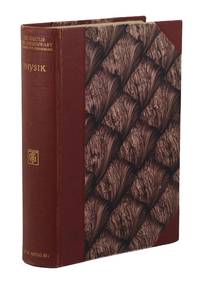
1915140945614Leipzig & Berlin: B.G. Teubner 1915. First edition. First edition. iv viii 762 8 pp. Bound in publisher's three quarter maroon cloth with marbled paper sides gilt spine lettering. Near Fine with rubbing along edges; a few marks to prelims text otherwise free of markings; hint of foxing to edges. Bookplate on paste down. <p>A German-language physics review with the first book publication of two articles by Albert Einstein as well as work by a number of famous physicists of the early 20th century. B.G. Teubner unknown
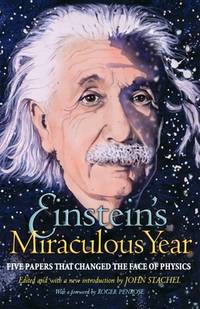
1998Q-0691059381Princeton University Press 1998-03-30. Hardcover. New. New. In shrink wrap. Looks like an interesting title! Princeton University Press hardcover
1996Q-0807614173George Braziller 1996-01-01. Hardcover. New. In shrink wrap. Looks like an interesting title! George Braziller hardcover
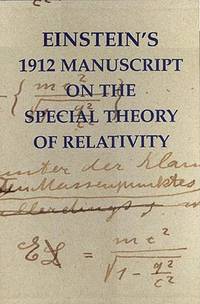
19960010399New York: George Braziller 1996. Hardcover. As New/issued without dj. Folio 192 pages clothbound in publisher's slipcase shrinkwrapped unopened <br/><br/>A highly detailed and accurate facsimile of the earliest surviving autograph manuscript published by George Braziller in association with the Jacob E. Safra Philanthropic Foundation and the Israel Museum. An English translation is provided for each page. Introduction by Hanoch Gutfreund. OP in hardcover original list price $195. George Braziller hardcover
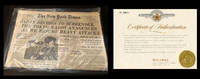
19311435New York: New York Times 1931. 1st Edition. First edition of the October 19th 1931 issue of the New York Times complete with "Certificate of Authentication" by the Historic Newspaper Archives. The certificate is #379912; it is signed and includes the seal of the archive. <br /> <br /> Einstein was asked to contribute to the New York Times' "World Mourns the Death of Edison; Body to Lie in State in Laboratory.". CONDITION: Historic Newspaper Archives see above has placed the issue in archival plastic and then into an Archive snap close bag. see photo By any measure this complete issue appears in very good condition. New York Times unknown
1979311182Cambridge: Harvard University Press 1979. hardcover. fine/fine. Edited by A.P. French. Illustrated throughout with black and white photographs and diagrams. xx 332 pages. Tall 8vo red cloth d.w. Cambridge: Harvard University Press 1979. A fine copy in a fine dust wrapper.<br/> <br/> Harvard University Press unknown
192514131925. 1st Edition. FIRST EDITION IN ORIGINAL PICTORIAL WRAPPERS. Near fine condition. <br /> <br /> "This paper is an early example of a series of papers - which continued until his death - in which he explored within the confines of general relativity possible pathways in the direction of a unified field theory. Here he discusses whether it is possible to explain why electrons and protons have equal charge but unequal masses. He notes that a more natural solution to the field equations would be particles of opposite sign and equal mass thus anticipating but for unrelated "Select Annotated Biography 114 p. 307. <br /> <br /> ALSO INCLUDED: Zeeman "Lorentz en de Hypothese der Licht-Quanta Bij de Voortplanting Van Licht" pp. 325-330 Lorentz was Zeeman's mentor. <br /> <br /> ALSO INCLUDED: Some of the issue is a memorial to Lorentz. CONDITION DETAILS: Complete issue. Very slight wear at the spine. Bright and clean inside and out. Near fine condition. unknown
191150316Leipzig: Johann Ambrosius Barth 1911. Einstein Albert 1879-1955. Elementare Betrachtungen über die thermische Molekular bewegung in festen Körpern. In Annalen der Physik 35 9: 679-694 pp. Whole issue disbound from larger volume but still stitched together front wrapper detached chipped with loss and tears else very good. Whole issue: pp. 617-816 3 plates.<br /> <br /> <p>First edition of Einstein's sequel and complement to his 1907 paper on Planck's theory of radiation and heat translated as Elementary Observations on Thermal Molecular Motion in Solids. Einstein tries to improve upon his model of specific heats after realizing the model was inocrrect at very low temperatures. The correct answer would come a year later with the Debye model. </p> <p>"Elementary observations on thermal molecular motion in solids. . . Here Einstein continues the work he had begun in 1907 on the specific heat of solids where the heat agitation of solids was reduced to a monochromatic oscillation of the atom and the specific heat was determined based on the quantum treatment of an oscillator in a radiation field. He explains the discrepancies between his formula and the measurements at low temperatures." p. 291. Calaprice Kennefick & Shulmann. An Einstein Encyclopedia. 2015. </p> <br /> <br /> <p>Weil's Einstein Bibliography no. 42. </p> . Johann Ambrosius Barth unknown
1911003227Leipzig: J. A. Barth 1911. Contemporary three-quarters cloth marbled boards. Discusses bending of light in gravitational field. First Edition. Very Good. J. A. Barth hardcover
191146958Leipzig Barth 1911. Plain wrappers. In: "Annalen der Physik" Vierte Folge Bd. 35 No 9. With titlepage to vol. 35. Pp. 617-816 a. 3 plates. Entire issue offered. Einstein'spaper: pp. 679-694. Clean and fine. <br/><br/><em>First edition. In the paper "Elementary observations concerning the thermal molecular motion in solid bodie" he continues his earlier investigations of the specific heat of solids in which the heat agitation of solids was reduced to a monochromatic oscillation of the atom and the specific heat calculated on the basis of the quantum treatment of an oscillator put in the radiation field. Here he deals with with the discrepancies between his formula of the measurements at low temperature." Cornelius Lanzos.Weil: 42. - Boni: 38. </em> unknown
191647015Berlin Julius Springer 1916. Royal8vo. Bound in contemporary half calf with gilt lettering to spine. In "Die Naturwissenschaften" 4 Jahrgang 1916. A very nice and clean copy. Pp. 509-510. Entire volume: XIV 866 pp. <br/><br/><em>First printing of Einstein's only paper on aircrafts. In it he proposed a new shape for aircraft wings. Disappointed that nobody took up his idea he took it to an airline in Berlin. A prototype was constructed but it performed poorly and it was never put into service. </em> unknown
1979030708Princeton NJ: Princeton University Press 1979. Book. Fine. Cloth. First Edition. 8vo - over 7¾" - 9¾" tall. Orange cloth lettered in black. As issued. Dust jacket as issued now in archival mylar. xvii235 pp. Princeton University Press Hardcover
1913188059Leipzig and Berlin: B. G. Teubner 1913. Generalizing relativity First edition of Einstein's early articulation of general relativity his first paper to describe gravity as the curvature of spacetime containing "virtually all the essential features of his general theory of relativity" Norton p. 253. In 1912 Einstein's old school friend Marcel Grossman 1878-1936 secured him a professorship at ETH Zurich where they had both studied as undergraduates. The two men began a collaboration to provide a firmer mathematical foundation to Einstein's concept of gravity as a geometrical property of time and space. The two sections of the Entwurf outline the resulting theory in full complete with gravitational field equations relating the curvature of spacetime to the distribution of mass and energy within it. Einstein contributed the initial section focussing on physical theories while Grossman added the following section developing the more complex mathematical formulae. Michel Janssen editor of the Einstein Papers Project notes that the Entwurf "was published as a separatum in early 1913 and was reprinted the following year in Zeitschrift für Mathematik und Physik" p. 1. The Zeitschrift reprint includes an added section outlining the famed "Hole" argument. An offprint dated 1914 was published with the journal. Provenance: Edward Vermilye Huntington 1874-1952 the American academic who studied the foundations of mathematics at Harvard for 40 years with his signature on the front wrapper. Octavo. Device to title page formulae in the text. Original light green wrappers printed in black. Light rubbing chipping and creasing to wrappers contents clean: a very good copy indeed. Boni 50; Norman 693; Weil 58a. Michael Janssen "Einstein's First Systematic Exposition of General Relativity" 2004; John Norton "How Einstein found his field equations: 1912-1915" Historical Studies in the Physical Sciences vol. 14 no. 2 1984. unknown
191343305Leipzig & Berlin: Teubner 1913. 38pp. 254 x 170 mm. Original printed wrappers chipped. Library stamps. Very good. First separate edition. "After his first discussions with Grossmann Einstein had found the correct starting point for general relativity. The real work could now begin . . . The Einstein-Grossmann paper published in 1913 contains profound physical insight into the nature of measurement some correct general relativistic equations some faulty reasoning and clumsy notation" Pais Subtle is the Lord p. 216. Weil Albert Einstein Bibliography 58. Teubner unknown
19132064Leipzig and Berlin: Teubner 1913. First edition. Original wrappers. Very Good. FIRST EDITION COMMERCIAL OFFPRINT ISSUE of Einstein's breakthrough work on general relativity: the famous "Entwurf" paper. "In this book Einstein and Grossman investigated curved space and curved time as they relate to a theory of gravity. They presented virtually all the elements of the general theory of relativity with the exception of one striking omission: gravitational field equations that were not generally covariant. Einstein soon reconciled himself to this lack of general covariance through the 'hole argument' which sought to establish that generally covariant gravitational field equations would be physically uninteresting. Einstein did not adopt the gravitational field equations until late in 1915 in his final formulations of the general theory. Here Einstein contributed the physics and Grossman the mathematics" Calaprice The Einstein Almanac 40. Weil 59a. Offprint from Zeitschrift für Mathematik und Physik volume 62. Leipzig and Berlin: Teubner 1913. Octavo original wrappers; custom box. Pencil notation on title. Small chips at spine ends. An outstanding copy without any of the cover-foxing so common with this issue. Teubner unknown
1916140941831Leipzig Germany: S. Hirzel 1916. First separate edition. First separate edition. 4 pp. Illustrated with portrait of August Mach from photograph. Publisher's original printed wrappers. Very Good with some small chips to fragile wrappers faint crease to top of front wrap contents toned with age. This copy belonged to Hans Albert Einstein Albert Einstein’s oldest son with his inkstamp at top of front wrapper; likely a presentation copy from his father. Neatly written at top of front wrapper is "43" and date "14.III.16." OCLC/WorldCat locates four copies two at the University of Toronto one at the Smithsonian Institution and one at the American Philosophical Society. Weil 89.<br /> <br /> <p>Very rare author's offprint stating "Uberreicht vom Verfasser" of the eulogy by Albert Einstein for fellow physicist Ernst Mach as first published in Physikalischen Zeitschrift. A noted scientist in his own right Mach is best known for the concept of "Mach's principle" which asserts that an entity's inertial mass is determined by all the other masses in the universe. Einstein in fact coined the phrase "Mach's principle" and his application of it had major ramifications for the development of his theory of general relativity Einstein in 1918 labeling it one of the "three pillars" of general relativity. S. Hirzel unknown
1995Q-0876544723Pomegranate 1995-09-01. Paperback. New. In shrink wrap. Looks like an interesting title! Pomegranate paperback