EINSTEIN, CharlesBiblio.com
1 506 résultats
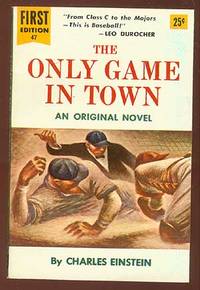
195523282New York: Dell First Edition 1955. Softcover. Fine. Paperback original. Pages slightly yellowed else a fine unread copy. Leo Durocher blurb. Novel by the compiler of The Fireside Book of Baseball about an aging player-manager taking one last shot at the big time. McCue p.38. Dell First Edition unknown
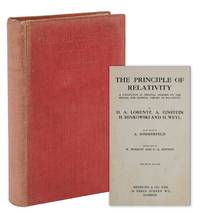
1923140949178London: Methuen & Co 1923. First Edition. Very Good. First British edition first printing. viii 216 8 ads pp. Bound in publisher's red cloth lettered in blind on front board and in gilt on spine; lacking the dust jacket. Very Good with fading light wear and soiling to covers. Evidence of bookplate removal to front pastedown offsetting to free endpapers rear hinge starting. Contents lightly toned with foxing to first and last few pages and textblock edges.<br /> <br /> <p>An influential collection of eleven papers on relativity. Seven are authored by Einstein two by Henrik Lorentz and one each by Hermann Minkowski and Hermann Weyl. The first edition of this translation of Das Relativitaetsprinzip taken from the fourth German edition. Methuen & Co unknown
1996Q-0691026963Princeton University Press 1996-09-16. Hardcover. New. New. In shrink wrap. Looks like an interesting title! Princeton University Press hardcover
1994Q-1884944000Elizabeth Einstein 1994-02-01. Paperback. New. In shrink wrap. Looks like an interesting title! Elizabeth Einstein paperback
196871878Simon. Good/Good. 1968. Second Printing. Hard Cover. 0671200720 B193 . Simon hardcover
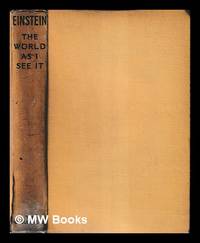
19341396463New York: Covici Friede 1934. First U.S. Edition. Hardcover. Octavo 290 pages. In Very Good condition. Bound in publisher's dark gray cloth with mildly worn silver lettering to spine. Mild general shelf wear. Textblock clean. Shelved in Case 10. Originally publisher in German as "Mein Weltbild." 1396463. Shelved Dupont Bookstore. Covici Friede hardcover
1949013382New York New York Usa: Philosophical Library 1949. Hardcover. Very Good/Fair. USA. In Very Good Condition. No Notes or Markings. Wear To Dust Jacket Corners Edges and Spine. For More Information On Condition. Please View All Images. Vintage 1949 - 112 Pages. Composed of assorted articles addresses letters interviews and pronouncements it includes Einstein's opinions on the meaning of life ethics science society religion and politics. <br/> <br/> Philosophical Library hardcover
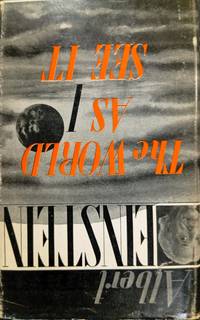
1941465337London : J. Lane 1941. Second Edition. Hardcover. Second cheap edition. Good copy in the original gilt-blocked cloth. Spine bands and panel edges somewhat dulled and rubbed as with age. Small tears to exterior cloth. Boards warped and stained corners bumped. Text remains clear and without blemish. Physical description; x 214 pages. Notes; Translation of the German: Mein Weltbild. Contents; The world as I see it.--Politics and pacificism.--Germany 1933.--The Jews.--Scientific. Subjects; Physics. Jews. Peace. Jews. Philosophy. Physics Addresses essays lectures. Jews Addresses essays lectures. Peace Addresses essays lectures. Philosophy German 20th century. Philosophy Modern. Pacifism. London : J. Lane hardcover
1935055004London: John Lane The Bodley Head Limited 1935. First British Edition First Printing. Hardcover. Good/No Dust Jacket. A Good copy in purple hard covers lettered in white with the cloth sun-faded at the spine only minor effect on the lettering. Mild cover wear. Tanning/foxing to the endpapers. The binding is sound the text is clean/unmarked and not ex-library. No dust jacket. The first British edition/first printing of 1935 a year later but scarcer than the U.S. edition. <br/> <br/> John Lane The Bodley Head Limited hardcover
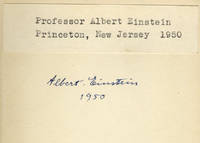
194932820624Original yellow cloth. Near fine dust jacket supplied from another copy. Early typed slip stating "Professor Albert Einstein / Princeton New Jersey 1950" mounted to top of front free endpaper. Light soiling. Very good <p><b>Signed and dated 1950 by Albert Einstein</b> on the front free endpaper.</p><p>This is the English translation of Einstein's <i>Mein Weltbild</i> first published in German in 1934 and then in English as <i>The World As I See It</i>in the same year. This abridged edition of 1949 omits the scientific essays preserving the extensive essays concerning philosophy religion Judaism economics current events government politics war and peace.</p> Philosophical Library hardcover
1981BN258385Frankfurt am Main : Suhrkamp 1981. 1981. Thematische Analyse der Wissenschaft : d. Physik Einsteins u. seiner Zeit. Gerald Holton. Übers. von Horst Huber / Suhrkamp-Taschenbuch Wissenschaft ; 293 <br/><br/>Thematische Analyse der Wissenschaft : d. Physik Einsteins u. seiner Zeit. Gerald Holton. Übers. von Horst Huber / Suhrkamp-Taschenbuch Wissenschaft ; 293 Einstein Albert - Holton Gerald James Frankfurt am Main : Suhrkamp unknown
1907433121907. Offprint from "Zeitschrift für Elektrochemie" 1907. Single sheet pp. 41-42. 287 x 206 mm. Chipped several marginal tears some toning. Fair. First edition offprint issue. "In 1907 Einstein published a paper entitled 'Theoretical Observations on the Brownian Motion' in which he considered the instantaneous velocity of a Brownian particle. Einstein showed that by measuring this quantity one could prove that 'the kinetic energy of the motion of the center of gravity of a particle is independent of the size and nature of the particle and independent of the nature of its environment.' This is one of the basic tenets of statistical mechanics known as the equipartition theorem. However Einstein concluded that due to the very rapid randomization of the motion the instantaneous velocity of a Brownian particle would be impossible to measure in practice. "Einstein: The Formative Years. unknown
19234609Praze Prague: Fr. Borový 1923 1923. First and only edition of the Czech translation of Einstein's Über die spezielle und die allgemeine Relativitätstheorie first published in German in 1916 with the English translation appearing in 1920. It was intended by Einstein as a brief popular introduction to his theory of relativity. This Czech edition has a special preface by Einstein written for this translation. Einstein worked in Prague for seventeen months in 1911-12 and retained a fondness for the city. 8vo. 210x135mmpp. 103 21bl. Original Blue card wrappers with striking design. Some toning and creasing to edges of wrappers but otherwise in very good condition and excellent internally. Title page has ownership inscription of Robert Knuwehil . This Czech translation is rare OCLC recording only five copies worldwide. Praze [Prague]: Fr. Borový, 1923 unknown
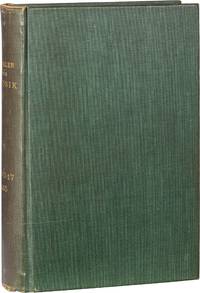
191250337Leipzig: Johann Ambrosius Barth 1912. <p>Einstein Albert 1879-1955. Thermodynamische Begründung des photochemischen Äquivalentgesetzes. In Annalen der Physik 37 832-838 pp. Red cloth with gilt lettering on the spine. Whole volume: 1048 pp. 5 plates 4 folding 1 b/w silver photograph w/ small fold at foot. Figs. Text-illust. 210 x 130 mm. Very good copy. </p> <br /> <br /> <p>"A supplement published in vol. 38 1912: 881-884 See Book ID: 50338. Einstein presents a continuation of his earlier work on the interaction between light matter and on photochemical processes. It contrasts with earlier work in that it makes no use of the quantum hypothesis. He demonstrates how what he calls 'the law of photochemical equivalence' is deducible by purely thermodynamical arguments if one makes certain plausible assumptions. He wrote a supplement to the paper in five months later in the same journal." p. 291-2. Calaprice Kennefick & Shulmann. An Einstein Encyclopedia. 2015.</p> <br /> <br /> <p>Weil's Bibliography of Einstein's Papers no. 46. <br> Boni's Bibliographical Checklist no. 42. </p> . Johann Ambrosius Barth unknown
191238839Leipzig J.A. Barth 1912. Bound in two contemp. hcalf richly gilt spine and one later full cloth. A library stamp on the first volume. "Annalen der Physik. Vierte Folge. Band 37 und 38. Hrsg. von W. Wien und M. Planck." VIII1048;VIII1064 pp. 58 plates. Einstein papers: pp. 832-38 vol.37 pp. 881-84 Nachtrag vol. 38; pp. 443-458 vol. 38; p. 888 vol. 38; pp. 1059-1064 vol. 38; Planck: pp. 642-656. Internally fine and clean. Both volumes offered. <br/><br/><em>All papers first edition. In the first paper "Thermodynamical derivation of the photochemical equivalence" Einstein calls "the law of photochemical equivalence" the statement that the decomposition of one gram equivalent of any substance by a photochemical proces demands the radiation energy of 'Nhv' where N=the Avogadro number. In this paper he demonstrates how this law is deducible by purely thermodynamical arguments if certain olausible assumotions are made. Lanzos. - The second paper "Concerning the theory of a static gravitational field" states that the 'equivalence hypothesis' permits us to come to very definite conclusions about the behaviour of a static gravitational field. - The next Einstein paper gives an answer to J. Stark as Stark claimed priority to the photochemical equivalence law. - In the last paper "Relativity and Gravitation. Reply to a remark of M. Abraham" Einstein elaborates his answer to the critique of M. Abraham. - Weil Nos 46 1-2 a. 48. - Planck Akademie No 95. </em> hardcover
1905786Leipzig: Barth 1905. First Edition. 8vo 222 x 159mm pp. 1 viii 1022. In German the first appearance anywhere of three seminal papers by Einstein each addressing a distinct problem and each now recognized as foundational for a major branch of twentieth-century physics. Original cloth publisher’s binding complete with half-title and index with light rubbing to the spine tips still near fine and exceptionally well preserved for this volume and unusually without institutional stamps or other markings. Half morocco case.<br /> <br /> The most consequential volume in the history of modern physics: a single 1905 journal containing three papers by Albert Einstein that simultaneously founded quantum theory proved the existence of atoms and overthrew Newton's conception of space and time. This is the year physics broke open. While offprints individual issues and extracted copies of one or another of these texts appear with some frequency complete and unrestored copies of the bound annual volume in contemporary cloth remain scarce and this copy is in unusually fine condition. As a unit Band 17 documents in real time the consolidation of a new theoretical framework that would reshape the subsequent development of physics. PMM 293 371 408. Dibner 167. The first paper "Über einen die Erzeugung und Verwandlung des Lichtes betreffenden heuristischen Gesichtspunkt" On a Heuristic Viewpoint Concerning the Production and Transformation of Light March 1905 pp. 132–148 introduces the light quantum hypothesis and provides the first satisfactory explanation of the photoelectric effect. By treating radiation in specific circumstances as consisting of localized energy quanta rather than as a continuously distributed wave Einstein resolved the empirical failure of classical electrodynamics to account for the frequency dependence of photoelectron energies. This conceptual move directly anticipates and influences later developments in quantum theory from the formalization of the photon concept in quantum electrodynamics to the probabilistic interpretation of radiation–matter interactions in quantum field theory. It is for this work rather than for relativity that Einstein received the 1921 Nobel Prize in Physics underscoring its centrality to the emerging quantum paradigm.<br /> <br /> The second paper "Über die von der molekularkinetischen Theorie der Wärme geforderte Bewegung von in ruhenden Flüssigkeiten suspendierten Teilchen" On the Motion of Small Particles Suspended in a Stationary Liquid as Demanded by the Molecular-Kinetic Theory of Heat May 1905 pp. 549–560 furnishes a quantitative theory of Brownian motion linking observable stochastic trajectories of suspended particles to underlying molecular collisions. By deriving explicit relations between mean squared displacement time viscosity and particle size Einstein showed how microscopic randomness could be described statistically and used to infer Avogadro’s number and molecular dimensions. The experimental confirmation of these predictions provided decisive evidence for the atomic hypothesis and helped to secure statistical mechanics as a fundamental framework in physics. This work underlies later advances in the theory of stochastic processes diffusion and fluctuation phenomena with ramifications from critical phenomena and noise in electronic devices to modern treatments of random walks and Langevin dynamics.<br /> <br /> The third paper "Zur Elektrodynamik bewegter Körper" On the Electrodynamics of Moving Bodies September 1905 pp. 891–921 formulates the Special Theory of Relativity reconciling Maxwell’s equations with the principle that the laws of physics take the same form in all inertial frames. By abandoning absolute simultaneity and treating space and time as components of a single relativistic structure Einstein derived time dilation length contraction and the relativity of simultaneity as necessary consequences of his postulates. A short follow-up note later in 1905 "Ist die Trägheit eines Körpers von seinem Energieinhalt abhängig" Does the Inertia of a Body Depend Upon Its Energy Content established the mass–energy relation E = mc² providing the bridge between kinematics and energetics in the relativistic regime. Together these contributions supplied the conceptual and mathematical apparatus for later developments in relativistic field theory including Minkowski’s spacetime formulation the construction of relativistic quantum mechanics and quantum field theory and ultimately the General Theory of Relativity and modern cosmology.<br /> <br /> Considered collectively the three 1905 papers in this volume inaugurate quantum theory provide decisive empirical and theoretical support for the molecular-kinetic view of matter and reconfigure the classical concepts of space time and motion. They set the stage for the principal theoretical revolutions of twentieth-century physics: the matrix and wave formulations of quantum mechanics quantum electrodynamics and later gauge field theories relativistic quantum field theory and the geometric theory of gravitation. As a complete contemporary issue of "Annalen der Physik" Band 17 this volume thus embodies not only three individual breakthroughs but also the point of departure for much of modern physical theory exerting an enduring influence on the trajectory of both fundamental physics and its technological applications. Barth unknown
1930510131930. <p>Einstein Albert 1879-1955. Théorie unitaire du champ physique. In Annales de l'Institut Henri Poincaré 1 fasc. 1 1930: 1-24. With: Fermi Enrico 1901-54. La théorie du rayonnement. In ibid.: 25-52. Whole number. 2 74 2pp. 285 x 197 mm. uncut and unopened. Original printed wrappers a bit sunned lower corner of front wrapper chipped and creased. Very good.</p> <p> First Edition. This issue of the Annales de l'Institut Henri Poincaré contains the texts of Einstein's lecture on unified field theory and Fermi's lecture on the theory of radiation both delivered at the Institut in 1929. Weil Albert Einstein Bibliography 174. Not in Fermi Collected Papers. </p> . unknown
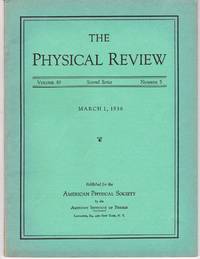
19366550Lancaster PA: American Physical Society 1 March 1936. Second series volume 49 number 5. Very Good. ppl 341-422. Original green wraps. Slight nick at bottom edge of lower wrap else better than very good. <br /><br />Includes the retort by Einstein and Rosen originators of speculation on the existence of "worm-holes" in spacetime to objections made to the general theory of relativity. According to Galina Weinstein: "Between 1935 and 1936 Einstein was occupied with the Schwarzschild solution and the singularity within it while working in Princeton on the unified field theory and with his assistant Nathan Rosen on the theory of the Einstein-Rosen bridges. He was also occupied with quantum theory. He believed that quantum theory was an incomplete representation of real things. Together with Rosen and Boris Podolsky he invented the EPR paradox. I demonstrate that the two-body problem in general relativity was a heuristic guide in Einstein's and collaborators' 1935 work on the Einstein-Rosen bridge and EPR paradox." <br /> <br />Also articles by notable physicists on radioactivity electron mobility quantum-mechanical measurement and so on. American Physical Society paperback
193647073Lancaster American Physical Society 1936. 4to. In: "The Physical Review" Vol. 49 Second Series. X971 pp. Entire volume offered. Einstein & Rosen's paper: pp. 404-405. <br/><br/><em>First printing of Einstein and Rosen's answer to Silberstein's critique of Einstein's Theory of Relativity ."Ludwik Silberstein who initially was a supporter of the special theory objected at different occasions against general relativity. In 1920 he argued that the deflection of light by the sun as observed by Arthur Eddington et al. 1919 is not necessarily a confirmation of general relativity but may also be explained by the Stokes-Planck theory of complete aether drag. However such models are in contradiction with the aberration of light and other experiments see "Alternative theories". And in 1935 Silberstein claimed to have found a contradiction in the Two-body problem in general relativity. However also this claim was refuted by Einstein and Rosen 1935 in the paper offered."Wikipedia. </em> unknown
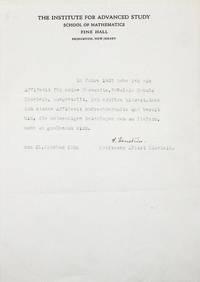
1938366717Princeton New Jersey 1938. 7 lines typed in German on letterhead of the Institute for Advanced Study School of Mathematics watermarked Chieftain Bond signed in ink. 4to 9-7/8 x 7-1/8 inches. Old folds. Fine. 7 lines typed in German on letterhead of the Institute for Advanced Study School of Mathematics watermarked Chieftain Bond signed in ink. 4to 9-7/8 x 7-1/8 inches. Im Jahre 1837 habe ich ein Affidavit für meine Verwandte Fräulein Ursula Einstein ausgestellt. Ich erkläre hiermit dass ich dieses Affidavit aufrechterhalte und bereit bin di notwendigen Unterlagen neu zi liefern wenn es gewünscht wird.<br /> den 31. Oktober 1938<br /> signed <br /> Professor Albert Einstein.<br /> <br /> "In the year 1937 I signed an affidavit on behalf of my relative Miss Urusula Einstein. I hereby state that I continue to certify this affidavit is correct and am ready to submit the necessary documents anew if this is requested."<br /> <br /> Albert Einstein 1879-1955 German-born physicist renowned for developing the theory of relativity in papers published in 1905 and 1916 was awarded the Nobel Prize for Physics in 1921 and left Germany in 1933. He was associated with the Institute for Advanced Study at Princeton.<br /> <br /> This statement was almost certainly prepared in connection with efforts to assist his relative in emigrating. In a letter to his sister Maja Winteler-Einstein then resident in Switzerland dated December 1938 Einstein wrote "I am now working as some sort of itinerant relief committee and buckets of letters are coming in . I am helping the Ulm relatives with emigrating". Ursula Einstein born 1916 was able to get out; in 1940 she was a refugee in Port-au-Prince and later reached Brazil. Her younger sister Barbara was not so fortunate. Barbara Einstein born 1918 took her own life in March 1943 after her fiancé Harry Jacob was taken off to the concentration camps.<br /> <br /> A choice Einstein autograph. unknown
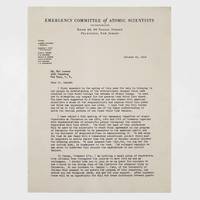
1946376560Princeton New Jersey 1946. 1 1/2 pages on recto and verso of quarto sheet of letterhead for the Emergency Committee of Atomic Scientists. Folded for mailing else Fine. Folding green cloth slipcase. 1 1/2 pages on recto and verso of quarto sheet of letterhead for the Emergency Committee of Atomic Scientists. An invitation written in Einstein's capacity as Chairman of the Trustees of the Committee to Lesser to attend a three day conference in Princeton the following month and asking him to be his special guest at a luncheon on the 17th of November. Einstein writes Lesser "as one who shares with American scientists a sense of the responsibility and urgency with which this great new force has impressed upon our lives ." and notes that one of the chief aims of the conference will be for "the scientists to reach final agreement on our program of education for survival ." Perhaps it was in his capacity as film producer that Lesser was considered a potential contributor beyond simple monetary help. The letter is addressed to Lesser at the Paramount Building 1501 Broadway NYC. Lesser 1890-1980 was a successful film producer a career that spanned the silent era up through such productions as THUNDER OVER MEXICO 1939 and OUR TOWN 1940 to the long string of post 1943 Tarzan films when he once again reacquired the rights after having produced the Buster Crabbe serial of 1933. He received the 1960 Jean Hersholt Humanitarian Award. unknown
19532270<p>Princeton NJ: np 1953. First edition. custom folder. Very Good. TOWARDS THE END OF HIS LIFE EINSTEIN WRITES TO ONE OF HIS FRIENDS FROM THE PATENT OFFICE CONCERNING ONE OF THE CENTRAL STRUGGLES OF HIS SCIENTIFIC LIFE.<br /><br />COMMENTING ON THE WORK OF DIRAC EINSTEIN ADMITS THAT ALTHOUGH HE "CAN'T TAKE A STATISTICAL FOUNDATION OF PHYSICS SERIOUSLY" HE FINDS IT "DIFFICULT TO MOVE BEYOND IT". Background:<br /><br />Einstein's struggle with accepting a strictly statistical quantum theory has been one of the most discussed and debated topics of twentieth-century physics. When introduced to the statistically-based quantum mechanics of Heisenberg Born and Jordan in 1926 Einstein famously wrote to Max Born that "Quantum mechanics is certainly imposing. But an inner voice tells me that it is not yet the real thing. The theory says a lot but does not really bring us any closer to the secret of the 'old one.' I at any rare am convinced that He is not playing at dice." Einstein letter to Born from 4 December 1926.<br /><br />From the onset "Einstein regarded the quantum theory as descriptively incomplete. What he meant was that in typical cases the probabilistic assertions provided by the theory for an individual quantum system do not exhaust all the relevant and true physical assertions about the system. Put briefly according to Einstein the typical statistical story told by quantum theory is not the whole story." Arthur Fine "What is Einstein's Statistical Interpretation or Is It Einstein for Whom Bell's Theorem Tolls". <br /><br />Einstein's discomfort with the new theory haunted him for the next three decades and his challenges to the theory were the cause of some of the most fertile and defining moments of modern science notably the celebrated "Bohr-Einstein debates" begun at the Fifth Solvay Conference 1927 and his monumentally influential "EPR" paper of 1935 "Can Quantum-Mechanical Description of Physical Reality Be Considered Complete" written with Boris Podolsky and Nathan Rosen.<br /><br />As late as 1949 in his "Reply to Criticisms" published in Albert Einstein: Philosopher-Scientist Einstein notes that Born and Wolfgang Pauli in their contributions to the volume "deprecate the fact that I reject the basic idea of contemporary statistical quantum theory insofar as I do not believe that this fundamental concept will provide a useful basis for the whole of physics" and spends the majority of the essay explaining his position and distinguishing between his acceptance of the model for "ensembles of systems" while still rejecting it for an "individual physical system".<br /><br />The letter:<br /><br />Dated September 12 1953 and written to his old colleague at the patent office in Bern Joseph Sauter the letter translated from the original German reads in full:<br /><br />Dear Mr. Sauter<br /><br />If I am able to I will gladly assist Mr. Keberle.<br /><br />I have heard of you often from my old friend Besso and I have also received a manuscript which deals critically with handwritten Dirac's presentation of the statistical approach to quantum theory. I have not been able to judge it myself because it is simply impossible for me to take a statistical foundation of physics seriously. But I have to admit that it is difficult to move beyond it.<br /><br />Yours sincerely <br /><br />signed A. Einstein.<br />Albert Einstein.<br /><br />The recipient Joseph Sauter worked with Einstein at the Bern Patent office during the years he was developing the ideas for his revolutionary papers of 1905. "Among his colleagues at the Patent Office Einstein discovered one with similar scientific interests-Dr. Josef Sauter a French-Swiss who had also studied at the Polytechnic and who had been Professor Weber's chief assistant for a while. Sauter like Einstein tried to fill the gaps in the Polytechnic's syllabus by private study so that Einstein was able to discuss with him Maxwell's thermodynamics and Helmholtz's and Hertz's theoretical concepts. The two also discussed Einstein's publications on thermodynamics with the result that Sauter discovered a mistake in them which Einstein accepted 'without being the least upset.' Fifty years later Einstein recalled 'that I had a lot of discussions with Sauter about. my thermal-statistical papers'. At least as important as his help with the 'rewriting and amending' were Sauter's connections with scientific circles in Bern to which he soon introduced his new colleague." Albrecht Fölsing Albert Einstein. <br /><br />Edouard Keberle mentioned in the first line by Einstein was a Bulgarian physicist who at the time of the letter had just left the Institute of Theoretical Physics in Bern over a publication dispute. Not long after this letter - in early 1954 - Keberle accepted a post at the Midwest Research Institute in Kansas City. It is unclear if Einstein helped him in any way to get this position.<br /><br />Michele Besso - also mentioned in this letter - was Einstein's close lifelong friend.<br /><br />What prompts Einstein to declare that "it is simply impossible for me to take a statistical foundation of physics seriously" is the mention of a manuscript on the work of Paul Dirac. Philosophically Dirac was almost the opposite of Einstein - he had no interest in probing the interpretations of quantum theory wryly noting in his paper "The Inadequacies of Quantum Field Theory" that "The interpretation of quantum mechanics has been dealt with by many authors and I do not want to discuss it here. I want to deal with more fundamental things."<br /><br />It is revealing in this letter that although Einstein re-states his objection to a statistical basis of quantum theory he has doubts about his position admitting - less than two years before his death - that he still has difficulty moving beyond it. <br /><br />Typed Letter Signed. Princeton NJ: September 12 1953. One 8.5x11 inch sheet with Einstein's embossed Mercer Street address at top. Custom silk presentation folder. With original mailing envelope with postmarks. A few small smudges usual folds; fine condition.<br /><br />ONE OF EINSTEIN'S FINAL STATEMENTS ON ONE OF THE CENTRAL TENETS OF HIS SCIENTIFIC PHILOSOPHY.</p> np
19341478Princeton: np 1934. 1st Edition. No Binding. Very Good. AN IMPORTANT SIGNED LETTER in English by Einstein revealing his reservations of associating with communism even in the fight against fascism. Written from Princeton NJ to Professor Albert Sprague Coolidge of Harvard University and dated February 16 1934 the letter reads:<br /> <br /> My dear Professor Coolidge:<br /> <br /> I had an opportunity of meeting personally Lord Marley and has sic very favorably impressed by his personality. It became known to me that he sympathizes with the Russian Government i.g. with the Russian communist party and that the committee for which he is active is influenced by communists.<br /> <br /> The problem as to the attitude which is advisable to be taken towards this committee is rather complicated. On the one hand the world-wide danger of fascism makes it necessary that all enemies of fascism cooperate; on the other hand an action which has communist leanings might endanger that fight since the important task undertaken in defense of culture and civilization may be linked up with interests of a political party. I myself have severed my connections with the committee which with my permission had used my name up to the end of last year. <br /> <br /> It seems to me advisable to take an attitude as follows: to help their action against fascism but not to identify oneself with the committee.<br /> <br /> Very truly yours<br /> signed A. Einstein<br /> <br /> P.S. I wish you would be good enough to use this strictly confidentially. <br /> <br /> In 1934 Lord Baron Marley Dudley Leigh Aman toured the United States to raise funds for his association the World Committee for the Victims of German Fascism. Marley through his committee was "passionately advocating a scheme for which he was to become an international figurehead - resettlement of oppressed German and Polish Jews in the Jewish Autonomous Region" in Siberia. He published a book "The Brown Book of the Hitler Terror and the Burning of the Reichstag sponsored by the World Committee and with an Introduction written by Lord Marley himself which was the first popular exposé of what was happening in Hitler's Germany. It documented the destruction of political parties trade unions and universities book-burning and the building of concentration camps. <br /> <br /> "At a fundraising dinner held in his honour in New York in February 1934 where Einstein presumably met him just before writing this letter Marley opened the Brown Book and 'speaking quietly declaring that he did not intend to harrow' read aloud to his audience of 600 American Jews some of the collected evidence of Nazi repressions. Here were documentary records of what was happening in Germany - a substantiation of the brutality that hitherto had had no distinct form in the mind of the American Jewish public. What before had been the subject of a growing fear mingled with disbelief was now being presented as hard fact and supported with detailed evidence. The New York Times 8 February 2005 reports the audience being 'startled' by the disclosures and the night ending with $3500 raised for the World Committee" The Jewish Quarterly No. 198. <br /> <br /> Einstein was correct to be suspicious of Marley's activities for it was later determined that the "World Committee" was indeed a Communist front; Einstein writing here to Coolidge in 1934 was prescient about the motives of the committee. <br /> <br /> This letter in addition to underscoring Einstein's passionate stance against fascism is particularly important as documentary evidence of Einstein's caution about having any dealings with communism especially considering that the U.S. FBI worried about Einstein's political leanings kept a file on Einstein that grew to 1427 pages.<br /> <br /> Princeton NJ: February 16 1934. One 8.5 x 11 in. page. Envelope folds minor spotting. An outstanding letter with important and revealing content. np unknown
1908003221Leipzig: J. A. Barth 1908. First Edition. Contemporary Cloth. Very Good. J. A. Barth Hardcover
1926374131926. Weil 153. Offprint from S. preuss. Akad. Wiss. unknown