1 506 résultats
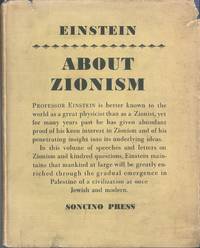
1930021309London: The Soncino Press 1930. 1st Edition . Hardcover. Fair/Fair. Hardcover book in fair condition. Dust jacket included in poor to fair condition showing toning light staining and tears. Book dampstained closer to spine crack to binding starting at middle. A few instances of marked lines in the margins not affecting text. An excellent resource copy of this scarce first edition. Questions welcome. We ship internationally from the United States and Canada every week. If buying internationally please be aware that additional charges may apply for heavier books. We guarantee a safe quick and secure transaction. 10 years in online bookselling experience. <br/> <br/> The Soncino Press hardcover
1931146050New York: The MacMillan Company 1931. First edition of this volume of Einstein's speeches and letters concerning his views on Zionism. Octavo original cloth. Boldly signed and dated in the year of publication on the front free endpaper "Albert Einstein 1931." Near fine with light toning to the endpapers in the scarce original dust jacket which is in good condition with some wear. Translated and edited with an introduction by Leon Simon. Exceptionally rare signed. Einstein was a prominent supporter of both Labor Zionism and efforts to encourage Jewish-Arab cooperation. He supported the creation of a Jewish national homeland in the British mandate of Palestine but was opposed to the idea of a Jewish state "with borders an army and a measure of temporal power." In a letter to Jawaharlal Nehru dated June 13 1947 he asserted "Long before the emergence of Hitler I made the cause of Zionism mine because through it I saw a means of correcting a flagrant wrong.The Jewish people alone has for centuries been in the anomalous position of being victimized and hounded as a people though bereft of all the rights and protections which even the smallest people normally has.Zionism offered the means of ending this discrimination." Einstein's speeches lectures and letters concerning Zionism were first published in 1930 by The Soncino Press and eleven of these essays were later collected in The World as I See It published in 1933 which Einstein dedicated "to the Jews of Germany". The MacMillan Company hardcover
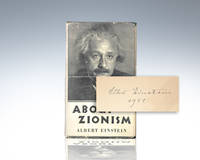
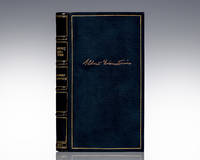
1931150006New York: The MacMillan Company 1931. First edition of this volume of Einstein's speeches and letters concerning his views on Zionism. Octavo bound in full morocco by the Harcourt Bindery with gilt titles and tooling to the spine in five compartments within raised gilt bands gilt ruling to the front and rear panel gilt signature to the front panel gilt inner dentelles stamp-signed by the Harcourt Bindery marbled endpapers all edges gilt. In fine condition. Translated and edited with an introduction by Leon Simon. An exceptional presentation. Einstein was a prominent supporter of both Labor Zionism and efforts to encourage Jewish-Arab cooperation. He supported the creation of a Jewish national homeland in the British mandate of Palestine but was opposed to the idea of a Jewish state "with borders an army and a measure of temporal power." In a letter to Jawaharlal Nehru dated June 13 1947 he asserted "Long before the emergence of Hitler I made the cause of Zionism mine because through it I saw a means of correcting a flagrant wrong.The Jewish people alone has for centuries been in the anomalous position of being victimized and hounded as a people though bereft of all the rights and protections which even the smallest people normally has.Zionism offered the means of ending this discrimination." Einstein's speeches lectures and letters concerning Zionism were first published in 1930 by The Soncino Press and eleven of these essays were later collected in The World as I See It published in 1933 which Einstein dedicated "to the Jews of Germany". The MacMillan Company unknown
1931345H4370New York: The Macmillan Company of Canada Limited. Good. 1931. First American Edition. Hardcover. 8 9-94 pages. Select Bibliography. First published in London in 1930. "Professor Einstein is better known as a physicist than as a Zionist. Yet for many years he has given abundant proof both of a keen interest in Zionism and of a penetrating insight into its underlying ideas. He is impelled to Zionism by his acute consciousness of the excessive price at which the blessings of assimilation are bought by the Jewish communities of the Western world which for him are mainly represented by that of Germany. The price is a loss of solidarity of moral independence and self-respect. These in his view can be regained only if assimilated Jews find some common task of absolute human value to which they can bend their corporate energies as Jews. Such a task is to be found in the restoration of Jewish national life in Palestine." - Introduction. Unmarked with average wear. Backstrip lettering faded. Binding tight. A sound copy of this important compilation. Emanuel p.51. Boni Russ & Laurence 306.; 8vo - over 7¾" - 9¾" tall; Zionism Albert Einstein Politics Israel Palestine Theodor Herzl Zionist Organisation Jewish Colonial Trust Balfour Declaration Keren Hayesod Palestine Foundation Fund . The Macmillan Company of Canada Limited hardcover
1930246ABC376London: The Soncino Press 1930. 1st Edition . Hardcover. Very Good/Poor. First British Edition First Edition in English Precedes the American edition by one year. Original Blue Cloth with some fading with title printed vertically in orange on the spine.Interior pages are clean and bright; a little foxing and some pencil markings inside covers.Original paper dust jacket with the price '5s. NET' printed on the spine in shabby condition as illustrated. <br/> <br/>A collection of Albert Einstein's speeches and letters concerning his views on Zionism Jewish-Arab cooperation and the Jewish National Home in Palestine. The Soncino Press hardcover
193110574New York: The Macmillan Company 1931. First American Edition. Cloth. Near fine/good. First American edition of About Zionism: Speeches and Letters by Professor Albert Einstein in scarce dust jacket. Twelvemo 8 9-94pp. Green cloth title stamped in gilt on spine. Published "February 1931" statement on copyright page. Uncut outer edge clean text throughout. Sound binding. In the scarce publisher's dust jacket price clipped retail price of $1.50 stamped on front flap chipping and some loss along top edge shelf wear to both covers a stable but well-worn example. Boni Russ & Laurence 306 An exceptionally scarce example of this work in the publisher's original dust jacket. First published in London in 1930 by The Soncino Press this work was translated into English by Leon Simon. The Macmillan Company unknown books
1921015388Paris Directeur: Florent Fels. 1921 In-8 Broché Edition originale
193046969New York The Science Press 1930. Royal8vo. Bound in contemporary black full cloth with gilt lettering to spine. In "Science" Vol. 71 1930. Small stamp to lower part of front free end-paper. Otherwise a very fine and clean copy. Pp.608-10. Entire volume: VIII 670 pp advertisements. <br/><br/><em>First printing. Einstein was invited to give a lecture at the University of Nottingham by a lecturer there Henry Brose who also acted as interpreter. Einstein came with his wife Elsa on 6th June 1930. He was due to start the lecture at 3.45pm but did not arrive until 6.30 as he took a detour to visit the birth place of Isaac Newton. The blackboard on which he wrote was quickly varnished over when the lecture was over and is still preserved in the university. While in Nottingham Einstein commented on George Green's contribution to mathematics saying that he had been 20 years ahead of his time.Weil no 174a. </em> hardcover
193046969New York, The Science Press, 1930. Royal8vo. Bound in contemporary black full cloth with gilt lettering to spine. In ""Science"", Vol. 71, 1930. Small stamp to lower part of front free end-paper. Otherwise a very fine and clean copy. Pp.608-10. [Entire volume: VIII, 670 pp + advertisements].
192033265-52Berlin E. S. Mittler for Julius Springer 1920. 15 1 pp. 8vo. Orig. wrappers. Berlin E. S. Mittler for Julius Springer 1920. First edition. Einstein discusses the concept of the aether in relation to his theory of relativity. This lecture examines the historical role of the aether in physics and its transformation under relativity. His conclusion is that relativity does not bring back the classical aether but introduces a new understanding of space as an active structured entity. The text of this speech delivered at Leiden University was also translated into French in 1921. The English translation appeared in Einstein's "Sidelights of Relativity" published at London in 1922. Einstein's manuscript is now kept in the Bibliotheca Bodmeriana Geneva. - Weil 111; Boni Russ and Laurence 115; Roller/Goodman I 354; Seelig 131; Schilpp-Shields 131. SCIENCE: PHYSICS ; Berlin, (E. S. Mittler for) Julius Springer unknown
192043308Berlin: Springer 1920. 15pp. 221 x 146 mm. Original printed wrappers foxed. Minor internal foxing but very good. First edition cover title does not include the date Einstein delivered his lecture; see Weil. "By royal decree of June 24 1920 a special chair in Leiden University was created for Einstein enabling him to come to that university for short periods of his choosing. On October 27 1920 Einstein began his new position with an inaugural address on aether and relativity theory" Pais Subtle is the Lord p. 313. Weil Albert Einstein Bibliography 111. Springer unknown
192047346Berlin:: Verlag von Julius Springer 1920. Later issue. original printed wrappers. Light use to wrappers. 8vo. Verlag von Julius Springer, unknown
192037403Berlin: Springer 1920. Springer unknown
192037403Berlin: Springer 1920. Springer unknown books
192043308Berlin: Springer 1920. 15pp. 221 x 146 mm. Original printed wrappers foxed. Minor internal foxing but very good. First edition cover title does not include the date Einstein delivered his lecture; see Weil. "By royal decree of June 24 1920 a special chair in Leiden University was created for Einstein enabling him to come to that university for short periods of his choosing. On October 27 1920 Einstein began his new position with an inaugural address on aether and relativity theory" Pais Subtle is the Lord p. 313. Weil Albert Einstein Bibliography 111. Springer unknown books
1975227114Subdica, Minerva, 1975. M. 2 Portr. Lwd.
1998Ein0043Demetra, 1998. - kKlappenbroschur, 471 S. - Ebd. mit leichten Gebrauchsspuren, etwas berieben, sonst gut - 8° Buch kartoniert
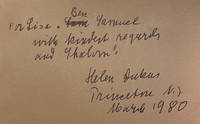
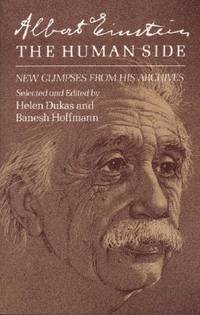
197932820372FIRST EDITION. <b>Presentation copy inscribed by Einstein's longtime assistant Helen Dukas: "For Lisa Ben Samuel with kindest regards and Shalom Helen Dukas Princeton N.J. March 1980."</b><p>Helen Dukas became Einstein's secretary in 1928 and after his death in 1955 served as a trustee of his literary estate and archivist of his papers. This volume prints letters and documents selected by Dukas over the years to shed light on Einstein's character and personality.</p><br /><p>Original cloth and dust jacket. Some rubbing to jacket else very good.</p><br /> Princeton: University Press
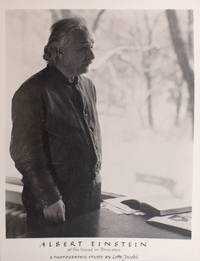
19403293321940. Black and white photographic print. 6 1/2 x 4 7/8 in. Fine. Black and white photographic print. 6 1/2 x 4 7/8 in. unknown
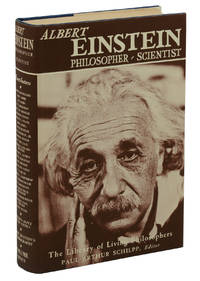
1949140941039Evanston IL: The Library of Living Philosophers Inc 1949. First Edition. Near Fine/Very Good. First edition first printing. Bound in publisher's original dark blue cloth stamped in gilt. Near Fine with toning to pages offsetting to endsheets former owner name to front free endpaper and small sticker ghost to front paste down. In a Very Good dust jacket with fraying and chip at bottom spine end and short closed tear at head light edge wear toning and soiling to rear panel. The Library of Living Philosophers, Inc unknown
1949140941891Evanston IL: The Library of Living Philosophers Inc 1949. First Edition. Fine/Fine. First edition trade issue. xvi 781 pp. Bound in publisher's navy cloth with gilt spine lettering. Fine with offsetting to endpapers in a Fine dust jacket unfaded and unworn. A very sharp copy of a collectible volume all about the famous theoretical physicist. The Library of Living Philosophers, Inc unknown
1979N2216Braunschweig / Wiesbaden: Fiedr.Vieweg & Sohn 1979. Original Cloth with d/j. Near Fine. 8vo. XV22pp. A fine copy with fine DJ. <br/> <br/> Fiedr.Vieweg & Sohn hardcover
19811-0691023689Princeton Univ Pr 1981. Paperback. New. 167 pages. 8.00x5.25x0.50 inches. Princeton Univ Pr paperback
1949343971949. <blockquote><p>On scientists and military work: “The majority of really good scientists in this country have withdrawn from military work…The young ones who cannot lean upon a standing of their own have generally given in to the almost irresistible pressure. One cannot expect it to be any different.""</p><p> </p><p>Einstein and other scientists faced the harsh reality of the product of their work after the war and the bombing of Japan; Here Einstein in a way grapples with his own role</p></blockquote><p> </p><blockquote><p>On the timeless nature of fighting for what you believe: “The truth appears foolish to the insane.Lost people are content to find themselves in agreement with the masses.""</p></blockquote><p><img class=""alignnone wp-image-34606 size-post-window"" src=""https://cdn.raabcollection.com/wp-content/uploads/20251001204256/Einstein_Letter_11-1-1600x897.jpg"" alt="""" width=""1600"" height=""897"" /></p><p>Although Albert Einstein’s participation in the production of the atomic bomb was limited the public perceived his role as crucial and he was in fact the face of the project to many. The reasons were that although he did not work on the Manhattan Project the US effort to build the bomb his famous equation E=mc2 provided the theoretical basis for understanding the immense energy released in nuclear fission which is the process that powers the bomb. And his 1939 letter to President Roosevelt co-signed by Leo Szilárd alerted the US government to the potential of nuclear weapons and prompted the start of research that eventually led to the Manhattan Project. Feeding the public perceptions of his responsibility were publications like The Smyth Report a history of the development of the bomb published the day after the bombing of Nagasaki which ascribed great historical weight to Einstein’s 1939 letter to President Franklin D. Roosevelt in catalyzing the development of the bomb. In 1946 Time magazine published the famous cover featuring Einstein’s portrait backgrounded by an enormous mushroom cloud emblazoned with “E=mc2†and the accompanying article by Whittaker Chambers referred to him as “the father of the bomb†a title which resonated in the popular imagination. A March 1947 Newsweek cover featured Einstein above the headline “Godfather of the Atomic Bombâ€. Einstein was hounded by the association throughout the rest of his life culminating in his November 1954 admission to Linus Pauling “I made one great mistake in my life when I signed the letter to President Roosevelt recommending that atom bombs be made….â€</p><p>Albert Einstein was known for his dedication to morality which he said was “of the highest importance†as well as beliefs that stemmed from morality like pacifism anti-militarism and loyalty to the facts taught by science. He viewed morality as fundamentally human and believed that ethical behavior should form a basis for both individual well-being and the collective good of humanity. Thus for Einstein the pursuit of morality was the most vital human endeavor essential for bringing beauty and dignity to life and ensuring the survival and thriving of the human race. He shared these beliefs with Dr. Herbert Jehle.</p><p>Dr. Jehle was a pioneering theoretical physicist whose work spanned quantum field theory biophysics and astrophysics. He was a student and friend of Einstein in the 1920s in Germany; and a disciple and friend of Dietrich Bonhoeffer. At Princeton in 1947 he provided Richard Feynman with the spark which would lead to his path integral formulation. Einstein had left for the United States in 1933 the same year that Jehle received his doctorate from the Technische Hochschule Berlin. In the same year Dietrich Bonhoeffer Jehle's friend and mentor stepped down from his professorship at Berlin in protest of the Nazi ascent to power. In 1940 Jehle refused to assist in the German armament and atomic project and was interned in concentration camps. Escaping in 1941 with the help of Quaker and Christian relief organizations Jehle made his way to the United States where he took a position at Harvard University until leaving for Princeton in 1947. At Princeton Jehle's pacifist beliefs coincided with Einstein's own and they reconnected bonding over shared views of social responsibility and ethics in science and playing music together regularly Einstein on violin Jehle on the piano.</p><p>Jehle was also the editor of the Society for Social Responsibility in Science newsletter of which Einstein was a member. Jehle additionally submitted articles to other science publications. During the 1950s Jehle collaborated with Linus Pauling on DNA research as well as advocating with Pauling for peace. In the early 1960s Jehle worked as a consultant to Marshall Nirenberg at the NIH on DNA-coding for which Nirenberg also won a Nobel Prize for in 1968.</p><p>Jehle's 1949 article ""For a Universal Morality"" asserted that ""participation in war preparations posed a challenge to man's conscience under any circumstances. and urged that scientists refuse to participate in war work under any government democratic or totalitarian"" see Nathan & Norden Einstein on Peace p 514. The editor of the Bulletin Eugene Rabinowitch rejected the article in a letter to Einstein to which Einstein replied advocating Jehle's position praising Jehle for not being “deterred by taboos†and then sent this letter to Jehle.</p><p>It is interesting to think how time and war had affected Einstein's thinking. Where his letter did much to advance the nuclear militarization and as a scientist he felt a need to intervene here is advocating the opposite.</p><p><strong>Autograph letter signed</strong> on paper watermarked <em>""Whiting Mutual Bond Rag Content""</em>Princeton 1949 to Herbert Jehle endorsing the article by Jehle that had been submitted to the Bulletin of Atomic Scientists on the topics of science and morality and cautioning Jehle on the complications of his position in the post-war world. <em>“I have read your article several times and find that it agrees exactly with my thinking. In accordance with your wishes I am sending your paper with my recommendation to the Bulletin of Atomic Scientists in the hope that they will publish it.</em></p><p><em>“I doubt however that the effect will correspond with the good intentions of the article. The truth appears foolish to the insane. He suspects disloyal intent and revolts against the thought that the 'foreigner' considers himself a better judge of what Americans should do. There are after all few who think and feel in a supra-national manner. Lost people are content to find themselves in agreement with the masses.</em></p><p><em>“The majority of really good scientists in this country have withdrawn from military work more so than it was ever the case in Germany. The young ones who cannot lean upon a standing of their own have generally given in to the almost irresistible pressure. One cannot expect it to be any different since few are born to be martyrs - if no mass movement drives them in that direction. I see the real justification of your approach in the attempt to help generate such a mass movement.</em></p><p><em>“The predicament in which we are is in a certain sense timeless. The public institutions necessarily represent a rather low moral level as do the men who stand behind these institutions. The individual is at the mercy of these institutions the standards of which he must recognize to be low if he is conscientious and not completely without ideas. He is thus forced into some compromise since he sees that that kind of necessarily imperfect institution cannot be dispensed with.</em></p><p><em>“If those who see the light do not stand honestly and courageously for the good the world will get deeper and deeper into the morass. In expressing my joy that you have acted in this way and continue to do so I remain with friendly greetings. Yours A. Einstein.â€</em></p><p>With: <strong>Autograph statement</strong> as a PS from Einstein in German with Jehle's autograph English translation beneath and annotations above transcribing his recommendation for Jehle which Einstein sent to the editor of the Bulletin. <em>“I am sending you this book article. It comes from a younger physicist who is courageous enough to simply say what is evident without being deterred by taboos. I hope that his note can be published in the Bulletin.â€</em></p><p>An important letter reflecting Einstein's post-war advocacy for morality and peace and assessments of the place of scientists in the moral sphere as well as realistic observations on and understanding of world politics.</p><p>We obtained this letter directly from the Jehle family.</p><p><img class=""alignnone wp-image-25018 size-post-window"" src=""https://cdn.raabcollection.com/wp-content/uploads/20231204144051/Folder-site-11-1600x1327.jpg"" alt="""" width=""1600"" height=""1327"" /></p> unknown
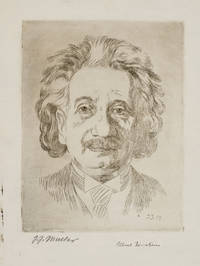
1933H-217<p>A stunning portrait etching of one of the greatest human minds signed by both the artist J J Muller and Albert Einstein.</p><p>The sketch is signed in ink by Einstein and by the artist J. J. Muller in pencil n.p. 1933. Plate 195 x 150mm; sheet 253 x 200mm.</p><p>A true collector's copy of a beautiful signed portrait.</p>