1 506 résultats
1957173586Berlin, Akademie-Verlag, 1957. M. 1 Portr. 174 S. OBr. Umschl. M. kl. Randlsäuren.
1953R0522-NWien,Schönbrunn-Vlg. 1953. 174 S. Mit Titelportr. u. mehr. Skizzen im Text. Oln. mit OU., Umschlag etw. beschädigt u. angestaubt, Einbd. am unteren Kapital bestoßen, innen tadellos.
1968BL4012Basel & Stuttgart:: Schwabe 1968. 1968. 8vo. 126 pp. Maroon cloth dust-jacket; jacket heavily rubbed. Very good. Exchange of Letters between Albert Einstein and Arnold Sommerfeld. Schwabe, (1968). hardcover books
1930110352New York: Albert & Charles Boni 1930. First edition of this Einstein biography written by Rudolf Kayser a German literary historian and husband to Albert Einstein's stepdaughter Ilse under the pseudonym Anton Reiser. Octavo original cloth frontispiece of Einstein. Signed and dated by Einstein on the front free endpaper in the year of publication "Albert Einstein New York 1930." In near fine condition. Housed in a custom half morocco clamshell box. Albert Einstein developed the general theory of relativity one of the two pillars of modern physics alongside quantum mechanics. Einstein's work is also known for its influence on the philosophy of science. Einstein is best known in popular culture for his mass-energy equivalence formula E = mc2 which has been dubbed "the world's most famous equation". He received the 1921 Nobel Prize in Physics for his "services to theoretical physics" in particular his discovery of the law of the photoelectric effect a pivotal step in the evolution of quantum theory David Bodanis. Albert & Charles Boni hardcover books
193090431New York: Albert & Charles Boni 1930. First edition of this Einstein biography written by Rudolf Kayser a German literary historian and husband to Albert Einstein's stepdaughter Ilse under the pseudonym Anton Reiser. Octavo original cloth frontispiece of Einstein. Inscribed by Albert Einstein with an original poem on the front free endpaper in German which translates as "It is <span class="match">a</span> curious f<span class="match">a</span>te to be objectified <span class="match">a</span>live. Think with humor while re<span class="match">a</span>ding. <span class="match">A</span>. Einstein." From the library of <span class="match">A</span>lex<span class="match">a</span>ndre <span class="match">a</span>nd C<span class="match">a</span>therine B<span class="match">a</span>rj<span class="match">a</span>nsky with her ownership signature to the verso of the front panel and notation below Einstein's inscription "S.S. 'Belgenl<span class="match">a</span>nd' New-York 14/XII/30." Russian sculptress Catherine Barjansky her celebrated cellist husband and Einstein were all close friends of King Albert I and Queen Elisabeth of Belgium. Barjansky described her experiences creating the now famed and very intimate sculptural portraits of Elizabeth and Albert in her 1947 joint memoir with her husband Portraits with Backgrounds. Catherine had an international career living at times in Rome <span class="hps">Berlin</span> <span class="hps">New York</span> <span class="hps">Vienna Paris</span> and <span class="hps">Brussels. </span>Einstein w<span class="match">a</span>s in New York <span class="match">a</span>t the time he inscribed the present volume h<span class="match">a</span>ving <span class="match">a</span>rrived <span class="match">a</span>bo<span class="match">a</span>rd the Belgenl<span class="match">a</span>nd three d<span class="match">a</span>ys e<span class="match">a</span>rlier. Einstein travelled aboard the Belgenland several times. He was on the ship in March 1933 intending to return home to Germany when he learned the alarming news that the Nazis had ransacked his summer cottage in Caputh. He soon decided it was too dangerous to return to Germany and when the ship docked in <span class="match">A</span>ntwerp Belgium he immedi<span class="match">a</span>tely reported to the Germ<span class="match">a</span>n consul<span class="match">a</span>te in Brussels where he turned in his Germ<span class="match">a</span>n p<span class="match">a</span>ssport <span class="match">a</span>nd renounced his citizenship. Einstein returned to <span class="match">A</span>meric<span class="match">a</span> in October beginning <span class="match">a</span> new life <span class="match">a</span>s <span class="match">a</span> member of the f<span class="match">a</span>culty of Princeton University's Institute for <span class="match">A</span>dv<span class="match">a</span>nced Study. In near fine condition. A complex and desirable association. Albert Einstein developed the general theory of relativity one of the two pillars of modern physics alongside quantum mechanics. Einstein's work is also known for its influence on the philosophy of science. Einstein is best known in popular culture for his mass-energy equivalence formula E = mc2 which has been dubbed "the world's most famous equation". He received the 1921 Nobel Prize in Physics for his "services to theoretical physics" in particular his discovery of the law of the photoelectric effect a pivotal step in the evolution of quantum theory David Bodanis. Albert & Charles Boni hardcover books
19492403Evanston IL: The Library of Living Philosophers Inc 1949. Signed Limited First Edition. Original leatherette. Fine. THE MAGNIFICENT SIGNED LIMITED FIRST EDITION ONE OF ONLY 760 COPIES SIGNED BY EINSTEIN. AN OUTSTANDING COPY IN ORIGINAL SLIPCASE. The seventh volume in "The Library of Living Philosophers" series Albert Einstein: Philosopher-Scientist is a tribute volume with essays by some of the most important scientists of the era reflecting on the importance of Einstein's work. Contributors include: Wolfgang Pauli Louis de Broglie Max Born Arnold Sommerfeld Georges Lemaitre Kurt Gödel and many more. Of special note is the essay by Niels Bohr "Discussion with Einstein on Epistemological Problems in Atomic Physics" which gives Bohr's perspective of the famous Einstein-Bohr debates. As Paul Schilpp notes in his Preface "These recollections of conversations with Einstein on the epistemological aspects of physical science would never have come into being were it not for the peculiar nature of this series."<br /> <br /> Also included as a first chapter is Einstein's important "Autobiographical Notes" in German and English and a final chapter by Einstein entitled "Remarks to the Essays Appearing in this Collective Volume". The "Autobiographical Notes" is the "closest Einstein ever came to writing an autobiography" Pais. <br /> <br /> With frontispiece portrait of Einstein by Yousef Karsh. Number 349 of the 760. Evanston IL: The Library of Living Philosophers Inc. 1949. Thick octavo approx. 6.75x9.75x1.75 original publisher's leatherette with gilt image of Einstein's signature on front board bevelled edges top edge gilt pages uncut; original slipcase. Housed in beautiful custom box by noted book artist Sjoerd Hofstra. Tiny bumps to spine ends some light wear to slipcase edges as usual. <br /> <br /> AN OUTSTANDING COPY OF AN ESSENTIAL EINSTEIN ITEM. The Library of Living Philosophers, Inc unknown books
1949140941460Evanston IL: The Library of Living Philosophers Inc 1949. First Edition; Signed Limited Issue. Near Fine. First edition signed limited issue; copy #362 of a 760 signed by Albert Einstein. Bound in publisher's brown morocco-grain cloth over bevel-edged boards stamped in gilt. Near Fine with slight darkening to spine and trivial rubbing to crown. Endsheets faintly browned. In a Near Fine publisher's original slipcase with light sunning and wear at edges. A fantastic copy signed by the iconic physicist whose name in synonymous with genius. The Library of Living Philosophers, Inc unknown books
1949140941039Evanston IL: The Library of Living Philosophers Inc 1949. First Edition. Near Fine/Very Good. First edition first printing. Bound in publisher's original dark blue cloth stamped in gilt. Near Fine with toning to pages offsetting to endsheets former owner name to front free endpaper and small sticker ghost to front paste down. In a Very Good dust jacket with fraying and chip at bottom spine end and short closed tear at head light edge wear toning and soiling to rear panel. The Library of Living Philosophers, Inc unknown books
19512305185New York: Tudor Publishing Company 1951. Second Edition. Second Edition. Near Fine/No Jacket. Second edition. No jacket. Ink name on front free endpaper. 1951 Hard Cover. xvi 781 pp. Blue cloth boards. CONTENTS: Einstein's Autobiography; Descriptive and Critical Essays on the Work of Albert Einstein; Einstein's Reply; Bibliography of the Writings of Albert Einstein to May 1951. Tudor Publishing Company unknown books
1949125016Evanston: Library of Living Philosophers 1949. Signed limited edition of Einstein's singular autobiography. Octavo original brown cloth top edge gilt original glassine and slipcase. One of 760 numbered copies signed and dated "Albert Einstein '49" this is number 458. Fine in the rare original glassine which is in near fine condition and in the original slipcase which is in fine condition. Housed in the original publisher's cardboard. An absolute pristine example which has been stored in the original cardboard box since publication. Edited by Paul Arthur Schilpp. Frontispiece portrait of Einstein by Yousuf Karsh. Rare and desirable in this condition particularly scarce in the original glassine and original box. Written by the man considered the "Person of the Century" by Time magazine this is not a glimpse into Einstein's personal life but an extension and elaboration into his thinking on science. Two of the great theories of the physical world were created in the early 20th century: the theory of relativity and quantum mechanics. Einstein created the theory of relativity and was also one of the founders of quantum theory. Here Einstein describes the failure of classical mechanics and the rise of the electromagnetic field the theory of relativity and of the quanta. "The greatest physicist of the 20th century" PMM 408. Library of Living Philosophers hardcover books
1949110472Evanston: Library of Living Philosophers 1949. Signed limited first edition number 711 of 760 copies signed and dated "Albert Einstein '49." Octavo original brown cloth top edge gilt. The book is in fine condition in the rare original dust jacket which is in very good condition. Edited by Paul Arthur Schilpp. Frontispiece portrait of Einstein by Yousef Karsh. Rare and desirable in this condition. Written by the man considered the "Person of the Century" by Time magazine this is not a glimpse into Einstein's personal life but an extension and elaboration into his thinking on science. Two of the great theories of the physical world were created in the early 20th century: the theory of relativity and quantum mechanics. Einstein created the theory of relativity and was also one of the founders of quantum theory. Here Einstein describes the failure of classical mechanics and the rise of the electromagnetic field the theory of relativity and of the quanta. "The greatest physicist of the 20th century" PMM 408. Library of Living Philosophers hardcover books
19472187Princeton NJ: Halsman 1947. Photograph. Fine. ONE OF THE MOST FAMOUS IMAGES OF EINSTEIN. Philippe Halsman's now iconic 1947 photograph of Einstein has become not only one of the most celebrated images of Einstein but one of the most recognizable images of the twentieth century. It was used to a 1966 US postage stamp of Einstein and was featured on the cover of Time Magazine honoring Einstein as the "Person of the Century".

 The photographer Halsman in his book Philippe Halsman: A Retrospective explained the circumstances of the photo: I admired Albert Einstein more than anyone I ever photographed not only as the genius who single-handedly had changed the foundation of modern physics but even more as a rare and idealistic human being.
 Personally I owed him an immense debt of gratitude. After the fall of France it was through his personal intervention that my name was added to the list of artists and scientists who in danger of being captured by the Nazis were given emergency visas to the United States.
 After my miraculous rescue I went to Princeton to thank Einstein and I remember vividly my first impression. Instead of a frail scientist I saw a deep-chested man with a resonant voice and a hearty laugh.
 The question of how to capture the essence of such a man in a portrait filled me with apprehension. Finally in 1947 I had the courage to bring on one of my visits my Halsman camera and a few floodlights. After tea I asked for permission to set up my lights in Einstein's study. The professor sat down and started peacefully working on his mathematical calculations. I took a few pictures. Ordinarily Einstein did not like photographers whom he called Lichtaffen light monkeys. But he cooperated because I was his guest and after all he had helped save me.
 Suddenly looking into my camera he started talking. He spoke about his despair that his formula E=mc2 and his letter to President Roosevelt had made the atomic bomb possible that his scientific search had resulted in the death of so many human beings. "Have you read" he asked "that powerful voices in the United States are demanding that the bomb be dropped on Russia now before the Russians have time to perfect their own" With my entire being I felt how much this infinitely good and compassionate man was suffering from the knowledge that he had helped to put in the hands of politicians a monstrous weapon of devastation and death.
 He grew silent. His eyes had a look of immense sadness. There was a question and a reproach in them.
 The spell of this moment almost paralyzed me. Then with an effort I released the shutter of my camera. Einstein looked up and I asked him "So you don't believe that there will ever be peace"
 "No" he answered. "As long as there will be man there will be wars." Silver prints of this photograph have been printed in different sizes over the years. This photograph is an official Halsman silver print with his copyright hand-stamp on the verso measuring approximately 10x13 inches. Princeton NJ. Silver print. Taken 1947; printed 1970s. Image: 13x10 inches 33x25.4 cm. Archivally matted and framed under UV-protecting museum glass to an overall size of 18.5x22 inches. A stunning piece in fine condition. Halsman unknown books
1979101752Berlin, Akademnie-Verlag, 1979. 287 S. Gr.-8° Groß-Oktav, Leinen
1998917101Hebrew University of Jerusalem, 1998. 156 S. mit zahlr. Abb., gebundene Ausgabe.
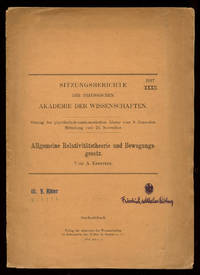
19271663Berlin: Verlag der Akademie der Wiss 1927. 1st Edition. FIRST EDITION OFFPRINT ISSUE IN ORIGINAL PAPER WRAPS VERY GOOD CONDITION. "Einstein and Grommer's work treats the particle as a singularity in the field and attemptss to obtain the equations of motion by imposing conditions on the exterior field in the neighborhood of the singularity" Stachel Einstein from ‘B' to'Z' pp. 507. Weil 155.<br /> <br /> In 1927 Einstein's research "concentrated on a new approach to the problem of the motion of particles in a general field theory" Mehra The Golden Age of Theoretical Physics 997. He presented his work conducted with Jakob Grommer in this report.<br /> <br /> Einstein and Grommer here show that ‘in the case of a pure gravitational field the mechanical behavior of singularities can be derived' a result which in Einstein's opinion ‘opened the possibility to obtain on the basis of the field equations a theory of matter characterized as discontinuities in space' ibid 997; Einstein and Grommer 1927.<br /> <br /> "After Einstein had tried for years to obtain a theory of material particles in a generalized field theory by describing these objects with the help of continuous functions Einstein and Grommer now proposed ‘to consider elementary particles as singular points or singular world lines respectively' motivated by the observation ‘that both the equations of the pure gravitational field and the equations augmented by Maxwell's electromagnetic field possess simple spherically-symmetric solutions which contain a singularity' ibid.<br /> <br /> Finally they arrived at the result: In the approximation of the gravitational field obtained by solving linearized equations the equation of motion for a singularity is completely determined - at least in the case of equilibrium - and corresponds to the law of a geodetic line" ibid. CONDITION & DETAILS: Berlin: Verlag der Akademie der Wiss. Pp. 2-13. Offprint in original wraps. 10 x 7.25 inches; 250 x 181mm. Toning at the edges & bearing the ownership stamp of "Friedrich Wilhelm Ritter" W. F. Ritter 1839-1929. Ritter had a large library. Very good condition. Verlag der Akademie der Wiss paperback
1927433031927. Offprint from Sitzungsberichte der preussischen Akademie der Wissenschaften 1927. 235-245pp. 255 x 183 mm. Original printed wrappers. Fine. On the problem of motion in general relativity theory; a follow-up to his and Grommer's paper of the same title published earlier in 1927. Weil Albert Einstein Bibliography 160. unknown
1927374151927. Offprint from S. preuss. Akad. Wiss. Weil 155. unknown
1927374151927. Offprint from S. preuss. Akad. Wiss. Weil 155. unknown books
1927433031927. Offprint from Sitzungsberichte der preussischen Akademie der Wissenschaften 1927. 235-245pp. 255 x 183 mm. Original printed wrappers. Fine. On the problem of motion in general relativity theory; a follow-up to his and Grommer's paper of the same title published earlier in 1927. Weil Albert Einstein Bibliography 160. unknown books
1970103865Berlin, Alternative 1970. 1970. S. 229- 275. Orig.-Karton.
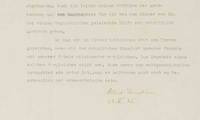
19351383623/05/1935. <blockquote><p style=""text-align: left;"">He prophesizes however that the road ahead for the Jews will be “arduous and very painfulâ€</p></blockquote><p>The Institute for Advanced Study in Princeton New Jersey was founded in 1930 by educator Abraham Flexner with funding from department store magnate Louis Bamberger. Flexner first recruited noted mathematicians from Princeton University to join the Institute then broadened its scope by including established scholars in economics politics and humanistic studies. In 1932 Flexner offered Einstein a faculty position at the Institute. Einstein’s decision was effected by historical events as in January 1933 Adolf Hitler became Chancellor of Germany. Soon after Einstein made the decision to resign from his Berlin position give up his German citizenship and accept the position in Princeton. The ocean liner Westmoreland which carried Einstein at age 54 to what would become his new home country arrived in New York Harbor on October 17 1933.</p><p><img class=""alignnone size-full wp-image-24695"" src=""https://cdn.raabcollection.com/wp-content/uploads/20231204145639/einsteinsig.gif"" alt="""" width=""1920"" height=""1080"" /></p><p>Einstein found the Institute and life in the United States congenial so in April 1934 just six months after his arrival Einstein announced that he was staying in Princeton indefinitely and assuming a permanent full-time status at the Institute. He would remain in the United States the rest of his life. Meanwhile he was very much a celebrity and was invited to the White House to meet with the Roosevelts. He politely declined saying he did not want to call attention to himself a position that German Jews had become accustomed to adopting during the rise of Naziism. However the First Lady Eleanor Roosevelt intervened writing Einstein directly requesting his presence. So Einstein and his wife Elsa arrived at the White House on January 24 1934 had dinner and spent the night. President Roosevelt was able to converse with them in passable German. Among other things they discussed Roosevelt’s marine prints and Einstein’s love for sailing. On learning that the Einsteins had decided to stay in the United States Roosevelt suggested that the Einsteins should accept the offer of some Congressmen to have a special bill passed on their behalf that he would sign granting them citizenship so that they would not have to endure the five year waiting period. The Einsteins declined the President’s generous suggestion saying they wanted to be treated like any other applicant for American citizenship. Because the Einsteins had not been sure of their ultimate destination and declared themselves as visitors instead of immigrants when they arrived in October 1933 this meant that they would need to leave the U.S. and return again to declare intention to seek citizenship.</p><p>The United Jewish Appeal UJA planned a fund-raising dinner in Einstein’s honor for May 28 1935. This was exactly the time the Einsteins had set aside to leave the country to perfect their citizenship so he was forced to decline the invitation. He did however provide them with a statement that was received by the UJA on <span class=""aBn"" tabindex=""0"" data-term=""goog_1737904750""><span class=""aQJ"">May 25</span></span> the very day the Einsteins stepped onboard the Queen Mary to travel to British-owned Bermuda for a few days to satisfy the formalities. The royal governor was there to greet them when they arrived in Hamilton and he recommended the island’s two best hotels. Einstein found them stuffy and pretentious. As they walked through town he saw a modest guest cottage and that is where they ended up.</p><p><img class=""alignnone wp-image-32085 size-post-window"" src=""https://cdn.raabcollection.com/wp-content/uploads/20240908143641/Einstein-May-23-1935-1-1600x968.jpg"" alt="""" width=""1600"" height=""968"" /></p><p><strong>Typed statement signed</strong> in German Princeton May 23 1935 time stamped as received on <span class=""aBn"" tabindex=""0"" data-term=""goog_1737904751""><span class=""aQJ"">May 25</span></span> to be read at the UJA dinner and issued to the press accordingly. It takes the moral high ground but warns of great dangers ahead. <em>â€Unfortunately because of non-deferrable obligations I can only express in writing my recognition and gratitude for the assistance provided to the many unfortunate people by the dinner on the <span class=""aBn"" tabindex=""0"" data-term=""goog_1737904752""><span class=""aQJ"">28th of May.</span></span> We can gain consolation in this critical time if we compare the moral standard of our friends and our enemies with each other. The result of such a comparison shows us that our way for world history can be considered the better one even if at times it is arduous and very painful.â€</em> Our research indicates that this important statement is unpublished as the dinner was postponed and it was never released to the press.</p><p>But even this moving and forceful statement was not enough for the event organizers. Learning that Einstein could not attend they postponed the dinner. Instead the $50-a-plate dinner for the benefit of the UJA arranged by that organization and the Council of Jewish Organizations was held in New York City on <span class=""aBn"" tabindex=""0"" data-term=""goog_1737904753""><span class=""aQJ"">June 26</span></span> with Einstein in attendance. About 1000 people attended the banquet at which Einstein spoke. In his speech Einstein returned to the same theme of morality as in the above statement saying that the ""moral disintegration and intensified national egoism"" of the times requires all Jews to strengthen their ranks to preserve Jewry. Of foremost importance he said was the upbuilding of the settlement in Palestine. On <span class=""aBn"" tabindex=""0"" data-term=""goog_1737904754""><span class=""aQJ"">June 28</span></span> the UJA announced it was using the proceeds from the dinner to aid German refugees in New York City by allocating funds to local agencies equipped to care for the refugees.</p><p>Einstein reentered the U.S. from Bermuda on June 3 1935. On January 15 1936 the Einsteins submitted their declaration of intention to become citizens of the United States.</p><p><img class=""alignnone wp-image-25018 size-post-window"" src=""https://cdn.raabcollection.com/wp-content/uploads/20231204144051/Folder-site-11-1600x1327.jpg"" alt="""" width=""1600"" height=""1327"" /></p> unknown
1961714603PN. New. 1961. Soft Cover. Date is original print. This is a reprint edition. . PN paperback
1921302276Leipzig Felix Meiner 1921. 1921. First edition. 8vo. Foreword by Raymund Schmidt. Articles by Oskar Kraus Friedrich Lepsius Paul F. Lincke Joseph Petzoldt. Text pages numbered 334-500. Original stiff green wrappers printed in black. Very good. Cover title: Zur Relativitatstheorie. Kraus' article entitled: "Fiktion und Hypothese in der Einsteinschen Relativitatstheorie.". 1st Edition. Soft cover. Very Good/No Jacket. Leipzig, Felix Meiner, 1921. paperback
1929ZB727262Leipzig : J.A. Barth 1929. 5. Folge 5th Series. Volumes 1 through 43 1929-1943 ALL PUBLISHED; all bound ex library else text clean & bindings tight. - If you are reading this this item is actually physically in our stock and ready for shipment once ordered. We are not bookjackers. Buyer is responsible for any additional duties taxes or fees required by recipient's country. Photos available upon request. Leipzig : J.A. Barth unknown
1921302276Leipzig Felix Meiner 1921. 1921. First edition. 8vo. Foreword by Raymund Schmidt. Articles by Oskar Kraus Friedrich Lepsius Paul F. Lincke Joseph Petzoldt. Text pages numbered 334-500. Original stiff green wrappers printed in black. Very good. Cover title: Zur Relativitatstheorie. Kraus' article entitled: "Fiktion und Hypothese in der Einsteinschen Relativitatstheorie.". 1st Edition. Soft cover. Very Good/No Jacket. Leipzig, Felix Meiner, 1921. paperback books