2 944 résultats
0265215838.Ghardcover. Good. Access codes and supplements are not guaranteed with used items. May be an ex-library book. hardcover
19351383623/05/1935. <blockquote><p style=""text-align: left;"">He prophesizes however that the road ahead for the Jews will be “arduous and very painfulâ€</p></blockquote><p>The Institute for Advanced Study in Princeton New Jersey was founded in 1930 by educator Abraham Flexner with funding from department store magnate Louis Bamberger. Flexner first recruited noted mathematicians from Princeton University to join the Institute then broadened its scope by including established scholars in economics politics and humanistic studies. In 1932 Flexner offered Einstein a faculty position at the Institute. Einstein’s decision was effected by historical events as in January 1933 Adolf Hitler became Chancellor of Germany. Soon after Einstein made the decision to resign from his Berlin position give up his German citizenship and accept the position in Princeton. The ocean liner Westmoreland which carried Einstein at age 54 to what would become his new home country arrived in New York Harbor on October 17 1933.</p><p><img class=""alignnone size-full wp-image-24695"" src=""https://cdn.raabcollection.com/wp-content/uploads/20231204145639/einsteinsig.gif"" alt="""" width=""1920"" height=""1080"" /></p><p>Einstein found the Institute and life in the United States congenial so in April 1934 just six months after his arrival Einstein announced that he was staying in Princeton indefinitely and assuming a permanent full-time status at the Institute. He would remain in the United States the rest of his life. Meanwhile he was very much a celebrity and was invited to the White House to meet with the Roosevelts. He politely declined saying he did not want to call attention to himself a position that German Jews had become accustomed to adopting during the rise of Naziism. However the First Lady Eleanor Roosevelt intervened writing Einstein directly requesting his presence. So Einstein and his wife Elsa arrived at the White House on January 24 1934 had dinner and spent the night. President Roosevelt was able to converse with them in passable German. Among other things they discussed Roosevelt’s marine prints and Einstein’s love for sailing. On learning that the Einsteins had decided to stay in the United States Roosevelt suggested that the Einsteins should accept the offer of some Congressmen to have a special bill passed on their behalf that he would sign granting them citizenship so that they would not have to endure the five year waiting period. The Einsteins declined the President’s generous suggestion saying they wanted to be treated like any other applicant for American citizenship. Because the Einsteins had not been sure of their ultimate destination and declared themselves as visitors instead of immigrants when they arrived in October 1933 this meant that they would need to leave the U.S. and return again to declare intention to seek citizenship.</p><p>The United Jewish Appeal UJA planned a fund-raising dinner in Einstein’s honor for May 28 1935. This was exactly the time the Einsteins had set aside to leave the country to perfect their citizenship so he was forced to decline the invitation. He did however provide them with a statement that was received by the UJA on <span class=""aBn"" tabindex=""0"" data-term=""goog_1737904750""><span class=""aQJ"">May 25</span></span> the very day the Einsteins stepped onboard the Queen Mary to travel to British-owned Bermuda for a few days to satisfy the formalities. The royal governor was there to greet them when they arrived in Hamilton and he recommended the island’s two best hotels. Einstein found them stuffy and pretentious. As they walked through town he saw a modest guest cottage and that is where they ended up.</p><p><img class=""alignnone wp-image-32085 size-post-window"" src=""https://cdn.raabcollection.com/wp-content/uploads/20240908143641/Einstein-May-23-1935-1-1600x968.jpg"" alt="""" width=""1600"" height=""968"" /></p><p><strong>Typed statement signed</strong> in German Princeton May 23 1935 time stamped as received on <span class=""aBn"" tabindex=""0"" data-term=""goog_1737904751""><span class=""aQJ"">May 25</span></span> to be read at the UJA dinner and issued to the press accordingly. It takes the moral high ground but warns of great dangers ahead. <em>â€Unfortunately because of non-deferrable obligations I can only express in writing my recognition and gratitude for the assistance provided to the many unfortunate people by the dinner on the <span class=""aBn"" tabindex=""0"" data-term=""goog_1737904752""><span class=""aQJ"">28th of May.</span></span> We can gain consolation in this critical time if we compare the moral standard of our friends and our enemies with each other. The result of such a comparison shows us that our way for world history can be considered the better one even if at times it is arduous and very painful.â€</em> Our research indicates that this important statement is unpublished as the dinner was postponed and it was never released to the press.</p><p>But even this moving and forceful statement was not enough for the event organizers. Learning that Einstein could not attend they postponed the dinner. Instead the $50-a-plate dinner for the benefit of the UJA arranged by that organization and the Council of Jewish Organizations was held in New York City on <span class=""aBn"" tabindex=""0"" data-term=""goog_1737904753""><span class=""aQJ"">June 26</span></span> with Einstein in attendance. About 1000 people attended the banquet at which Einstein spoke. In his speech Einstein returned to the same theme of morality as in the above statement saying that the ""moral disintegration and intensified national egoism"" of the times requires all Jews to strengthen their ranks to preserve Jewry. Of foremost importance he said was the upbuilding of the settlement in Palestine. On <span class=""aBn"" tabindex=""0"" data-term=""goog_1737904754""><span class=""aQJ"">June 28</span></span> the UJA announced it was using the proceeds from the dinner to aid German refugees in New York City by allocating funds to local agencies equipped to care for the refugees.</p><p>Einstein reentered the U.S. from Bermuda on June 3 1935. On January 15 1936 the Einsteins submitted their declaration of intention to become citizens of the United States.</p><p><img class=""alignnone wp-image-25018 size-post-window"" src=""https://cdn.raabcollection.com/wp-content/uploads/20231204144051/Folder-site-11-1600x1327.jpg"" alt="""" width=""1600"" height=""1327"" /></p> unknown
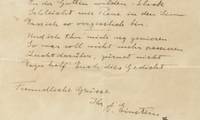
36130<blockquote><p>In the poem he apologizes for leaving Von Neumann’s party early and incurring the wrath of his wife calling himself a “thick skinned fool†and a “clumsy bullâ€</p><p> </p><p>Einstein urges Von Neumann not to be angry that “regret creeps at the memory†and that he is filled with dismay</p><p> </p><p>This is a real rarity and is the only poem by Einstein that we have ever carried; it has been in a private collection for a generation</p></blockquote><p>embedhttps://vimeo.com/1180595880share=copy&fl=sv&fe=ci/embed</p><p> </p><p>John Von Neumann was a mathematician physicist computer scientist and engineer who in 1933 Von Neumann accepted a tenured professorship at the Institute for Advanced Study in Princeton. This was also where Albert Einstein worked so the two were colleagues. Von Neumann had perhaps the widest coverage of any mathematician of his time integrating pure and applied sciences and making major contributions to many fields including mathematics physics economics computing and statistics. He was a pioneer in building the mathematical framework of quantum physics and the digital computer. His analysis of the structure of self-replication preceded the discovery of the structure of DNA. During World War II Von Neumann worked on the Manhattan Project. Before and after the war he consulted for many organizations including the Office of Scientific Research and Development the U.S. Army’s Ballistics Research Laboratory and the Oak Ridge National Laboratory. At the 1950s he chaired a number of Defense Department committees. He was also a member of the influential Atomic Energy Commission in charge of all atomic energy development in the country.</p><p>Von Neumann and Einstein shared a similar cultural background but had different personalities and differed in work style sometimes creating friction. Working just a few offices down from each other Einstein was exceptionally irked by the loud music that often emanated from Von Neumann’s office. In time Einstein would admire Von Neumann’s intellect but be critical of both his work and style; and Von Neumann would become envious of Einstein. Colleagues considered von Neumann's mind faster and more acute while viewing Einstein's understanding as deeper more original and more foundational to physical reality. In summary while von Neumann may have had more raw lightning-fast processing power Einstein had a greater depth in understanding the universe.</p><p>Von Neumann was socially active within the local academic community. He was a renowned high-energy party host in Princeton known as a ""bon vivant"" who loved socializing loud music and dancing. His parties were frequent and often featured fine wine off-color jokes and a mix of academic and social guests. Among his guests was Albert Einstein. It is said that Von Neumann could attend parties until the early hours of the morning and then deliver a lecture at 8:30 am. Whereas Von Neumann was known for social parties Einstein was more of an introvert who actively embraced solitude and tended to avoid displays of luxury.</p><p><strong>Autograph manuscript signed</strong> being a poem in German Princeton no date to Von Neumann and his wife apologizing for his bad behavior at their cocktail party.<em> “Dear Neumanns The following Knittel traditional German poem of rhyming couplets known for their humorous or satirical nature verses should help you forgive my clumsiness:</em></p><p><em>“You thick skinned fool you clumsy bull</em><br /><em>So rang the scold in my ear so full</em><br /><em>Which met me once down the stairs</em><br /><em>As I made my way to the cars.</em></p><p><em>""And she was right I swear</em><br /><em>The lady of the gentle sex so fair</em><br /><em>That I did neglect the Neumanns</em><br /><em>As I took off without any plans</em></p><p><em>""I now shudder thinking back</em><br /><em>At the wild looks of the spouse’s attack</em><br /><em>Regret creeps at the memory</em><br /><em>That I should so forgetful be.</em></p><p><em>""And I am filled with such dismay</em><br /><em>Such a thing will never do again or say</em><br /><em>Laugh it off but anger not</em><br /><em>May this poem help a lot.</em></p><p><em>""Yours truly A. Einsteinâ€</em></p><p>This provides a fascinating window into how Einstein saw his relationship with Von Neumann and the strain it was under as well as on Einstein’s own behavior calling himself a “thick skinned fool you clumsy bullâ€.</p><p>This is a real rarity and is the only poem by Einstein that we have ever carried.</p><p><img class=""alignnone wp-image-25018 size-post-window"" src=""https://cdn.raabcollection.com/wp-content/uploads/20231204144051/Folder-site-11-1600x1327.jpg"" alt=""historical memorabilia dealer"" width=""1600"" height=""1327"" /></p> unknown
Milano, Gorlich, 1946. (mm. 240 x 170). Cartonato editoriale. pp. 39(1)(le prime due bianche). Ottimo esemplare.
1961714603PN. New. 1961. Soft Cover. Date is original print. This is a reprint edition. . PN paperback
198263769Conservatoire National des Arts et Métiers , Annales de la Fondation Louis de Broglie Malicorne sur Sarthe, 72, Pays de la Loire, France 1982 Book condition, Etat : Bon broché, sous couverture imprimée éditeur In-8 1 vol. - 79 pages
1921302276Leipzig Felix Meiner 1921. 1921. First edition. 8vo. Foreword by Raymund Schmidt. Articles by Oskar Kraus Friedrich Lepsius Paul F. Lincke Joseph Petzoldt. Text pages numbered 334-500. Original stiff green wrappers printed in black. Very good. Cover title: Zur Relativitatstheorie. Kraus' article entitled: "Fiktion und Hypothese in der Einsteinschen Relativitatstheorie.". 1st Edition. Soft cover. Very Good/No Jacket. Leipzig, Felix Meiner, 1921. paperback
1929ZB727262Leipzig : J.A. Barth 1929. 5. Folge 5th Series. Volumes 1 through 43 1929-1943 ALL PUBLISHED; all bound ex library else text clean & bindings tight. - If you are reading this this item is actually physically in our stock and ready for shipment once ordered. We are not bookjackers. Buyer is responsible for any additional duties taxes or fees required by recipient's country. Photos available upon request. Leipzig : J.A. Barth unknown
1921302276Leipzig Felix Meiner 1921. 1921. First edition. 8vo. Foreword by Raymund Schmidt. Articles by Oskar Kraus Friedrich Lepsius Paul F. Lincke Joseph Petzoldt. Text pages numbered 334-500. Original stiff green wrappers printed in black. Very good. Cover title: Zur Relativitatstheorie. Kraus' article entitled: "Fiktion und Hypothese in der Einsteinschen Relativitatstheorie.". 1st Edition. Soft cover. Very Good/No Jacket. Leipzig, Felix Meiner, 1921. paperback books
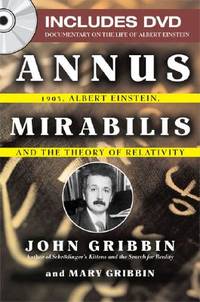
2005b0979<p>Chamberlain Bros. 2005. X310 pages. New Hardcover with sealed CD. New DJ. 8.5"x5.8"x1.0". be35</p> Chamberlain Bros. hardcover
Book shows light wear to covers only. Binding is solid and square, text/interior is clean and free of marking of any kind.
Clean, unmarked text pages with a tight binding. Slight wear to cover and a few crayon marks on last page, which is an advertisement.
Mm 130x205 Brossura editoriale di 329 pagine, testo in lingua francese. Buono stato. Spedizione entro 24 ore dalla conferma dell'ordine.
195046543[1950]. 8vo. Original proof-copy (of the latest stage, presumably final proof, in the same format as the printed version and with no corrections), printed on rectos and versos. Stapled twice in left margin. A few marginal creases. A (proof-) number to upper left corner in red ink (297). Pp. 109-148 + tipped-in errata slip at p. 147.
1932100586Gauthier-Villars , Mémorial des Sciences Mathématiques Malicorne sur Sarthe, 72, Pays de la Loire, France 1932 Book condition, Etat : Bon broché, sous couverture imprimée éditeur rose grand In-8 1 vol. - 57 pages
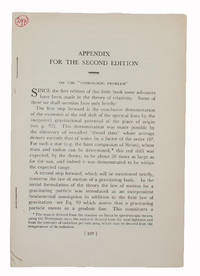
1950465431950. 8vo. Original proof-copy of the latest stage presumably final proof in the same format as the printed version and with no corrections printed on rectos and versos. Stapled twice in left margin. A few marginal creases. A proof- number to upper left corner in red ink 297. Pp. 109-148 tipped-in errata slip at p. 147. <br/><br/><em>Very rare original proof-copy of the two highly important appendices for Einstein's "The Meaning of Relativity" third edition 1950 the second appendix being one of the most important pieces Einstein ever wrote namely the appendix "in which he described his most recent work on unification" Pais and the work which was hailed by The New York Times under the heading "New Einstein theory gives a master key to the universe". The first appendix which appeared for the second edition of the work remained unchanged throughout the history of "the Meaning of Relativity" and was written because "Since the first edition of this little book some advances have been made in the theory of relativity. . The first step forward is the conclusive demonstration of the existence of the red shift of the spectral lines by the negative gravitational potential of the place of origin" . A second step forward which will be mentioned briefly concerns the law of motion of a gravitating body." . A third step forward concerning the so-called "cosmologic problem" wiil be considered here in detail." pp. 109-10. The present 40 pages constitute the final proof-copy of the entire appendices I and II to the Generalized Theory of Gravitation exactly as they appeared in the third edition Princeton in 1950. Einstein's "The Meaning of Relativity" was originally published in 1922 on the basis of his "Vier Vorlesungen ueber Relativitetstheorie" given at Princeton in 1921. A second edition with an appendix appendix I appeared in 1945 several issues and editions of this appeared also and in 1949 the third edition with the seminal Appendix II printed for the first time appears also appeared in 1950 in Princeton. In 1950 a revised edition of the third edition appears having Appendix II slightly revised and in 1953 the heavily revised fourth edition appears. THIS IS THE PROOF-COPY OF APPENDICES I AND II FOR THE "THIRD EDITION INCLUDING THE GENERALIZED THEORY OF GRAVITATION" PRINCETON 1950. The main focus of the work throughout all these editions of the work since 1949 is Appendix II which deals with Einstein's main interest the generalization of the Gravitation Theory which was to unite the general theory of relativity with electromagnetism recovering an approximation for quantum theory and presenting us with a theory to explain the universe as a unified entity the ultimate goal for the greatest physicist that ever lived. "This was Einstein's ultimate response to the mechanical-electromagnetic crisis in physical theory he had first talked about in the opening of his 1905 light quantum-paper." Nandor in D.S.B. p. 330. It was indeed Einstein's aim to provide an explanation of the universe through his unified field theory although he was well aware that his sort of field theory might not exist. However even the establishing of the non-existence of it could bring us closer to an explanation than we had ever been before. There is no topic of greater importance to Einstein than his theory of unification. "In 1949 Einstein wrote a new appendix for the third edition of his "The Meaning of Relativity" in which he described his most recent work on unification. It was none of his doing that a page of his manuscript appeared on the front page of "The New York Times" under the heading "New Einstein theory gives a master key to the universe". He refused to see reporters and asked Helen Dukas to relay this message to them: "Come back and see me in twenty years"." Pais p. 350. </em> unknown
2005G9875505870I5N00Longseller 2005. Paperback. Acceptable. Readable copy. Pages may have considerable notes/highlighting. ~ ThriftBooks: Read More Spend Less.Dust jacket quality is not guaranteed. Longseller paperback
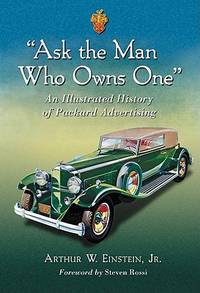
2010220730001McFarland 2010-09-10. Hardcover. Like New. 7x5x1. Hardcover. Near fine with minor shelf wear. Tight binding. Clear text. For any additional information or pictures please inquire. McFarland hardcover
20171-1476667918McFarland Publishing 2017. Paperback. New. reprint edition. 258 pages. 10.00x7.00x0.75 inches. McFarland Publishing paperback
1944Berlin, Springer, 1920, un volume in 8, broché, couverture imprimée, 15pp.
19222081002109000573SPRINGER-VERLAG 1922. Soft Cover. Fine. Number of pages: 15 SPRINGER-VERLAG paperback
19201433Berlin: Julius Springer 1920. 1st Edition. FIRST EDITION IN ORIGINAL WRAPPERS OF EINSTEIN'S LEIDEN LECTURE EXPLAINING AT LENGTH HIS THEORY OF THE ETHER ALONG WITH THOSE OF LORENTZ & MAXWELL. Very good condition. "Einstein's lecture at the University of Leiden on the occasion of his appointment as a visiting professor summarized his current views on the ether and retrospectively looked at the development of his opinions on the physical properties of space" Calaprice The Einstein Almanac 86. <br /> <br /> In this lecture Einstein recanted his earlier denial of the ether writing: "Recapitulating we may say that according to the general theory of relativity space is endowed with physical qualities; in this sense therefore there exists an ether. According to the general theory of relativity space without ether is unthinkable; for in such space there not only would be no propagation of light but also no possibility of existence for standards of space and time measuring-rods and clocks nor therefore any space-time intervals in the physical sense. But this ether may not be thought of as endowed with the quality characteristic of ponderable media as consisting of parts which may be tracked through time. The idea of motion may not be applied to it" Einstein Ather 1920. <br /> <br /> In this lecture Einstein also sought "to reconcile his theory of relativity with his mentor's Lorentz's cherished concept of the aether. Einstein stressed that special relativity took away the last mechanical property of Lorentz's aether: immobility. However he continued that special relativity does not necessarily rule out the aether because the latter can be used to give physical reality to acceleration and rotation. This concept was fully elaborated within general relativity in which physical properties which are partially determined by matter are attributed to space but no substance or state of motion can be attributed to that "aether" aether = curved space-time" Wikipedia. CONDITION & DETAIL: Berlin Julius Springer 1920. Complete in original cream colored wrappers. 8vo. 22 x 15cm. 15pp. Slight toning. Very good condition. <br /> <br /> ITEM: Ather und Relativitätstheorie. Rede gehalten am 5. Mai 1920 an der Reichs-Universität zu Leiden. Julius Springer unknown
184p. (6)[Publisher's catalogue]. Illustrated with drawings. Paper browned but not brittle. Small 8vo. Avon paperback. Published in the same year as the first edition, with special arrangement with Dodd, Mead & Company. Attractive little book."The Great New Bomb / Nature of the Atom / How It Was Smashed / Future Use of Its Energy." SPACE/7
20061253880Weinheim : Wiley-VCH-Verl., 2006. 364 S. : Ill. ; 22 cm Gebundener Originalpappband mit Umschlag
1930433061930. Offprint from Mathematische Annalen 102 1930. 685-697pp. Original printed self-wrappers. 233 x 157 mm. Very good apart from small split in lower spine. Weil Albert Einstein Bibliography 171. unknown