1 506 résultats
191338832Berlin J.A. Barth 1913. Later full cloth. "Annalen der Physik. Vierte Folge. Band 40. Hrsg. von W. Wien und M. Planck." VIII1056 pp. 1 plate. Einstein paper: pp. 551-60. Internally fine and clean. The whole volume offered. <br/><br/><em>First edition. In this paper "Some arguments for the existance of a molecular agitation at the absolute zero point" Einstein derives Planck's radiation law without the usual discontinuity assumptions.The volume contains also papers by W. Pauli Stark Nordström and others. - Weil No 53. </em> hardcover
1982V33028Reinbek (Rowohlt Taschenbuch Verlag) 1982 (= rororo sachbuch 7215, Erste Ausgabe). 8°, Originalbroschur ( Paperback) 166 S., ISBN 3 499 17215 1 1
199961825Freiburg, Herder Verlag, 1999. "Originalausgabe, in der Reihe ""Herder Spektrum Meisterdenker"", 8°, 206 S., kartonierter Einband"
199223018Paderborn : Junfermann 1992. 179 S. : graph. Darst. ; 22 cm, mit Schutzumschlag Pp.,gebundene Ausgabe, Hardcover/Pappeinband, Exemplar in gutem Erhaltungszustand
19791199794Braunschweig, Wiesbaden : Vieweg Verlag, 1979. 467 S. : 1 Ill. ; 23 cm; fadengeh. Orig.-Pappband m. OUmschl.
1980028718New York: Aspen Institute for Humanistic Studies 1980. Book. Fine. Soft cover. First Edition. 4to - over 9¾" - 12" tall. Stiff color illus. wrasp. Mere hints of handling wear essentially as issued. Square uncreased binding. vii174 pp. Very scarce. Aspen Institute for Humanistic Studies Paperback
1980028752New York: Aspen Institute for Humanistic Studies 1980. Book. VG. Soft cover. First Edition. 4to - over 9¾" - 12" tall. Stiff color illus. wrasp. Light shelf/handling wear diagonal creases to bottom corners. Square uncreased binding. vii174 pp. Very scarce. Aspen Institute for Humanistic Studies Paperback
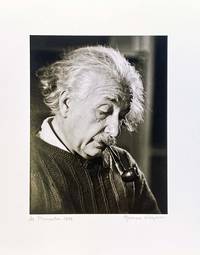
19802611New York: np 1980. First edition. Clamshell box. Fine. EXTREMELY RARE COMPLETE SUITE OF SEVEN LARGE SILVER PRINTS FROM EINSTEIN'S FAMOUS PHOTO SHOOT AT PRINCETON WITH ROMAN VISHNIAC. Each print is signed by Vishniac and dated "At Princeton 1942" in his hand below the image and numbered on the back. "One day Vishniac decided to visit Albert Einstein at Princeton to offer greetings from mutual friends in Berlin. Uninvited he hoped Einstein would pose for a portrait but Einstein had little interest. Vishniac recalled:<br /> <br /> It was a singular experience. An idea had suddenly come to him and the room was filled with the movement of the great man's thought. I waited several minutes and then when I saw that he did not intend to say anything more to me and that he was off in a world of his own I started taking pictures.<br /> <br /> Einstein later admitted that a Vishniac photograph taken that day was his favorite portrait" Encyclopedia of Twentieth-Century Photography. <br /> <br /> Vishniac provided details about this portolfio in a letter to an original recipient the letter is not included here explaining:<br /> <br /> The size of the edition's limitation is uncertain due to my age and only spare time to make them. The most expensive portfolios - Ansel Adams Kertesz - are limited in large numbers I can never measure up - 999 1001 and similar. <br /> <br /> The originality of Portfolio "Einstein" consists of its special character. It is made not to get images but the feeling that you are present during the creativity by the Great Man. All pictures are made with "hidden camera" method.<br /> <br /> The value of this portfolio is great and can hardly be estimated today. <br /> <br /> Princeton/New York: 1942 negatives; 1980 silver prints. Elephant folio clamshell box approx. 17x21 in. housing seven silver prints. Image size: approx. 10.25 x 13.25 in.; with matte 16x20 in. A few minor blemishes to box. Photos in fine condition. RARE. np unknown
19742091502133533903Kyoritsu shuppan 1974. Soft Cover. Fine. Number of books: 1 Kyoritsu shuppan paperback
200083056ABNew York, Viking 2000. Gr.-8°. XV, 416 S., OPp. mit ill. OUmschl. (dieser gering nachgedunkelt, Kopfschnitt angestaubt). Sonst gutes Exemplar. EA. OPp. mit ill. OUmschl. (dieser gering nachgedunkelt, Kopfschnitt angestaubt). Sonst gutes Exemplar. EA.
1986145797Leipzig, Offizin Andersen Nexö, 1986. 5,4x5,7 cm. M. zahlr. Fotos. 380 S. OLdr. m. OPp.-Schuber.
1986117899ABLeipzig, Offizin Andersen Nexö, 1986. 5,3 x 5,3 cm. 378 S., 3 Blatt mit zahlreichen teils farbigen Abb. auf Tafeln. Olivgrüner Original-Lederband mit Goldprägung in OSchuber.
1986122238ABLeipzig, Offizin Andersen Nexö, 1986. 5,3 x 5,3 cm. 378 S., 3 Blatt mit zahlreichen teils farbigen Abb. auf Tafeln. Olivgrüner Original-Lederband mit Goldprägung in OSchuber.
198647747Leipzig, Verlag Offizin Andersen Nexö 1986. Mit Abbildungen., 378 Seiten., 5,5 cm x 5,7 cm. grünes OLeder mit Front- und Rückenvergoldung im illustrierten grünen OPappschuber (dieser gering berieben).,
1947316757Emergency Committee of Atomic Scientists 1947. Paper Back. Very Good. Letterhead of Emergency Committee of Atomic Scientists on two sheets soliciting contributions to the Committee. Dated August 6 1947 the second anniversary of the Hiroshima bombing. An original typed letter with a facsimile Einstein signature in blue ink. Emergency Committee of Atomic Scientists unknown
190850421Leipzig 1908. <p> 1 Planck Max 1858-1947. Zur dynamik bewegter systeme. In Annalen der Physik 26 6: 1-34 pp. 2 Einstein Albert 1879-1965 and Jakob Laub 1882-1962. Über die elektromagnetischen grundgleichungen für bewegte Körper. In Annalen der Physik 26 8: 532-40 pp. Boni 22 Weil 22. 3 Einstein A. and J. Laub. Über die im elektromagnetischen felde auf ruhende Körper ausgeubten ponderomotorischen Krafte. In Annalen der Physik 26 8: 541-50 pp. Boni 23 Weil 23. Red cloth gilt lettering on spine. Figs. Text-illust. 230 x 141 mm. Whole volume: viii 1032 pp. 8 plates 3 folding 3 b/w silver photos. Spine a little worn but still Very Good. </p> <br /> <br /> <p>Approximate English translations of titles: 1 "On the dynamics of moving systems". 2 "On the fundamental electromagnetic equations for moving bodies;" and 3 "On the ponderomotive forces exerted on bodies at rest in the electromagnetic field." </p> <br /> <br /> <p>"Einstein wrote no. 2 above and "Elementary theory of Brownian motion" in Zeitschrift für Elektrochemie und angewandte physikalische Chemie 14 1908: 235-239 pp. in a three-week period with Jakob Laub his first scientific collaborator to address the problems of formulating relativistically invariant equations for electromagnetic fields in moving media first raised by Hermann Minowski the year before." Calaprice An Einstein Encyclopedia. 2015. A correction to this paper no. 2 was published later in the year in vol. 27 1908: 232 and a supplement for the following year in vol. 28 1909: 445-447. Elaborating on the relativistic transformation of Maxwell's vacuum equations . . . Einstein and Laub also consider the displacement vector D and the magnetic induction B. </p> <br /> <br /> <p>Weil's Einstein Bibliography nos. 22 23. <br> Boni's Einstein Checklist nos. 22 23. </p> <br /> <br /> <p> Max Karl Ernst Ludwig Planck 1858-1947 was a German theoretical physicist who was awarded the 1918 Nobel Prize in Physics "in recognition of the services he rendered to the advancement of Physics by his discovery of energy quanta" nobelprize.org. Planck revolutionized human understanding of atomic and subatomic processes as the originator of the quantum theory. Jakob Laub 1882-1962 was a physicist who is best known for his work in the early period of special relativity having worked alongside Albert Einstein during that time. </p> . unknown
199433034Oxford: Clarendon Press 1994. Clarendon Press unknown books
1987114361ABHalle, Postreiter-Verlag, [1987]. Quer-8°. (12) S. auf Pappe mit farbigen Illustrationen von Manfred Bofinger. Original-Halbleinenband.
1988Q-0517345803Random House Value Publishing 1988-12-12. Hardcover. New. New. In shrink wrap. Looks like an interesting title! Random House Value Publishing hardcover
1960014279New York: Simon & Schuster 1960. Unclipped dust jacket. First Edition. Original Cloth. Very Good/Very Good. Simon & Schuster Hardcover
192426006<p>"<i>I'm working a lot but not managing to come up with the real thing. Science is a difficult profession. Sometimes I'm glad that you chose a practical vocation where one doesn't have to search for four-leaf clovers.</i>"</p> <b>ALBERT EINSTEIN.</b>Autograph Letter Signed "<i>Papa</i>" to his son Hans Albert Einstein March 7 1924 Berlin Germany. In German. 1 p.<p><b><br /></b></p><p><b>Complete Translation</b></p><p> <i>7.III.24</i></p><p><i>Dear Albert</i></p><p> <i>My research projects of the past few years are completely inappropriate for a popular lecture and then I generally dread public appearances of such a kind. That's why I unfortunately have to decline the talk this time too. The Fr 45000 I designated for the down payment of the house purchase; and I invested another Fr 45000 which is supposed to belong to you that is Mama. I hope you'll find a suitable little home.</i></p><p> <i>I'm probably going to be staying in Zurich for a bit on the trip back from Naples; on the trip there only briefly. There's no question of it being official; the main thing for me is to be with you for a while. I don't have much time because I'm supposed to go to Kiel in May.</i></p><p> <i>In any case I'm very happy about seeing you all again soon. I'm working a lot but not managing to come up with the real thing. Science is a difficult profession. Sometimes I'm glad that you chose a practical vocation where one doesn't have to search for four-leaf clovers.</i></p><p> <i>Looking forward to a happy reunion! Best regards to the three of you from your</i></p><p> <i>Papa.</i></p><p><b>Historical Background</b></p><p>Einstein's Theory of Relativity published in 1915 describes gravity as a curved geometric property of spacetime. Though <i>E</i>=<i>mc</i>2 captures the theory for which he is most remembered he never won the Nobel Prize in Physics. Rather in 1922 he won for his 1905 explanation of the photoelectric effect.</p><p>In 1914 Albert and Mileva Marić-Einstein separated and she and their sons returned to Zurich. When they divorced in 1919 they agreed that any Nobel Prize money he might win would go to Mileva for the children. He won the Nobel Prize for Physics in 1922.</p><p>In May 1924 two months after this letter Marić purchased a building in Zurich and moved into the third floor apartment. In 1930 she purchased two more buildings but when the worldwide economic crisis reached Switzerland many tenants could not afford their rent; she lost the two additional buildings to foreclosure in 1936. Einstein had invested the remaining prize money in America in Marić's name. He lost much of that due to the Great Depression but he ultimately paid Marić more than he received from the prize.</p><p>Einstein also mentions to his nineteen-year-old son his plans to travel to Naples in May. He would attend the fifth International Congress of Philosophy with his theory of relativity scheduled to be "an object of particular discussion." First organized in 1900 the Congress was a global meeting held every few years under the auspices of the International Federation of Philosophical Societies. It was interrupted by both World Wars but reconvened in 1948 and has been held every five years since in locations throughout the world.</p><p>Einstein also planned to go to Kiel Germany to stay and work with Hermann Anschütz-Kaempfe 1872-1931 a German art historian and inventor. Kaempfe pioneered gyro compasses for ships and submarines.</p><p>From the 1920s until his death in 1955 the most elusive clover for which Einstein searched was a unified field theory. Einstein tried to meld together general relativity and electromagnetism. This would describe a single field in which all forces are mediated and the properties of all particles could be deduced.</p><p><b>Albert Einstein</b> 1879-1955 was born in the Kingdom of Wurttemberg in the German Empire to non-observant Ashkenazi Jewish parents. In 1894 the family moved to Italy. Einstein graduated from the Swiss Federal Polytechnic in Zürich in 1900. In 1903 he married Mileva Marić 1875-1948 with whom he had two sons. In 1905 he received a Ph.D. from the University of Zürich. From 1908 to 1932 he taught at a series of universities in Switzerland the Austrian Empire and the German Empire. As a theoretical physicist he published ground-breaking papers as early as 1905 and developed the theory of relativity including the mass–energy equivalence formula <i>E</i>=<i>mc</i>2. Albert and Mileva divorced in 1919. That same year he married Elsa Löwenthal. In 1922 he received the Nobel Prize in Physics for the discovery of the photoelectric effect. In January 1933 when Adolph Hitler came to power Einstein was visiting the U.S. and remained here In 1939 he signed a letter to President Franklin D. Roosevelt warning that Germany could develop a nuclear bomb thus inspiring the "Manhattan project." He became a U.S. citizen in 1940. After the war he became known for efforts to further world peace. At the Institute for Advanced Study in Princeton N.J. from 1933 until his death in 1955 he worked to develop a unified field theory and to refute the accepted interpretation of quantum physics. Considered the father of modern physics and one of the most prolific intellects of history Einstein published more than 300 scientific papers and over 150 non-scientific works.</p><p><b>Hans Albert Einstein</b> 1904-1973 was born in Bern Switzerland to Albert Einstein and Mileva Marić. Hans followed both parents in studying at ETH the Swiss Federal Institute of Technology in Zurich graduating with a degree in civil engineering in 1926. In 1927 he married Frieda Knecht and they had four children two of whom died very young. In 1936 Hans earned a doctor of technical science degree. At his father's advice he left Switzerland in 1938 to escape the Nazi threat. He settled in Greenville South Carolina and worked for the U.S. Department of Agriculture studying sediment transport. In 1943 he transferred to the California Institute of Technology and in 1947 he accepted a position teaching hydraulic engineering at the University of California Berkeley. He became a full professor and eventually professor emeritus winning several research awards and fellowships.</p> books
198051180Berlin, Buchverlag Der Morgen, 1980. 2., durchgesehene Auflage 170 Seiten , 20 cm, Leinen
1997ZB3938491997-2000. volumes 4; 6-7. 1997-2000. partly bound library markings textually clean & tight PRICE IS FOR THE LOT. - If you are reading this this item is actually physically in our stock and ready for shipment once ordered. We are not bookjackers. Buyer is responsible for any additional duties taxes or fees required by recipient's country. unknown
19912083002116405282Japan Broadcasting Publishing Association 1991. Soft Cover. Fine. The book is in fine condition. Japan Broadcasting Publishing Association paperback
19922090202118102415Japan Broadcasting Publishing Association NHK Publishing 1992. Soft Cover. Fine. The book is in fine condition. Japan Broadcasting Publishing Association (NHK Publishing) paperback