ALBERT EINSTEINABAA

2 944 résultats
192426006<p>"<i>I'm working a lot but not managing to come up with the real thing. Science is a difficult profession. Sometimes I'm glad that you chose a practical vocation where one doesn't have to search for four-leaf clovers.</i>"</p> <b>ALBERT EINSTEIN.</b>Autograph Letter Signed "<i>Papa</i>" to his son Hans Albert Einstein March 7 1924 Berlin Germany. In German. 1 p.<p><b><br /></b></p><p><b>Complete Translation</b></p><p> <i>7.III.24</i></p><p><i>Dear Albert</i></p><p> <i>My research projects of the past few years are completely inappropriate for a popular lecture and then I generally dread public appearances of such a kind. That's why I unfortunately have to decline the talk this time too. The Fr 45000 I designated for the down payment of the house purchase; and I invested another Fr 45000 which is supposed to belong to you that is Mama. I hope you'll find a suitable little home.</i></p><p> <i>I'm probably going to be staying in Zurich for a bit on the trip back from Naples; on the trip there only briefly. There's no question of it being official; the main thing for me is to be with you for a while. I don't have much time because I'm supposed to go to Kiel in May.</i></p><p> <i>In any case I'm very happy about seeing you all again soon. I'm working a lot but not managing to come up with the real thing. Science is a difficult profession. Sometimes I'm glad that you chose a practical vocation where one doesn't have to search for four-leaf clovers.</i></p><p> <i>Looking forward to a happy reunion! Best regards to the three of you from your</i></p><p> <i>Papa.</i></p><p><b>Historical Background</b></p><p>Einstein's Theory of Relativity published in 1915 describes gravity as a curved geometric property of spacetime. Though <i>E</i>=<i>mc</i>2 captures the theory for which he is most remembered he never won the Nobel Prize in Physics. Rather in 1922 he won for his 1905 explanation of the photoelectric effect.</p><p>In 1914 Albert and Mileva Marić-Einstein separated and she and their sons returned to Zurich. When they divorced in 1919 they agreed that any Nobel Prize money he might win would go to Mileva for the children. He won the Nobel Prize for Physics in 1922.</p><p>In May 1924 two months after this letter Marić purchased a building in Zurich and moved into the third floor apartment. In 1930 she purchased two more buildings but when the worldwide economic crisis reached Switzerland many tenants could not afford their rent; she lost the two additional buildings to foreclosure in 1936. Einstein had invested the remaining prize money in America in Marić's name. He lost much of that due to the Great Depression but he ultimately paid Marić more than he received from the prize.</p><p>Einstein also mentions to his nineteen-year-old son his plans to travel to Naples in May. He would attend the fifth International Congress of Philosophy with his theory of relativity scheduled to be "an object of particular discussion." First organized in 1900 the Congress was a global meeting held every few years under the auspices of the International Federation of Philosophical Societies. It was interrupted by both World Wars but reconvened in 1948 and has been held every five years since in locations throughout the world.</p><p>Einstein also planned to go to Kiel Germany to stay and work with Hermann Anschütz-Kaempfe 1872-1931 a German art historian and inventor. Kaempfe pioneered gyro compasses for ships and submarines.</p><p>From the 1920s until his death in 1955 the most elusive clover for which Einstein searched was a unified field theory. Einstein tried to meld together general relativity and electromagnetism. This would describe a single field in which all forces are mediated and the properties of all particles could be deduced.</p><p><b>Albert Einstein</b> 1879-1955 was born in the Kingdom of Wurttemberg in the German Empire to non-observant Ashkenazi Jewish parents. In 1894 the family moved to Italy. Einstein graduated from the Swiss Federal Polytechnic in Zürich in 1900. In 1903 he married Mileva Marić 1875-1948 with whom he had two sons. In 1905 he received a Ph.D. from the University of Zürich. From 1908 to 1932 he taught at a series of universities in Switzerland the Austrian Empire and the German Empire. As a theoretical physicist he published ground-breaking papers as early as 1905 and developed the theory of relativity including the mass–energy equivalence formula <i>E</i>=<i>mc</i>2. Albert and Mileva divorced in 1919. That same year he married Elsa Löwenthal. In 1922 he received the Nobel Prize in Physics for the discovery of the photoelectric effect. In January 1933 when Adolph Hitler came to power Einstein was visiting the U.S. and remained here In 1939 he signed a letter to President Franklin D. Roosevelt warning that Germany could develop a nuclear bomb thus inspiring the "Manhattan project." He became a U.S. citizen in 1940. After the war he became known for efforts to further world peace. At the Institute for Advanced Study in Princeton N.J. from 1933 until his death in 1955 he worked to develop a unified field theory and to refute the accepted interpretation of quantum physics. Considered the father of modern physics and one of the most prolific intellects of history Einstein published more than 300 scientific papers and over 150 non-scientific works.</p><p><b>Hans Albert Einstein</b> 1904-1973 was born in Bern Switzerland to Albert Einstein and Mileva Marić. Hans followed both parents in studying at ETH the Swiss Federal Institute of Technology in Zurich graduating with a degree in civil engineering in 1926. In 1927 he married Frieda Knecht and they had four children two of whom died very young. In 1936 Hans earned a doctor of technical science degree. At his father's advice he left Switzerland in 1938 to escape the Nazi threat. He settled in Greenville South Carolina and worked for the U.S. Department of Agriculture studying sediment transport. In 1943 he transferred to the California Institute of Technology and in 1947 he accepted a position teaching hydraulic engineering at the University of California Berkeley. He became a full professor and eventually professor emeritus winning several research awards and fellowships.</p> books
198185935François Maspero , Pour débutants Malicorne sur Sarthe, 72, Pays de la Loire, France 1981 Book condition, Etat : Bon broché, sous couverture imprimée éditeur crème, illustrée d'un dessin d'Albert Einstein grand In-8 1 vol. - 170 pages
198051180Berlin, Buchverlag Der Morgen, 1980. 2., durchgesehene Auflage 170 Seiten , 20 cm, Leinen
1997ZB3938491997-2000. volumes 4; 6-7. 1997-2000. partly bound library markings textually clean & tight PRICE IS FOR THE LOT. - If you are reading this this item is actually physically in our stock and ready for shipment once ordered. We are not bookjackers. Buyer is responsible for any additional duties taxes or fees required by recipient's country. unknown
19912083002116405282Japan Broadcasting Publishing Association 1991. Soft Cover. Fine. The book is in fine condition. Japan Broadcasting Publishing Association paperback
19922090202118102415Japan Broadcasting Publishing Association NHK Publishing 1992. Soft Cover. Fine. The book is in fine condition. Japan Broadcasting Publishing Association (NHK Publishing) paperback
19912082502113905773Japan Broadcasting Publishing Association 1991. Soft Cover. Fine. Number of books: 1 Japan Broadcasting Publishing Association paperback
br. Una nuova prospettiva sulla formazione scientifica e filosofica di Einstein, a partire dalle sue note autobiografiche, che tracciano un quadro avvincente sull'itinerario che portò alla relatività generale. Gutfreund e Renn presentano al lettore di oggi le riflessioni del celebre fisico, seguendo il suo percorso intellettuale dall'infanzia agli ultimi anni attraverso gli scritti e la corrispondenza personale di Einstein e i saggi critici dei suoi contemporanei. Oltre alla replica di Einstein effettivamente pubblicata, sono citati vari estratti dalla prima bozza inedita in cui il grande scienziato cercò di ribattere alle osservazioni dei detrattori. Il saggio si chiude prendendo in esame un breve testo autobiografico di Einstein, scritto poche settimane prima di morire e finora inedito, in cui le sue idee rivoluzionarie sono contestualizzate nel panorama degli altri straordinari progressi scientifici compiuti nel Novecento.
A.Z. Petrov Einstein Spaces. , Pergamon 1969, Copertina rigida originale, con sovraccoperta usurata. Tagli con gore. Interno in buono stato. Buono (Good) . <br> <br> <br> 411<br>
19791345Berlin, Heidelberg, New York : Springer (Lecture notes in physics ; Vol. 100), 1979. Aus Anlass der 100. Wiederkehr seines Geburtstages (25. - 30. März 1979) VIII, 550 S.; 25 cm Paperback
1949160919012Philosophical Library 1949. Hardcover. very good/Good - considerable wear. Hardcover very good condition typical reader wear. Gift inscription inside front cover DJ very good but considerable wear. Philosophical Library hardcover
1960413765Dordrecht, Reidel, (1960). XVI, 481 S. OLwd. St. verso Tit. (Sovietica).
200591518Editions Frison-Roche 2005 In-8 broché 22,4 cm sur 14,8. 378 pages. Très bon état d’occasion.
1960F94331Dordrecht, Reidel 1960 xvi + 481pp., in the series "Sovietica", editor's hardcover in red cloth, dustwrapper, 23cm., good condition, F94331
xvi + 481pp., in the series "Sovietica", editor's hardcover in red cloth, dustwrapper, 23cm., good condition, F94331
1960107366Dordrecht: Reidel 1960. XVI, 481 Seiten. Gr. 8° (22,5-25 cm). Orig.-Leinenband. [Hardcover / fest gebunden].
197956295Buchverlag der Morgen Berlin. 1979. 365 Seiten. Oktav. mit Abbildungen. 2. Auflage. Leinen mit Umschlag.
19864743Berlin, Buchverlag der Morgen 1986. Oleinen, 8 , 365 S., 3., durchgesehene Auflage, mit Abb. auf Tafeln, "Die hier vereinigten ausgewählten Abhandlungen über Albert Einstein sind aus unterschiedlichsten Anlässen entstanden und - soweit es sich nicht um bisher unveröffentlichte Texte handelt - an verschiedenen Stellen erschienen. Für den Abdruck in dem vorliegenden Band habe ich sie überall auf den jüngsten Stand der Forschung gebracht, und mit Anmerkungen sowie mit einem Literatur- und Quellennachweis versehen. Einband leichte Gebrauchsspuren, Ecke vorn oben leicht bestoßen. Hardcover
6378555261Princeton University Press . Hardback. New. Princeton University Press hardcover
200627290Frankfurt am Main, Berlin, Bern, Bruxelles, New York, Oxford, Wien: Peter Lang, 2006. 520 S., 7 Abb. Originalbroschur.
1992100848Presses Universitaires de Vincennes , Histoires de Science Malicorne sur Sarthe, 72, Pays de la Loire, France 1992 Book condition, Etat : Bon broché, sous couverture imprimée éditeur blanche, illustrée de la une d'un journal français annonçant le passage d'Einstein au Collège de France In-8 1 vol. - 222 pages
19981-0691059381Princeton Univ Dept of Art & 1998. Hardcover. New. illustrated edition. 198 pages. 8.75x6.00x0.75 inches. Princeton Univ Dept of Art & hardcover
2004Q-0807615323George Braziller Inc 2004-05-17. Paperback. New. In shrink wrap. Looks like an interesting title! George Braziller Inc paperback
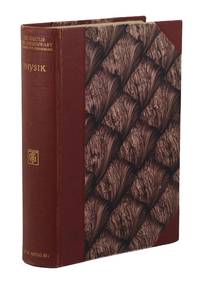
1915140945614Leipzig & Berlin: B.G. Teubner 1915. First edition. First edition. iv viii 762 8 pp. Bound in publisher's three quarter maroon cloth with marbled paper sides gilt spine lettering. Near Fine with rubbing along edges; a few marks to prelims text otherwise free of markings; hint of foxing to edges. Bookplate on paste down. <p>A German-language physics review with the first book publication of two articles by Albert Einstein as well as work by a number of famous physicists of the early 20th century. B.G. Teubner unknown
0156004178.Gpaperback. Good. Access codes and supplements are not guaranteed with used items. May be an ex-library book. paperback