Isaacson, WalterMareMagnum
Clark Ronald W.MareMagnum
Einstein. La vita pubblica e privata del più grande scienziato del nostro tempo.
In-8°, pp.742, tela edit. con sovraccop. fig. e cofanetto fig.

Libreria Xodo · Torino, IT25,00 €
2 944 résultats
Mm 145x225 Edizione Mondolibri su licenza Mondadori. Volume cartonato rigido di 645 pagine, numerose illustrazioni in bianco e nero fuori testo, sovraccoperta editoriale. Esemplare in ottime condizioni. SPEDIZIONE IN 24 ORE DALLA CONFERMA DELL'ORDINE.
Mm 145x225 Collana "Le Scie" - Volume in copertina rigida con sovraccoperta, 645 pagine con 22 tavole in nero non comprese nel testo. Copia ottima poco o nulla consultata; spedizione in 24 ore dalla confervma dell'ordine.
In-8°, pp.742, tela edit. con sovraccop. fig. e cofanetto fig.
In 8°, tela edit. + sovracop. ill., cofanetto, pp.742-(6nn). Ottimo.
ill., br. Uomo intelligente, popstar della fisica: Albert Einstein ha reinventato l'Universo più di 100 anni fa, e la sua teoria della relatività è ancora estremamente attuale, come dimostra la recente individuazione delle prime onde gravitazionali. Ma cosa ha davvero scoperto Einstein, come sono state confermate le sue teorie e perché senza di esse i navigatori satellitari non potrebbero funzionare? Questo libro spiega in modo semplice e brillante i geniali pensieri di quest'uomo originale e incredibilmente talentuoso!
195027614Editions Albin Michel, coll. “Les savants et le monde” 1950 In-8 broché 20,5 cm sur 13. 435 pages. Très bon état d’occasion.
33894Albin Michel. 1950. In-8. Br. Qlques ills. 435 p. BE.
195099939034Albin Michel Albin Michel 1950, In-8 broché, 429 pages. Bon état.
Albin Michel 1950, In-8 broché, 429 pages. Bon état.
36903P., Albin Michel (Collection "Les Savants et le Monde"), 1950, in 8° broché, 435 pages ; couverture illustrée (un peu fanée).
200598932Wiley-VCH Verlag 2005. 727 Seiten., 8°. OPappe mit illustriertem OSchutzumschlag (dieser mit Gebrauchsspuren).,
197338390ABLondon, Hodder and Stoughton, 1973. 24 cm, 670 Seiten, mit Schwarzweißfotos auf 16 unpaginierten Tafeln, schwarzer Pappband, Original-Schutzumschlag. Buch etwas verbogen, Schutzumschlag mit Randläsuren, insgesamt gut erhalten.
In 8°, leg. e sovraccop. edit., pp.742.
ill., br. "Sottile è il Signore, ma non malevolo". Con questa frase, Einstein commentava nel 1921 alcuni dati (poi rivelatisi errati) che avrebbero potuto mettere in crisi la sua teoria della relatività. Guidato da un marcato senso estetico, oltre che da una logica stringente, il pensiero einsteiniano si opponeva naturalmente a ogni complicazione non necessaria, sempre teso a ricercare la più semplice ed elegante delle spiegazioni al più complesso dei problemi. Dotato di una tenacia fuori dal comune, Einstein visse da solitario nella vita come nella scienza, spesso contro corrente, giungendo così ad alcune delle più eclatanti scoperte del XX secolo. Questa biografia, scritta da un suo allievo e amico, resta a tutt'oggi insostituibile e insuperata per chi voglia ripercorrere il cammino scientifico e umano del grande fisico.
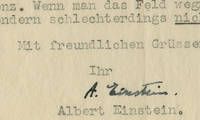
184029/9/54. <blockquote><p>The fullest summation we have seen by Einstein comparing relativity to Newtonian concepts of space and time</p></blockquote><p>Immanuel Kant took both Euclidean geometry and the Newtonian laws of motion to be synthetic a priori principles which from Kant’s point of view function as necessary presuppositions for applying our fundamental concepts of space time matter and motion to our sensible experience of the natural world meaning they are fixed necessary conditions. This idea rested on the absolute nature of space and time the work of Newton and the relationship between geometry and physics.</p><p>In 1905 while a young patent clerk and physicist in Bern Switzerland Albert Einstein obtained his doctorate and published a paper that explained his newly developed Special Theory of Relativity. This unlocked many mysteries of the universe and introduced the world to ""e=mc2"" equating mass and the speed of light with energy. It established that time and space are not fixed and in fact change to maintain a constant speed of light regardless of the relative motions of sources and observers. Just 10 years later in 1915 Einstein published his General Theory of Relativity which described the universe as a four-dimensional continuum with time added as the fourth dimension where gravitational effects are explained by the warping of space-time. In this theory Einstein incorporated gravity as a geometric property of space-time.</p><p>The impact of Einstein's work between 1905 and 1915 challenged many principles of physics that had been accepted for centuries. In 1921 he won the Nobel Prize for his work. Time Magazine named him the Person of the Century for the 20th century for his discoveries in relativity and space-time. Einstein is the most important scientist since Isaac Newton and probably the most famous in history.</p><p>Space and time were considered relativistic more subjective and not the fixed a priori notions that had long permeated the mathematical and scientific worlds.</p><p>Max Fischler was a California scientist who was interested in the implications of this distinction: were space and time now to be studied together in this context only or were the nature of space and the nature of time different</p><p>In special relativity what appears simultaneous to one person might not to another - they are relative. You cannot separate space and time; they occur subjectively and semi-dependently but are not tied to the content of that space.</p><p>With General Relativity space-time remains but matter warps it. It's a field like the sheet of a trampoline but reacts to matter. One needs all four dimensions of space-time and without them the others don't exist. You need matter for space.</p><p>On September 5 1954 he wrote to Einstein: "".Can anything in your theory of Relativity be said to throw new light on the nature of space and time themselves Or must we rest satisfied with the purely new logical treatment of these conceptions In other words does the new view of space and time as space-time carry any new meaning ontologically beyond the purely mathematical and logical relationship between the two. Or to put it differently: When Minkowski in his famous words said 'Space by itself and time by itself must not sink into the mere shadows and only a kind of union of the two can preserve an independent existence' did he not attach some new real meaning to the 'spacetime' which the old independent notions of space and time could not convey If so in what does this new meaning consist.""</p><p>Four days later Einstein replied in this letter:</p><p><strong>Typed letter signed</strong> in German on his personal blind embossed letterhead Princeton September 9 1954 to Max Fishler. <em>""The expression cited in the second paragraph only signifies the wish for logical clarity in the formal expressions. De facto the justification for concepts lies in their ability to comprehend the empirically given.</em></p><p><em>""In classical mechanics space and time were completed existences which had to be presupposed as real a priori in order to give meaning to the laws of motion. It was a reality in the same sense as the reality of matter; even governing the latter. In this sense Kant was entirely wrong.</em></p><p><em>""The case was the same as regards the Special Theory of Relativity only that an objective separation of space and time was abandoned in the sense that there could no longer be any objective simultaneity. Here too the four dimensional space is a reality independently of the physical content of space.</em></p><p><em>""Regarding the General Theory of Relativity however this is principally different. What we call ""space"" is here only an extension of a Field dimensionality hence no longer independent of the content of space. It is real in the same sense as matter but has no real existence independently of matter. When the field is taken away there does not remain any space but just nothing.â€</em></p><p>Letters of Einstein directly relating to relativity are increasingly uncommon and this is one of the finest such letters we have had.</p> unknown
1979311182Cambridge: Harvard University Press 1979. hardcover. fine/fine. Edited by A.P. French. Illustrated throughout with black and white photographs and diagrams. xx 332 pages. Tall 8vo red cloth d.w. Cambridge: Harvard University Press 1979. A fine copy in a fine dust wrapper.<br/> <br/> Harvard University Press unknown
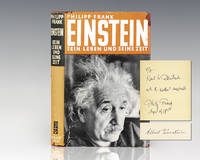
1949133215Munchen: Paul List Verlag 1949. First German edition of this classic work by Frank a famed contemporary of Einstein. Octavo original cloth. Signed by Albert Einstein on the slip to the title page and inscribed by the author on the front free endpaper "To Karl W. Deutsch with the author's compliments Philipp Frank August 10 1950." Philipp Frank was a physicist mathematician and also a philosopher during the first half of the 20th century. He was a logical-positivist and a member of the Vienna Circle. He was influenced by Mach and was one of the Machists criticised by Lenin in Materialism and Empirio-criticism. He studied physics at the University of Vienna and graduated in 1907 with a thesis in theoretical physics under the supervision of Ludwig Boltzmann. Albert Einstein recommended him as his successor for a professorship at the German Charles-Ferdinand University of Prague a position which he held from 1912 until 1938. Very good in a good dust jacket. Much has been written about Albert Einstein technical and biographical but very little remains as valuable as this unique hybrid of a book written by Einstein's colleague and contemporary. Both rich in personal insights and grounded in a deep knowledge of twentieth-century science Phillip Frank's biography anchors the reader with a lucid overview of physics and draws an intimate portrait of the Nobel Prize–winner. Paul List Verlag hardcover
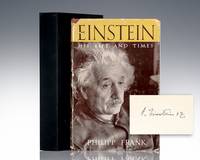
1947147192New York: Alfred A. Knopf 1947. First edition of this classic work by Frank a famed contemporary of Einstein. Octavo original cloth. Signed by the subject in the year of publication on the front free endpaper "A. Einstein 47." Translated from a German manuscript by George Rosen. Edited and Revised by Shuichi Kusaka. Housed in a custom half morocco slipcase. Rare and desirable signed by Einstein. Much has been written about Albert Einstein technical and biographical but very little remains as valuable as this unique hybrid of a book written by Einstein's colleague and contemporary. Both rich in personal insights and grounded in a deep knowledge of twentieth-century science Phillip Frank's biography anchors the reader with a lucid overview of physics and draws an intimate portrait of the Nobel Prize–winner. Very good in a very good dust jacket name to the front pastedown side edges. Alfred A. Knopf hardcover
2007021222New York London Toronto Sydney: Simon & Schuster 2007. FIRST EDITION first printing. Original two toned hardcover. Jacket is not price clipped. No previous owner's names not exlibrary. Overall an EXCELLENT book in an EXCELLENT bordart protected dust jacket. First Edition. Hard Cover. Near Fine/Near Fine. 8vo - over 7¾" - 9¾" tall. Hardcover. Simon & Schuster Hardcover
Biography of the great scientist Albert Einstein, (1879-1955) published in time for his 75th birthday. The author knew Einstein and his family for many years. 219 pages. Dust jacket a little soiled and darkened on spine with tear on joint of back cover.
Lots of pictures of Einstein with accompanying notes plus letters, documents and newspaper accounts. 126 pages. Browning to free endpapers. Short inscription at top of front free endpaper.
A. GENOVESI Einstein: scienza e società. Novara, Fondazione Achille e Giulia Boroli 2005 italian, 207 SC226O Brossura editoriale, volume come nuovo, copertina e interno in condizioni eccellenti, legatura salda, illustrato in b\n 207 pagine circaCopertina come da foto
718p., illus. Hardcover Very good condition, light glass stain on front cover
198456881New York, Avon Books, 1984. 878 S. Taschenbuch
199769269Cambridge University Press, 1997. XII, 291 SS. mit vielen Abbildungen. Gr.-8°, Illustrierte Original-Broschur.