187 résultats
1946037281London etc.: Oxford University Press 1946. 4th Printing. Translated by Arthur Mendel and Nathan Broder. xi 492p. 6 b/w illus. music original burgundy cloth. Oxford University Press unknown books
14394NY OXFORD 1945. FIRST AMERICAN EDITION VERY GOOD. 1st Edition. NY, OXFORD, 1945 unknown books
19063140Boston: The Merrymount Press 1906. 4pp. with fold-over order form. Printed on handmade paper with elaborate and decorative border design on cover by W. A. Dwiggins in red. With lengthy description of book its history and rationale and 28 new books announced. <br/><br/> The Merrymount Press unknown books
1979285534Princeton: Princeton University Press 1979. First. hardcover. fine/fine. 235 pages 8vo. stamped orange cloth d.w. First edition. Princeton: Princeton University Press 1979. A fine copy in a fine wrapper.<br/><br/> Princeton University Press unknown books
1925321321Buenos Aires: Imprenta y Casa Editora Coni 1925. First Edition. 14 pp. Plate with halftone photograph portrait of Albert Einstein by Witcomb. 8vo. Original printed wrappers. Minor browning at wrapper edges. First Edition. 14 pp. Plate with halftone photograph portrait of Albert Einstein by Witcomb. 8vo. From the Library of Einstein's Eldest Son. This scarce commemorative booklet issued on the occasion of Einstein's visit to the University of Buenos Aires contains a biography and bibliography of Einstein together with a list of Einstein's activities while in Argentina during 1925. This example with provenance to Hans Albert Einstein Albert Einstein's oldest son with his inkstamp at top of front wrapper. OCLC locates only three copies Princeton University the National Library of Israel and Hebrew University in Israel. Imprenta y Casa Editora Coni unknown books
192143310Paris: Gauthier-Villars 1921. 19pp. 228 x 147 mm. Original printed wrappers foxed lower corner chipped. Some toning but very good. French translation by M. Solovine of Einstein's "Geometrie und Erfahrung". Weil 115b. Gauthier-Villars unknown books
19312331Lancaster: Physical Review 1931. First Edition. Original wrappers. Fine. FIRST EDITION FIRST PRINTING IN ORIGINAL WRAPPERS of Einstein's paper outlining a thought experiment to suggest that the uncertainty principle requires the acknowledgement of an indeterminate past. "To Heisenberg at the 1920's only the prediction of the future was important and the mathematical theory assisted him to calculate the probability of the end-state given the initial state: the description of the intermediate development of the system between two objectively recorded or recordable states did not seem to correspond to physical reality. <br /> <br /> "On the other hand Einstein as a critic of quantum physics did not admit Heisenberg's standpoint especially that the indeterminacy principle does not refer to the past. In the paper 'Knowledge of Past and Future in Quantum Mechanics' 1931 Einstein proposed an imaginary experiment in which 'the possibility of describing the past path of one particle would lead to predictions as to the future behavior of a second particle of a kind not allowed in the quantum mechanics.' So Einstein concluded that 'the principle of the quantum mechanics must involve an indeterminacy in the description of past events which is analogous to the indeterminacy in the prediction of future events.'<br /> <br /> "This should be understood in the context of Einstein's argument against the 'completeness' of quantum physics just in the same way that the purpose of the EPR argument 1935 was to show that the 'completeness' of quantum physics would lead to absurdity. In other words Einstein did not positively assert the existence of indeterminate past events but only intended to deduce it as the necessary conclusion of the 'completeness' of quantum physics.<br /> <br /> "The problem of the 'indeterminate' past re-appeared about fifty years later in J. A. Wheeler's discussion of the 'delayed-choice' experiment. This experiment is not an imaginary but an actual one which uses one particle say photon instead of two particles in Einstein's case.<br /> <br /> "After confirming the fact that what we can say of past events is decided by delayed choices made in the near past and now Wheeler discusses the possibility that the phenomena called into being by the present decision can reach backward in time even to the earliest days of the universe. He says:<br /> <br /> 'To use other language we are dealing with an elementary act of creation. It reaches into the present from billions of years in the past. It is wrong to think of the past as "already existing" in all detail. The "past" is theory. The past has no existence except as it is recorded in the present. By deciding what questions our quantum registering equipment shall put in the present we have an undeniable choice in what we have the right to say about the past.'<br /> <br /> "The interpretation of the indeterminacy principle will be altered if we accept the concept of the past indeterminacy. Heisenberg originally considered this principle as the limit of the exactitude of two incommensurable quantities at the simultaneous measurement. But the indeterminacy of past events which have not been recorded have a connection not with their simultaneous measurability but rather with the definability of their historic routes. That the definition of the past route or history of a particle depends on the present choice of an experimenter is the meaning of the 'indeterminate past'" Yutaka Tanaka "The 'Individuality of a Quantum Event". Weil 178.<br /> <br /> IN: Physical Review pp. 780-781 Vol. 37 No. 6 March 15 1931. Octavo original wrappers; custom box. Only slight wear to wrappers. A rare fine copy in original wrappers without any library stamps. Physical Review unknown books
1986345581986. Softcover. VG. White ill. stapled wraps. 6 pp. 4 color plates. unknown books
19052103Leipzig: Johann Ambrosius Barth 1905. First edition. Contemporary morocco over marbled boards. Very Good. FIRST PRINTING of Albert Einstein's groundbreaking 1905 paper the introduction and derivation of the most famous equation in modern physics: E=mc2. "A few months after first publishing the theory of relativity Einstein discovered something that particularly intrigued him; the relation between inertial mass and energy. He wrote to Conrad Habicht during the summer of 1905: 'One more consequence of the paper on electrodynamics has also occurred to me. The principle of relativity in conjunction with Maxwell's equations requires that mass be a direct measure of the energy contained in a body; light carries mass with it. A noticeable decrease of mass should occur in the case of radium. The argument is amusing and seductive but for all I know the Lord might be laughing over it and leading me around by the nose'" Stachel Einstein's Miraculous Year. Einstein continued to work late into the summer on this "amusing and seductive" problem before proving the mass-energy relationship that would become known throughout the world as the simple and elegant E=mc2. Received by Annalen der Physik on September 27 Einstein's derivation and proof of his most famous equation was a dramatic contribution to his annus mirabilis of 1905. Weil 10. Note: In this paper and others until 1912 Einstein used the symbol "L" for energy in his equations and wrote the formula in the form: Mass= L/c2. In: Annalen der Physik Vierte Folge Volume 18 part 13 pages 639-41. Leipzig: Barth 1905. Octavo contemporary half-morocco over marbled boards. The whole volume 18 offered complete with volume halt-title title and contents. Some scuffing to spine of binding; text exceptionally fine. A rare copy in a contemporary binding with no institutional stamps. Johann Ambrosius Barth unknown books
1947010662New York: Prentice-Hall Inc 1947. Book. Very good condition. Hardcover. Reprint edition. Octavo 8vo. xvi 287 pages of text including an index. Hardcover binding with minimal shelfwear. No dustjacket. Small previous owners' label and stamp affixed to the inside front cover "Property of William J. Sturm 1740 No. 54th St. Milwaukee 8 Wis." Sturm a scientist at the University of Chicago was a part of CP-1 Chicago Pile One and present at the December 2 1942 experiment. Sturm has made numerous small notations in pencil throughout the text. Pages are overall moderately browned. Prentice-Hall Inc Hardcover books
197718100501n.p.: Margaret Shepherd 1977. Limited Edition. No binding. Fine. One of 200 copies broadside inscribed by Margaret Shepherd. Margaret Shepherd is a prominent artist and teacher of calligraphy with a career spanning forty-five years; Shepherd has published numerous books about the history of calligraphy and correspondence as well as instructional books on the art form itself and has taught classes and workshops at the Rhode Island School of Design and Stanford University among others n. b. from the website of Margaret Shepherd. <br/><br/>This broadside features her elegant lettering with the large "T" foil-stamped the text printed by photo-offset depicting a quote from Albert Einstein; per the artist about 200 were printed and were used as gifts and professional examples with "a few sold occasionally".<br/><br/>___DESCRIPTION: Broadside with photo-offset printed red and black calligraphy with a large initial "T" decorated wtih an acorn and oak leaf embossed and foil stamped in gilt bottom edge uncut; 15.5" by 11.5" one of 200 copies unnumbered inscribed in pencil "for Ruth Shelby" dated 2011 by Margaret Shepherd.<br/><br/>___CONDITION: Fine clean with bright colours without wear.<br/><br/>___POSTAGE: Â International customers please note that additional postage may apply as the standard does not always cover costs; please inquire for details.<br/><br/>___Swan's Fine Books is pleased to be a member of the ABAA ILAB and IOBA and we stand behind every book we sell. Please contact us with any questions you may have we are here to help. Margaret Shepherd unknown books
1979BL1593New York:: Center for Physics; American Institute of Physics 1979. 1979. Second revised edition. Oblong 8vo. 77 pp. Figs. Printed wrappers; corners creased. Burndy bookplate. Very good. ISBN: 0883182483 Center for Physics; American Institute of Physics, (1979). unknown books
1985S4963New York:: Crown 1985. 1985. 203 x 137 mm. 8vo. vi 377 pp. Printed wrappers. Very good. Crown, (1985). unknown books
35418NY: Bonanza. 8vo pp. 377. Based on Mein Weltbild edited by Carl Seellig and other sources. Donor's presentation on flyleaf. A nice copy in lightly scuffed dj. Bonanza unknown books
191667998EinsteinÃs Theory of Relativity in Original Wrappers EINSTEIN Albert. Die Grundlage der allgemeinen Relativit‰tstheorie. Sonderdruck aus den Annalen der Physik Band 49 1916. Leipzig: Verlag von Johann Ambrosius Barth 1916. First separate printing with significant additions and revisions to the edition printed in the Annalen der Physik. With printerÃs imprint ìDruck von Metzger & Witting in Leipzigî on the verso of the title and the shorter imprint ìMetzger & Witting Leipzigî on the back wrapper. Octavo 9 1/2 x 6 3/8 inches; 240 x 160 mm. 64 pp. Original tan printed wrappers. Some light browning around the edges of the wrappers. Overall an excellent copy with none of the spine erosion or soiling usually found with this fragile item. ìThe authorized version of EinsteinÃs general theory of relativity. The theoryÃs impact upon twentieth-century science and thought can hardly be overstatedî Norman Library 695 describing the first printing. ìThis separate edition is printed on good strong paper the wrappers are of strong material too.and it is described now as ëthe original editionà of this classic paperî Weil. Grolier/Horblit 26c describing the first printing. Norman Library 696. Printing and the Mind of Man 408. Weil 80a. HBS 67998. $7500 Verlag von Johann Ambrosius Barth unknown books
194144121NY: Oxford 1941. First Edition. 8vo pp. vii 288. Translated from the German by Cesar Saerchinger. Blue cloth stamped in gilt. A VG tight copy. Oxford unknown books
192225530Braunschweig & Berlin Germany: Friedr. Vieweg & Sohn/Julius Springer 1922 1923 1924. First Edition. Hardcover. Very Good. Alexander Alexandrovich Friedmann 1888-1925 was a Russian mathematician and physicist who built upon Einstein's theory of relativity and further expanded his own theories that the universe has both homogeneous looks the same from every location and isotropic looks the same in every direction. The following articles expand upon these theories: "Über die Krümmung des Raumes" "On the Curvature of Space" by Alexander Friedmann Zeitschrift für Physik 10 pp. 377-386 1922. "Notiz du der Arbeit von A. Friedmann ‘Über die Krümmung des Raumes'" "Note on the work of A. Friedmann ‘On the Curvature of Space'" by Albert Einstein Zeitschrift für Physik 16 p. 228 1923. "Über die Möglichkeit einer Welt mit konstanter negativer Krümmung des Raumes" "On the possibility of a world with constant negative curvature of space" by Alexander Friedmann Zeitschrift für Physik 21 pp. 326-332 1924. Volume 10: iv 413 pp. 8vo; Volume 16: iv 409 1 pp. 8vo; Volume 21: iv 382 pp 8vo. Each volume is ex-library with brown patterned paper boards lighter brown cloth spines and corner tips; gold embossed titling to spine. Library stamps within including stamps on title page of each volume very clean with card pocket remaining on the rear pastedown of each volume. All text in German. Friedr. Vieweg & Sohn/Julius Springer hardcover books
1979BL1592Austin:: University of Texas Press 1979. 1979. Series: The Library Chronicle New Series no. 12. Thin 8vo. 107 pp. Printed wrappers. Four lectures by Loyd S. Swenson C.P. Snow Howard Stein Ilya Prigogine. University of Texas Press, 1979. unknown books
16970EINSTEIN Albert. Relativity: The Special and General Theory. New York: Henry Holt & Company 1921. First Edition third printing. 1921 on title page making it the second printing of this edition and the third overall. Publisher's original blue cloth no dust jacket. Octavo 168 pages. Relativity: The Special and the General Theory began as a short paper and was eventually published as a book written with the aim of giving "an exact insight into the theory of relativity to those readers who from a general scientific and philosophical point of view are interested in the theory but who are not conversant with the mathematical apparatus of theoretical physics."- from the Preface. It is divided into 3 parts the first dealing with special relativity the second dealing with general relativity and the third dealing with considerations on the universe as a whole. It is unique both for giving special insight into one of the greatest minds of the 20th century and for providing a remarkably concise explanation of relativity. In very good to near fine condition with only very slight mottling to cloth cover and very minor foxing to outer bottom page edges. Absolutely clean and tight inside. unknown books
1951WB16897New York: Van Vechten Press 1951. Limited Edition. Hardcover. Fine. One of a total edition of 350. Full blue morocco binding by Suzanne Schrag; housed in clamshell box also by Schrag. With dedicatory essays by John Berryman Herman Broch Albert Einstein Ben Shahn Thomas Mann and others. <br/><br/> Van Vechten Press hardcover books
191343305Leipzig & Berlin: Teubner 1913. 38pp. 254 x 170 mm. Original printed wrappers chipped. Library stamps. Very good. First separate edition. "After his first discussions with Grossmann Einstein had found the correct starting point for general relativity. The real work could now begin . . . The Einstein-Grossmann paper published in 1913 contains profound physical insight into the nature of measurement some correct general relativistic equations some faulty reasoning and clumsy notation" Pais Subtle is the Lord p. 216. Weil Albert Einstein Bibliography 58. Teubner unknown books
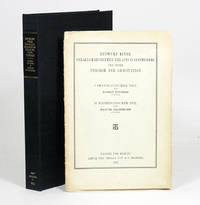
19132064Leipzig and Berlin: Teubner 1913. First edition. Original wrappers. Very Good. FIRST EDITION COMMERCIAL OFFPRINT ISSUE of Einstein's breakthrough work on general relativity: the famous "Entwurf" paper. "In this book Einstein and Grossman investigated curved space and curved time as they relate to a theory of gravity. They presented virtually all the elements of the general theory of relativity with the exception of one striking omission: gravitational field equations that were not generally covariant. Einstein soon reconciled himself to this lack of general covariance through the 'hole argument' which sought to establish that generally covariant gravitational field equations would be physically uninteresting. Einstein did not adopt the gravitational field equations until late in 1915 in his final formulations of the general theory. Here Einstein contributed the physics and Grossman the mathematics" Calaprice The Einstein Almanac 40. Weil 59a. Offprint from Zeitschrift für Mathematik und Physik volume 62. Leipzig and Berlin: Teubner 1913. Octavo original wrappers; custom box. Pencil notation on title. Small chips at spine ends. An outstanding copy without any of the cover-foxing so common with this issue. Teubner unknown books
191344851Leipzig & Berlin: Teubner 1913. 38pp. 254 x 170 mm. Original printed wrappers chipped. Library stamps ownership inscription. Very good. First separate edition. "After his first discussions with Grossmann Einstein had found the correct starting point for general relativity. The real work could now begin . . . The Einstein-Grossmann paper published in 1913 contains profound physical insight into the nature of measurement some correct general relativistic equations some faulty reasoning and clumsy notation" Pais Subtle is the Lord p. 216. Weil Albert Einstein Bibliography 58. Teubner unknown books
192478904London: Methuen & Company 1924. First edition of this classic account of Born's analysis and interpretation of Einstein's theory of relativity. Octavo original cloth frontispiece of Einstein. Signed by Max Born on the verso of the frontispiece. Translated by Henry L. Brose. Very good in a very good dust jacket. Housed in a custom half morocco clamshell box. First editions are uncommon signed examples rare. Einstein's Theory of Relativity is a book in which one great mind explains the work of another great mind in terms comprehensible to the layman is a significant achievement. This is such a book. Max Born was awarded the Nobel Prize in 1954 and was one of the world's great physicists: in this work he analyzes and interprets the theory of Einsteinian relativity. The result is undoubtedly the most lucid and insightful of all the books that have been written to explain the revolutionary theory that marked the end of the classical and the beginning of the modern era of physics. Born follows a quasi-historical method of presentation. The book begins with a review of the classical physics covering such topics as origins of space and time measurements geometric axioms Ptolemaic and Copernican astronomy concepts of equilibrium and force laws of motion inertia mass momentum and energy Newtonian world system absolute space and absolute time gravitation celestial mechanics centrifugal forces and absolute space laws of optics the corpuscular and undulatory theories speed of light wave theory Doppler effect convection of light by matter electrodynamics including magnetic induction electromagnetic theory of light electromagnetic ether electromagnetic laws of moving bodies electromagnetic mass and the contraction hypothesis. Born then takes up his exposition of Einstein's special and general theories of relativity discussing the concept of simultaneity kinematics Einstein's mechanics and dynamics relativity of arbitrary motions the principle of equivalence the geometry of curved surfaces and the space-time continuum among other topics. Born then points out some predictions of the theory of relativity and its implications for cosmology and indicates what is being sought in the unified field theory. This work steers a middle course between vague popularizations and complex scientific presentations. This is a careful discussion of principles stated in thoroughly acceptable scientific form yet in a manner that makes it possible for the reader who has no scientific training to understand it. Only high school algebra has been used in explaining the nature of classical physics and relativity and simple experiments and diagrams are used to illustrate each step. The layman and the beginning student in physics will find this an immensely valuable and usable introduction to relativity. Methuen & Company hardcover books
2006S12505Sagamore Beach:: Science History Publications 2006. 2006. 8vo. xii 228 pp. Illus. bibliography appendix index. Black silver-stamped cloth dust-jacket. Fine. ISBN: 0-88135-283-7 ". . . In tandem with the revival of quantum skepticism in physics Elzinga's book helps us recover Einstein's story from the tendentious interpretation of it that has gone unchallenged far too long."—BJHS ". . . The great value of Einstein's Nobel Prize is its detailed analysis of relevant documents showing how the academy managed to give Einstein the prize despite his work on relativity. . . "—Isis. Science History Publications, 2006. hardcover books