1 803 résultats
a108448Braunschweig 1918 first edition. Vieweg. Hardcover octavo. 280p. Articles by several of the leading physicists of the day including Einstein Born Sommerfeld. Near Fine two old faint bookseller stamps. no owner names or marks. . hardcover
1902003204Leipzig: J. A. Barth 1902. In Annalen der Physik 4 Folge Band 8 pp. 798 - 814. First edition of Einstein's second published work. Contains papers by many other famous physicists: W. Wien P. Drude W. Voigt W. Nernst J. Stark and others. Former owner's ink stamp on frontfly and title page. First Edition. Later Red Cloth. Very Good. J. A. Barth Hardcover
190249500Berlin J.A. Barth 1902. 8vo. Bound in contemporary half cloth with paper label pasted on to spine. In "Annalen der Physik. Vierte Folge. Band 8. Hrsg. von Paul Drude.". Entire volume offered. Front board loose and stamp to pasted down front free end paper. Otherwise a fine copy. <br/><br/><em>First edition of Einstein's second publication. Here "Einstein was looking for experimental support for a hypothesis concerning molecular forces"Pais Subtle is the Lord P. 56 Weil No 2. </em> hardcover
190249829Berlin J.A. Barth 1902. Contemp. hcalf. Gilt spine. Some scratches along edges. Stamp on halftitle and title-page. "Annalen der Physik. Vierte Folge. Band 8. Hrsg. von Paul Drude." VIII928 pp. and 7 plates. Einstein paper: pp. 798-814. Internally fine and clean. The entire volume offered. <br/><br/><em>First editon. - Weil No 2. </em> unknown
190238834Berlin J.A. Barth 1902. Contemp. hcloth. Top of spine with light wear bottom of spine with small nicks. "Annalen der Physik. Vierte Folge. Band 8. Hrsg. von Paul Drude." VIII928 pp. and 7 plates. Einstein paper: pp. 798-814. Internally fine and clean. The whole volume offered. <br/><br/><em>First editon. - Weil No 2. </em> hardcover
188748810Leipzig Barth 1887-91. 8vo. No wrappers. 4 papers. In: "Annalen der Physik und Chemie. Hrsg. von G. Wiedemann" Neue Folge Bd. XXX No. 4 XXXI No 6 XXXII No. 11 XLIV No. 11. - Pp. 545-704 a. 1 plate pp. 145-336 a. 1 plate pp. 337-528 a. 1 plate pp. 385-576 a. 1 plate. With titlepge to vol. XXX htitlepage to vol. XXXI titlepage to vol. XXXII and titlepage to vol. XLIV. Titlepages with a stamp and on verso. Planck's papers: pp. 562-582 pp. 189-203 pp. 462-503 and pp. 385-428. Clean copies. <br/><br/><em>First appearance of all 4 papers constituting Planck's seminal papers on entropy carrying the general title "On the principles of Increase of Entropy" in which he applied the second law of thermodynamics to chemical problems."His goal was as he said in the first paper of the series to carry further the "grand generalization" of Helmholtz Josiah Willard Gibbs and others: like the first principle of the mechanical heat theory the second the "Carnot-Clausius" principle applies not only to heat phenomena but to all kinds of physical and chemical phenomena; and because the second principle applies not only to reversible processes but also to irreversible or "natural" processes it applies to all processes whatsoever."Jungnickel and McCormach "Intellectual Mastery of Nature vol. 2 pp. 52 ff.What Einstein admired and called Planck's "first great scientific discovery" was the generality of its formulas which contain all that can be derived from pure thermodynamic principles. Einstein referred to the third paper in this series with the title "Gesetze des Eintritts beliebiger thermodynamischer und chemischer Reactionen"Akademie Nos. 8910 and 20. </em> unknown
19141199Braunschweig: Friedr. Vieweg & Sohn 1914. 1st Edition. FIRST EDITION FULL VOLUME OF THE FRANCK-HERTZ EXPERIMENT: THE FIRST ELECTRICAL MEASUREMENT TO CLEARLY SHOW THE QUANTUM NATURE OF ATOMS - PROOF OF THE QUANTIZED MODEL OF THE BOHR ATOM & OF PLANCK'S QUANTUM THEORY. Note that this volume includes both the first and second Franck-Hertz experiment. In the first they demonstrate that atoms can only absorb and be excited by specific amounts of energy; in the second experiment performed the same year they demonstrate that the frequency of the light emitted following the collision of electrons with mercury atoms corresponds precisely with the energy lost by the electrons in the collision. Franck and Hertz received the Nobel Prize for this work specifically "for their discovery of the laws governing the impact of an electron upon an atom" Nobel Prize Committee. <br /> <br /> Of equal import this volume also contains a paper by Einstein in which he uses the light quantum hypothesis to give new derivations of Planck's radiation law and Nernst's third law of thermodynamics. His "proofs introduced the quantum hypothesis" Calaprice The Einstein Almanac 40. <br /> <br /> In 1914 James Franck and Gustav Hertz were working together in the Physics Institute of Berlin and were "particularly interested in ionization i.e. in the process in which an electron is removed from an atom" The Harvest of a Century" p. 102-103. The experiment they devised now known commonly as the Franck-Hertz experiment is "a vivid illustration of the quantization of energy" that relied on methodology so simple "that it is now carried out regularly by undergraduates. They accelerated electrons through a low-pressure gas of mercury. When the electrons' energy reach the energy of a stationary state of mercury they gave up a quantum of energy to the mercury resulting in a stepwise shape to the curve of current through the apparatus. This demonstrated that atoms could absorb energy only in discrete amounts" Peacock The Quantum Revolution 40. <br /> <br /> "Franck and Hertz had not only shown for the first time that electrons lose their kinetic energy to mercury atoms in energy quanta but also that these energy quanta are equal to the energy of the light emitted by the same atoms if interpreted with Einstein's light-quantum hypothesis.This was the first experimental determination of Planck's constant not using blackbody radiation" Brandt 103. CONDITION & DETAILS: Braunschweig: Friedr. Vieweg & Sohn. 8vo. Unobtrusive stamp on front paste down and title page. In-text figures throughout. Tightly bound in leather over marbled paper boards; gilt-lettered and tooled at the slightly faded and spotted spine which looks worse in the image due to the bright light than it does to the eye. Unusually beautiful marbled paper edges. Bright and very clean throughout. Near fine. Friedr. Vieweg & Sohn hardcover
1910003224Leipzig: J.A.Barth 1910. In Annalen der Physik Vierte Folge Band 33. First two papers coauthored with L. Hopf. Full title of third paper: "Theorie der Opaleszenz von homogenen Flussigkeiten und Flussigkeitsgemischen in der Nahe des kritischen Zustandes." "It was his las major paper on classical statistical mechanics" Abraham Pais 'Subtle is the Lord.' page 103. Buckram two leather spine labels; bookplate; ink stamp on frontfly; small adhesion of title to half-title. First Edition. Contemporary Cloth. About Very Good. J.A.Barth Hardcover
1906504131906. <p>Einstein Albert 1879-1955. Über eine Methode zur Bestimmung des Verhältnisses der transversalen und longitudinalen Masse des Elektrons. In Annalen der Physik 21 1906. 583-586pp. Figs. Text-illust. 214 x 140 mm. Laid-in item: notecard with penciled notes probably in the hand of Lord Rayleigh. Red cloth gilt spine. Frontis portrait of P. Curie d. 1906. Whole volume: viii 1056pp. 9 plates 5 b/w silver photos 4 folding. Small cut on spine starting approximately two inches from the head and is about three inches in length -very thin- otherwise Very Good. </p> <br /> <br /> <p>First Edition Whole Volume. In his landmark 1905 paper on special relativity Einstein used the velocity-dependent concepts of transverse and longitudinal mass for the moving electron these terms have now been replaced with the concept of relativistic mass first defined by Lewis and Tolman in 1909. In the present paper Einstein proposed an experimental method for determining the ratio of the transverse to the longitudinal mass and invited experimentalists to verify his special theory of relativity. Einstein later abandoned velocity-dependent mass concepts stating in 1948 that "it is better to introduce no other mass concept than the rest mass" quoted in L. B. Okun "The concept of mass" Physics Today 1989: 31-36. Lavenda A New Perspective on Relativity pp. 7-8. </p> <br /> <br /> <p>Weil's Einstein Bibliography no. 14. <br> Boni's Einstein Checklist no. 14</p> <br /> <br /> <p> John William Strutt third Baron Rayleigh Lord Rayleigh 1842-1919 was a british mathematician and physicist; he was one of the very few members of higher nobility who won fame as an outstanding scientist. Rayleigh was born as the son of John James Strutt second Baron and his wife Clara Elizabeth La Touche eldest daughter of Captain Richard Vicars R.E. Lord Rayleigh was awarded the 1904 Nobel Prize in Physics "for his investigations of the densities of the most important gases for his discovery of argon in connection with these studies." Rayleigh provided the first theoretical treatment of the elastic scattering of light by particles much smaller than the light's wavelength now known as "Rayleigh scattering" - a process which notably explains why the sky is blue. He also made extensive contributions to fluid dynamics e.g. the Rayleigh number critereon for the stability of the Taylor-Couette flow etc. Rayleigh also formulated the circulation theory of aerodynamic lift. His derivation of the Rayleigh-Jeans law for classical black body radiation played an important role in the birth of quantum mechanics i.e. the Ultraviolet catastrophe. During the first World War he was president of the United Kingdom government's Advisory Committee for Aeronautics. Notable students of the 3rd Lord Rayleigh include J.J. Thomson 1856-1940 and Sir William Ramsay 1852-1916 who was awarded the Nobel Prize in Chemistry in 1904 "in recognition of his services in the discovery of the elements in air." In 1871 he married Evelyn Balfour sister of the future prime minister the Earl of Balfour and daughter of James Maitland Balfour and his wide Blanche the daughter of the second Marquis of Salisbury. They had three sons the eldest of whom Robert John Strutt 1875-1946 was to become Professor of Physics at Imperial College of Science and Technology London. Strutt inherited the title of fourth Baron Rayleigh after his father's death in 1919. nobelprize.org. </p> <br /> <br /> <br /> <p> Also in this volume: Einthoven Willem 1860-1927. Weitere mitteilungen ueber das saitengalvanometer. Analyse der saitengalvanometrischen kurven. Masse und spannung des quarzfadens und widerstand gegen die fadenbewengung. Erster teil. In Annalen der Physik ser. 4 21 1906. 483-514 pp. <br> Willem Einthoven 1860-1927 was a Dutch doctor and physiologist who won the Nobel Prize in Physiology or Medicine in 1924 "for his discovery of the mechanism of the electrocardiogram" nobelprize.org. </p> . unknown
1906003218Leipzig: J. A. Barth 1906. Several small dents in cover edges. First Edition. Contemporary Cloth. Very Good. J. A. Barth Hardcover
ria9783322982728_inpPaperback. New. New Book; Fast Shipping from UK; Not signed; Not First Edition; N/A paperback
ria9783322983190_inpPaperback. New. New Book; Fast Shipping from UK; Not signed; Not First Edition; N/A paperback
ria9783663037750_inpPaperback. New. New Book; Fast Shipping from UK; Not signed; Not First Edition; N/A paperback
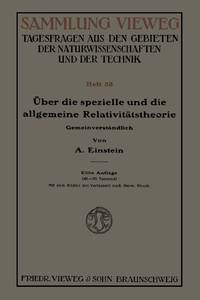
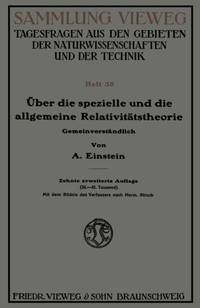
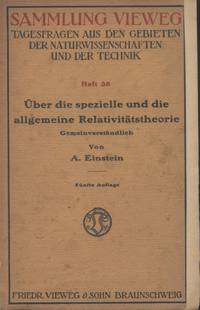
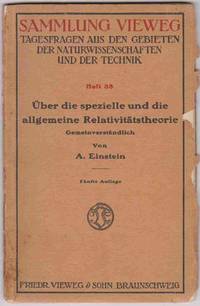
1920108736Friedr. Vieweg und Sohn in Braunschweig 1920. Paperback. <b>Livre en anglais</b>. Couverture souple. Mit 3 Figuren. Fünfte Auflage. Sammlung Vieweg. Heft 38. Broché. 83 pages. Papier bruni. Couverture légèrement défraîchie. Découpure de quelques millimètres sur la longueur des plats. <i>ref. 108736</i> Friedr. Vieweg und Sohn in Braunschweig paperback
191952454Friedr. Vieweg & Sohn. G. 1919. 5th Edition. Paperback. Paperback in Good condition. 8vo 8" - 9" tall. 83 pages. Moderate chipping to foredge of covers; cover spines cracked. Quick Shipping All Books Mailed in Boxes Free Tracking Provided . Friedr. Vieweg & Sohn paperback
192018375Braunschweig: Verlag Von Friedrich Vieweg & Sohn 1920. Teil der Sammlung Vieweg Tagesfragen aus den Gebieten der Naturwissenschaften und der Technik. Heft 38. Mit 3 Figuren. In orange printed covers in Very Good condition with light coverwear. 83 pages in Very Good condition. Text in German .Scarce . Funfte Auflage 10-14.Tausend. Very Good. Verlag Von Friedrich Vieweg & Sohn unknown
192118374Braunschweig: Verlag Von Friedrich Vierweg & Sohn 1921. Teil der Sammlung Vieweg Tagesfragen aus den Gebieten der Naturwissenschaften und der Technik. Heft 38. Mit dem Bildniss des Verfassers nach Herm.Struck. IMit 4 Figuren. In gray cardboard covers. Front cover detached . 91 pages in Very Good condition. Text in German . With an intersting handmade brown paper cover titled and illustrated by a previous owner of the book and dated 1923.Scarce . Elfte Auflage 46.-50.Tausend. Good. Verlag Von Friedrich Vierweg & Sohn unknown
1926374131926. Weil 153. Offprint from S. preuss. Akad. Wiss. unknown
1908003221Leipzig: J. A. Barth 1908. First Edition. Contemporary Cloth. Very Good. J. A. Barth Hardcover
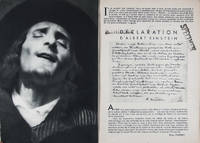
193345000Paris: Société Anonyme Les Illustrés Français 1933. First edition. Softcover. g- to vg. Large quarto 11 1/2 x 8". 105 3pp. Original photo-illustrated wrappers with white lettering to front cover. <br /> <br /> This scarce issue of "Témoignages de Notre Temps" Witness to our Time is a loving and moving tribute to Jewish life and culture that spans ancient times to the early 1930s with the spectre of Hitler and the early persecutions of Jews in Nazi Germany Hitler became chancellor a few months prior on January 30th. <br /> <br /> Includes texts by Albert Einstein Dr. Chaïm Weizmann and others along with hundreds of splendid black-and-white photogravures many full page including Helmar Lerski’s impressive series on Jews in Palestine. <br /> <br /> "Témoignages de Notre Temps" was edited by noted French photographer and publisher Lucien Vogel.<br /> <br /> Wrappers partly creased along edges. Page 5 with four "Spécimen" stamps not affecting lettering. Lower corner of the first 18 pages slightly creased. Lower front corner bumped thus slightly affecting pages throughout. Text in French. Wrappers in overall good- to good interior in good to very good condition. Société Anonyme Les Illustrés Français unknown
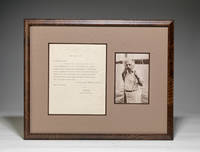
19461206241946. Signed. EINSTEIN Albert. Typed letter signed. Princeton April 3 1946. Single sheet of gray letterhead measuring 8-1/2 by 11 inches; p. 1. Matted and framed with a portrait entire piece measures 19 by 15-1/2 inches. $9500.Original typed letter signed by Albert Einstein thanking his friend Dr. Isadore Held for his birthday wishes as well as for sending a new book that Einstein found both ""extraordinarily enlightening"" and humorous. Text in German.The letter typed on Einstein's personal letterhead with his name and Princeton address blindstamped at the top reads in full translation: ""3 April 1946. Dear Mr. Held: I would like to express my sincere thanks for your birthday wishes and for the sending of the last work of this wonderful contemporary. I have already read quite a bit and find that it is extraordinarily enlightening. His penetration into the mentality of far-off times and attitudes toward thinking is most remarkable and his humor no less. With fond greetings to you and your dear wife. Yours signed Albert Einstein."" This letter was written to Austrian-American medical Dr. Isadore Held who was friends with Einstein since at least 1938. Held and Einstein shared numerous interests particularly related to Jewish humanitarian relief and Israel. At Held's death Einstein wrote to his widow that ""True goodness emanated from this man who alleviated the harshness of human relations and who understood and forgave all weaknesses As a role model for his fellow men he was the best that a human being can be."" Einstein was not a huge fan of birthdays though he happily acknowledged well wishes from friends. Just before turning 65 Einstein crankily said to a New York Times interviewer: ""What is there to celebrate Birthdays are automatic things. Anyway birthdays are for children."" In a 1954 letter to physicist Hans Mühsam Einstein described his birthday as ""a natural disaster a shower of paper full of flattery under which one is drowned."" Einstein was generally quite shy and did not like to be the center of attention particularly from strangers obsessed with his accomplishments and fame. However well-meaning letters and small gifts like the book given by Held were always welcomed and graciously accepted by Einstein. Original mailing creases and a few pinpoint holes along top edge possibly from stapling. About-fine condition. unknown
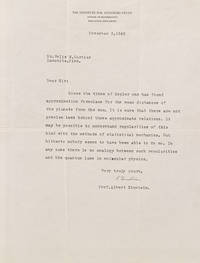
19421265881942. Signed. EINSTEIN Albert. Typed letter signed. Princeton November 3 1942. One sheet measuring 8-1/2 by 11 inches typing on recto only; matted and framed with a portrait of Einstein entire piece measures 21 by 17 inches. $38000.An exceptional typed letter signed by Einstein on precursors like Johannes Kepler's work to his Special and General Theories of Relativity beautifully framed.The letter on letterhead from the Institute for Advanced Study in Princeton reads in full: ""November 3 1942. Mr. Felix W. Cartier. Laconite Minn. Dear Sir: Since the times of Kepler one has found approximation formulaes for the mean distances of the planets from the sun. It is sure that there are not precise laws behind those approximate relations. It may be possible to understand the irregularities of this kind with the methods of statistical mechanics. But hitherto nobody seems to have been able to do so. In any case there is no analogy between such regularities and the quantum laws in molecular physics. Very truly yours signed A. Einstein. Prof. Albert Einstein.""Early in the 17th century Johannes Kepler 1571-1630 discovered that planets orbit the sun in ellipses rather than perfect circles. This great discovery paved the way for Isaac Newton's laws of gravity and for Albert Einstein's general and special theories of relativity. Previous to Einstein's time people believed in real distances and absolute time and showed that instruments could not objectively measure the distances between planets. Einstein's theories which hypothesized that light and space curve near a massive object revolutionized scientific thought and gave man an exciting new perspective of his universe.Einstein's letter reflects on some of the most important scientific revelations in the history of physics and astronomy. Kepler defined three laws of planetary motion; however the one specifically referred to in this letter is that all planets move about the Sun in elliptical orbits having the Sun as one of the foci. If the Universe then consisted only of two point massesthe Sun and a planetthe orbit of that planet would make a perfect closed ellipse that returned the world to its starting location with each trip around the Sun. But in a Universe governed by Newtonian gravity with a plethora of massive bodies in our Solar System that ellipse will precess or rotate slightly in its orbit.In the mid-1800s orbital deviations of Uranus from its predicted motions led to the discovery of Neptune as the outermost world's gravitational influence accounted for the excess motion. But in the inner Solar System the nearest planet to the Sun Mercury was experiencing a similar problem. With detailed accurate observations going back to the late 1500s thanks to astronomer Tycho Brahe we could measure how Mercury's perihelion its closest orbital point to the Sun was advancing. The number we came up with was 5600"" per century just over 1.5 degrees over a 100 year period. But of that 5025"" came from the precession of Earth's equinoxes a well-known phenomenon while 532"" was due to Newtonian gravity.But 5025"" plus 532"" comes up short by a small but significant amount. Attempts at explanationincluding the existence of an unknown inner planet interior to Mercuryall failed. But after Einstein's special theory of relativity came out in 1905 mathematician Henri Poincare showed that the phenomena of length contraction and time dilation contributed a fraction between 15-25% of the needed amount towards the solution dependent on the error. That plus Minkowski's formalization of space and time as not separate entities but as a single structure bound together by their union spacetime led Einstein to develop the general theory of relativity. On November 25 1915 he presented his results computing the spectacular figure that the contribution of the extra curvature of space predicted an additional precession of 43"" per century exactly the right figure needed to explain this observation sending shockwaves through the astronomy and physics communities. Less than two months after this Karl Schwarzschild found an exact solution predicting the existence of black holes. The deflection of starlight and gravitational redshifts/blueshifts were realized as possible tests and finally the solar eclipse of 1919 validated general relativity as superseding Newtonian gravity. Expected fold lines. An incredible letter scarce in its important content. unknown
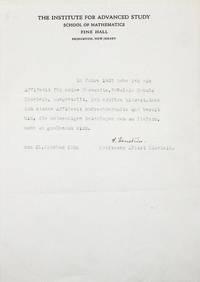
1938366717Princeton New Jersey 1938. 7 lines typed in German on letterhead of the Institute for Advanced Study School of Mathematics watermarked Chieftain Bond signed in ink. 4to 9-7/8 x 7-1/8 inches. Old folds. Fine. 7 lines typed in German on letterhead of the Institute for Advanced Study School of Mathematics watermarked Chieftain Bond signed in ink. 4to 9-7/8 x 7-1/8 inches. Im Jahre 1837 habe ich ein Affidavit für meine Verwandte Fräulein Ursula Einstein ausgestellt. Ich erkläre hiermit dass ich dieses Affidavit aufrechterhalte und bereit bin di notwendigen Unterlagen neu zi liefern wenn es gewünscht wird.<br /> den 31. Oktober 1938<br /> signed <br /> Professor Albert Einstein.<br /> <br /> "In the year 1937 I signed an affidavit on behalf of my relative Miss Urusula Einstein. I hereby state that I continue to certify this affidavit is correct and am ready to submit the necessary documents anew if this is requested."<br /> <br /> Albert Einstein 1879-1955 German-born physicist renowned for developing the theory of relativity in papers published in 1905 and 1916 was awarded the Nobel Prize for Physics in 1921 and left Germany in 1933. He was associated with the Institute for Advanced Study at Princeton.<br /> <br /> This statement was almost certainly prepared in connection with efforts to assist his relative in emigrating. In a letter to his sister Maja Winteler-Einstein then resident in Switzerland dated December 1938 Einstein wrote "I am now working as some sort of itinerant relief committee and buckets of letters are coming in . I am helping the Ulm relatives with emigrating". Ursula Einstein born 1916 was able to get out; in 1940 she was a refugee in Port-au-Prince and later reached Brazil. Her younger sister Barbara was not so fortunate. Barbara Einstein born 1918 took her own life in March 1943 after her fiancé Harry Jacob was taken off to the concentration camps.<br /> <br /> A choice Einstein autograph. unknown
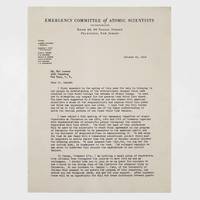
1946376560Princeton New Jersey 1946. 1 1/2 pages on recto and verso of quarto sheet of letterhead for the Emergency Committee of Atomic Scientists. Folded for mailing else Fine. Folding green cloth slipcase. 1 1/2 pages on recto and verso of quarto sheet of letterhead for the Emergency Committee of Atomic Scientists. An invitation written in Einstein's capacity as Chairman of the Trustees of the Committee to Lesser to attend a three day conference in Princeton the following month and asking him to be his special guest at a luncheon on the 17th of November. Einstein writes Lesser "as one who shares with American scientists a sense of the responsibility and urgency with which this great new force has impressed upon our lives ." and notes that one of the chief aims of the conference will be for "the scientists to reach final agreement on our program of education for survival ." Perhaps it was in his capacity as film producer that Lesser was considered a potential contributor beyond simple monetary help. The letter is addressed to Lesser at the Paramount Building 1501 Broadway NYC. Lesser 1890-1980 was a successful film producer a career that spanned the silent era up through such productions as THUNDER OVER MEXICO 1939 and OUR TOWN 1940 to the long string of post 1943 Tarzan films when he once again reacquired the rights after having produced the Buster Crabbe serial of 1933. He received the 1960 Jean Hersholt Humanitarian Award. unknown
19532270<p>Princeton NJ: np 1953. First edition. custom folder. Very Good. TOWARDS THE END OF HIS LIFE EINSTEIN WRITES TO ONE OF HIS FRIENDS FROM THE PATENT OFFICE CONCERNING ONE OF THE CENTRAL STRUGGLES OF HIS SCIENTIFIC LIFE.<br /><br />COMMENTING ON THE WORK OF DIRAC EINSTEIN ADMITS THAT ALTHOUGH HE "CAN'T TAKE A STATISTICAL FOUNDATION OF PHYSICS SERIOUSLY" HE FINDS IT "DIFFICULT TO MOVE BEYOND IT". Background:<br /><br />Einstein's struggle with accepting a strictly statistical quantum theory has been one of the most discussed and debated topics of twentieth-century physics. When introduced to the statistically-based quantum mechanics of Heisenberg Born and Jordan in 1926 Einstein famously wrote to Max Born that "Quantum mechanics is certainly imposing. But an inner voice tells me that it is not yet the real thing. The theory says a lot but does not really bring us any closer to the secret of the 'old one.' I at any rare am convinced that He is not playing at dice." Einstein letter to Born from 4 December 1926.<br /><br />From the onset "Einstein regarded the quantum theory as descriptively incomplete. What he meant was that in typical cases the probabilistic assertions provided by the theory for an individual quantum system do not exhaust all the relevant and true physical assertions about the system. Put briefly according to Einstein the typical statistical story told by quantum theory is not the whole story." Arthur Fine "What is Einstein's Statistical Interpretation or Is It Einstein for Whom Bell's Theorem Tolls". <br /><br />Einstein's discomfort with the new theory haunted him for the next three decades and his challenges to the theory were the cause of some of the most fertile and defining moments of modern science notably the celebrated "Bohr-Einstein debates" begun at the Fifth Solvay Conference 1927 and his monumentally influential "EPR" paper of 1935 "Can Quantum-Mechanical Description of Physical Reality Be Considered Complete" written with Boris Podolsky and Nathan Rosen.<br /><br />As late as 1949 in his "Reply to Criticisms" published in Albert Einstein: Philosopher-Scientist Einstein notes that Born and Wolfgang Pauli in their contributions to the volume "deprecate the fact that I reject the basic idea of contemporary statistical quantum theory insofar as I do not believe that this fundamental concept will provide a useful basis for the whole of physics" and spends the majority of the essay explaining his position and distinguishing between his acceptance of the model for "ensembles of systems" while still rejecting it for an "individual physical system".<br /><br />The letter:<br /><br />Dated September 12 1953 and written to his old colleague at the patent office in Bern Joseph Sauter the letter translated from the original German reads in full:<br /><br />Dear Mr. Sauter<br /><br />If I am able to I will gladly assist Mr. Keberle.<br /><br />I have heard of you often from my old friend Besso and I have also received a manuscript which deals critically with handwritten Dirac's presentation of the statistical approach to quantum theory. I have not been able to judge it myself because it is simply impossible for me to take a statistical foundation of physics seriously. But I have to admit that it is difficult to move beyond it.<br /><br />Yours sincerely <br /><br />signed A. Einstein.<br />Albert Einstein.<br /><br />The recipient Joseph Sauter worked with Einstein at the Bern Patent office during the years he was developing the ideas for his revolutionary papers of 1905. "Among his colleagues at the Patent Office Einstein discovered one with similar scientific interests-Dr. Josef Sauter a French-Swiss who had also studied at the Polytechnic and who had been Professor Weber's chief assistant for a while. Sauter like Einstein tried to fill the gaps in the Polytechnic's syllabus by private study so that Einstein was able to discuss with him Maxwell's thermodynamics and Helmholtz's and Hertz's theoretical concepts. The two also discussed Einstein's publications on thermodynamics with the result that Sauter discovered a mistake in them which Einstein accepted 'without being the least upset.' Fifty years later Einstein recalled 'that I had a lot of discussions with Sauter about. my thermal-statistical papers'. At least as important as his help with the 'rewriting and amending' were Sauter's connections with scientific circles in Bern to which he soon introduced his new colleague." Albrecht Fölsing Albert Einstein. <br /><br />Edouard Keberle mentioned in the first line by Einstein was a Bulgarian physicist who at the time of the letter had just left the Institute of Theoretical Physics in Bern over a publication dispute. Not long after this letter - in early 1954 - Keberle accepted a post at the Midwest Research Institute in Kansas City. It is unclear if Einstein helped him in any way to get this position.<br /><br />Michele Besso - also mentioned in this letter - was Einstein's close lifelong friend.<br /><br />What prompts Einstein to declare that "it is simply impossible for me to take a statistical foundation of physics seriously" is the mention of a manuscript on the work of Paul Dirac. Philosophically Dirac was almost the opposite of Einstein - he had no interest in probing the interpretations of quantum theory wryly noting in his paper "The Inadequacies of Quantum Field Theory" that "The interpretation of quantum mechanics has been dealt with by many authors and I do not want to discuss it here. I want to deal with more fundamental things."<br /><br />It is revealing in this letter that although Einstein re-states his objection to a statistical basis of quantum theory he has doubts about his position admitting - less than two years before his death - that he still has difficulty moving beyond it. <br /><br />Typed Letter Signed. Princeton NJ: September 12 1953. One 8.5x11 inch sheet with Einstein's embossed Mercer Street address at top. Custom silk presentation folder. With original mailing envelope with postmarks. A few small smudges usual folds; fine condition.<br /><br />ONE OF EINSTEIN'S FINAL STATEMENTS ON ONE OF THE CENTRAL TENETS OF HIS SCIENTIFIC PHILOSOPHY.</p> np