EINSTEIN, ALBERTBiblio.com

1 803 résultats
19341478Princeton: np 1934. 1st Edition. No Binding. Very Good. AN IMPORTANT SIGNED LETTER in English by Einstein revealing his reservations of associating with communism even in the fight against fascism. Written from Princeton NJ to Professor Albert Sprague Coolidge of Harvard University and dated February 16 1934 the letter reads:<br /> <br /> My dear Professor Coolidge:<br /> <br /> I had an opportunity of meeting personally Lord Marley and has sic very favorably impressed by his personality. It became known to me that he sympathizes with the Russian Government i.g. with the Russian communist party and that the committee for which he is active is influenced by communists.<br /> <br /> The problem as to the attitude which is advisable to be taken towards this committee is rather complicated. On the one hand the world-wide danger of fascism makes it necessary that all enemies of fascism cooperate; on the other hand an action which has communist leanings might endanger that fight since the important task undertaken in defense of culture and civilization may be linked up with interests of a political party. I myself have severed my connections with the committee which with my permission had used my name up to the end of last year. <br /> <br /> It seems to me advisable to take an attitude as follows: to help their action against fascism but not to identify oneself with the committee.<br /> <br /> Very truly yours<br /> signed A. Einstein<br /> <br /> P.S. I wish you would be good enough to use this strictly confidentially. <br /> <br /> In 1934 Lord Baron Marley Dudley Leigh Aman toured the United States to raise funds for his association the World Committee for the Victims of German Fascism. Marley through his committee was "passionately advocating a scheme for which he was to become an international figurehead - resettlement of oppressed German and Polish Jews in the Jewish Autonomous Region" in Siberia. He published a book "The Brown Book of the Hitler Terror and the Burning of the Reichstag sponsored by the World Committee and with an Introduction written by Lord Marley himself which was the first popular exposé of what was happening in Hitler's Germany. It documented the destruction of political parties trade unions and universities book-burning and the building of concentration camps. <br /> <br /> "At a fundraising dinner held in his honour in New York in February 1934 where Einstein presumably met him just before writing this letter Marley opened the Brown Book and 'speaking quietly declaring that he did not intend to harrow' read aloud to his audience of 600 American Jews some of the collected evidence of Nazi repressions. Here were documentary records of what was happening in Germany - a substantiation of the brutality that hitherto had had no distinct form in the mind of the American Jewish public. What before had been the subject of a growing fear mingled with disbelief was now being presented as hard fact and supported with detailed evidence. The New York Times 8 February 2005 reports the audience being 'startled' by the disclosures and the night ending with $3500 raised for the World Committee" The Jewish Quarterly No. 198. <br /> <br /> Einstein was correct to be suspicious of Marley's activities for it was later determined that the "World Committee" was indeed a Communist front; Einstein writing here to Coolidge in 1934 was prescient about the motives of the committee. <br /> <br /> This letter in addition to underscoring Einstein's passionate stance against fascism is particularly important as documentary evidence of Einstein's caution about having any dealings with communism especially considering that the U.S. FBI worried about Einstein's political leanings kept a file on Einstein that grew to 1427 pages.<br /> <br /> Princeton NJ: February 16 1934. One 8.5 x 11 in. page. Envelope folds minor spotting. An outstanding letter with important and revealing content. np unknown
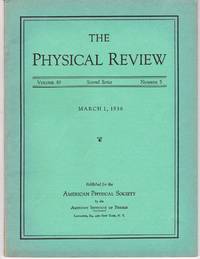
19366550Lancaster PA: American Physical Society 1 March 1936. Second series volume 49 number 5. Very Good. ppl 341-422. Original green wraps. Slight nick at bottom edge of lower wrap else better than very good. <br /><br />Includes the retort by Einstein and Rosen originators of speculation on the existence of "worm-holes" in spacetime to objections made to the general theory of relativity. According to Galina Weinstein: "Between 1935 and 1936 Einstein was occupied with the Schwarzschild solution and the singularity within it while working in Princeton on the unified field theory and with his assistant Nathan Rosen on the theory of the Einstein-Rosen bridges. He was also occupied with quantum theory. He believed that quantum theory was an incomplete representation of real things. Together with Rosen and Boris Podolsky he invented the EPR paradox. I demonstrate that the two-body problem in general relativity was a heuristic guide in Einstein's and collaborators' 1935 work on the Einstein-Rosen bridge and EPR paradox." <br /> <br />Also articles by notable physicists on radioactivity electron mobility quantum-mechanical measurement and so on. American Physical Society paperback
193647073Lancaster American Physical Society 1936. 4to. In: "The Physical Review" Vol. 49 Second Series. X971 pp. Entire volume offered. Einstein & Rosen's paper: pp. 404-405. <br/><br/><em>First printing of Einstein and Rosen's answer to Silberstein's critique of Einstein's Theory of Relativity ."Ludwik Silberstein who initially was a supporter of the special theory objected at different occasions against general relativity. In 1920 he argued that the deflection of light by the sun as observed by Arthur Eddington et al. 1919 is not necessarily a confirmation of general relativity but may also be explained by the Stokes-Planck theory of complete aether drag. However such models are in contradiction with the aberration of light and other experiments see "Alternative theories". And in 1935 Silberstein claimed to have found a contradiction in the Two-body problem in general relativity. However also this claim was refuted by Einstein and Rosen 1935 in the paper offered."Wikipedia. </em> unknown
2080202105400654Michi Koku N.A. Soft Cover. Fine. Number of pages: 456p Size: 20cm Michi Koku paperback
2023x-1032358440CRC Press 2023. Hardcover. New. 552 pages. 10.00x7.00x1.10 inches. CRC Press hardcover
53372191-nnew. unknown
53372191like new. unknown
2026x-1032358459Taylor & Francis Ltd 2026. Paperback. New. 612 pages. 7.00x1.27x10.00 inches. Taylor & Francis Ltd paperback
133031350X.Gpaperback. Good. Access codes and supplements are not guaranteed with used items. May be an ex-library book. paperback
1290381380.Gpaperback. Good. Access codes and supplements are not guaranteed with used items. May be an ex-library book. paperback
1163244317.Gpaperback. Good. Access codes and supplements are not guaranteed with used items. May be an ex-library book. paperback
1357100264.Ghardcover. Good. Access codes and supplements are not guaranteed with used items. May be an ex-library book. hardcover
1432543970.Gpaperback. Good. Access codes and supplements are not guaranteed with used items. May be an ex-library book. paperback
0666419604.Ghardcover. Good. Access codes and supplements are not guaranteed with used items. May be an ex-library book. hardcover
0821715283.Gpaperback. Good. Access codes and supplements are not guaranteed with used items. May be an ex-library book. paperback
BOOK_0821715194New. unknown
1930510131930. <p>Einstein Albert 1879-1955. Théorie unitaire du champ physique. In Annales de l'Institut Henri Poincaré 1 fasc. 1 1930: 1-24. With: Fermi Enrico 1901-54. La théorie du rayonnement. In ibid.: 25-52. Whole number. 2 74 2pp. 285 x 197 mm. uncut and unopened. Original printed wrappers a bit sunned lower corner of front wrapper chipped and creased. Very good.</p> <p> First Edition. This issue of the Annales de l'Institut Henri Poincaré contains the texts of Einstein's lecture on unified field theory and Fermi's lecture on the theory of radiation both delivered at the Institut in 1929. Weil Albert Einstein Bibliography 174. Not in Fermi Collected Papers. </p> . unknown
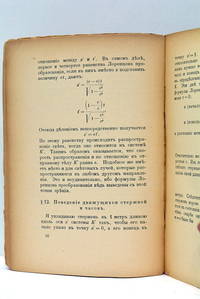
118261Berlin Slovo 1922. 150 pages. 1 feuillet. 21x145 Cm. Broché. Couverture imprimée. Petits manques. Dos cassé. En 1922 au cur de Berlin un ouvrage d'Albert Einstein sur la théorie de la relativité a été édité par Slovo une maison fondée par Iosif Hessen et August Kaminka deux ans auparavant. Cette publication en russe s'inscrit dans un contexte post-révolutionnaire où l'intérêt pour les sciences et les idées nouvelles transcende les frontières. Einstein déjà reconnu pour ses contributions révolutionnaires à la physique s'adresse à un public élargi démontrant l'universalité de ses théories. Berlin, Slovo, 1922. unknown
2511RS031<p>Mise a la portée de tout le monde. Traduit dAprès la douzième édition allemande par M J. Rouvière Licenciée ès sciences mathématiques. Avec une Préface de M. Émile Borel. Actualites Scientigiques. Gauthier-Villars et C Éditeurs. Paris. 1921.</p>_x000d_<p>De 195x12 cm. Com xxii 120 págs. Brochado. Ilustrado com cálculos matemáticos. Exemplar com manchas de humidade assinatura de posse na capa anterior e carimbo oleográfico de posse na folha de guarda. </p>_x000d_<p>Páginas em numeração romana com prefácio de Emile Borel e do autor e um pequeno suplemento da 3.ª edição. Obra em 33 capítulos divididos em três partes: Première Partie: La Realtivité Restreinte; Deuxième Partie: La Théorie de Relativité Généralisée; Réflexions sur lUnivers Considéré Comme un Tout. índice geral nas páginas finais. </p>_x000d_<p> </p> SACO RS782-22 unknown
1905786Leipzig: Barth 1905. First Edition. 8vo 222 x 159mm pp. 1 viii 1022. In German the first appearance anywhere of three seminal papers by Einstein each addressing a distinct problem and each now recognized as foundational for a major branch of twentieth-century physics. Original cloth publisher’s binding complete with half-title and index with light rubbing to the spine tips still near fine and exceptionally well preserved for this volume and unusually without institutional stamps or other markings. Half morocco case.<br /> <br /> The most consequential volume in the history of modern physics: a single 1905 journal containing three papers by Albert Einstein that simultaneously founded quantum theory proved the existence of atoms and overthrew Newton's conception of space and time. This is the year physics broke open. While offprints individual issues and extracted copies of one or another of these texts appear with some frequency complete and unrestored copies of the bound annual volume in contemporary cloth remain scarce and this copy is in unusually fine condition. As a unit Band 17 documents in real time the consolidation of a new theoretical framework that would reshape the subsequent development of physics. PMM 293 371 408. Dibner 167. The first paper "Über einen die Erzeugung und Verwandlung des Lichtes betreffenden heuristischen Gesichtspunkt" On a Heuristic Viewpoint Concerning the Production and Transformation of Light March 1905 pp. 132–148 introduces the light quantum hypothesis and provides the first satisfactory explanation of the photoelectric effect. By treating radiation in specific circumstances as consisting of localized energy quanta rather than as a continuously distributed wave Einstein resolved the empirical failure of classical electrodynamics to account for the frequency dependence of photoelectron energies. This conceptual move directly anticipates and influences later developments in quantum theory from the formalization of the photon concept in quantum electrodynamics to the probabilistic interpretation of radiation–matter interactions in quantum field theory. It is for this work rather than for relativity that Einstein received the 1921 Nobel Prize in Physics underscoring its centrality to the emerging quantum paradigm.<br /> <br /> The second paper "Über die von der molekularkinetischen Theorie der Wärme geforderte Bewegung von in ruhenden Flüssigkeiten suspendierten Teilchen" On the Motion of Small Particles Suspended in a Stationary Liquid as Demanded by the Molecular-Kinetic Theory of Heat May 1905 pp. 549–560 furnishes a quantitative theory of Brownian motion linking observable stochastic trajectories of suspended particles to underlying molecular collisions. By deriving explicit relations between mean squared displacement time viscosity and particle size Einstein showed how microscopic randomness could be described statistically and used to infer Avogadro’s number and molecular dimensions. The experimental confirmation of these predictions provided decisive evidence for the atomic hypothesis and helped to secure statistical mechanics as a fundamental framework in physics. This work underlies later advances in the theory of stochastic processes diffusion and fluctuation phenomena with ramifications from critical phenomena and noise in electronic devices to modern treatments of random walks and Langevin dynamics.<br /> <br /> The third paper "Zur Elektrodynamik bewegter Körper" On the Electrodynamics of Moving Bodies September 1905 pp. 891–921 formulates the Special Theory of Relativity reconciling Maxwell’s equations with the principle that the laws of physics take the same form in all inertial frames. By abandoning absolute simultaneity and treating space and time as components of a single relativistic structure Einstein derived time dilation length contraction and the relativity of simultaneity as necessary consequences of his postulates. A short follow-up note later in 1905 "Ist die Trägheit eines Körpers von seinem Energieinhalt abhängig" Does the Inertia of a Body Depend Upon Its Energy Content established the mass–energy relation E = mc² providing the bridge between kinematics and energetics in the relativistic regime. Together these contributions supplied the conceptual and mathematical apparatus for later developments in relativistic field theory including Minkowski’s spacetime formulation the construction of relativistic quantum mechanics and quantum field theory and ultimately the General Theory of Relativity and modern cosmology.<br /> <br /> Considered collectively the three 1905 papers in this volume inaugurate quantum theory provide decisive empirical and theoretical support for the molecular-kinetic view of matter and reconfigure the classical concepts of space time and motion. They set the stage for the principal theoretical revolutions of twentieth-century physics: the matrix and wave formulations of quantum mechanics quantum electrodynamics and later gauge field theories relativistic quantum field theory and the geometric theory of gravitation. As a complete contemporary issue of "Annalen der Physik" Band 17 this volume thus embodies not only three individual breakthroughs but also the point of departure for much of modern physical theory exerting an enduring influence on the trajectory of both fundamental physics and its technological applications. Barth unknown
191250337Leipzig: Johann Ambrosius Barth 1912. <p>Einstein Albert 1879-1955. Thermodynamische Begründung des photochemischen Äquivalentgesetzes. In Annalen der Physik 37 832-838 pp. Red cloth with gilt lettering on the spine. Whole volume: 1048 pp. 5 plates 4 folding 1 b/w silver photograph w/ small fold at foot. Figs. Text-illust. 210 x 130 mm. Very good copy. </p> <br /> <br /> <p>"A supplement published in vol. 38 1912: 881-884 See Book ID: 50338. Einstein presents a continuation of his earlier work on the interaction between light matter and on photochemical processes. It contrasts with earlier work in that it makes no use of the quantum hypothesis. He demonstrates how what he calls 'the law of photochemical equivalence' is deducible by purely thermodynamical arguments if one makes certain plausible assumptions. He wrote a supplement to the paper in five months later in the same journal." p. 291-2. Calaprice Kennefick & Shulmann. An Einstein Encyclopedia. 2015.</p> <br /> <br /> <p>Weil's Bibliography of Einstein's Papers no. 46. <br> Boni's Bibliographical Checklist no. 42. </p> . Johann Ambrosius Barth unknown
191238839Leipzig J.A. Barth 1912. Bound in two contemp. hcalf richly gilt spine and one later full cloth. A library stamp on the first volume. "Annalen der Physik. Vierte Folge. Band 37 und 38. Hrsg. von W. Wien und M. Planck." VIII1048;VIII1064 pp. 58 plates. Einstein papers: pp. 832-38 vol.37 pp. 881-84 Nachtrag vol. 38; pp. 443-458 vol. 38; p. 888 vol. 38; pp. 1059-1064 vol. 38; Planck: pp. 642-656. Internally fine and clean. Both volumes offered. <br/><br/><em>All papers first edition. In the first paper "Thermodynamical derivation of the photochemical equivalence" Einstein calls "the law of photochemical equivalence" the statement that the decomposition of one gram equivalent of any substance by a photochemical proces demands the radiation energy of 'Nhv' where N=the Avogadro number. In this paper he demonstrates how this law is deducible by purely thermodynamical arguments if certain olausible assumotions are made. Lanzos. - The second paper "Concerning the theory of a static gravitational field" states that the 'equivalence hypothesis' permits us to come to very definite conclusions about the behaviour of a static gravitational field. - The next Einstein paper gives an answer to J. Stark as Stark claimed priority to the photochemical equivalence law. - In the last paper "Relativity and Gravitation. Reply to a remark of M. Abraham" Einstein elaborates his answer to the critique of M. Abraham. - Weil Nos 46 1-2 a. 48. - Planck Akademie No 95. </em> hardcover
19892081402110003867Iwanami bunko 1989. Soft Cover. Fine. Number of books: 1 Iwanami bunko paperback
19234609Praze Prague: Fr. Borový 1923 1923. First and only edition of the Czech translation of Einstein's Über die spezielle und die allgemeine Relativitätstheorie first published in German in 1916 with the English translation appearing in 1920. It was intended by Einstein as a brief popular introduction to his theory of relativity. This Czech edition has a special preface by Einstein written for this translation. Einstein worked in Prague for seventeen months in 1911-12 and retained a fondness for the city. 8vo. 210x135mmpp. 103 21bl. Original Blue card wrappers with striking design. Some toning and creasing to edges of wrappers but otherwise in very good condition and excellent internally. Title page has ownership inscription of Robert Knuwehil . This Czech translation is rare OCLC recording only five copies worldwide. Praze [Prague]: Fr. Borový, 1923 unknown
1907433121907. Offprint from "Zeitschrift für Elektrochemie" 1907. Single sheet pp. 41-42. 287 x 206 mm. Chipped several marginal tears some toning. Fair. First edition offprint issue. "In 1907 Einstein published a paper entitled 'Theoretical Observations on the Brownian Motion' in which he considered the instantaneous velocity of a Brownian particle. Einstein showed that by measuring this quantity one could prove that 'the kinetic energy of the motion of the center of gravity of a particle is independent of the size and nature of the particle and independent of the nature of its environment.' This is one of the basic tenets of statistical mechanics known as the equipartition theorem. However Einstein concluded that due to the very rapid randomization of the motion the instantaneous velocity of a Brownian particle would be impossible to measure in practice. "Einstein: The Formative Years. unknown