Albert EinsteinBiblio.com
1 803 résultats
1391625323.Ghardcover. Good. Access codes and supplements are not guaranteed with used items. May be an ex-library book. hardcover
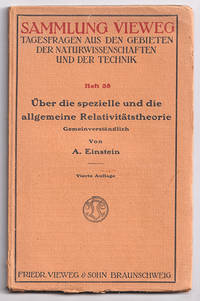
NAT2035aBraunschweig Vieweg 1921. IV 91 S. OKart. etwas gebräunt Umschlag randrissig = Sammlung Vieweg ; 38. Weil 90 zur Erstausgabe von 1917. Braunschweig, Vieweg 1921. unknown
1261-25Braunschweig Vieweg 1919. 4. Aufl. gr.-8°. IV 83 S. Mit 3 Textabb. OBrosch. Kanten berieb. - Sammlung Vieweg Tagesfragen aus den Gebieten der Naturwissenschaften und der Technik Heft 38 Braunschweig, Vieweg 1919. unknown
1969__3112595998De Gruyter 1969. Hardcover. New. 21 reprint edition. 136 pages. German language. 5.00x0.44x8.00 inches. De Gruyter hardcover
1970__3112596013De Gruyter 1970. Hardcover. New. 21 reprint edition. 136 pages. German language. 5.00x0.44x8.00 inches. De Gruyter hardcover
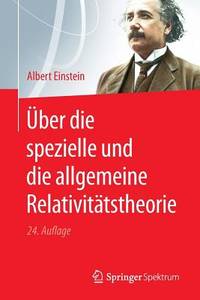
3642312780.Gpaperback. Good. Access codes and supplements are not guaranteed with used items. May be an ex-library book. paperback
19176547Braunschweig: Friedrich Vieweg 1917. Ninth printing. Acceptable. 23 cm; iv. 79 pages. Three figures in text along with numerous equations. In original printed wraps. Acceptable only with paper peeling from the spine and sewing tender. Paper cover is completely detached in front and hanging by a thread in back. The pages are yellowed. There is an ownership autograph of one E. Bodländer. That said a clean unmarked copy in original state. <br /><br />The original German edition of Einstein's epoch-making "On the Special and General Theory of Relativity. Friedrich Vieweg paperback
1015495907.Ghardcover. Good. Access codes and supplements are not guaranteed with used items. May be an ex-library book. hardcover
3322982726.Gpaperback. Good. Access codes and supplements are not guaranteed with used items. May be an ex-library book. paperback
3322983196.Gpaperback. Good. Access codes and supplements are not guaranteed with used items. May be an ex-library book. paperback
3663037754.Gpaperback. Good. Access codes and supplements are not guaranteed with used items. May be an ex-library book. paperback
x-3322983196Vieweg Teubner Verlag 1963. Paperback. New. 19 edition. 113 pages. German language. 8.26x5.82x0.32 inches. Vieweg + Teubner Verlag paperback
x-3322982726Vieweg Teubner Verlag 1921. Paperback. New. 11 edition. 98 pages. German language. 8.82x5.98x0.32 inches. Vieweg + Teubner Verlag paperback
x-3663037754Vieweg Teubner Verlag 1920. Paperback. New. 10 spi rep edition. 95 pages. German language. 8.51x5.52x0.25 inches. Vieweg + Teubner Verlag paperback
191722780Braunschweig Fridr. Vieweg. & Sohn 1917. "Heft 38 sammlung Vieweg" 8vo. Orig. printed wrappers. Title page with ink note and owners name. Some underlinings in ink. IV70 pp. <br/><br/><em>Second printing of the original from the same year. Weil No. 90. </em> unknown
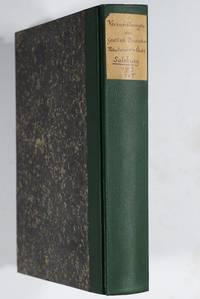
1909376751909. Verh. Ges. Naturf. Ärzte 81/1. 2.T./1.2. - Versammlung Salzburg 1909 . - Leipzig F.C.W. Vogel 1910 8° 4 205 3; XII 234 4 pp.; XIV 317 1 39 Abbildungen im Text Halbleinenband Erstdruck! EINSTEIN und die Salzburger Naturforscherversammlung! "In das helle Rampenlicht der physikalischen Bühne trat das Quantenproblem erstmalig beim Auftritt EINSTEINS auf der 81. Versammlung der Deutschen Naturforscher und Ärzte die vom 19. bis 25. September 1909 in Salzburg stattfand. EINSTEIN war bislang nur einigen wenigen jüngeren Physikern die die Reise nach Bern nicht gescheut hatten persönlich bekannt geworden. Als EINSTEIN nun zum ersten Mal an einem Naturforscherkongreß teilnahm begegneten ihm viele Fachkollegen mit außergewöhnlichem Interesse; sein Auftreten war zweifellos ein Höhepunkt der Tagung. Die Versammlung blieb - was insbesondere die "stark besuchte physikalische Abteilung" betraf - allen Beteiligten als höchst glanzvoll in Erinnerung. So schrieb etwa LISE MEITNER: "This congress was altogether a very impressive experience. It was attended by theoretical and experimental physicists from the entire world . . It was really something quite out of the ordinary a most stimulating meeting". EINSTEINS Vortrag fand in der Abteilung Physik in Gemeinschaft mit der Abteilung Mathematik am 21. September 1909 zu Beginn der Nachmittagssitzung statt. Aus den angegebenen Zahlen kann man schließen daß über 100 Hörer EINSTEINS Referat beiwohnten unter ihnen ein Großteil der führenden Physiker des deutschen Sprachraumes. EINSTEINS Vortrag "Über die Entwicklung unserer Anschauungen über das Wesen und die Konstitution der Strahlung" beeindruckte die Hörer zumindest die jüngeren gewaltig. EINSTEIN vertrat und begründete die These daß weder die bisherige Wellentheorie noch eine naiv-korpuskulare Auffassung des Lichtes angemessen ist sondern daß "eine Art Verschmelzung von Undulations- und Emissionstheorie" die Wirklichkeit trifft. EINSTEIN hatte damit in die Optik das Dualitätsprinzip eingeführt welches nach einem Worte SOMMERFELDS "unter allen erstaunlichen Entdeckungen dieses Jahrhunderts die erstaunlichste ist". Wie MAX BORN registrierte wurde "von der versammelten Gelehrsamkeit EINSTEINS Leistung abgestempelt". EINSTEIN wurde sozusagen in den engen Kreis der führenden Physiker aufgenommen. Tatsächlich spricht aus PLANCKS Diskussionsbemerkung große Hochachtung wenn auch PLANCK den kühnen Ideen des jungen EINSTEIN was die Lichtquantenhypothese betraf gleichsam noch die offizielle Billigung versagte. Zweifellos muß der Auftritt EINSTEINS und PLANCKS Stellungnahme großes Aufsehen erregt haben. Unmittelbar vordergründig konnte EINSTEIN mit seiner Lichtquantenhypothese nicht durchdringen. FRITZ REICHE einer der zahlreichen jüngeren Teilnehmer berichtete: "I must say I was very much impressed by the appearance of the second term in the fiuctuation formula. Though it is of course a rather indistinct proof of photons'. I remember of course that people were opposed and tried to find another reason or tried to give the formula another form." Auch PAUL EPSTEIN glaubte nicht daß EINSTEIN mit seinem Vortrag allzuviele überzeugte: "HEILBRON: Do you recall whether that talk of EINSTEIN had a great effect' EPSTEIN: NO great effect. You see the chairman of the meeting was PLANCK and he immediately said that it was very interesting but he did not quite agree with it. And the only man who seconded at that meeting was JOHANNES STARK. You see it was too far advanced". Für EINSTEIN war die Salzburger Tagung nicht nur deshalb bedeutungsvoll weil er hier zum ersten Male vor einem großen Kreis seine Gedanken vortragen konnte sondern ihm hier auch die Möglichkeit gegeben war mit seinen Kollegen in einen persönlichen Gedankenaustausch zu treten. Dies gilt für MAX PLANCK für MAX BORN und besonders für ARNOLD SOMMERFELD. Die nach Herkommen und Veranlagung so verschiedenen Männer der Ostpreuße SOMMERFELD und der Weltbürger EINSTEIN begründeten in Salzburg eine auf gegenseitige Hochachtung basierende Zuneigung die den Wandel der Zeiten überdauerte. EINSTEIN schloß wie er an JOHANN JACOB LAUB schrieb SOMMERFELD stürmisch in sein Herz. Er sei "ganz verliebt" in ihn denn "er ist ein prachtvoller Kerl". Ähnlich hegte auch SOMMERFELD für EINSTEIN fortan das Gefühl der "Bewunderung und Verehrung". Konnte man EINSTEIN in der Lichtquantenhypothese auch nicht folgen mußte man seine Überlegungen doch als scharfsinnig anerkennen. Jedenfalls war nun seit dem ersten Hervortreten im Jahre 1905 EINSTEIN aus einem unbekannten "Experten III. Klasse" beim Eidgenössischen Patentamt zu einem Manne geworden dem ungewöhnlicher Respekt gezollt wurde. Wesentlich war daß EINSTEIN in seinem Salzburger Referat nicht nur über die Spezielle Relativitätstheorie vortrug "die er kleineren Propheten überließ" sondern hauptsächlich über das Quantenproblem. Vor dem Forum der großen Physikerversammlung wurde so die Bedeutung dieses weitgehend ungelösten Fragenkomplexes hervorgehoben. EINSTEINS Ansehen das er sich vor allem durch die Begründung der Speziellen Relativitätstheorie verschafft hatte veranlaßte nun manchen Kollegen doch sich auch mit dem Quantenproblem ernsthaft zu beschäftigen. Heute betrachten wir Relativitäts- und Quantentheorie als zuständig für getrennte Erfahrungsbereiche: Die Spezielle Relativitätstheorie basiert auf der Endlichkeit der Lichtgeschwindigkeit während die nichtrelativistische Quantentheorie als Konsequenz der Naturkonstanten h 4= 0 erscheint. Haben also die beiden wichtigsten physikalischen Theorien des beginnenden 20. Jahrhunderts auch keinen logischen Zusammenhang so war doch ihre Entwicklung historisch eng verknüpft. Die Erfolge der Relativitätstheorie bewirkten eine schnellere Entwicklung der Quantentheorie." Armin Hermann & Ulrich Benz Quanten- und relativitätstheorie im Speigel der Naturforscherversammlungen 1906-1920 pp.130-131 unknown
190750420Leipzig: Johann Ambrosius Barth 1907. Einstein explicitly establishes E=mc2.<p>Einstein Albert 1879-1955. 1 Über die Möglichkeit einer neuen Prüfung des Relativitätsprinzips. In Annalen der Physik 23 6: pp. 197-8. 2 Bemerkungen zu der Notiz von Hrn. Paul Ehrenfest: "Die translation deformierbarer Elektronen und der Flächensatz." In Annalen der Physik 23 6: pp. 206-8. 3 Über die vom relativitätsprinzip geforderte Trägheit der Energie. In Annalen der Physik 23 7: pp. 371-384. 8vo. Red cloth gilt lettering on spine. 214 x 140 mm. Whole volume: viii 1000 pp. 4 plates numbered Taf. I - IV. Tafs. I II and IV are folding Taf. III is b/w silver photograph tipped to sheet. Foot of the spine is repaired. Very good. </p> <br /> <br /> <p>Approximate English translations of titles: 1 "On the possibility of a new test of the principle of relativity." 2 "Remarks on Mr. Paul Ehrenfest's note: 'The translation of deformable electrons and the surface theorem.'" 3 "On the inertia of energy required by the principle of relativity." </p> In "On the inertia of energy required by the relativity principle" May 1907 "Using rather than m V rather than c and 0 rather than E0 Einstein wrote his famous equation for the first time as V2= 0 and he did it in a footnote. At the end of that paper he introduced the symbol E0 to denote energy in the rest frame and wrote the famous expression again this time as =E0/V2." -Eugene Hecht How Einstein confirmed E0 = mc2 </p> <p> In the third paper Einstein explicitly establishes his famous equation E=mc2 although with different symbols. In this paper Einstein discussed the relationship between inertial mass and energy arguing for their complete equivalence namely that every mass has an equivalent energy just as every form of energy has an equivalent mass. This relation says that a photon can convert for the equivalence of mass and energy his celebrated equation E = mc2 Calaprice The Einstein Almanac. </p> <br /> <br /> <p> Weil's Einstein Bibliography nos. 17 18 and 19 respectively. <br> Boni's Einstein Checklist nos. 17 18 and 19 respectively.</p> . Johann Ambrosius Barth unknown
190741347Leipzig Barth 1907. 8vo. Extract from "Annalen der Physik IV23" pp.197-198. <br/><br/><em>First edition in the periodical form. - Weil No. 17. </em> unknown
190729338Leipzig Barth 1907. 8vo. Extract from "Annalen der Physik IV23" pp.197-198. Some slight browning to leaves. <br/><br/><em>First edition. Weil No. 17. </em> unknown
190738817Leipzig J.A. Barth 1907. Contep. hcloth. Both hinges with a tear at upper part. "Annalen der Physik Vierte Folge. Band 23. Herausgegeben von W.Wien und M. Planck" VIII1000 pp. and 4 plates. Einstein's papers pp. 197-98 a. 206-209 a. 371-384. Internally fine and clean. The whole volume offered. <br/><br/><em>All 3 papers in first edition. - The first paper "New possibility of testing the relativity principle" deals with the shift of canal rays in the Dobbler effect as a possible confirmation of the Principle of Relativity - the confirmation became actual only in 1938 when new improved instrumentation made it possible. - The second paper "remarks concerning Paul Ehrenfest's note: 'Translation of the deformable electron and the momentum law' Einstein gives his answer by relating it to his Theory of Relativity. - The third paper "The inertia of energy as demanded by the principle of relativity" which is a importen paper as it i is the first to state E=mc2 in its general form. general form. This new relation which was adumbrated already in his paper of 1906 Das prinzip von der Erhaltung der Schwerpunktsbewegung brings about the complete unification of mass and energy into a single concept. In natural units which make c=1 we have E=m i.e. mass and energy are one and the same quantity. Every form of energy also has a mass value just as every mass represents a definite amount of energy. - Weil Nos 1718 a. 19 </em> hardcover
192234667Berlin Julius Springer 1922-24. 8vo. In: "Zeitschrift für Physik" Vol. 10 pp. 377 ff.Vol.11 pp.326 vol.16 pp.228 vol.21 pp.326-332. The entire four volumes offered here. Contemporary half cloth bindings. <br/><br/><em>Two landmark papers in the history of cosmology: All first editions. In 'Über die Krümmung des Raumes' Friedman derived the non-stationary solutions to Einstein's field equations. Einstein quickly responded in a short comment 'Bemerkung' in which he expressed his suspicion of such a model of the Universe and apparently pointed out an error in Friedman's calculations. However Friedman now wrote a letter to Einstein in which he enclosed his full calculations. Shortly after this Einstein submitted a short notice Notiz in which he admitted that he himself had performed a calculation error and that Friedman's solutions which shed new light on the matter were valid. Friedman's expanding universe model was corroborated by Edwin Hubble's red-shift observations in 1929. In 'Über die Möglichkeit einer Welt mit konstanter negativer Krümmung des Raumes' Friedman derived the Friedman-equations and demonstrated that he had command of all three Friedman-models describing positive zero and negative curvature respectively nearly a decade before the independent discoveries of the same models by Lemaître Robertson and Walker. </em> hardcover
192249429Berlin Julius Springer 1922-24. 8vo. 4 contemporary half cloth binding: two in uniform half green cloth and two en uniform grey/blue half cloth. In "Zeitschrift für Physik" Bd. 10 11 16 & 21. Entire volumes offered. All volumes with stamp to title page and front free end paper otherwise a fine and clean set. Friedmann: Bd. 10: Pp. 377-386; Bd. 21: P.p. 326-332. Einstein: Bd. 11:P. 326; Bd. 16: P. 228. <br/><br/><em>First printing of these four landmark paper in which Friedman "introduced into cosmology two concepts of revolutionary importance the age og the world and the creation of the world" Kragh Cosmology and Controversy. "In his paper of 1922 Friedmann offered a complete analysis of the solutions of Einstein's cosmological field equations that went beyond the earlier solutions of Einstein and de Sitter as it also included nonstatic solutions. Friedmann did so clearly and explicitly: "The purpose of this note" he wrote "is firstly to show that the cylindrical Einsteinand spherical de Sitter worlds are special cases of more general assumptions and secondly to demonstrate the possibility of a world in which the curvature of space is independent of the three spatial coordinates but does on time".Ibid.In 'Über die Krümmung des Raumes' Friedman derived the non-stationary solutions to Einstein's field equations. Einstein quickly responded in a short comment 'Bemerkung' in which he expressed his suspicion of such a model of the Universe and apparently pointed out an error in Friedman's calculations. However Friedman now wrote a letter to Einstein in which he enclosed his full calculations. Shortly after this Einstein submitted a short notice Notiz in which he admitted that he himself had performed a calculation error and that Friedman's solutions which shed new light on the matter were valid. Friedman's expanding universe model was corroborated by Edwin Hubble's red-shift observations in 1929. In 'Über die Möglichkeit einer Welt mit konstanter negativer Krümmung des Raumes' Friedman derived the Friedman-equations and demonstrated that he had command of all three Friedman-models describing positive zero and negative curvature respectively nearly a decade before the independent discoveries of the same models by Lemaître Robertson and Walker. "Friedmann made a valuable contribution to Einstein's general theory of relativity. As always his interest was not limited simply to familiarizing himself with this new field of science but led to his own remarkable investigations. Friedmann's work on the theory of relativity dealt with one of its most difficult questions the cosmological problem. In his paper "Über die Krümmung des Raumes" 1922 he outlined the fundamental ideas of his cosmology: the supposition concerning the homogeneity of the distribution of matter in space and the consequent homogence of "world" time for which at any moment in time the metrics of space will be identical at all points and in all directions. This theory is especially important because it leads to a sufficiently correct explanation of the fundamental phenomenon known as the "red shift." This solution of the Einstein field equations obtained from the above propositions is the model for any homogeneous and isotropic cosmological theory. It is interesting to note that Einstein thought that the cosmological solution to the equations of a field had to be static and had to lead to a closed model of the universe. Friedmann discarded both conditions and arrived at an independent solution. Einstein welcomed Friedmann's results because they showed the dispensability of the ad hoc cosmological term Einstein had been forced to introduce into the basic field equation of general relativity". DSB. Weil 122 & 130. </em> hardcover
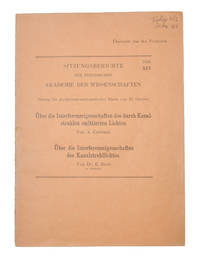
H4008Berlin Akademie der Wissenschaften 1926 In: Sitzungsberichte der Königl.Preuss. Akademie der Wissenschaften Band 1926. 4to. S.334-340. Anbei u.a.: Schrödinger E.: Die Energiestufen des idealen einatomigen Gasmodells. S.23-36; Planck Max: Über die Begründung des zweiten Hauptsatzes der Thermodynamik. S.453-466. Halbleinenband der Zeit leicht berieben Bibl.-Nr.am Rücken Original-Broschur miteingebunden unaufgeschnitten gutes Exemplar. The Einstein and Rupp articles are the heart of the Einstein-Rupp scandal perhaps the most famous of all scientific scandals. unknown
1926465401926. Royal8vo. Author's presentation offprint with the printed presentation statement on top of frontwrapper "Überreicht von den Verfassern" i.e. "Given by the authors". Original printed wrappers. Front wrapper loose but fully intact. "Chilpp 202" and "Recdese 160" written in hand to top of front wrapper. A very fine and clean copy. Pp. 334-351. <br/><br/><em>First edition in the scarce author's presentation offprint issue of this important paper which contains Einstein's theories on wave-particle duality and German physicist Rupp's work on the same subject seemingly to corroborating Einstein's theories. Rupp's experimental results later turned out to have been falsifications and today he is mainly known as the protagonist in one of the biggest scandals in physics in the 20th century.Rupp published a number of papers on the interference properties of light emitted by canal ray sources. These articles particularly the present that came into being in close collaboration with Albert Einstein attracted quite a lot of attention as they probed the wave versus particle nature of light. They also significantly propelled Rupp's career even though they were considered highly controversial to begin with.In April 1926 Albert Einstein proposed to Emil Rupp to carry out two experiments that were to prove the wave nature of light versus the particle nature of light: the so-called 'Wire Grid Experiment' and the 'Rotated Mirror Experiment' experiments that Einstein had worked on theoretically and now would like to gain confirmation of through experiments. Rupp at the time regarded as one of the most important and most competent experimental physicists gladly took up the challenge. Rupp's observations - though highly controversial - confirmed Einstein's theory. Due to the surprising outcome of the experiments Einstein was interested in exactly how it they were conducted as Rupp's initial descriptions did not convince him that the results were feasible."Rupp stood by his observations and suggested yet other circumstances that might explain them. Did Einstein now realize that there was something rather dubious about Rupp's work He had seen him change his data repeatedly-and each time in better accordance with his own criticism and on one occasion in no less than two days. He had had to accept that Rupp claimed to earlier have "unknowingly" or "unconsciously" rotated a mirror and he will likely have seen that Rupp's work was highly controversial amongst experimentalists leading to very public criticism in Die Naturwissenschaften. He himself was now also convinced that in fact Rupp's results were incomprehensible. So did Einstein choose to suspend the publication of Rupp's piece so that an additional round of checks and balances could take place The answer is no: Rupp's paper was presented by Einstein to the Prussian Academy in a session on 21 October 1926 and it appeared in print in the Academy's proceedings in November of 1926-the articles by Einstein and Rupp came out back to back and reprints circulated with both papers bound together with a joint cover page that displayed both titles. Einstein referred in his article to Rupp's claims and he had even written the abstract of Rupp's paper" Dongen: "Emil Rupp Albert Einstein and the Canal Ray Experiments on Wave-Particle".The first clear indication that Rupp's work was impossible to recreate came in 1930 in a paper published by Staub - nothing was wrong with Einstein's theory but Rupp's work was simply impossible: "Rupp immediately set out to respond to Straub's publication. On 12 July 1930 he sent a first draft to Einstein to whom he also announced his intention of redoing his canal ray experiments-Straub was dismissed as a clumsy graduate student with a lousy apparatus. Einstein suggested inviting Straub once Rupp had his experiment up and running again but cautioned him not to engage the polemic in too sharp a tone". Rupp managed to convince the physics society and continued to publish the new few years. In 1934 various different physicians pointed out that Rupp's work was impossible to recreate and in 1935 the final blow to Rupp's career came about when the German Physical Society's decided not to allow any citations of Rupp's work. This seems to have had very severe consequences as today it is almost impossible to find any quotations - or even mentioning of Rupp in general let alone his fraud - in any historical studies of either quantum theory or of Einstein.Despite the unquestionable fraud by Rupp his experiments and collaboration with Einstein might have had a positive influence on the further progression to quantum mechanics. The two present papers became of seminal importance in the discussions between Bohr and Heisenberg which eventually in 1927 resulted in Heisenberg publishing his landmark thesis on the uncertainty principle. When Max Born received the Nobel Prize in physics he stated that: "An idea of Einstein gave me the lead From the present paper. He had tried to make the duality of particles-light quanta or photons-and waves comprehensible by interpreting the square of the optical wave amplitudes as probability density for the occurrence of photons."Boni 160; Weil 153. </em> unknown
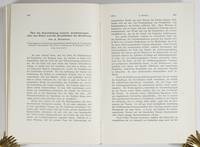
1909524241909. Verh. Dtsch. Physik. Ges. 11/ 1-24. - Hrsg. im Auftrage der Gesellschaft von Karl Scheel. - Braunschweig Druck und Verlag von Friedrich Vieweg und Sohn 1909 8° VII 749 pp. Abbildungen Halbleinenband d.Zt.; St.a.Tit.; feines Expl. First Edition! The true first printing see below of this paper which Wolfgang Pauli said "can be considered as one of the landmarks in the development of theoretical physics" Schilpp p. 154. This paper marks the introduction of the modern "photon" concept although the term itself was introduced much later in a 1926 paper by Gilbert N. Lewis. It contains "the first well-conceived promulgation of the wave-particle duality of light which had implications as profound as Einstein's earlier theoretical breakthroughs" Isaacson p.157. Einstein here anticipated the principle of complementarity one of the fundamental principles of quantum mechanics. His own proposal for a solution of the wave-particle paradox - that Maxwell's equations for electromagnetic fields be modified to allow wave solutions that are bound to singularities of the field - was never developed although it may have influenced Louis de Broglie's pilot wave hypothesis for quantum mechanics developed in his famous thesis Recherches sur la théorie des quanta 1924. The present paper was also published in Physikalische Zeitschrift Vol. 10 1909 but the Verhandlungen printing has priority: it was published on 30 October 1909 the Physikalische Zeitschrift printing appeared on 10 November. "This extensive paper given as lecture before the 81st assembly of the "Gesellschaft Deutscher Naturforscher" in Salzburg on 21st September 1909. He spoke on "The Development of Our View of the Nature and Constitution of Radiation" a topic that embraced both relativity and quanta. Among those who attended Einstein's lecture were some of the world's foremost physicists. In Einstein's austere opinion his address regarded strictly as a work of science was of little importance since as he writes to a co-worker it contained nothing new. Einstein was being overmodest. Besides to many in Einstein's audience and it should be born in mind that it was the year after Minkowski's stirring introduction of the concept of the fourth dimension this Lecture came as a revelation. The occasion was important for Einstein too. He had been working for years in a sort of scientific exile and his curiosity as to what great scientists were like in face-to-face discussion was at least as great as their curiosity about him. His confidence in himself was certainly not harmed when he found that he was able to hold his own easily in their company. Moreover at this congress Einstein first met Planck. In addition he made new'lasting friendships leading to a voluminous scientific correspondence. Amongst those attending the congress were Max von Laue Max Born. Arnold Sommerfeld Hasnohrl. Ladenburg. Max von Laue was to be the first to publish in 1911 the first text-book on relativity theory. All of them are present in this issue with scientific papers of their own." Walter Alicke 11. Jahrg. 30. Oktober 1909 Nr. 20 - Vorgetragen in der Sitzung der physiklaischen abteilung der 81. Versalung Deutscher Naturforscher und Ärzte zu Salzburg am 21. September 1909." Weil No. 30; Schilpp-Shields No. 30; Hoffmann Einstein p. 93. unknown