1 803 résultats
190659121Leipzig Johann Ambrosius Barth 1906. Full cloth. Spine with gilt lettering. In: "Annalen der Physik. Vierte Folge. Band 20. Herausgegeben von Paul Drude." Portrait Paul Drude VIII1048 pp. and 6 plates. Einstein papers: pp. 199-206 and 627-33. Internally fine and clean. The entire volume offered. Broad margins. <br/><br/><em>Both papers first edition. It was for the papers "Ueber einen die Erzeugung und Verwandlung des Lichtes betreffenden heuristischen Gesichtspunkt" of 1905 and "Zur Theorie der Lichterzeugung. Theory of light emission and absorption the offered item that Einstein was awarded the Nobel Prize in 1921. "The quantum theory has affected virtually every branch of physics. Its earliest and one of its most significant developments was Einstein's application of the theory to what is known as the 'photo-electrical effect'.Einstein explained this effext by suggesting that the classical view that light is emitted in the form of continous waves must be abandoned. The photo-electrical effect could be explained only as an example of quantum action where the waves of light or X-rays are emitted in minute particles or bullets. It is he size of the bullet the wave-lenght of the radiation which determines the number of electrons ejected. It was for this and not for the theory of relativity that Einstein was awarded the Nobel Prize in 1921. Einstein's two fundamental papers on this subject are "Ueber einem Erzeugung." 1905 and Zur Theorie der Lichterzeugung the paper offered here" PMM the note to 391. In the second paper Principle of the conservation of the centre of mass motion and the inertia of energy he shows that the conservation of mass is a special application of his energy principle E= Mc2 - Weil: 12 & 13.Among the many papers in this volume we have Max von Laue: Zur Thermodynamik der Inteferenzerscheinungen. pp. 365-378. </em> hardcover
19221648Berlin: Verlag der Akademie der Wissenschaften 1922. 1st Edition. FIRST EDITION COMMERCIAL OFFPRINT ISSUE OF EINSTEIN'S THEORY OF THE LIGHT PROPAGATION IN DISPERSIVE MEDIA. WEIL 120. <br /> <br /> "After 1917 Einstein firmly believed that light-quanta were here to stay thus it is not surprising that he would look for new ways in which the existence of photons might lead to observable deviation from the classical picture. In this he did not succeed. At one point in 1921 he thought he had found a new quantum criterion but it soon turned out to be a false lead as demonstrated in this paper" Schilpp-Shields 162. <br /> <br /> That paper — the one offered here — is Einstein's evidence that his 1921 efforts were incorrect. In it Einstein introduces a calculation on the topic and explains why his earlier proposed experiment had not been well considered because it could not predict a good choice between two theoretical alternatives" Calaprice Einstein Encyclopedia 98. CONDITION & DETAILS: Berlin: Koniglich Akademie der Wissenschaften. Commercial offprint from Sitzungsberichte der Koniglich preussischen Akademie der Wissenschaften III 1916 pp. 18-22. Octavo 252 x 179 mm. Original printed wrappers. Pristine inside and out. Fine. Verlag der Akademie der Wissenschaften unknown
1930433141930. Offprint from Sitzungsberichte der preussischen Akademie der Wissenschaften 1930. Single sheet pp. 1-2. 256 x 184 mm. Upper edge a bit creased light toning but very good. First edition offprint issue. One of Einstein's last papers on Riemann metrics and distant parallelism written the year before he abandonded this approach to constructing a unified field theory. Pais Subtle is the Lord p. 347. Weil Albert Einstein Bibliography 173. unknown
72535Braunschweig Friedrich Vierweg & Sohn; Berlin J. Springer 1924. 8vo 22.8 x 15.4 cm. 6 pp. Original printed wrappers. = On the theory of radiometer forces. "The Crookes radiometer also known as a light mill consists of an airtight glass bulb containing a partial vacuum with a set of vanes which are mounted on a spindle inside. The vanes rotate when exposed to light with faster rotation for more intense light providing a quantitative measurement of electromagnetic radiation intensity. The reason for the rotation was a cause of much scientific debate in the ten years following the invention of the device" Wikipedia. James Clerk Maxwell first gave a wrong then a correct explanation. However some subtleties still needed to be solved and in 1924 Albert Einstein had a crack at it "A partial explanation is that gas molecules hitting the warmer side of the vane will pick up some of the heat bouncing off the vane with increased speed. Giving the molecule this extra boost effectively means that a minute pressure is exerted on the vane. The imbalance of this effect between the warmer black side and the cooler silver side means the net pressure on the vane is equivalent to a push on the black side and as a result the vanes spin round with the black side trailing. The problem with this idea is that while the faster moving molecules produce more force they also do a better job of stopping other molecules from reaching the vane so the net force on the vane should be the same. The greater temperature causes a decrease in local density which results in the same force on both sides. Years after this explanation was dismissed Albert Einstein showed that the two pressures do not cancel out exactly at the edges of the vanes because of the temperature difference there. The force predicted by Einstein would be enough to move the vanes but not fast enough" Wikipedia. Contained first paper in: Zeitschrift für Physik volume 271. The complete issue in its original wrappers. Front wrapper slightly spotted at the fore and bottom edges. Volume number written on spine. A very good clean copy. Weil 139. unknown
192449431Berlin Springer 1924. 8vo. Bound in contemporary half cloth. In "Zeitschrift für Physik" Bd. 27. Entire volume offered. Stamp to front free end paper. Fine and clean. Einstein: Pp. 1-6; P. 392. Bose: P. 392. Entire volume: IV 395 1 pp. <br/><br/><em>First appearance of Einstein's paper on statistical mechanics and the physics of radiometers. Weil 139 143a </em> hardcover
190638794Leipzig Johann Ambrosius Barth 1906. Bound together in one contemp. hcloth. Small tears to spine ends. = "Annalen der Physik. Vierte Folge. Band 20. Herausgegeben von Paul Drude." Portrait Paul Drude VIII1048 pp. and 6 plates. Einstein papers: pp. 199-206 and 627-33. Internally fine and clean. The whole volume offered. <br/><br/><em>Both papers first edition. It was for the papers "Ueber einen die Erzeugung und Verwandlung des Lichtes betreffenden heuristischen Gesichtspunkt" of 1905 and "Zur Theorie der Lichterzeugung. Theory of light emission and absorption the offered item that Einstein was awarded the Nobel Prize in 1921."The quantum theory has affected virtually every branch of physics. Its earliest and one of its most significant developments was Einstein's application of the theory to what is known as the 'photo-electrical effect'.Einstein explained this effext by suggesting that the classical view that light is emitted in the form of continous waves must be abandoned. The photo-electrical effect could be explained only as an example of quantum action where the waves of light or X-rays are emitted in minute particles or bullets. It is he size of the bullet the wave-lenght of the radiation which determines the number of electrons ejected. It was for this and not for the theory of relativity that Einstein was awarded the Nobel Prize in 1921. Einstein's two fundamental papers on this subject are "Ueber einem Erzeugung." 1905 and Zur Theorie der Lichterzeugung the paper offered here" PMM the note to 391. In the second paper Principle of the conservation of the centre of mass motion and the inertia of energy he shows that the conservation of mass is a special application of his energy principle E= Mc2 - Weil: 12 & 13.Among the many papers in this volume we have Max von Laue: Zur Thermodynamik der Inteferenzerscheinungen. pp. 365-378. </em> hardcover
190646956Leipzig Johann Ambrosius Barth 1906. No wrappers. Extracted from "Annalen der Physik" Vierte Folge. Bd. 20. Pp. 199-206. Clean and fine. <br/><br/><em>First printing of one of the papers for which Einstein was awarded the Nobel Prize in 1921. It was for the papers "Ueber einen die Erzeugung und Verwandlung des Lichtes betreffenden heuristischen Gesichtspunkt" of 1905 and "Zur Theorie der Lichterzeugung. Theory of light emission and absorption the offered item that Einstein received the prize: "for his services to theoretical physics and especially for his discoveryof the law of the photoelectrical effect" - his reward was not based on relativity."The quantum theory has affected virtually every branch of physics. Its earliest and one of its most significant developments was Einstein's application of the theory to what is known as the 'photo-electrical effect'.Einstein explained this effext by suggesting that the classical view that light is emitted in the form of continous waves must be abandoned. The photo-electrical effect could be explained only as an example of quantum action where the waves of light or X-rays are emitted in minute particles or bullets. It is he size of the bullet the wave-lenght of the radiation which determines the number of electrons ejected. It was for this and not for the theory of relativity that Einstein was awarded the Nobel Prize in 1921. Einstein's two fundamental papers on this subject are "Ueber einem Erzeugung." 1905 and Zur Theorie der Lichterzeugung the paper offered here" PMM the note to 391.Weil: 12 with an asterix denoting a major paper - Boni:12. </em> unknown
190646962Leipzig Johann Ambrosius Barth 1906. Bound together in one contemp. halfcalf. Spine gilt. Minor scratches to spine. A stamp to titlepage and htitle. "Annalen der Physik. Vierte Folge. Band 20. Herausgegeben von Paul Drude." Portrait Paul Drude VIII1048 pp. and 6 plates. Einstein papers: pp. 199-206 and 627-33. The entire volume offered. <br/><br/><em>Both papers first edition. It was for the papers "Ueber einen die Erzeugung und Verwandlung des Lichtes betreffenden heuristischen Gesichtspunkt" of 1905 and "Zur Theorie der Lichterzeugung. Theory of light emission and absorption the offered item that Einstein was awarded the Nobel Prize in 1921."The quantum theory has affected virtually every branch of physics. Its earliest and one of its most significant developments was Einstein's application of the theory to what is known as the 'photo-electrical effect'.Einstein explained this effext by suggesting that the classical view that light is emitted in the form of continous waves must be abandoned. The photo-electrical effect could be explained only as an example of quantum action where the waves of light or X-rays are emitted in minute particles or bullets. It is he size of the bullet the wave-lenght of the radiation which determines the number of electrons ejected. It was for this and not for the theory of relativity that Einstein was awarded the Nobel Prize in 1921. Einstein's two fundamental papers on this subject are "Ueber einem Erzeugung." 1905 and Zur Theorie der Lichterzeugung the paper offered here" PMM the note to 391. In the second paper Principle of the conservation of the centre of mass motion and the inertia of energy he shows that the conservation of mass is a special application of his energy principle E= Mc2 - Weil: 12 & 13.Among the many papers in this volume we have Max von Laue: Zur Thermodynamik der Inteferenzerscheinungen. pp. 365-378. </em> unknown
192228358Berlin Gruyter & Co. 1922. 4to. Orig.printed orange wrappers. Offprint/Sonderabdruck aus Sitzungsberichten. pp. 18-22. Fine fresh copy. <br/><br/><em>First edition in the rare Offprint still called "Abdruck". - Weil No. 120.The early Offprints from "Sitzungsberichten." are called "Sonderabdruck" up to Weil No.165 including this. From Weil 166 they are called "Sonderausgabe.". - Before 161 up to 160 the Offprints do not have separate title and pagination the pagination follows the numbering in the periodical. From 166 the Offprint has both separate printed title and pagination. - So Weil Nos 161-165 is still "Abdruck" but with separate title and pagination. These facts are not mentioned in the bibliographies. </em> unknown
a88012a1924 first edition. Viewig Article on pp. 1-6 in one complete issue of Zeitschrift fur Physik siebenundzwanzigster band 27 heft 1. In complete volume. Hardcover. Octavo 395p. blue buckram. Many similiar important articles in same volume by other scientists. Near Fine. . hardcover
1906292Leipzig: Barth 1906. 1st Edition. FIRST EDITION FIRST ISSUE of two important 1906 Einstein papers. Einstein wrote two papers on the photoelectric effect his revolutionary 1905 paper and "Zur Theorie der Lichterzeugung und Lichtabsorption" his continuation of it. In them Einstein employed Planck's theory that luminous energy can be absorbed or emitted only in discrete amounts called quanta and proposed a theory of light quanta involving particles with no mass photons whose energy depended on frequency. All of Einstein's experimental results confirmed that light actually consisted of discrete energy packets. <br /> <br /> "Based on this theory Einstein wrote an equation describing how the photoelectric effect works. The energy of individual electrons emitted by a photocell is a function of the frequency of the light hitting the photocell and the rate of electron emission is a function of the light source's intensity number of photons with sufficient energy being emitted. This is contrary to what is predicted by classical physics" History of Physics: The Wenner Collection. <br /> <br /> In this Einstein's second paper on photoelectrics he revisited Planck's theory and from it developed his ideas to show that an electromagnetic wave such as light could be described as a particle photon with discrete quanta of energy that was dependent on its frequency. In the long history of quantum mechanics this would lead to a theory of unity between subatomic particles and electromagnetic waves called wave-particle duality in which particles and waves were neither one nor the other but had certain properties of both. <br /> <br /> At first Einstein believed that light-quantum hypothesis was merely 'heuristic': that it behaved only as if it consisted of discontinuous quanta. But in this paper and others to follow Einstein used his statistical mechanics to demonstrate that when light interacts with matter Planck's entire formula can arise only from the existence of light quanta -- not from waves. In other words in explaining the photoelectric effect by extending Planck's concept of quantum of energy had Einstein "demonstrated that his own 'light-quantum hypothesis' was implicit in Planck's earlier work" Honner The Description of Nature 31. <br /> <br /> ALSO included in this volume is "Daz Prinzip von der Erhaltung." The Principle of Conservation of Motion of the Center of Gravity and the Inertia of Energy. In this "ingenious thought experiment involving energy transport in a hollow cylinder Einstein returned to the relationship between inertial mass and energy giving more general arguments for their complete equivalence" Calaprice The Einstein Almanac 18. This was the first statement that the conservation of mass is a special case of the conservation of energy. CONDITION & DETAILS: Leipzig: Barth 1906. Octavo. 8.75 x 6 inches; 222 x 152mm. Ex-libris bearing minimal markings only a small stamp on the title page. Illustration: 6 plates and figures throughout. Entire volume in black cloth gilt-lettered at the spine. The cloth is a bit rubbed and scuffed and there is fading at the spine. Solidly and tightly bound. Bright and clean throughout. Barth hardcover
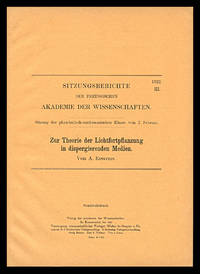
192232430Berlin: Sitzungsberichten der Preussischen Akademie der Wissenschaften 1922. First Thus. First Thus. Einstein Albert 1879-1955. Zur Theorie der Lichtfortpflanzung in dispergierenden Medien. Complete. Quarto. Offprint from Sitzungsberichten der Preussischen Akademie der Wissenschaften. Berlin: 1922. First edition in very fine condition. This superb offprint is a separate printing of the Prussian Academy's session reports here with independent pagination. A small number of such off prints were presented to the author by the publisher as voucher copies. References: Schilpp-Shields 162; Weil 120. This paper gives evidence that Einsteins ideas on the photon were not able to contradict classical theory. "Since after 1917 Einstein firmly believed that light-quanta were here to stay it is not surprising that he would look for new ways in which the existence of photons might lead to observable deviation from the classical picture. In this he did not succeed. At one point in 1921 he thought he had found a new quantum criterion but it soon turned out to be a false lead as demonstrated in this paper". An excellent example. "The early Offprints from "Sitzungsberichten." are called "Sonderabdruck" up to Weil No.165 including this. From Weil 166 they are called "Sonderausgabe.". - Before 161 up to 160 the Offprints do not have separate title and pagination the pagination follows the numbering in the periodical. From 166 the Offprint has both separate printed title and pagination. - So Weil Nos 161-165 is still "Abdruck" but with separate title and pagination. Sitzungsberichten der Preussischen Akademie der Wissenschaften unknown
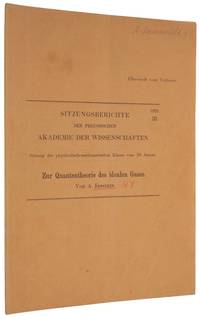
19256417Berlin: Königlich Akademie der Wissenschaften 1925. First edition. <p>First edition very rare author's presentation offprint from the library of the great German physicist Arnold Sommerfeld with his signature and annotations of Einstein's third paper on his quantum theory of the ideal gas of 1924-1925 Einstein's "last major innovative contribution to physics" Pais Subtle is the Lord. "The arguments advanced in this third paper do not make use of the new Bose-Einstein statistics. Instead Einstein invokes arguments involving dimensional analysis and adiabatic compression" Papers Vol. 14.</p>. BOSE-EINSTEIN STATISTICS - WITHOUT THE STATISTICS. <p>First edition very rare author's presentation offprint not to be confused with the more common trade separate - see below from the library of the great German physicist Arnold Sommerfeld with his signature and annotations of Einstein's third paper on his quantum theory of the ideal gas of 1924-1925 Einstein's "last major innovative contribution to physics" Pais Subtle is the Lord p. 343. In 1924 Einstein received a copy of the Indian physicist S. N. Bose's paper 'Planck's law and the hypothesis of light quanta.' Einstein immediately recognized its importance and had it published shortly followed by a paper of his own applying Bose's ideas to ideal gases rather than radiation molecules rather than light quanta. These two papers laid the foundations of 'Bose-Einstein statistics.' Einstein published a second paper in which he showed that the new statistics led to the prediction of a new state of matter the 'Bose-Einstein condensate' the creation of which in the laboratory was the topic of the 2001 Nobel Prize in Physics. At the time however many of Einstein's colleagues in particular his close friend Paul Ehrenfest were sceptical of the new statistics. Einstein therefore attempted in the present paper to justify his quantum theory of the ideal gas by more traditional methods rather than the novel statistics he had used in his two previous papers. "It contains an attempt to extend and exhaust the characterization of the monatomic ideal gas without appealing to combinatorics. Its ambiguities illustrate Einstein's confusion with his initial success in extending Bose's results and in realizing the consequences of what later came to be called Bose-Einstein statistics . Its arguments are based on Einstein's belief in the complete analogy between the thermodynamics of light quanta and of material particles and invoke considerations of adiabatic transformations as well as of dimensional analysis. These techniques were well known to Einstein from earlier work on Wien's displacement law Planck's radiation theory and the specific heat of solids" Pérez & Sauer. "In a letter to Ehrenfest he writes that on his next visit in Leyden 'I shall then convince you completely of the gas-degeneracy-equation. I found another safe though not entirely complete approach to it free of the incriminating statistics'. The arguments advanced in this third paper indeed do not make use of the new statistics. Instead Einstein invokes arguments involving dimensional analysis and adiabatic compression" Papers p. lxx. The only other copy of this offprint listed on RBH is that in Einstein's own collection Christie's 2008.</p> <br /> <p>Provenance: Arnold Sommerfeld 1868-1951 his signature and characteristic numbering in red pencil '44' on front cover and three annotations in the text. The annotations consist of corrections to formulas 5 on p. 20 11 and 12 on p. 21 16a on p. 23 and 19 on p. 24 to the equation on the last line of p. 22 and to two mathematical symbolson lines 2 and 3 of p. 25. "The son of a physician Sommerfeld was educated at the University of Königsberg. After teaching briefly at the universities of Göttingen Clausthal and Aachen he was appointed professor of physics at the University of Münich in 1906. Sommerfeld should have retired in 1936 in favour of his pupil Werner Heisenberg. Opposition from the Nazi party to Heisenberg's appointment prolonged Sommerfeld's tenure and it was not in fact until late 1939 that he finally retired to be succeeded not by Heisenberg but by Wilhelm Müller a Nazi aerodynamicist without a single publication in physics to his credit. Although Sommerfeld and Heisenberg were not Jewish they were regarded by the Nazis as Jewish sympathizers. Sommerfeld however survived the war and returned to his Münich chair in 1945 continuing to work at physics until he died in a car accident in 1951" Oxford Reference. "Arnold Sommerfeld was one of the most distinguished representatives of the transition period between classical and modern theoretical physics. The work of his youth was still firmly anchored in the conceptions of the nineteenth century; but when in the first decennium of the century the flood of new discoveries experimental and theoretical broke the dams of tradition he became a leader of the new movement and in combining the two ways of thinking he exerted a powerful influence on the younger generation. This combination of a classical mind to whom clarity of conception and mathematical rigour are essential with the adventurous spirit of a pioneer are the roots of his scientific success while his exceptional gift of communicating his ideas by spoken and written word made him a great teacher" Max Born p. 275. </p> <br /> <p>The motivation for the publication of this paper is given by Einstein in the opening paragraph translation from Papers Vol. 14 English Translation Supplement:</p> <br /> <p>'Stimulated by a derivation of Planck's radiation formula originating from Bose which consistently supports itself on the light-quantum hypothesis I recently postulated a quantum theory for ideal gas. This theory seems legitimate when one starts out from the conviction that a light quantum disregarding its polarization property differs from a monatomic molecule essentially only in that the quantum's mass at rest is vanishingly small. But because the presupposition of this analogy is certainly not accepted by all researchers and furthermore because the statistical method used by Mr. Bose and me is certainly not beyond doubt but rather just seems justified a posteriori by its success in the case of radiation I looked for other considerations on the quantum theory of ideal gas that are as free of arbitrary hypotheses as possible. These considerations shall be communicated in the following. They provide an effective support for the theory postulated earlier even though the results attained do not yield a full substitute for that theory. Here it is a matter of establishing considerations in the field of gas theory by a method and with results largely analogous to those in the field of radiation theory leading to Wien's displacement law.'</p> <br /> <p>"Einstein followed an approach in this paper that was not based only on statistical considerations and that was closer to thermodynamics. He tried to find general conditions that any theory of the ideal gas would have to satisfy mainly by establishing and exploiting analogies with radiation where the displacement law at least provided some hints as to what the radiation law should look like" Pérez & Sauer.</p> <br /> <p>The problem Einstein wished to solve was to find the distribution function Ï = ÏL κT V m where L is the kinetic energy κ the Boltzmann constant T the temperature V the volume and m the mass of the molecules. The distribution law will be of the form</p> <br /> <p>dn = ÏL κT V mVdp1dp2dp3 / h3</p> <br /> <p>where dn is the number of molecules whose Cartesian components of the momenta are in the range p1 p2 p3 to p1 dp1 p2 dp2 p3 dp3 h is Planck's constant. Einstein did not assume that collisions between molecules are governed by the laws of mechanics. He asserted that if that were the case one would arrive at the classical Maxwell's distribution law. He neglected interactions among molecules this being essentially the definition of an ideal gas.</p> <br /> <p>Einstein first used dimensional analysis to place a restriction on the possible forms of the distribution function. He had used similar arguments in his 1909 paper 'Zum gegenwärtigen Stand des Strahlungsproblems' Physikalische Zeitschrift 10 185-193 to deduce Wien's displacement law and in his 1911 paper on the quantum theory of solids 'Elementare Betrachtungen über die thermische Molekularbewegung in festen Körpern' Annalen der Physik 35 679-694. Since Ï is dimensionless a pure number it had to be a function only of dimensionless combinations of L κT V m and h. There are two independent such combinations which means that Ï is reduced to a function of two variables rather than five:</p> <br /> <p>A = L/κT and B = mV/N2/3κT/h2.</p> <br /> <p>To reduce Ï to a function of a single variable Einstein needed further restrictions. "Einstein proposed two of those:</p> <br /> <br /> The entropy of an ideal gas does not change in an 'infinitely slow adiabatic' sic compression.<br /> The required velocity distribution is valid for an ideal gas also in an external field of conservative forces.<br /> <br /> <p>Einstein argued that these two properties should be valid disregarding collisions. But the neglect of intermolecular collisions made their assumption unprovable even if they would be 'very natural.' In support of both he announced they would lead not only to the same result but also to a result according to which Maxwell's distribution law is valid in the region where quantum effects can be neglected" Pérez & Sauer.</p> <br /> <p>Einstein deduced from these assumptions that </p> <br /> <p>Ï = ΨA χB </p> <br /> <p>where Ψ and χ are universal functions of dimensionless variables. </p> <br /> <p>Einstein then looked at the case in which the constant h disappears from the expression for dn i.e. at the classical limit. He found that </p> <br /> <p>Ï = Be-A </p> <br /> <p>i.e. the Maxwell-Boltzmann law. In contrast Einstein's statistical theory had produced the expression</p> <br /> <p>Ï = B/eA - 1.</p> <br /> <p>"Summarizing Einstein pointed out that two aims have been achieved:</p> <br /> <p>'First we found a general condition equation which has to be satisfied by any theory of the ideal gas. Second it follows from the above that the equation of state which I derived will not be changed by either adiabatic compression or by the existence of conservative force fields'" Pérez & Sauer. </p> <br /> <p>Why was this paper little noticed by Einstein's colleagues "The practically immediate appearance of the revolutionary contributions of 1925 to quantum theory eclipsed any possible interest of Einstein's paper. The arguments it contains only concern the ideal gas from a thermodynamic perspective. But what is more important it includes hypotheses that were in open contradiction with the course quantum researches had taken. Many physicists had rejected already the laws of mechanics and Einstein assumed their validity for describing the motions of the gas molecules.</p> <br /> <p>"The papers of the twenties that refer to Einstein's theory usually mention all three instalments. This indicates that in spite of the almost complete lack of comments on it its existence was known. We are inclined to think that it simply was not of any interest to Einstein's colleagues. Einstein justified the considerations of the non-statistical paper with the deep dissatisfaction over the statistical route by which he had arrived at the new distribution function. However the problem was not whether his colleagues saw Bose's statistics favourably but that in the following months the physicists' ideas around the quantum issues changed substantially. Bose's statistics in spite of implying a way of counting that was incompatible with classical statistics led to an already accepted result. This was much more than could be said of other attempts of explaining for example the Zeeman effect or multielectronic spectra .</p> <br /> <p>"In retrospect Einstein's initial suspicion about Bose's statistics will turn into one of the first symptoms of his later distancing himself from quantum mechanics. For this reason we find no justification for the neglect of Einstein's paper by historians of physics. Perhaps we are dealing here with Einstein's last attempt to contribute positively to the construction of the quantum theory for which he had done so much. In addition this paper closed the circle he initiated in 1905 with the hypothesis of energy quanta. First the analogy was going one way now finally it was also going the other way. The statistical dependence among light quanta which had limited the analogy with an ideal gas now was found also among molecules. Hence for the first time the analogy was complete .</p> <br /> <p>"The last 'positive contribution' of Einstein to statistical physics includes a paper in which he offered arguments independent of the 'incriminated statistics' because what nowadays is called Bose-Einstein's statistics was not more according to its creator than a calculatory artifice absolutely devoid of any physical meaning. It was simply a consequence of using the wrong mechanics or of not considering some kind of interaction. As Einstein explained to Halpern it 'cannot be considered as giving a true theoretical basis to Planck's law'" Pérez & Sauer.</p> <br /> <p>This author's presentation offprint is very rare and must be distinguished from other so-called 'offprints' of papers from the Berlin Sitzungsberichte many of which are commonly available on the market. The celebrated bookseller Ernst Weil 1919-1981 in the introduction to his Einstein bibliography wrote: "I have often been asked about the number of those offprints. It seems to be certain that there were few before 1914. They were given only to the author and mostly 'Überreicht vom Verfasser' Presented by the Author is printed on the wrapper. Later on I have no doubt many more offprints were made and also sold as such especially by the Berlin Academy." If the term 'offprint' means as we believe it should a separate printing of a journal article given only to the author for distribution to colleagues then 'offprints' were not commercially available. Although there is certainly some truth in Weil's remark in our view it requires clarification and explanation.</p> <br /> <p>Until about 1916 most of Einstein's papers were published in Annalen der Physik; from 1916 until he left Germany for the United States in 1933 most were published in the Berlin Sitzungsberichte. The Sitzungsberichte differed from other journals in which Einstein published in that it made separate printings of its papers commercially available. These separate printings have 'Sonderabdruck' printed on the front wrapper the usual German term for offprint but they are not offprints according to our definition. They were available to anyone; indeed a price list of these 'trade offprints' is printed on the rear wrapper. True author's presentation offprints can be distinguished from these trade offprints by the presence of 'Überreicht vom Verfasser' on the front wrapper as in the present offprint.</p> <br /> <p>In the period 1916 to 1919 or 1920 the Sitzungsberichte trade offprints are themselves rare: for example RBH list only three 'offprints' of Einstein's famous 1917 Sitzungsberichte paper 'Kosmologische Betrachtungen zur allgemeinen Relativitätstheorie' the auction records do not distinguish between trade and author's presentation offprints. After 1919 or 1920 however the trade offprints become much more common although the author's presentation offprints are still very rare. The reason for this change is that it was only in 1919 that Einstein became famous among the general public.</p> <br /> <p>Weil 145. Shields "Writings of Albert Einstein" in Albert Einstein: Philosopher-Scientist 1948 pp. 689-758 no. 195. Born 'Arnold Johannes Wilhelm Sommerfeld 1868-1951' Obituary Notices of Fellows of the Royal Society 8 1952 pp. 275-296. The Collected Papers of Albert Einstein digital Vol. 14: The Berlin Years: Writings & Correspondence April 1923-May 1925. Pais Subtle is the Lord 1982. Pérez & Sauer 'Einstein's quantum theory of the monatomic ideal gas: non-statistical arguments for a new statistics' Archive for History of Exact Sciences 64 2010 pp. 561-612.</p> <br/> <br/> 8vo 255 x 183 mm pp. 18-25. Original orange printed wrappers. Königlich Akademie der Wissenschaften unknown
a108418Leipzig 1917 first edition. Hirzel. One complete issue of PHYSIKALISCHE ZEITSCHRIFT for 15 Marz 1917. no 6. 18. Jahrgang. 4to. Original cover gone now in later plain wraps. In German. Issue paginated 117-152. Einstein paper pp. 121-128. One of Einstein's great achievements in quantum mechanics. Near Fine. clean no wear no owner marks. Pictures available on request. . paperback
1923432881923. <p>Einstein Albert 1879-1955 and Paul Ehrenfest 1880-1933. Zur Quantentheorie des Strahlungsgleichgewichts. Offprint from Zeitschrift für Physik 19 1923. 301-306pp. Original printed self-wrappers. 230 x 157 mm. Light toning but very good.</p> <p>First Edition Offprint Issue. In 1916 after publishing his great work on general relativity Einstein returned to the question of blackbody radiation. In November 1916 he wrote to his friend Besso that "a splendid light has dawned on me about the absorption and emission of radiation" quoted in Pais p. 405 one that led him to a new derivation of Planck's radiation law and convinced him of the reality of light-quanta photons. After publishing these results in three papers culminating with the famous "Zur Quantentheorie der Strahlung" 1917 Einstein kept looking for "new ways in which the existence of photons might lead to observable derivations from the classical picture" Pais p. 413. He found none until 1923 when Arthur Compton and Peter Debye independently derived the relativistic kinematics for the scattering of a photon off an electron at rest. The work of Compton and Debye led Wolfgang Pauli to extend Einstein's work of 1917 to the case of radiation in equilibrium with free electrons see Pais p. 414n. "Pauli examined the requirements of detailed balance under Lorentz transformations and found that scattering of light by free electrons must include a term of a form which we would now call stimulated emission . . . Einstein and Ehrenfest then showed that Pauli's results could be obtained by an extension of Einstein's 1917 paper with the unnecessary specialization to discrete energy levels removed . . . The core of Einstein's argument is that the scattering process should be broken into two parts: the absorption of energy from radiation of frequency 1 and the emission of energy as radiation of frequency 2" Lewis p. 42. Lewis "Einstein's derivation of Planck's radiation law" American Journal of Physics 41 1973: 38-44. Pais Subtle is the Lord ch. 21. Weil Albert Einstein Bibliography 138.</p> . unknown
a94390Lipezig 1917. first edition. 4to. hardcover. Volume 18 of Physikalische Zeitschrift volume 18 at pp. 121-128. One of Einstein's great achievements in quantum mechanics. 3/4 black cloth and marbled boards gilt spine lettering. Ex-university library with no spine numbers but a bookplate and pocket. Cover board edges rounded at tips. Text clean and binding secure; no other owner marks. no hinges cracked. . hardcover
a94782Lipezig 1917. first edition. 4to. hardcover. Volume 18 of Physikalische Zeitschrift volume 18 at pp. 121-128. One of Einstein's great achievements in quantum mechanics. 3/4 maroon cloth with green marbled boards. One old tiny circular stamp of German university NO other library marks no spine number no pocket no bookplate. VG. light cover wear. hinges secure; text clean. . hardcover
192349498Berlin Julius Springer 1923. 8vo. Bound in contemporary full cloth with gilt lettering to spine. Entire volume 19 "Zeitschrift für Physik" Library stamp to title-page and paper label pasted on to lower part of spine. Minor wear to extremities. A nice and clean copy. Pp. 301-6. Entire volume: IV 426 pp. <br/><br/><em>First edition.Weil 138; Schilpp-Shields 178.The volume also contains:Meitner Lise. Ueber eine mögliche Deutung des kontinuierlichen beta-Strahlenspektrums. Pp. 307-321. </em> hardcover
192343840Berlin Julius Springer 1923. 8vo. Entire volume 19 and 20 of "Zeitschrift für Physik" bound in contemporary black half cloth with gilt title to spine. Library stamp to title-page and paper label pasted on to lower part of spine. Minor wear to extremities. A nice and clean copy. Pp. 301-6. Entire volume: IV 426 pp. <br/><br/><em>First edition.Weil 138; Schilpp-Shields 178.The volume also contains:Meitner Lise. Ueber eine mögliche Deutung des kontinuierlichen beta-Strahlenspektrums. Pp. 307-321.Pauli W. Zur Frage der Zuordnung der Komplexstrukturterme in starken und in schwachen äusseren Feldern. Pp. 371-88. </em> hardcover
192348937Berlin Julius Springer 1923. 8vo. Bound in contemporary half cloth with gilt lettering to spine. Library stamp to front free end paper and titel page. In "Zeitschrift für Physik" bd. 19. Fine and clean. Pp. 301-6. Entire volume: IV 415 pp. <br/><br/><em>First edition.Weil 138; Schilpp-Shields 178.The volume also contains:Meitner Lise. Ueber eine mögliche Deutung des kontinuierlichen beta-Strahlenspektrums. Pp. 307-321. </em> hardcover
191746895Leipzig S. Hirzel 1917. Royal8vo. Bound in contemporary half calf with gilt lettering to spine and 5 raised bands with ornaments in gilt. In "Physikalische Zeitschrift" Bd. 18 1917. Spine and hinges with wear otherwise a fine and clean copy. Pp. 121-128. Entire volume: XI 1 604 pp. 14 plates. <br/><br/><em>The paper was first published in 1916 in Mitteilungen der Physikalischen Gesellschaft in Zürich but here for the first time in Physikalische Zeitschrift. All subsequent research on absorption and emission of radiation and the entire discovery of the maser later the laser was based on the research presented in the present paper. The paper is also notable for introducing the concept but not the name of the photon; Einstein argues that in the interaction of matter and radiation there must be in addition to the processes of absorption and spontaneous emission a third process of stimulated emission. If stimulated emission exists then he can derive the Planck distribution for blackbody radiation and without it the same argument implies the invalid Wien-distribution theory."In this paper he derived Planck's original quantum law from a different starting point he suggested that as well as spontaneous emission and absorption there could also take place the process of stimulated emission. In 1917 this seemed mainly of theoretical interest; forty years later it was utilized to provide the maser and laser of modern technology. In 1916 "Einstein came back once more to blackbody radiation and made further progress. In November 1916 he wrote to Besso: 'A splendid light has fallen on me about the absorption and emission of radiation'. His reasoning is divided into three papers two of which appeared in 1916 and the third one early in 1917 the two papers above - note that these are the two papers of Einstein on radiation theory cited by Weil as "principal works"; a third paper from 1916 is not. In these papers Einstein proposed a statistical theory of the interaction between atoms and photons gave a new demonstration of Planck's radiation theory and introduced the concept of 'stimulated emission' providing the basis for the discovery of masers and lasers " Bertolotti The History of the Laser."When Einstein returned to the radiation problem in 1916 the quantum theory had undergone a major change. Niels Bohr's papers had opened a new and fertile domain for the application of quantum concepts-the explanation of atomic structure and atomic spectra. In addition Bohr's work and its generalizations by Arnold Sommerfeld and others constituted a fresh approach to the foundations of the quantum theory of matter. Einstein's new work showed the influence of these ideas . He had found still another derivation of Planck's black-body radiation law an "astonishingly simple and general" one which he thought mightproperly be called "the derivation" 12 of this important law. It was based on statistical assumptions about the processes of absorption and emission of radiation and on Bohr's basic quantum hypothesis that atomic systems have a discrete set of possible stationary states. The proof turned on the requirement that absorption and emission of radiation both spontaneous and stimulated suffice to keep a gas of atoms in thermodynamic equilibrium. This paper introduced the concept of stimulated emission into the quantum theory and is therefore often described as the basis of laser physics. Einstein himself considered the most important contribution of this work to be not the new derivation of the distribution law but rather the arguments he presented for the directional character of energy quanta. DSB Weil No 91 with an asterix denoting major paper. </em> hardcover
a87636Berlin 1923 Vieweg Braunschweig Springer. Original printing of this article at pp.301-306 in one complete volume of Zeitschrift fur Physik Volume 19. Included in complete volume 18. Hardcover. Octavo 415p. 148 text figures original contermporary binding. Many additional articles on Physics in volume as well by Hertz Sommerfeld Lise Meitner Georg Joos and others. Good cover board edges and tips worn light spotting on cover end papers toned.hinges not cracked; binding secure; text clean; no owner marks . hardcover
19052895<p>Leipzig: Johann Ambrosius Barth 1905. First edition. original wrappers. Very Good. FIRST PRINTINGS WITH EXTREMELY RARE ORIGINAL WRAPPERS of Einstein's revolutionary papers of 1905 including the first edition of the initial paper on special relativity; three of the most important papers in the history of science. Beautiful clean copies without any institutional stamps. In the first paper "On a Heuristic Viewpoint Concerning the Production and Transformation of Light" published in March "Einstein postulated that light is composed of individual quanta later called photons that in addition to wavelike behaviour demonstrate certain properties unique to particles. In a single stroke he thus revolutionized the theory of light and provided an explanation for among other phenomena the emission of electrons from some solids when struck by light called the photoelectric effect" Britannica. It was for this paper on the photoelectric effect that Einstein was granted the Nobel Prize in physics in 1921. The next paper "On the Motion-Required by the Molecular Kinetic Theory of Heat-of Small Particles Suspended in a Stationary Liquid" published in May provided a theoretical explanation of Brownian motion. It is generally regarded as the first proof that molecules exist.<br /><br />Although the first two papers were of astonishing originality and importance it was the third paper introducing what would be later known as Einstein's special theory of relativity that would make him famous. "Toward the end of June it was all written up and on June 30 receipt of the manuscript was recorded at the editorial office of Annalen in Berlin. The thirty-page article published three months later was titled 'On the Electrodynamics of Moving Bodies'. It was a treatise beyond compare and without precedent one of the greatest scientific achievements in content and one of the most brilliant in style. Of course there were later additions some from Einstein himself and some from others but these were mere addenda to a theory which had appeared before all the world ready and complete valid for all time" Folsing Albert Einstein. Einstein's theory with the premise that "if for all frames of reference the speed of light is constant and if all natural laws are the same then both time and motion are found to be relative to the observer" "involved a complete rethinking of the entire conceptual tradition of modern physics from its beginning" Britannica; Folsing. Weil 6. Weil 8. Weil 9. Grolier/Horblit 26b.<br /><br />Zur Elektrodynamik bewegter Korper in Annalen der Physik Vierte Folge Volume 17 part 10 pp. 891-921; WITH: Über einen die Erzeugung und Verwandlung des Lichtes betreffenden heuristischen Gesichtspunkt ibid part 6 pp. 132-148. WITH: Über die von der molekularkinetischen Theorie der Warme geforderte Bewegung von in ruhenden Flussigkeiten suspendierten Teilchen ibid part 8 pp. 549-560. Leipzig: Johann Ambrosius Barth 1905. Octavo three issues in original wrappers rebacked; three custom boxes. <br /><br />Note: The issues are slightly trimmed indicating that it is likely they were originally bound with the wrappers and then re-assembled. With general title page volume half-title and index included in part 6. Some chipping to exceedingly rare and brittle original wrappers; otherwise fine. Extremely rare in such outstanding condition.</p> Johann Ambrosius Barth
192917857Berlin: Verlag Der Akademie der Wissenschaften 1929. An important offprint first edition. With mathematical formulas in text. Small folio in the original orange off-print paper wrappers printed in black on both covers. 8 pp. Very fine nearly as new. A RARE AND IMPORTANT OFFPRINT. EINHEITLICHEN FELDTHEORIE which means "A Coherent Theory of the Electro-Magnetic Field" and is the title of a five-page paper of highest mathematical formulae which Relativist Albert Einstein worked on for ten years. His report is a purely mathematical extension of the general theory of relativity to include gravitational and electromagnetic phenomena.<br> His relativity theory which he phrased within only three printed pages made time & space the creator of matter. When this paper on the Unified Field Theory was published it was a headline story in the newspapers. Few if any people understood the complex mathematics but many were fascinated by the thought that Einstein had possibly came up with a new theory expanding on "General Relativity" and unifying the fundamental forces of nature. It is considered Einstein's last important scientific work Weil #165.<br> "In 1928 Einstein embarked on a new approach to a unified field theory. involving what he called 'distant parallelism'. By early 1929 he had solved the main problems involved in writing down field equations for his unified field theory. On the day of official publication of the third of a formidably technical series of nine articles on the theory. excited headlines appeared in foreign newspapers throughout the world. In this frenzied unscientific atmosphere Einstein's new theory was hailed in the press as an outstanding scientific advance. Yet Einstein had stated in his article that this was still tentative; and soon he found he had to abandon it" Hoffmann/Dukas ''Albert Einstein: Creator and Rebel'' 1972 pp. 225-226 Verlag Der Akademie der Wissenschaften unknown