2 944 résultats
1951997581951 Gauthiers-Villars - 1951 - Grand In-8 broché - 50 pages
FR3567HBroché. Tampon bibliothèque école normale supérieure. PHOTOS SUR DEMANDE
11444Gauthier-Villars, imprimeur-éditeur - Libraire du Bureau des Longitudes, de l'Ecole Polytechnique. 1951. Grand in-8° broché. 50 pages. E.O.
192539308Paris, Gauthier-Villars et Cie, 1925. Small8vo. Uncut in orig. printed wrappers. Portrait. (4),56,(2) pp. + Publisher's Cat. (6 pp.). 2 leaves with an insignificant small loss of upper right corner. A fine copy.
7146P., Gauthier-Villars, 1955, un volume in 8 broché couverture imprimée, 1 portrait d'Einstein, (2), 56pp.
1925R160222037Gauthier-villars et cie. 1925. In-12. Broché. Etat d'usage, 1er plat abîmé, Coiffe en pied abîmée, Papier jauni. 56 pages - portrait en noir et blanc de l'auteur en frontispice - coiffes abîmées - 1er plat désolidarisé - tampon sur la page de faux titre.. . . . Classification Dewey : 530-Physique
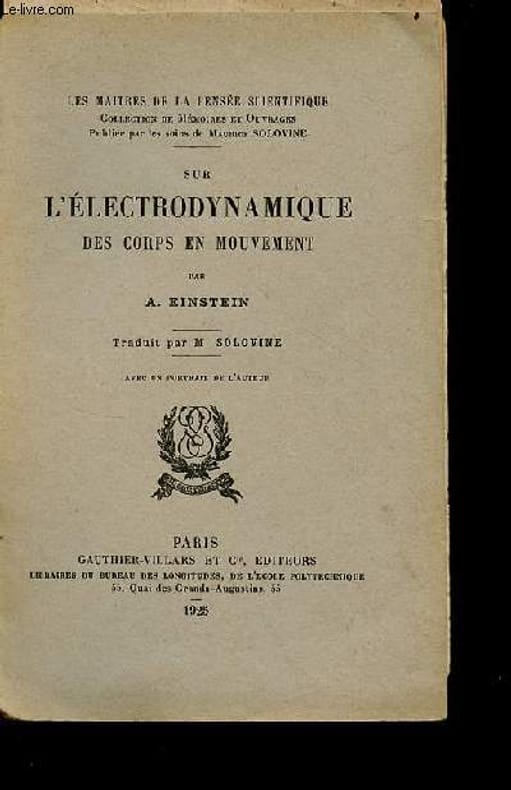
192539308Paris Gauthier-Villars et Cie 1925. Small8vo. Uncut in orig. printed wrappers. Portrait. 4562 pp. Publisher's Cat. 6 pp. 2 leaves with an insignificant small loss of upper right corner. A fine copy. <br/><br/><em>First French edition of the initials papers on Special Relativity. It is a translation of the 2 Einstein-papers which appeared in 1905 "Elektrodynamik bewegter Körper" and "Ist die Trägheit eines Körpers von seinem Energieinhalt abhängig ". Published in the series "Les Maitres de la Pensee scientifique". - Weil: 9 c - Schielpp-Schields: 189. - Boni-Laurence: 9 B and 10 B. </em> unknown
192531311Paris, Gauthier-Villars, 1925, in-12, 56pppp, broché, Superbe exemplaire! 56pppp
31311Couverture rigide. Bon/1925. in-12. Paris Gauthier-Villars 1925 in-12 56pppp broché Superbe exemplaire! unknown
192579Paris: Gauthier-Villars 1925. First French edition of Zur Elektrodynamik bewegter Korper On the Electrodynamics of Moving Bodies and 1st die Tragheit eines Korpers von seinem Energieinhalt abhangig Does the Inertia of a Body Depend on its Energy Content. Both 1905 treatises are "beyond compare and without precedent one of the greatest scientific achievements in content and one of the most brilliant in style" Gosling Albert Einstein. <br /> <br /> The first paper is "a landmark in the development of physics one of the two papers that laid out the theory of special relativity formulated a new conception of time. By assuming that the speed of light is the same to every observer moving at a constant velocity Einstein showed that space and time were not independent: spacetime was born. According to Hermann Weyl in 1918 this theory ‘led to the discovery that time is associated as a fourth coordinate on an equal footing with the other three coordinates of space and that the scene of material events the world is therefore a four-dimensional metrical continuum.' It was a revolutionary piece of scientific work" Calaprice The Einstein Almanac 15. <br /> <br /> In the second work Einstein uses "the postulates of the special theory of relativity Einstein showed that energy radiated is equivalent to mass lost. For the first time he concluded that ‘the mass of a body is a measure of its energy content'" ibid 16. CONDITION & DETAILS: Paris: Gauthier-Villars 1925. Small 8vo. 4 56 2 6 catalog. ILLUSTRATION: Frontispiece portrait of Einstein. EXTERIOR: Complete issue bound in original light brown stiff wraps. Some light surface dirt on the front wraps and a small area in the lower right where a piece of tape has been removed. Two barely visible repairs at the spine. Tightly bound. INTERIOR: Complete. Very small spot at the upper margin of page 3. Otherwise very good condition throughout. Gauthier-Villars paperback
br. Albert Einstein è da tempo diventato l'icona dello scienziato geniale, l'eletto in grado di porre le basi di una rivoluzione scientifica fertile e duratura. La svolta della relatività, iniziata nel 1905 e proseguita con la formulazione della teoria della relatività generale nel 1915, offre però moltissimo materiale per indagare più a fondo e in maniera meno ovvia le ragioni e le modalità di un cambiamento tanto epocale nel nostro modo di intendere il mondo, Einstein certamente poggiava "sulle spalle dei giganti" che lo avevano preceduto (da Galileo a Newton), ma per Jürgen Renn la scienza non progredisce in modo lineare, per semplice e lento accumulo di nozioni; più spesso di quanto si pensi all'impresa scientifica partecipano anche molti "nani", che contribuiscono in maniera decisiva a determinare le grandi scoperte. Frutto di un'indagine corale, svolta all'Istituto Max Planck di Berlino per oltre vent'anni, "Sulle spalle di giganti e nani" delinea un ritratto esemplare e a tutto tondo di una teoria complessa e solida, che mette in risalto tutti i rivoli che ne costituiscono il fondamento e che ne hanno determinato il successo, permettendoci di conoscere un po' più nel dettaglio il mondo nel quale viviamo.
19751403301975. Signiert. Im Stein monogrammiert. Druck auf Japan. 24,8 x 35,8 cm. Papier: 35 x 44,5 cm.
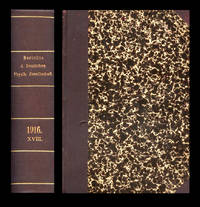
19162364Braunschweig: Druck und Verlag von Friedr Vieweg and Son 1916. First edition. Original wrappers. Very Good. FIRST PRINTING IN ORIGINAL WRAPPERS OF ONE OF EINSTEIN'S MAJOR WORKS: HIS FIRST PAPER ON THE DERIVATION OF PLANK'S LAW AND PROVIDING THE THEORETICAL BASIS FOR THE LASER. "Einstein commended the 'unparalleled boldness' of Planck's derivation of 1900 meaning not only the problem itself but also the fact that it was based on assumptions that were not entirely free of contradictions. Einstein now succeeded in the first of two papers in eliminating that flaw. More interesting than the derivation itself was the general character of his methods. Einstein proceeded from Niels Bohr's basic--and by then well tested--assumption that the electrons within an atom occupy a number of discrete energy states and are able through emission or absorption of radiation to pass from one of those states to another. Added to this was an assumption of thermodynamic equilibrium between radiation field and atom as well as a consideration of the 'classical' limiting case at high temperatures--and there was Planck's formula. This brief argument. also covers emission stimulated by the radiation field; thus the formulas already by implication contain the theory of the laser though it was to take nearly half a century to be realized" Folsing Albert Einstein 389. Weil 85. The "implication" containing the theory of the laser was more fully developed in his companion paper "On the Quantum Theory of Radiation" published a few weeks later. In the first paper Einstein wrestled with the concept that the atomic emission of radiation could be a directed process; in the second paper he convincingly demonstrates that this is indeed the case. IN: Verhandl. D. Deutch. Phys. Ges. Vol 18 pp. 318-323. Braunschweig: Druck und Verlag von Friedr. Vieweg and Son 1916. Octavo original wrappers; housed in custom half leather chemise. One thread literally resewn on wrappers a little creasing and soiling. A beautiful copy. RARE IN ORIGINAL WRAPPERS. Druck und Verlag von Friedr Vieweg and Son unknown books
128800aaf(Braunschweig, Vieweg), 1916, in-8vo, 18 S. (315-332 aus Verhandl.). Mit Abbildung, Rckn.-Broschüre.
19162364Braunschweig: Druck und Verlag von Friedr Vieweg and Son 1916. First edition. Original wrappers. Very Good. FIRST PRINTING IN ORIGINAL WRAPPERS OF ONE OF EINSTEIN'S MAJOR WORKS: HIS FIRST PAPER ON THE DERIVATION OF PLANK'S LAW AND PROVIDING THE THEORETICAL BASIS FOR THE LASER. "Einstein commended the 'unparalleled boldness' of Planck's derivation of 1900 meaning not only the problem itself but also the fact that it was based on assumptions that were not entirely free of contradictions. Einstein now succeeded in the first of two papers in eliminating that flaw. More interesting than the derivation itself was the general character of his methods. Einstein proceeded from Niels Bohr's basic--and by then well tested--assumption that the electrons within an atom occupy a number of discrete energy states and are able through emission or absorption of radiation to pass from one of those states to another. Added to this was an assumption of thermodynamic equilibrium between radiation field and atom as well as a consideration of the 'classical' limiting case at high temperatures--and there was Planck's formula. This brief argument. also covers emission stimulated by the radiation field; thus the formulas already by implication contain the theory of the laser though it was to take nearly half a century to be realized" Folsing Albert Einstein 389. Weil 85.<br /> <br /> The "implication" containing the theory of the laser was more fully developed in his companion paper "On the Quantum Theory of Radiation" published a few weeks later. In the first paper Einstein wrestled with the concept that the atomic emission of radiation could be a directed process; in the second paper he convincingly demonstrates that this is indeed the case.<br /> <br /> IN: Verhandl. D. Deutch. Phys. Ges. Vol 18 pp. 318-323. Braunschweig: Druck und Verlag von Friedr. Vieweg and Son 1916. Octavo original wrappers; housed in custom half leather chemise. One thread literally resewn on wrappers a little creasing and soiling. A beautiful copy. RARE IN ORIGINAL WRAPPERS. Druck und Verlag von Friedr Vieweg and Son unknown
19161614Braunschweig: Druck und Verlag von Friedr. Vieweg and Son 1916. 1st Edition. FIRST EDITION OF AN IMPORTANT WORK BY EINSTEIN: HIS FIRST PAPER ON THE DERIVATION OF PLANCK'S LAW HERE INTRODUCING THE THEORY OF THE STIMULATED EMISSION OF ELECTROMAGNETIC RADIATION INTO THE QUANTUM THEORY. "EINSTEIN'S CONCEPT OF STIMULATED EMISSION IS THE OPERATING PRINCIPLE OF THE NOW UBIQUITOUS LASER" Brandt Harvest of the Century 136. <br /> <br /> In 1900 Max Planck laid the foundation for quantum theory with his publication of Planck's law. Though Einstein commended Planck in his own "light-quantum hypothesis of 1905 he Einstein postulated that the energy quantization is a property of the radiation field itself and not due to the material resonators as Planck believed" ibid. "Einstein found a similarity between a cavity filled with radiation consisting of quanta and a vessel filled with gas consisting of atoms" Brandt Harvest of the Century 136. Einstein believed that "although either part of Planck's derivation was in itself consistent their combination was logically incompatible.For Einstein this inconsistency was no reason to reject Planck's quantum theory as such" it was a reason to study the foundations of traditional radiation theory and if needed revise them Jammer The Conceptual Development of Quantum Mechanics 26. <br /> <br /> "After completion of his general theory of relativity in 1916 Einstein was able to derive Planck's original quantum law to his satisfaction "by considering the possible interactions between radiation and matter" Brandt. From there he was able to suggest that in addition to spontaneous emission and absorption a process of stimulated emission could also take place. <br /> <br /> In Einstein's derivation of Planck's law he treats "the interaction between light quanta and atoms in the formalism of his A and B coefficients. They describe the probabilities for the absorption and emission of a light quantum of a given energy. The probability of absorption is of course proportional to the density of the radiation of that frequency. The emission is in part spontaneous like radioactivity but there is also stimulated emission which again is proportional to the density of the radiation of that frequency ibid. This is one of two papers Einstein wrote on the subject. <br /> <br /> Einstein's derivation "predicted that as light passed through a substance it could stimulate the emission of more light. This effect is at the heart of the modern laser" The Quantum and the Cosmos I History AIP portal. CONDITION & DETAILS: Braunschweig: Druck und Verlag von Friedr. Vieweg and Son. 8.5 x 6 in. vi 485 1 2 368. 2. Ex-libris with few markings and non at the spine see scan. Tightly bound. Brown cloth over marbled paper boards; gilt- ruled and lettered at the spine. Clean and bright throughout. Near fine. This volume is bound together with the 1916 volume titled Halbmonatliches Literaturverzeichnis der "Fortschritte der Physik" Bi-monthly bibliography of the "Advances in Physics". Druck und Verlag von Friedr. Vieweg and Son hardcover
1990237634PN. New. 1990. Soft Cover. Date is original print. This is a reprint edition . PN paperback
0394735242.Gpaperback. Good. Access codes and supplements are not guaranteed with used items. May be an ex-library book. paperback
0025351001.Ghardcover. Good. Access codes and supplements are not guaranteed with used items. May be an ex-library book. hardcover
U02B-05388Macmillan Pub Co. Used - Good. Good condition. Very Good dust jacket. A copy that has been read but remains intact. May contain markings such as bookplates stamps limited notes and highlighting or a few light stains. Macmillan Pub Co unknown
0886712173New. paperback. New. Satisfaction Guaranteed or your money back. paperback
1986Q-0886712173Brand: 1986-01-01. Paperback. New. In shrink wrap. Looks like an interesting title! Brand: paperback
50102pamphlet. 11 pages p 1105-1115 FROM: Annalen der Physik fourth series vol. 33. Modern wrappers. Leipzig 1910.<br/><br/> unknown books
50102pamphlet. 11 pages p 1105-1115 FROM: Annalen der Physik fourth series vol. 33. Modern wrappers. Leipzig 1910.<br/> <br/> unknown
200472753Stuttgart, B.G. Teubner, 2004. Ein neuer Zugang in Einsteins Welt (Mit einem Beitrag über Literatur zur Relativitätstheorie bei B. G. Teubner) 154 S. (24 cm) Paperback / kartonierte Ausgabe