Einstein, AlbertBiblio.com
2 944 résultats
1494091399.Gpaperback. Good. Access codes and supplements are not guaranteed with used items. May be an ex-library book. paperback
0837101247.Ghardcover. Good. Access codes and supplements are not guaranteed with used items. May be an ex-library book. hardcover
66-0300New York: Philosophical Library 1951. 8vo. 309 pp. Very good in blue cloth in good scuffed dust jacket with a few tears. Spine bottom slightly frayed; spine top less so. Light wear to all cover corners. Page edges slightly yellowed. Previous owner's signature on front endpaper at top. Foreword by Albert Einstein. New York: Philosophical Library, 1951. hardcover
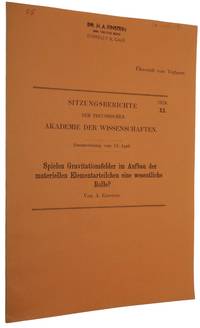
19191857Berlin: Königlich Akademie der Wissenschaften 1919. First Edition. Fine. FIRST EDITION IN ORIGINAL WRAPPERS of one of Einstein's major papers on the modification of general relativity and the beginning of his unified field theory. "As so often the case in relativity the story of quantum gravity begins with Einstein himself. Soon after the final formulation of general relativity he pointed out the need for a quantum modification of the theory. In "Do Gravitational Fields Play an Essential Role in the Structure of the Elementary Particles of Matter" he began to speculate whether gravitation plays a role in the atomistic structure of matter: There are reasons for thinking that the elementary formations which go to make up the atom are held together by gravitational forces. The above reflections show the possibility of a theoretical construction of matter out of the gravitational field and the electromagnetic field alone. "In order to construct such a model of an 'elementary particle' Einstein shows that it is necessary to modify the original gravitational field equations. The major interest of this paper is that his attention now shifted from possible quantum modifications of general relativity to the search for a unified theory of the electromagnetic and gravitational fields on the basis of which he hoped to explain the structure of matter. Quantum effects are to be derived from such a theory rather than postulated ad hoc. Einstein remained committed to this approach for the rest of his life: the search for a 'natural' mathematical extension of the general theory in the hope that such a theory would somehow explain the quantization of matter and energy" Iyer and Bhawal Black Holes Gravitational Radiation and the Universe. IN: Sitzungsberichte der Preussischen Akademie der Wissenschaften Vol XX pp. 349-356. Berlin: Akademie der Wissenschafter 1919. Octavo original wrappers; custom box. A tiny bit of edgewear. A FINE COPY. Königlich Akademie der Wissenschaften unknown books
19196166Berlin: Verlag der Akademie der Wissenschaften In Kommission bei Walter de Gruyter Reichsdruckerei 1919. First edition. <p>First edition extremely rare author's presentation offprint 'Überreicht vom Verfasser' and the copy of Einstein's son Hans Albert of "Einstein's first attempt at a unified field theory" Pais Subtle is the Lord. Once Einstein completed work on the general theory of relativity at the end of 1915 "his attention shifted to the search for a unified theory of the electromagnetic and gravitational fields out of which he hoped to be able to explain the structure of matter. Quantum effects were to be derived from such a theory rather than postulated ad hoc. This remained his approach for the rest of his life" Cao Conceptual foundations of quantum field theory.</p>. EINSTEIN'S FIRST ATTEMPT AT A UNIFIED FIELD THEORY" PAIS<br /> HANS ALBERT EINSTEIN'S COPY OF THE PRESENTATION OFFPRINT. <p>First edition extremely rare author's presentation offprint 'Überreicht vom Verfasser' and the copy of Einstein's son Hans Albert of "Einstein's first attempt at a unified field theory" Pais Subtle is the Lord p. 287. Once Einstein completed work on the general theory of relativity at the end of 1915 "his attention shifted to the search for a unified theory of the electromagnetic and gravitational fields out of which he hoped to be able to explain the structure of matter. Quantum effects were to be derived from such a theory rather than postulated ad hoc. This remained his approach for the rest of his life" Cao Conceptual foundations of quantum field theory pp. 166-167. "As so often the case in relativity the story of quantum gravity begins with Einstein himself. Soon after the final formulation of general relativity he pointed out the need for a quantum modification of the theory. In his first paper on gravitational radiation the 1916 paper 'Näherungsweise Integration der Feldgleichungen der Gravitation' 'Approximate Integration of the Field Equations of Gravitation' Einstein argued that quantum effects must modify the general theory of relativity. Two years later he reiterated this conclusion the 1918 paper 'Über Gravitationswellen' 'On Gravitational Waves': 'As already emphasized in my previous paper the final result of this argument which demands a gravitational energy loss by a body due to its thermal agitation must arouse doubts about the universal validity of the theory. It appears that a fully developed quantum theory must also bring about a modification of the theory of gravitation.' Einstein writing in the 1919 paper offered here soon began to speculate whether gravitation plays a role in the atomistic structure of matter: 'There are reasons for thinking that the elementary formations which go to make up the atom are held together by gravitational forces. The above reflections show the possibility of a theoretical construction of matter out of the gravitational field and the electromagnetic field alone' In order to construct such a model of an 'elementary particle' Einstein shows that it is necessary to modify the original gravitational field equations .The major interest of this paper is that his attention now shifted from possible quantum modifications of general relativity to the search for a unified theory of the electromagnetic and gravitational fields on the basis of which he hoped to explain the structure of matter. Quantum effects are to be derived from such a theory rather than postulated ad hoc. Einstein remained committed to this approach for the rest of his life: the search for a 'natural' mathematical extension of the general theory in the hope that such a theory would somehow explain the quantization of matter and energy" Iyer and Bhawal Black Holes Gravitational Radiation and the Universe pp. 525-526. Einstein's work on unified field theory was inspired by James Clerk Maxwell's success in finding a unified theory of electricity and magnetism one of the greatest achievements of nineteenth century physics which showed that light was a form of electromagnetic wave and made possible modern inventios such as radio television and the telephone. Einstein continued his attempts to devise a unified theory of gravitation and electromagnetism for the rest of his life; his contributions in this area represent about a quarter of his entire research output and half his scientific production after 1920. Although he was ultimately unsuccessful a similar vision was realized in the decades after his death in the construction of the 'standard model' a unified theory of electromagnetism with the weak and strong nuclear forces which were unknown in Einstein's time and efforts to incorporate gravity into the model continue to this day. RBH lists three copies. OCLC lists only one copy none in US.</p> <br /> <p>Provenance: Hans Albert Einstein 1904-73 ink stamp and pencil notes on front wrapper. Hans Albert Einstein was a Swiss-American engineer and educator the second child and first son of physicists Albert Einstein and Mileva Marić. He was a long-time professor of hydraulic engineering at the University of California Berkeley.</p> <br /> <p>"As early as 1909 in his fundamental paper 'Zum gegenwärtigen Stand des Strahlungsproblems' 'On the current status of the radiation problem' which resulted from a discussion with Walter Ritz Einstein remarks 'dass des elektrische Elementarquantum e ein Fremdling ist in der Maxwell-Lorentzschen Elektrodynamik' 'that the electrical elementary quantum e is alien to Maxwell-Lorentz electrodynamics'. Einstein expressed the hope that 'die gleiche Modifikation der Theorie welche das Elementarquantum e als Konsequenz enthält auch die Quantenstruktur der Strahlung als Konsequenz enthalten wird' 'the same modification of the theory which contains the elementary quantum e as a consequence will also contain the quantum structure of radiation as a consequence'. Pauli 1949 in his review about 'Einstein's Contribution to Quantum theory' pointed out that though quantum theory later on deduced the quantum structure of radiation it has not solved Einstein's first problem and the elementary charge 'auch in der Quantenmechanik ein Fremdling geblieben ist' 'has also remained alien to quantum mechanics'. He emphasized that just this fact had been one of the strongest arguments to Einstein against the finality of the steps leading to quantum mechanics.</p> <br /> <p>"So during his Berlin years Einstein made it his task to find a synthesis of his general theory of relativity GRT and the then nascent quantum physics. In this connection he attributed logical primacy to the relevant relativistic field theory because it had reached a high degree of maturity in the GRT. After all Einstein's general-relativistic gravitation theory is the first theory on the fundamentals of physics working with genuinely non-linear equations and Einstein observed that such a nonlinearity is necessary for understanding the existence of the 'discrete field-quanta.' A linear theory allowing arbitrary superposition of fields would without further restrictions in the form of boundary and uniqueness conditions never lead to a discrete spectrum of solutions. But recourse to such restrictions means that the fields are held together by the operation of entities outside the scope of the theory .</p> <br /> <p>"In Einstein's view the problem of incorporating the elementary particles into field physics involved the question of finding field-theoretical models of electrons and protons which were the only known particles at that time. Einstein searched for solutions or general-relativistic field equations for the combined gravitational and electromagnetic fields representing mass and charge distributions with central symmetry and he hoped there would emerge self-consistent solutions only for discrete values of the mass and charge parameters i.e. for a 'particle spectrum.'</p> <br /> <p>"This 'Einstein particle problem' pursued ideas that had been developed already in the framework of the special theory of relativity and the Maxwell-Lorentz electrodynamics for instance in the nonlinear theory of the electromagnetic field by G. Mie and D. Hilbert. As an essential progress by the general-relativistic treatment Einstein regarded the genuine nonlinearity of the field equations which Mie and Hilbert had to introduce ad hoc and full consideration of the particle dynamics in the sense of the general-relativistic problem of motion. The generalizations of the Maxwell equations considered by Mie and Hilbert contain a too small number of components for the integrability conditions to determine the particle dynamics whereas the Einstein problem of motion in the GRT furnishers just this dynamics as a consequence of the integrability conditions for the field equations of gravitation. It is the GRT that with its metric field for the first time embraces inertia and gravity that is just those properties which are characteristic of all particles.</p> <br /> <p>"Einstein in fact succeeded in driving self-consistent gravitational and electromagnetic fields which can be interpreted as particle models of that kind. But his success depended on a weakening of his own equations of gravitation which physically amounts to the introduction of an additional hypothetical cosmical field of the 'Poincaré pressure.' By this weakening it becomes possible to set up self-consistent particle models with spherical symmetry for arbitrary centrosymmetric mass and charge distributions. In 1919 Einstein presented his result to the academy in his paper 'Spielen Gravitationsfelder im Aufbau der materiellen Elementarteilchen eine wesentliche Rolle' His answer to the question says that in his particle models the electrical field energy contributes ¾ and the gravitational energy ¼ of the total energy.</p> <br /> <p>"Einstein's first discourses on the particle problem in the GRT were closely related to the 1917/18 papers in which he laid the foundations of relativistic cosmology. In his Academy report 'Kosmologische Betrachtungen zur allgemeinen Relativitätstheorie' 'Cosmological considerations on the general theory of relativity' 1917 Einstein had by introducing the term λgμν with the 'cosmological constant' λ extended his equations of gravitation to his cosmological equations of gravitation</p> <br /> <p>Rμν - ½ gμνR λgμν = - κ Tμν . </p> <br /> <p>He could show that these equations permit as a particular solution with λ > 0 and constant positive mass density a statical model of the universe representing a closed spheric or elliptic three devotional Riemannian space .</p> <br /> <p>"In his paper of 1919 about the role of gravitation in the structure of elementary particles Einstein also interpreted the cosmological constant λ as the universal 'Poincaré' pressure' which according to a hypothesis of H. Poincaré is to guarantee the stability of Lorentz's electrons against their own repulsion forces. Einstein's ideas concerning this matter partly resulted from a controversial discussion with E. Schrödinger 1918 about the gravitational energy in the GRT and the structure of the energy tensor" Treder pp. 149-151.</p> <br /> <p>Indeed Schrödinger had pointed out another way of treating the cosmological constant: moving it from the left-hand side of equation where it represents a contribution to space-time curvature to the right-hand side where it represents a contribution to the energy-matter distribution. Then it would correspond physically to a kind of cosmic pressure. Schrödinger believed this might be the pressure postulated by Poincaré to maintain the stability of charged particles: an electric charge on the surface of a sphere creates a force pushing outwards so without any opposing force the charged sphere would explode outwards. </p> <br /> <p>Einstein never liked the cosmological constant. In the present paper he acknowledged that his introduction of the cosmological constant was "gravely detrimental to the formal beauty of the theory" Cambridge Companion to Einstein p. 257.</p> <br /> <p>Boni-Russ-L. 111; Schilpp 123; Weil 106. Treder 'Antimatter and the particle problem in Einstein's cosmology and field theory of elementary particles A historical essay on Einstein's work at the Akademie der Wissenschaften zu Berlin' Astronomische Nachrichten 296 1975 pp. 149-161.</p> <br/> <br/> Large 8vo 254 x 182 mm pp. 349-356. Original printed wrappers. A very fine copy. Verlag der Akademie der Wissenschaften, In Kommission bei Walter de Gruyter [Reichsdruckerei] unknown
200764280Wiesbaden, B. G. Teubner Verlag // GWV Fachverlage GmbH, 2007. Gr.8°; 341 Seiten, 65 Abbildungen; 1. Auflage Orig.-Broschur geringe Gebrauchsspuren
1987156153Metuchen NJ: The Scarecrow Press 1987. Hardcover. Fair. xv 1051 p. 22 cm. Black hardcover. Small tear in top of spine. Cracking at p. 3 and pages 3-22 detached. <br/><br/> The Scarecrow Press hardcover
0810832208.Ghardcover. Good. Access codes and supplements are not guaranteed with used items. May be an ex-library book. hardcover
Mm 130x180 Collana "Biblioteca di cultura scientifica - Serie azzurra". Volume nella sua brossura originale, 258 pp. con XX disegni in nero nel testo e una tavola con figura dell'Autore in apertura. Il libro è in perfette condizioni. Spedizione in 24 ore dalla conferma dell'ordine.
In 8', bross.ed., pp.126.Qualche lieve traccia del tempo alla cop. con lievi bruniture intorno al dorso,il resto in buone condizioni.Ristampa anastatica sull'edizione del 1922.Prefaz. di Carlo Bernardini.Luogo di pubblicazione BolognaEditore ZanichelliAnno pubblicazione 1981Collana Collana di Fisica CF1Materia/Argomento Fisica, Einstein
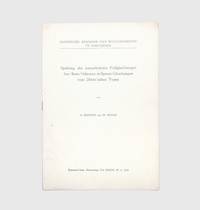
1933180318Amsterdam: Koninklijke Akademie van Wetenschappen 1933. First edition offprint issue of the third of Einstein and Mayer's four classic papers on semi-vectors in which they aimed to incorporate the Dirac equation into the general theory of relativity. "By introducing semi-vectors Einstein wanted to arrive at a mathematically simpler and more general formulation of spinors. The semi-vector generalization of the Dirac equation was thought to give a unified description of charged elementary particles in particular of the electron and proton" Van Dongen pp. 103-5. Large octavo pp. 4. Original cream wrappers front wrapper printed in black wire-stitched as issued. Extremities gently creased short closed tears at spine ends occasional light foxing: a very good copy. Boni 223; Weil 192. Jeroen van Dongen Einstein's Unification 2010. unknown
In-8 (cm. 22), brossura, pp. pp. 676, con illustrazioni in bianco e nero. In buono stato di conservazione (good copy).
Pais, Abraham Sottile è il signore...La vita e la scienza di Albert Einstein. , Bollati Boringhieri 1986-10-01 - TS.2 italian, 676 Opera con copertina rigida e sovraccoperta. ill. in b/n ft e nt. TS.2.
20051-0060838515Harper Resource 2005. Hardcover. New. 286 pages. 11.00x9.50x1.00 inches. Harper Resource hardcover
1922692L1Berlin: Akademie der Wissenchaften 1922-38. Cloth. Very Good Indeed. 10.5" by 7.5". None. A scarce complete run of the Akademie der Wissenschaften's publications from the year 1922-38 which contain twenty-six first editions of Einstein's lectures held at the Prussian Academy 1922-38. Containing 26 first editions of Einstein's lectures held at the Prussian Academy 1922-38 some library ink stamps some toning occasional fraying and one or two closed tears bound with original printed wrappers uniform cloth spines slightly faded and with remnants of paper labels at foot large 8vo Comprising of the following works by Einstein: 1. Zur Theorie der Lichtfortpflanzung in dispergierenden Medien 1922 pp. 18-22; 2. Bemerkung zu der Abhandlung von E. Trefftz: Das statische Gravitationsfeld zweier Massenpunkte in der Einsteinschen Theorie 1922 pp. 448-449; 3. Zur allemeinen Relativitätstheorie 1923 pp. 32-38; 4. Bemerkung zu meiner Arbeit "Zur allgemeinen Relativitätstheorie" 1923 pp. 76-77; 5. Zur affinen Feldtheorie 1923 pp. 137-140; 6. Bietet die Feldtheorie Moeglichkeiten fuer die Loesung des Quantenproblems 1923 pp. 359-364; 7. Quantentheorie des einatomigen idealen Gases 1924 pp. 261-267; 8. Quantentheorie des einatomigen idealen Gases. Zweite Abhandlung 1925 pp. 3-25; 9. Einheitliche Feldtheorie von Gravitation und Elektrizität 1925 pp.414-419; 10. Über die Interferenzeigenschaften des durch Kanalstrahlen emittierten Lichtes 1926 pp. 334-340; 11. With J. Grommer: Allgemeine Relativitätstheorie und Bewegungsgesetz 1927 pp.2-13; 12. Zu Kaluzas Theorie des Zusammenhanges von Gravitation und Elektrizität. Erste Mitteilung 1927 pp. 23-25; 13. Zu Kaluzas Theorie des Zusammenhanges von Gravitation und Elektrizität. Zweite Mitteilung 1927 pp. 26-30; 14. Allgemeine Relativitätstheorie und Bewegungsgesetz 1927 pp. 235-245; 15. Reimann-Geometrie mit Aufrechterhaltung des Begriffes des Fernparallelis-mus 1928 pp. 217-221; 16. Neue Möglichkeit für Eine Einheitliche Feldtheorie von Gravitation und Elektrizität 1928 pp. 224-227; 17. Zur einheitlichen Feldtheorie 1929 pp. 2-7; 18. Einheitlichen Feldtheorie 1929 pp. 2-7; 19. Die Kompatabilität der Feldgleichungen in der einheitlichen Feldtheorie 1930 pp. 18-23; 20. With Walter. Mayer: Zwei Strenge Statische Losungen der Feldgleichungen der Einheitlichen Feldtheorie 1930 pp. 110-120; 21. Zur Theorie der Raeume mit Riemann-Metrik und Fernparallelismus 1930 pp. 401-402; 22. Die Kompatibilitaet der Feldgleichungen in der einheitlichen Feldtheorie 1930 pp. 18-23; 23. Zum Kosmologischen Problem der allgemeinen Relativitaetstheorie 1931 pp. 235-237; 24. Systematische Untersuchung über kompatible Feldgleichungen welche in einem Riemannschen Raume mit Fern-Parallelismus gesetzt werden können 1931 pp. 257-265; 25. Einheitliche Theorie von Gravitation und Elektrizitaet 2. Abhandlung 1932 pp. 130-137; 26. Semi-Vektoren und Spinoren 1932 pp. 522-550. Einstein is known for developing the theory of relativity which is one of the two pillars of modern physics. His work greatly influenced the philosophy of science and for producing the world's most famous equation 'E= mc2'. He won the Nobel Prize in Physics in 1921 for his services to theoretical physics and for his discovery of the law of the photoelectric effect. The papers to this work include Einstein's papers on Bose-Einstein condensation the phenomenon that causes bosons to become a superfluid at low temperatures. There is also Einstein's two part commentary on Kaluza's theory involving field equations in five-dimensional space. These papers are from the Royal Prussian Academy of Sciences which was first established in 1700. In uniform full cloth bindings. With the original paper wraps bound in. Externally all volumes are very smart. Light fading to the spine. Light shelfwear to the joints. Small split to the front joint of 1929 volume. A few marks to the tail of spines with evidence of library label removal. Internally all volumes are firmly bound. Institutional stamp to the verso of original wraps bound in for the Bodleian Library with their cancellation stamps. Repair to the front wrap of 1928 wrap. Minor chips to the occasional extremity. Pages are slightly age toned to edges due to paper used. Otherwise pages are very clean. Very Good Indeed Akademie der Wissenchaften hardcover
20191-0764357271Schiffer Pub Ltd 2019. Hardcover. New. 272 pages. 11.25x8.75x1.25 inches. Schiffer Pub Ltd hardcover
196018958Gauthier-Villars Couverture souple Paris 1960
196023277Paris, 1960, in-8, (6), 57, (3)pp, broché, Traduit de l'anglais par Solovine et Tonnelat. Cet ouvrage forme l'appendice à la 5° édition de "Meaning of Relativity" (décembre 1954) (6), 57, (3)pp.
196074379Gauthier-Villars et Cie, éditeurs Malicorne sur Sarthe, 72, Pays de la Loire, France 1960 Book condition, Etat : Bon broché, sous couverture imprimée éditeur grand In-8 1 vol. - 59 pages
1960101332Gauthier-Villars et Cie, éditeurs Malicorne sur Sarthe, 72, Pays de la Loire, France 1960 Book condition, Etat : Bon broché, sous couverture imprimée éditeur grise grand In-8 1 vol. - 59 pages
23277Couverture rigide. Bon/1960. in-8. Paris 1960 in-8 6 57 3pp broché Traduit de l'anglais par Solovine et Tonnelat. Cet ouvrage forme l'appendice à la 5° édition de ""Meaning of Relativity"" décembre 1954 unknown
193313747Los Angeles 1933. Signed by the photographer Aaron Tycko of Los Angeles. Prominently signed “Albert Einstein. 1933†below image. Rarely seen photograph of the famous scientist taken during his last visit to Southern California in January 1933 the month Hitler took power in his native Germany. During the five-month trip Einstein 1879-1955 spent most of his time at the Mount Wilson Observatory and the California Institute of Technology where he was offered a position. Later that year he renounced his German citizenship and accepted a professorship at the Institute for Advanced Studies in Princeton New Jersey.<br /> <br /> Tycko 1893-1975 was based in Los Angeles and often photographed Einstein along with other Hollywood icons of the early twentieth century including Irving Berlin. At the time this photograph was taken Tycko also shot a well-known photograph of Einstein with his wife Elsa. Interestingly Tycko is mention in Einstein’s FBI files because a Hollywood informant reported that the photographer believed Einstein was a communist. This informant contended that Tycko thought Einstein was “the brain that was setting up Hollywood in the 1930’s for the big Communist push . . . He was one of the most dangerous and powerful figures in what has become the Communist movement.†<br /> <br /> Jerome The Einstein File: J. Edgar Hoover’s Secret War Against the World’s Most Famous Scientist. unknown
106283aafLondon: Methuen & Co.Ltd, 1922, sm. in-8vo, 2 leaves (halftitle & titlepage) + 56 p. + 2 leaves + 8 p. publicity on diff. paper, printed on heavy paper, slightly yellowed, Ex-Libris ‘Edward Wilder Playfair’, full cloth publisher’s binding, blind-stamped title to front, gilt title to spine, spine sunned.
198335229NY: Dover 1983. 8vo pp. 56. Paper wraps. Cover very slightly soiled o/w a nice tight copy. Two addresses: Ether and the theory of relativity 1920 and Geometry and experience 1921. Dover unknown books
0266512895.Ghardcover. Good. Access codes and supplements are not guaranteed with used items. May be an ex-library book. hardcover