FOOTE, Eunice NewtonBiblio.com
311 résultats
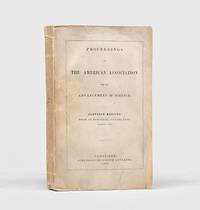
1858155260Cambridge: Joseph Lovering 1858. One of only two known papers by the author Uncommon first edition of the first article by a woman published in the Proceedings of the AAAS: a well-preserved copy in the original wrappers with the ownership signature of American ornithologist George N. Lawrence 1806-1895 listed as a member of the AAAS on p. xxxviii of this volume. The American scientist inventor and women's rights campaigner Eunice Newton Foote 1819-1888 is best remembered for her discovery of the absorption of thermal radiation by carbon dioxide and water vapour: namely the greenhouse effect. Her famous paper on the topic was presented to the AAAS in August 1856 read on her behalf by Joseph Henry first Secretary of the Smithsonian and published shortly after in the American Journal of Science and Arts. This is Foote's second paper which provides an early experimental description of the effect of a pressure-driven change on the static electricity of air with reference to observations by Humboldt Sabine and de Saussure. It was presented to the AAAS on 14 August 1857 again read by Joseph Henry on her behalf. Its first appearance in print was in the Proceedings; abbreviated versions later appeared in the American Journal of Science and Arts and in the Philosophical Magazine. In Mary Creese's landmark study of American and British women scientists from 1800 to 1900 she noted that of the approximately 3400 scientific publications authored by women in the period - less than 1% of the total published - there were "just 16 papers by American women in physics over the whole century. Only two pre-date 1889 and they are the two papers by Eunice Foote" Jackson p. 117. John Perlin author and visiting scholar at the UCSB Physics department which hosted a 2019 exhibition on Foote remarked that she was "the only woman to be published in serious physics journals until Madame Curie" quoted in Jacobs. Octavo. Five folding plates one engraved with astronomical illustrations the rest featuring diagrams and graphs and two engraved plates numerous illustrations in text. Original buff printed wrappers. Faint pencilled signature "Geo. N. Lawrence" along upper edge of front cover pencilled number at centre of spine. Wrappers expertly restored spine ends chipped contents crisp and clean: a very good copy. Roland Jackson "Eunice Foote John Tyndall and a Question of Priority" Notes and Records 74 2019 pp. 105-18; Tom Jacobs "More than a Historical Foote Note" UCSB's The Current 6 November 2019 available online. unknown
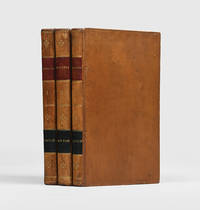
1819183664London: Printed for Sherwood Neely and Jones; and Davis and Dickson 1819. The Newtonian ascendancy A handsomely bound edition bringing together Newton's masterpiece with several works refining Newtonian theory and an early draft of the Principia itself. This translation of the Principia together with the Laws of the Moon's Motion by John Machin c. 1686-1751 is drawn from the first edition in English published in 1729. William Davis 1771-1807 originally brought out the three-volume edition in 1803 revising and extending Motte's translation to cover the remaining third of Newton's text. This is thus only the second edition of a complete translation of the Principia into English. No further edition was published until the "modernized" version brought out by the University of California Press in 1934 and no entirely new translation was made until 1999. This edition pairs these works with the Short Comment on and Defence of The Principia 1770 by William Emerson 1701-1782 and Newton's own System of the World written 1685. By the turn of the 19th century the Principia's theory of gravity had become widely accepted in scientific circles and Davis's edition "made this available to a number of generations of nineteenth-century students" ODNB. 3 vols octavo 212 x 127 mm. Engraved portrait frontispiece and 56 plates 8 of which folding. Extensive tables and formulae in the text. Contemporary calf spines lettered decorated and ruled in gilt and with red and black morocco labels covers panelled in blind light brown coated endpapers edges sprinkled brown. Spine ends restored. Light bumping and wear minor browning and offsetting to contents: a very good copy. Babson 22; Grey 25; Wallis 25. unknown
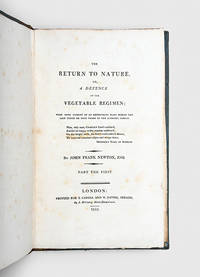
1811164685London: printed for T. Cadell and W. Davies by J. McCreery 1811. The root of the Shelleys' vegetarianism First edition of this pioneering work of vegetarianism in which the author advocates for the medical and intellectual benefits of a meat-free diet. It was a great influence on fellow vegetarian Percy Bysshe Shelley as well as on Mary Shelley's depiction of the Creature as a herbivore in Frankenstein. This is a particularly well-preserved copy in the original boards. Newton 1767-1837 promoted a diet of fruit vegetables raisins bread eggs milk and potatoes and he drank only distilled water because of his belief that the Thames was contaminated with animal fat. Unlike his mentor William Lambe 1765-1847 Newton was not a vegan. He inspired several significant figures to adopt a vegetarian diet including the physician John Snow 1813-1858 and Percy Shelley whose Vindication of Natural Diet 1813 echoed Newton's ideas. "It is from his meeting with John Newton in November 1812 that Shelley's proselytising vegetarianism dates. From Newton's book he drew many of his arguments" Crook and Guiton p. 77. The two men differed in the fact that Newton was mainly concerned with the scientific benefits rather than the moral implications of vegetarianism. "Though not a doctor Newton regarded The Return to Nature principally as a work of medicine; he had himself found relief from chronic asthma through vegetarianism and was anxious to impart to others the knowledge of its benefits in a number of diseases" ibid. However "in one of his most surprising and emphatic passages" Newton ventures into a diatribe against "the monster syphilis with all its gorgon terrors" and explains his hope that vegetarianism could cause it to "be driven from the earth" p. 131. This was expanded upon by Shelley in his own writing through his emphasis on the immorality of consuming flesh in all its guises along with his link between a carnivorous diet and alcoholism. He made use of the allegory of Prometheus; it was only through the unnatural theft of fire that humans gained the ability to transform meat from bloody flesh into something fit for consumption. Newton was also an occasional guest of Mary Shelley's father William Godwin a fellow proponent of the vegetarian diet. Presumably it was because Newton's ideas filtered through Shelley and Godwin that Mary Shelley decided to describe the Creature in Frankenstein as a vegetarian: "My food is not that of man; I do not destroy the lamb and the kid to glut my appetite; acorns and berries afford me sufficient nourishment. The picture I present to you is peaceful and human." The Return to Nature is rare in commerce particularly so in original boards. We can trace just one copy thus at auction which appeared over 50 years ago. Octavo. Uncut in original brown paper-backed blue boards printed paper spine label. Dedication leaf misbound following introduction. Head of spine crumpled corners worn light foxing to boards and contents but otherwise very crisp initial leaves creased at upper margin leaf A3 partially loose at lower cord and consequently standing proud: a very good copy. Nora Crook & Derek Guiton Shelley's Venomed Melody 2010. hardcover
18552091202133212831Bell and Daldy 1855. Soft Cover. Fine. Volume: 1 Bell and Daldy paperback
1803327150London: Symonds 1803. hardcover. near fine. 3 volumes. 55 folding copper engravings and small engravings throughout the text frontispiece copperplate portrait of Isaac Newton in volume 1. 8vo handsomely rebound in full dark brown calf with blind-stamped design on covers and spine black leather spine labels. Some scattered age toning and spotting; neat small ownership name at top of title pages and half titles. London: H. D. Symonds 1803. A scarce set in a handsome binding.<br/> <br/> Symonds unknown
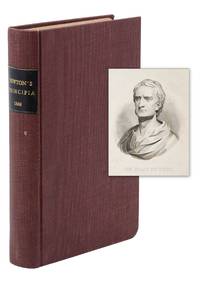
1848140949208New York: Daniel Adee 1848. First American Edition. Very Good. First American edition first printing with date 1848 on title page and publisher's address listed as 107 Fulton-Street. 4 v-viii 9-581 pp. illustrated with engraved frontispiece protected by tissue guard. Recently bound in maroon buckram title label to spine. Very Good with light wear to covers and slight bumping to lower corners; title label beginning to lift at one corner. Band of paper residue to front free endpaper. Light toning and moderate foxing to textblock edges and contents dampstain to outer textblock edge and outer margin throughout. Cohen pp. 347-352.<br /> <br /> <p>The first American edition of the foundational physics text first published in Latin in 1687. Andrew Motte's 1729 translation was reprinted in 1803 and 1819 in Britain but subsequent 19th century editions were printed only in the United States and Germany. The New York-based publisher Daniel Adee deposited a copyright for the Principia in 1846 then printed five issues between 1848 and 1850. A contemporary notice in the Scientific American declared:<br /> <br /> <p>"For a long time the 'Principia' was kept far out of the reach of the mere English Scholar as if Newton had written it exclusively for the classical student and philosopher. It was a scarce book when printed in the Latin language; it is now thanks to the spirit of an American publisher printed in our mother tongue and should find a place in every family library. Daniel Adee unknown
1803122898London: Printed for H.D. Symonds 1803. First complete edition in English of Sir Isaac Newton's Principia the greatest work of physics in the exceedingly rare original boards. Octavo 3 volumes bound in original boards uncut 54 folding copper-engraved plates of diagrams and figures all but one folding; 2 folding tables. with 22 folding. In near fine condition with light toning to the text. An exceptional example rare and desirable in the original boards. Housed in a custom clamshell box. "Newtons Principia is generally described as the greatest work in the history of science. Copernicus Galileo and Kepler had certainly shown the way; but where they described the phenomena they observed Newton explained the underlying universal laws. The Principia provided the greatest synthesis of the cosmos proving finally its physical unity. Newton showed that the important and dramatic aspects of nature that were subject to the universal law of gravitation could be explained in mathematical terms with a single physical theory. With him the separation of the natural and supernatural of sublunar and superlunar worlds disappeared. The same laws of gravitation and motion rule everywhere; for the first time a single mathematical law could explain the motion of objects on earth as well as the phenomena of the heavens. The whole cosmos is composed of inter-connecting parts influencing each other according to these laws. It was this grand conception that produced a general revolution in human thought equaled perhaps only by that following Darwins Origin of Species Newton is generally regarded as one of the greatest mathematicians of all time and the founder of mathematical physics" PMM 161. "It is perhaps the greatest intellectual stride that it has ever been granted to any man to make" Einstein. Printed for H.D. Symonds hardcover books
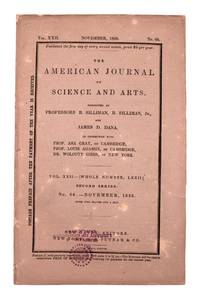
1856323434New York: G.P. Putnam & Co 1856. Three engraved plates folding engraved map woodcut text figures. 8vo. Original printed wrappers untrimmed; some occasional light marginal foxing wrappers chipped at head and foot of spine. Three engraved plates folding engraved map woodcut text figures. 8vo. The first appearance of the discovery of greenhouse gasses as delivered on Foote's behalf before the American Association for the Advancement of Science AAAS on August 23 1856 she was not a member although there were two women members by 1850 three years after its founding. Although in the early 19th Century Joseph Fourier suggested that the Earth's temperature was warmed by more than just the sun and Claude Pouillet suggested that water vapor and carbon dioxide must effect it it was Foote who provided the first experimental proof of the insulating effects of various gasses proving that increasing amounts of carbon dioxide in the air would increase the ground temperature.<br /> <br /> "Foote's paper demonstrated the interactions of the sun's rays on different gases through a series of experiments using an air pump four thermometers and two glass cylinders. First Foote placed two thermometers in each cylinder and using the air pump removed the air from one cylinder and condensed it in the other. Allowing both cylinders to reach the same temperature she then placed the cylinders with their thermometers in the sun to measure temperature variance once heated and under various states of moisture. She repeated this process with hydrogen common air and CO2 all heated after being exposed to the sun." McNeill<br /> <br /> Her work predates that of John Tyndall who presented a paper the relation between thermal radiation and various gasses in 1859 and that of Svante Arrhenius who quantified the effect of airborne carbon dioxide on the ground temperature of the Earth in his paper "On the Influence of Carbonic Acid in the Air upon the Temperature of the Ground" 1896 forty years after Foote.<br /> <br /> Eunice Newton Foote 1819-1888 was a scientist inventor and campaigner for the rights of women. She was a neighbor and friend of Elizabeth Cady Stanton and attended the 1848 Senaca Falls Convention the first women's right's convention where she and her husband signed the declaration of the legal rights of women and helped prepare the proceedings of the convention. Her scientific work was overlooked in preference to that of her male peers until more recently and the American Geophysical Union started a prize in her name in 2022 honoring discoveries in earth and life sciences. L. McNeill "This lady scientist defined the greenhouse effect but didn't get the credit because sexism" SmithsonianMag.com 5 December 2016; E. W. Reed American women in science before the Civil War 1992 2019 pages 64-68; R. P. Sorenson "Eunice Foote's pioneering research on CO2 and climate warming" Search and discovery American Association of Petroleum Geologists Tulsa no. 70092 31 January 2011; J. Perlin "Science knows no gender: Eunice Foote the woman who in 1856 discovered the cause of global warming" symposium UC Santa Barbara 17 May 2018; Baum Sr. Rudy M. 2016. "Future Calculations: The first climate change believer". Distillations. 2 2: 38-39 2018 G.P. Putnam & Co unknown
18481803065Daniel Adee 1848. 1st Edition. Hardcover. Near Fine/No Jacket. Near fine TRUE first American edition 1st issue as stated on the title page. Some water stains on page edges. Previous owner's bookplate on front pastedown. Rubbing on outside spine and corners and at bottom of spine. Tape at endpapers and pastedowns along gutters. Housed in custom-made slip case. Daniel Adee hardcover books
18481803065Daniel Adee 1848. 1st Edition. Hardcover. Near Fine/No Jacket. Near fine TRUE first American edition 1st issue as stated on the title page. Some water stains on page edges. Previous owner's bookplate on front pastedown. Rubbing on outside spine and corners and at bottom of spine. Tape at endpapers and pastedowns along gutters. Housed in custom-made slip case. Daniel Adee hardcover
1830124608London: Newton Son & Berry c. 1830-1836. Fine pair of rare early 19th century celestial and terrestrial table globes published by Newton Son & Berry. Both the celestial and terrestrial globe measure 12 inches in diameter with a calibrated brass meridian ring and 19 inch mahogany horizon ring decorated with mounted hand colored decorations. Mounted on ebonized oak stands. Each globe is comprised of 12 richly detailed hand-colored gores with polar calottes the terrestrial globe detailing the earth's landmasses major countries and cities and the celestial showing the major stars in various sizes related to their brightness displayed with a table of magnitudes. Major constellations and all twelve zodiac signs are illustrated with detailed hand-colored drawings. The cartouche on the celestial globe is inscribed "Newton's New & Improved Celestial Globe On which all the Stars Nebulae & Clusters contained in the extensive Catalogue of the late E. Wollaston E.R.S. are accurately laid down their Right Ascensions and Declinations having been recalculated for the Year 1830 by W. Newton. Manufactured by Newton Son & Berry Chancery Lane London Published 1836." In near fine condition with some light restoration. Each globe measures 19 inches tall. The sphericity of the Earth was established by Greek astronomers in the 3rd century BC with the earliest terrestrial globe appearing during that period. The earliest known globe was constructed by Crates of Mallus in Cilicia now Cukurova in modern-day Turkey in the mid-2nd century B.C.E. Now known as the Erdapfel the earliest extant terrestrial globe was produced in 1492 by German mapmaker navigator and merchant Martin Behaim in Nuremberg Germany. Traditionally globes were manufactured by gluing a printed paper map onto a sphere often made from wood. Newton, Son & Berry unknown books