John Milton; Thomas NewtonBiblio.com
152 résultats
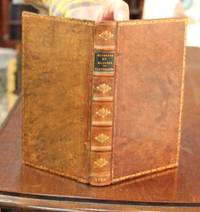
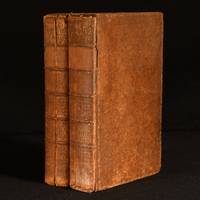
1770930P11London: J. Beecroft; W. Strahan; J. and F. Rivington; et al 1770. Leather. Good Only. 8.5" by 5.5". Not Stated. Milton's influential blank verse poem 'Paradise Lost' illustrated with lovely detailed engraved plates for each book of the poem. Complete in two volumes.Illustrated with a frontispiece and six plates to each volume.Collated complete.'Paradise Lost' is an epic blank verse poem concerning the biblical Fall of Man with the temptation of Adam and Even and their subsequent expulsion from the Garden of Eden.Written by John Milton a seventeenth century English poet who is best known for this poem. He wrote during a period of political upheaval and religious flux in England with the English Civil War.This edition with notes of various authors edited by Thomas Newton. One page of adverts to the rear of Volume II. In a full calf binding. Externally worn. The textblock of Volume I is split in two. Leather is rubbed with light marks. Minor bumping to the head and tail of the spine and to the extremities. Lacking the spine labels. Front joint of Volume I is starting cracks to the rear joint. A small amount of loss to the tail of the spine and to the head of the front joint of Volume I. Front hinge of Volume I is strained rear hinge is starting. Joints and hinges of Volume II are starting. Internally Volume I is firmly bound Volume II is split in two between pages 226 and 239 with pages 227 to 238 detached but present. Pages are lightly age-toned and generally clean with a few scattered spots. Good Only J. Beecroft; W. Strahan; J. and F. Rivington; et al hardcover
179943865Halle, Rengerschen Buchhandlung, 1799. Without wrappers. In ""Annalen der Physik. Herausgegeben von Ludwig Wilhelm Gilbert"", Bd. 2, Erstes Stück. (The entire issue offered). Titlepage to vol. 2. Pp. 1-118 a. 2 folded engraved plates. Cavendish's paper: pp. 1-62. (the torsion balance of Michell shown on the plates).
179943865Halle Rengerschen Buchhandlung 1799. Without wrappers. In "Annalen der Physik. Herausgegeben von Ludwig Wilhelm Gilbert" Bd. 2 Erstes Stück. The entire issue offered. Titlepage to vol. 2. Pp. 1-118 a. 2 folded engraved plates. Cavendish's paper: pp. 1-62. the torsion balance of Michell shown on the plates. <br/><br/><em>First German edition of Cavendish's famous paper in which he calculated the weight of the earth and determined its mass. He also as the first observed gravitational motion of minute portions of matter. He estimates the earth's mass to 66 x 10 to the potential of 24 kg. The original paper "Experiments to determine the Density of the Earth" appeared in Philosophical Transaction 1798."Cavendish published five papers between 1784 and 1809.With one exception they were comparatively minor productions.The exception was his determination of the density of the earth or weighing of the world in 1798 by means of John Michell's torsion balance. The apparatus consisted of two lead balls on either end of a suspended beam; these movable balls were attracted by a pair of stationary lead balls. Cavendish calculated the the force of attraction between the balls fro the observed period of oscillation of the balance and deduced the density of the earth from the force. He found it to be 5.48 times that of water. Cavendish was the first to observe gravitational motions induced by comparatively minute portions of ordinary matter.By weighing the world he rendered the law of gravitation complete. The law was no longer a proportionally statement but a quantitatively exact one; this was the most importent addition to the science of gravitation since Newton."DSB III p. 158. </em> unknown
1752BBS-2006348Printed by E. Cave at St. John's Gate; And sold by Mr. Watson an apothecary over-against St Martin's Church in the Strand; Mr Parker at Oxford; Mr Sandby at the Ship in Fleet-Street: London 1752. Hardcover. Very Good. Unpaginated; primarily illustrated with index and preface preceding 174 leaves of plates. This herbal presents images and English names for several thousand trees and plants organized in tables each containing about twenty images grouped by type. It was based on the work of earlier herbals made by James Newton 1639-1718 physician and botanist and was re-issued in 1752 through arrangement of his grandson James Newton Rector of Newnham the author of the dedication. Leather with gilt decoration to front and back cover plates gilt-stamped titling and decoration to spine blind-stamped decoration and four raised bands to spine. Leather boards age-worn with occasional faint cracking rubbing to edges skewed to fraying at fore-edge corners. Spine has been beautifully and unobtrusively repaired. Pages 3-6 of index loose laid-in; binding else sound. Sticker ghost to front paste-down with no residue. No plate numbered 1 as issued. Lacks plates 15 and 16. Engraved frontispiece portrait. 5in x 7.5in. BP-008 Printed by E. Cave at St. John's Gate; And sold by Mr. Watson, an apothecary, over-against St Martin's Church, in the St hardcover
1742702044 107 7 102 pages With a statement of authenticity signed by the publisher on title page verso also contains The Money'd Man's Pocket-Book. Being Tables of Simple Interest Exactly Computed; For One to Twelve Months and for One to Ninety-one Days or a Quarter of a Year with separate title page and authentication page signed by publisher Printed for Thomas Astley hardcover
17661259798London: J. Beecroft W. Strahan et al.; J. and R. Tonson et al. 1766-1770. Seventh Edition. Hardcover. Octavos 4 volumes; VG; bound in full polished brown calf paneled brown spines with gilt numbering and a maroon morocco label with gilt lettering; gilt floral tooling on board edges; some minor peeling to heads of spines; boards show some shelf-wear but in good condition; text clear save for previous owners name on inside front board of all volumes; text blocks red minor scratches small black mark on volume 2 else clean; Vol 1: 510pp. Vol 2: 463pp. index 185pp. Vol 3: 335pp. Vol 4: 386pp. index 4; insect damage to lower right corner of volume 4 starting on page 368 does not impact readability of text; spines list volume numbers J/2/3/4; Stated Seventh Edition of Paradise Lost; GP consignment; shelved case 0. Wickenheiser 720 and 1569 uniformly bound as usual;. 1259798. Shelved Dupont Bookstore. J. Beecroft, W. Strahan, et al.; J. and R. Tonson, et al. hardcover books
176065501Birmingham:: Printed by John Baskerville for J. and R. Ronson 1760. old full polished calf; gilt spines. Old armorial bookplate in each volume; contents fine. One of two spine labels on Vol. I title is missing; "Vol. I" the other damaged; joints worn and starting to split; rubbing and wear at edges. . 8vo. To Which is Added Samson Agonistes and Poems upon Several Occasions. From the Text of Thomas Newton. Gaskell 9 & 10. Printed by John Baskerville, for J. and R. Ronson, unknown
175978662Birmingham:: Printed by John Baskerville for J. and R. Ronson 1759. Second quarto edition. full polished deep blue morocco gilt-ruled; elaborately gilt spines; a.e.g. Some slight rubbing along the joints; but a beautiful set very handsomely bound. 4to. To Which is Added Samson Agonistes and Poems upon Several Occasions. From the Text of Thomas Newton. Gaskell 6 & 7; with the corrected state of "Samson.". Printed by John Baskerville, for J. and R. Ronson, unknown
1727026143London: J. Tonson 1727. First Edition. Quarto. 12 327 pages 18 leaves of tables one folding errata mounted to bottom of the second page of contents verso. This volume includes plate 18 which was done by Sir Isaac Newton near the end of his life Wallis 'Newton & Newtoniana' #357 while he was Master of the British Mint 1700-1727; During Newton's tenure at the mint he issued at least thirteen reports which like this one are all rare. Table 34 which is a fold-out of plate 18 is among his very last original works accomplished in his lifetime. While Newton is certainly best known for his scientific work in mathematics and physics a large part of his working life was his time as Master of the Mint; in fact his precise measurements enabled savings in the minting process. The previous system had not been uniform his keen measurements enabled an exact weight in determining the number of grains in an ounce of gold with precision had not been available previous to his work. The table is also known in Scottish bibliographies for the section on Scottish Weights and Measurements. Bound in full calf ruled in gilt earlier and fine rebacking decoratively stamped in gilt renewed endpapers all edges red wear to corners some toning. A very good copy. J. Tonson unknown books
1749102783Lausanne et Genève, Marc-Michel Bousquet & Socios, 1749, , 2 vol. in-4 : [2]-VI-423 pp. 32 pl. + VI-466-[1] pp. 4 pl, Demi-parchemin à coins à la bradel, dos long, pièce de titre blonde, tranches mouchetées, Première édition collective des volumes IIe et IIIe de ce recueil réunissant les petits traités de mathématiques, philosophie et philologie de Newton établie par Giovanni di Castillione. Elle est illustrée de 36 pl, d'une vignette à chaque titre et de charmantes lettrines. Le second volume est consacré à la philosophie et le troisième et dernier à la philologie. Un tampon au titre non identifié. Reliure frottée comportant quelques taches, une pièce de titre manquante, manques à la seconde, rousseurs, pâles mouillures angulaires sans atteinte, quelques rares taches, premier volume manquant. Couverture rigide
1738197061738 Londres (Paris), sans nom d'éditeur, (Prault), 1738, in-8 de 1 portrait gravé de Voltaire en frontispice-(4) pp. (faux-titre et titre avec vignette gravée par Duflos)-(2) pp. d'avertissement des libraires-XVI pp. (pour les Eclaircissements nécessaires)-(4) pp. (pour la table des chapitres)- 326 pp. (paginé 3 à 328), (cf. Bengesco,Tome II, p. 29)-(12) pp. de table des matières, (sans page d'errata, ni le portrait de Newton), reliure de l'époque, de plein veau brun, dos à nerfs orné de fers dorés, pièce de titre de maroquin rouge, bon exemplaire.
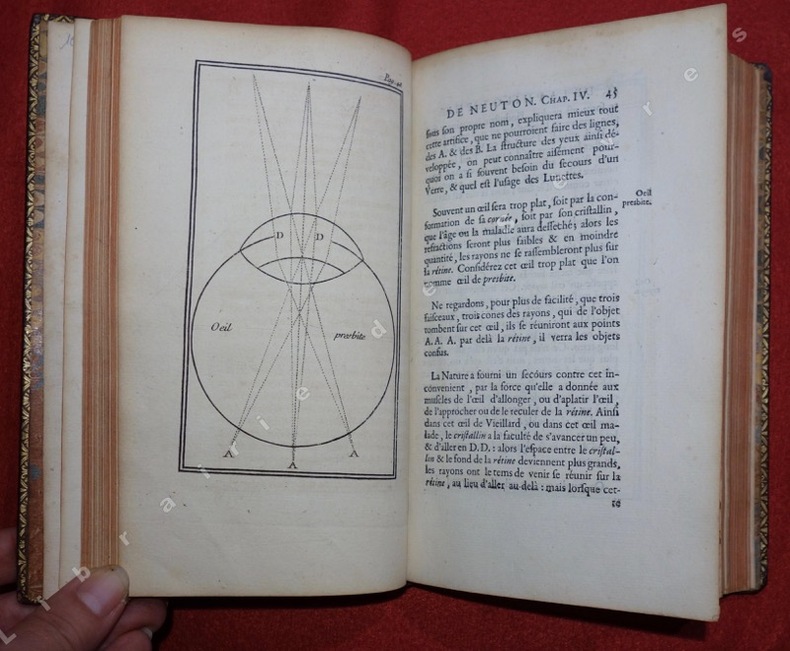
1748101732Paris, Sebastien Jorry, 1748, , 3 parties en un volume in-12 : [2]-VII-[3]-156 pp. et 2 pl. + XII-141 pp. et 4 pl. + VIII-112 pp. et 1 pl. +, basane marbrée brune de l'époque, dos lisse et fleuronné, pièce de titre rouge, tranches rouges, Quatre ouvrages sont réunis dans ce volume qui présente l'état le plus avancé des recherches sur l'électricité à la veille des travaux de Benjamin Franklin : Winckler, Essai sur la nature, les effets et les causes, de l'électricité, avec une description de deux nouvelles machines à l'électricité. Première et seule édition française, elle est ornée de 2 planches gravées dépliantes figurant des machine à électricité. Watson, Expériences et observations, pour servir à l'explication de la nature et des propriétés de l'électricité. Première édition française traduite d'après la seconde édition anglaise. Les jolies planches sur cuivre qui l'accompagnent représentent des machines à électricité manipulées par d'élégants jeunes hommes et jeunes femmes. Watson, Essai sur la cause de l'électricité, où l'on examine, pourquoi certaines choses ne peuvent pas être électrifiées. Et quelle est l'influence de l'électricité dans les rhumatismes du corps humain, dans la nielle des arbres, dans les vapeurs des mines et dans la plante sensitive. Seconde édition française traduite Watson. Newton, Essai sur l'électricité, contenant des recherches sur sa nature, ses causes et propriétés, fondées sur la théorie du mouvement de vibration de la lumière et du feu de M. Newton... Première édition française traduite par Benjamin Martin. Une planche qui représente des éléments d'expérience électrique. Dos légèrement gauchi, minuscules épidermures, coiffe supérieure arasée, 1 mors fendu, rares taches. Étiquette et tampons de l'Institut catholique. Wheeler Gift, 313c ; Bakken, p. 100 et 118. Couverture rigide
176038264Birmingham/London: Printed by John Baskerville for J. and R. Tonson in London 1760. Hardcover. Very Good. Printed by John Baskerville Birmingham. A two volume set. 416 and 390 pages. Bound in full calf with gilt borders to the covers and gilt decorations between the six raised bands. All edges and endpapers marbled. Bookplates of Juliet Foord-Bowe with harold on front paste-down endpaper. Light foxing on initial and final pages. Interior hinges professionally reinforced. Exterior hinges and head of spine professionally repaired. Corners worn. Printed title labels on volume 2 absent. About very good copies. <br/> <br/> Printed by John Baskerville, for J. and R. Tonson in London hardcover
1779015142London: Excudebat Joannes Nichols London 1779. Books measure 29.5x24.cm. xxii 5921pp with two double folded tables xxv34591pp text illustrations throughout. Bound in period full calf raised bands gilt lines and lettering. Bindings heavily worn boards detached. Internally minor worming to inner margin of about 20 pages. Pages in very good clean condition. Very good clean volumes in heavily worn bindings. . Good Plus. Quarto. Excudebat Joannes Nichols, London hardcover
1761168701761 Amsterdam, Marc Michel Rey, 1761, 3 parties en 2 tomes rel. en 1 vol. in 4 de (6)-XVIII-310-(2) pp. ; (4)-288 pp. ; (2)-134-(2) pp., pages de titres imprimées en rouge et noir, 37 planches dépliantes gravées, rel. début XIXe de plein veau brun raciné, dos richement orné de fers dorés, pièce de titre de maroquin rouges, tranches jaspées de couleurs, bel ex.
17121600201712. In der Platte bezeichnet "G. Kneller Eques pinx. / J. Smith Fecit et ex. 1712. Ausgezeichneter, samtiger Druck mit feinen Wischkritzeln und akzentuierenden Roulettespuren, mit schmalem Rändchen. 34,8 x 25,5 cm (Plattengröße). Papier: 5,8 x 26,5 cm.
17280040391728 Paris, Martin, Coignard, Guerin, Montalant, 1728. In-quarto (190 X 246 mm) veau fauve brun, dos cinq nerfs, caissons dorés ornés aux petits fers, pièce de titre maroquin grenat, large frise dorée en queue, tranches rouges (reliure de l'époque) ; (20) ff. de titre, préface, catalogue des oeuvres de Newton et avertissement de l'éditeur anglais, 416 pages, (2) ff. de table, approbation, privilège et errata. Ex-libris tampon encre bleue en queue du feuillet de titre : «De Cayrol », répété sur le premier feuillet blanc, avec sa signature autographe.
1738212251738 Londres (Paris), sans nom d'éditeur, (Prault), 1738, in-8 de (4) pp. (faux-titre et titre avec vignette gravée par Duflos)-XVI pp. (pour les Eclaircissements nécessaires)-(4) pp. (pour la table des chapitres)-(2) pp. d'avertissement des libraires - 326 pp. (paginé 3 à 328), (cf. Bengesco,Tome II, p. 29)-(12) pp. de table des matières, et 1 p. d'errata, portrait gravé de Voltaire, et portrait gravé de Newton par J. Dupin, reliure de l'époque, de plein veau fauve marbré, dos à nerfs orné de fers dorés, pièce de titre de maroquin fauve, ex libris manuscrit à l'encre brune en haut de la page de titre, quelques restaurations, bon exemplaire.
17901230921790. First Edition. NEWTON John. The Christian Correspondent; or A Series of Religious Letters Written by The Rev. John Newton to Captain Alexr. Clunie From the Year 1761 to the Death of the Latter in 1770. Hull: Printed by George Prince 1790. Octavo modern half olive cloth black morocco spine labels. $1200.First edition of the collected 18th-century letters between John Newton a slaveship master and born-again Christian to Alexander Clunie a fellow slaveship captain and Newton's Christian mentor.The Rev. John Newton was born into a sailing family. His father was a shipmaster in the Mediterranean. While Newton's mother raised him as a Christian she died when he was just six years old. Newton spent a few years in boarding school before joining his father at sea. While Newton was slated to become a slave master at a Jamaican sugar plantation he was forced into naval service. After attempting to desert and surviving a brutal court marshal Newton went to work in the slave trade. While he found Christianity in 1748 after nearly dying in a storm at sea he remained an active slave shipmaster. ""In the summer of 1750 Newton began another slaving expedition this time as master of the Duke of Argyle Throughout this voyage and the next as master of the African Newton felt no scruples about slave trading seeing it as the work marked out for him by Providence though he admits to his horror at slavery's brutal accoutrements and his prayer that in God's own time he would receive a more humane calling one that would keep him in regular communion with other Christians perhaps a reflection of his new friendship with Alexander Clunie whom he met when the African called at St. Kitts. Clunie a fellow ship master and believer convinced Newton of the importance of the fellowship of believers and of his security in the covenant of grace. In 1790 their long-term friendship ultimately resulted in the publication of The Christian Correspondent a collection of letters they exchanged over the years"" mainly dealing with Christianity and family life Encyclopedia of Christian Literature 489. In the time between the writing and publication of these letters a great deal changed in Newton's life. Following a series of strokes in 1854 that forced him to leave the seafaring life Newton reconsidered his association with slavery. He acknowledged the damage that it wreaked on a person's humanity and began to view it as fundamentally opposed to Christian beliefs. In the final years of his life he became an ardent abolitionist. He wrote extensively on the subjectas he had on all subjects throughout his lifeand counted Wilberforce among his closest friends. ESTC T18631. Contemporary owner signature.Scattered soiling to interior binding fine. A near-fine copy. hardcover
17678972Graz, Widmannstädter, 1767. 8 Bll., 152 S. 2 gefalt. Kupfertafeln. Gr.-8°. Ldr. der Zeit mit reicher Rückenvergoldung und Rückenschild (etw. bestoßen und beschabt, Deckel leicht verzogen).
1800B4784London : Francis Maseres c. 1800. Very good condition. Text toned uniformly. . Binding: Contemporary calf boards rebacked skillfully in matching calf. Spine in six compartments of raised bands with gilt ruling and blind tooled decorative devices. Gilt label on 2. Notes: In the preface the publisher states that “The principle object of the present collection of tracts is to explain and illustrate by examples Mr. Raphson’s and Dr. Halley’s methods of resolving affected algebraic equations by approximation and to compare these two methods with each other in order to be able to form a judgment of their respective merits and determine to which of them we ought to give the preference.â€<br>Francis Maseres 1731-1824 was an English lawyer an attorney general of the Province of Quebec judge mathematician historian member of the Royal Society and cursitor baron of the exchequer. <br> Size: 8vo. 208x120mm. Illustration: Illustrated with a profusion of in text equations. Provenance: Ex Libris on the verso of half title ‘of Mathematical Society’. On the same leaf it states in period hand writing “Twelve copies of this work were presented to the mathematical society for distribution among its members by Baron Meseres. This copy was not Pages: P. Half title Blank with hand written note Title Blank Preface v-lxxii Errata lxxiii-lxxiv Table of Contents lxxv-lxxviii 1-479. Category: Book Canada; Book Science & Technology; Francis Maseres hardcover
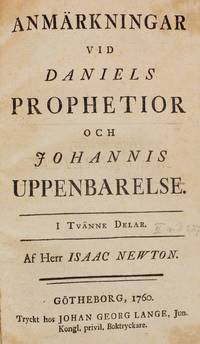
1760B4388Gothenburg c. 1760. In very good condition. Binding: Contemporary half calf with speckled boards. Notes: Ex Libris Abel E. Berland. First Edition in Swedish after original 1733 First Edition in English. <br><br>Newton's work: Observations on the Prophecies on the Prophecies of Daniel and the Prophecies of St. John. Six years after his death Newton's nephew Benjamin Smith published a small portion of Newton's later writings on the prophetic Books of Daniel and Revelation. For more than two centuries this book provided the only glimpse into Newton's prophetic thought. In addition scientific historians suggest that “Newton was an apocalyptic thinker†Snobelen Canadian Journal of History who “arrived at his theory of gravity partly through his exploration of alchemy and early biblical theology†White 358. Size: 8vo: 115mm x 190mm Volume: 2 Volumes in 1 Pages: P. Title Printer infoforward iii-vi Contents vii-viii 1-324 Category: Book Religious Christianity hardcover
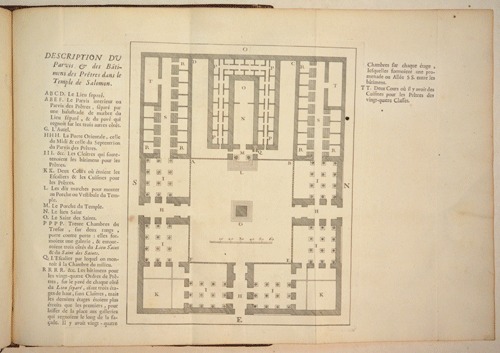
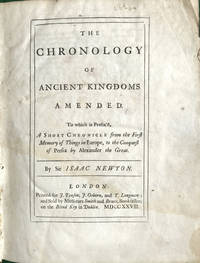
173858701<p>NEWTON'S RADICAL THEOLOGICAL OPINIONS SANITIZED - RARE ISSUE FOR SALE IN IRELAND</p><p>first edition issue with title page indicating for sale in Ireland 4to.26 x 20.5 cms. xvi 376pp. 3 folding plates of the Temple of Solomon contemporary sprinkled calf double gilt fillet border on sides with tiny gilt leaf ornaments at corners. spine panelled by raised bands edges sprinkled red short crack at head of front joint lacks title label on spine front free endpaper pasted down very light water mark on early leaves running to about p.80 but always light and generally unobtrusive and generally diminishing so that by p.100 it is barely discernable very light waterstain at one point on fore-margin of the last few leaves else a fresh copy.</p><p>Contemporary inscription on upper edge of a terminal blank endpaper "10s.10d To E: Hudson" and a faint early signature in a small hand at upper margin of title page "G. T. Payne".</p><p>ESTC t30722 GRAY 'Newton Bibliography' 309<br />The imprint of the standard first edition ESTC n2784 names only the London booksellers Tonson Osborn and Longman but special cancel title pages were printed for copies destined to be sold in both Dublin and Edinburgh ESTC n962 and these are understandably much rarer than the standard one. <br />Newton 1642–1727 natural philosopher and mathematician had been elected a fellow of Trinity College Cambridge in 1667 and Lucastrian professor of mathematics in 1669. Those positions combined with income from his estate made him both financially secure and almost free from prescribed duties. His great researches on optics were the first fruits of that freedom. However at the same time he became an earnest student of both alchemy and of theology. His surviving manuscripts show that in the latter field he reached firstly an anti-Trinitarian or Arian position which developed into an even more radical position which saw Jesus as merely the latest of a series of prophets sent by God to reclaim mankind from false gods a position Newton developed in the 1680s in the unpublished manuscript of "his most important theological composition 'Theologiae gentilis origines philosophicae' 'The philosophical origins of gentile theology'" O.D.N.B.<br />Such opinions were completely unacceptable to contemporary society and Newton realising that they would have undermined his position kept them a closely guarded secret but in later life he revisited the treatise and "thoroughly purged it became his 'Chronology of Ancient Kingdoms Amended' 1728. The original treatise he kept to himself . When he died his heirs found the completed manuscript of the Chronology which they immediately sold to a publisher for £350" O.D.N.B. and the book was published shortly thereafter.<br />The book was distributed in Dublin by Smith and Bruce. John Smith an Ulster Presbyterian whose radical activities had led to his expulsion from Glasgow University in 1722 came to Dublin in 1724 where with the sympathetically minded William Smith and later William Bruce he established a book-selling business. They were notable for their intellectual and continental connections they were cousins of the philosopher Francis Hutcheson and their publication of works challenging conventional opinions. <br />E. Hudson is probably Edward Hudson 1703 ca. - 1757 of Ardee Co. Louth who having entered Trinity College in 1722 aged 19 became a Fellow in 1728 the year of publication of this book. He was later Rector of Omagh. The signature on the title page may be that of Rev. George Thomas Payne 1819-1888 of Kilkenny who had entered T.C.D. in 1833.</p> Printed for J. Tonson, J. Osborn, and T. Longman; and sold by Messieurs Smith and Bruce Booksellers on the Blind Key in Dublin hardcover
179095361London: Printed for J.F. and C. Rivington et al 1790. Eighteenth century example of Milton's masterpiece Paradise Lost: A Poem in Twelve Books and Paradise Regain'd. Octavo 4 volumes bound in full contemporary tree calf gilt titles and tooling to the spine red morocco spine labels gilt ruled marbled endpapers ribbons bound in all edges speckled brown engraved frontispiece to two volumes. In near fine condition. A desirable example. First published in 1667 "Paradise Lost is generally conceded to be one of the greatest poems in the English language; and there is no religious epic in English which measures up to Milton's masterpiece. Milton performed an artist's service to his God" Magill 511 515. The writer and critic Samuel Johnson wrote that Paradise Lost shows off "Milton's peculiar power to astonish" and that "Milton seems to have been well acquainted with his own genius and to know what it was that Nature had bestowed upon him more bountifully than upon others: the power of displaying the vast illuminating the splendid enforcing the awful darkening the gloomy and aggravating the dreadful." By 1688 when England was on the verge of the Whig revolution Milton's reputation had revived considerably. He was commended for his republicanism as well as his record as a defender of liberty. His supporters believed that his greatest poetic achievement merited this handsome monumental edition. One of the earliest examples of subscription publishing financed by Lord Somers the fourth edition of Paradise Lost was the first to be printed in folio format and is the first illustrated edition distinguished by high quality paper large clear type and ample margins. Milton had previously reorganized the poem into twelve books by splitting Books 7 and 10 of the original to parallel Virgil's Aeneid more closely. Printed for J.F. and C. Rivington et al unknown books
1752B4844London : Samuel Peterson c.1752. . A near fine copy. Plates and text are clean and crisp. . Edition: Second Edition. Binding: Contemporary calf boards with gilt decorative borderings. Rebacked skillfully. Spine in six compartments of raised bands with gilt decorative devices and rulings. Gilt title on green calf label on 2. Notes: This is one of the most important works introducing Newtonian physics to continental Europe. Wilhelm Jacob Gravesande 1688-1742 was a Dutch lawyer and natural philosopher chiefly remembered for developing experimental demonstrations of the laws of classical mechanics. As professor of mathematics astronomy and philosophy at Leiden University he helped to propagate Isaac Newton’s ideas in Continental Europe. Size: 8vo. 184x127mm. Illustration: Illustrated with a multitude of in text equations as well as 4 fold out plates depicting mathematical relationships. Pages: P. Title Blank Preface iii-iv 1-187 Category: Book Science & Technology; Samuel Peterson hardcover