152 résultats
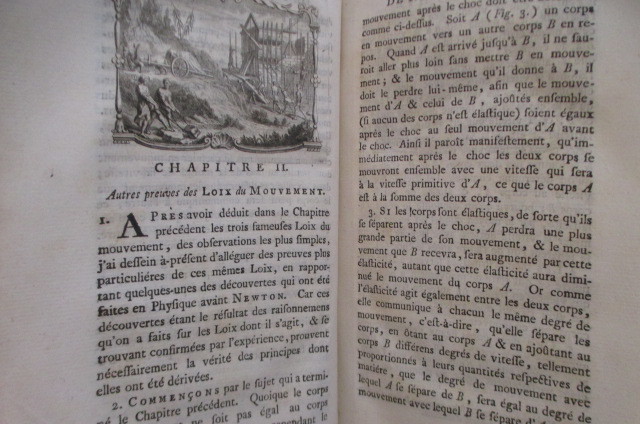
1787102658Paris, Chez Leroy, 1787, in-8, XXXIV-192-[4]-308 pp. 21 pl, Reliure composite : demi-basane brune, dos lisse orné de caissons dorés, tranches mouchetées, Première édition de la traduction de Jean-Paul Marat, la troisième après deux éditions de la traduction de Pierre Coste en 1720 et 1722. Elle est illustrée de 21 planches dépliantes et comporte deux corrections manuscrites au 2nd tome. Babson qualifie cette édition de rare comme tous les ouvrages de Marat et d'autant plus intéressante qu'il fut le seul à s'opposer à la théorie corpusculaire de Newton. Le célèbre physicien et révolutionnaire l'entreprit car celle de Coste lui semblait comporter plusieurs défauts : "termes impropres, redites éternelles [...] style lâche, diffus, incohérent" (notice du traducteur). Il se proposait ainsi d'en rendre la lecture moins laborieuse. Étiquette de la librairie F. Cahu. Reliure restaurée, dos provenant d'un autre exemplaire remonté, petits manques et frottements, rares rousseurs ou taches éparses. Babson, 143; Gray, 188; PMM, 172. ? Couverture rigide
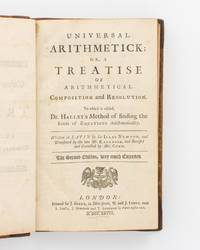
1761102657?Amsterdam, Marc-Michel Rey, 1761, , 2 vol. in-4 : [6]-XVIII-310-[1] pp. 32 pl. + [4]-288-[2]-134-[1] pp. 5 pl, Demi-chagrin noir, filets dorés sur les plats, dos à nefs orné de caissons dorés, tranches marbrées, Édition commentée par Giovanni di Castillione qui fut lui-même éditeur d'ouvrages de Newton. Elle comporte également au second volume l'Additamentum vel de Solutione et constructione Aequationum, &c. d'Halley et 9 petits traités de Colson, Moivre, Halley (2), Folkes, Campbell, Baermanno, Kaestner et Boscovich. Elle est illustrée de 37 planches hors-texte. L'Arithmétique de Newton est le texte qui établit la réputation du physicien anglais. Elle contient ses cours d'algèbre professés à Cambridge entre 1673 et 1683. Newton parvint à déterminer des valeurs approchées des racines numériques et établit les fondements de la théorie des fonctions de ces racines. Babson, 205; Gray 281. Petits frottements et épidermures, rousseurs, petits manques angulaires sans atteinte à 4 pl. et restaurations angulaires sans atteinte à 9 pl. du 1er vol. Ex-libris René Mariaux. Couverture rigide
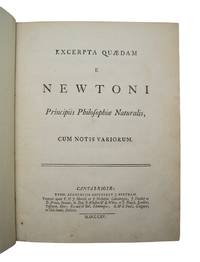
176569380Cambridge: J. Bentham 1765. Full Description:<br> <br> NEWTON Sir Isaac. Excerpta Quaedam. e Newtoni Principiis Philosophiae Naturalis Cum Notis Variorum. Cambridge: J. Bentham 1765.<br> <br> First edition of a selection of excerpts from Newton's "Principia." Subscriber's copy. Quarto 9 3/4 x 8 inches; 248 x 200 mm. ix list of subscribers 1 corrigenda 180 pp. With twelve engraved folding plates and commentary on Newton's text by three Cambridge scholars.<br> <br> Modern full red morocco. Newer marbled endpapers. Binding with some mild rubbing. Some dampstaining along outer lower and fore-edge margins. Title-page and leaf a4 Subscribers have been remargined at inner margin. Leaf Y4 and Plate XI remargined at fore-edge not affecting text. Overall a very good copy.<br> <br> Excerpts for subscribers from "the greatest work in the history of science" PMM.<br> <br> PMM 161. Babson 15.<br> <br> HBS 69380.<br> <br> $1500. J. Bentham unknown
1748B4804London : Patrick Murdoch; Author’s Children c.1748. A very good example plates and text are clean and crisp. Edition: Second Edition. Binding: Contemporary marbled boards rebacked spine with 5 compartments of raised bands gilt lettering on two. Notes: An important commentary by MacLaurin. On Newton’s recommendation he was appointed to his chair at Edinburgh. He died in 1746 and later the work was completed by Murdoch who has added a valuable ‘Account of the Life and Writings of the Authorâ€. Size: 8vo. Illustration: With 6 engraved plates. References: Babson 85; Gray 112. Pages: P. 28 xx 392 Category: Book Science & Technology; Patrick Murdoch; Author’s Children hardcover
1716102764Londres, J. Senex, 1716, in-8, [2]-443-[1 errata] pp. 9 pl. dép, Basane havane mouchetée de l'époque, plats ornés à froid, dos consolidé à l'adhésif, Première publication en anglais d'une sélection exhaustive des Principia, avec le récit du Dr Halley sur les comètes illustré de 9 planches dépliantes gravées de figures de comètes par Senex. Le théologien et mathématicien William Whiston (1667-1752), qui par cette publication popularisa auprès du grand public l'oeuvre de Newton, fut comme Edmond Halley un des premiers partisans de la périodicité des comètes. Assistant de Newton à l'université de Cambridge, il lui succéda à la Chaire de professeur lucasien de mathématiques. Il est surnommé le "Wicked Willie Whiston" (le méchant Willie Whiston) par Swift après avoir été expulsé de l'université pour hérésie et pour ses opinions ariennes, pour les mêmes raisons il ne sera jamais admis à la Royal Society dont Newton était le président. Étiquette ex-libris armoriée gravée sur cuivre au contreplat de Patrick Hume (1641-1724), ancien lord chancelier d'Écosse : "Lord High Chancelor of Scotland", 1702. Dos consolidé, planches légèrement brunies, sans le feuillet de faux-titre, titre découpé et collé sur un feuillet, adhésif et petites déchirures au premier f. de texte, reliure un peu lâche. Babson 127. Couverture rigide
1728177<b>4to 288 x 218 mms. pp. 50 407 408 blank engraved vignette on title-page other engraved vignettes and illustrations in text by John Pine after John Grison 12 folding engraved plates. FIRST EDITION. The subscriber s list is also present. Full contemporary calf boards are slightly worn which has been professionally rebacked by the Heritage Bindery. Henry Pemberton was tasked with bringing Newtonian philosophy to the layman with this work which was completed and published a year after Newton s death. Small blind- stamp from the Meadville theological school library on the title page. </b> S. Palmer hardcover
177619583Leipzig, Junius, 1776. 2 Teile in 1 Bd. XIII S., 1 Bl., 568 S., 4 Bll. 16 mehrfach gefalt. Kupfertafeln. Gr.-8°. Mod. HLdr. unter Verwendung der Reste des alten Materials (etw. berieben).
1720523641720. Amsterdam Chez Pierre Humbert 1720 12° 15 1 328 pp.; 1 pp.331-583; 17 pp. Catalgoue des Livres Impres Chez Pierre Humbert . 12 gefalt. Kupferstichtafeln; Ledereinband d.Zt.; Rücken erneuert; feines Exemplar. PREMIERE EDITION FRANCAISE ! Pierre Coste 1668-1747 "the translator spent many years in England where he fled on the revocation of the Edict of Nantes and where he became intimate with Locke. His translations were of durable service and helped to introduce english thought to the French of the XVIIIth century" Babson Babson 139; Wallis 186; Dibner 148; PMM 172; Horblit N° 79b all 1st engl. Ed. unknown
1728000772London: James and John Knapton 1728. 2nd Edition Corrected . Hardcover. Good/N/A. Full leather darkened and some cracking to spine. 5 bands to spine. Vol 2 part 2. Illustrated with Dr. Samuel Clark's notes taken mostly out of Sir Isaac Newton's Philosophy in olde English. Rubricated title page. Hinges cracked. Also fold out tables numbered XII to XXVII laid in the back all in good shape. ex lib from the Hartford Seminary. First belonging to Aaron Day dated May 3 1737. Then belonging to H A Gleason Jr. A very rare book. photos on request. <br/> <br/> James and John Knapton hardcover
1732285967Leyden: Verbeek 1732. Third. hardcover. very good. Title page in red & black with engraved vignette; illustrated with 13 folding copperplates. 344 pages short 4to bound in 19th century leather-backed marbled boards lightly edge-rubbed; new end-leaves. Lugduni Batavorum: Joh. et Herm. Verbeek 1732.<br/><br/> Third Latin edition of his professorial lectures on mathematics mostly on algebra and analytic geometry given at Cambridge during 1673-83. Some of this material was incorporated into the Principia. Babson no. 204. Lowndes 1674. Some browning to the pages and light staining in top gutter but a very good copy.<br/><br/> Verbeek unknown books
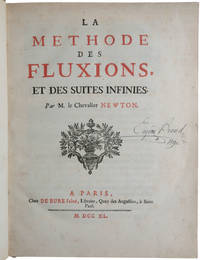
1740D4441Paris: Chez de Bure l'aine 1740. First Edition in French. Hardcover. Very Good. xxx 2 148 2 pp. With diagrams in the text. 4to 9¾ x 7½ period paneled calf spine tooled in gilt raised bands morocco label. First French Edition of Newton's important work the most extensive description of the mathematical method he used in his "Principia" the method of infinitesimals which was already written about 1671 but not published until 1736 with the title "Method of Fluxions and Infinite Series." Extensive notes in French on the title-page in a contemporary hand along with 3 wax seals which affect the top of the first three letters of METHODE. Additional ink notes some crossed out in margins of the first two pages of the preface. Two ink ownership signatures on front flyleaf. Spine scuffed label chipped rubbing to cover edges; pp. xix-xx of preface partially detached with edge wear as also final errata leaf; else very good. <br/><br/> Chez de Bure l'aine hardcover books
1755SCI101M1755 / 495 pages dont 12 planches dépliantes et 17 en-têtes gravés. Relié au format : 13 x 20,5 cm (In8) Editions Chez Arkstee & Merkus (+PCM)
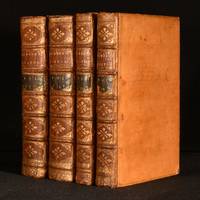
1753867P22London: C. Hitch and L. Hawes; J. Hodges; J. and R. Tonson; et al 1753-57. Leather. Good. 8.5" by 5.5". Not Stated. An early set of John Milton's important epic poems an illustrated set edited by biblical scholar Thomas Newton. ESTC citation numbers T132846 and T134240.The fourth Newton edition of 'Paradise Lost' and the second Newton edition of 'Paradise Regain'd'.With a comma after 'edition' to the title page of Volume II of 'Paradise Regain'd'.Volume I illustrated with a portrait frontispiece and six plates. Volume II illustrated with six plates. One leaf of adverts to the rear.Volume III illustrated with a frontispiece and two plates.Volume IV illustrated with three plates.Title pages of 'Paradise Lost' are cancels. Collated complete. Both of John Milton's epic poems bound in four uniform volumes 'Paradise Lost' and 'Paradise Regain'd'.'Paradise Lost' is an epic blank verse poem concerning the biblical Fall of Man with the temptation of Adam and Even and their subsequent expulsion from the Garden of Eden. The poem is considered to be one of the greatest works of literature ever written.The sequel 'Paradise Regain'd' is likewise a blank verse poem though is much shorter than its predecessor being described as a brief epic.'Paradise Lost' includes a life of Milton. Written by John Milton a seventeenth century English poet who is best known for 'Paradise Lost'. He wrote during a period of political upheaval and religious flux in England with the English Civil War.Edited by Thomas Newton a clerical Bishop of Bishop and biblical scholar. In the original calf binding. Externally generally smart. Chip to the spine label to Volume IV. Bumping to the head and tail of the spines and to the extremities resulting in loss to the head of the spines heavier to Volume II. Spines are discoloured and a little rubbed with minor surface cracks. Minor marks to the boards and spines with a larger mark to the front board of Volume III. Crack to the head of the front joint of Volumes I and IV. Crack to the tail of the joints of Volume II. Internally firmly bound. Pages are lightly age-toned and generally clean with some scattered spotting. Title of Volume I has offset to the frontispiece. Ribbon marker of Volumes III and IV are detached but present. Good C. Hitch and L. Hawes; J. Hodges; J. and R. Tonson; et al hardcover
1747RW1580London:: Printed by W. Innys T. Longman and T. Shewell C. Hitch and M. Senex 1747. 1747. 2 volumes. 4to. 4 lxxv 1 475 1; ii 389 33 pp. Original full calf raised bands calf gilt-stamped red & brown spine labels; joints cracked. Small rubberstamp on title. Very good. NICE CLEAN COPY. Sixth edition "greatly improved by the author" of 'sGravedande's extensive experimentation and instruction in Newtonian physics. The experiments range from basic physics to hydraulics optics electricity and astronomy. The entire work is profusely illustrated with folding engraved plates detailing among many other experiments and apparatuses a steam-powered Hero's Engine plate 78 a static electricity generator plate 79 the first magic lantern slide projector plate 109 the prismatic effect of a rainbow plate 120 and the known solar system plate 122. 'sGravesande "is the author of Elements de physique demonstres mathematiquement. . . ou introduction a la philosophie Newtonienne which was translated from the Latin and published at Leyden in 1746. In the second volume he gives a description of an electrical machine constructed on the plan of that of Hauksbee. It consisted merely of a crystal globe which was mounted upon a copper stand and against which was pressed the hand of the operator while it was made to revolve rapidly by means of a large wheel." Mottelay. / Willem Jacob 'sGravesande was a Dutch philosopher and mathematician. Born in 's-Hertogenbosch he studied law in Leiden and wrote a thesis on suicide. In 1715 he visited London and King George I. He became a member of the Royal Society. In 1717 he became professor in physics and astronomy in Leiden and introduced the works of his friend Newton in the Netherlands. He was ardently opposed to fatalists like Hobbes and Spinoza. In 1724 Peter the Great offered him a job in Saint Petersburg but 'sGravesande did not accept. His best remembered work is Physices elementa mathematica experimentis confirmata sive introductio ad philosophiam Newtonianam or Mathematical Elements of Natural Philosophy Confirm'd by Experiments Leiden 1720 in which he laid the foundations for teaching Newtonian physics. / 'sGravesande's chief original contribution to physics involved an experiment in which brass balls are dropped with varying velocity onto a soft clay surface. This demonstrated that a ball with twice the velocity of another would leave an indentation four times as deep that three times the velocity yielded nine times the depth and so on. He shared these results with Emilie du Châtelet who subsequently corrected Newton's formula E = mv to E = mv2. / 'sGravesande was also the owner of the oldest known magic lantern which was built around 1720 by Jan van Musschenbroek and is currently housed at the Museum Booerhave in Leiden. / "From the outset of his teaching both physics and astronomy 'sGravesande modeled his lectures on the example of Newton in the Principia and Opticks although in later years they incorporated other influences especially that of Boerhaave. Moreover he adopted from Keill and Desaguliers the notion of demonstrating to his classes the experimental proof of scientific principles accumulating an ever larger collection of apparatus as may be seen from successive editions of his Physics elementa mathematica experimentis confirmata. Sive introductio ad philosophiam Newtonianam Leiden 1720 1721. The scientific reputation of 'sGravesande is enshrined in this book which he constantly corrected and amplified in later editions. An 'official' English translation prepared by Desaguliers to whom copies of the Latin original were sent in haste was also issued in 1720 and 1721 and it passed through six editions. The booksellers Mears and Woodward printed a rival version under the name of John Keill. French translations appeared only in 1746 and 1747 but a critical review by L. B. Castel was published in the Memoires de Trevoux in May and October 1721. The book was at once welcomed by British and a number of German scholars." – DSB V p. 510. References: Babson 70; Mottelay p. 181. Printed by W. Innys, T. Longman and T. Shewell, C. Hitch, and M. Senex, 1747. hardcover books
172819285London: S. Palmer 1728. FIRST EDITION. With engraved title-vignette of an observatory within a border of instruments 12 folding plates and historiated initials all engraved by J. Pine after J. Grison including the arms of Sir Robert Walpole to whom the work is dedicated. Complete with subscriber’s list including Isaac Newton’s 12 books. Half-calf over marbled boardsspine with gilt decorations and morocco label. An absolutely exquisite wide-margined copy preserved in a slipcase. First edition. Pemberton’s ability in mathematical problems impressed Newton and consequently he asked him to edited the third and definitive edition of his Principia mathematica 1726. The preface contains Pemberton’s recollections of Newton especially in his old age. However this work is most notable for its explanation of Newtonia philosophy. Pemberton 1694-1771 studied under Boerhaave at Leiden and was attached to St. Thomas’ Hospital in London. <br /> <br /> Babson 98; Gray 132. S. Palmer unknown
1740012680Lausanne & Geneve.: Marci-Michaelis Bousquet & Sociorum 1740. All edges stained red. Spine labelled near top. Half-title page present. Portrait frontispiece. Title-page with vignette printed in red and black. Errata page at end of text. Engraved head and tail pieces. Illuminated first letters of sections. Front free endpaper has missing piece at top corner. Endpaper are browned. Very faint suggestion of erasure at top of title-page. Wide margins and clean text throughout. Old water-staining to bottom of first 30 pages See photo. Twelve fold-out plates all intact and clean. This treatise on optics was first published in English in 1704 the first Latin edition published in 1706. Sir Isaac Newton 1643-1727 was an English physicist mathematician astronomer alchemist philosopher and theologian. He is most well-known for his "Philosophiae Naturalis Principia Mathematica" published in 1687 laying the ground work for most classical mechanics. He built the first practical reflecting telescope and he developed a theory of color based on the observation that a prism decomposes white light into many colors that form the visible light spectrum. He expanded on these theories in "Opticks". We find 20 libraries worldwide holding the book. ABPC shows a total of 7 copies sold at auction in the past 32 years. ii half-title blank frontispiece and title-page xxxii 1-363 errata 12 folding plates ii. Collated complete 10 May 2011. See "Printing And The Mind Of Man" 172. New Edition. Full Vellum. Moderate General Soiling. Quarto. Marci-Michaelis Bousquet & Sociorum Hardcover books
1740S13116Lausannae & Geneva: Marci-Michaelis Bousquet & Sociorum 1740. 1740. 4to. iv xxxii 363 1 pp. Half-title engraved frontispiece portrait of Newton engr. Jean-Louis Daudet after Vanderbank 12 engraved folding plates title vignette of 4 cherubs and a female figure each using an optical instrument representing learning optics/perspective drawn by Delamoncein and engraved by Daudet head & tail pieces and woodcut initial letters drawn by Papillon index; first 11 leaves browned. Contemporary full vellum green leather gilt-stamped spine label edges with decorative red freckling as designed by the binder; foot of spine with faint ink marking "11-". Paper unevenly browned. Verso of title with small ink annotation "=1135="; rear pastedown with another notation "á 20.Luglio 1801." Very good. Third Latin edition edited by Bousquet with a dedication to Joannes Bernoulli. This edition contains the full array of 31 querries. / "Newton's contributions to the science of optics :: his discovery of the unequal refractions of rays of different color his theory of color and his investigations of 'Newton's rings' to mention only a few of the most noteworthy :: place him among the premier contributors to that science. . . . Today we recognize that his work on optics offers unique rewards in its exciting innovative conjunction of physical theory experimental investigation and mathematics and in the revealing glimpse that it provides of a crucial period in the evolution of experimental science." :: Alan E. Shapiro The Optical Papers of Isaac Newton: Volume 1 1984 p. xi. / Jean-Louis Daudet 1695-1756 who made the frontispiece and title vignette was an engraver and print publisher active in Lyon inherited business from his father Etienne Joseph Daudet. He flourished from 1722 till his death in 1756. Thereafter the business continued by his widow in association with his son-in-law Louis Martin Roch Joubert until 1773. / "Newton famously declared that it is not the business of science to make hypotheses. However it's well to remember that this position was formulated in the midst of a bitter dispute with Robert Hooke who had criticized Newton's writings on optics when they were first communicated to the Royal Society in the early 1670's. The essence of Newton's thesis was that white light is composed of a mixture of light of different elementary colors ranging across the visible spectrum which he had demonstrated by decomposing white light into its separate colors and then reassembling those components to produce white light again. However in his description of the phenomena of color Newton originally included some remarks about his corpuscular conception of light perhaps akin to the cogs and flywheels in terms of which James Maxwell was later to conceive of the phenomena of electromagnetism. Hooke interpreted the whole of Newton's optical work as an attempt to legitimize this corpuscular hypothesis and countered with various objections." / "Newton quickly realized his mistake in attaching his theory of colors to any particular hypothesis on the fundamental nature of light and immediately back-tracked arguing that his intent had been only to describe the observable phenomena without regard to any hypotheses as to the cause of the phenomena. Hooke and others continued to criticize Newton's theory of colors by arguing against the corpuscular hypothesis causing Newton to respond more and more angrily that he was making no hypothesis he was describing the way things are and not claiming to explain why they are. This was a bitter lesson for Newton and in addition to initiating a life-long feud with Hooke went a long way toward shaping Newton's rhetoric about what science should be. . ." / "The first edition of The Opticks 1704 contained only 16 queries but when the Latin edition was published in 1706 Newton was emboldened to add seven more which ultimately became Queries 25 through 31 when in the second English edition he added Queries 17 through 24. Of all these one of the most intriguing is Query 28 which begins with the rhetorical question "Are not all Hypotheses erroneous in which Light is supposed to consist of Pression or Motion propagated through a fluid medium" In this query Newton rejects the Cartesian idea of a material substance filling in and comprising the space between particles. Newton preferred an atomistic view believing that all substances were comprised of hard impenetrable particles moving and interacting via innate forces in an empty space as described further in Query 31." :: Newton's Cosmological Queries :: MathPages. / Grace K. Babson Sir Isaac Newton 1950 141; George J. Gray A Bibliography of the Works of Sir Isaac Newton 182; Wallis 182. See: Printing and the Mind of Man 172. Marci-Michaelis Bousquet & Sociorum, 1740. hardcover books
1740S13116Lausannae & Geneva: Marci-Michaelis Bousquet & Sociorum 1740. 1740. 4to. iv xxxii 363 1 pp. Half-title engraved frontispiece portrait of Newton engr. Jean-Louis Daudet after Vanderbank title printed in red & black 12 engraved folding plates title vignette of 4 cherubs and a female figure each using an optical instrument representing learning optics/perspective drawn by Delamoncein and engraved by Daudet head & tail pieces and woodcut initial letters drawn by Papillon index; first 11 leaves browned. Contemporary full vellum green leather gilt-stamped spine label edges with decorative red freckling as designed by the binder; foot of spine with faint ink marking "11-". Paper unevenly browned. Verso of title with small ink annotation "=1135="; rear pastedown with another notation "a 20.Luglio 1801." Very good. Third Latin edition edited by Bousquet with a dedication to Joannes Bernoulli. This edition contains the full array of 31 querries. / "Newton's contributions to the science of optics :: his discovery of the unequal refractions of rays of different color his theory of color and his investigations of 'Newton's rings' to mention only a few of the most noteworthy :: place him among the premier contributors to that science. . . . Today we recognize that his work on optics offers unique rewards in its exciting innovative conjunction of physical theory experimental investigation and mathematics and in the revealing glimpse that it provides of a crucial period in the evolution of experimental science." :: Alan E. Shapiro The Optical Papers of Isaac Newton: Volume 1 1984 p. xi. / Jean-Louis Daudet 1695-1756 who made the frontispiece and title vignette was an engraver and print publisher active in Lyon inherited business from his father Etienne Joseph Daudet. He flourished from 1722 till his death in 1756. Thereafter the business continued by his widow in association with his son-in-law Louis Martin Roch Joubert until 1773. / "Newton famously declared that it is not the business of science to make hypotheses. However it's well to remember that this position was formulated in the midst of a bitter dispute with Robert Hooke who had criticized Newton's writings on optics when they were first communicated to the Royal Society in the early 1670's. The essence of Newton's thesis was that white light is composed of a mixture of light of different elementary colors ranging across the visible spectrum which he had demonstrated by decomposing white light into its separate colors and then reassembling those components to produce white light again. However in his description of the phenomena of color Newton originally included some remarks about his corpuscular conception of light perhaps akin to the cogs and flywheels in terms of which James Maxwell was later to conceive of the phenomena of electromagnetism. Hooke interpreted the whole of Newton's optical work as an attempt to legitimize this corpuscular hypothesis and countered with various objections." / "Newton quickly realized his mistake in attaching his theory of colors to any particular hypothesis on the fundamental nature of light and immediately back-tracked arguing that his intent had been only to describe the observable phenomena without regard to any hypotheses as to the cause of the phenomena. Hooke and others continued to criticize Newton's theory of colors by arguing against the corpuscular hypothesis causing Newton to respond more and more angrily that he was making no hypothesis he was describing the way things are and not claiming to explain why they are. This was a bitter lesson for Newton and in addition to initiating a life-long feud with Hooke went a long way toward shaping Newton's rhetoric about what science should be. . ." / "The first edition of The Opticks 1704 contained only 16 queries but when the Latin edition was published in 1706 Newton was emboldened to add seven more which ultimately became Queries 25 through 31 when in the second English edition he added Queries 17 through 24. Of all these one of the most intriguing is Query 28 which begins with the rhetorical question "Are not all Hypotheses erroneous in which Light is supposed to consist of Pression or Motion propagated through a fluid medium" In this query Newton rejects the Cartesian idea of a material substance filling in and comprising the space between particles. Newton preferred an atomistic view believing that all substances were comprised of hard impenetrable particles moving and interacting via innate forces in an empty space as described further in Query 31." :: Newton's Cosmological Queries :: MathPages. / Grace K. Babson Sir Isaac Newton 1950 141; George J. Gray A Bibliography of the Works of Sir Isaac Newton 182; Wallis 182. See: Printing and the Mind of Man 172. Marci-Michaelis Bousquet & Sociorum, 1740. hardcover
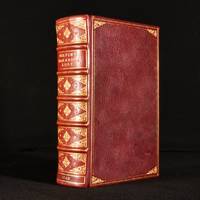
1760838P7DBirmingham; London: John Baskerville; J. and R. Tonson 1760. Leather. Near Fine. 10" by 6.5". None. A beautiful Baskerville edition of John Milton's 'Paradise Lost' and 'Paradise Regain'd' both epic poems bound here in one volume. A Baskerville edition.Complete as two volumes bound in one.ESTC citation number T134228 and N11290 - 'Paradise Regain'd' with 'Life of Milton' paginated in Roman numerals.List of subscribers to the front of 'Paradise Lost'. Pages 69 231 235 262 and 330 misnumbered 96 131 135 268 and 230.Bound by BookEnds.Collated complete.Both of John Milton's epic poems bound in one volume 'Paradise Lost' and 'Paradise Regain'd'.'Paradise Lost' is an epic blank verse poem concerning the biblical Fall of Man with the temptation of Adam and Even and their subsequent expulsion from the Garden of Eden. The poem is considered to be one of the greatest works of literature ever written.The sequel 'Paradise Regain'd' is likewise a blank verse poem though is much shorter than its predecessor being described as a brief epic.Written by John Milton a seventeenth century English poet who is best known for 'Paradise Lost'. He wrote during a period of political upheaval and religious flux in England with the English Civil War.John Baskerville was an important and pioneering printer and type designer who invented 'wove paper'.Prior owner's ink inscription to the verso of the front blank. Prior owner's ink inscription to the head of the title of 'Paradise Lost'. In a modern crushed morocco binding. Externally smart. A little very light rubbing to the extremities and a couple of very faint marks to the boards. Prior owner's ink inscription to the verso of the front blank. Internally firmly bound. Pages are lightly age toned and generally clean with the occasional spot. Tide mark to the gutter of the last few pages. Very small chip to the tail of the title page of 'Paradise Lost'. Prior owner's ink inscription to the head of the title of 'Paradise Lost'. Near Fine John Baskerville; J. and R. Tonson hardcover
1760RW1581Geneva:: Sumptibus Cl. & Ant. Philibert 1760. 1760. 3 volumes. 4to. xxxii 548; viii 422; 8 xxviii 703 1 pp. Half-titles woodcut title vignettes title printed in red & black woodcut head & tail pieces numerous mathematical figs. index. Contemporary mottled calf raised bands gilt-stamped spines maroon & green spine labels; occasional browning. Ownership signature "Nolland avocat"auvcat. An excellent set. Very good . Second Jesuit edition emended and corrected based on the text of the third London edition of the Principia. This version is valued for its excellent annotations and copious commentary which is nearly the same length as the Principia itself. It contains Newton's Dedication to the Royal Society; Prefaces to the first second and third editions and Roger Cotes's Preface. In addition the Jesuits' edition of the Principia is prized for the inclusion of the important treatises on the theory of the tides: Daniel Bernoulli's Traite sur le Flux et Reflux de la Mer Colin MacLaurin's De Causa Physica Fluxus et Refluxus Maris and Leonardo Euler's Inquisitio Physica in causam Fluxus ac Refluxus Maris. These three works gained the prize given by the Royal Academy of Sciences in 1724 for resolving tidal problems relating to the theory of gravity. They represent the most significant discovery concerning tidal mechanics between the publication of the Principia and the discoveries of Laplace. REFERENCES: Babson 31; Gray 14; Wallis 14. Sumptibus Cl. & Ant. Philibert, 1760. hardcover books
1760SW1581Geneva:: Sumptibus Cl. & Ant. Philibert 1760. 1760. 3 volumes. 4to. xxxii 548; viii 422; 8 xxviii 703 1 pp. Half-titles woodcut title vignettes title printed in red & black woodcut head & tail pieces numerous mathematical figs. index. Contemporary mottled calf raised bands gilt-stamped spines maroon & green spine labels; occasional browning. Ownership signature "Nolland avocat"auvcat. An excellent set. Very good . Second Jesuit edition emended and corrected based on the text of the third London edition of the Principia. This version is valued for its excellent annotations and copious commentary which is nearly the same length as the Principia itself. It contains Newton's Dedication to the Royal Society; Prefaces to the first second and third editions and Roger Cotes's Preface. In addition the Jesuits' edition of the Principia is prized for the inclusion of the important treatises on the theory of the tides: Daniel Bernoulli's Traite sur le Flux et Reflux de la Mer Colin MacLaurin's De Causa Physica Fluxus et Refluxus Maris and Leonardo Euler's Inquisitio Physica in causam Fluxus ac Refluxus Maris. These three works gained the prize given by the Royal Academy of Sciences in 1724 for resolving tidal problems relating to the theory of gravity. They represent the most significant discovery concerning tidal mechanics between the publication of the Principia and the discoveries of Laplace. REFERENCES: Babson 31; Gray 14; Wallis 14. Sumptibus Cl. & Ant. Philibert, 1760. hardcover books
17405802Paris: De Bure l'aine 1740. First edition. <p>First edition in French of Newton's first exposition of his fluxional calculus translated with a long and impotant preface by the celebrated naturalist Comte de Buffon. Originally written in 1671 in Latin this was Newton's first comprehensive presentation of his method of fluxions which according to Hall 'might have effected a mathematical revolution in its own day' Philosophers at War pp. 65-6. It should properly be placed first in the great trilogy of Newton's major works: Fluxions Principia 1687 and Opticks 1704.</p>. BUFFON'S TRANSLATION OF NEWTON'S EXPOSITION OF CALCULUS. <p>First edition in French of Newton's first exposition of his fluxional calculus translated with a long and important preface by the celebrated naturalist Comte de Buffon. Originally written in 1671 in Latin this was Newton's first comprehensive presentation of his method of fluxions which according to Hall 'might have effected a mathematical revolution in its own day' Philosophers at War pp. 65-6. It should properly be placed first in the great trilogy of Newton's major works: Fluxions Principia 1687 and Opticks 1704. Newton's Methodus fluxionum remained unpublished until its English translation by John Colson in 1736. In it he presents a method of determining the magnitudes of finite quantities by the velocities of their generating motions. At its time of preparation it was Newton's fullest exposition of the fundamental problem of the calculus in which he presented his successful general method. Newton prepared this treatise just before his death. The autograph manuscript which survives in Cambridge University Library was entrusted to Henry Pemberton after Newton's death but he did not publish it. John Colson 1680-1760 based his translation on a copy of Newton's original manuscript made by William Jones. Both Newton's manuscript and Jones's copy lack a title page and it is unknown what title if any Newton gave to the manuscript. The title 'De methodus fluxionum' originates with Colson. In the preface Colson writes "I thought it highly injurious to the memory and reputation of our own nation that so curious and useful a piece should be any longer suppressed." Buffon translated Colson's edition in 1737 and added his lengthy preface the following year. The most interesting part of the preface is that dealing with the conception of the infinite and the metaphysical errors to which it leads. This includes a discussion of Berkeley's The analyst 1734 which oddly he criticizes although Berkeley's conclusions are very similar to his own.</p> <br /> <p>Provenance: Eugène Brand signature on title dated 1890.</p> <br /> <p>Newton wrote three accounts of the calculus. The composition of the first a tract entitled 'De analysi per aequationes numero terminorum infinitas' resulted from Newton's reception from Isaac Barrow in the early months of 1669 of a copy of Mercator's Logarithmotechnia a work which contained the series for log1 x. The work in which Newton demonstrated his much more general methods of infinite series was not published until 1711 when William Jones included it along with a number of other tracts in his Analysis per quantitatum series. In 'De analysi' however Newton "did not explicitly make use of the fluxionary notation or idea. Instead he used the infinitely small both geometrically and analytically in a manner similar to that found in Barrow and Fermat and extended its applicability by the use of the binomial theorem. . It will be noticed that although the work of Newton contains the essential procedures of the calculus the justification of these is not clear from the explanation he gave. Newton did not point out by what right the terms involving powers of o were to be dropped out of the calculation any more than Fermat or Barrow . His contribution was that of facilitating the operations rather than of clarifying the conceptions. As Newton himself admitted in this work his method is 'shortly explained rather than accurately demonstrated'" Boyer The Concept of Calculus p.191.</p> <br /> <p>It was first in 'Methodus fluxionum' that "Newton introduced his characteristic notation and conceptions. Here he regarded his variable quantities as generated by the continuous motion of points lines and planes rather than as aggregates of infinitesimal elements the view which had appeared in 'De analysi'. . In the 'Methodus fluxionum' Newton stated clearly the fundamental problem of the calculus: the relation of quantities being given to find the relation of the fluxions of these; and conversely" ibid. pp. 192-3.</p> <br /> <p>In Newton's third exposition De quadratura which was composed some twenty years after 'Methodus fluxionum' and published as an appendix to the Opticks "Newton sought to remove all traces of the infinitely small" ibid.</p> <br /> <p>"It was often lamented that the world had had to wait so many years to see Newton's masterpiece on fluxions. It is astonishing to realize that publication sixty years beforehand would have changed the history of the calculus and would have avoided for Newton any controversy over priority. In 1736 all the results contained in Newton's treatise were well known to mathematicians. However it was too concise for a beginner and Colson added almost 200 pages of explanatory notes. His commentary contributed to the establishment of a kinematical approach to the problem of foundations. In his explanatory notes Colson presents the 'geometrical and Mechanical Elements of Fluxions'. He writes:</p> <br /> <p>'The foregoing Principles of the Doctrine of Fluxions being chiefly abstracted and Analytical. I shall here endeavour after a general manner to shew something analogous to them in Geometry and Mechanicks: by which they may become not only the object of the Understanding and of the Imagination which will only prove their possible existence but even of Sense too by making them actually to exist in a visible and sensible form'.</p> <br /> <p>"Colson was convinced that by using moving diagrams it is possible to exhibit 'Fluxions and Fluents Geometrically and Mechanically . so as to make them the objects of Sense and ocular Demonstration'. The motivation for using the geometrical and mechanical elements of fluxions is clearly that of guaranteeing an ontological basis to the calculus; in fact:</p> <br /> <p>'Fluents Fluxions and their rectilinear Measures will be sensibly and mechanically exhibited and therefore must be allowed to have a place in rerum natura'.</p> <br /> <p>"Colson's approach to the calculus is representative of a whole generation of British mathematicians: his 'sensibly exhibited rectilinear measures' of fluxions are a naive anticipation of Maclaurin's kinematic definitions of the basic concepts of the calculus" Guicciardini The Development of Newtonian Calculus in Britain 1700-1800 pp. 56-57.</p> <br /> <p>"In his preface . Colson noted:</p> <br /> <p>'The chief Principle upon which the Method of Fluxions is here built is. taken from the Rational Mechanicks; which is That Mathematical Quantity particularly Extension may be conceived as generated by continued local Motion; and that all Quantities may be conceived as generated after a like manner. Consequently there must be comparative Velocities of increase and decrease during such generations whose Relations are fixt and determinable and may therefore . proposed to be found.'</p> <br /> <p>"Thus a line or a curve was seen as generated by a continuously moving point a surface by the motion of a line and a solid by the motion of a surface. After defining fluxions fluents and moments Newton went on to show how within this framework significant results could be derived. Following an introduction in which it was shown how equations could be solved with the use of infinite series seven major problems were considered:</p> <br /> <br /> From the Following Quantities fluents given to find their fluxions.<br /> From the given Fluxions to find the Flowing Quantities.<br /> To determine Maxima and Minima of Quantities.<br /> To draw Tangents to Curves.<br /> To find the Quantity of Curvature in any Curve.<br /> To find the Quality of Curvature in any Curve.<br /> To find any number of Curves that may be squared"<br /> <br /> <p>Gjertsen Newton Handbook p. 158.</p> <br /> <p>"Buffon did start his scientific career as a Newtonian. He agreed that science should search for nature's laws and that those laws should be as simple and as universal as possible. Buffon's strong stance in favor of an orthodox Newtonianism was most obvious during his academic polemics with Alexis Clairaut. Buffon also published translations of two English books: Stephen Hales's Vegetable Staticks 1735 and Newton's Treatise on Fluxions 1740. The young man who wrote the prefaces to these books praised the experimental spirit of the English. But to what extent did these texts in fact express Buffon's supposed Newtonian position .</p> <br /> <p>"The case of the preface to Newton's Fluxions 1740 was a different matter since it appeared to be a sign of allegiance both to Newton and to mathematics in the guise of the calculus. But in fact Buffon's preface while acknowledging the perfect clarity of Newton's ideas developed a metaphysical critique of the concept of the infinite that had been closely tied to the practice of geometry. Buffon asserted that our daily experience by means of sensation is restricted to the limited the finite-and therefore that the arithmetical or geometrical infinite had no actual existence. The preface to the Fluxions far from being a sign of Buffon's loyalty to mathematical conceptions of science instead stressed the lack of reality of mathematical ideas. Some of these strong statements would later be developed near the end of the 'Premier discours' of the Histoire naturelle" Hoquet pp. 39-41.</p> <br /> <p>"In his preface Buffon rewrote the history of the calculus - drawing inspiration largely from a book that Fontenelle had published in 1727 Élémens de la géométrie de l'infini - in which he sided strongly with Newton against Leibniz. He was rightly criticized for his lack of objectivity and he became closely tied with English scholars whose point of view he blindly adopted. In France furthermore he became involved with Clairaut Maupertuis and Voltaire in a battle in defense of Newton. His translation and preface must be viewed from his perspective - historical objectivity was not his main concern .</p> <br /> <p>"The debate on infinity tells us something about Buffon's intellectual temperament . At the end of the seventeenth century a lengthy evolution of ideas had led to the Newtonian conception of an infinite time and space and therefore an infinite universe . Calculus gave a new topicality to this philosophical debate since it raised the question of whether the infinitely small quantities manipulated by the new calculus really existed. Leibniz did not believe so . In 1727 Fontenelle defended their real existence and Buffon seemed at first to have accepted his argument. He now attacked Fontenelle without naming him .</p> <br /> <p>"Buffon rejected Fontenelle's conclusion mainly because he did not differentiate between geometrical and metaphysical infinities. 'The idea of infinity' he said 'is only an idea of absence and has no concrete representation.' Even 'space time and duration are not real Infinities.' Likewise 'there is no number that is at present Infinite or infinitely small or smaller or bigger than an Infinity etc.' Because 'Numbers are no more than representations and never exist independently of the things they represent' they do not have a 'real existence' and things themselves cannot be infinite .</p> <br /> <p>"The direct consequence of this philosophy was that mathematics does not teach us anything about reality. More precisely - and here Buffon distanced himself radically from Fontenelle - mathematics does not have its own reality. Fontenelle gives an intellectual reality to numbers and geometrical figures independent of all physical and metaphysical reality. For Buffon there was only physical reality. Thus mathematics was only a tool practical even indispensable but nothing more .</p> <br /> <p>"The last argument in which Buffon intervened was the one that the idealistic philosopher Berkeley had provoked by attacking the metaphysical foundations of calculus .it is clear that Buffon addressed it only to defend his friend the English doctor and mathematician James Jurin. Regardless of what he said Buffon certainly had not read Berkeley's book The analyst 1734 attentively otherwise he would have seen that Berkeley's criticisms of the status of the infinitely small corresponded exactly to his own although they were based on an extremely different metaphysics. As with Leibniz the fundamental philosophical differences prevented Buffon from recognising what they had in common. His attack on Berkeley was more satire than philosophical discussion. By intervening so lightly into a serious debate Buffon exposed himself to criticism. The interesting thing about this episode is that it shows his friendship with James Jurin and suggest that it was Jurin who had advised him in the Leibniz-Newton controversy" Roger pp. 34-38.</p> <br /> <p>Babson 173; Macclesfield 1533; Wallis 236. Hoquet 'History without Time. Buffon's natural history as a nonmathematical physique Isis 101 2010 pp. 30-61. Roger Buffon: A Life in Natural History 1997.</p> <br/> <br/> 4to 255 x 196 mm pp. xxx 4 errata and privilege 148 title printed in red and black woodcut figures in text. Contemporary quarter-morocco and marbled boards spine ruled and in gilt with red lettering-piece a little rubbed joints starting. De Bure l'aine unknown
1728117773London: Printed for J. Senex W. and J. Innys J. Osborne and T. Longman 1728. 2nd Edition. Hardcover. Very Good. London Printed for J. Senex W. and J. Innys J. Osborne and T. Longman 1728 'Second Edition very much Corrected'/ 1720 first edition in English/ 1707 first edition in Latin. Octavo iv half-title and title leaves versos blank iv 271 1 publisher's advertisement pages plus 8 full-page plates. Early full polished calf decorated in blind on the sides later expertly recornered and rebacked retaining the original gilt-decorated spine with two contrasting leather title-labels; leather a little unevenly discoloured and rubbed with minor loss to the polished surface of the spine; scattered foxing moderate in places; plates offset; tiny blemish to the bottom margin of one plate a paper flaw well clear of the printed surface; trifling signs of age and use a shallow crease to the bottom corner-tip of the last ten leaves is about the extent of it; overall an excellent copy. The eight plates normally found with a small folding section are bound into this copy in an unfolded state by the simple expedient of having the narrow left-hand border of the printed surface of each plate deep in the gutter. The border is visible in four instances and although the border cannot be seen on the other four plates all of the other printed plate surface is visible. Interestingly the plates show no evidence of ever having been folded. Babson 202. Printed for J. Senex, W. and J. Innys, J. Osborne, and T. Longman hardcover
170208586Oxoniae Oxford: Sheldonian Theatre 1702. First Edition. The first astronomical book on gravitational principles; important because it contains the first publication of Isaac Newton's Lunar Theory "Lunae Theoria" pp. 332-336. The rather lengthy Preface contains Newton's Classical Scholia." Folio 14 1/8" x 9 1/2" 124942. bound in contemporary full paneled calf rebacked to style with red leather label on spine; with a plethora of diagrams in the text and a fine engraving on the title page. A lovely wide-margined copy printed on laid paper. First several leaves with light marginal dampstain affecting only a few words of text; small chip at foot of FFEP; discreet archival repair to gutter and lower part of title page; page 237 with light marginal soiling. David Gregory 1659 - 1708 was a close friend and associate of Isaac Newton. Babson 71. <br/><br/> Sheldonian Theatre hardcover books
1720102659Amsterdam, Humbert, 1720, , 2 vol. in-12 : XV-[1]-228 pp. + [2] pp. 331 à 583 pp. [17] pp. 12 pl, Demi-basane marbrée havane de Lobstein-Laurenchet, dos à nerfs orné de caissons dorés, pièce de titre rouge, Édition originale de la traduction depuis l'anglais par M. Coste, faite sur la seconde édition augmentée par l'auteur. Elle est illustrée de 12 planches dépliantes, reliées in fine du 2nd volume. La pagination est continue sur les 2 tomes mais chacun possède sa propre page de titre. Newton commence la rédaction de ce traité alors qu'il est encore étudiant à Cambridge et en termine la rédaction autour de 1665-1666. Il y explore notamment le spectre des couleurs, sa nature, ses réactions et ses différentes modifications autant par le prisme de la théorie mathématique que celui de l'expérimentation. L'ouvrage connaît une grande répercussion à sa publication tant chez ses détracteurs que ses admirateurs et sera maintes fois réédité et traduit. Petits frottements, restaurations de l'angle inférieur du f. *2 au premier vol, dans l'angle supérieur des ff. O7 et O8, aux pl. 2, 4, 8, 10 et 12, quelques rousseurs et taches éparses. Ex-libris manuscrits Esparron et P. Morel au titre . Babson, 139; PMM, 172; Gray, 186; Dictionary of National biography, XII, p. 275 : "His translations were of durable service and helped to introduce english thought to the French of the eighteenth century." Couverture rigide