565 résultats
192348873Braunschweig u. Berlin Vieweg & Sohn Julius Springer 1923. Contemp. hcloth. . Stamp on titlepage. In "Zeitschrift für Physik. Hrsg. von Karl Scheel" Bd. 13. IV406 pp. Bohr's paper: pp. 117-165. Clean and fine. <br/><br/><em>First edition. As Bohr in his 1918 paper The quantum theory of line spectra had discussed the expectation that there was a necessary connection between the classical and the future theory in the limit of large quantum numbers and in a later paper 1920 named it "Korrespondenzprincip" Principle of Correspondance Bohr now in the paper offered discussed again the fundamental principles of Quantum Theory in connection with the Principle of Correspondence.Rosenfeld No 29. </em> hardcover
186243530Leipzig Johann Ambrosius Barth 1862. Without wrappers as issued in "Annalen der Physik und Chemie. Hrsg. von J.C. Poggendorff" 115. Bd. 1. issue "Heft" No 1 1862. Titlepage to vol. 115. Pp. 1-176 a. 1 folded engraved plate. The entire issue offereed "Heft" 1. Clausius' paper: pp. 1-56. Some brownspots to right marginon some leaves. <br/><br/><em>First printing of this importent paper the seciond of C's papers in the working out of the Kinetic Theory of Gases. In the paper he states that he found an error in Maxwell's theory of gases an error Maxwell was to admit as far more serious. "In his initial approach to the conduction of heat in gases Maxwell drew a brilliant analogy between diffusion a transfer of mass and conduction a transfer of kinetic energy thereby making it possible to use the form of his diffusion equation to represent conduction simply replacing the mass of a molecule with its kinetic energy. Clausius critized this adoption of the diffusion equation because given the assumptions mass transfer would accompany the heat conduction and the process would not be one of energy transfer alone. He then offered a revised theory of conduction. "DSB III p. 308."Clausius was one of the founders of the kinetic theory of gases and of the science of thermodynamics. He and Lord Kelvin at about the same time and independently announced the Second Law of thermodynamics. Clausius particularly developed the theory of thermodynamics by applying it to the study of gases and vapors."Magie in "A Source Book in Physics" p. 228. </em> unknown
184045032Paris Fortin Masson et Cie 1840. 8vo. Without wrappers. Extracted from 'Annales de Chimie et de Physique' 2e Series tome 73. Pp. 73-103 incl. Note de Liebig pp. 100-103 and pp. 113-166. Some scattered brownspots. <br/><br/><em>This paper which was published at the same year in "Comptes Rendues" 3 Fevrier is the most importent on the theory of structural types and the nomenclature of organic compounds refuting the electrochemical theory of Berzelius. "The development of this idea type organique into what is sometimes called the "Older Type Theory" as distinguished from Gerhardt's Type heory is contained in Dumas' importent memoir on the substitution and the theory of types presented on 3 febriary 1840."Partington IV p. 365. In the second paper Stas and Dumas record the first use of 'potash-lime' the precursor of soda-lime an invaluable reagent in organic chemistry."Jean Baptiste Dumas advances a theory that the chemical properties of an organic compound are determined by its structure and not as seems to be the case with inorganic compounds by its electrical properties. he illustrates the concept with the example that the basic qualitative properties of acetic acid are retained even after replacing three fourths of the hydrogen by chlorine. As a consequence he calls for a revision of chemical nomenclature for organic compounds basing terms on common features not on elemental composition."Parkinson "Breakthroughs" 1840 C. </em> unknown
176844804Berlin Haude et Spener 1768 4to. No wrappers as issued in "Mémoires de l'Academie Royale des Sciences et Belles-Lettres" tome XXII Année 1766. Pp. 119-170 pp. 171-201 and 2 folded engraved plates. pp. 202-212 and 1 folded engraved plate. <br/><br/><em>First printing of three importent Euler-papers on the construction of composite lenses in order to avoid confusion. Euler presents the mathematical theory to explain the effects. The third paper describe how to analyze refraction phenomena in glasses by way of prisms. - Eneström E 359 E 360 E 361. </em> unknown
176944803Berlin Haude et Spener 1769 4to. No wrappers as issued in "Mémoires de l'Academie Royale des Sciences et Belles-Lettres" tome XVIII Année 1762. Pp. 195-225 and 1 folded engraved plate. Pp. 226-248. <br/><br/><em>First printing of two importent Euler-papers on the mathematical theory of dioptrics and how to avoid the confusions of lenses. - Eneström E 379 a. 380. </em> unknown
183959127Paris Crochard 1839. Entire October-issue with original printed yellow wrappers wrappers loose. In:"Annales de Chimie et de Physique Par MM. Gay-Lussac et Arago." tome 72 Series 2. Entire volume octobre-issue offered. Pp. 113-222. Gerhardt's paper: pp. 184-214.Clean and fine. <br/><br/><em>First printing of a classic paper in organic chemistry in which Gerhardt breaks with the conceptions of dualism and pre-existing radicals and sets forth his "Theory of Residues". The October-issue also contains Gerhards paper "Recherches chimiques sur l'Hellénine" pp. 163-183. A subject for his doctoral thesis in 1840. "A new aspect was given to the substitution-type theory by Gerhardt who explained the formation of organic compounds as due to "pairing" or "copulation" of residues."Findlay "A Hundred years of Chemistry" p. 30 ff. </em> unknown
183443361Leipzig Johann Ambrosius Barth 1834. Without wrappers as issued in "Annalen der Physik und Chemie. Hrsg.von Poggendorff" 1. Bd. 31. Bd. der Reihe No. 21 22 a. 23. Pp. 321-368. Liebig's paper: Titlepage to 1. Bd. pp. 321-360. Clean and fine. <br/><br/><em>First appearance - the paper was published at the same time in "Annalen der Pharmacie" - of an importent paper on Radicals in which he regards alcohol as a hydrate of the ethyl radical and ether as the oxide of the ethyl radical. The paper is also relevant for the discovery and development of ether as an anaesthesia. </em> unknown
179943872Halle Rengerschen Buchhandlung 1799. Without wrappers. In "Annalen der Physik. Herausgegeben von Ludwig Wilhelm Gilbert" Bd. 1 Viertes Stück und Bd. 2 Drittes Stück. The entire issues offered. Pp. 379-518 a. 2 folded engravd plates pp. 249-368 a. 2 folded engraved plates. Rumford's papers: pp. 436-463 a. pp. 249-286. <br/><br/><em>First German editions of Rumford's central essays on heat flows in liquids describing his DISCOVERY OF THE CONVECTION OF HEAT and his experiments that led to his theory of the CONVECTION CURRENTS IN THE OCEAN. The papers appeared originally in the Philosophical Transactions in 1798. </em> unknown
2006x-0415974186Routledge 2006. Hardcover. New. 1st edition. 206 pages. 9.00x6.00x0.75 inches. Routledge hardcover
1994x-082479270XMarcel Dekker Inc 1994. Paperback. New. 1st edition. 384 pages. 10.25x7.25x0.75 inches. Marcel Dekker Inc paperback
176850190Berlin Haude et Spener 1768. 4to. No wrappers as issued in "Mémoires de l'Academie Royale des Sciences et Belles-Lettres" tome XXII Année 1766. Pp. 119-170 pp. 171-201 and 2 folded engraved plates. pp. 202-212 and 1 folded engraved plate. With the section title-page to "Classe Mathématique". <br/><br/><em>First printing of three importent Euler-papers on the construction of composite lenses in order to avoid confusion. Euler presents the mathematical theory to explain the effects. The third paper describe how to analyze refraction phenomena in glasses by way of prisms. - Eneström E 359 E 360 E 361. </em> unknown
BN66473Dispersionen für Bautenfarben: Acrylatsysteme in Theorie und Praxis Farbe und Lack Edition Baumstark Roland and Schwartz Manfred <br/><br/> unknown
BN66470Stabilitätsprüfung in der Pharmazie: Theorie und Praxis Der Pharmazeutische Betrieb Grimm Wolfgang; Harnischfeger Goetz and Tegtmeier Martin <br/><br/> unknown
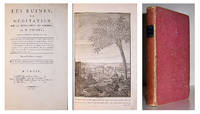
1792000262Paris: Desenne. Volland. Plassan. Libraires 1792. Hardcover. See Description. New and corrected edition First edition printed in France. 8vo. pp. xvi 295 1. With plate depicting the ruins of Palmyra and 2 fold out plates illustrating 1. the eastern hemisphere and 2. the astrological constellations ceil astrologique des anciens. Bound in original pink paste paper boards - some wear to the outer hinges and extremities. Pages are clean; occasional speck of marginal foxing. Volney's book of meditations on the rise and fall of empires was influential on the Romantic movement and on the Hudson River school of painting. Chapters also discuss ancient religions and mysticism. <br/> <br/> Desenne... Volland... Plassan.... Libraires hardcover
26383England. Dating from at least between 1963 and 1975. The collection is in good condition on lightly aged and worn paper and can be grouped into three sections. ONE: Complete typewritten draft 3 44pp. 4to of Sussman's unpublished monograph on Bloch is contained in a large brown envelope with the following note by Sussman on the front: '2ND COPY without illustrations of "Ernest Bloch - Music's Prophet" JS'. It includes the contents list of illustrations introduction and two-page 'Key and Bibliography'. In seven chapters with titles including: '"Blochian" - The Hebraic idiom' 'The nationalist paradox' and 'Voice in the wilderness'. The monograph clearly went through a long process of revision and also present are a number of typescript drafts of various sections with extensive autograph emendations. These total 56pp. 4to with some sections disordered. TWO: Autograph 'Surrey County Council' notebook in Sussman's close handwriting and with extensive emendations is 93pp. 8vo with a further 45pp. 8vo loosely inserted. THREE: Approximately 70pp. 4to of miscellaneous autograph notes by Sussman mainly on traditional Jewish music together with four leaves torn from the 'Synagogue Review' November and June 1951. Sussman lived at 62 St Quintin Avenue London W10. There is no record of his having published any of his music criticism. In 1949 'The Gramophone' carried an advertisement in which he offered 'thorough tuition in Pianoforte playing and theoretical musical subjects'. England. Dating from at least between 1963 and 1975. unknown
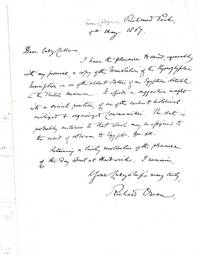
22391Owen's letter to Lady Cullum dated from Sheen Lodge Richmond Park 5 May 1867. Transcription of Birch's letter to Owen dated from British Museum London 9 July 1860. An interesting item in the field of Victorian Egyptology. The subject is what Owen describes here as 'one of the oldest Statues of an Egyptian Notable in the British Museum'. Its current Museum Number is EA103 and it has been in the Museum since 1835 but the details of its acquisition are unclear. In his translation Birch calls the sitter 'the Royal Scribe Amenhelp' but the current BM description begins: 'Scribal statue of Amenhotep son of Hapu: of black grano-diorite. Hieroglyphic texts are inscribed on the papyrus unrolled on his lap and on the statue plinth. His right hand now broken held a pen as if writing while his left hand holds the papyrus roll. .' At the time of writing Owen and Birch were colleagues at the British Museum Owen as Superintendent of the Natural History Department and Birch as head the Egyptian and Assyrian branch see the entries on both men in the Oxford DNB. The recipient of Owen's covering letter to Birch's translation is Lady Ann Cullum 1807-1875 widow of Sir Thomas Gery Cullum 1777-1855 of Hardwick House. As a palaeontologist Owen opposed Darwin's theory of evolution with a biblical view of creation and his interest in Ancient Egypt bound up with his Christian beliefs is apparent in the letter in an elegant assessment of the significance of the statue and in his annotation of Birch's translation. The letter and translation are on four 4to pages of the same paper. In good condition with light signs of age and wear. The letter is on the recto of the first leaf of a bifolium and the first page of the translation on the recto of the second leaf but they have now been inverted by folding with the two leaves carrying the other two pages of the translation tipped-in at the front resulting in the material being presented in reverse order. ONE: Covering Autograph Letter Signed from Owen to Lady Cullum with good firm signature addressed from 'Sheen Lodge Richmond Park 5th May 1867.' 1p 4to. The letter reads: 'Dear Lady Cullum I have the pleasure to send agreeably with my promise a copy of the Translation of the hyeroglyphic sic Inscription on one of the oldest Statues of an Egyptian Notable in the British Museum. It affords a suggestive insight into a social position of one of the earliest historical civilized & organized Communities. The date is probably anterior to that which may be assigned to the visit of Abram to Egypt. Gen. XII. Retaining a lively recollection of the pleasure of the day spent at Hardwick I remain Your Ladyship's very truly Richard Owen.' TWO: Manuscript translation described in Owen's letter. 3pp 4to. Written out in an unknown hand with the first of the five sections titled: 'Translation of the Inscription on the Garment and Papyrus which he is unrolling.' The other four sections of the translation are: 'Inscription In Front of the base' 'Running to the left of the figure' 'right Side' and 'Left side'. At the head of the first page in Owen's autograph: 'Hyeroglyphics sic on the Statue of the Seated Royal Scribe “Amenhelp†in the British Museum.' On the third page at the end of the translation and in the same unknown hand is written out a 'Copy of letter from Samuel Birch Esqre: F.S.A. &c. Keeper of Antiquities in the British Museum enclosing the above Translation to Professor Owen: -'. Birch's letter is dated from the British Museum 9 July 1860. It reads: 'My dear Professor Enclosed is the Translation of the Inscriptions on the Granite Statue of the Seated Scribe. It Consists of the Dedication of the Statue to the Royal Scribe Amenhelp and of his prayers to the God Amen-Ra – the Theban Jupiter. Believe me Yours very truly signed Samuel Birch'. The translation carries tem marginal annotations in Owen's autograph indicating an interest in and knowledge of the subject. The two of Owen's annotations read: 'His territorial Title: Baron Shamer like all the Nobility of Egypt was a priest: the condition is now parallel'd at the Court of Rome.' and 'the Upper & Lower Provinces of Egypt paralleling the Heavens & the Earth.' See Image of Owen's letter. Owen's letter to Lady Cullum dated from Sheen Lodge, Richmond Park, 5 May 1867. Transcription of Birch's letter to Owen dated fr unknown
179948206Halle Rengerschen Buchhandlung 1799. Without wrappers. In "Annalen der Physik. Herausgegeben von Ludwig Wilhelm Gilbert" Bd. 2 Erstes Stück. The entire issue offered. 1-118 a. 2 folded engraved plates. Cavendish's paper: pp. 1-62. the torsion balance of Michell shown on the plates. <br/><br/><em>First German edition of Cavendish's famous paper in which he calculated the weight of the earth and determined its mass. He also as the first observed gravitational motion of minute portions of matter. He estimates the earth's mass to 66 x 10 to the potential of 24 kg. The original paper "Experiments to determine the Density of the Earth" appeared in Philosophical Transaction 1798."Cavendish published five papers between 1784 and 1809.With one exception they were comparatively minor productions.The exception was his determination of the density of the earth or weighing of the world in 1798 by means of John Michell's torsion balance. The apparatus consisted of two lead balls on either end of a suspended beam; these movable balls were attracted by a pair of stationary lead balls. Cavendish calculated the the force of attraction between the balls fro the observed period of oscillation of the balance and deduced the density of the earth from the force. He found it to be 5.48 times that of water. Cavendish was the first to observe gravitational motions induced by comparatively minute portions of ordinary matter.By weighing the world he rendered the law of gravitation complete. The law was no longer a proportionally statement but a quantitatively exact one; this was the most importent addition to the science of gravitation since Newton."DSB III p. 158.The issue contains further papers by Ritter Chladni et al. </em> unknown
19802091502133537147San'yoshinbunsha 1980. Soft Cover. Fine. Number of books: 1 San'yoshinbunsha paperback
20212110502151006128Keibun-do 2021. Soft Cover. Fine. Number of books: 29 Keibun-do paperback
2091202133212949Not Available N.A. Soft Cover. Fine. Number of books: 9 Not Available paperback
BN66266Stabilitätsprüfung in der Pharmazie: Theorie und Praxis Der Pharmazeutische Betrieb Grimm Wolfgang; Harnischfeger Goetz and Tegtmeier Martin <br/><br/> unknown
179943865Halle Rengerschen Buchhandlung 1799. Without wrappers. In "Annalen der Physik. Herausgegeben von Ludwig Wilhelm Gilbert" Bd. 2 Erstes Stück. The entire issue offered. Titlepage to vol. 2. Pp. 1-118 a. 2 folded engraved plates. Cavendish's paper: pp. 1-62. the torsion balance of Michell shown on the plates. <br/><br/><em>First German edition of Cavendish's famous paper in which he calculated the weight of the earth and determined its mass. He also as the first observed gravitational motion of minute portions of matter. He estimates the earth's mass to 66 x 10 to the potential of 24 kg. The original paper "Experiments to determine the Density of the Earth" appeared in Philosophical Transaction 1798."Cavendish published five papers between 1784 and 1809.With one exception they were comparatively minor productions.The exception was his determination of the density of the earth or weighing of the world in 1798 by means of John Michell's torsion balance. The apparatus consisted of two lead balls on either end of a suspended beam; these movable balls were attracted by a pair of stationary lead balls. Cavendish calculated the the force of attraction between the balls fro the observed period of oscillation of the balance and deduced the density of the earth from the force. He found it to be 5.48 times that of water. Cavendish was the first to observe gravitational motions induced by comparatively minute portions of ordinary matter.By weighing the world he rendered the law of gravitation complete. The law was no longer a proportionally statement but a quantitatively exact one; this was the most importent addition to the science of gravitation since Newton."DSB III p. 158. </em> unknown
180344129Halle Rengerschen Buchhandlung 1803. Without wrappers as extracted from "Annalen der Physik. Herausgegeben von Ludwig Wilhelm Gilbert" Bd. 12. Pp. 310-318 a. pp. 385-395. <br/><br/><em>First German edition of both papers constituting the first 2 papers in his "Experimental Essays on the constitution of mixed gases." 1802 in which he formulated his famous gas laws and raised the foundation of the atomic theory in chemistry.The publication of these papers gave him at once international reputation they tried to explain why the gases of the atmosphere remain mixed instead of segregating with the heaviest element at the bottom it states that the maximum density of a vapour in contact with its liquid remains the same whether other gases be present or not and the vies that the particles of everykind of elastic fluid are elastic only with regard to their own kind and that the total pressure of the atmosphere equals the sum of the pressures exerted by the individual gases each of which excerts its pressure independently of the others. This was the first step toward his atomic theory of in chemistry. </em> unknown
184047109Paris Bachelier 1840 4to. No wrappers. In: "Comptes Rendus Hebdomadaires des Séances de L'Academie des Sciences" Tome X No 5 entire issue offered. Pp. 143- 207. Dumas' paper: pp. 149-178. <br/><br/><em>First appearance of this paper which was published the same year in 'Annales de Chimie et de Physique' is the most importent on the theory of structural types and the nomenclature of organic compounds refuting the electrochemical theory of Berzelius. "The development of this idea type organique into what is sometimes called the "Older Type Theory" as distinguished from Gerhardt's Type heory is contained in Dumas' importent memoir on the substitution and the theory of types presented on 3 febriary 1840."Partington IV p. 365. "Jean Baptiste Dumas advances a theory that the chemical properties of an organic compound are determined by its structure and not as seems to be the case with inorganic compounds by its electrical properties. he illustrates the concept with the example that the basic qualitative properties of acetic acid are retained even after replacing three fourths of the hydrogen by chlorine. As a consequence he calls for a revision of chemical nomenclature for organic compounds basing terms on common features not on elemental composition."Parkinson "Breakthroughs" 1840 C. </em> unknown
175842952Berlin Haude et Spener 1758. 4to. No wrappers as issued in "Memoires de l'Academie Royale des Sciences et Belles Lettres". tome XII 1756. Pp. 165-234 a. 1 folded engraved plate. <br/><br/><em>First printing of Euler's importent large memoir in which he develops the mathematical theory of windmills and generates analytically the equations of the effects of winds on duoble-bended surfaces in relation to mechanical work. - Together with d'Alembert and Daniel Bernoully Euler laid the foundation of mathematical physics. - Enestroem E 233. </em> unknown