565 résultats
1991ZB3938081991-2002. volumes 1-20. 1991-2002. partly bound library markings textually clean & tight price is for the set. - If you are reading this this item is actually physically in our stock and ready for shipment once ordered. We are not bookjackers. Buyer is responsible for any additional duties taxes or fees required by recipient's country. Photos available upon request. unknown
19822111902160201271Tottori prefecture 1982. Soft Cover. Fine. Volume: 18 volumes Tottori prefecture paperback
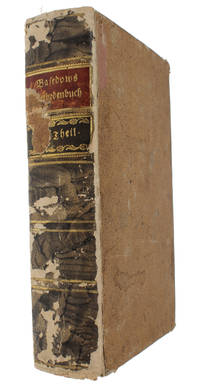
177050344Altona und in der Cramerischen Handlung in Bremen 1770. 8vo. Contemp. marbled boards. The marbled paper on covers gone scratches to marbled paper on spine. Binding fully intact. Title-and tomelabels in leather with gilt lettering. A stamp on foot of title-page. 6XXIV56032;VIII112 pp. Some scattered brownspots mainly to "Verbesserungen des ersten Theiles" and to title-pages. <br/><br/><em>Very scarce first edition of Basedow's main work in educational theory meant to explain his "Elementarwerk".He was strongly influenced by Rousseau's ideas on education in Emile and he proposed the reform of schools and of the common methods of instruction the establishment of an institute for qualifying teachers and solicited subscriptions for the printing of a new illustrated book Elementarwerk "Elementary Book" where his principles were to be explained at length assisted by "Das Methodenbuch".Basedow was called to Denmark in 1753 to become professor at Soroe Akademi where he stayed for 8 years. He was dismissed to Altona in 1761 caused by his theological views going against the prevailing orthodoxy. While he stayed in Soroe he published his "Praktische Philosophie für alle Stände" 1758. </em> hardcover
192948182Berlin Julius Springer 1929 u. 1930. Bound in 2 contemp. uniform hcloth over marbled boards. A stamp to top of titlepages. Gilt lettering to spine. In: "Zeitschrift für Physik. Herausgegeben von Karl Scheel" 56. und 59. Band. VII867 pp. u. VII874 pp. 2 entire volumes offered. Heisenberg & Pauli's paper: pp. 1-61 a. pp. 168-190. Internally clean and fine. <br/><br/><em>First appearance of these two papers of seminal importence as Heisenberg and Pauli here laid the foundation by using a new method for the quantum field theory and gave the "relativistic formulation of quantum electrodynamics in the presence off charges and currents"Pais. They were the first to attempt a general formulation of quantum electrodynamics by setting up a general scheme for the quantization of fields which they hoped would be applicable to the Maxwell field.In the papers they also introduced what is today called "gauge fixing" which from then on are among the precious tools of field theory."Heisenberg and Pauli thus established the basic structure of QFT which can be found in any introduction to QFT up to the present day" Stanford Encyclopaedia of Philosophy. </em> hardcover
9810224117New. Brand new and still unused unknown
18872111902160201414Fukyusha 1887. Soft Cover. Fine. Volume: 1 Fukyusha paperback
192948904Berlin Julius Springer 1929 u. 1930. Bound in 2 contemp. uniform hcloth. Spine ends a bit worn cloth broken on fronthinge to vol. 56. binding not loose. In: "Zeitschrift für Physik. Herausgegeben von Karl Scheel" 56. und 59. Band. VII867 pp. u. VII874 pp. 2 entire volumes offered. Heisenberg & Pauli's paper: pp. 1-61 a. pp. 168-190. Internally clean. <br/><br/><em>First appearance of these two papers of seminal importence as Heisenberg and Pauli here laid the foundation by using a new method for the quantum field theory and gave the "relativistic formulation of quantum electrodynamics in the presence off charges and currents"Pais. They were the first to attempt a general formulation of quantum electrodynamics by setting up a general scheme for the quantization of fields which they hoped would be applicable to the Maxwell field.In the papers they also introduced what is today called "gauge fixing" which from then on are among the precious tools of field theory."Heisenberg and Pauli thus established the basic structure of QFT which can be found in any introduction to QFT up to the present day" Stanford Encyclopaedia of Philosophy. </em> hardcover
192747023London Harrison And Sons Ltd. 1927. Royal8vo. Contemp. full cloth. A small stamp on verso of titlepage. In: "Proceedings of the Royal Society of London" Series A Vol. 114. VIIX748 pp. entire volume offered. Dirac's papers: pp. 243-265 a. pp. 710-728. Clean and fine. <br/><br/><em>First appearance of these milestone papers in Quantum Physics constituting the first step in Quantum Field Theory and the invention of the Second Quantifization Method. By these papers Dirac "gave the foundation for that theory quantum electrodynamics"Pais."A New Radiation Theory. Dirac liked his transformation theory because it was the outcome of a planned line of research and not a fortuitous discovery. He forced his future investigations to fit it. The first results of this strategy were almost miraculous. First came his new radiation theory in February 1927 which quantized for the first time James Clerk Maxwell’s radiation in interaction with atoms. Previous quantum-mechanical studies of radiation problems except for Jordan’s unpopular attempt retained purely classical fields. In late 1925 Jordan had applied Heisenberg’s rules of quantization to continuous free fields and obtained a light-quantum structure with the expected statistics Bose Einstein and dual fluctuation properties. Dirac further demonstrated that spontaneous emission and its characteristics—previously taken into account only by special postulates—followed from the interaction between atoms and the quantum field. Essential to this success was the fact that Dirac’s transformation theory eliminated from the interpretation of the quantum formalism every reference to classical emitted radiation contrary to Heisenberg’s original point of view and also to Schrödinger’s concept of as a classical source of field.This work was done during Dirac’s visit to Copenhagen in the winter of 1927. Presumably to please Bohr who insisted on wave-particle duality and equality Dirac opposed the "corpuscular point of view" to the quantized electromagnetic "wave point of view." He started with a set of massless Bose particles described by symmetric waves in configuration space. As he discovered by’ playing with the equations ’ this description was equivalent to a quantized Schrödinger equation in the space of one particle; this’ second quantization’ was already known to Jordan who during 1927 extended it into the basic modern quantum field representation of matter. Dirac limited his use of second quantization electromagnetic to radiation: to establish that the corpuscular point of view once brought into this form was equivalent to the wave point of view."DSB. </em> hardcover
176941682Berlin Haude et Spener 1769. 4to. No wrappers as issued in "Mémoires de l'Academie Royale des Sciences et Belles-Lettres" tome XIX. 2 =halftitle Mémoires.141-220. 1.memoir pp. 141-179 a. 1 enraved plate. - 2. pp. 180-193. - 3. pp. 194-220. - 4. pp. 221-234 a. 1 plate. <br/><br/><em>First printing of these 4 fundamental papers on the perturbations of the moon as Euler was the first to use of the Calculus on the motion of the moon in relation to the attractive powers of the Moon the Earth and the Sun. The theories laid down here is also called Euler's second theory and it is the most interesting. It was of the greatest importtence as a basis for later developments."He applied his mathematics to astronomy working out the nature of some perturbations being in this respect the precursor of Lagrange and Laplace. He began to replace the geometric methods of proof used by Galileo and Newton with the algebraic a tendency carried to its conclusion by Lagrange. In particular he worked on lunar theory that is on the analysis of the exact motion of the moon the complications of which have been the despair of astronomers and mathematicians since the time of Kepler. - Eneström: 398 399 400 a. 401. </em> unknown
184342922Paris Imprimerie de Bachelier 1843. 4to. No wrappers as extracted from "Journal de Mathématiques pures et appliquées.Publié par Joseph Liouville" tome VIII. Pp. 273-360. Clean and fine. <br/><br/><em>First appearance of Le Verrier's provisional theory on the motion of Mercury his studies of which eventually did much to demonstrate the validity of Einstein's Theory of Relativity. The planetary orbits should agree with the predictions of the General Theory of relativity but as Einstein pointed out in his "Erklärung der Perihelbewegung des Merkurs aus der allgemeinen Relativitätstheorie" from 1915 the divergences predicted were too small to be observed except in the case of the nearest planet Mercury where the perihelion advance according to the formula reaches the value of 43"" per 100 years being in full agreement with the calculations of Le Verrier who found this unexplained rest in the perihelion advance of Mercury per century if the perturbations due to the other planets are deduced.- Einstein tells in a letter to a friend that for several days he was in a 'state of delirious joy' by this wonderful astronomical confirmation of his theory."Le Verrier first began to study Mercury on the suggestion of Arago in 1840. Astronomers realized that Mercury's perihelion the point at which the orbit of a planet is closest to the sun advanced along its orbit at a rate of 566 seconds per century. Le Verrier calculated that even when taking into account the forces exerted by other planets in the solar system there still existed a discrepancy between calculation and observation. Le Verrier's accurate calculations showed that the planet's perihelion.did indeed advance forty seconds of an arc per century more than could be accounted for by Newton's theory of gravitation even after the minor pertubing effects of the other planets had been allowed for." Asimov. - Le verrier published these findings in the present work carefully as to the mass of the planet comparison with other orbits of planets and their perihelia. At the time Le Verrier put down the discrepancy to mis-observation or mis-calculation.- Sparrow Milestones of Science No. 133. </em> unknown
176949805Berlin Haude et Spener 1769. 4to. No wrappers as issued in "Memoires de L'Academie Royale des Sciences et Belles Lettres" tome XXIII pp. 165-310. Clean and fine. <br/><br/><em>First edition of a fundamental paper in the Theory of Numbers in which Lagrange gives a solution in integers of indeterminate equations of the second degree - a remarkable turning point in Diophantine analysis. - Fermat had asserted that he could determine when the more general equation x2-Ay2=B was solvable in integers and that he could solve it when solvable but Lagrange solved it in this paper and furthermore he gives the complete solution to the problem of giving all integral solutions of a general equation where the coefficients are integers. - Cajori calls Lagrange "One of the greatest mathematicians of all times." - Poggendorff I:1344. </em> unknown
186048140Paris Mallet-Bachelier 1860. 4to. No wrappers. In: "Comptes Rendus Hebdomadaires des Séances de L'Academie des Sciences" Tome 50 No 6 a. No 19 Tome 51 No 10 a. No 19. 4 entire issues offered. Pasteur's papers: pp. 303-307 849-854 tome 50 pp. 348-352 675-678 tome 51. <br/><br/><em>First appearance of the suite of the 4 groundbreaking papers marking the downfall of the theory of spontaneous generation and all of Pasteur's later work in this field can be seen as an extension elaboration and defence of the principles and methods set forth here. It is from these conclusions all modern bacteriology and immunology have developed. Pasteur was awarded the Zecker Price 1861 for these discoveries. "Pasteur's publications on the subject of spontaneous generation consists chiefly of communications to the Academy of Sciences in Paris and published in abstracts in the Comptes rendus. the paper offered. In these communication he dealt with the collection and demonstration of erms in the air the origin of ferments the distribution of germs in nature and many other questions. These reports were finally expanded in his famous "Memoire sur les corpuscules organisés qui existent dans l'atmosphere. Examen de la doctrine de génerations spontanées" which was published in 1861. Bullocdh "The History of Bacteriology" p. 96.Printing and the Mind of Man No 336 b - Garrison & Morton No. 2474. </em> unknown
179852947Åbo Frenckellska Boktryckeriet 1798. Orig. blanke kartonomslag. Håndskrevet rygtitel. Lidt rifter i rygpapiret. 41502 pp. Lidt spredte brunpletter. De sidste 5 blade med en skjold øverst. <br/><br/><em>Originaludgaven. First edition. "His Inleding till chemien 1798 was the first Swedishlanguage textbook written in the spirit of the new combustion theory. Although he accepted the phlogiston theory early in his career Gadolin attempted to understand Lavoisier’s ideas. In a paper published in 1788 he tried to define phlogiston and admitted that the French explanation of combustion was superior to some phlogiston theories but for a long time he was not wholly converted. His lectures always made use of the new chemistry and he eventually became the spokesman in Scandinavia for Lavoisier’s nomenclature and combustion theory often encountering Berzelius opposition."DSB.Poggendorff I 827. - Neville I p. 496. </em> unknown
190048173Berlin Johann Ambrosius Barth 1900. Contemp. hcloth. over marbled boards gilt title to spine. Housed in a fine black morocco slicase gilt borders on sides spine with raised bands and gilt lettering. In: "Annalen der Physik" Vierte Folge Band 1. VIII 792 pp. 3 folded engraved plates.Entire volume offered. Planck's papers: pp. 69-122; 621-624;719-737. A very fine and clean copy. With the bookplate of Andras Gedeon on inside frontcover. <br/><br/><em>First edition of these fundamental and highly influential Planck-papers in which he defines his concept of entropy and heat radiation and hereby ANTICIPATES HIS FAMOUS SEMINAL PAPER OF 1900 which redefined physics and took it to the 20th century. - The first two papers "Ueber irreversible Strahlungsvorgänge" were rewritten for the "Annalen" and was first introduced in "Sitzungsberichte d.k. Akad. Wissensch. zu Berlin"."By invoking the hypothesis of natural radiation Planck not only succeeded in obtaining a relation between the energy of the resonator and the intensity of radiation for a given wavelength or frequency but also in defining the entropy of radiation by a proper expression such that the change of the total entropy was always a positive quantity". Mehra Jagdish. The historical development of quantum theory 2001 p. 36. These results found in the period 1894-00 culminated in the present paper "Ueber irreversible Strahlungsvorgänge" and for the first time incorporates the concept of natural radiation and made a purely electromagnetic definition of entropy and of temperature. </em> hardcover
19992091202133200535Kaitaku-sha 1999. Soft Cover. Fine. Number of books: 20 Kaitaku-sha paperback
5b31Kluwer Academic Publishers Hingham 1996. 316/298 pages in total. Paperback. Quart. - very good condition/complete - paperback
BN90651Quintessenz Verlag. Die keramikverblendete NEM-Konuskrone: Theorie Klinik Technik Lenz Jürgen; Schindler Hans J and Pelka Hubert <br/><br/>Die keramikverblendete NEM-Konuskrone: Theorie Klinik Technik Lenz Jürgen; Schindler Hans J and Pelka Hubert Die keramikverblendete NEM-Konuskrone: Theorie Klinik Technik Lenz Jürgen; Schindler Hans J and Pelka Hubert Quintessenz Verlag unknown
185843056Leipzig Johann Ambrosius Barth 1858. Contemp. hcalf. 5 raised bands gilt spine and gilt lettering to spine. A few scratches to spine. Small stamp on verso of first -and general- titlepage. In: "Annalen der Physik und Chemie. Hrsg. von J.C. Poggendorff" Vierte Reihe Bd. 15 =Poggendorff Bd. 105. X636 pp. and 4 folded lithographed plates. Clausius's paper: pp. 239-258. The entire volume offered. Fine and clean. <br/><br/><em>First printing of this main paper in the working out of the Kinetic Theory of Gases in which Clausius announced his determination of the equation governing the mean free path lenght of a molecule moving freely in gases. By this he inscribed his name as one of the founders of the Kinetic Theory of Gases."Clausius was one of the founders of the kinetic theory of gases and of the science of thermodynamics. He and Lord Kelvin at about the same time and independently announced the Second Law of thermodynamics. Clausius particularly developed the theory of thermodynamics by applying it to the study of gases and vapors."Magie in "A Source Book in Physics" p. 228."In order to analyze the process of molecular collisions Clausius adopted a simplified model for his admittedly complicated molecule. He assumed that whatever the actual patterns on intermolecular forces one could suppose that there is some advantage distance between the centers of molecules which would represent a general boundary between attractive and repulsive forces. If two molecules were to approach each other within that boundary repulsion would generally occur. Thus the very complex problem of intermolecular action was reduced to a "billiard ball" model." DSB III p. 307-06. - Parkinson Breakthroughs C/P 1858. </em> hardcover
181646878London Baldwin Cradock and Joy 1816 a. 1821. Bound in 2 uniform contemp. moiré boards. Light wear along edges and a fes smaller scratches. In: "Annals of Philosophy; or Magazine of Chemistry Mineralogy Mechanics Natural History. By Thomas Thomson." Vol. VIII and New series Vol. I. VIII479 pp. a. 9 engraved plates VIII479 pp. a. 7 engraved plates. Entire volumes offered. Herapath's papers: pp. 56-60 1816 a. pp. 273-293 340-351 a. 401-416. <br/><br/><em>First printing of these contoversial papers where Herapath revived the kinetic theory of gases. His theory was more or less neglected by the scientific community at his time. The kinetic theory remained dormant and forgotten after Euler's and Bernouilli's work "until 1816 when Herapath proposed a theory which is essential Bernoulli's. Unfortunately he chose to define temperature as being proportional to the momentum rather than the kinetic energy of molecules. Herapath was the first to show more or less that kinetic theory can provide simple explanations for the changes of state diffusion and the propagation of sound."Trousdell "Essayas in the History of Mechanics" pp. 283 ff.Euler Bernoulli Herapath and Waterston may be considered the principal scientists who prior to 1850 attempted a more or less complete mathematical treatment of gases based on a set of molecular postulates. Jamie Wisniak."Having published a preliminary notice of his theory in the Annals of Philosophy in 1816 Herapath submitted a detailed account to the Royal Society in 1820. Davy who was elected to the presidency of the Society in November of that year was primarily responsible for the fate of the paper. Although Davy was already known as an advocate of the qualitative idea that heat is molecular motion he found Herapath’s quantitative development too speculative and complicated; he rejected the hypothesis of an absolute temperature implying an "absolute zero" of cold. Having been told that his paper would not be accepted for publication in the Philosophical Transactions Herapath withdrew it and published it instead in the Annals of Philosophy in 1821. Five years later he launched an attack on Davy in the Times of London accusing him of circulating unfounded criticisms of his experimental work which prevented its publication. Although Davy ignored a series of letters and challenges published in the Times Herapath later claimed Davy’s resignation from the presidency of the Royal Society 1827 as a victory for himself."DSB. </em> hardcover
192248912Paris Gauthier-Villars 1922. 4to. Bound in 2 uniform full cloth but of slightly different sizes. Paperlabels pasted to lower part of spines. A faint stamp to titlepage and some of the issues. In "Comptes Rendus Hebdomadaires des Séances de L'Academie des Sciences" Tome 174. 18151 pp. Entire volume offered. Cartan's papers: pp.437-439 593-595 734-737 857-60 1104-1107. <br/><br/><em>First edition of these papers in which Cartan intruced the concept of "Torsion" the main inspiration for Einstein in his searce for a unified field theory. The ECT of gravity is a modification of the General relativity Theory"The Einstein-Cartan theory also known as the Einstein-Cartan-Sciama-Kibble theory is a classical theory of gravitation similar to general relativity but relaxing the assumption that the affine connection has vanishing antisymmetric part torsion tensor so that the torsion can be coupled to the intrinsic angular momentum spin of matter much in the same way in which the curvature is coupled to the energy and momentum of matter. In fact the spin of matter in curved spacetime requires that torsion is not constrained to be zero but is a variable in the principle of stationary action. Regarding the metric and torsion tensors as independent variables gives the correct generalization of the conservation law for the total orbital plus intrinsic angular momentum to the presence of the gravitational field. The theory was first proposed by Élie Cartan in 1922 and expounded in the following few years. Dennis Sciama and Tom Kibble independently revisited the theory in the 1960s and an important review was published in 1976. Albert Einstein became affiliated with the theory in 1928 during his unsuccessful attempt to match torsion to the electromagnetic field tensor as part of a unified field theory. This line of thought led him to the related but different theory of teleparallelism." Wikipedia. </em> hardcover
174046843Paris L'Imprimerie Royale 1740. 4to. Without wrappers. Extracted from "Mémoires de l'Academie des Sciences. Année 1737". Pp. 205-227 a. 2 folded engraved plates. <br/><br/><em>First appearance of this extremely importent paper in which Clairaut directly confirms the rotation and the orbital movement of the Earth around the Sun and giving an indirect proof of the axiom that the velocity of light does not depend on whether the light source moves away or toward the observer. The Earth does move after all !!In 1728 James Bradley trying to measure the stellar parallax discovered stellar aberration - the angular displacement of the apparent direction of starlight due to the earth's motion - and attributed it to the combined effect of the finite velocity of light and the earth's orbital velocity. But Bradley had not given any theoretical proof but Clairaut did in the offered paper.Aberration is "the apparent change in direction of a source of light caused by an observers component of motion perpendicular to the impinging rays. During this time the telescope has moved a short distance causing the photons to reach a spot on the focal plane displayed from the former image position. This discovery provided the first direct physical confirmation of the Copernican theory. A second importent application of aberration has been its clear-cut demonstration that as is axiomatic to special relativity light reaching the earth has a velocity unaffected by the relative motion of the source toward or away from earth."McGraw-Hill "Concise Encyclopedia.". </em> unknown
180843629Halle Rengerschen Buchhandlung 1808. Without wrappers as published in "Annalen der Physik. Herausgegeben von Ludwig Wilhelm Gilbert" Bd. 28 Viertes Stück. The entire issue offered =Heft 4. Titlepage to vol. 28 small stamps on verso. Pp. 377-496 a. 3 engraved plates. Dalton's paper: pp. 397-416 a. 1 engraved plate showing apparatus. <br/><br/><em>First appearence i German of Dalton's epoch-making paper in which is contained THE FIRST CLEAR STATEMENT OF MODERN ATOMIC THEORY and having the FIRST LIST OF ATOMIC WEIGHTS "Verhältniss der Gewichte der kleinsten Theilschen von gasförmigen und andern Körpern." Table of the relative weights of the ultimate particles of gaseous and other bodies. The paper offered is a free translation of Dalton's paper "On the Absorption of Gases by Water and Other Liquids" published 1805 in "Memoirs of the Literary and Philosophical Society of Manchester"."The paper was read to the Manchester Philosophical Society by Dalton in 1803 and printed in 1805. The appended table in this paper is the first list of atomic weights. Dalton in this publication took the law which William henry had recently enunciated that the amount of of gas absorbed by a liquid is proportional to the pressure and extended it to apply to mixtures of gases using his own law of partial pressures." Leicester & Klicktein "A Source Book in Chemistry" p. 258.Parkinson "Breakthroughs" 1803 C.- Smyth No. 38. </em> unknown
191448028Braunschweig Friedr. Vieweg & Sohn 1914. Lex8vo. Contemp hcloth gilt spine. Lower spine end a bit frayed otherwise very fine. In: "Verhandlungen der deutschen Physikalischen Gesellschaft im Jahre 1914" 16. Jahrgang. IX1072 pp. Franck & Hertz' papers: pp. 457-467 a. 512-517 textillustr. Fine and clean. <br/><br/><em>First apperance of the famous Franck-Hertz Experiment which is considered as a new and independent support not only of Planck's quantum theory and Einstein's light-quantum hypothesis but also of Bohr's theory of the atom with stationary states of discrete energies.Franck and Hertz were awarded the Nobel Prize in Physics in 1925 for this work and Franck concluded his Nobel lecture with the words "We know only to well that we owe the wide recognition that our work received to contact with the great concepts and ideas of M. Planck and in particular Niels Bohr.""In their famous experiments Franck and Hertz' showed that electrons could impart energy to a mercury atom only if they had a kinetic energy exceeding 4.9 ev. and that exactly this quantum of energy was taken up by the mercury atom causing it to emit light of the resonance line Å 2537. It was the first direct proof of the quantized nature of the energy transfer and of the connection of the quantum DeltaE of energy with the frequency p = DeltaE/h of the light emitted as the result of the transfer. These experiments are rightly regarded as the first decisive proof of the reality of the quantized energy levels that had just been postulated by Niel’s Bohr." DSB.See: Siegmund Brandt "The Harevest of a Century. Discoveries of Modern Physics in 100 Episodes" Episode 25 The Franck-Hartz Experiment 1914 pp. 102-104.The volume contains another importent paper ALBERT EINSTEIN "Beiträge zur Quantentheorie" pp. 820-828. First edition. "In this paper. two considerations are given which are interrelated by a common goal inasmuch as it is attempted to derive two of the most importent achievementss of quantum theory viz. Planck's radiation law and Nernst's third law of thermodynamics in a new manner. The proofs do not involve Boltzmann's equation and are thus based enterely on macroscopic thermodynamics. They do introduce however the quantum hupothesis. Einstein points out that the alleged 'proofs' which try to derive the theorem of Nernst from the mere fact that the heat capacity of all substances goes to zero at absolute zero temterature are not genuine." Cornelius Lanczos.Weil No 67. </em> hardcover
186642764London Taylor and Francis 1866. Large 4to. Without wrappers. Extracted from "Philosophical Transactions of the Royal Society of London." Vol. 156 - Part I. Pp. 249-268 a. 1 lithographed plate. A few brownspots to the plate. Having the titlepage to vol. 156 - Part I. A few brownspots to lower margins. <br/><br/><em>First appearance of a major paper in the kinetic theory of gases in which Maxwell proved that the viscosity was independent of pressure as predicted and nearly a linear function of the absolute temperature T.One of Maxwell's major investigations was on the kinetic theory of gases. Originating with Daniel Bernoulli this theory was advanced by the successive labours of John Herapath John James Waterston James Joule and particularly Rudolf Clausius to such an extent as to put its general accuracy beyond a doubt; but it received enormous development from Maxwell who in this field appeared as an experimenter on the laws of gaseous friction as well as a mathematician."James Clerk Maxwell published a famous paper in 1866 the paper offered using the kinetic theory of gases to study gaseous viscosity. The internal friction the viscosity of the gas is determined by the probability a particle of layer A enters layer B with a corresponding transfer of momentum. Maxwell's calculations showed him that the viscosity coefficient is proportional to both the density the mean free path and the mean velocity of the atoms. On the other hand the mean free path is inversely proportional to the density. So an increase of pressure doesn't result in any change of the viscosity. </em> unknown
190049800Berlin Johann Ambrosius Barth 1900. Later full buckram. Stamp on verso of titlepage. Narrow inner margins binding style with cords in margin. In: "Annalen der Physik" Vierte Folge Band 1. VIII 792 pp. 3 folded engraved plates.Entire volume offered. Planck's papers: pp. 69-122; 621-624;719-737. Internally fine and clean. <br/><br/><em>First edition of these fundamental and highly influential Planck-papers in which he defines his concept of entropy and heat radiation and hereby ANTICIPATES HIS FAMOUS SEMINAL PAPER OF 1900 which redefined physics and took it to the 20th century. - The first two papers "Ueber irreversible Strahlungsvorgänge" were rewritten for the "Annalen" and was first introduced in "Sitzungsberichte d.k. Akad. Wissensch. zu Berlin"."By invoking the hypothesis of natural radiation Planck not only succeeded in obtaining a relation between the energy of the resonator and the intensity of radiation for a given wavelength or frequency but also in defining the entropy of radiation by a proper expression such that the change of the total entropy was always a positive quantity". Mehra Jagdish. The historical development of quantum theory 2001 p. 36. These results found in the period 1894-00 culminated in the present paper "Ueber irreversible Strahlungsvorgänge" and for the first time incorporates the concept of natural radiation and made a purely electromagnetic definition of entropy and of temperature. </em> hardcover