8 209 résultats
16511696Paris, Langlois, 1651. Bll., 128 S. mit 1 Titelvignette und 2 Kopfvignetten in Kupferstich sowie 56 Textkupfern. 1 Kupfertitel (alles von R. Lochon nach N. Poussing und Ch. Errard gestochen). Gr.-4°. Pgmt. der Zeit (etw. fleckig und beschabt, restauriert).
17795471ABLeipzig, M.G. Weidmanns Erben und Reich, 1779 - 1785. 25 x 22 cm. Ggpr. Original Halbleder (Hardcover) m. 2 ggpr. Rücken, Fadenheftung auf echten Bünden. 5 Bände in 2 gebunden. (Komplett) Gute Exemplare. Einbände beschabt und gering bestoßen, Seiten teils braunfleckig. Kleber u. Name von alter Hand auf Titel. Ein Blatt mit einem Einriss von ca. 5 cm. Insgesamt eine schöne Ausgabe dieses bedeutenden Werkes.
17794922ABLeipzig, M.G. Weidmanns Erben und Reich, 1779 - 1785. 25 x 21 cm. Ggpr. Original Halbleder m. 2 ggpr. RS., Band 1 in Vollleder, Fadenheftung auf echten Bünden. 5 Bände (komplett) Gute Exemplare. Einbände beschabt und gering bestoßen, Seiten teils braunfleckig. Lederrücken sauber mit Japanpapier verstärkt, Fehlteile behutsam farblich angepasst. Name von alter Hand auf Titel. Bei Band 1 mit abweichendem Einband und Seiten 153/154 mi
1991ZB3938081991-2002. volumes 1-20. 1991-2002. partly bound library markings textually clean & tight price is for the set. - If you are reading this this item is actually physically in our stock and ready for shipment once ordered. We are not bookjackers. Buyer is responsible for any additional duties taxes or fees required by recipient's country. Photos available upon request. unknown
19822111902160201271Tottori prefecture 1982. Soft Cover. Fine. Volume: 18 volumes Tottori prefecture paperback
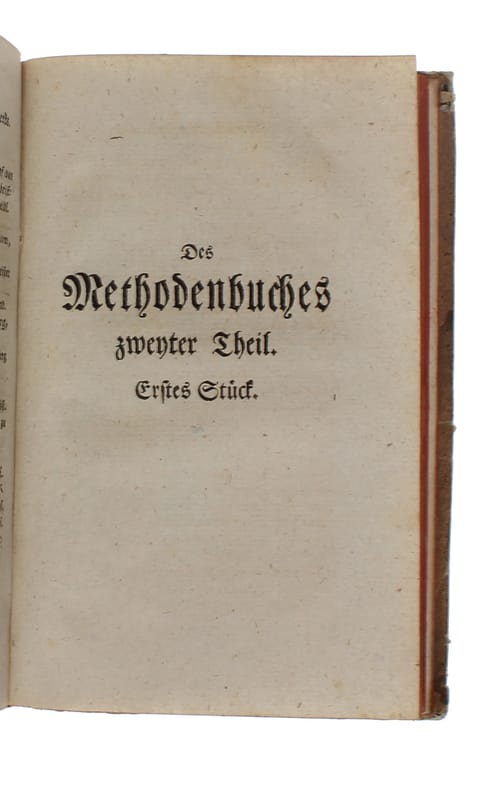
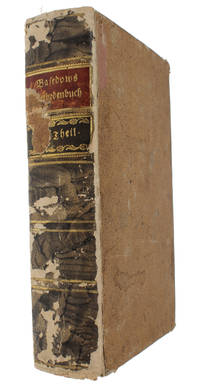
177050344Altona und in der Cramerischen Handlung in Bremen 1770. 8vo. Contemp. marbled boards. The marbled paper on covers gone scratches to marbled paper on spine. Binding fully intact. Title-and tomelabels in leather with gilt lettering. A stamp on foot of title-page. 6XXIV56032;VIII112 pp. Some scattered brownspots mainly to "Verbesserungen des ersten Theiles" and to title-pages. <br/><br/><em>Very scarce first edition of Basedow's main work in educational theory meant to explain his "Elementarwerk".He was strongly influenced by Rousseau's ideas on education in Emile and he proposed the reform of schools and of the common methods of instruction the establishment of an institute for qualifying teachers and solicited subscriptions for the printing of a new illustrated book Elementarwerk "Elementary Book" where his principles were to be explained at length assisted by "Das Methodenbuch".Basedow was called to Denmark in 1753 to become professor at Soroe Akademi where he stayed for 8 years. He was dismissed to Altona in 1761 caused by his theological views going against the prevailing orthodoxy. While he stayed in Soroe he published his "Praktische Philosophie für alle Stände" 1758. </em> hardcover
177050344Altona, und in der Cramerischen Handlung in Bremen, (1770). 8vo. Contemp. marbled boards. The marbled paper on covers gone, scratches to marbled paper on spine. (Binding fully intact). Title-and tomelabels in leather with gilt lettering. A stamp on foot of title-page. (6),XXIV,560,32"VIII,112 pp. Some scattered brownspots, mainly to ""Verbesserungen des ersten Theiles"" and to title-pages.
In-folio, (4), pp240, (4), legatura coeva in pelle, . Trattato volto a illustrare le virtù civiche di sentimento del bene comune e di partecipazione alla vita pubblica, dato alle stampe nel 1617. Il Cebà, di nobile famiglia genovese, fu fecondo poeta in volgare, prevalentemente imitatore, con esiti non disprezzabili, del grande modello del Petrarca, con una quantità di liriche dedicate all’amata Aurelia Spinola, morta giovane nel 1596, e a Geronima di Negro, poi fattasi monaca. Dopo gli studi a Genova e a Padova, ove ebbe maestri lo Speroni e Giasone di Nores, nel 1591 entrò nell’Accademia degli Addormentati, dedicandosi da allora esclusivamente alla professione letteraria. Traduttore di Teofrasto, lasciò anche un altro poema sacro, “Lazzaro il mendico”, nonché il dialogo teorico “Il Gonzaga ovvero del poema epico”. Treaty aimed at illustrating the civic virtues and feeling for the common good and participation in public life, first published in 1617. Ansaldo Cebà, of a noble Genoese family, was a fruitful poet in vulgar, mainly imitator, with non-despicable results, of the great model of Petrarch, with a quantity of lyrics dedicated to his beloved Aurelia Spinola, who died young in 1596, and to Geronima di Negro, who became a nun. After his studies in Genoa and Padua, with Speroni and Giasone di Nores as teachers, in 1591 he entered the Academia degli Addormentati, focusing from then on exclusively to the literary profession. Translator of Theofrastus, he also left another sacred poem, “Lazzaro il mendico”, as well as the theoretical dialogue “Il Gonzaga ovvero del poema epico” Vinciana 364, Gamba 1853,Bozza scrittori politici
173115173ABAugsburg, Andreas Pfeffel, 1731. 19 cm. Doppelseitiger Titel, Frontispiz, (6) Bl., 368, (2) S. mit einigen geschnittenen Kartuschen und 38 teils (mehrfach) gefalteten Kupferstichen. Neues Halbleder (Hardcover), Fadenheftung. Gutes Exemplar. Durchgängig feuchtigkeitsfleckig. Am unteren Rand teils stärker und mit Materialverlust durch Fraß außerhalb Text und Abbildungen. Dort wo erforderlich fachmännisch mit Japanpapier stabilisiert.
17372674DBParis, Prault, 1737. 4°. (16), 201, (13) S. Mit 12 Kupfertafeln. + Wichtig: Für unsere Kunden in der EU erfolgt der Versand alle 14 Tage verzollt ab Deutschland / Postbank-Konto in Deutschland vorhanden +, 2674D
Hardcover Like New. Ships directly from publishers being a new release book . Pls. allow a minimum of 25 business days delivery time.
1521LD11069Augsburg: Peter Detleffsen for Jeremias Wolff 1715-21. Hardcover. Very Good. Illustrated bound volume containing eight monographs from Sturms series of commentaries on the writings by master architect Nicolaus Goldmann offering complete instructions on civil architecture and engineering. Folio 332 x 207 mm. German type. Modern half leather; some toning or browning of text leaves occasional light to moderate foxing on plates. Contents: 1 Vollständige Anweisung Grosser Herren Palläste . . . schön und prächtig anzugeben. Augsburg: 1718. 84 pages. 36 plates of architectural plans aerial and façade views 14 folding. dampstain along top edge of text leaves. 2 Auffrichtige Entdeckung des zu Auffnahm der Länder und Commercien höchst-nützlichen Nivellirens oder Wasserwägens. Augsburg: 1720. 18 pages. 4 plates of architectural instruments. 3 Kurtze Vorstellung der gantzen Civil-Bau-Kunst. Augsburg: 1718. 32 pages. 11 plates of architectural design and construction arches facades detailing title browned. 4 Ein sehr nöthiges Haupt Stück der vollstandigen Anweisung zu der Civil-Bau-Kunst . von Land-Wohnungen und Meyereyen. Augsburg: 1715. 20 pages. 9 plates of houses façades and aerial plans. Goldmanns tract on civil architecture with in-text diagrams. 5 Vollständige Anweisung alle Arten von bürgerlichen Wohn-Häusern wohl anzugeben. Augsburg: 1721. 16 pages. 15 plates of homes and aerial plans. 6 Leonhard Christoph Sturms Vollständige Anweisung die Bogen-Stellungen nach der Civil-Bau-Kunst in allen Fällen einzutheilen. Augsburg: 1718. 18 pages. 19 plates of architectural façades and aedicules. Goldmanns magnum opus. 7 Gründliche und Practische Unterweisung wie man Fang-Schlaeussen und Roll-Bruecten.Augsburg: 1715. 28 pages. 8 plates of bridge construction. 8 Vollständige Muhlen Baukunst. Augsburg: 1718. 6 35 pages. 51 plates of architectural plans and instruments. Woodcut chapter head and tail-pieces. Sound collected volume in all with good plates. <br/><br/>In 1721 Augsburg based Jeremias Wolff published a collection of tracts from the work known collectively as Verneuerte Goldmann a series of commentaries made by Leonhard Christoph Sturm on the works of Nicolaus Goldmann a professor of mathematics and architecture at Leiden University. Sturm was a German author architecture theorist builder and theologian. He published several architectural treatises in his lifetime before beginning to edit and comment on master architect Goldmanns groundbreaking theoretical works. Wolff attempted to gather Sturms edits together posthumously; Sturm died about 4 years into the project and it took another 3 years to complete. Although the final make-up of the collection is variable it has been said that no two copies have been found to be exactly the same this copy is an impressive compilation in content and illustration. It is very likely these tracts on civil architecture have been around each other for quite some time they may have been intended to be bound in several volumes as sometimes found. As mathematicians Goldmann and Sturm go through great lengths for accuracy. Their mode of thought is analytical even if their procedure is a bit eclectic. The goal remains the same throughout to offer a comprehensive and informative look at architectural theories across the ages. Sturm stresses the constructive rationality in architecture which he believes finds its roots in the engineering of the Temple of Solomon. At the core both authors sought to open up the possibility of a new and indeed German architectural order. These tracts concern town houses public buildings including schools and hospitals gardens and churches and the elaborate Baroque engravings are of façades instruments and aerial views. Wolff was one of the best engravers of his time active in Augsburg until his death in 1724. Peter Detleffsen for Jeremias Wolff hardcover books
17372674DBParis, Prault 1737. 4°. (16), 201, (13) S. Mit 12 Kupfertafeln.
192778147New York: The MacMillan Company. 1927. XIV, (2), 213 S., 1 Falttafel,. Sehr sauber - sehr gut erhalten. - Very fine condition. 8° (Oktav, 18,5 bis 22,5 cm), Goldgeprägtes Orig.- Leinen (Hardcover).
192948182Berlin, Julius Springer, 1929 u. 1930. Bound in 2 contemp. uniform hcloth over marbled boards. A stamp to top of titlepages. Gilt lettering to spine. In: ""Zeitschrift für Physik. Herausgegeben von Karl Scheel"", 56. und 59. Band. VII,867 pp. u. VII,874 pp. (2 entire volumes offered). Heisenberg & Pauli's paper: pp. 1-61 a. pp. 168-190. Internally clean and fine.
192948182Berlin Julius Springer 1929 u. 1930. Bound in 2 contemp. uniform hcloth over marbled boards. A stamp to top of titlepages. Gilt lettering to spine. In: "Zeitschrift für Physik. Herausgegeben von Karl Scheel" 56. und 59. Band. VII867 pp. u. VII874 pp. 2 entire volumes offered. Heisenberg & Pauli's paper: pp. 1-61 a. pp. 168-190. Internally clean and fine. <br/><br/><em>First appearance of these two papers of seminal importence as Heisenberg and Pauli here laid the foundation by using a new method for the quantum field theory and gave the "relativistic formulation of quantum electrodynamics in the presence off charges and currents"Pais. They were the first to attempt a general formulation of quantum electrodynamics by setting up a general scheme for the quantization of fields which they hoped would be applicable to the Maxwell field.In the papers they also introduced what is today called "gauge fixing" which from then on are among the precious tools of field theory."Heisenberg and Pauli thus established the basic structure of QFT which can be found in any introduction to QFT up to the present day" Stanford Encyclopaedia of Philosophy. </em> hardcover
9810224117New. Brand new and still unused unknown
18872111902160201414Fukyusha 1887. Soft Cover. Fine. Volume: 1 Fukyusha paperback
192948904Berlin, Julius Springer, 1929 u. 1930. Bound in 2 contemp. uniform hcloth. Spine ends a bit worn, cloth broken on fronthinge to vol. 56. (binding not loose).. In: ""Zeitschrift für Physik. Herausgegeben von Karl Scheel"", 56. und 59. Band. VII,867 pp. u. VII,874 pp. (2 entire volumes offered). Heisenberg & Pauli's paper: pp. 1-61 a. pp. 168-190. Internally clean.
192948904Berlin Julius Springer 1929 u. 1930. Bound in 2 contemp. uniform hcloth. Spine ends a bit worn cloth broken on fronthinge to vol. 56. binding not loose. In: "Zeitschrift für Physik. Herausgegeben von Karl Scheel" 56. und 59. Band. VII867 pp. u. VII874 pp. 2 entire volumes offered. Heisenberg & Pauli's paper: pp. 1-61 a. pp. 168-190. Internally clean. <br/><br/><em>First appearance of these two papers of seminal importence as Heisenberg and Pauli here laid the foundation by using a new method for the quantum field theory and gave the "relativistic formulation of quantum electrodynamics in the presence off charges and currents"Pais. They were the first to attempt a general formulation of quantum electrodynamics by setting up a general scheme for the quantization of fields which they hoped would be applicable to the Maxwell field.In the papers they also introduced what is today called "gauge fixing" which from then on are among the precious tools of field theory."Heisenberg and Pauli thus established the basic structure of QFT which can be found in any introduction to QFT up to the present day" Stanford Encyclopaedia of Philosophy. </em> hardcover
199313830BLaaber, Laaber-Verlag, 1993-2006. 4°, Zusammen 9302 Seiten, 2177 Notenbeispiele, 1.361 Abb. OLn. mit illustr. OU
192747023London, Harrison And Sons, Ltd., 1927. Royal8vo. Contemp. full cloth. A small stamp on verso of titlepage. In: ""Proceedings of the Royal Society of London"", Series A, Vol. 114. VI,IX,748 pp. (entire volume offered). Dirac's papers: pp. 243-265 a. pp. 710-728. Clean and fine.
192747023London Harrison And Sons Ltd. 1927. Royal8vo. Contemp. full cloth. A small stamp on verso of titlepage. In: "Proceedings of the Royal Society of London" Series A Vol. 114. VIIX748 pp. entire volume offered. Dirac's papers: pp. 243-265 a. pp. 710-728. Clean and fine. <br/><br/><em>First appearance of these milestone papers in Quantum Physics constituting the first step in Quantum Field Theory and the invention of the Second Quantifization Method. By these papers Dirac "gave the foundation for that theory quantum electrodynamics"Pais."A New Radiation Theory. Dirac liked his transformation theory because it was the outcome of a planned line of research and not a fortuitous discovery. He forced his future investigations to fit it. The first results of this strategy were almost miraculous. First came his new radiation theory in February 1927 which quantized for the first time James Clerk Maxwell’s radiation in interaction with atoms. Previous quantum-mechanical studies of radiation problems except for Jordan’s unpopular attempt retained purely classical fields. In late 1925 Jordan had applied Heisenberg’s rules of quantization to continuous free fields and obtained a light-quantum structure with the expected statistics Bose Einstein and dual fluctuation properties. Dirac further demonstrated that spontaneous emission and its characteristics—previously taken into account only by special postulates—followed from the interaction between atoms and the quantum field. Essential to this success was the fact that Dirac’s transformation theory eliminated from the interpretation of the quantum formalism every reference to classical emitted radiation contrary to Heisenberg’s original point of view and also to Schrödinger’s concept of as a classical source of field.This work was done during Dirac’s visit to Copenhagen in the winter of 1927. Presumably to please Bohr who insisted on wave-particle duality and equality Dirac opposed the "corpuscular point of view" to the quantized electromagnetic "wave point of view." He started with a set of massless Bose particles described by symmetric waves in configuration space. As he discovered by’ playing with the equations ’ this description was equivalent to a quantized Schrödinger equation in the space of one particle; this’ second quantization’ was already known to Jordan who during 1927 extended it into the basic modern quantum field representation of matter. Dirac limited his use of second quantization electromagnetic to radiation: to establish that the corpuscular point of view once brought into this form was equivalent to the wave point of view."DSB. </em> hardcover
176941682Berlin Haude et Spener 1769. 4to. No wrappers as issued in "Mémoires de l'Academie Royale des Sciences et Belles-Lettres" tome XIX. 2 =halftitle Mémoires.141-220. 1.memoir pp. 141-179 a. 1 enraved plate. - 2. pp. 180-193. - 3. pp. 194-220. - 4. pp. 221-234 a. 1 plate. <br/><br/><em>First printing of these 4 fundamental papers on the perturbations of the moon as Euler was the first to use of the Calculus on the motion of the moon in relation to the attractive powers of the Moon the Earth and the Sun. The theories laid down here is also called Euler's second theory and it is the most interesting. It was of the greatest importtence as a basis for later developments."He applied his mathematics to astronomy working out the nature of some perturbations being in this respect the precursor of Lagrange and Laplace. He began to replace the geometric methods of proof used by Galileo and Newton with the algebraic a tendency carried to its conclusion by Lagrange. In particular he worked on lunar theory that is on the analysis of the exact motion of the moon the complications of which have been the despair of astronomers and mathematicians since the time of Kepler. - Eneström: 398 399 400 a. 401. </em> unknown