8 209 résultats
185843056Leipzig, Johann Ambrosius Barth, 1858. Contemp. hcalf. 5 raised bands, gilt spine and gilt lettering to spine. A few scratches to spine. Small stamp on verso of first -and general- titlepage. In: ""Annalen der Physik und Chemie. Hrsg. von J.C. Poggendorff"", Vierte Reihe Bd. 15, (=Poggendorff Bd. 105). X,636 pp. and 4 folded lithographed plates. Clausius's paper: pp. 239-258. The entire volume offered. Fine and clean.
181646878London Baldwin Cradock and Joy 1816 a. 1821. Bound in 2 uniform contemp. moiré boards. Light wear along edges and a fes smaller scratches. In: "Annals of Philosophy; or Magazine of Chemistry Mineralogy Mechanics Natural History. By Thomas Thomson." Vol. VIII and New series Vol. I. VIII479 pp. a. 9 engraved plates VIII479 pp. a. 7 engraved plates. Entire volumes offered. Herapath's papers: pp. 56-60 1816 a. pp. 273-293 340-351 a. 401-416. <br/><br/><em>First printing of these contoversial papers where Herapath revived the kinetic theory of gases. His theory was more or less neglected by the scientific community at his time. The kinetic theory remained dormant and forgotten after Euler's and Bernouilli's work "until 1816 when Herapath proposed a theory which is essential Bernoulli's. Unfortunately he chose to define temperature as being proportional to the momentum rather than the kinetic energy of molecules. Herapath was the first to show more or less that kinetic theory can provide simple explanations for the changes of state diffusion and the propagation of sound."Trousdell "Essayas in the History of Mechanics" pp. 283 ff.Euler Bernoulli Herapath and Waterston may be considered the principal scientists who prior to 1850 attempted a more or less complete mathematical treatment of gases based on a set of molecular postulates. Jamie Wisniak."Having published a preliminary notice of his theory in the Annals of Philosophy in 1816 Herapath submitted a detailed account to the Royal Society in 1820. Davy who was elected to the presidency of the Society in November of that year was primarily responsible for the fate of the paper. Although Davy was already known as an advocate of the qualitative idea that heat is molecular motion he found Herapath’s quantitative development too speculative and complicated; he rejected the hypothesis of an absolute temperature implying an "absolute zero" of cold. Having been told that his paper would not be accepted for publication in the Philosophical Transactions Herapath withdrew it and published it instead in the Annals of Philosophy in 1821. Five years later he launched an attack on Davy in the Times of London accusing him of circulating unfounded criticisms of his experimental work which prevented its publication. Although Davy ignored a series of letters and challenges published in the Times Herapath later claimed Davy’s resignation from the presidency of the Royal Society 1827 as a victory for himself."DSB. </em> hardcover
17814873CBGeneve, 1781. 12°. 448 (2) S. Lederband der Zeit mit verblasster Rückenvergoldung und dreis. Goldschnitt.
Paperback This a new rleased book that ships from publishers. Pls. allow a minimum of 4 - 6 weeks for deliervy.
193292109210437xbvkMoscow, 'Federatsija' (Federation), 1932. 94 (2) pages on fine paper. - Publisher's color-illustrated (by A. Levina) hardcover binding titled in russian cyrillic; 8vo.(ca. 16 x 11,5 cm).
192248912Paris, Gauthier-Villars, 1922. 4to. Bound in 2 uniform full cloth, but of slightly different sizes. Paperlabels pasted to lower part of spines. A faint stamp to titlepage and some of the issues. In ""Comptes Rendus Hebdomadaires des Séances de L'Academie des Sciences"", Tome 174. 1815,(1) pp. (Entire volume offered). Cartan's papers: pp.437-439, 593-595, 734-737, 857-60, 1104-1107.
174046843(Paris, L'Imprimerie Royale, 1740). 4to. Without wrappers. Extracted from ""Mémoires de l'Academie des Sciences. Année 1737"". Pp. 205-227 a. 2 folded engraved plates.
191448028Braunschweig, Friedr. Vieweg & Sohn, 1914. Lex8vo. Contemp hcloth, gilt spine. Lower spine end a bit frayed, otherwise very fine. In: ""Verhandlungen der deutschen Physikalischen Gesellschaft im Jahre 1914"", 16. Jahrgang. IX,1072 pp. Franck & Hertz' papers: pp. 457-467 a. 512-517, textillustr. Fine and clean.
186642764(London, Taylor and Francis, 1866). Large 4to. Without wrappers. Extracted from ""Philosophical Transactions of the Royal Society of London."", Vol. 156 - Part I. Pp. 249-268 a. 1 lithographed plate. A few brownspots to the plate. Having the titlepage to vol. 156 - Part I. A few brownspots to lower margins.
190049800Berlin, Johann Ambrosius Barth, 1900. Later full buckram. Stamp on verso of titlepage. Narrow inner margins (binding style with cords in margin). In: ""Annalen der Physik"", Vierte Folge, Band 1. VIII, 792 pp. + 3 folded engraved plates.(Entire volume offered). Planck's papers: pp. 69-122" 621-624"719-737. Internally fine and clean.
192248912Paris Gauthier-Villars 1922. 4to. Bound in 2 uniform full cloth but of slightly different sizes. Paperlabels pasted to lower part of spines. A faint stamp to titlepage and some of the issues. In "Comptes Rendus Hebdomadaires des Séances de L'Academie des Sciences" Tome 174. 18151 pp. Entire volume offered. Cartan's papers: pp.437-439 593-595 734-737 857-60 1104-1107. <br/><br/><em>First edition of these papers in which Cartan intruced the concept of "Torsion" the main inspiration for Einstein in his searce for a unified field theory. The ECT of gravity is a modification of the General relativity Theory"The Einstein-Cartan theory also known as the Einstein-Cartan-Sciama-Kibble theory is a classical theory of gravitation similar to general relativity but relaxing the assumption that the affine connection has vanishing antisymmetric part torsion tensor so that the torsion can be coupled to the intrinsic angular momentum spin of matter much in the same way in which the curvature is coupled to the energy and momentum of matter. In fact the spin of matter in curved spacetime requires that torsion is not constrained to be zero but is a variable in the principle of stationary action. Regarding the metric and torsion tensors as independent variables gives the correct generalization of the conservation law for the total orbital plus intrinsic angular momentum to the presence of the gravitational field. The theory was first proposed by Élie Cartan in 1922 and expounded in the following few years. Dennis Sciama and Tom Kibble independently revisited the theory in the 1960s and an important review was published in 1976. Albert Einstein became affiliated with the theory in 1928 during his unsuccessful attempt to match torsion to the electromagnetic field tensor as part of a unified field theory. This line of thought led him to the related but different theory of teleparallelism." Wikipedia. </em> hardcover
174046843Paris L'Imprimerie Royale 1740. 4to. Without wrappers. Extracted from "Mémoires de l'Academie des Sciences. Année 1737". Pp. 205-227 a. 2 folded engraved plates. <br/><br/><em>First appearance of this extremely importent paper in which Clairaut directly confirms the rotation and the orbital movement of the Earth around the Sun and giving an indirect proof of the axiom that the velocity of light does not depend on whether the light source moves away or toward the observer. The Earth does move after all !!In 1728 James Bradley trying to measure the stellar parallax discovered stellar aberration - the angular displacement of the apparent direction of starlight due to the earth's motion - and attributed it to the combined effect of the finite velocity of light and the earth's orbital velocity. But Bradley had not given any theoretical proof but Clairaut did in the offered paper.Aberration is "the apparent change in direction of a source of light caused by an observers component of motion perpendicular to the impinging rays. During this time the telescope has moved a short distance causing the photons to reach a spot on the focal plane displayed from the former image position. This discovery provided the first direct physical confirmation of the Copernican theory. A second importent application of aberration has been its clear-cut demonstration that as is axiomatic to special relativity light reaching the earth has a velocity unaffected by the relative motion of the source toward or away from earth."McGraw-Hill "Concise Encyclopedia.". </em> unknown
180843629Halle Rengerschen Buchhandlung 1808. Without wrappers as published in "Annalen der Physik. Herausgegeben von Ludwig Wilhelm Gilbert" Bd. 28 Viertes Stück. The entire issue offered =Heft 4. Titlepage to vol. 28 small stamps on verso. Pp. 377-496 a. 3 engraved plates. Dalton's paper: pp. 397-416 a. 1 engraved plate showing apparatus. <br/><br/><em>First appearence i German of Dalton's epoch-making paper in which is contained THE FIRST CLEAR STATEMENT OF MODERN ATOMIC THEORY and having the FIRST LIST OF ATOMIC WEIGHTS "Verhältniss der Gewichte der kleinsten Theilschen von gasförmigen und andern Körpern." Table of the relative weights of the ultimate particles of gaseous and other bodies. The paper offered is a free translation of Dalton's paper "On the Absorption of Gases by Water and Other Liquids" published 1805 in "Memoirs of the Literary and Philosophical Society of Manchester"."The paper was read to the Manchester Philosophical Society by Dalton in 1803 and printed in 1805. The appended table in this paper is the first list of atomic weights. Dalton in this publication took the law which William henry had recently enunciated that the amount of of gas absorbed by a liquid is proportional to the pressure and extended it to apply to mixtures of gases using his own law of partial pressures." Leicester & Klicktein "A Source Book in Chemistry" p. 258.Parkinson "Breakthroughs" 1803 C.- Smyth No. 38. </em> unknown
191448028Braunschweig Friedr. Vieweg & Sohn 1914. Lex8vo. Contemp hcloth gilt spine. Lower spine end a bit frayed otherwise very fine. In: "Verhandlungen der deutschen Physikalischen Gesellschaft im Jahre 1914" 16. Jahrgang. IX1072 pp. Franck & Hertz' papers: pp. 457-467 a. 512-517 textillustr. Fine and clean. <br/><br/><em>First apperance of the famous Franck-Hertz Experiment which is considered as a new and independent support not only of Planck's quantum theory and Einstein's light-quantum hypothesis but also of Bohr's theory of the atom with stationary states of discrete energies.Franck and Hertz were awarded the Nobel Prize in Physics in 1925 for this work and Franck concluded his Nobel lecture with the words "We know only to well that we owe the wide recognition that our work received to contact with the great concepts and ideas of M. Planck and in particular Niels Bohr.""In their famous experiments Franck and Hertz' showed that electrons could impart energy to a mercury atom only if they had a kinetic energy exceeding 4.9 ev. and that exactly this quantum of energy was taken up by the mercury atom causing it to emit light of the resonance line Å 2537. It was the first direct proof of the quantized nature of the energy transfer and of the connection of the quantum DeltaE of energy with the frequency p = DeltaE/h of the light emitted as the result of the transfer. These experiments are rightly regarded as the first decisive proof of the reality of the quantized energy levels that had just been postulated by Niel’s Bohr." DSB.See: Siegmund Brandt "The Harevest of a Century. Discoveries of Modern Physics in 100 Episodes" Episode 25 The Franck-Hartz Experiment 1914 pp. 102-104.The volume contains another importent paper ALBERT EINSTEIN "Beiträge zur Quantentheorie" pp. 820-828. First edition. "In this paper. two considerations are given which are interrelated by a common goal inasmuch as it is attempted to derive two of the most importent achievementss of quantum theory viz. Planck's radiation law and Nernst's third law of thermodynamics in a new manner. The proofs do not involve Boltzmann's equation and are thus based enterely on macroscopic thermodynamics. They do introduce however the quantum hupothesis. Einstein points out that the alleged 'proofs' which try to derive the theorem of Nernst from the mere fact that the heat capacity of all substances goes to zero at absolute zero temterature are not genuine." Cornelius Lanczos.Weil No 67. </em> hardcover
186642764London Taylor and Francis 1866. Large 4to. Without wrappers. Extracted from "Philosophical Transactions of the Royal Society of London." Vol. 156 - Part I. Pp. 249-268 a. 1 lithographed plate. A few brownspots to the plate. Having the titlepage to vol. 156 - Part I. A few brownspots to lower margins. <br/><br/><em>First appearance of a major paper in the kinetic theory of gases in which Maxwell proved that the viscosity was independent of pressure as predicted and nearly a linear function of the absolute temperature T.One of Maxwell's major investigations was on the kinetic theory of gases. Originating with Daniel Bernoulli this theory was advanced by the successive labours of John Herapath John James Waterston James Joule and particularly Rudolf Clausius to such an extent as to put its general accuracy beyond a doubt; but it received enormous development from Maxwell who in this field appeared as an experimenter on the laws of gaseous friction as well as a mathematician."James Clerk Maxwell published a famous paper in 1866 the paper offered using the kinetic theory of gases to study gaseous viscosity. The internal friction the viscosity of the gas is determined by the probability a particle of layer A enters layer B with a corresponding transfer of momentum. Maxwell's calculations showed him that the viscosity coefficient is proportional to both the density the mean free path and the mean velocity of the atoms. On the other hand the mean free path is inversely proportional to the density. So an increase of pressure doesn't result in any change of the viscosity. </em> unknown
190049800Berlin Johann Ambrosius Barth 1900. Later full buckram. Stamp on verso of titlepage. Narrow inner margins binding style with cords in margin. In: "Annalen der Physik" Vierte Folge Band 1. VIII 792 pp. 3 folded engraved plates.Entire volume offered. Planck's papers: pp. 69-122; 621-624;719-737. Internally fine and clean. <br/><br/><em>First edition of these fundamental and highly influential Planck-papers in which he defines his concept of entropy and heat radiation and hereby ANTICIPATES HIS FAMOUS SEMINAL PAPER OF 1900 which redefined physics and took it to the 20th century. - The first two papers "Ueber irreversible Strahlungsvorgänge" were rewritten for the "Annalen" and was first introduced in "Sitzungsberichte d.k. Akad. Wissensch. zu Berlin"."By invoking the hypothesis of natural radiation Planck not only succeeded in obtaining a relation between the energy of the resonator and the intensity of radiation for a given wavelength or frequency but also in defining the entropy of radiation by a proper expression such that the change of the total entropy was always a positive quantity". Mehra Jagdish. The historical development of quantum theory 2001 p. 36. These results found in the period 1894-00 culminated in the present paper "Ueber irreversible Strahlungsvorgänge" and for the first time incorporates the concept of natural radiation and made a purely electromagnetic definition of entropy and of temperature. </em> hardcover
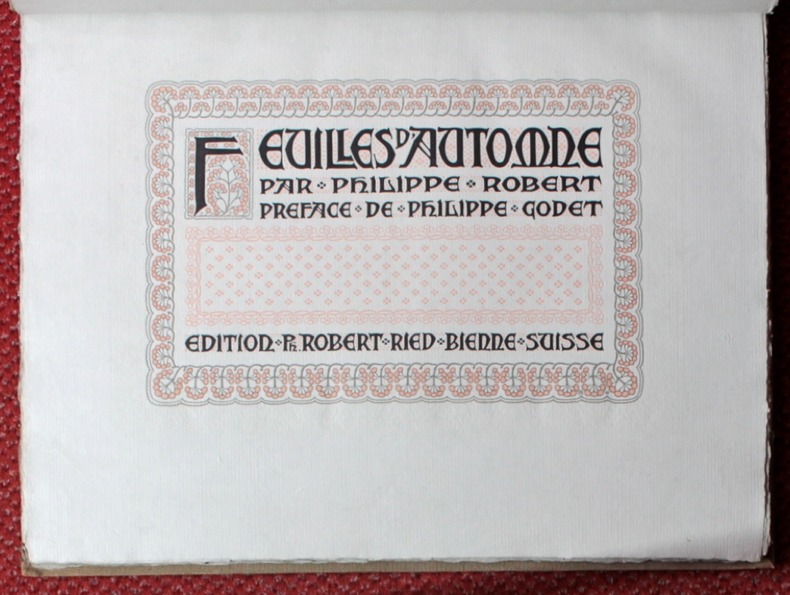
19098328Bienne, Ph. Robert, 1909. In-folio de 45-[3]pages et 18 pl. sous serpentes légendées, pleine toile verte d'éditeur ornée au premier plat du titre estampé en deux teintes. Coiffe supérieure frottée, toile un peu passée, petite marque au second plat. Intérieur sans aucuns défauts.
7903A Paris, chez Guillaume Loyson, au Palais, en la Gallerie des prisonniers, au Nom de Jesus, 1646. In-8, reliure d'époque plein veau, dos titré et orné de caissons dorés à fleuron, double filet doré d'encadrement sur les plats, (6)-350-(9)-248-(6)-98-(6) pp. Au lecteur. - Nicolas Macchiavel à Zanobe Bondelmont, et Cosme Rucelay - Le Seigneur des Essarts, N. de Herberay, Au traducteur des Discours de Nicolas Macchiavel, Acuerdo Olvido - Soneto Di M.G. M. al Lettore - Les Discours de M. ...
4 livraisons en 3 volumes, en feuilles, 77 pp. et 110 pl. en numérotation continue Chemises demi-toile à lacets de l'éditeur 1853, 1853, in-4, 4 livraisons en 3 volumes, en feuilles, 77 pp. et 110 pl. en numérotation continue, Chemises demi-toile à lacets de l'éditeur, Atlas seul. Les livraisons 1 et 2 sont réunies dans le même portefeuille. Seconde édition, après une première parue 1844-1846, augmentée de plus de 30 planches. Les planches représentent des ossements de nombreux mammifères terriens et aquatiques, reptiles, dinosaures, oiseaux, poissons, insectes, animaux marins et fossiles. François-Jules Pictet (1809-1872) s'intéressa tout d'abord à l'entomologie, puis, à partir du milieu des années 1840 et jusqu'à la fin de sa vie à l'entomologie et aux fossiles des animaux vertébrés principalement trouvés en Suisse, son pays natal. Il était, avec Cuvier, l'un des tenants du créationnisme ("fixisme" selon la terminologie de Cuvier). Toutefois, il reconnaissait l'hypothèse d'un mécanisme d'évolution entre les espèces, sans suivre la théorie darwiniste jusqu'au bout, lui ; il lui objectait que l'immense diversité des formes de vie, propre aux ères primitives des recensement paléontologique conteste l'idée des types primitifs. C'est la théorie qu'il défend dans son Traité de paléontologie, qui est sans doute l'un des plus grands textes de paléozoologie et d'anatomie comparée du XIXe s. Cachet aux initiales "E.D." sur les plats supérieurs. Chemises salies, quelques rousseurs claires sur les feuillets de texte et sur les planches. Lacets conservés. Nissen ZBI, n° 3176. Ward & Carozzi n° 1778
Paperback No expedite shipping. Pls. allow 4 - 6 weeks delivery being a newly release book from publishers. Ships from publishers directly.
185449410(London, Richard Taylor and William Francis, 1854). 4to. No wrappers as extracted from ""Philosophical Transactions"" 1854, Vol. 144 - Part I. Pp. 245-258.
185449410London Richard Taylor and William Francis 1854. 4to. No wrappers as extracted from "Philosophical Transactions" 1854 Vol. 144 - Part I. Pp. 245-258. <br/><br/><em>First printing of the first paper in Cayley's famous memoirs on 'quantics' a term he coined for algebraic forms. In this paper Cayley throughout remodelled the whole basis for Invariant Theory."In addition to his part in founding the theory of abstract groups Cayley has a number of important theorems to his credit: perhaps the best known is that every finite group whatsoever is isomorphic with a suitable group of permutations see the first paper of 1854. This is often reckoned to be one of the three most important theorems of the subject the others being the theorems of Lagrange and Sylow. But perhaps still more significant was his early appreciation of the way in which the theory of groups was capable of drawing together many different domains of mathematics: his own illustrations for instance were drawn from the theories of elliptic functions matrices quantics quaternions homographic transformations and the theory of equations. If Cayley failed to pursue his abstract approach this fact is perhaps best explained in terms of the enormous progress he was making in these subjects taken individually."DSB </em> unknown
190142079Leipzig Veit & Comp. 1901-03. Lex8vo. Bound in 2 fine contemp. hcalf. Raised bands gilt spines and with gilt lettering. A few minor scratches. A name cut from front free endpaper. XII648;XIV752 pp. textillustrations and 12 colourplates. Internally fine and clean. <br/><br/><em>First edition og this classic work in genetics where de Vries further develops the theory of mutations.- "De Vries experimental work in the 1890' led to the rediscovery of Mendel's laws and the discovery of the phenomenon of mutation. The rediscovery of Mendel's laws was announced almost simultabeously by de Vries Correns and Tschermak-Seysenegg - in that order.The results of his more than ten years of experimentation and study were laid down in de Vries's "Die Mutationstheorie.1901-1903 in which he described in detail his work on the segregation laws on phenomena of variation and on plant mutations. The book made him famous and he was recognized as one of the foremost botanists of his time."DSB."De Vries discovered revealed and proved the importence of Mendel's work. Advanced the theory of "mutations" or discontinous change in the character of species." Horblit. One Hundred Books famous in Science No. 73 b. - Dibner. Heralds of Science No 36. - Garrison & Morton No 240. - Sparrow. Milestones of Science No 194. </em> hardcover
9257A Paris, chez Desenne, Libraire, Palais Egalité, Quatremère, Libraire, rue S. Benoît et les Marchands de Nouveautés, An IV-1796. In-12, broché sans couverture, 74 pp.
22987A Genève, et se trouve à Paris, chez Gattey; A Lyon, chez Maire de Mars; A Bordeaux, chez Bergeret, 1792. 2 volumes in one. (2), xvi, 304 pp.; viii, 295 pp. 8vo. Sewn in contemporary wrappers, paper label on spine with handwritten title, a bit rubbed, an uncut copy. Martin & Walter 25395. First edition. Mounier gained prominence as a leader of the Revolution of 1788 in the Dauphiné and as one of the more influential leaders of the Estates General and the National Constituent Assembly in the summer of 1789. He was a constitutional monarchist and as long as he thought the Revolution was taking France toward his ideal, he was a revolutionary. He was the proposer of the Tennis Court Oath, rejoiced at the 14 July uprising and the storming of the Bastille; and his wording of the first three articles of the Declaration of the Rights of Man was accepted by the Assembly.'Mounier, in 1788 the leader of a great popular movement, a year later was merely representative of what was condemned as a revolutionary wing of the Assembly' (Cobban, Aspects of the French Revolution.) Later the author had to take refuge in Switzerland, England, Italy and Germany. From 1805 onwards he served in the council of State under Napoleon I.