INTERNATIONAL CONFERENCE ON INFORMATION SYSTEMS AND DEVELOPMENT: METHODS AND TOOLS THEORY AND PRACTIBiblio.com
SYSTEMS DEVELOPMENT METHODS FOR THE NEXT CENTURY
1997Adhya-9780306456930SPRINGER 1997. Hardcover. New. SPRINGER hardcover
565 résultats
185449410London Richard Taylor and William Francis 1854. 4to. No wrappers as extracted from "Philosophical Transactions" 1854 Vol. 144 - Part I. Pp. 245-258. <br/><br/><em>First printing of the first paper in Cayley's famous memoirs on 'quantics' a term he coined for algebraic forms. In this paper Cayley throughout remodelled the whole basis for Invariant Theory."In addition to his part in founding the theory of abstract groups Cayley has a number of important theorems to his credit: perhaps the best known is that every finite group whatsoever is isomorphic with a suitable group of permutations see the first paper of 1854. This is often reckoned to be one of the three most important theorems of the subject the others being the theorems of Lagrange and Sylow. But perhaps still more significant was his early appreciation of the way in which the theory of groups was capable of drawing together many different domains of mathematics: his own illustrations for instance were drawn from the theories of elliptic functions matrices quantics quaternions homographic transformations and the theory of equations. If Cayley failed to pursue his abstract approach this fact is perhaps best explained in terms of the enormous progress he was making in these subjects taken individually."DSB </em> unknown
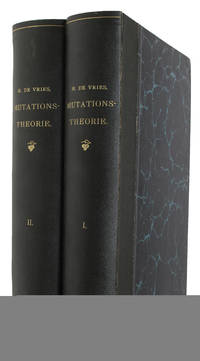
190142079Leipzig Veit & Comp. 1901-03. Lex8vo. Bound in 2 fine contemp. hcalf. Raised bands gilt spines and with gilt lettering. A few minor scratches. A name cut from front free endpaper. XII648;XIV752 pp. textillustrations and 12 colourplates. Internally fine and clean. <br/><br/><em>First edition og this classic work in genetics where de Vries further develops the theory of mutations.- "De Vries experimental work in the 1890' led to the rediscovery of Mendel's laws and the discovery of the phenomenon of mutation. The rediscovery of Mendel's laws was announced almost simultabeously by de Vries Correns and Tschermak-Seysenegg - in that order.The results of his more than ten years of experimentation and study were laid down in de Vries's "Die Mutationstheorie.1901-1903 in which he described in detail his work on the segregation laws on phenomena of variation and on plant mutations. The book made him famous and he was recognized as one of the foremost botanists of his time."DSB."De Vries discovered revealed and proved the importence of Mendel's work. Advanced the theory of "mutations" or discontinous change in the character of species." Horblit. One Hundred Books famous in Science No. 73 b. - Dibner. Heralds of Science No 36. - Garrison & Morton No 240. - Sparrow. Milestones of Science No 194. </em> hardcover
1997Adhya-9780306456930SPRINGER 1997. Hardcover. New. SPRINGER hardcover
1997Adhya-9780306456930SPRINGER 1997. Hardcover. New. SPRINGER hardcover
184051504Paris Bachelier 1840. 4to. No wrappers. In: "Comptes Rendus Hebdomadaires des Séances de L'Academie des Sciences" Tome X No 5 entire issue offered. Pp. 143- 207. Dumas' paper: pp. 149-178. With half-title to Tome X. <br/><br/><em>First appearance of this paper which was published the same year in 'Annales de Chimie et de Physique' is the most importent on the theory of structural types and the nomenclature of organic compounds refuting the electrochemical theory of Berzelius. "The development of this idea type organique into what is sometimes called the "Older Type Theory" as distinguished from Gerhardt's Type heory is contained in Dumas' importent memoir on the substitution and the theory of types presented on 3 February 1840."Partington IV p. 365. "Jean Baptiste Dumas advances a theory that the chemical properties of an organic compound are determined by its structure and not as seems to be the case with inorganic compounds by its electrical properties. he illustrates the concept with the example that the basic qualitative properties of acetic acid are retained even after replacing three fourths of the hydrogen by chlorine. As a consequence he calls for a revision of chemical nomenclature for organic compounds basing terms on common features not on elemental composition."Parkinson "Breakthroughs" 1840 C. </em> unknown
190144710Leipzig Veit & Comp. 1901-03. Lex8vo. Bound in 2 contemp. hcalf spines gilt and with gilt lettering. Spines slightly rubbed. XII648;XIV752 pp. textillustrations and 12 colourplates. Internally fine and clean. <br/><br/><em>First edition og this classic work in genetics where de Vries further develops the theory of mutations.- "De Vries experimental work in the 1890' led to the rediscovery of Mendel's laws and the discovery of the phenomenon of mutation. The rediscovery of Mendel's laws was announced almost simultabeously by de Vries Correns and Tschermak-Seysenegg - in that order.The results of his more than ten years of experimentation and study were laid down in de Vries's "Die Mutationstheorie.1901-1903 in which he described in detail his work on the segregation laws on phenomena of variation and on plant mutations. The book made him famous and he was recognized as one of the foremost botanists of his time."DSB."De Vries discovered revealed and proved the importence of Mendel's work. Advanced the theory of "mutations" or discontinous change in the character of species." Horblit. One Hundred Books famous in Science No. 73 b. - Dibner. Heralds of Science No 36. - Garrison & Morton No 240. - Sparrow. Milestones of Science No 194. </em> unknown
190144522Leipzig Veit & Comp. 1901-03. Lex8vo. Bound in 2 contemp. hcloth. Gilt lettering to spines. XII648;XIV752 pp. textillustrations and 12 colourplates. Internally fine and clean. <br/><br/><em>First edition og this classic work in genetics where de Vries further develops the theory of mutations.- "De Vries experimental work in the 1890' led to the rediscovery of Mendel's laws and the discovery of the phenomenon of mutation. The rediscovery of Mendel's laws was announced almost simultabeously by de Vries Correns and Tschermak-Seysenegg - in that order.The results of his more than ten years of experimentation and study were laid down in de Vries's "Die Mutationstheorie.1901-1903 in which he described in detail his work on the segregation laws on phenomena of variation and on plant mutations. The book made him famous and he was recognized as one of the foremost botanists of his time."DSB."De Vries discovered revealed and proved the importence of Mendel's work. Advanced the theory of "mutations" or discontinous change in the character of species." Horblit. One Hundred Books famous in Science No. 73 b. - Dibner. Heralds of Science No 36. - Garrison & Morton No 240. - Sparrow. Milestones of Science No 194. </em> hardcover
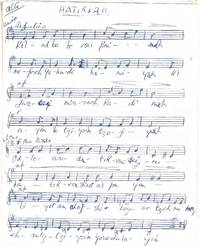
26499Without place or date 1940s. With manuscript map of the Aldgate East area of the East End of London. Six items in good condition on lightly-aged paper. In addition to manuscript scores by Sussman of five parts soprano tenor bass alto and conductor of 'Hatikvah' the five parts totalling 6pp. 4to with staves also drawn out in manuscript there is a duplicated typescript of an English translation of 'Hatikvah' titled 'Men Awake!' 'Workers all! Hear the call!' on one side of a 4to leaf with the Hebrew lyrics in Sussman's duplicated autograph on the reverse with directions to Gardiner's Corner Aldgate East London where the song was presumably sung in support of the Jewish settlement of Palestine/Israel. From the papers of Joseph Sussman of 62 St Quintin Avenue London W10 who in a 1949 issue of 'The Gramophone' advertised 'thorough tuition in Pianoforte playing and theoretical musical subjects'. See Image. "Gardiner's Corner" where crowd assembled to block the Blackshirts. Without place or date [1940s]. With manuscript map of the Aldgate East area of the East End of London. unknown
1984x-0824771303Marcel Dekker Inc 1984. Paperback. New. 1st edition. 592 pages. 10.25x7.25x1.00 inches. Marcel Dekker Inc paperback
1979x-0824768450Marcel Dekker Inc 1979. Paperback. New. 1st edition. 256 pages. 10.25x7.25x0.05 inches. Marcel Dekker Inc paperback
1960100979AB1960. Yale / London / and others MacMillan / and others c. 1960 - c. 2000. Octavo. More than 3000 pages. Original Softcover and Hardcover bindings. All Volumes with signs of external wear but overall in very good condition. In addition the collection also includes a few publications on Administration Policy. From the library of an irish Councilman and University lecturer. Includes for example the following essays: paperback
179943865Halle Rengerschen Buchhandlung 1799. Without wrappers. In "Annalen der Physik. Herausgegeben von Ludwig Wilhelm Gilbert" Bd. 2 Erstes Stück. The entire issue offered. Titlepage to vol. 2. Pp. 1-118 a. 2 folded engraved plates. Cavendish's paper: pp. 1-62. the torsion balance of Michell shown on the plates. <br/><br/><em>First German edition of Cavendish's famous paper in which he calculated the weight of the earth and determined its mass. He also as the first observed gravitational motion of minute portions of matter. He estimates the earth's mass to 66 x 10 to the potential of 24 kg. The original paper "Experiments to determine the Density of the Earth" appeared in Philosophical Transaction 1798."Cavendish published five papers between 1784 and 1809.With one exception they were comparatively minor productions.The exception was his determination of the density of the earth or weighing of the world in 1798 by means of John Michell's torsion balance. The apparatus consisted of two lead balls on either end of a suspended beam; these movable balls were attracted by a pair of stationary lead balls. Cavendish calculated the the force of attraction between the balls fro the observed period of oscillation of the balance and deduced the density of the earth from the force. He found it to be 5.48 times that of water. Cavendish was the first to observe gravitational motions induced by comparatively minute portions of ordinary matter.By weighing the world he rendered the law of gravitation complete. The law was no longer a proportionally statement but a quantitatively exact one; this was the most importent addition to the science of gravitation since Newton."DSB III p. 158. </em> unknown
180344129Halle Rengerschen Buchhandlung 1803. Without wrappers as extracted from "Annalen der Physik. Herausgegeben von Ludwig Wilhelm Gilbert" Bd. 12. Pp. 310-318 a. pp. 385-395. <br/><br/><em>First German edition of both papers constituting the first 2 papers in his "Experimental Essays on the constitution of mixed gases." 1802 in which he formulated his famous gas laws and raised the foundation of the atomic theory in chemistry.The publication of these papers gave him at once international reputation they tried to explain why the gases of the atmosphere remain mixed instead of segregating with the heaviest element at the bottom it states that the maximum density of a vapour in contact with its liquid remains the same whether other gases be present or not and the vies that the particles of everykind of elastic fluid are elastic only with regard to their own kind and that the total pressure of the atmosphere equals the sum of the pressures exerted by the individual gases each of which excerts its pressure independently of the others. This was the first step toward his atomic theory of in chemistry. </em> unknown
184047109Paris Bachelier 1840 4to. No wrappers. In: "Comptes Rendus Hebdomadaires des Séances de L'Academie des Sciences" Tome X No 5 entire issue offered. Pp. 143- 207. Dumas' paper: pp. 149-178. <br/><br/><em>First appearance of this paper which was published the same year in 'Annales de Chimie et de Physique' is the most importent on the theory of structural types and the nomenclature of organic compounds refuting the electrochemical theory of Berzelius. "The development of this idea type organique into what is sometimes called the "Older Type Theory" as distinguished from Gerhardt's Type heory is contained in Dumas' importent memoir on the substitution and the theory of types presented on 3 febriary 1840."Partington IV p. 365. "Jean Baptiste Dumas advances a theory that the chemical properties of an organic compound are determined by its structure and not as seems to be the case with inorganic compounds by its electrical properties. he illustrates the concept with the example that the basic qualitative properties of acetic acid are retained even after replacing three fourths of the hydrogen by chlorine. As a consequence he calls for a revision of chemical nomenclature for organic compounds basing terms on common features not on elemental composition."Parkinson "Breakthroughs" 1840 C. </em> unknown
175842952Berlin Haude et Spener 1758. 4to. No wrappers as issued in "Memoires de l'Academie Royale des Sciences et Belles Lettres". tome XII 1756. Pp. 165-234 a. 1 folded engraved plate. <br/><br/><em>First printing of Euler's importent large memoir in which he develops the mathematical theory of windmills and generates analytically the equations of the effects of winds on duoble-bended surfaces in relation to mechanical work. - Together with d'Alembert and Daniel Bernoully Euler laid the foundation of mathematical physics. - Enestroem E 233. </em> unknown
175945126Berlin Haude et Spener 1759. 4to. No wrappers as issued in "Mémoires de l'Academie Royale des Sciences et Belles Lettres" Année 1757 tome XIII pp. a. 1 engraved plate. <br/><br/><em>First printing of an importent paper in which Euler shows how to manufacture catoptrical telescopes and microscopes in accordance with general rules and founded on his own experiments. - The calculation concerning light ray aberrations brought about due to the sphericty of the glass is a masterpiece of analysis of the highest order and he also incorporates the mathematical theory of achromatic combination of lenses which was first realized by Dollond in the same year 1757. </em> unknown
185243564Leipzig Johann Ambrosius Barth 1852. Without wrappers as issued in "Annalen der Physik und Chemie. Hrsg.von Poggendorff" Dritte Reihe Bd. 26 Achtes Stück.= Heft No. 8 of 1852. The entire issue No. 8 offered. Titlepage to vol. 26. Pp. 501-600. Helmholtz's paper: pp. 501-523. Clean and fine. <br/><br/><em>First appearance of this founding paper in the modern theory of colour in which Helmholtz proved the surprising fact that there are only two among the colours of the spectrum yellow and indigo-blue which together yields pure white that is are complementary to each other whereas their combination had always been supposed to produce green."Helmholtz turned to the intricate problems of color vision in 1852 with an attack on Sir David Brewster's new theory of light. Brewster had maintained the objective reality of three primary colors by supposing in opposition to Newton that there exist three distinct kinds of light each of which excites in the eye one of the sensations red yellow or blue. Helmholtz regarded the theory as still another confusion of physical stimulus and subjective responce.He also revived Young's theory of color visoin.only to refute it. He had discovered that spectral colors when mixed always yield a duller color of less-than-spectral saturation. Therefore the whole idea that all colors may be obtained from mixtures of three primary colors must be incorrect he concluded for the spectral colorss at least can never be obtained in their full saturation by mixing any three of their number.Although Helmholtz dismissed Young's theory in 1852 by 1858 he had changed his mind and become its formost advocate. In order to save Ypoung's theory.Helmholtz asumed that Young's physiological primaries are not spectral colors att all but colors of far greater-than-spectral saturation."DSB VI pp. 246-247. Garrison & Morton 1508. </em> unknown
182159163London Baldwin Cradock and Joy 1821. Contemp. Hcalf. Minor scratches to spine. In: "Annals of Philosophy; or Magazine of Chemistry Mineralogy Mechanics Natural History. By Thomas Thomson." New series Vol. I. VIII479 pp. a. 7 engraved plates. Entire volumes offered. Herapath's papers: pp. 273-293 340-351 a. 401-416. <br/><br/><em>First printing of these contoversial papers where Herapath revived the kinetic theory of gases. His theory was more or less neglected by the scientific community at his time. The kinetic theory remained dormant and forgotten after Euler's and Bernouilli's work "until 1816 when Herapath proposed a theory which is essential Bernoulli's. Unfortunately he chose to define temperature as being proportional to the momentum rather than the kinetic energy of molecules. Herapath was the first to show more or less that kinetic theory can provide simple explanations for the changes of state diffusion and the propagation of sound."Trousdell "Essayas in the History of Mechanics" pp. 283 ff. </em> unknown
189741482Berlin 1897. 4to. Uncut and unopened in original printed wrappers. Fresh copy fine and clean. Near mint. The entire "Heft" II: Pp. 35-81. Planck's paper pp.35-46. <br/><br/><em>Max Planck is considered to be the founder of the quantum theory and was awarded the Nobel Prize in Physics in 1918. "Über irreversible Strahlungsvorgänge" is a mathematical description of the electromagnetic radiation emitted from a black-body."Über irreversible Strahlungsvorgänge was published in five parts in the period 1897-1901 the present volume being number 1."With the Kirchhoff-Wien-Boltzmann work as a background Max Planck began his attack on the black-body problem in 1897. He labored under the erroneous impression for some time that Wien's formula was the only one which harmonized with the second law of thermodynamics. The experiments on black-bodies due to Lummer and Pringsheim Rubens and Kurlbaum forced him from that position." Planck Max. Catalogue 258 Interlibrum Vaduz "I had already been struggling with the problem of the equilibrium of matter and radiation for some years without success; I knew the problem is of fundamental significance for Physics." The significance was unparallelled when he in December 1900 delivered a paper entitled "On the Theory of the Energy Distribution Law in the Normal Spectrum" before the German Physical Society which today is considered the birth of quantum physics. The present volume constitutes a precursor to this work. - Akademie No 33 </em> unknown
BN66266Stabilitätsprüfung in der Pharmazie: Theorie und Praxis Der Pharmazeutische Betrieb Grimm Wolfgang; Harnischfeger Goetz and Tegtmeier Martin <br/><br/> unknown
20212110502151006128Keibun-do 2021. Soft Cover. Fine. Number of books: 29 Keibun-do paperback
2091202133212949Not Available N.A. Soft Cover. Fine. Number of books: 9 Not Available paperback
19802091502133537147San'yoshinbunsha 1980. Soft Cover. Fine. Number of books: 1 San'yoshinbunsha paperback
179948206Halle Rengerschen Buchhandlung 1799. Without wrappers. In "Annalen der Physik. Herausgegeben von Ludwig Wilhelm Gilbert" Bd. 2 Erstes Stück. The entire issue offered. 1-118 a. 2 folded engraved plates. Cavendish's paper: pp. 1-62. the torsion balance of Michell shown on the plates. <br/><br/><em>First German edition of Cavendish's famous paper in which he calculated the weight of the earth and determined its mass. He also as the first observed gravitational motion of minute portions of matter. He estimates the earth's mass to 66 x 10 to the potential of 24 kg. The original paper "Experiments to determine the Density of the Earth" appeared in Philosophical Transaction 1798."Cavendish published five papers between 1784 and 1809.With one exception they were comparatively minor productions.The exception was his determination of the density of the earth or weighing of the world in 1798 by means of John Michell's torsion balance. The apparatus consisted of two lead balls on either end of a suspended beam; these movable balls were attracted by a pair of stationary lead balls. Cavendish calculated the the force of attraction between the balls fro the observed period of oscillation of the balance and deduced the density of the earth from the force. He found it to be 5.48 times that of water. Cavendish was the first to observe gravitational motions induced by comparatively minute portions of ordinary matter.By weighing the world he rendered the law of gravitation complete. The law was no longer a proportionally statement but a quantitatively exact one; this was the most importent addition to the science of gravitation since Newton."DSB III p. 158.The issue contains further papers by Ritter Chladni et al. </em> unknown
26383England. Dating from at least between 1963 and 1975. The collection is in good condition on lightly aged and worn paper and can be grouped into three sections. ONE: Complete typewritten draft 3 44pp. 4to of Sussman's unpublished monograph on Bloch is contained in a large brown envelope with the following note by Sussman on the front: '2ND COPY without illustrations of "Ernest Bloch - Music's Prophet" JS'. It includes the contents list of illustrations introduction and two-page 'Key and Bibliography'. In seven chapters with titles including: '"Blochian" - The Hebraic idiom' 'The nationalist paradox' and 'Voice in the wilderness'. The monograph clearly went through a long process of revision and also present are a number of typescript drafts of various sections with extensive autograph emendations. These total 56pp. 4to with some sections disordered. TWO: Autograph 'Surrey County Council' notebook in Sussman's close handwriting and with extensive emendations is 93pp. 8vo with a further 45pp. 8vo loosely inserted. THREE: Approximately 70pp. 4to of miscellaneous autograph notes by Sussman mainly on traditional Jewish music together with four leaves torn from the 'Synagogue Review' November and June 1951. Sussman lived at 62 St Quintin Avenue London W10. There is no record of his having published any of his music criticism. In 1949 'The Gramophone' carried an advertisement in which he offered 'thorough tuition in Pianoforte playing and theoretical musical subjects'. England. Dating from at least between 1963 and 1975. unknown