Broglie, Louis deAntiquariat.de

8 209 résultats
1923137714London, Macmillan, 1923. 26 x 18 cm (10,5 x 7 inches). Present is the complete volume 112 with 960 pp. Half cloth binding.
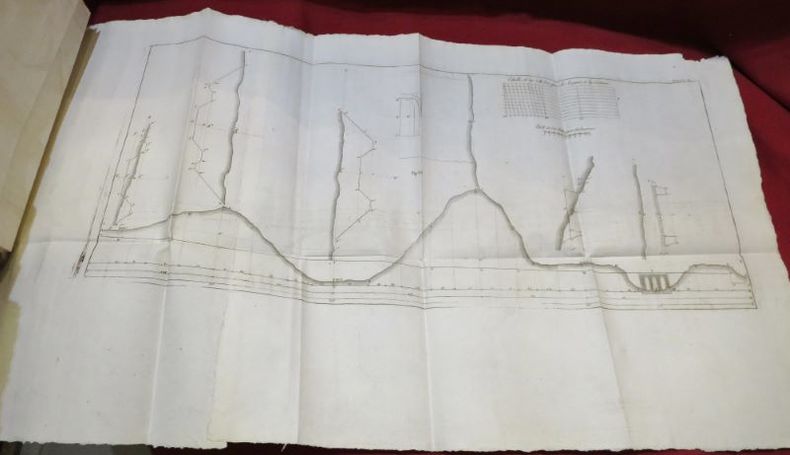
102156A Draguignan, chez Fabre, Imprimeur-Libraire de la Préfecture et des Tribunaux, sans date (1812), 1 volume in-folio de 320x245 mm environ, xxiv-368 pages, cartonnage postérieur crème avec titres manuscrits sur le premier plat, étiquette de titre collée sur le dos. Avec 6 tableaux dépliants et 21 planches dépliantes hors-texte. Petite trace d'humidité p. 245-245, marge un peu salie p. 339, feuillets non rognés avec bordures fendillées et et un peu salies par endroits, sinon bon état.
179938186Wien, gedruckt mit J. C. Schuender'schen Schriften im k. k. Taubstummen-Institute, 1799. 8°. Mit 5 gefalt. Kupfertafeln. 3 Bll., X, 316; 3 Bll., X, 285 S., Ppbd. d. Zt. m. goldgepr. Rückenschild u. dreiseitigem Rotschnitt.
1855266839Erlangen, Enke, 1855-58. XVI, 599 S.; XII, 602 S., 1 Bl.; XV, 851 S. Leinen d. Zeit (gering berieben, Innengelenke teils angeplatzt). [2 Warenabbildungen]
1828604227Heidelberg, Winter, 1828. XIV, 436 S. Grüner Ppbd der Zeit mit rotem Rückenschild.
26383England. Dating from at least between 1963 and 1975. The collection is in good condition on lightly aged and worn paper and can be grouped into three sections. ONE: Complete typewritten draft 3 44pp. 4to of Sussman's unpublished monograph on Bloch is contained in a large brown envelope with the following note by Sussman on the front: '2ND COPY without illustrations of "Ernest Bloch - Music's Prophet" JS'. It includes the contents list of illustrations introduction and two-page 'Key and Bibliography'. In seven chapters with titles including: '"Blochian" - The Hebraic idiom' 'The nationalist paradox' and 'Voice in the wilderness'. The monograph clearly went through a long process of revision and also present are a number of typescript drafts of various sections with extensive autograph emendations. These total 56pp. 4to with some sections disordered. TWO: Autograph 'Surrey County Council' notebook in Sussman's close handwriting and with extensive emendations is 93pp. 8vo with a further 45pp. 8vo loosely inserted. THREE: Approximately 70pp. 4to of miscellaneous autograph notes by Sussman mainly on traditional Jewish music together with four leaves torn from the 'Synagogue Review' November and June 1951. Sussman lived at 62 St Quintin Avenue London W10. There is no record of his having published any of his music criticism. In 1949 'The Gramophone' carried an advertisement in which he offered 'thorough tuition in Pianoforte playing and theoretical musical subjects'. England. Dating from at least between 1963 and 1975. unknown
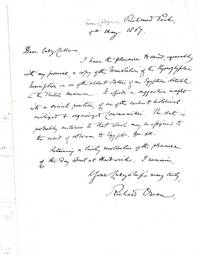
22391Owen's letter to Lady Cullum dated from Sheen Lodge Richmond Park 5 May 1867. Transcription of Birch's letter to Owen dated from British Museum London 9 July 1860. An interesting item in the field of Victorian Egyptology. The subject is what Owen describes here as 'one of the oldest Statues of an Egyptian Notable in the British Museum'. Its current Museum Number is EA103 and it has been in the Museum since 1835 but the details of its acquisition are unclear. In his translation Birch calls the sitter 'the Royal Scribe Amenhelp' but the current BM description begins: 'Scribal statue of Amenhotep son of Hapu: of black grano-diorite. Hieroglyphic texts are inscribed on the papyrus unrolled on his lap and on the statue plinth. His right hand now broken held a pen as if writing while his left hand holds the papyrus roll. .' At the time of writing Owen and Birch were colleagues at the British Museum Owen as Superintendent of the Natural History Department and Birch as head the Egyptian and Assyrian branch see the entries on both men in the Oxford DNB. The recipient of Owen's covering letter to Birch's translation is Lady Ann Cullum 1807-1875 widow of Sir Thomas Gery Cullum 1777-1855 of Hardwick House. As a palaeontologist Owen opposed Darwin's theory of evolution with a biblical view of creation and his interest in Ancient Egypt bound up with his Christian beliefs is apparent in the letter in an elegant assessment of the significance of the statue and in his annotation of Birch's translation. The letter and translation are on four 4to pages of the same paper. In good condition with light signs of age and wear. The letter is on the recto of the first leaf of a bifolium and the first page of the translation on the recto of the second leaf but they have now been inverted by folding with the two leaves carrying the other two pages of the translation tipped-in at the front resulting in the material being presented in reverse order. ONE: Covering Autograph Letter Signed from Owen to Lady Cullum with good firm signature addressed from 'Sheen Lodge Richmond Park 5th May 1867.' 1p 4to. The letter reads: 'Dear Lady Cullum I have the pleasure to send agreeably with my promise a copy of the Translation of the hyeroglyphic sic Inscription on one of the oldest Statues of an Egyptian Notable in the British Museum. It affords a suggestive insight into a social position of one of the earliest historical civilized & organized Communities. The date is probably anterior to that which may be assigned to the visit of Abram to Egypt. Gen. XII. Retaining a lively recollection of the pleasure of the day spent at Hardwick I remain Your Ladyship's very truly Richard Owen.' TWO: Manuscript translation described in Owen's letter. 3pp 4to. Written out in an unknown hand with the first of the five sections titled: 'Translation of the Inscription on the Garment and Papyrus which he is unrolling.' The other four sections of the translation are: 'Inscription In Front of the base' 'Running to the left of the figure' 'right Side' and 'Left side'. At the head of the first page in Owen's autograph: 'Hyeroglyphics sic on the Statue of the Seated Royal Scribe “Amenhelp†in the British Museum.' On the third page at the end of the translation and in the same unknown hand is written out a 'Copy of letter from Samuel Birch Esqre: F.S.A. &c. Keeper of Antiquities in the British Museum enclosing the above Translation to Professor Owen: -'. Birch's letter is dated from the British Museum 9 July 1860. It reads: 'My dear Professor Enclosed is the Translation of the Inscriptions on the Granite Statue of the Seated Scribe. It Consists of the Dedication of the Statue to the Royal Scribe Amenhelp and of his prayers to the God Amen-Ra – the Theban Jupiter. Believe me Yours very truly signed Samuel Birch'. The translation carries tem marginal annotations in Owen's autograph indicating an interest in and knowledge of the subject. The two of Owen's annotations read: 'His territorial Title: Baron Shamer like all the Nobility of Egypt was a priest: the condition is now parallel'd at the Court of Rome.' and 'the Upper & Lower Provinces of Egypt paralleling the Heavens & the Earth.' See Image of Owen's letter. Owen's letter to Lady Cullum dated from Sheen Lodge, Richmond Park, 5 May 1867. Transcription of Birch's letter to Owen dated fr unknown
344 pages plus 40 pages of black and white plates at back. Index. Oatmeal cloth-covered boards. "Guercino's style underwent a remarkable volte-face. The writer was primarily interested in discovering why this occurred, and became involved, during the course of his investigation, with certain aspects of Seicento art theory." - from Introduction. Tiny vintage bookseller's label inside front board, otherwise unmarked with moderate wear. Modest spine slant. A sound copy. Book
1792000262Paris: Desenne. Volland. Plassan. Libraires 1792. Hardcover. See Description. New and corrected edition First edition printed in France. 8vo. pp. xvi 295 1. With plate depicting the ruins of Palmyra and 2 fold out plates illustrating 1. the eastern hemisphere and 2. the astrological constellations ceil astrologique des anciens. Bound in original pink paste paper boards - some wear to the outer hinges and extremities. Pages are clean; occasional speck of marginal foxing. Volney's book of meditations on the rise and fall of empires was influential on the Romantic movement and on the Hudson River school of painting. Chapters also discuss ancient religions and mysticism. <br/> <br/> Desenne... Volland... Plassan.... Libraires hardcover
189917338BLeipzig, Breitkopf & Härtel, 1899/1900 - 1905/06. Gr.-8°, Pro Jg. ca. 700 Seiten Original-Umschläge (Buchblock unbeschnitten) bzw. HLn.d.Z. (IV)
19765795BWien usw., Fritz Molden, 1976. Qu.-Gr.-8° (20,7 x 24 cm), 432 Seiten, zahlr. Notenbeispiele, 3 Langspielplatten 17 cm; 5 Zeitungsartikel (darunter eine Todesanzeige) Weißer illustr. OPb. in weißem O.-Klapp-Schuber
BN66473Dispersionen für Bautenfarben: Acrylatsysteme in Theorie und Praxis Farbe und Lack Edition Baumstark Roland and Schwartz Manfred <br/><br/> unknown
BN66470Stabilitätsprüfung in der Pharmazie: Theorie und Praxis Der Pharmazeutische Betrieb Grimm Wolfgang; Harnischfeger Goetz and Tegtmeier Martin <br/><br/> unknown
176850190(Berlin, Haude et Spener, 1768). 4to. No wrappers, as issued in ""Mémoires de l'Academie Royale des Sciences et Belles-Lettres"", tome XXII, Année 1766. Pp. 119-170 , pp. 171-201 and 2 folded engraved plates., pp. 202-212 and 1 folded engraved plate. With the section title-page to ""Classe Mathématique"".
176850190Berlin Haude et Spener 1768. 4to. No wrappers as issued in "Mémoires de l'Academie Royale des Sciences et Belles-Lettres" tome XXII Année 1766. Pp. 119-170 pp. 171-201 and 2 folded engraved plates. pp. 202-212 and 1 folded engraved plate. With the section title-page to "Classe Mathématique". <br/><br/><em>First printing of three importent Euler-papers on the construction of composite lenses in order to avoid confusion. Euler presents the mathematical theory to explain the effects. The third paper describe how to analyze refraction phenomena in glasses by way of prisms. - Eneström E 359 E 360 E 361. </em> unknown
First and only edition of this study of ethics in drama. One of thirty large-paper copies signed by the author and printed on fine, thick wove paper. The normal copies of this book were printed on wood-pulp paper, and are now crumbling into dust. Art-nouveau inspired vignettes throughout. Large 8vo. Original wraps with an attractive modernist design on the front cover. Minor wear to wraps and light sunning to spine. Internally uncut, bright, and fine. Palau 332384.
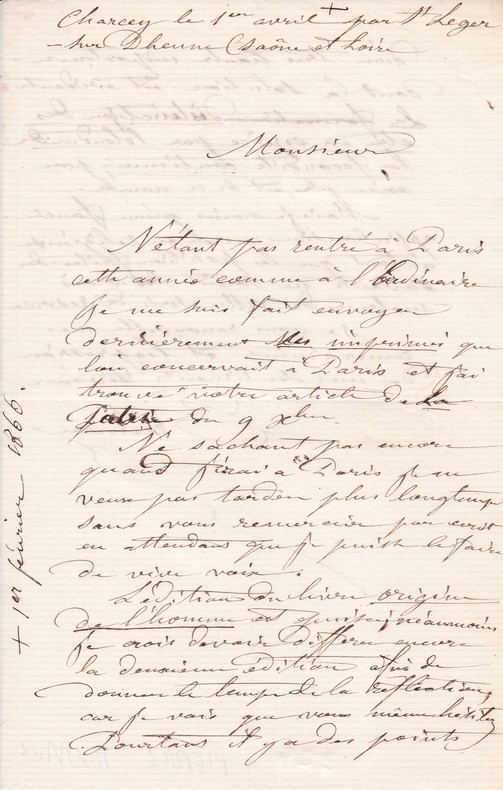
010183Pierre Trémaux (1818-1895), architecte, orientaliste, photographe, auteur de nombreuses publications scientifiques et ethnographiques, précurseur de la théorie des équilibres ponctués. L.A.S., Charcey [Charrecey], 1er avril [Mangin a noté 1er février 1866], 1pœ in-8. A Arthur Mangin. Il s'est fait envoyer les imprimés de paris et le remercie pour l'article dans La Patrie du 9 décembre 1865, sur son livre Origine et transformations de l'homme et des autres êtres. Le livre est épuisé, « néanmoins je crois devoir différer encore la deuxième édition afin de donner le temps de la réflexion car je vois que vous-même hésitez. Pourtant il y a des points d'une très haute importance dont la solution est évidente. La distinction des êtres en espèce par l'étendue de la fécondité continue, par exemple est de ce nombre. Mais je crains qu'une fausse appréhension morale ou religieuse autant que les positions faites des savants ne soient les vrais moteurs de cette sorte de réserve ». Origine et transformations de l'homme et des autres êtres est considéré comme le livre précurseur de la théorie des équilibres ponctués. Très rare et intéressant document. [303]
1930614034Berlin, 1930/34. OKart.
EXTREMELY RARE autobiography of Jewish artist Boris Schatz, founder of the Betzalel school of art. In this bilingual monograph, he relates his works to his life and ideals. The work is prefaced by historian Joseph Klausner and is accompanied by 40 plates large b&w plates, of which 8 are missing in this copy (missing plates - nos. 4, 15, 16, 17, 23, 27, 30 & 33). The text pages themselves also feature some illustrations and text decoration. 395x300mm. 28+35 pages. 32 plates (unbound-folder format). Text is in orange softcover booklet, placed along with the plates within a gray cloth slipcase with some decoration on front. Slipcase slightly worn and very lightly stained. Booklet spine worn and peeling at the middle. Pages slightly yellowing. [SUMMARY]: This rare album is else in good condition.
17292Paris, 1649. 34 pp. 4to. Modern half vellum, marbled boards, gilt lettering to spine. Moreau 1837; not in Welsh. Based on theories of François Hotman as exposed in his Franco-Gallia and on ideas expressed by Du Plessis Mornay in his Vindiciae contra tyrannos, this piece provoked quite some polemical replies. It is considered to be one of the most important pieces of the Mazarinades.
17291Paris, 1649. 34 pp. 4to. Modern half vellum, marbled boards, green label with gilt lettering to spine. Moreau 1837; not in Welsh. Based on theories of François Hotman as exposed in his Franco-Gallia and on ideas expressed by Du Plessis Mornay in his Vindiciae contra tyrannos, this piece provoked quite some polemical replies. It is considered to be one of the most important pieces of the Mazarinades.
193114792BKassel, Bärenreiter, 1931. (Nachdruck der Ausgabe: Berlin 1768)., Quart (23,2 x 18,2 cm), 3 Blatt, 291 Seiten; 4 Blatt, XX, 185 (14) (4) Seiten, Zahlr. Figuren und Tabellen Halblederband der Zeit mit Rückentitel Frakturschrift Kl. Stempel Titel verso; Exlibris
183639226Berlin, Nicolai, 1836. 8°. X, 253 (1) S., HLdr. d. Zt. m. etw. Rückenverg., goldgepr. Rückentitel u. dreiseitigem Farbschnitt.
Acquaforte misure: mm 333 x 430 Incisore italiano formatosi inizialmente sotto il padre stampatore, libraio e autore di almanacchi e calendari popolari. Successivamente Gaetano frequenta l'accademia di Brera con Vincenzo Vangelisti (Firenze 1740 - Milano 1798) che dal 1790 è direttore della Scuola d'incisione. Particolarmente attivo tra il 1790 e il 1825 viene ricordato per le illustrazioni del volume Dell’arte dei giardini inglesi (pubblicato a Milano, 1801) di Ercole Silva (Milano 1756 - Cinisello 1840) scrittore e architetto del paesaggio italiano, ma anche per le tavole poi confluite nel volume Atlas geologique ou vues d’amas de colonnes basaltiques….Milano 1818 di Scipion Breislak (Roma 1750 - Milano 1826) geologo di origini svedesi. Interessanti sono anche le sue incisioni popolari sulla creazione del mondo. In questa stampa viene rappresentata l'idea che l'artista ha del mondo, un'elaborata allegoria densa di dettagli. La composizione è divisa in due parti ben distinte raccordate al centro dalla raffigurazione della Torre di Babele sullo sfondo. Le due zone raffigurano rispettivamente la vita dominata dall'Inganno e quella dominata dal Disinganno. Sulla sinistra, in un paesaggio collinare, contraddistinto tra templi e città ordinate vediamo la figura di Cristo predicatore appoggiato ad una croce e circondato da diversi famiglie di fedeli in preghiera, in primo piano donne che filano rappresentano l'operosità e il lavoro. Un mondo laborioso, ordinato e pio si contrappone alla parte destra della stampa. Qui tumulti, disordine, uomini e donne che si abbandonano ai piaceri, ai vizi, mangiano suonano e adorano Lucifero seduto sul suo trono tra le fiamme. In alto e in basso, oltre l'immagine, un testo descrive l'immagine rappresentata. Impressione eccellente, fresca e con inchiostratura dai toni grigio-argentei. Ottimo stato di conservazione, eccetto minimo foxing sparso. Ampi margini oltre la battuta del rame. Bibliografia: G. Milesi, Dizionario degli incisori, Bergamo 1989, p. 273
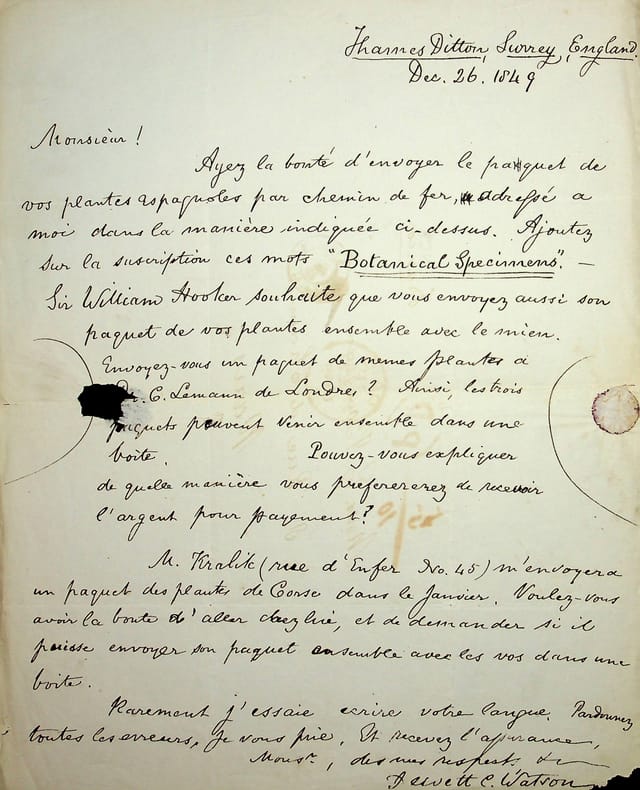
017269Hewett Cottrell Watson (1804-1881), botaniste anglais, partisan de la théorie de l'évolution. L.A.S., Thames Ditton (Angleterre), 26 décembre 1849, 1p in-4. Au botaniste français Eugène Bourgeau (1813-1877). Lettre en français, retranscrite avec les petites erreurs de Watson qui s'en excuse en fin de lettre : « Monsieur ! Ayez la bonté d'envoyer le paquet de vos plantes espagnoles par chemin de fer, adressé à moi dans la manière indiquée ci-dessus. Ajoutez sur la suscription ces mots "Botanical Specimens". Sir William Hooker souhaite que vous envoyez aussi son paquet de vos plantes ensemble avec le mien. Envoyez-vous un paquet de mêmes plantes à M. C. Lemann de Londres ? Ainsi, les trois paquets peuvent venir ensemble dans une boite. Pouvez-vous expliquer de quelle manière vous préférerez de recevoir de l'argent pour payement ? M. Kralik (rue d'Enfer N°45) m'envoyera un paquet des plantes de Corse dans le janvier. Voulez-vous avoir la bonté d'aller chez lui, et de demander si il puisse envoyer son paquet ensemble avec les vos dans une boite. Rarement j'essaie écrire votre langue. Pardonnez toutes les erreurs, je vous prie. Et recevez l'assurance, Monsieur, des mes respects &c. Hewett C. Watson ». La lettre mentionne donc William Jackson Hooker (1785-1865), Charles Morgan Lemann (1806-1852), autres botanistes anglais et Jean-Louis Kralik (1813-1892), autre botaniste français. Petit manque de papier mangeant une lettre, dû au cachet qui fermait le courrier. Beau courrier, rare lettre en français. [133]