[Medicine] [Bilz, F EBiblio.com
4 079 résultats
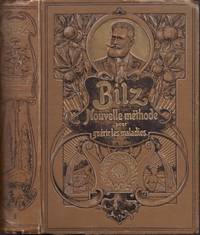
35545Paris: F. E. Bilz Librarie-Editeur n.d. Hardcover. Fair. Octavo. Volume 1 only. 1 iv 1040 pages. Brown cloth hardcover with title and embossed illustrated decorations on the front cover. Illustrated with color chromo lithographic plates including fold outs of the human body on the front and rear paste downs; a photograph collage of Bilz's graduates; two page color lithographic view of "Institution de medication naturelle Bilz" in Dresden; two color pages of mushrooms and fungi; the Larynx; teeth; children diseases; stomach; exercises; organs; and several sketched illustrations. Hinges are cracked. Edge wear to the upper boards and corners. Covers are a bit loose. A large closed tear to the photo collage portrait. A couple of small edge tears to the 'exercise' plate and to the last few pages. Pages 1039 and 1040 are loose. Contents clean. All text is in French. Fair. F. E. Bilz, Librarie-Editeur hardcover
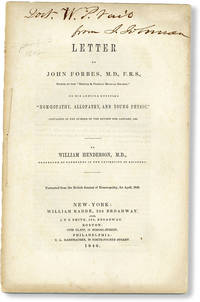
184649312New-York: William Radde 1846. First American Edition. Octavo 23cm.; removed retaining original stitching; 66pp. Some light dust-soil and wear from handling contemporary gift inscription at head of title page serving as upper cover else Very Good and sound. Letter first published in the "British Journal of Homœpathy" April 1846. The author a Scottish physician was one of the earliest British practitioners of homeopathy losing both his position at the Royal Infirmary and most of his practice while also drawing criticism from not just Forbes but many others. Interestingly even Forbes' original article was itself deemed too sympathetic to homeopathy and his Review closed shortly after its publication while the present article raised Henderson in the eyes of the public if not the medical profession DNB. William Radde unknown
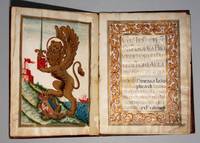
17175670<p>4to manuscript on vellum 23.5 x 17.1 cm 7 ff. 4 ff. vellum blanks including a full-page frontispiece illumination of Venetian Lion of St. Mark each text page with foliate borders in gold ink headings and initials in gold ink. Bound in contemporary Venetian morocco elaborately gold tooled gold block-printed foliate pastedowns. Edge wear and minor rubbing to spine and boards manuscript loose in binding oxidizing to edges of pastedowns. Marginal flaws to frontispiece illumination just touching border in places a few small wormholes elsewhere minor handsoiling.<br /></p><p>Finely illuminated early 18th-century Venetian manuscript issued by the city's Magistrato alla Sanità Health Department as a license to certify the physician Antonio Damugliano d. 1747 to practice medicine in the Venetian Republic using his propriety formula for topical salves <i>balsami</i> to treat "wounds and ulcers" f. 3v-3r. The manuscript ornately written out and decorated in gold and colored ink opens with a full-page image of the winged Lion of San Marco in the Venetian landscape which serves as an official seal of the document's authenticity and is inscribed by five <i>Provveditori</i> of the Magistrato and one notary who witnessed the certification.</p><p>This pharmaceutical license represents a rare material survival of how Venice's Magistrato alla Sanità regulated the practice of medicine in its territories even down to the level of controlling how individual practitioners could work with specific drugs. Damugliano presumably was required to keep the document on his person while plying his trade and to present it to the relevant authorities or even to his patients should his practice be called into question. The text of the document is written out twice – first in Italian and then in Latin – to suit the linguistic preferences of both the common Venetian citizen and the professional medical class.</p><p>Damugliano also known as Antimo Damulianos is noted in the document dated April 1717 as being a native of the Ionian island of Zante or Zakynthos at the time a Venetian colony and having recently returned from Moscow "where with good success and for a long time he practiced medicine with full official permission of many noteworthy people" f. 2v. Damugliano is said to have studied medicine in Europe likely in Italy specializing in contagious diseases and eventually practicing in Asia Minor Persia India China Egypt Constantinople and Trieste and to have been ordered by Emperor Charles VI 1685-1740 to treat the sick of a plague outbreak in Corinth see L. Zoes passim. Damugliano's name is also associated with a 1725 treatise entitled 'Medicina' which circulated in manuscript form in Venice and dealt with the use of salves pills and stones to treat hydrophobia see L. Zoes; we have been unable to locate a copy of this treatise. Damugliano is also recorded as having worked in Vienna where an April 1746 news magazine comments that the "very famous" Damugliano having traveled through numerous kingdoms has arrived to demonstrate the curative powers of "the wondrous Chinese stone called Bezoar" which is effective against fevers snake bites fatigue colic etc. <i>Nachtrag</i> p. 64. The bezoar stone an indigestible mass formed in the digestive tract of ruminants was lauded from the middle ages as a universal antidote to poison.</p><p> R. Palmer "Pharmacy in the Republic of Venice in the Sixteenth Century" in A. Wear et al. eds. <i>The Medical Renaissance of the Sixteenth Century</i> pp. 100-17; <i>Epeteris: Hetaireia Byzantinon Spoudon</i> vol. 43-44 1977 p. 417; H. Schmuck <i>Grieschischer Biographischer Index</i> vol. 1 p. 247; L. Zoes <i>Lexikon historikon kai laographikon Zakynthou</i> vol. 1; S. Carbone <i>Provveditori e sopraprovveditori alla Santità della Repubblica di Venezia</i>; P. Selmi "Il Magistrato all Sanità" in <i>Difesa della Sanità a Venezia Secoli XIII-XIX</i> pp. 28-50; <i>Nachtrag zu denen wöchentlich-kurtzgefaßter historischer Nachrichten Der neuern Europäischen Begebenheiten auf das Jahr 1746</i> p. 64.</p>
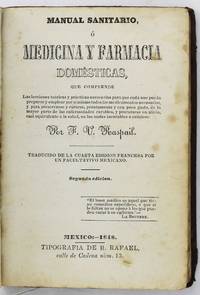
18484960Mexico City: Tipografia de R. Rafael 1848. Very good. 295pp. Contemporary Mexican calf spine gilt with leather label. Light wear to extremities heavier to corners; label a bit chipped. Light foxing and wear to text. Second edition after the first of the previous year. A popular manual for hygiene and the diagnosing and curing of diseases. Translated from the French and published in Mexico three subsequent years the present work provides advice on the means to stay well and prevent disease. Each tidbit of information is helpfully numbered 345 in all with the opening sections being devoted to health and hygiene with useful suggestions such as avoiding drafts and cold damp rooms; there follow several sections on various types of diseases with symptoms causes and recipes for curatives. The work covers everything from croup in children to heart palpitations to epileptic fits to the flux. The final half of the book is an alphabetical dictionary of afflictions followed by an index. The author was a French chemist and physician who published several works on domestic medicine including the original of this text in 1845. It is rare in all its Mexican editions. We locate copies of the first edition of 1847 at the University of Toronto and the Biblioteca Nacional de Mexico; one copy of the present edition located at the University Complutense de Madrid; and two copies of the third edition of 1849 found at the University of Texas and the Natural History Museum of Los Angeles County. Tipografia de R. Rafael unknown
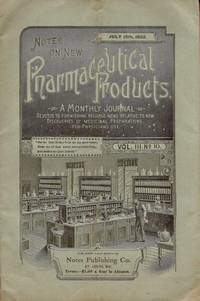
189235172St. Louis: Notes Publishing Co 1892. Wraps. Good. Stapled wraps. 9.5" x 6.5". vi pages 387-406 vii-X. Light green illustrated wraps. Some illustrated advertisements. This number has been folded vertically. Light toning to the covers. Interior contents clean. Scarce and obscure. Notes Publishing Co unknown
2952<p><strong>A meticulously-detailed account of clinical practice and research at a pioneering paediatric hospital in St. Petersburg. Illustrated with numerous tables graphs and reproductions of hand-drawn charts.</strong></p><p>The Elizavetinsky also called Princess Elisabeth Clinical Hospital for Young Children was founded in 1844 as a private charitable organisation at the behest of Grand Duchess Elena Pavlovna two of whose daughters had died as infants and named in honour of Grand Duchess Elizaveta Mikhailovna a granddaughter of Tsar Paul I. After the Bolshevik Revolution it was renamed the Louis Pasteur Clinical Hospital. The first paediatric hospital in Russia also in St. Petersburg had been founded a decade earlier; but the Elizavetinsky was the first in the world to focus on the treatment of children under the age of three 'Formirovanie'.</p><p>The report describes the development of the hospital including details on buildings and facilities and various departments such as ambulatory care surgery and infectious diseases. It offers copious patient statistics and a section devoted to the problem of the high mortality rate among children suffering from tuberculosis. The authors also include discussions of various digestive respiratory and infectious ailments as well as a list of research publications by doctors on staff and an expense report for 1893. The preface is by Thomas Woldemar von Reitz who had been heading the Hospital for 25 years since 1869.</p><p><strong>Rare</strong>: we couldn't find any other copy going through the market in recent times. We could trace two copies in the US NYPL and NLM and one in both main Russian libraries RGB and RNB.</p><p>Description<br />Large 8vo 24.5 x 18.5 cm. Title 2 preface and 224 pp.<br />Binding<br />Contemporary full dark brown morocco gilt lettering to upper cover and flat spine patterned endpapers.<br />Condition<br />Rebound with brown leather retaining most of the contemporary binding the latter significantly chipped at spine and corners; some upper outer corners shaved or chipped some restored light recent pencil annotations on upper flyleaf and title otherwise very clean.<br />Bibliography<br />"Formirovanie klinicheskikh tsentrov" online medfox.ru. ref: 2952</p> Goppe, Skt. Peterburg, 1894. hardcover
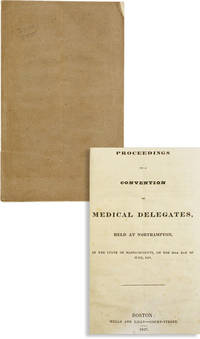
182748837Boston: Wells and Lilly 1827. First Edition. Octavo 22cm.; contemporary drab wrappers; 12pp. Faint vertical crease light wear to extremities and foxing to textblock else Very Good or better. SABIN 65788; SHOEMAKER 30351. Wells and Lilly unknown
1869885781869. MEDICINE SUGITA Gempaku. RANGAKU KOTO HAJIME. Tokyo Tenshinro Meiji 2 1869. 22.5 x 15.1 cm. 2 vols. srting-bound Japanese-style fukuro-toji. Original covers and printed paper title labels. This memoir by the scientist behind the ground-breaking KAITAI SHINSHO was originally completed in Gempaku's old age in 1815. It was transmitted via manuscript until the fall of the ancien regime when Fukuzawa Yukichi and Gempaku's grandson arranged to have it published in a woodblock edition. The book was written in a very clear and simple style and reveals the great lengths of ingenuity the KAITAI SHINSHO author/translators went to to uncover the secrets and understand the esoteric Dutch vocabulary of Kulmas' anatomy that they translated therein. The RANGAKU KOTOHAJIME is often cited as perhaps the earliest Japanese text to explain techniques of cryptoanalysis from a practical and logically rigorous point of view. It is also a compelling story of scientific investigation in isolated traditional Japan. Finally despite its relatively late publication date the RANGAKU KOTOHAJIME is vanishingly rare. Our copy is in very good condition enclosed in a custom-fitted clasped chitsu case. unknown
1830228066Madrid Imprenta Real 1830. 1830. 8vo. Later red wrappers. Very good. Fresh text no foxing. 104 pages. No signatures or bookplates. Soft cover. Very Good. Madrid, Imprenta Real, 1830. paperback
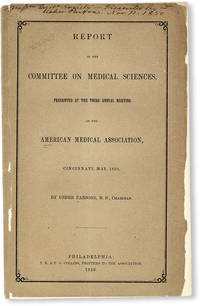
185050123Philadelphia: T.K. & P.G. Collins 1850. First Edition. Slim octavo 23.5cm.; publisher's brown wrappers printed within decorative border; 53pp.; illus. throughout. Upper cover separated and a bit chipped else Very Good internally sound. Inscribed and signed by the author at head of upper cover. Contents cover cases of idiocy congenital and not "both parents intemperate / simpletons / puny / scrofulous / related by blood" vs. "self-pollution.blow to the head.head stuped in hot rum by a nurse when three days old" p. 31. T.K. & P.G. Collins unknown
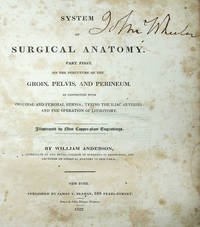
182254222New York: James V. Seaman 1822. First Edition. Quarto 28cm signed in twos. Original paper-covered boards with printed spine label; 19912pp; 9 leaves of plates bound in at rear. Early ink ownership signature to title page John Wheeler. A complete but worn copy. Covers are somewhat rubbed and worn with some flaking of paper at spine and portions of printed spine label rubbed away; text conspicuously foxed throughout; half-title lacking; front endpaper partially excised one plate partially detached at gutter. Text is uncut and despite the prominent foxing to text the plate leaves are mostly unblemished. Complete and Good. <br /> <br /> An infrequently encountered American surgical text. Anderson who trained at the Royal College of Surgeons in Edinburgh emigrated to America in 1820 and after delivering a series of anatomical lectures in New York under the patronage of Valentine Mott the current work was published to supplement these lectures became affiliated with the Vermont Academy of Medicine see Kelly American Medical Biographies. NY: 1920. This work is notable for the nine anatomical plates all engraved by A.B. Asher Brown Durand including four engraved from his original illustrations. These are quite early works by Durand who would achieve his first prominence as the engraver of John Trumbull's edition of the Declaration of Independence 1823 and later great renown as a landscape painter of the Hudson River School from about 1840 on. Not cited in any of the standard medical bibliographies and infrequent in commerce with only a single copy traced at auction in the past 50 years Swann 1979. James V. Seaman unknown
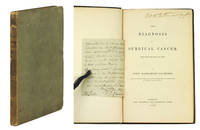
18551250181855. London: John Churchill 1855. <br /> <br /> Slim 8vo 77pp. 2 plates at the end then 28 pp. ads for Churchill's "Publications in Medicine Surgery and Science". Original green cloth hinges repaired at front and back cloth dull and backstrip with some wear.<br /> <br /> § First edition of the author's first book; presentation copy inscribed on the title-page by the author "With the Author's best complts" and a 4pp. mostly illegible ALs from the author to Dr. Long tipped in facing the title-page. A little known but apparently quite early and important study by this ophthalmic surgeon best known for his recognition of Laurence-Moon syndrome and his research on retinitis pigmentosa. The essay won the Liston prize for 1854. In the Journal of Ophthalmology for 1932 there is a long essay on Laurence who died at the age of 42 entitled "A Belated Tribute" by Arnold Sorsby pp. 727-740 with a bibliography of his writings. Laurence was a brilliant student and later ophthalmologist who founded the South London Ophthalmic Hospital now the Royal Eye Hospital. Among many other unrecognised achievements he was the first to describe macular degeneration. The tribute concludes: "the work that he started and did not see completed is today a living force. He has become an integral part of modern ophthalmology as founder of an important hospital as a pioneer in ophthalmic journalism and as one of the forerunners of that growing school of thought which correlates ocular defect with bodily structure." Not in Garrison-Morton. Armorial bookplate of Richard Long M.D. unknown
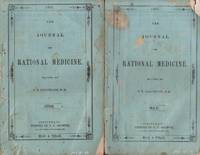
186136000Cincinnati: Printed by P. C. Browne 1861. First Edition. Wraps. Fair. Stitched printed blue wraps. Two issues. May 1861: pages 141-172 6 pages of advertisements. June 1861: pages 173-204 8 pages of advertisements. Rear wrap and possibly an additional page of advertisments missing from the May issue. Paper covers are stained and chipped. Tiny punch holes on the left margins both issues. Interior contents have light to moderate toning and scattered foxing. Contents cover Small Pox Cow Pox Diphtheria Hand-Book for Military Surgeons and more. Fair only. Printed by P. C. Browne unknown
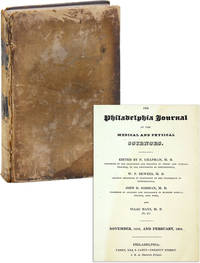
182345237Philadelphia: Carey Lea & Carey 1823. First Edition. Octavo 22cm.; full contemporary calf two black gilt-lettered spine labels; iv447pp. Boards rubbed and front joint cracked but holding tear along gutter edge of front free endpaper with coin-sized loss later ownership ex libris to front pastedown else Good or better internally sound. Contents include two consecutive issues of the Journal with publisher's advertisements bound in between. Includes medical papers Chapman's "Thoughts on Animal Heat" case studies John T. Sharpless on a "Case of Imperforate Anus" and reviews. Carey, Lea & Carey unknown
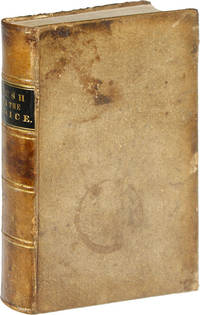
184452438Philadelphia: Lippincott Grambo 1844. Fourth edition enlarged. Octavo 23cm; contemporary full sheep; 559p. Upper 1/2" of title page margin excised to remove an ownership signature. Else a tight copy in contemporary binding faintly foxed at prelims; Very Good. Engraved bookplate of S.H. Bibighaus to front pastedown with later pencil presentation to Thomas B. Bibighaus. Better known for his psychological works especially Brief Outline of an Analysis of the Human Intellect 1865; Rush son of the noted American physician Benjamin Rush devoted much of his early career to the current work which presents a detailed physiological and medical study of the human voice followed by a treatise on elocution. "Although unattractive to the modern reader this work achieved popularity in an age of declamation and went through six editions by 1867" DAB. A solid and attractive copy. Lippincott, Grambo unknown
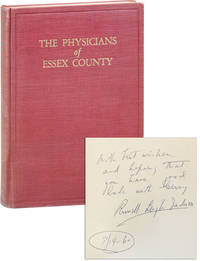
194844580Salem MA: Essex Institute 1948. First Edition. Octavo. Red cloth boards lettered in gilt on spine and front cover; 152pp; illus. Spot of discoloration to rear board else Near Fine. Inscribed by the author on front endpaper: "With best wishes and hoping that you have good luck with Gerry" - signed dated 7/14/60. Essex Institute unknown
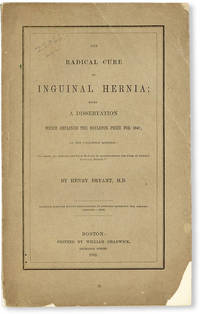
185150146Boston: William Chadwick 1851 but 1852. First Edition. Slim octavo 23.5cm.; pubilsher's brown printed wrappers printed within double rule; 68pp. Wrappers rather chipped and toned faint crease across upper cover rear cover raggedly split at bottom half of spine edge else a Good or better copy internally fine. Title page dated 1851 upper cover 1852. William Chadwick unknown
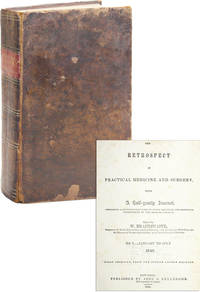
184249833New York: Adee & Estabrook 1842-3. First American Edition. From the Fourth London Edition. Octavo; contemporary calf; 151158160171pp. The four issues bound as one. Boards lightly chaffed and worn contents lightly aged; still tight sound and Very Good. All four issues of the inaugural volume of this long-running medical journal which aimed to present the most recent work of leading international though chiefly British physicians. Adee & Estabrook unknown
196584030Springfield Ill: Charles C. Thomas 1965. First Edition. Large Quarto. 29cm. Publisher's original deep bottle green cloth titled in gilt to spine and front board. Dustjacket. 974pp. A near fine copy in dustjacket with only the lightest traces of wear.<br /> <br /> An eccentric and fascinating fully illustrated history of the science of Radiology the X-Ray intersections with military nuclear research etc. Interestingly and this would seem to be entirely dependent upon the scholarly eccentricity of Dr. Grigg the history veers into grammar symbology an assessment of how many radiological institutions and authorities have mandala-inspired logos and emblems is particularly odd and facinating and the metaphysical or esoteric aspects of the development of x-ray science. It's a far cry from the usual dry medical monograph and manages to be informative and compelling whilst also remaining energetic and rather joyful which is not a word usually applied to the development of medical equipment. Charles C. Thomas unknown
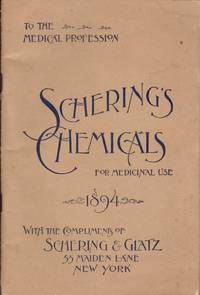
189435171New York: Schering & Glatz 1894. Wraps. Good. Stapled wraps. title on the front cover and company advertisement on the back cover. 80 pages. Illustrations of two chemical plants in Berlin inside the covers. Light wear and a tiny chip on the back cover. A few page corners folded back. Interior contents clean. Schering & Glatz unknown
1936197925New York W.W. Norton Company 1936. 1936. First American edition so stated. 8vo. Translated by Bernard Miall. 9 illustrations. Original gilt stamped green cloth. Dust jacket price clipped' nicks. Very good. No signatures or bookplates. Scheich surgeon pioneering in anesthesia. F. Hardcover. New York, W.W. Norton Company [1936]. hardcover
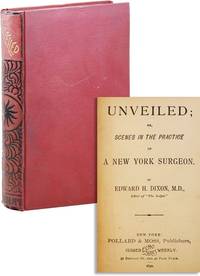
189032299New York: Pollard & Moss 1890. Octavo 19cm.; publisher's maroon cloth decorative spine embossed in black and gilt; xvi9-4077adspp. Spine cloth a hint faded textblock uniformly toned and a bit brittle due to poor paperstock; still Very Good and sound overall. Collection of essays first published in the periodical The Scalpel of which Dixon was the editor. An earlier edition of this work appeared simply as Scenes in the Practice of a New York Surgeon 1855. Pollard & Moss unknown
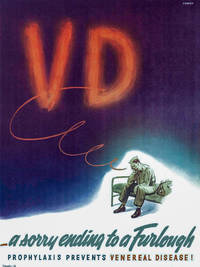
19460213181946. First Edition. Poster. Very light soiling. About Fine. A 15" x 19-1/2" poster in color apparently produced in 1946 when the U.S. military was trying to enforce a policy of non-fraternization in the occupation zones between the troops and European women. It depicts a sullen soldier sitting on his bunk in uniform above the title of the poster and the caption "Prophylaxis Prevents Venereal Disease!" In the lower left corner in small letters: "VDgraphic--76." <br/><br/> unknown
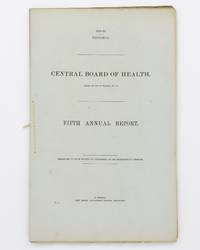
186027323Melbourne: John Ferres Government Printer 1860. First Edition. Paperback. Fine. Melbourne John Ferres Government Printer 1860. Foolscap folio 47 pages. Title-wrappers stab-sewn as issued all edges uncut; minimal foxing to the edges; essentially a fine copy. Victorian Parliamentary Paper Number 71 of 1859-60. A 13-page appendix contains the Superintending Inspector's detailed reports on 22 towns and various Chinese encampments. John Ferres, Government Printer paperback
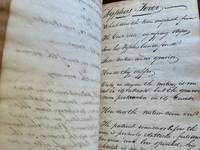
35539n.p.: n.p. n.d. Manuscript. Good. Octavo. Brown leather covers that have been previously varnished. Restored. New mulberry paper spine. Front and rear boards reattached and repaired with mulberry tissue. 223 pages used for hand written manuscript notes on the front sides of the paper. 44 blank leaves of paper follows the handwriting. The versos of the pages are all blank with the exception of one note written on back. <br /> <br /> Provenance unknown. A name of of D. Umberges located on the front paste down. Undated but circa mid 1800's. Binding paper and ink are similar to comarable manauscripts written in the mid 1800's. Topics include Yellow Fever Typhoid Fever Plague other fevers fungi and several more diseases. Hand writing is neat and legible for the most part. Interior contents are clean. n.p. unknown