312 résultats
BN67573Bronchopulmonale Erkrankungen im Kindesalter: Anatomie Physiologie Klinik und Therapie Roeser Alfons <br/><br/> unknown
243868 September 1939; and 9 February and 28 April 1940. All from 152 HD Field Ambulance R.A.M.C. T.A. B.E.F. the first also from Dundee the second and third written from France. Mulligan’s collection of lantern slides is now part of the St Andrew’s collections and information about him is to be gleaned from its web pages. David Waterston 1871-1942 was Bute Professor of Anatomy at the University of St Andrews from 1914 to 1942. In 1913 while Professor of Anatomy at King's College London he was the first authority to debunk the Piltdown Man hoax. A total of ten pages of closely and neatly written text. In fair condition lightly ruckled and with slight loss to the edge of one page and the ink of one leaf having slightly run on removal from mount. ONE 8 September 1939: 2pp 8vo. Begins by discussing the ‘laboratory work’ which ‘Colonel Mitchell’ said he would probably get ‘when he first suggested my entering the R.A.M.C. T.A.’ He hopes that Waterston will not need him ‘at the Bute’ until the war is over and sends his regards to his family. TWO 9 February 1940: 4pp 4to. While on duty in France he gives news of his activities: ‘Our work is at present to form hospitals and turn in a hospital for German measles. I expect I shall get it myself and when I look in the mirror I shall see what my former hero has done for me - another attack of German measles! I confess that every new record of German atrocity comes as a shock to me still for Germany and the Germans were once surrounded by romance for me - as you know. In spite of the unhappiness of my last visit to Germany I have happy memories of my work at Bonn and the people whom I met there. Now they are all enemies.’ THREE 28 April 1940: 4pp 4to. He begins with personal and professional news before commenting: ‘It is very difficult to think about research work here. The Royal Society of Medicine will not send me the books - barring text-books - for one thing. However I am settling down to read for the final F.R.C.S. again and will keep up my Anatomy. I may never have the opportunity to sit the examination or to get into a surgical ward to prepare for it but at any rate I shall be able to return to St. Andrews with ideas of value for teaching purposes . Of course if war breaks out in France these plans for reading will break down but I am making them because I am afraid of losing touch with the academic work and growing stale especially if the war lasts.’ 8 September 1939; and 9 February and 28 April 1940. All from 152 (HD) Field Ambulance, R.A.M.C. (T.A.), B.E.F., the first also f unknown
BN92941Urban und Schwarzenberg. Leberresektionen. Chirurgische Anatomie Inikationen Technik Hardcover <br/><br/>Leberresektionen. Chirurgische Anatomie Inikationen Technik Hardcover Leberresektionen. Chirurgische Anatomie Inikationen Technik Hardcover Urban und Schwarzenberg hardcover
BN66905Hardcover. Mensch Irrläufer der Evolution. Eine Anatomie der menschlichen Vernunft und Unvernunft Hardcover <br/><br/> hardcover
19056233Paris: Octave Doin 1905. Fifth Edition Corrected Revised & Enlarged. Hardcover. Good. 4tos quarter red calf raised bands a section of pages in vol.1 re-attached with cellophane tape ink stains on vol. 2 edgeworn <br/><br/>Extensively illustrated. A classic of anatomy and still influential by a man who initially failed his anatomy examinations. Octave Doin hardcover
AA-1503-01Very Good. Tight clean unmarked pages with square spine. Light wear at the corners. No jacket as issued. unknown
19770005180New York: Editions Medicina Rara 1977. Limited edition. Hardcover. Fine/issued without. Folio half leather boards fine publisher's slipcase with 36pp. Introductory booklet in wrappers. <br/><br/>Copy 567 of 2800 facsimiles. Woodcuts. " In this treatise on ophthalmic surgery Bartisch who limited his practice to ophthalmology and hernia repair left the first extensively illustrated account of any surgical specialty . The illustrations in his book form a comprehensive pictorial record of Renaissance eye-surgery; some of the woodcuts show the parts of the eye in various layers as they are viewed in dissection by means of movable anatomical flaps. This is one of the earliiest uses of movable flaps to illustrate a medical book - Garrison/Morton 5817." Editions Medicina Rara hardcover
1920192341920. Original Vintage Photograph from June 1920 of a group of young scientists including a young woman doing a dissection of a human skeletal cadaver. Black and white silver gelatin photograph. 7" x 5" photograph on 8" x 10" board. Captioned "June 1920" on verso. It is likely that this coeducational group are medical students with one older man in glasses seeming to be their instructor. In the background we can see a variety of anatomical drawings as well as bones preserved in liquid in a glass case. The students wear white lab coats except for the female student who is wearing a white gown. While women had entered the nursing profession in large numbers during the 19th century there were still very few female doctors in 1920 making this photo a depiction of a rather uncommon scene. There is a horizontal crack along the upper part of the board which is holding but delicate. The photo itself has a very small closed tear and a small blue smudge in the bottom left corner but is in very good condition overall. unknown
ria9780323796439_inpMultiple-component retail product. New. New Book; Fast Shipping from UK; Not signed; Not First Edition; N/A unknown
19232111902160201350Dainippon Law Publishing 1923. Soft Cover. Fine. Volume: 1 Dainippon Law Publishing paperback
21728299-nnew. unknown
21728299like new. unknown
BN66626Anatomie des Kiefer-Gesichts-Bereiches Schumacher Gert-Horst <br/><br/> unknown
BN91390Parey bei Blackwell. Lehrbuch der Anatomie der Haustiere 5 Bde. Bd.2 Eingeweide Frehwein Josef; Gasse Hagen; Leiser Rudolf; Nickel Richard; Schummer August and Seiferle Eugen <br/><br/>Lehrbuch der Anatomie der Haustiere 5 Bde. Bd.2 Eingeweide Frehwein Josef; Gasse Hagen; Leiser Rudolf; Nickel Richard; Schummer August and Seiferle Eugen Lehrbuch der Anatomie der Haustiere 5 Bde. Bd.2 Eingeweide Frehwein Josef; Gasse Hagen; Leiser Rudolf; Nickel Richard; Schummer August and Seiferle Eugen Parey bei Blackwell unknown
BN66422Organe des aktiven Bewegungsapparates der Koordination der Umweltbeziehung des Stoffwechsels Vergleichende Anatomie der Wirbeltiere Bd.3: Band . des Stoffwechsels und der Fortpflanzung Starck D. <br/><br/> unknown
BN91163Schober. Farbatlas der Anatomie der Ratte. Sektionsanleitung Hardcover <br/><br/>Farbatlas der Anatomie der Ratte. Sektionsanleitung Hardcover Farbatlas der Anatomie der Ratte. Sektionsanleitung Hardcover Schober hardcover
SONG1878576488McGraw-Hill Education 0000-00-00. cards. Used: Good. 4.75x6.25x6.00. Buy with confidence. Excellent Customer Service & Return policy. McGraw-Hill Education unknown
BN90792Thieme. Klinische Anatomie der Halswirbelsäule Hardcover <br/><br/>Klinische Anatomie der Halswirbelsäule Hardcover Klinische Anatomie der Halswirbelsäule Hardcover Thieme hardcover
BN66125Allgemeine Anatomie und Bewegungssystem 1 DVD-ROMFür Windows 98 SE/2000/ME/XP/Vista <br/><br/> unknown
61852Printed by J. Dixwell No. 148 St. Martin's Lane near Charing Cross. London. 1777. 8vo. pp. 8168 i182-250. Text is continuous despite erratic pagination. Contemporary half calf and marbled boards though now with a later cloth spine occasional foxing more especially at the front ex-libris with stamps and book-label on the front paste-down neat oval stamp on verso of title and in margin of last page overall a very good copy. MAGNUS FALCONAR not in Munk or Plarr was a friend and colleague of William Hewson surgeon anatomist and physiologist; in 1772 Hewson established and ran an anatomy school at 36 Craven Street where Franklin lodged in London now the Benjamin Franklin House museum. In 1998 workmen restoring this building dug up the remains of six children and four adults hidden below the home. The Times reported on 11 February 1998: 'Initial estimates are that the bones are about 200 years old and were buried at the time Franklin was living in the house which was his home from 1757 to 1762 and from 1764 to 1775. Most of the bones show signs of having been dissected sawn or cut. One skull has been drilled with several holes. Paul Knapman the Westminster Coroner said yesterday: "I cannot totally discount the possibility of a crime. There is still a possibility that I may have to hold an inquest." ' The Friends of Benjamin Franklin House noted that the bones were likely placed there by Hewson who lived in the house for two years. They also note that Franklin likely knew what Hewson was doing. Proof was demonstrated by archaeological evidence which showed liquid mercury associated with turtle bones and vermilion colouring associated with dog bones found in the deposit. Hewson had documented experimentation on the lymphatic system using both substances and animals. Hewson died on 1 May 1774 as a result of sepsis contracted whilst dissecting a cadaver. His work was continued after his death by Magnus Falconar who had married Hewson's sister Dorothy in September 1774. Falconar repeated Hewson's experiments on the spleen and thymus and as a result re-published Hewson's work on red blood cells in 1777 together with his corroboration Experimental inquiries: part the third. Containing a description of the red particles of the blood in the human subject and in other animals; with an account of the structure and offices of the lymphatic glands of the Thymus Gland and of the Spleen: being the remaining part of the observations and experiments of the late Mr. William Hewson F. R. S. and Teacher of Anatomy. By Magnus Falconar Surgeon and Teacher of Anatomy. Printed for T. Longman No. 39. Pater-Noster-Row MDCCLXXVII. Samuel Paterson in 1778 published the catalogue of the auction sale of Falconar's anatomical collection - 'Museum falconarianum. A catalogue of the entire and capital museum of anatomical preparations and other subjects of natural history; a great variety of chirurgical anatomical and philosophical instruments; medicaments cabinets preparation-glasses and other effects; of the late Mr. Magnus Falconar surgeon and professor of anatomy deceased: which by order of the adminstrator will be sold by auction by Mr. Paterson at his Great Room No 6. in King-Street Covent-Garden London on Monday the 12th of October 1778 and the nine following evenings to begin precisely at five o'clock. To be viewed on Wednesday the 7th instant and to the time of sale. Catalogues price one shilling may be had at the place of sale; where also may be had Mr. Falconar's synopsis of his course of lectures on anatomy and surgery printed only for the use of his pupils and never before published Price five shillings.' ESTC also records the publication of 'A syllabus of a course of lectures on anatomy on physiology and on the operations and practice of surgery' 1777 Printed by J. Dixwell, No. 148, St. Martin's Lane, near Charing Cross. London. 1777. 8vo. hardcover
BN66051Anatomie des Auges DOZ and Maidowsky Werner <br/><br/> unknown
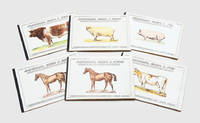
1900188515London: Vinton & Company Ltd c.1900. A set of elaborate moveable books depicting the anatomy of farmyard animals. Each includes five layers of folding colour diagrams showing the skeleton arteries and veins muscles and organs accompanied by a key. It was printed in Bavaria a prestigious centre of moveable books and home to skilled artisanal paper engineers such as Ernest Nister and Lothar Meggendorfer. This is the second edition of the set. Six works oblong quarto. Each 8 pp. and with folding chromolithographic illustration comprising two large overslips and multiple lift-the-flap tabs representing internal anatomy. Original printed boards black cloth backstrips wire-stitched as issued. Foxing toning and soiling to boards and contents wear to backstrips wire-stitches rusted but holding firm outer margins of contents with a few chips and damp stains a handful of neat repairs to folding stubs colours bright: in very good condition. hardcover
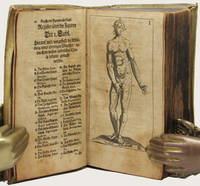
170434368Leipzig: Thomas Fritsch 1704. First German Edition. Illustrated with an engraved frontispiece of the author and 31 additional full-page engravings depicting various anatomical views. 8vo bound in the original contemporary vellum the spine with calligraphic titling by hand. viii 742 26 Register pp. A very good copy the binding still strong and well preserved the text with the usual mellowing and aging still crisp and very usable. FIRST GERMAN EDITION of this important work on anatomy partnered with the work of Philippi Verheyen Anmerckungen In Die Anatomiam Blancardi. Brieff An den weitberühmten Hrn. Friedrich Ruyschium.<br> 'Verheyen was a prolific writer including several books and manuscripts. His main work published originally in Latin the “Corporis Humani Anatomiae†was translated into multiple languages as here. This book became one of the most used anatomy books of the time.<br> The following excerpt of his book "Corporis Humani Anatomiae Liber Primus" reads : " . QuintusAuricularis quia cum minimum sit auribus expurgandis est aptissimus" translates as".the fifth finger called Auricularis because how small it is is most suitable to clean the ears". Incredibly anatomists at that time called the fifth digit "digitus auricularis".<br> Verheyen is credited with the creation of the eponym the “Achilles tendon†which denominates the common tendon for the gastrocnemius and soleus muscle although at the time he called it the “Chorda Achillisâ€. He also described the kidneys in detail especially the arterial “stars†found on the surface of the kidney which are today known as the “Stars of Verheyen†'. E. A. Miranda 2014 M.T.D. Thomas Fritsch hardcover
182840962London 1828. <p>Parliament. House of Commons. Report from the select committee on anatomy. Folio. 150pp. London: House of Commons 22 July 1828. 331 x 212 mm. 19th century boards rebacked and recornered in calf light edgewear. Very good copy. Old medical library stamp on title and first page.</p> <p>First Edition of this highly interesting and entertaining report on the British body-snatching crisis. Since the mid-eighteenth century obtaining cadavers for teaching purposes had been regulated in Britain by the Murder Act of 1752 which stipulated that only the corpses of executed criminals could be used for dissection. By the beginning of the nineteenth century however improvements in medical science coupled with a substantial drop in the number of executions caused the demand for cadavers to far outstrip the legal supply. This situation was ripe for exploitation by "resurrection men" criminals who robbed the graves of the newly deceased and sold their corpses to teachers of anatomy who of necessity turned a blind eye to the illegality of these transactions. Some grave-robbers even resorted to murder including the infamous William Burke who in December 1828 was arrested in Edinburgh for the murders of over a dozen victims whose corpses he and his partner Hare sold to an anatomical demonstrator connected to Edinburgh University.</p> <p>In the first half of 1828 in response to increasing calls for reform the British Parliament appointed a committee to "enquire into the manner of obtaining subjects for dissection by schools of Anatomy and the State of law affecting persons employed in obtaining and dissecting bodies." During the course of its investigation the committee heard testimony from a wide range of witnesses from eminent medical men to procurers of bodies for medical schools these last identified only by initials. The medical men included Sir Astley Cooper Benjamin Collins Brodie John Abernethy William Lawrence Herbert Mayo Granville Sharp Pattison who himself was indicted for body-snatching at the age of 23 Thomas Southwood Smith Henry Halford John Webster and Benjamin Harrison the treasurer of Guy's Hospital. The witness list can be found on page 13 of the committee's report. The testimony of these men reproduced in full in the report is followed by several appendices including tables of paupers' deaths broken down by parish; the committee was proposing legislation that would allow the state to seize unclaimed corpses from workhouses and sell them to surgical schools. The committee's efforts were successful: In 1832 Parliament passed the Anatomy Act granting licenses to teachers of anatomy and giving physicians surgeons and medical students legal access to corpses unclaimed after death. Wise The Italian Boy: A Tale of Murder and Body Snatching in 1830s London 2004. Garrison-Morton.com 7096.</p> . unknown
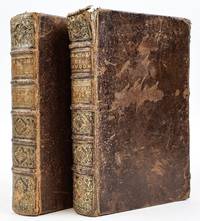
17341408797Paris: Guillaume Cavelier 1734. Later Editions. Hardcover. Octavos Four Volumes bound as two. The first book contains a single volume; the second book contains the second volume of Anatomie Chirurgicale in addition to two other standalone works. In Good condition. In full brown leather bindings; spines paneled with elaborate gilt decoration and gilt titling on tan leather labels; gilt roll to board edges. Scuffing and wear to boards with peeling to covers. All edges and fore corners rubbed with sections of exposed board. Chipping to heads and tails of spines; heaviest at head of Vol. I with head band nearly detached. Text block edges show shelf wear and dust soiling. Lightly age toned and very sparsely foxed throughout. Splitting to hinges. Rear pastedown in Vol. I and both pastedowns in Vol. II are separating from the boards. ~2 in. closed tear in Vol. I p. 39. Splitting in gutters of several signatures throughout both volumes due to damage to end bands. Closed tears affect some fold-out plates. Tidemarks affect pages in the rear of both volumes.<br /> <br /> <br> <br> <br /> <br /> CONTENTS: Anatomie Chirurgicale Vol. I xxiv 514 2 pages plus plates i-xxx; Anatomie Chirurgicale Vol. II viii 313 336-352 453-465 366-403 pages plus plates xxxi-xlviii bound together with Observations Anatomiques viii 175 pages plus 8 plates and Six Observations 2 36 2 pages. Shelved in Room A. The first work in this set is the second edition of Flemish surgeon Jean Palfin's Jan Palfijn's very famous treatise on anatomy which was first published in 1726 under the title Anatomie du Corps Humain. This work and its earlier edition were very influential in the medical field for their detailed anatomical illustrations and descriptive actionable advice for surgeons becoming a widespread authoritative medical text throughout Europe and other parts of the world. <br /> <br /> <br> <br> <br /> <br /> The second work bound together with Vol. II of Anatomie Chirurgicale is a French translation of Frederik Ruysch's Observationum Anatomico-Chirurgicarum Centuria. Ruysch was a renowned anatomist and botanist in his own right most well-known for his anatomical museum - the Cabinet of Curiosities - and his improved embalming technique which preserved bodies for longer periods of time in a more visually life-like state.<br /> <br /> <br> <br> <br /> <br /> The final work also bound together with Vol. II of Anatomie Chirurgicale and Observations Anatomiques is a revised edition of Six Observations by Michel Brisseau who is notable for being the first to demonstrate the true nature of cataracts as an increased opacity of the lens of the eye rather than a film that covered the eye which was the prevailing belief at the time. Together these works comprise a collection of highly influential studies treatises and observations on anatomy and surgery by some of the most notable medical practitioners of the late 17th and early 18th centuries. 1408797. Special Collections. Guillaume Cavelier hardcover