PICARD Jean & LA HIRE DE PhilippeMareMagnum

44 898 résultats
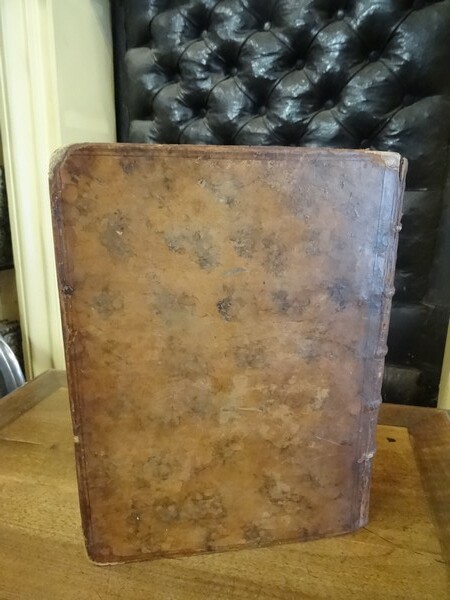
- Chez Etienne Michalet, à Paris 1684, In-12 (9x16cm), (12) 248pp. (2), relié. - Edition originale, rare, illustrée de plusieurs diagrammes in-texte et de 3 planches d'instruments de nivellement inventés par Picard pour le nivellement du château de Versailles. Edition réalisée par Philippe de la Hire, après le décès de Jean Picard, et d'après les manuscrits trouvés à son domicile. Reliure en pleine basane brune mouchetée d'époque. Dos à nerfs orné. Pièce de titre de veau brun. 3 coins émoussés. frottements. Bon exemplaire. L'ouvrage est divisé en chapitres bien distincts, le premier est une théorie du nivellement par rapport à la surface de la terre, ceux qui suivent sont une application de cette théorie et des exemples pratiques du nivellement. On y trouve par exemple la façon d'apporter l'eau à Versailles par des mesures malgré les différences de terrain. La dernière partie concerne la mesure de la terre. Picard avait été chargé par l'Académie des sciences de mesurer un degré de méridien. Le résultat trouvé par Picard fut le plus exact trouvé alors et permit à la science et notamment à Newton de poursuivre ses travaux sur la gravitation universelle alors qu'il avait été freiné par des mesures imprecises et fautives. [ENGLISH DESCRIPTION ON DEMAND]
- Rue et Hotel Serpente, A Paris 1781, In-12 (9,5x17cm), xliv, 45-268pp., relié. - Edition originale française, traduite par le Baron de Dietrich. Introduction par Tobern Bergman, professeur de chimie et de pharmacie. Une planche dépliante avec 5 figures. Notes du traducteur en fin de volume. Reliure en pleine basane blonde d'époque marbrée. Dos lisse orné de 5 fleurons caissonnés. Pièce de titre de maroquin brun. Coiffe de queue légèrement élimée en partie. Un accroc le long du mors supérieur. Coins émoussés. Ouvrage dans lequel Scheele démontre la découverte de l'oxygène dans l'air, découverte qui fut faite indépendamment de celle de Joseph Priestley. L'auteur observe qu'il se trouve deux gaz dans l'air dont l'un est sensible à la combustion. Scheele cherche également à analyser à l'aide de plusieurs expériences décrites les implications de la composition de l'air pour la respiration, le sang, et la croissance des plantes. [ENGLISH DESCRIPTION ON DEMAND]
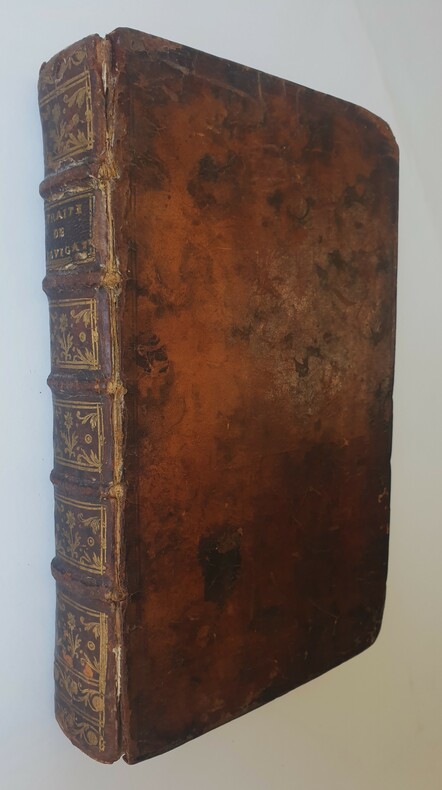
- Chez Gueffier, A Paris 1775, in 8 (12,5x20,3cm), xxiv, 342pp. 24Pl. et (4) 456pp. 28Pl., 2 volumes reliés. - Edition originale, illustrée de 51 planches dépliantes (23 pour le tome I et 28 pour le second, en fin de volumes) sur papier fort. Reliure en plein veau blond marbré d'époque. Dos à nerfs orné. Pièces de titre et de tomaison en maorquin rouge. Coiffe de tête du tome I arrachée. Un manque dans le caisson de tête du tome I. Un manque dans le caisson de queue du tome II. Ensemble frotté et épidermé. Coiffe de queue du tome I élimée. Une bande de cuir sur le plat inférieur du tome I arrachée. 3 coins émoussés au tome I. 2 planches mal pliées dans le tome I et ressortant. Pédagogue et démonstrateur extraordinaire, Sigaud de la Fond suit très tôt les cours de l'abbé Nollet (non moins célèbre pour ses expérimentations en physique et en électricité) auquel il succèdera, et se constitue rapidement un cabinet de physique expérimentale. Ses expérimentations sont multiples et s'engagent dans de nombreux domaines, l'électricité, mais aussi le phospore, la recette du dentifrice, la médecine... Avec le temps, il se consacrera plus amplement à son cabinet de physique et à ses expérimentations, mais s'il conservera une activité enseignante admirée partout en Europe. Tampon en page de titre : M. A. Gelin. [ENGLISH DESCRIPTION ON DEMAND]
- Chez Vincent, A Paris 1771, In-12 (9,5x17cm), xxiv, 480pp., relié. - Edition originale française, traduite par le Baron d'Holbach. Reliure en plein veau brun glacé et marbré d'époque. Dos lisse orné. Pièce de titre en maroquin grenat. Coiffes, mors, bordures et coins restaurés. Brunissures en marge de la page de titre. Ex libris, Bibliohtèque de Henri Tardivi. Oeuvre majeure du chimiste allemand Stahl, qui développa la fameuse théorie phlogistique, laquelle domina la chimie jusqu'à la fin du XVIIIe. Stahl en avait lui même emprunté la notion à son maître Becker. Bien que cette théorie fut invalidée par Lavoisier, elle fut très importante car pour la première fois dans l'histoire, un principe unifiait toute la chimie. Dans sa théorie des sels, l'auteur applique sa théorie à un nouvel élément, l'axiome de la théorie phlogistique étant l'affinité des corps semblables. [ENGLISH DESCRIPTION ON DEMAND]
- Chez Vincent, A Paris 1774, In-8 (13x20cm), LXII (2) 590pp. (2) et (2) 640pp. (4 pp.), 2 volumes reliés. - Mention de seconde édition, après la première parue en 1762, avec 14 tables dépliantes (la plupart des exemplaires n'en annconçant que 13). 4 pages de catalogue in fine. Préface de l'auteur pour cette nouvelle édition corrigée et augmentée. Reliure en pleine basane brune marbrée d'époque. Dos à nerfs orné. Pièce de titre en maroquin rouge, pièce de tomaison en maroquin noir. Coiffe de tête du tome I arrachée, manque à celle du tome II. Un manque en queue du tome II. Coins très émolussés et dénudés. Ensemble très frotté. Tampon rouge en page de titre : Bibliothèque de M. Héricart de Thury, Conseiller d'état. Traité de minéralogie basé sur le système de Wallerius et la classification de Linné, avec les propriétés et les usages mécaniques de chaque minéral, une géographie des minéraux, un vocabulaire et un lexique. Un des premiers manuels de minéralogie systématique. [ENGLISH DESCRIPTION ON DEMAND]
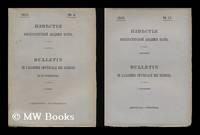
1916204400St. Petersburg - Petrograd : l'Academie Imperiale des Sciences de St.-Petersbourg 1916 1916. First Edition. Paperback. Very good paperback copies; edges somewhat dust-dulled and nicked. Condition varies slightly with a small number of issues having torn front covers with loss. Remains particularly and surprisingly well-preserved overall; tight bright clean and especially sharp-cornered. Minor library marks remain. Some issues are unread copies with unopened pages. Further scans images etc. and additional bibliographical material available on request.; 8vo 8"" - 9"" tall; 0 pages; Description: 75v. illus. ; 28cm. Summary: a collection of 75 issues of 'Bulletin de l'Academie imperiale des sciences' published between 1912 - 1916. Includes 1 issue published in 1909 and 1 issue of 'Bulletin de l'Academie Imperiale des Sciences de l'Union de Republiqiues Sovietiques Socialistes' published in 1926. Subjects: Periodicals -- Science -- Societies -- Russia -- Soviet Union. Notes: Cover titles in Russian and French. Text in Russian. Language: Russian. [St. Petersburg - Petrograd : l'Academie Imperiale des Sciences de St.-Petersbourg], 1916 paperback
135165aafZürich und Winterthur, bei Joh. Caspar Füessli Sohn; und in Commission bei Heinrich Steiner und Comp. Buchhändlern, 1776, in-4to, Mit gest. Titelvign. (Karte der Schweiz), 10 großen Textvignetten und 18 (tls. gefalt., num. 1-16, 12-b und 1 n. numm.) Kupfertafeln (gest. von J.R. Schellenberg, Pfenninger, Vogler und Holzhalb). XXII + 346 S. + 1 Bl. Erklärung der Tafeln, Zettel auf Spiegel „F.L. Albanus Buchhändler in Berlin Bruderstralse 19“, Halbleder d. Zeit mit Ecken d. Zeit.
133265aafParis, A. Franck, 1849, in-8vo, XXIV + 420 p. + 16 planches depl., qqs feuilles brunies, rousseurs (parfois abondantes), reliure en d.-cuir d’époque, dos orné de titre et de filets dorés.
125720aafA Nîmes, Gaude, et à Avignon, J. J. Niel, M.DCC.LXXXI., (1781), in-8°, 2 ff. + XXXII + 512 p.+ 2 planches gravées dépl. / 2 ff. + 566 p. + 4 planches / IV + 423 p. (+1) + 2 planches / IV + 610 p. + 1 f. + 4 planches, Lettre manuscr. de 15 lignes ‘Premier Prix des Vers pour Philippe Déglise’ + une seconde composition de 20 lignes ms. pour ‘Ant.e Déglise ...Rhet. Premier prix des vers, second de l’amplification oratoire 1810’ + une 2ème pièce manuscr. dans le tome 3 + cachet ovale sur la page de garde ‘J.M. Comte Curé Châtel St. Denis, Suisse’, doublures et gardes en beau papier marbré caillouté à coquilles, solide et élégante reliure en veau marbré, dos à cinq nerfs richement doré aux petits fers, pièce de titre et de tomaison claires, filet doré sur les plats, coiffes dorées au trait, tranches mouchetées, très bel exemplaire. Reliure fribourgeoise de prix avec au dos ‘PRAEMIUM’, larges bandelettes en soie, rose et bleue.
141688aafEn Suisse, chez les Librairies Associés, 1780, in-8°, reliure en d.-basane originale, pièce de titre dorée, en maroquin brun.
Album of watercolours devoted to flowering plants native to South Africa. Contains 30 images hand drawn and painted recto only one per leaf, most named in manuscript by the artist. A presentation copy inscribed to front pastedown, "E. Lawdon. From J. Bincker Dec. 1906". Oblong 8vo. sketch book made by Winsor & Newton whose label is affixed to front pastedown, with Whatman's drawing paper, taupe cloth boards, pencil sleeve (pencil not present), and a stretch band for secure closure. Volume measures approximately 19 x 13 cm. Minor age-toning to boards, small ink marks to verso, otherwise in very good condition, internally clean and bright, A pleasing work with lovely renderings of South African flora. Some of the flora painted in the present album include: Protea; Erica; Morea (commonly known as the Cape tulip); Aloe Davyama; Erythina Caffra (the African Coral tree); Ornithogalum; Gladiolous; Striilitzia; Vellozia retinerius; Striga elegans; Watsonia; Crassula; Hypoxis; Salvia africana; Gomphocarpus. The artist may be Johanna Jacoba Brincker (1842-1923, née KNAB) of Stellenbosch, South Africa. Johanna Jacoba Knab was born in South Africa, on 12 June 1842 in Stellenbosch. Little is known about Johanna, though she lived in South Africa and Southwest Africa [now Namibia] for her whole life, and she was a missionary to the Herero people, having a complete understanding of their language and customs. We get a fuller picture of her adult life through her husband, putting her in the circles of notable German Rhenish missionaries. On 10 February 1864 in Stellenbosch she married German missionary Peter Heinrich Brinckner, born 9 May 1836 in Isselhorst, Westfalen. Brinckner had arrived in South Africa in 1863. After completing his theological training, Brincker was ordained in November 1862 and seconded to German South West Africa on 5 November 1862, with the task of proselytizing the Herero and Nama, who were at odds with one another. After an 83-day journey, he landed in Cape Town at the beginning of February 1863. In Stellenbosch, about 50 kilometers east of Cape Town, he was welcomed by missionary brothers. There he met his future wife Johanna Rath and became engaged to her. Missionary Johann Rath, who had worked with the Herero for 15 years, introduced Brincker to the Herero language. By early 1864 Peter had returned to Stellenbosch, where he married Johanna. Together, on 20 February 1864, they took over the work in the mission station of Otjikango, called Klein-Barmen, which had been founded twenty years earlier. Because of fighting between Herero and Nama, the couple had to flee to Otjimbingwe seven times over the next year and a half. In September 1865 the station in Otjikango was destroyed by the Nama and had to be painstakingly rebuilt.
One Original Signed Letter, written Springfield Newnham, Cambridge, Nov 24 [1879]. 2 pages, 8vo. Bi-folium on headed paper with mourning border, "Down, Beckenham, Kent, Railway Station, Orpington S.E.R." Leaf measures approximately 11,5cm x 18cm (4.5 inches x 7 inches), when folded. Very Good Condition, nicely preserved. Accompanied by a Certificate of Authenticity. The Letter reads: My dear Frances, I see in the papers that you have lost your dear mother. I remember when you kindly wrote to me by her wish, that she felt herself that her end could not be very distant. I should be very grateful for a line, and I trust you will be able to tell me that she did not suffer very much; but rather that her placid & happy nature remained with her to the last. Believe me , Very sincerely yours, Emma Darwin" Frances Julia "Snow" Wedgwood (9 July 1833 – 26 November 1913) was an English feminist novelist, biographer, historian and literary critic. She was described as "a young woman of extreme passions and fastidious principles" and "at once a powerful reasoner and an inexorable critic of reason” Manuscript
One Original Signed Letter, written ca.1889, 2 pages 8vo. Bi-folium on headed paper, "Down, Farnborough R.S.O, Kent". Leaf measures approximately 11,5cm x 18cm (4.5 inches x 7 inches), when folded. Very Good Condition, nicely preserved. Accompanied by a Certificate of Authenticity. The letter reads: My dear Frances, I am anxious to know how your cousin is today, & whether you have hopes of being able to move tomorrow. If you had leisure to come & see me this afternoon for a short time, I should be glad; but only send me a verbal answer at all events. yours very sincerely, E. Darwin, (Mrs. Charles Darwin)" Frances Julia "Snow" Wedgwood (9 July 1833 – 26 November 1913) was an English feminist novelist, biographer, historian and literary critic. She was described as "a young woman of extreme passions and fastidious principles" and "at once a powerful reasoner and an inexorable critic of reason. Manuscript
An English translation by Dr. C. F. Fisher, from the Scientific Publications of the Novara Expedition, comprising important and fascinating observations and survey work by German-Austrian geologist Ferdinand von Hochstetter at the onset of British settlement in the region. 8vo. 113 pages, plus table of contents, title page. Red cloth boards titled in gilt to front. Volume measures approximately 14 x 21 cm. Faint blemish to boards, otherwise very good condition, clean and bright. An early work presenting discoveries made in New Zealand, specifically in Auckland and Nelson, during the Austrian Imperial Novara Expedition. It includes two important lectures delivered by esteemed geologist and expedition leader Ferdinand von Hochstetter. A principal member of the expedition, Hochstetter was involved in its planning from the onset. His surveys were used in the making of the first geological map of New Zealand, created the bases for future geological research. The Novara Expedition (1857-1859) was the first large-scale scientific, around-the-world mission of the Austrian Imperial navy. In 1859, during the expedition, Hochstetter was funded by the government of New Zealand to make a rapid geological survey of the islands. Over 150 years later, his work is regarded as an authoritative primary source still today. the volume's content centers largely on Hochstetter's survey of Auckland, beginning with his lecture on the region's geology. Subjects further include its extinct volcanos, Lake Rotomahana and its hot springs [Te Tarata thermal springs], and three inlets on North Island - Whaingaroa [now known as Raglan], Aotea, and Kawhia. Approximately one quarter of the text is devoted to his geological work in the Province of Nelson.
Japan: Suharaya, and others, Kaei 7 (1854). Fascinating and scarce account of a samurai's son whose personal determination led him to rise above the family's financial poverty, to properly care for his horse, build his own stables, and breed additional horses, all by learning the ancient long-forgotten ways of the ancient samurai. 8vo. 1 volume, 78 pages, including 9 full-page illustrations, two of which are hand coloured. Woodblock print. All text is in Japanese. Postscript records the first edition being published in 1806. Traditional karitoji paper binding string-stitched at spine, fukurotoji style ("bound-pocket" with folded leafs bound into spine), and opening from left to right. Natural paper covers, with manuscript title label to front. Together the volumes measure approximately 18 x 25,5 x 1 cm. Negligible creasing to boards and age-toning to upper margins, otherwise in very good and original condition, a pleasing and uncommon work. Based primarily on contemporary descriptions of the financial distress felt by the long-standing prestigious samurai class, such as the present account, it is accepted, without dissent that the ruling samurai class suffered increasing poverty during the Tokugawa (Edo) period. Seifu Murata (1746-1811) wrote: "For years now, the samurai have suffered from poverty and their minds have been occupied by making a living. ‘Buy this, sell that’ and ‘pawn this to pay for that’ has become all of their lives. Even for those dedicated to their duties, it was inevitable to debase themselves and to engage in unsavory conduct (i.e., engage in trading)". Even the wives of those who were earning as much as 200 koku busied themselves in trading and in shops. This is the hero's journey, imparted firsthand, of a brilliant young samurai born into poverty but wide-eyed and unrelentingly in pursuit of mastering the skills of a samurai and honouring his destined status in this class of nobility. Young Ryuzando Shujin began by learning the equestrian warrior traditions with a borrowed horse, and was eventually able to convince his father to buy him a horse of his own, despite of the family's economic situation. When the cost of caring for the horse became a burden no longer bearable, and he was told the horse would be sold, he fixated on finding a solution. Immediately, he began conducting extensive research into the ancient methods employed when most samurai were farmers who held the role of warrior in the event of a battle. The solution to combating the costs was breeding and selling. He began the process, while being scrutinized, mocked and judged by others, in particular jeering his rudimentary (cost-effective) hand-made stables. But he did not let any outside opinions pierce his confidence. After repeated trial and error, it was not long that he possessed six horses. Surely too, he had solved the challenges of the household finances. Shujin championed horsemanship as a duty of all samurai. With the belief that all samurai should therefore possess their own horse, in part to best perform archery, spearmanship, and swordsmanship, and owing to the fact that this was an era where some samurai families were poor, he published his methods for others to follow, and ultimately uphold their rights and responsibilities that their title suggests. The volume includes instructions for building horse stables by hand, without incurring high costs. He describes the breeding process, his training methodology, and proper feeding. His own experiences with horses falling to sickness and how he treated them back to health are also shared. Clearly a man with a charitable and honest heart, he concludes by stating that all of this aside, the single most important thing for a healthy and happy horse is "aishin" (affection).
Manuscript letter by Sir Richard Croft, Physician to King George III and the Royal Family, accoucheur (obstetrician), and British peer, describes complications of a pregnancy four years before the "triple obstetrical tragedy" Princess Charlotte which has become his unfortunate infamy. 8vo. 2 pages in manuscript. Double leaf measuring approximately 12 x 18,5 cm, watermarked with the year 1811, with integral address, two postal ink stamps and a lovely red wax seal. Very faint age-toning only to sections of the leaf exposed for mailing, otherwise in very good condition, beautifully preserved and highly relevant to the writer's occupation as a manmidwife and the complications of pregnancy and birthing in the early nineteenth century. "Sir Richard Croft (1762-1818) physician and man-midwife gained notoriety after his involvement in the labor of Princess Charlotte, which resulted in her death. He never shook off the shame of the tragedy, and shot himself three months later." (Oxford DNB). Manuscript signed letter from the Royal Physician and Male Midwife to the late Princess Charlotte, Sir Richard Croft, who is remembered for causing the "Triple Obstetrical Tragedy" of 1817, in which is a primary source account of early nineteenth century complications and precepts surrounding pregnancy and child deliveries. The writer is Sir Richard Croft, 6th Baronet (9 January 1762 - 13 February 1818), English physician to the British Royal Family and the obstetrician to Princess Charlotte, who is famed for his role in "the triple obstetrical tragedy" of her death in 1817. He received his medical training from, among others, his father-in-law, Dr. Thomas Denman, a preeminent obstetrician in London whose textbook on childbirth had been first published in 1788. He graduated with his MD from the University of Oxford in 1789. Croft was appointed the personal physician of King George III. He was also a member of the Medical and Chirurgical Society of London, and Physician to the Lying-in Charity on Old Burlington Street. He was the primary accoucheur or midwife to Princess Charlotte, granddaughter of the reigning King George III. Manuscript
1963190719Madrid, 1930-1963. M. zahlr. (teils farb.) Abb. In 29 uniformen Hldrbdn. Sehr gut erhalten.
1777185599Paris, Panckoucke, 1777. 12°. M. 108 (st. 111) Kpfr.-Taf. Hldrbde. d. Zt. m. Rsch. u. Rverg. Einbde. (teils stark) beschabt u. bestoßen. Rücken teils etwas angerissen. Gebräunt u. braunfl. Stellenw. m. Nässespur. Es fehlen: Taf 5 u. 9 in 1759/3 sowieTaf. 8 in 1766/2. 1759/3 eine Taf. doppelt eingeb, ebenso in 1762/2. Dort auch eine Taf. (19) m. Fehlst.
1986168523Washington, 1940-1986. Bibl.-Hlwdbde. bzw. OBr. m. Bibl.-St. Vol. 92 No. 2392 Tit. mit Ausschnitt. Es fehlen: Vol. 113 No. 2937; Vol. 151 No. 3710-3712; Vol. 154 No. 3745; Vol. 183 No. 4127.
1951221751Berlin, 1951-84. 4°. Geb. u. in Heften. Teilw. St. a. Tit. Fehlt: TI zu Jg. 33.
1741DEZ-6846Paris, Jean Desaint et Charles Saillant, 1741. In-4 en plein marbré au dos à nerfs orné de fleurons dorés. 4 pp dont titre, avertissement, et errata, xxiv dont préface, réflexions sur le mouvement, avertissements, avis et errata, 616 pp, lvii-(1) pp dont "formation de l'ellipse, tables, et approbation et privilèges du roi". Bien complet des 25 planches dépliantes dont celle avec les systèmes. Edition Originale. Exemplaire de second tirage qui contient la préface. Coins émoussés, coiffe supérieure arasée, cuir fendu au niveau du plat supérieur, reliure restant solide. Intérieur frais.
175248400Chez Jean-Florent Baour | à Avignon 1752 | 17 x 21 cm | broché
178917404S. n. | à Genève [Auxerre] 1789 | 13 x 20 cm | 2 volumes reliés
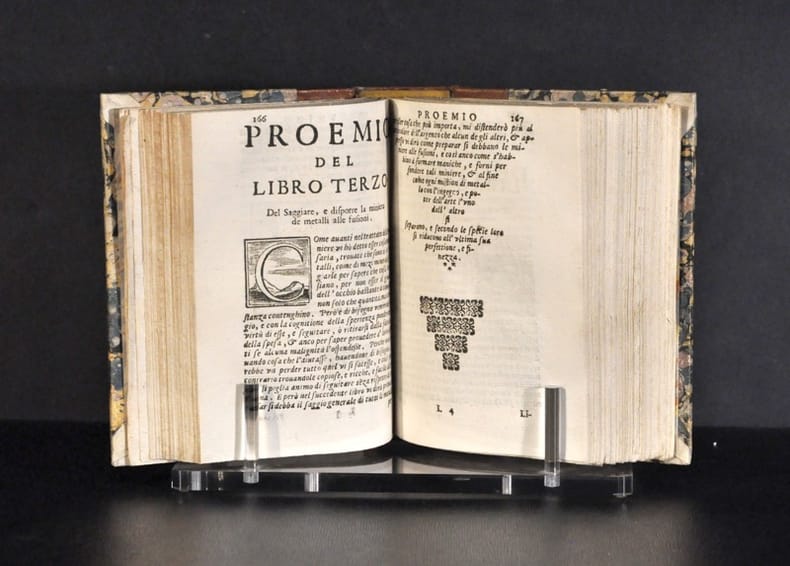
1229In Bologna, per Giosesso Longhi, 1678., (15), 630 p. Petit in-8, demi-basane brune, dos plat orné, reliure moderne.
17604790A Paris, chez H.L. Guérin & L.F. Delatour, rue S. Jacques, à S. Thomas d'Aquin, 1760. 1760 1 vol. in-8° (206 x 132 mm.) de : XXXII (dont f. bl., faux titre, titre, avertissement, avis au relieur); 352pp; [1] f. (titre); 23 pp. (tables); [1] p. (Remarque); [47] ff. (dont titre, table des Logarithmes); 13 planches dépliantes (dont 6 cartes). (déchirure à une planche). Plein veau de lépoque, dos à nerfs orné. (mors usé, coins frottés).