42 661 résultats
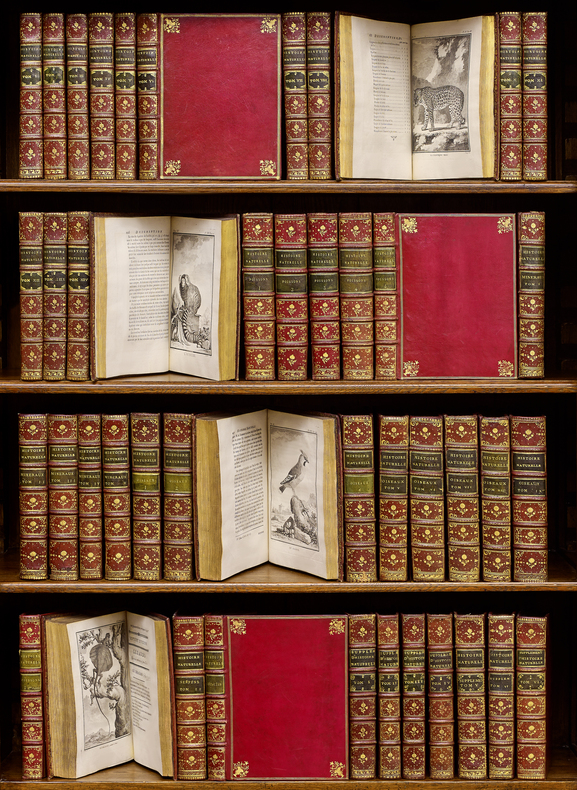
YTB-104Paris, Imprimerie royale, 1749-1804. 45 volumes in-4. Maroquin rouge, triple filet, fleuron au vase fleuri répété dans les angles, dos orné de filets et fleurons, pièces de titre et tomaison vertes, tranches dorées. Les décors varient au fur et à mesure de l’édition de l’œuvre sur cinquante années, avec des minimes différences. Reliure en maroquin de l’époque. 256 x 198 mm. EDITION ORIGINALE DU PLUS CELEBRE OUVRAGE FRANÇAIS ILLUSTRE DE SCIENCES NATURELLES DU SIECLE DES LUMIERES ornée d’un portrait de Buffon, 3 tableaux dépliants, 4 cartes dépliantes et 1 255 planches gravées d’après les dessins de Jacques de Sève. Bien complet de la Table de l'ordre des chiens (vol. V). « Les amateurs recherchent cette première édition in-4 des œuvres de Buffon, à cause de la beauté des gravures qu'elle contient ; mais il est très difficile de se procurer des exemplaires dont tous les volumes soient également pourvus de bonnes épreuves et cela parce que l'ouvrage ayant été publié dans l'espace de 50 ans, beaucoup de personnes ont négligé de retirer les volumes à mesure qu'ils paraissaient... » (Brunet). L'ouvrage comprend 4 parties dues à Buffon avec la collaboration notamment de Louis J. M. Daubenton et de Ph. Guéneau de Montbeillard, et 3 parties de complément publiées par Lacépède après la mort du naturaliste. Etendue pratiquement sans interruption sur près de 50 années, à raison d’un volume par an, la collection se compose des ensembles suivants : 1. Histoire naturelle générale et particulière, 1749-1767 ; 15 volumes. 2. Histoire naturelle. Supplément, 1774-1789 ; 3 volumes. 3. Histoire naturelle des Oiseaux, 1770-1783 ; 9 volumes. 4. Histoire naturelle des Minéraux, 1783-1788 ; 5 volumes. 5. Ovipares et serpents par Lacépède, 1788-1789 ; 2 volumes. 6. Histoire naturelle des Poissons, par Lacépède, 1798-1804 ; 6 volumes. 7. Cétacés. L’an XII Une des œuvres les plus ambitieuses et les plus complètes de la littérature scientifique, ce premier survol général, sous forme accessible, de l’Histoire naturelle, donnait à celle-ci ses lettres de noblesse. Le succès de l'entreprise fut immédiat, éclatant et durable ; la première édition, tirée à 1 000 exemplaires, fut épuisée en 6 semaines. “In 1739 Buffon was appointed Director of the Jardin du Roi. It would appear that the “Natural History” germinated in the preparation of a catalogue of the royal collection. Buffon then enlarged its scope to Aristotelian or Plinian proportions and finally transformed it into a conspectus of nature of a breadth and depth previously unknown. The Natural History was a great popular success” (PMM). Commencée par Buffon et terminée avec la collaboration de Daubenton et Lacépède, cette somme fait de ces naturalistes des Lumières des précurseurs dans des domaines de pointe comme le transformisme, la biogéographie, l'écologie, l’anatomie comparée, l’éthologie et la paléontologie. EXCEPTIONNEL EXEMPLAIRE COMPLET DES 45 VOLUMES RELIES EN MAROQUIN ROUGE DE L’EPOQUE.
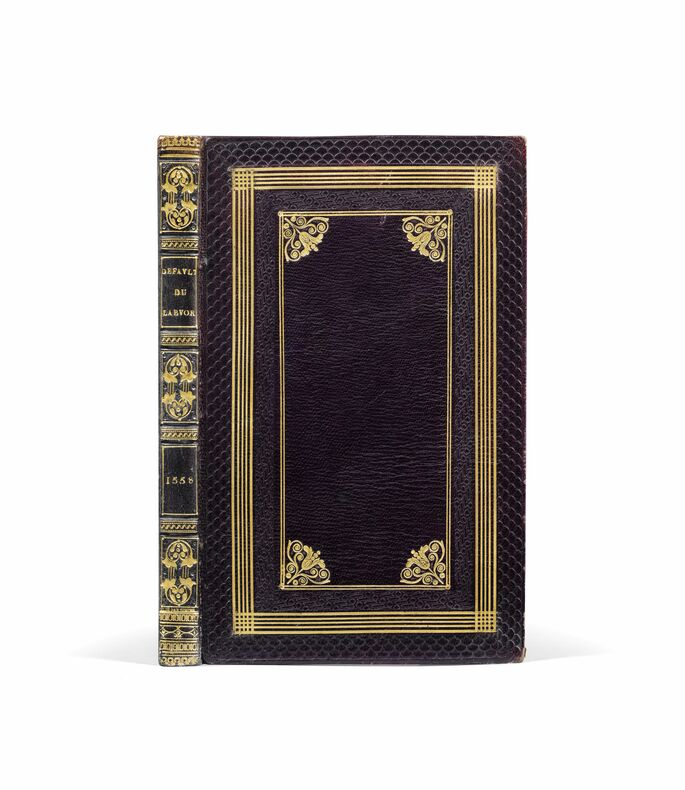
YTB-102Paris, Cavellat, 1558. Petit in-8 de (20) et 80 ff. Maroquin bleu, plats entièrement ornés de filets dorés et motifs à froid, dos à faux nerfs richement orné, coupes décorées, roulette intérieure dorée, tranches dorées. Reliure de Simier, relieur du Roi. 170 x 105 mm. “The exceedingly rare first edition of Belon’s last work”. Pritzel, 609. « Ces remonstrances dans le domaine agricole offrent un grand nombre d’observations utiles » (Michaud). « La traduction latine par Clusius (de l’Ecluse) a été imprimée à Anvers, chez Chr. Plantin,1589, in-8. On trouve au verso de la table des sommaires le portrait de Belon, gravé sur bois » (Brunet, I, 761). Le présent ouvrage qui traite de l’agriculture fut traduit en latin pat de Lécluse sous le titre de Neglecta stirpium Cultura, etc , Anvers, Plantin, 1589, in-8, et Belon le réunit aux Observations, dont il publia aussi une édition latine à Anvers, 1605., in fol, accompagné du portrait de l’auteur. Ces Remontrances offrent un grand nombre d’observations utiles. Il y provoque l’établissement d’une pépinière d’arbres étrangers dont il donne la liste ; il engage le collège des médecins de Paris à cultiver dans un lieu public, « tant pour leur délectation que pour l’augmentation du savoir des doctes » diverses espèces de plantes ; idée adoptée ensuite par Richer de Belleval, qui fonda à Montpellier, le jardin des Plantes, antérieur à celui de la capitale. Le plan de Belon, en partie réalisé par l’évêque du Mans, René du Bellay, dans ses jardins de Tourvoye, fut recommandé à Henri II par le cardinal de Lorraine, mais le mauvais état des finances ne permit pas son exécution. Edition partagée par Guillaume Cavellat et Gilles Corrozet : l'exemplaire est conforme à celui de la BNF, avec, aux lignes 7 et 8 du titre : « La manière d'affranchir & apprivoiser les arbres sauvages". On trouve au verso du huitième feuillet liminaire un portrait gravé sur bois représentant Pierre Belon à l'âge de 36 ans. Ce portrait ornait déjà les Observations de plusieurs singularitez publiées en 1554 par les mêmes Cavellat et Corrozet ; d'après Albert Ohl Des Marais, il est l'œuvre du graveur lorrain Claude Wœiriot (cf. Renouard). SUPERBE EXEMPLAIRE D’UNE EDITION ORIGINALE DEVENUE INTROUVABLE, REVETU D’UNE EBLOUISSANTE RELIURE DE SIMIER, RELIEUR DU ROI.
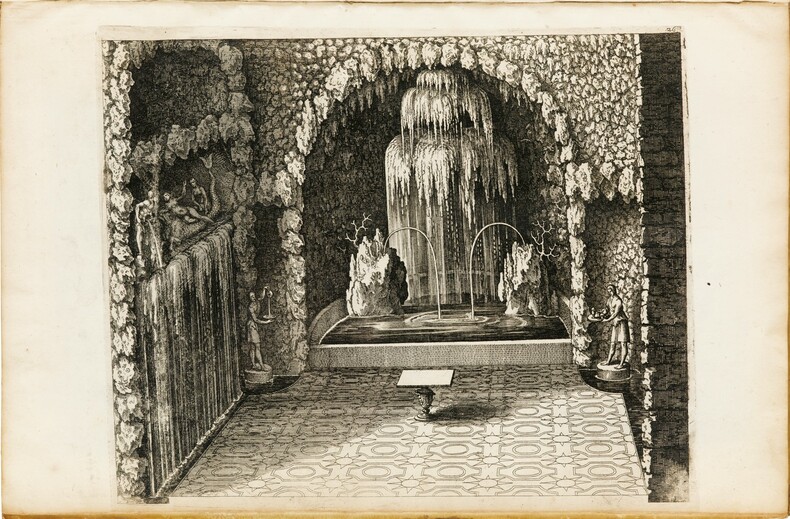
YTB-80Frakfurt, Theodor de Bry, 1620 In-folio de 1 titre frontispice, 1 feuillet de dédicace en français “A sa majesté de Boheme, électeur palatin, duc de Bavière” daté du 20 décembre 1619 ; 4 pages « Au lecteur » de commentaires en français, 30 planches gravées de vues de jardins, fontaines, paysages dont l’immense et magnifique planche dépliante illustrant le château et les jardins d’Heidelberg (dimensions de la planche dépliée : 1 025 mm x 683 mm). Vélin ivoire, dos lisse. Reliure de l’époque en vélin. 390 x 250 mm. EDITION ORIGINALE D’UNE LEGENDAIRE RARETE PRESENTANT LES JARDINS PAYSAGES ET ARCHITECTURES PAR SALOMON DE CAUS POUR L’ELECTEUR PALATIN FREDERICK V. Brunet I, 1691 ; Hunt 204 ; Guilmard, p. 395, n°22 ; Destailleur, 1895, p. 146, n°554 ; non cité par Ganay. « The extraordinary large folding panoramic view of Heidelberg was engraved by Matthias Merian after the painting by Jacob Focquier, while the other plates illustrate the fountains set in verdant grottos, as well as sculpted fountain pools, parterres and various garden ornaments and architecture. » Salomon de Caus est né en 1576 à Dieppe, en Normandie. En 1605 l’archiduc Albert le nomme « ingéniaire à la fontaine artificielle et en toutes autres choses que luy seront commandées ». Dans les années 1608-1609, de Caus est à Londres pour enseigner le dessin au prince Henry ; mais il travaille aussi pour la Cour et la noblesse en tant qu’architecte de jardins. En 1614, par l’entremise de la princesse Élisabeth Stuart, qui avait épousé le Prince électeur Palatin, il répond à l’appel de Heidelberg. Il quitte la ville pour Paris en 1620, à cause de la guerre, pour se mettre au service de Louis XIII, qui l’emploie comme ingénieur et architecte du Roi. Il meurt à Paris en 1626. L’Hortus Palatinus est un recueil de gravures publié en 1620 à Francfort par l’imprimeur et graveur Jean Théodore de Bry dans une double édition originale allemande et française, avec des pages de titre identiques. C’est l’une des plus précoces publications de ce genre. Dans sa structure générale – une dédicace, un court texte de présentation et trente gravures – l’ouvrage fait référence aux Plus excellents bastiments de France de Jacques Androuet du Cerceau (1576 et 1579). Mais à la différence du Français, Salomon de Caus consacre tout son Hortus Palatinus à une seule réalisation, le jardin que Frédéric V, prince électeur palatin élu l’année précédente roi de Bohême, avait fait réaliser pour son château de Heidelberg. Dans ce cas, le jardin devient l’élément le plus représentatif de la résidence, les bâtiments, relativement aux critères de l’uniformisation formelle de la typologie palatiale, s’avérant moins importants. Les gravures sont de Mathieu Mérian, gendre J. T. de Bry, ce qui n’est cependant attesté que par la signature de la « Scenographia » (« Iacob Focqier pinxit, Matthae Merian fecit »). Mérian a suivi la vue du jardin d’Heidelberg peinte par le Flamand Jacques Foucquiers (76 x 103 cm, collection privée), reprise dans un plus grand format (1620, 179 x 263 cm, Heidelberg, Kurpfälzisches Museum). L’Hortus Palatinus peut être considéré comme le chef d’œuvre de Salomon de Caus. En comparaison du jardin de Heidelberg, les travaux qu’il a réalisés à Bruxelles, en Angleterre ou en France (à propos desquels on ne sait pour ainsi dire rien) passent au second plan. Or l’histoire de l’influence de ce jardin détruit dès le XVIIe siècle repose principalement sur le traité, premier recueil d’estampes monographiques consacré à l’aménagement d’un jardin. "This slim volume of plates, published in 1620, is one of the most moving monuments to the fragility of gardens, however great. Caus had designed and supervised the creation of the renaissance marvel, built on an intractable site beside the castle, high above the town and the river Neckar. The text of his book is an au lecteur of only three [sic: four] pages, in which he speaks of the 'delay to the work' which has occurred," precipitated by the wars of Bohemia. His work was never finished, and what had been built was soon abandoned, but its aspirations were unquestionable: "It had delights within and without--Alberti could not complain about the view--and the intricacy and variety respond to the magnitude of its scale. In the eighteenth century, the debased successors to the formal gardens at Versailles will be grand, but empty. At Heidelberg, every section is 'curious', with the excitement in detailed work which inspires the sculpture of fountains in the palazzo Borghese in Rome, or the knots in the garden at Gaillon" (Christopher Thacker, The History of Gardens, 1979, p. 134). SUPERBE EXEMPLAIRE DE L’EDITION ORIGINALE CONSERVE DANS SON VELIN DE L’EPOQUE. DE TOUTE RARETE : NUC ne cite que quatre exemplaires ; aucun exemplaire répertorié sur le marché public au cours du siècle écoulé.
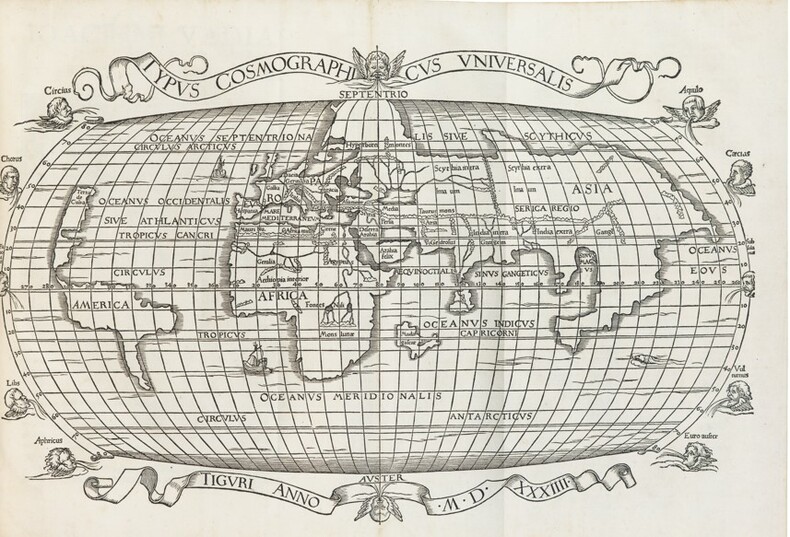
YTB-69Zurich, Christoph Froschauer, 1534. In-folio de 6 ff., 273 pp., 1 p. et 14 ff. ; une carte dépliante. Demi-peau de truie sur ais de bois. Reliure du siècle dernier. 272 x 180 mm. FIRST EDITION of Vadianus’s influential description of the world, with the very important map of the world depicting America for almost the first time, showing the complete outline of South America and according to Sabin « lacking in most of the copies located ». Alden & Landis 534/31; Harrisse, BAV 189 ; JCB I, p, 460 ; Karrow 58/47.1 ; Sabin 98279 (erroneously dated 1533) ; Shirley 70 ; VD 16, V20. The map is a reduced size copy of the world map attributed to Sebastian Munster published in Grynaeus's Novis orbis regionum ac insularum veteribus incognitarum (Basel, 1532) itself primarily based on Waldseemüller's map of 1507.Vadianus describes all the continents, seas and islands, regions, mountains and towns of the world, with separate chapters on Europe, Africa, Asia, Palestine and even Paradise, offering a geographical reading of biblical history, The description of America can be found on pp. 263-273, In the same year an octavo edition was published (without the map), later followed by several other editions. Very good copy. Joachim Vadian (1484-1551), de son nom de naissance von Watt, fut un universitaire humaniste et réformiste de Saint-Gall qui, après une carrière dans la médecine à l'étranger, revient dans sa ville d'origine et participa activement à la vie politique de celle-ci en se faisant élire au sein du Petit Conseil puis en assurant le rôle de Bourgmestre. Il défendit les idées de la Réforme et produisit des travaux sur l'histoire qui firent autorité en son temps. Ex-libris manuscrit ancien de Joann Hueber et ceux de Harrison D. Horblit et celui de B. Mendel qui furent chacun d'importants bibliophiles et collectionneurs américains d'ouvrages scientifiques portant notamment sur les grandes navigations et la découverte de l'Amérique. TRES BEL EXEMPLAIRE COMPLET DE LA MAPPEMONDE tirée Typus cosmographique universalis proposant une projection ovale du monde avec la mention « America » notée pour l’actuelle Amérique du sud tandis que le nord y est nommé « terras de cuba ».
20212081502111902788national library 2021. Soft Cover. Fine. The book is in fine condition. national library paperback
20212081502111904661National Library Publishing Company 2021. Soft Cover. Fine. The book is in fine condition. National Library Publishing Company paperback
1618163261618, Francofurti apud Lucamiennis, in-8 plein vélin jaune, texte en latin. Inventaire des gravures : gravure sur la page de titre de l'Opus chymicum, 1 gravure «Les 12 clefs de Basile Valentin » sur page de titre du Basilica Chymica, 1 gravure (femmes assises sur des lions) sur page de titre du Basilica Philosophica, figures noir et blanc sur les pages 71, 72, 74 et 77. 1/ Basilica medica : Physiologiam, Pathologiam, Therapeuticam, 2/ Basilica chymica : anatomiam auri, argenti & mercurii, Jovis, Martis ac Veneris, tractat de gemmis, examinat mineralia, vegetabilia resoluit, animalia explicat, 3/ Basilica philosophica : horum prior [...] | Etat : Assez bon état général pour un ouvrage de cette époque, vélin noirci, dos désolidarisé, rousseurs, quelques écritures à la plume dans les marges, partie 3 : pages 59 à 88 vermoulues en un point précis (empêchant la lecture de quelques mots sur les pages), pages foncées au début des 2ème et 3ème parties (ne nuisant pas à la lecture), quelques pages réparées. (Ref.: g430)
The archive contains a plethora of material. Original Artwork in different formats, namely a collection of 14 original sketchbooks with numerous original colored drawings, approx. 540 original pencil drawings, 16 original water colored pencil drawings, 24 original watercolors, 15 original ink drawings, 32 original pencil ink drawings, 18 original watercolors, 79 original etchings, partly in aquatint, 30 manuscript pages of notes, 4 original oil studies and 3 photographs. Sheet dimensions from approx. 4 x 8 inches to approx. 22 x 26 inches. The archive includes manuscript cost calculations and numerous, partly large-scale construction drawings for the restoration work at the town hall Bülach. With his keen sense and appreciation of history, the Swiss architect Rordorf was an attentive observer of Swiss culture. As a result of the restoration work based on his designs at the town hall Bülach (around 1905) and in the Castle Greifensee (historic room conversions 1917) he drew the attention of the Swiss public to his work. Also, architectural and floor plan drawings, beautiful views (between 1876-1933) of Switzerland, including Bremgarten, Dübendorf, Effretikon, Lugano, Freiburg, New Bechburg, Thierstein, Bern-Thun, Mariastein, Aarberg, Castle Burgdorf, Kyburg, Locarno, Arbon, Brugg, Zurich, Erlach, as well as Italy, France and Germany. Documents include announcement and invitations and manuscripts of the Société "On the Wall" in Zürich, manuscript letters, poems, purchase contracts and dividing documents between David and Paul Rordorf, etc., as well as a district plan of the city of Zurich. Rordorf-Mahler was a member of the Zurich Artist Society, the Swiss Association of Engineers and Architects, the Société "On the Wall" in Zurich, and at times its President. All in all, an impressive archive of original drawings and at the same time, an important primary source material for the history of architecture in Switzerland. Manuscript
1822B6522Paris: Imprimerie de C.L.F. Panckoucke. 1822. . A very good copy with marginal minor light spotting. Publisher's blind stamps to corners of plates. Edition: Second Edition. Binding: contemporary half red calf over orange calf title in gilt on upper board and spine spine with 6 raised bands spine compartments with gilt ruling and blind decorative central devices. Notes: The second edition contained in total 11 plate volumes in large folio and 24 volumes of text in octavo.<br>The Description de L'Egypte was a series of publications appearing first in 1809 and continuing until the final volume appeared in 1829 which aimed to comprehensively catalog all known aspects of ancient and modern Egypt as well as its natural history. It is the collaborative work of about 160 civilian scholars and scientists known popularly as the savants who accompanied Bonaparte's expedition to Egypt in 1798 to 1801 as part of the French Revolutionary Wars as well as about 2000 artists and technicians including 400 engravers who would later compile it into a full work.<br> Size: Large Folio 670 x 515 mm Illustration: Illustrated with some superb folding large plates of panoramas and maps.<br>Volume 3 illustrated with 43 single full-page plates 20 double page plates 6 large folding plates of maps plans views and more.<br>Volume 4 illustrated with 58 single full-page plates 2 double page plates 4 large folding plates of maps plans views and more lacking 8 plates never bound.<br>Volume four missing plates 3 6 7 10 13 14 29 42 not bound originally.<br> Volume: Volume 3-4 out of 11 pl Category: Book Plate Books General; Book Africa Egypt; Imprimerie de C.L.F. Panckoucke. hardcover
New York, Ormsby, 1852. Folio. Original illustrated, richly gilt boards with a large gilt centre resembling a guilloche-gravure. Blindstamped corner-ornamentations and gilt lettering to boards as well. Old owner's inscription of ""Nissen & Parker/ 43 Mark Lane"" to front free end-paper and with a gift-inscription from H N Nissen, dated 1867, to first blank. VIII, 102 pp. + 13 engraved plates (including frontispiece, which is ""PLATE 5"") - complete. The 13 finely engraved plates demonstrate different technologies and depict bank notes, vignettes, and various design elements.
1779148241779-1781, imprimerie royale, in-4 plein cuir de XVI+707 et 844 pages, gardes marbrées, dos à 5 nerfs, titrages dorés, 13 planches dépliantes en fin de chaque ouvrage. | Etat : Bon état général, dos, champs et mors usés, rousseurs, manque de la 14ème planche du 2nd volume, complet de ses 2 volumes. (Ref.: MA87)
155841789Lyon, Macé Bonhomme, 1558. 2 parties en 1 vol. in-4 de (20)-240 et 135 pp. (erreur pour 134 pp.), maroquin rouge, dos orné à nerfs, triple filet doré sur les plats, dentelle intérieure, tranches dorées (reliure du XVIIIe siècle).
- s.n., Paris 1788, in-8 (12,5x20cm), xij ; 344 pp.; (4 p.), relié. - Essai sur le Phlogistique, et sur la constitution des Acides [Essay on Phlogiston] n. p. | Paris 1788 | 8vo (12.5 x 20 cm) | xij ; 344 pp.; (4 p.) | contemporary half sheep First edition and sole publication of the French translation and critical analysis under the direction of Madame Lavoisier of this text published in English the previous year under the title An Essay on Phlogiston and the Constitution of Acids. The work is made up of twelve sections, all followed by critical notes by Louis-Bernard Guyton de Morveau, Pierre Simon de Laplace & Gaspard Monge & Claude Louis Berthollet & Antoine François de Fourcroy. Contemporary half light brown sheep over marbled paper boards, smooth leather spine decorated with gilt fillets and fleurons, morocco leather title piece. Very skillfully restored joints. Interior in very good condition except for two marks left by bookmarks on pages 68-69 and 176-177. Rare autograph inscription by Marie-Anne Paulze Lavoisier to Joseph Louis de Lagrange, prominent mathematician and loyal friend to Antoine Lavoisier. Valuable record of the leading role played by Marie-Anne Paulze Lavoisier in the "chemical revolution" at the dawn of the French Revolution. Phlogiston theory emerged at the end of the 17th century - conceived by Johann Becker and developed by Georg Ernst Stahl - postulating the existence of a "flame element" inherent in combustible bodies and released during combustion. This hypothesis was completely refuted by Lavoisier, who revealed the role of oxygen in the combustion process, thus inventing the theory of oxidation. Irritated by Lavoisier's skepticism with regard to phlogiston theory, the eminent Irish chemist Richard Kirwan published this text titled Essay on Phlogiston. "[...] The French chemists who rallied around Lavoisier decided to respond by translating An Essay on Phlogiston into French." (Keiko Kawashima, "Madame Lavoisier et la traduction française de l'Essay on phlogiston de Kirwan" in Revue d'histoire des sciences, 2000). This text, far from being a simple translation of Kirwan's work, adopted the form of a manifesto in itself in which the greatest chemists of the day contested phlogiston theory, dissecting its advocates' arguments one by one. The huge success of the French translation led Kirwan to attempt to refute the objections of Lavoisier and his collaborators. In 1789, he published a second edition of his work, translating the French notes written by its detractors into English and adding his own refutations. He finally converted to the ideas of the anti-phlogisticians, the founders of modern organic chemistry. Marie-Anne Pierrette Paulze - Mme Lavoisier - played a key role in the career of her husband, who taught her chemistry at her request; she then became his assistant, recording the experiments he carried out and their results. She very quickly took on a role that went beyond that of the devoted wife, becoming a translator but also a writer: many of the notes in the Essai sur le phlogistique were written by her. At the height of her involvement, it was she - in her capacity as a skilled illustrator - who drew all the plates in Traité élémentaire de chimie (1789), appending her signature "Paulze Lavoisier Sculpsit" on this occasion. This specimen includes a rare autograph inscription "by the translator" - Mme Lavoisier - to Joseph Louis de Lagrange (1736-1813), one of her husband's closest friends. It was Lavoisier who aroused the interest of Lagrange in the new science of chemistry. Together they participated in the development of a metric system that standardized weights and measures, which came to light during the Revolution. Working for the revolutionary government, Lagrange had more opportunities than his chemist friend, who was executed as a victim of the Terror. When he learned that Lavoisier had been killed at the guillotine, the mathematician declared: "It took them onl
28174Paris, 1699-1760 [1720-1766]. 62 volumes in-4°, veau fauve marbré, dos à nerfs ornés de fleurons dorés, pièces de titre en maroquin rouge, roulette dorée sur les coupes, tranches jaspées de rouge. Reliure de l'époque, qq. épidermures et petits manques de cuir sur les plats, qq. défauts au niveau de la tomaison aux dos. Plaisant exemplaire en reliure uniforme. On joint 6 volumes de tables couvrant les années 1699-1760. Nombreuses figures gravées sur bois dans le texte et 1178 planches hors-texte gravées en taille-douce dont 459 repliées. Il manque 3 planches (aux volumes de 1723 et 1741).
- Impensis Autoris, Lutetiae Parisiorum 1791-1812, in-4 (20x26,5cm), 22pp. ; 18pp. ; 16pp. ; 16pp. ; 16pp., 5 livraisons reliées en un volume. - Icones Plantarum Syriae rariorum, descriptionibus et observationibus illustratae Impensis Autoris, Lutetiae Parisiorum 1791-1812, in-4 (20 x 26,5 cm), 22 pp; 18 pp; 16 pp; 16 pp; 16 pp., contemporary half sheep First edition, one of the rarest complete copies of the 5 issues. It is illustrated with 50 plates, some of which are folding and one is heightened in color, drawn by Pierre-Joseph and Henri Redouté, Turpin and Poiteau. Contemporary binding in half blond tree sheepskin, spine with triple gilt fillets, as well as a morocco red title piece, tree paper boards. Discreet repair to spine. Following his study of medicine at the Université de Montpellier, La Billardière turned towards natural history and more specifically botany. In 1786, under Louis Guillaume Le Monnier's initiative, he was sent on a mission by the French government to Cyprus, Palestine and Syria. This was a prolific journey for him and he brought back a large number of plants which allowed him, on his return, to start to publish his work under the title Icones Plantarum Syriæ rariorum descriptionibus et observationibus illustratæ. This considerable work, started in 1791, will not be completed until 1812 because the author was sent in search of La Pérouse's research expedition to Oceania. [FRENCH VERSION FOLLOWS] Édition originale, l'un des rarissimes exemplaires complets des 5 livraisons. Elle est illustrée de 50 planches, certaines dépliantes et l'une rehaussée en couleurs, dessinées par Pierre-Joseph et Henri Redouté, Turpin et Poiteau. Reliure de l'époque en demi basane blonde racinée, dos lisse orné de triples filets dorés ainsi que d'une pièce de titre de maroquin rouge, plats de papier raciné. À la suite de ses études de médecine à l'université de Montpellier, La Billardière s'orienta vers l'histoire naturelle et plus précisément la botanique. En 1786, sous l'impulsion de Louis Guillaume Le Monnier, il fut envoyé en mission par le gouvernement français à Chypre, en Palestine et en Syrie. Ce voyage fut pour lui prolifique et il en rapporta un grand nombre de végétaux qui lui permirent à son retour de commencer la publication de ses travaux sous le titre Icones Plantarum Syriæ rariorum descriptionibus et observationibus illustratæ. Cette uvre considérable, commencée en 1791, ne sera achevée qu'en 1812 car son auteur fut envoyé à la recherche de l'expédition de La Pérouse en Océanie.
1919110879Washington, 1886-1919. Lwd., Hlwd., Pp., Brosch. u. in Heften. Bd. 14 Einbd. etwas gelockert; 48 Lwd. oben beschabt. Alle Brosch. etwas bestoßen u. beschmutzt. Meist St. a. Tit. u. Rsign. Es fehlt: TI zu Bd. 59, 77-79, 81, 125.
151866812Filippo Giunta | Florence 1518 | 21 x 32.50 cm | relié
175615777La Haye, Pierre de Hondt, 1756. In-4 de XVI-125-(3) pp., 1 frontispice et 39 planches numérotées en couleurs, veau porphyre, dos orné à nerfs, pièce de titre en maroquin brun, fleurons aux angles et triple filet doré d'encadrement sur les plats, gardes de papier dominoté doré, tranches dorées (reliure de l'époque).
182242940Paris, Crochard, 1822. In-8 de (4)-383 pp. (erreurs de pagination sans manque), table, errata, 10 planches repliées signées Adam d'après Girard, basane racinée, dos lisse orné de filets dorés (reliure de l'époque).
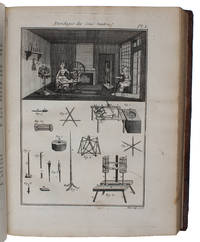
177156289Neuchatel L'Imprimerie de la Société Typographique 1771-83. 4to. Bound in 19 contemp. uniform full mottled calf. Raised bands. Gilt spines. Title-and tomelabels with gilt lettering. Spine-ends on nearly all volumes strenghtened. Stamp on title-pages. Each volume around 650 pp. With 508 fine engraved plates. <br/><br/><em>Second edition and the first 4to-edition was published in 19 volumes plus an additional volume by Jean Elie Bertrand where vol. 20 is an additional volume published much later 1799 - not present here - dealing with the art of printing. This importent collection of books on crafts was published by between 1761 and 1788. The full series comprises 113 parts cahiers in 27 folio volumes along with three supplements and "provide detailed accounts of a wide range of handcraft and manufacturing processes carried out in France at that time. The volumes are well-illustrated with precise engravings by Jean Elie Bertrand 1737-1779 a noted typographer from Neuchâtel where the printing was done. Many of them provide the background for shorter articles in Diderot's Encyclopedia which was appearing at much the same time. The project had its origin in request from Colbert in 1675 to the Academy Royal des Sciences for detailed accounts of various mechanic arts to be prepared and for new machines to be reported upon. This led to the formation of the Bignon Commission under Abbé Bignon. René-Antoine Ferchault de Réaumur 1683-1757 became editor soon after he joined the Academy. He inherited number of drawings the earliest prepared in 1693 and an illustrated manuscript on printing type and book binding which had been prepared in 1704. It was left to Réaumur's successor Duhamel du Monceau to bring about the publication of the series probably as the result of the competition from the Encyclopedia." Wikipedia.Brunet II618 ff. - Graesse II 367. </em> hardcover
122459aafLondon, Reeve & Co., (John Edward Taylor, Printer), 1863 - 1867, lg. in-8vo, 6 volumes with each 24 tipped-in original photogr. mounted on stiff white leaves with yellow frame (albumin prints), overall a fine original, complete set, original contemporary clothbound, spine with gilt title & publisher, covers with gilt central piece and blindpressing (binder’s ticket in vol. V: Bound by Westleys & Co. London).
89380aafZürich, bey Heidegger und Comp., 1752, kl. in-4to, komplett mit 2 gest. Front. und 32 (10 gefalt., davon 1 mit gr. Klappteil) Kupfertafeln. Bd. 1: IV + 268 S. + 2 Bl. Register / Bd. 2: VIII + 480 S. + 4 Bl. Register / Bd. 3: VIII + 336 S., Halbleder der Zeit mit Lederecken und Rückenschildchen, Buchdeckel mit Schabspuren, sonst sehr schönes Exemplar.
179165159Impensis Autoris | Lutetiae Parisiorum 1791-1812 | 20 x 26.50 cm | 5 livraisons reliées en un volume
- Bechet, à Paris 1822, 30x43cm, relié. - MAYGRIER Jacques-Pierre & CHAZAL Antoine Nouvelles démonstrations d'accouchemens [New Demonstrations of Deliveries] Bechet, à Paris 1822, 30 x 43 cm, contemporary brown calf First edition, with the illustrations of the author (often missing) and 79 plates (plate 27-28 double page) hors texte steel-engraved by Forestier after drawings by Antoine Chazal. Strictly contemporary Romantic binding in brown calf, spine in six compartments richly decorated with gilt fillets and blindtooled arabesques, boards with blindtooled arabesques to corners, double fillet frame and gilt initials 'A.D.' to centre, gilt roulette framing marbled endpapers and pastedowns, double gilt fillets to edges of covers. Binding very skilfully restored. Jacques-Pierre Maygrier (1771-1835) was a student of Antoine Dubois, the obstetrician of Empress Marie-Louise. He practiced at the Cochin hospital and at the Hôtel Dieu and lectured extensively on obstetrics with the intention of simplifying the teaching of the subject (e.g. on the anatomy of the fetus, the mechanics of birth, etc.). A very attractive copy of this rare and magisterial atlas of obstetrics in a remarkable strictly contemporary binding. $ 7 500 [FRENCH VERSION FOLLOWS] Édition originale illustrée du portrait de l'auteur qui manque souvent et de 79 planches (planche 27-28 sur double page) hors-texte gravées sur acier par Forestier d'après les dessins d'Antoine Chazal. Reliure romantique strictement de l'époque en plein veau brun, dos à cinq nerfs richement orné de filets dorés et d'arabesques à froid, plats ornés d'arabesques à froid en écoinçons, d'un double filet en encadrement et d'initiales dorées A.D. au centre, roulette dorée en encadrement des gardes et contreplats de papier à la cuve, double filets doré sur les coupes. Reliure très habilement restaurée mais présentant quelques frottements. Jacques-Pierre Maygrier (1771-1835) fut l'élève d'Antoine Dubois, accoucheur de l'impératrice Marie-Louise. Il exerça à l'hôpital Cochin et à l'Hôtel-Dieu et prodigua des cours d'obstétrique avec la volonté constante de simplifier l'apprentissage de cette matière (anatomie du ftus, mécanique de l'accouchement...). Très bel exemplaire de ce rare et magistral atlas d'obstétrique remarquablement établi en reliure strictement de l'époque.
16934565Paris: L'Imprimerie Royale 1693. First edition. <p>First edition a fine copy in its Royal presentation binding of this remarkable union of major texts on mathematics and physics by the leading scientists of seventeenth-century France. Especially important are nine treatises by Roberval comprising the principal corpus of his published works. They include his independent discovery of the geometry of indivisibles his foundation work on kinematic geometry and his treatise on the composition of movements. </p>. Hardcover. A ROYAL PRESENTATION BINDING. <p>First edition of this superb collection of thirty-one treatises by the leading scientists of seventeenth-century France almost all of which are published here for the first time. This is one of the earliest important publications of the Académie des Sciences and one of the most magnificent and the present copy was probably intended for presentation: it is bound in contemporary calf with the arms of Louis XIV on each cover. Founded on 22 December 1666 one of the principal functions of the Académie was to facilitate publication of the works of its members. Frenicle and Roberval were founding members as was Huygens and without the assistance of the Académie it is likely that many of their works would have remained unpublished only two works by Frenicle and two by Roberval were published in their lifetimes. After the death of Frenicle and Roberval in 1675 their books and manuscripts were entrusted to the astronomer Jean Picard; eight treatises by Huygens were also sent to Picard for publication in this collection. After Picard's death in 1682 publication of the works was brought to fruition by Philippe de la Hire. La Hire also included in the Divers ouvrages five treatises by Picard himself including an unusual 37-page work on dioptrics one by Mariotte and two each by Auzout and Rømer. The most important work in the volume is probably Roberval's Traité des indivisibles composed around the same time as Cavalieri's Geometria indivisibilibus 1635 but independent of it and published here for the first time. The treatises by Frenicle a close correspondent of Fermat treat topics in number theory and related fields. See below for a full list of contents.</p> <br /> <p>Gilles Personne de Roberval 1602-75 arrived in Paris in 1628 and put himself in contact with the Mersenne circle. "Mersenne especially always held Roberval in the highest esteem. In 1632 Roberval became professor of philosophy at the Collège de Maître Gervais. On 24 June 1634 he was proclaimed the winner in the triennial competition for the Ramus chair a position that he kept for the rest of his life at the Collège Royal in Paris where at the end of 1655 he also succeeded to Gassendi's chair of mathematics. In 1666 Roberval was one of the charter members of the Académie des Sciences in Paris . He himself published only two works: Traité de méchanique 1636 and Aristarchi Samii de mundi systemate 1644. A rather full collection of his treatises and letters was published in the Divers ouvrages de mathématique et de physique par messieurs de I'Académie royale des sciences 1693 but since few of his other writings were published in the following period Roberval was for long eclipsed by Fermat Pascal and above all by Descartes his irreconcilable adversary.</p> <br /> <p>"Roberval was one of the leading proponents of the geometry of infinitesimals which he claimed to have taken directly from Archimedes without having known the work of Cavalieri. Moreover in supposing that the constituent elements of a figure possess the same dimensions as the figure itself Roberval came closer to the integral calculus than did Cavalieri although Roberval's reasoning in this matter was not free from imprecision. The numerous results that he obtained in this area are collected in the Divers ouvrages under the title of Traité des indivisibles. One of the first important findings was in modern terms the definite integration of the rational power which he most probably completed around 1636 although by what manner we are not certain. The other important result was the integration of the sine . the most famous of his works in this domain concerns the cycloid. Roberval introduced the "compagne" "partner" of the original cycloidal curve and appears to have succeeded before the end of 1636 in the quadrature of the latter and in the cubature of the solid that it generates in turning around its base .</p> <br /> <p>"On account of his method of the "composition of Movements" Roberval may be called the founder of kinematic geometry. This procedure had three applications-the fundamental and most famous being the construction of tangents. "By means of the specific properties of the curved line" he stated "examine the various movements made by the point which describes it at the location where you wish to draw the tangent: from all these movements compose a single one; draw the line of direction of the composed movement and you will have the tangent of the curved line." Roberval conceived this remarkably intuitive method during his earliest research on the cycloid before 1636. At first he kept the invention secret but he finally taught it between 1639 and 1644; his disciple François du Verdus recorded his lessons in Observations sur la composition des mouvemens et sur le moyen de trouver les touchantes des lignes courbes . In the second place he also applied this procedure to comparison of the lengths of curves a subject almost untouched since antiquity . The third application consisted in determining extrema .</p> <br /> <p>"Roberval composed a treatise on algebra De recognitione aequationum and another on analytic geometry De geometrica planarum et cubicarum aequationum resolutione. Before 1632 he had studied the "logistica speciosa" of Viète; but the first treatise which probably preceded Descartes's Géométrie contains only the rudiments of the theory of equations. On the other hand in 1636 he had already resorted to algebra in search of a tangent. By revealing the details of such works he would have assured himself a more prominent place in the history of analytic geometry and even in that of differential calculus .</p> <br /> <p>"In 1647 Roberval wrote to Torricelli: "We have constructed a mechanics which is new from its foundations to its roof having rejected save for a small number the ancient stones with which it had been built" p. 301 . around 1669 Roberval wrote Projet d'un livre de mechanique traitant des mouvemens composez . Roberval dreamed certainly with too great temerity of a vast physical theory based uniquely on the composition of motions" DSB.</p> <br /> <p>Bernard Frenicle de Bessy 1605-75 was an accomplished amateur mathematician who corresponded with Descartes Huygens Mersenne and perhaps most importantly Fermat. "Frenicle de Bessy is best known for his contributions to number theory. In fact Fermat in a letter to Roberval writes: 'For some time M Frenicle has given me the desire to discover the mysteries of numbers an area in which he is highly versed' . He solved many of the problems posed by Fermat but he did more than find numerical solutions for he also put forward new ideas and posed further questions" Mactutor. </p> <br /> <p>In "Méthode pour trouver la solution des problèmes par les exclusions Frenicle says that in his opinion arithmetic has as its object the finding of solutions in integers of indeterminate problems. He applied his method of exclusion to problems concerning rational right triangles e.g. he discussed right triangles the difference or sum of whose legs is given . The most important of these works by Frenicle is the treatise Des quarrez ou tables magiques. These squares which are of Chinese origin and to which the Arabs were so partial reached the Occident not later than the fifteenth century. Frenicle pointed out that the number of magic squares increased enormously with the order by writing down 880 magic squares of the fourth order and gave a process for writing down magic squares of even order" DSB. </p> <br /> <p>In 1666 Jean Picard 1620-82 "was named a founding member of the Académie Royale des Sciences and even before its opening participated in several astronomical observations. In collaboration with Adrien Auzout he perfected the movable-wire micrometer and utilized it to measure the diameters of the sun the moon and the planets. During the summer of 1667 he applied the astronomical telescope to the instruments used in making angular measurements-quadrants and sectors-and was aware that this innovation greatly expanded the possibilities of astronomical observation. The making of meridian observations by the method of corresponding heights which he suggested in 1669 was not put into practice until after his death. Yet when the Academy decided to remeasure an arc of meridian in order to obtain a more accurate figure for the earth's radius Picard was placed in charge of the operation . it was primarily through the use of instruments fitted with telescopes quadrants and sectors for angular measurements that Picard attained a precision thirty to forty times greater than that achieved previously . This increased precision made possible a great advance in the determination of geographical coordinates and in cartography and enabled Newton in 1684 to arrive at a striking confirmation of the accuracy of his principle of gravitation .</p> <br /> <p>"In 1673 Picard moved into the Paris observatory and collaborated with Cassini Romer and later Philippe de La Hire on the institution's regular program of observations. He also joined many missions away from the observatory. The first of these enabled him to provide more precise data on the coordinates of various French cities 1672-1674; others conducted from 1679 to 1681 with La Hire had the purpose of establishing the bases of the principal triangulation of a new map of France. The results of these geodesic observations were published in 1693 by La Hire pp. 368-370 of the present work" DSB. "In 1692 William Molyneux who was familiar with Isaac Barrow's Lectiones XVIII published his Dioptrica nova which was a practical treatise on lenses and telescopes. He independently arrived at Huygens's rule for images in thin lenses though in a slightly different form and stated less generally. In the following year Jean Picard's posthumous writings on dioptrics pp. 375-412 also contained a similar rule for thin lenses as well as a series of equations for thick lenses. Picard had read and admired the Lectiones XVIII shortly after it had appeared" Feingold Before Newton: The Life and Times of Isaac Barrow 1990 p. 151.</p> <br /> <p>Adrien Auzout 1622-91 made a significant contribution to the final development of the micrometer and to the replacement of open sights by telescopic sights . By the summer of 1666 Auzout and Picard were making systematic observations with fully developed micrometers. In a letter sent on 28 December 1666 to Henry Oldenburg the first secretary of the Royal Society of London Auzout explained how his new micrometer with two parallel wires either of silk of silver one of which could be moved by a screw could be used to calculate the diameters of the planets and the parallax of the moon. His treatise Du micrometre pp. 413-422 appears to be the first published account of Auzout's work.</p> <br /> <p>Of the eight works by Christiaan Huygens 1629-95 in the present volume all appear here for the first time except for his treatise on gravity De la cause de la pesanteur which was first published three years earlier as an appendix to the Traitéde la lumière. </p> <br /> <p>Most of these works were reprinted at The Hague in 1731 in quarto format in three separate volumes. </p> <br /> <p>CONTENTS</p> <br /> <p>FRENICLE: Méthode pour trouver la solution des Problèmes par les exclusions 1-44; Abregé des Combinaisons 45-64; Des Quarrez magiques 423-483; Table générale des Quarrez magiques de quatre de coste 484-507</p> <br /> <p>ROBERVAL: Observations sur la composition des mouvements & sur le moyen de trouver les touchantes des lignes courbes 69-111; Projet d'un livre de Méchanique traitant des mouvements composez 112-113; De Recognitione aequationum 114-135; De Geometrica planarum & cubicarum equationum resolutio 136-189</p> <br /> <p>Traité des Indivisbles 190-245; De Trochoide ejusque spatio 246-278; Epistola Aegedii Personerii de Roberval ad R. P. Mersennum 278-282; Epistola Evangelista Torricellii ad Robervallium 283-284; Epistola Aegedii Personerii de Roberval ad Evangelistam Torricellium 284-302</p> <br /> <p>HUYGENS: De la cause de la pesanteur 305-312; Démonstration de l'equilibre de la balance 313-316; De potentiis fila funesque trahentibus 317-319; Nouvelle force mouvante par le moyen de la poudre a canon & de l'air 320-321; Constructio loci ad Hyperbolam per Asymptotos 322-325; Demonstratio regula de maximis et minimis 326-330; Regula ad inveniendas Tangentes curvarum 330-335; Construction d'un problème d'Optique 336</p> <br /> <p>PICARD: De la pratique des grands Cadrans par le calcul 341-365; De mensuris 366-368; Mésures prises sur les originaux & comparés avec le pied du Chastelet de Paris 368-370; De mensura liquidorum & aridorum 370-374; Fragments de Dioptrique 375-412</p> <br /> <p>AUZOUT: Du micromètre 413-422</p> <br /> <p>MARIOTTE: Règles pour les jets d'eau & de la depense qui se fait par différens ajustages selon les diverses élévations des reservoirs 508-516</p> <br /> <p>RØMER: De crassitie & viribus tuborum in aqua-ductibus secundum diversae fontium altitudines diversaequae tuborum diametros 516-517; Experimenta circa altitudines & amplitudeines projectionis corporum gravium institute cum argento vivo 517-518.</p> <br/> <br/> Folio 365 x 240 mm pp. viii last leaf blank 518 2 colophon with numerous woodcut diagrams and illustrations in text. Contemporary mottled calf with the arms of Louis XIV in the centre of each cover Olivier 2494 fer 10 and with his monogram in each spine compartment hinges with some wear and top capital chipped an entirely unrestored copy in its original state. / Hardcover. L'Imprimerie Royale unknown