35 968 résultats
188726187AB2. Auflage. Basel, Benno Schwabe, 1887. 8°. IV, (2) 152 S. Halbleinenbd. d. Zt. mit mont., handschriftl. Rücken-Titel (dieser gebräunt, Kanten etwas berieben).
7621aafParis, B. Renault et Cie, Libr.-Éditeurs (Paris. - Typ. Walder rue Bonaparte), 1860, gr. in-8vo, 344 p., ill. / 342 p. ill., pages non rognées, pt. tampon rond ‘Colportage Seine’ au début de l’ouvrage, brochure originale jaune, illustrée. Dos fendilllé, sinon bon état.
6928aafGenève, J.J. Paschoud, 1808, in-8°, 2 ff. + XVI + 138 p., avec signet, ex libris ms. ancien ‘Caroline Gady’, jolie reliure en demi-veau à coins, dos sobrement décoré, tranches jaunes, bel exemplaire.
180611338A Paris, chez A.-J. Marchant, 1806. In-8 de VIII-224 pages, demi-veau bond, dos lisse orné de filets, roulettes, fleurons et titre dorés, pièce de tite bordeaux, tranches mouchetées, "Bibliothèque de V. Perdonnet" doré au premier plat. Quelques repères au crayon à papier dans le texte.
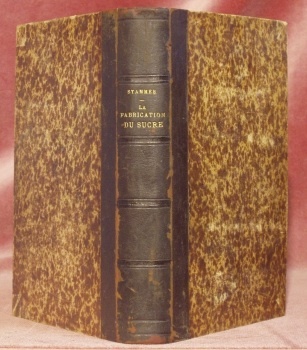
50467Paris, Librairie Scientifique Industrielle et Agricole Eugène Lacroix 1875, 250x155mm, VII- 495 + 111 + 95pages, demi-basane noire, titre au dos doré, déchirure de 3 cm sur la page de garde et de faux titre, autrement bon état.
178335045ABLeipzig, Johann Friedrich Junius, 1783-1786. Ca. 21 x 12,5 cm. XX S., 774 S., (22) Seiten; XXII S., (2) S., 800 S., (24) Seiten; (16) S., 830 S., (16) Seiten; XX S., 548 S., (20) Seiten. Halblederbände der Zeit mit Rückenschildern. 4 (von 5) Bände.
Book shows light wear only to oversize covers: two marks at spine on front cover, a little bit of corner wear, back upper corner is turned out slightly, covers show scuffing. Binding is solid and square, text/interior is clean and free of marking of any kind. 80 pages with usually four captioned b&w photos per oversize page, with chapter introductions, usually one page. Chapters include: Voyage of the North Star, Arrival of the Colonists, Drawing for the Land, Permanent program of construction, Colonial life, Farming, Personalities and personnel, Transient camp life. Signed by the author on the title page. Rare. In 1935, the Federal Emergency Relief Administration created an experimental farming community known as the Matanuska Valley Colony as part of the New Deal resettlement plan.[1] Situated in the Matanuska Valley, about 45 miles northeast of Anchorage, Alaska, the colony was settled by 203 families from Minnesota, Wisconsin and Michigan. The Matanuska Colony was part of Franklin D. Roosevelt's New Deal plan to help move the United States out of the Great Depression. It was one of many rural rehabilitation colonies to be established by the Federal Emergency Relief Administration (FERA). Others included Cherry Lake Farms in Florida, Dyess Colony in Arkansas, and the Pine Mountain Valley Rural Community in Georgia. In 1935, Americans in rural areas of northern states were among the worst sufferers of the Great Depression. In order to alleviate some of the pressures upon these areas, the FERA commissioned applicants from the northern states of Minnesota, Wisconsin, and Michigan to colonize a tract of land in the Territory of Alaska. The administration chose these three northern states because of their climate and belief that representatives would be well suited to survive harsh elements of subarctic winters. The hope was that the colony candidates would be good farmers with the necessary skills and hardiness required for self-sufficiency in the harsh Alaskan environment. Each family was to receive a 40-acre plot to turn into farmland. From conception to realization, the project progressed rapidly. A survey was made of the Matanuska Valley in June 1934 to ascertain its agricultural viability. Some of the information that would have proven to be useful in planning the colony was not even available until after colonization had begun. Nonetheless, the following January, FERA and Department of the Interior agreed to undertake the project. A few weeks later, 80,000 acres of land was set aside for the project and, by April, the first construction workers and colonists left for the valley. According to historian Orlando W. Miller, a total of 241,332 acres were initially set aside for the colony, with an additional 7,780 acres added later on to provide more continuity between the farms. After all, it was supposed to be a colony with startup assistance from the government. In effect, they wanted to keep the farms together in a single area as opposed to being spread out across the vast region reserved by President Roosevelt?s Executive Order 6957 of 4 February 1935. Colonists began to arrive to their new home in early May 1935. There was very little ready for them as far as housing and supplies. Colonists were forced to stay on the train until transient workers could complete their temporary tent housing. Plots of land were given out through a draw, with the majority of the plots still forested. The colonists quickly got to work clearing their land in order to comply with the government contracts they signed. The Alaska Rural Rehabilitation Corporation (ARRC) was the governing body of the colony. The ARRC regulated the commissary, what was planted, as well as the activities of the colonists. It was also in charge of removing colonists who did not continue to meet expectations. Colonists who were in poor health, broke major rules, or were bad farmers could be asked to leave. There were many major issues within this administration. Rules and regulations as well as administrators were constantly changing. Within a month of their arrival, the colonists were extremely unhappy with their conditions. Currently, the town of Palmer, Alaska, which descended from the Matanuska Valley colonists, is home to many of the children of the settlers. Some of the original structures from the colony, including a church and barn, have been moved to the Alaska State Fairgrounds. Other remnants of the colony include the lush crops of the valley. Although the colony was not a booming success, it did become stable enough to provide dairy and farming. It did not significantly increase the population of the area, but it did develop the Matanuska Valley as the primary agriculturally productive region within Alaska. During the latter part of the twentieth century, the Matanuska Valley saw continued success with dairies and farming for local consumption. However, a number of factors limited their commercial success. With the decline of air and refrigerated freight costs, milk and other dairy products from the Pacific Northwest could be obtained for less than locally produced products. In addition, as the population of Anchorage grew to make it the largest city in Alaska, residents began to look towards the Matanuska Valley to build homes. Farm land became more expensive and taxes increased. As a result, many farmers sold their land to developers. (from Wikipedia)
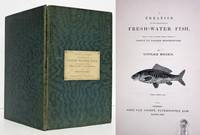
184117009London: John Vanvoorst. Very Good. 1841. First Edition. Hardcover. Clean green paper covered boards title label on front cover. Interior of text is tight clean & intact. No foxing. Spiegel or Mirror Carp wood-cut illustration on title page. Appendix containing 23 German Recipes for cooking fresh water fish. Building and stocking fish ponds. Prior owners book-plate. Lightly rubbed spine ends. Agriculture Pisciculture; Wood-cut; 8vo 8" - 9" tall; 38 pages . John Vanvoorst hardcover
3440Rome: FAO and UNEP 1978-1982. First edition. A fine set in near fine dust jackets. Pp. xxv 264 3; ix 151 2; x 504 1; x 541 3 numerous photos maps and diagrams. Publisher's original medium blue cloth lettered in light blue on the spines and front covers and with drawing of a whale tail on the front covers color pictorial dust jackets 4to. Volume I: Report of the FAO ACMRR Working Party on Marine Mammals; Volume II: Pinniped Species Summaries and Reports on Sirenians Volume III: General Papers and Large Cetaceans Volume IV: Small Cetaceans Seals and Otters. Small signature of original owner Brownell on the front endpapers. Rome: FAO and UNEP, 1978-1982. First edition hardcover
1965135912New York: Limited Editions Club 1965. Limited Edition Collectible . Slipcased Hard Cover. Good/No Jacket as Issued. 4to - over 9¾" - 12" tall. Robert Shore. Original boards. With an Introduction by Maxwell Geismar and paintings by Robert Shore. Printed for the members of THE LIMITED EDITIONS CLUB New York 1965. One of fifteen hundred copies signed by the illustrator of which this is number 1261. Designed by Eugene M. Ettenberg and printed by A. Colish in Mount Vernon New York. Pages are clean unmarked. Binding is tight and secure. Boards have slight rubbing to extremities. Housed in the original cloth slipcase. Slipcase is scuffed/sunned with rubbing to extremities. Nice copy and increasingly scarce. <br/> <br/> Limited Editions Club hardcover
191928895Mexico: Poder Ejecutivo Federal 1919. First edition. Hardcover. g. Quarto. 143 1pp. Original green morocco with gold lettering and decoration on front cover and spine. All edges gilt. Decorative endpapers. Printer's device on title page. Special Bulletin of the Ministry of Agriculture and Development profusely illustrated with numerous b/w photographic reproductions color or color-outlined maps charts plans mostly folding. Some age wear on binding with rubbing along edges and spine age-toned. Binding in overall good interior in very good condition. Poder Ejecutivo Federal hardcover
1818269155Hartford: Printed for Hudson and Co. and Cooke and Hale 1818. First American Edition. Full Leather. Very Good binding. An attractive copy of the First American Edition of this agricultural treastise by a prominent Scots politician and agricultural writer. With two plates of a Hereford Cow and a Hereford Bull and six additional plates. The front board of this mottled calf binding has been discreetly reattached; morocco title label to the spine. Shaw and Shoemaker 45720. Very Good binding. Printed for Hudson and Co. and Cooke and Hale unknown
1818269155Hartford: Printed for Hudson and Co. and Cooke and Hale 1818. First American Edition. Full Leather. Very Good binding. An attractive copy of the First American Edition of this agricultural treastise by a prominent Scots politician and agricultural writer. With two plates of a Hereford Cow and a Hereford Bull and six additional plates. The front board of this mottled calf binding has been discreetly reattached; morocco title label to the spine. Shaw and Shoemaker 45720. Very Good binding. Printed for Hudson and Co. and Cooke and Hale unknown books
190115022Chicago: The Union Stock Yard and Transit Company. Near Fine. 1901. First Edition; First Printing. Hardcover. Perhaps the slightest fading to the spine. ; 8vo 8" - 9" tall; 260 pages . The Union Stock Yard and Transit Company hardcover
1940af77Nantes (impression : impr. à Saint-Nazaire) Journal 1940 "Rare réunion de 2 années du Journal : La Terre nantaise organe hebdomadaire d'informations et de défense agricoles paraissant le samedi [""puis"" organe hebdomadaire de l'Union des syndicats agricoles de la Loire-Inférieure, de la Coopérative agricole de Nantes, de la Coopérative de Saint-Mars-la-Jaille et de la Coopérative vinicole de la région nantaise relié demi toile noire, 41,5 * 59,5, ensemble de numéros de la septième année comprenant du numéro 1 au numéro 24 fin de cette publication (les 4 et 5 sont en lambeaux (Du 3 janvier au 13 juin) puis le titre change ainsi que le format et devient le bulletin de l'union des syndicats agricole de la Loire-Inférieure et des régions limitrophes. Les numéros 1 à 20 sont sur un petit format et vont du 10 août au 21 décembre 1940 (Pendant juin et juillet et les mois suivants, il y a eu des problèmes important d'approvisionnement de papier en France). Puis le numéro 21 grand format conclus la première année de ce nouveau titre. La seconde année commance avec le numéro numéro 1 du 4 janvier 1941 au numéro 52 du 27 décembre 1941 ; mis à part les numéro 4 et 5 de 1940 qui sont en morceaux l'ensemble est en bon état. Livraison a domicile (La Poste) ou en Mondial Relay sur simple demande."
1845622518Magdeburg/ Halle, Baensch/ Buchh. d. Waisenh. 1845-93. Pp. u. Hlwd. Einige Rücken beschabt bzw. Ecken bestoßen; 26 Rücken beschäd.; 29 Bezugspapier beschäd. Bd. 34/35 in 1 Bd. gebunden.
18851166015London, Reeves and Turner, 1885. Gestoch. Porträt-Taf., 48, 406 S. u. 2 Bl., 409 S., 1 lithograph. Falttafel. Illustr. OLwdbde (Kapitale u. Ecken stärker bestoßen, Rücken v. Bd 1 am Gelenk mehrfach eingerissen, Gelenke gelockert, Portr.-Taf. lose).
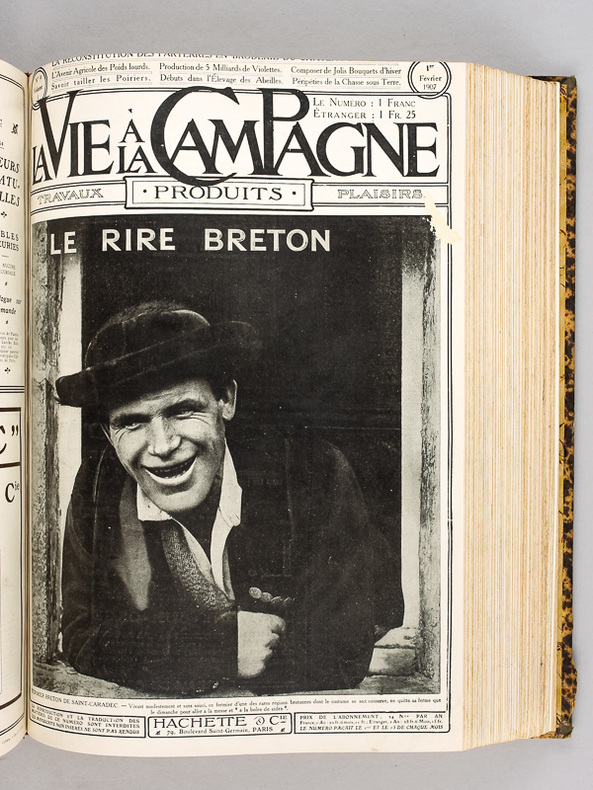
1906514651 vol. fort et grand in-4 reliure de l'époque demi-basane marron, Hachette & Cie, 1906-1917, 576 pp., réclames et 2 ff. de tables
1 vol. fort et grand in-4 reliure de l'époque demi-basane marron, Hachette & Cie, 1906-1917, 576 pp., réclames et 2 ff. de tables Exemplaire peu commun réunissant l'intégralité des 18 premiers numéros, complets de leurs couvertures. Cette célèbre revue traite naturellement de toutes les questions de culture et d'élevage, mais aussi beaucoup de la chasse. Bon état (qq. rares accrocs à qq. ff., dos lég. frotté avec petit pincement, bon exemplaire par ailleurs). Français
1895622762Berlin, Hertz, 1895. M. einigen Abb. Hlwd. M. Rsign. u. Rgoldpräg. Einbde. minimal berieben. St. verso Tit. Der Atlas zu Bd. 3 ist hier nicht vorhanden. (Wanderungen, Anbau u. Agrarrecht d. Völker Europas nördl. d. Alpen. Abt. 1/1-3).
184357325Publié d'après les ordres de M. le Ministre de l'Agriculture et du Commerce, 1 vol. in-8 cartonnage postérieur vert, couvertures conservées, Imprimerie Royale, Paris, 1843, 374 pp. avec carte dépliante (probablement en très bon fac-similé)
An investigation ordered by the French king into the causes of ergot on wheat. viii, 32 pages. Rebound
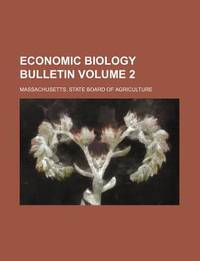
BN251253Rarebooksclub.com. Economic Biology Bulletin Volume 2 <br/><br/>Economic Biology Bulletin Volume 2 Massachusetts State Agriculture Rarebooksclub.com unknown
2019BN239024Forgotten Books 2019. 2019. Hardcover. Legislative History <br/><br/>Legislative History United States Department Of Agriculture Forgotten Books hardcover
2019BN246978Forgotten Books 2019. 2019. Softcover. Legislative History <br/><br/>Legislative History United States Department Of Agriculture Forgotten Books paperback