PITTA, Sebastiao da RochaBiblio.com
61 résultats
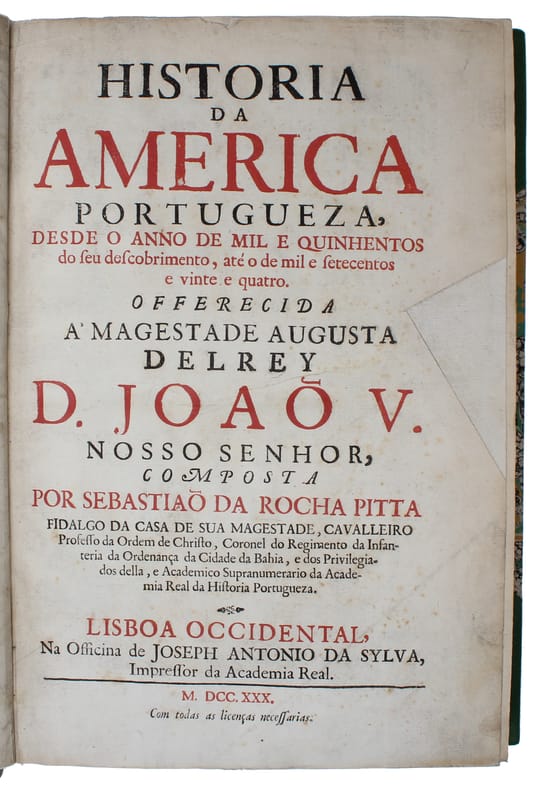
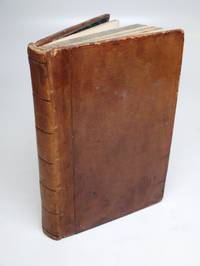
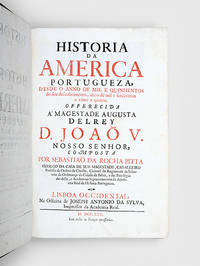
1730176140Lisbon: Joseph Antonio da Sylva Impressor da Academia Real 1730. The first history of Brazil First edition "much sought after by Brazilians" Borba de Moraes. Sebastiao da Rocha Pitta 1660-1738 was himself Brazilian having been born in Bahia. This is an attractive copy of this rare and important work in a carefully restored contemporary binding. The last copy to appear at auction was in 1985. "Though scornfully dismissed by Robert Southey as being 'a meagre and inaccurate work which has been accounted valuable merely because there is no other' the Historia does not deserve such censure. For all its Gongoric turgidity it contains some valuable and authentic information being on some points more fair-minded and accurate than Southey's better written but more prejudiced work" Boxer p. 160. Thomas Lindley writing in his Narrative of a Voyage to Brazil 1805 is less dismissive and certainly more specific in his criticisms describing Pitta as "an intelligent and well-informed Brazilian" who compiled his history "from the chronicles of the Jesuits and other authorities and some valuable local knowledge of his own. This work is copious in its details of the foundation of Brazil as a colony its successive governors its churches its monasteries and convents". However Lindley was less enthusiastic about Pitta's coverage of natural history manufacturing and commerce but the Historia is evidently more of an old-style chronicle than a practical up-to-the-minute guidebook. Lindley also remarks that the Portuguese government "publicly prohibited its being read under the severest penalties and it is now only met with carefully secluded in the cabinets of the curious". Quarto 295 x 197 mm pp. xxvi ii blank 716. Title printed in red and black woodcut headpieces; bound with the half-title and the integral blank before the main body of the text which are frequently lacking. Contemporary sprinkled sheep new dark red morocco label compartments gilt with scrolled foliate corner-pieces floral lozenge central tools edges sprinkled red and blue. Binding a little rubbed and worn in some places some stripping from the front cover. Judicious restoration to spine ends and joints expert repair to head of front board occasional professional paper repairs to margins. Short closed tear to half-title page pale tidemark in margin of last few leaves; overall a very good copy. Borba de Moraes 1983 II 678; Sabin 72300. C. R. Boxer The Golden Age of Brazil 1695-1750: Growing Pains of a Colonial Society 1962. unknown
173060026Lisboa Occidental, na Officina de Joseph Antonio da Sylva, 1730. Folio (29 x 195 mm). In recent green half calf with five raised bands and gilt lettering and ornamentation to spine. Title-page mounted and with repair to outer margin, no loss of text. Last leaf with repair to lower outer corner, also with no loss of text. First and least few leaves with brownspotting. Very light browning in margins throughout. Title printed in red and black, woodcut initials and head-pieces. A fine and clean copy. (14), 716 pp. (Here with the often missing half title, but wanting the final blank).
173060026Lisboa Occidental na Officina de Joseph Antonio da Sylva 1730. Folio 29 x 195 mm. In recent green half calf with five raised bands and gilt lettering and ornamentation to spine. Title-page mounted and with repair to outer margin no loss of text. Last leaf with repair to lower outer corner also with no loss of text. First and least few leaves with brownspotting. Very light browning in margins throughout. Title printed in red and black woodcut initials and head-pieces. A fine and clean copy. 14 716 pp. Here with the often missing half title but wanting the final blank. <br/><br/><em>Rare first edition here with the often missing half title of the first general history of Brazil – “This work is extremely copious in the details of its foundation as a colony its successive governors its churches its monasteries and convents†Sabin. "This first edition is becoming rare and is much sought after by Brazilians . since it is the first history of Brazil to have been printed and since it was written by a Brazilian" Borba de Moraes. The author's purpose was to narrate the events that had taken place in Brazil with the help of "truthful reports" these largely from Jesuit sources and "modern information" given by those who had traveled in the vast Brazilian territory. This was the only history of Brazil available to Pitta’s contemporaries since most of the others composed in the first two centuries of colonization remained in manuscript form until the nineteenth century. Rocha Pitta was born in Bahia in 1660 and died in the year 1738. At the age of 22 he left the University of Coimbra where he took his degree to return to Bahia where he got married. He made up his mind to write a history of Brazil and he spent years in collecting documents in the Monasteries of Brazil and Portugal where he went in order to study French Dutch and Italian for the purposes of his history. “In 1728 after 40 years of study he began to print his history which appeared in 1730. It was universally well received and King John V. appointed him a member of the household in consequence yet in a few years the Portuguese government publicly prohibited its being read under the severest penalties.†Sabin.Sabin 72300 Borba de Moraes 1983 p. 748 </em> hardcover
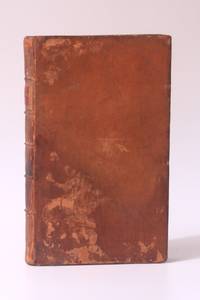
176611625Amsterdam and Paris: P.-F. Gueffier 1766. Contemporary cat’s paw sheep neatly restored slightly defective gilt spine and label red edges pink silk marker; interleaved throughout — a vertical crease divides the interleaves in two columns. <p>With: Jousse Daniel-Charles.       1742-1769.<br />        Lettre D’Un Orléanois…Sur La Nouvelle Histoire De L’Orléanois. Bruxelles and Paris E. Flon and J. Debure 1766. 12mo 173 x 110 mm. inlaid in blank quarto sheets for binding. 40p.</p> <br /> <p>      Ad I-II: This volume belonged to the local historian and Orléans Cathedral canon Louis-Eusèbe Loiseau 1721-95.<br />       Ad I: ALL PUBLISHED SUPPRESSED. Only Edition. Luchet believed “Good history is a long fable†p. iv tr. Immediately upon publication of this first volume of a projected five Luchet’s fanciful account of the history of Orléans and environs 52 B.C.E. to 1428 C.E. came under fire. He had manufactured personal information abandoned the facts cloven to the marvelous and doubted Jeanne d’Arc’s divine mission pp. 307-419. This last angered the clergy and THE DUC D’ORLÉANS FORCED THE AUTHOR TO BUY UP AND DESTROY THE EDITION.<br />       COUNTERING LUCHET’S FANTASIES LOISEAU COMPILED HIS OWN THIRTY THOUSAND WORD DOUBLE-COLUMN CHRONOLOGY filling 115 interleaf pages. Its preface summarizes Luchet’s History — “detestable in substance and form†tr. lists errors and sketches a damning biography of Luchet. One column of the manuscript chronology draws on Polluche’s Essais historiques sur Orléans 1778 and the other on articles in Calendrier historique d’Orléanois by the Orléans Maurist librarian Louis Fabre 1710-98.<br />       The longest and earliest inserted manuscript is A FIFTEEN-PAGE ESSAY UNFAVORABLE TO LUCHET’S HISTORY identifying still more inaccuracies nine concern Jeanne d’Arc. The Mémoire takes a statistical and economic perspective on Orléans its architecture and exports. Signed by Loiseau the Observations treats the by-laws of the new Orléans learned society born of the 1786 merger of two earlier groups. Loiseau was secretary of one for 25 years 1761-85.<br /> ¶Lanéry d’Arc Le Livre d’or de Jeanne d’Arc. Bibliographie 700; Lelong Bibliothèque historique de la France III: 35603-4; Brainne et al. Les Hommes illustres de l’Orléanais I: 250-2.<br />       Ad II: Only Edition the author’s sole book and the first published attack on Luchet’s History. Exposing 108 blunders with context and secondary source proof Jousse used material gathered by his father 1710-81 who supplied all the entries related to Orléans in Lelong’s Bibliothèque historique 1768-78.<br /> ¶Lanéry d’Arc 700; Lelong III: 35604; Conlon Le Siècle des Lumières 66:976.<br />       All items are in good condition.</p> P.-F. Gueffier unknown
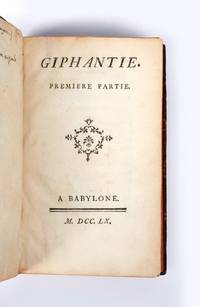
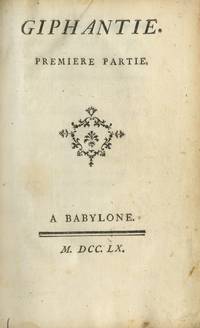
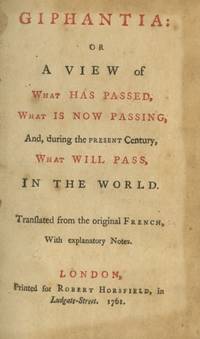
17603006485Babylone" in fact Paris: n.p. 1760. Octavo with four engraved plates by Cochin after Desfriches illustrating the second work "Mon Odyssée ou le Journal de Mon Retour de Saintonge"; contemporary mottled calfspine gilt with red label. <p><p>First edition: a marvellous imaginary work describing an utopian community and prefiguring the uses of photography television and the telephone.</p> <p>Tiphaigne de la Roche 1729-1774 was a physician polymath and much-published writer. In Giphantie an anagram of the author's name the protagonist is lifted semi-conscious and transported by air to a beautiful garden where a charming spirit guide shows him around a 'vaguely utopian society' Lewis. The book is a good example of the imaginary voyage genre using a quite plausible African setting but is more renowned for the fantastical series of technical advances that are discussed in striking detail including everything from prototype televisions to telephones. The discussion of the way in which the ruling spirits of the land have learnt to 'fix' the fleeting images formed by light is so detailed that the novel is considered a milestone in the pre-history of photography. A relevant passage in the subsequent English edition of 1761 is often quoted: 'You know that the rays of light reflected from different bodies form a picture and paint the image reflected on all polished surfaces for instance on the retina of the eye on water and on glass. The elementary spirits have sought to fix these fleeting images.'.</p> <p>This copy is bound together with Pierre Honoré Robbe de Beauveset's rococo poem in four verses Mon Odyssée ou le Journal de Mon Retour de Saintonge La Haye 1760 illustrated with four engraved plates. De Beauveset was an influential French writer known for his satires and erotic works.</p> </p> . n.p. unknown
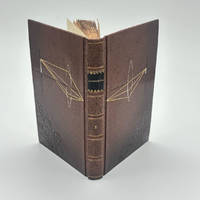
176188236London: Robert Horsfield 1761. First edition in English. Hardcover. 1761 First edition in English. 2 vols. 8vo. Main title printed in red & black part title with woodcut decoration. Uniformly bound by Glenn Malkin in modern speckled calf with geometric gilt design and blind-tooled roll & cogs decorations to covers spines with raised bands and gilt rules with contrasting leather title labels. Housed in leather-backed marbled board compartmentalised slipcase. A scarce imaginary voyage considered to be one of the earliest works of utopian science fiction. This work is also considered a cornerstone book in any collection of photographic literature and photography's first fictional work see Roosens & Salu <em>History of Photography</em> No. 10421. <br /><br />Originally published in France in 1760 as <em>Giphantie</em> an anagram of the author's name this work is credited with one of the earliest mentions of photography in Chapter 17: "That window that vast horizon those thick clouds that raging sea are all but a picture. Thou knowest that the ways of light reflected from different bodies make a picture and paint the bodies upon all polished surfaces on the retina of the eye for instance on water on glass. The elementary spirits have studied to fix these transient images; they have composed a most subtile matter very viscous and proper to harden and dry by the help of which a picture is made in the twinkle of an eye. the impression of the images is made the first instant they are received on the canvas which is immediately carried away into some dark place; an hour after the subtile matter dries and you have a picture so much the more valuable as it cannot be imitated by art nor damaged by time" pages 95-96.<br /><br />Glenn Malkin began binding professionally in 2008 and has since won numerous awards for his design bindings in national and international competitions. Some foxing and other marking all pages uncut; bindings and solander very good. ESTC T99917; Gernsheim History of Photography p. 26. No jacket Robert Horsfield hardcover
1760263025Babylon Paris 1760. First. hardcover. fine. Two parts in one volume. 16mo old calf later rebacked in leather; marbled end-leaves & edges. Babylon i.e. Paris 1760. First Edition. Fine.<br/> <br/> A fantasy voyage comparable to Gulliver's Travels and often considered an early work of science fiction predicting both photography and television. Early writing on the title page identifies the author as "M. Tiphaigne Medecin" and notes that the title is an anagram of his name.<br/> <br/> unknown
1760263025Babylon Paris 1760. First. hardcover. fine. Two parts in one volume. 16mo old calf later rebacked in leather; marbled end-leaves & edges. Babylon i.e. Paris 1760. First Edition. Fine.<br/><br/> A fantasy voyage comparable to Gulliver's Travels and often considered an early work of science fiction predicting both photography and television. Early writing on the title page identifies the author as "M. Tiphaigne Medecin" and notes that the title is an anagram of his name.<br/><br/> unknown books
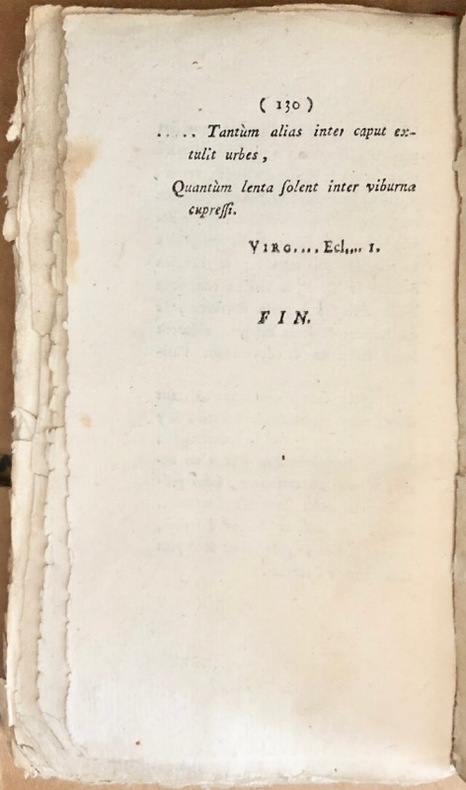
1761006246London: Robert Horsfield 1761. The title in French Giphantieis an anagram of the author's name. The book is compared with Swift's Gulliver's Travels and is considered to be an early work of science fiction. It is also held to be predictive of television and also the photographic process describing the "fixing" of an image as held by a mirror. This volume consists of the two parts of Giphantia bound together in one book each with seperate paginations and seperate title pages dated 1761 part 1 and 1760 part 2.Original full calf with five raised bands gilt decorated compartments and red title compartment with title in gilt spelled "Gibhantia". Marbled endpapers two blank leaves then the title page dated 1761 2 page dedication from the translator to Honourable Miss Ross then two page contents or "Table of Chapters. Then Giphantia part the first 130 pages. Then the title page to part 2 dated 1760 contents to part two 2 pages part two126 pages one page of publishers ads with the verso blank then two blank leaves. 4 X 6.5 inches approx.Overall the book is quite good with the outer hinges cracking boards holding well Intenally all complete and in good order and quite clean throughout with no foxing etc. First Edition. Full-Leather. Good/No Jacket. Robert Horsfield Hardcover
176052879Babylone Paris: n. p. 1760. First edition. 16mo. Part I 2 176 pp; Part II 2 174 pp. Contemporary full mottled calf with the spine in six gilt-decorated compartments; hinges partially cracked but firm; rubbing at the edges and chipping at the corners. Moderate foxing or soiling. A near very good copy. "In 1760 the French writer Charles François Tiphaigne de la Roche wrote a novel that today would be considered science fiction. Titled Giphantie an anagram of his name it describes his imaginary travels. He was lifted into the air and transported half unconscious to a beautiful garden in a strange land. There he met a Spirit who said 'I am the Prefect of this island which is called Giphantie.' With the Prefect as guide Tiphaigne explored the wonders of 'the island.'" In GIPHANTIA Chapter XVII Part I The author prophecies the fixing of transient images of nature by the action of light. "Thou knowest that the rays of light reflected from different bodies make a picture and paint the bodies upon all polished surfaces on the retina of the eye for instance on water on glass. The elementary spirits have studied to fix these transient images: they have composed a most subtle matter very viscous and proper to harden and dry by the help of which a picture is made in the twinkle of an eye. They do over this matter a piece of canvas and hold it before the objects they have in mind to paint. The first effect of the canvas is that of a mirror; there are seen upon it all the bodies far and near whose image the light can transmit. But what the glass cannot do the canvas by means of the viscous matter retains the images. The mirror shows the objects exactly; but keeps none; our canvases show them with the same exactness and retains them all. This impression of the images is made the first instant they are received on the canvas which is immediately carried away into some dark place; an hour after the subtle matter dries and you have a picture so much the more valuable as it cannot be imitated by art nor damaged by time." See PHOTOGRAPHY: ESSAYS & IMAGES 1980 edited by Beaumont Newhall p. 13-14.<br/><br/>This is considered a cornerstone book in any collection of photographic literature and photography's first fictional work.<br/><br/>The English edition of a year later is titled: GIPHANTIA: OR A VIEW OF WHAT HAS PASSED WHAT IS NOW PASSING AND DURING THE PRESENT CENTURY WHAT WILL PASS IN THE WORLD.<br/>Roosens and Salu No. 10421. <br/><br/> n. p. unknown books
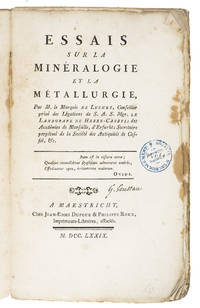
1779K89BNAR73VU7Maastricht 1779. 8vo 22.5 x 13.5 cm. J.E. Dufour & P. Roux Contemporary decorated paper wrappers. 3 parts in 1 volume. 4 XXVII 1 232 pp. Very rare first edition printed in Maastricht of a mining manual by a French enlightened marquis who worked as chief librarian at the Hessen-Kassel court of Friedrich II 1720-1785. Although mentioned reference literature the book is very rare on the market and we found no copy in auction records. Luchet was an acquaintance of Voltaire and in fact had a letter of recommendation from him that helped him obtain his position at the Hessen-Kassel court. Luchet's other writings concerned literature and theatre which makes this mining manual a curious standout. It is unclear why this work was printed in Maastricht except that the Maastricht south Limburg region does have a long history of mining. In a lengthy discourse on mining in the preliminaries Luchet makes a strong pro-mining statement. This is followed by reflections on several aspects of mining often in a question and answer form. He goes into the medical consequences of mining and names several minerals and metals such as coal quartz lead tin gold silver copper and more.A second edition appeared in 1797 often bound with H. Struve Methode analytique des fossils Lausanne 1797.Bookplate on front paste-down owner's name on title-page small stamp on title-page and pages 9 99 199 and 232. First few pages with marginal stains. Binding worn. Otherwise in good condition and wholly untrimmed.l Geology emerging 1404; Hoover 549; Wellcome III p. 451; Worldcat 3 copies; not in Margerie. unknown
176113462London: Printed for Robert Horsfield 1761. First English edition. 16mo. Part I 130 pp. dated 1761; Part II 126 pp. dated 1760 1 p. advert. Contemporary full calf with the spine expertly repaired; board edges are rubbed. Previous owner's name on endpaper few light pencil notations light foxing and offsetting to endpapers and tile page from the binder's glue. See PHOTOGRAPHY: ESSAYS & IMAGES 1980 edited by Beaumont Newhall p. 13-14 "In 1760 the French writer Charles François Tiphaigne de la Roche wrote a novel that today would be considered science fiction. Titled Giphantie an anagram of his name it describes his imaginary travels. He was lifted into the air and transported half unconscious to a beautiful garden in a strange land. There he met a Spirit who said 'I am the Prefect of this island which is called Giphantie.' With the Prefect as guide Tiphaigne explored the wonders of 'the island.'" In GIPHANTIA Chapter XVII Part I The author prophecies the fixing of transient images of nature by the action of light. "Thou knowest that the rays of light reflected from different bodies make a picture and paint the bodies upon all polished surfaces on the retina of the eye for instance on water on glass. The elementary spirits have studied to fix these transient images: they have composed a most subtle matter very viscous and proper to harden and dry by the help of which a picture is made in the twinkle of an eye. They do over this matter a piece of canvas and hold it before the objects they have in mind to paint. The first effect of the canvas is that of a mirror; there are seen upon it all the bodies far and near whose image the light can transmit. But what the glass cannot do the canvas by means of the viscous matter retains the images. The mirror shows the objects exactly; but keeps none; our canvases show them with the same exactness and retains them all. This impression of the images is made the first instant they are received on the canvas which is immediately carried away into some dark place; an hour after the subtle matter dries and you have a picture so much the more the valuable as it cannot be imitated by art nor damaged by time." This is considered a cornerstone book in any collection of photographic literature and photography's first fictional work.<br/><br/>Roosens and Salu No. 10421. <br/><br/> Printed for Robert Horsfield unknown books
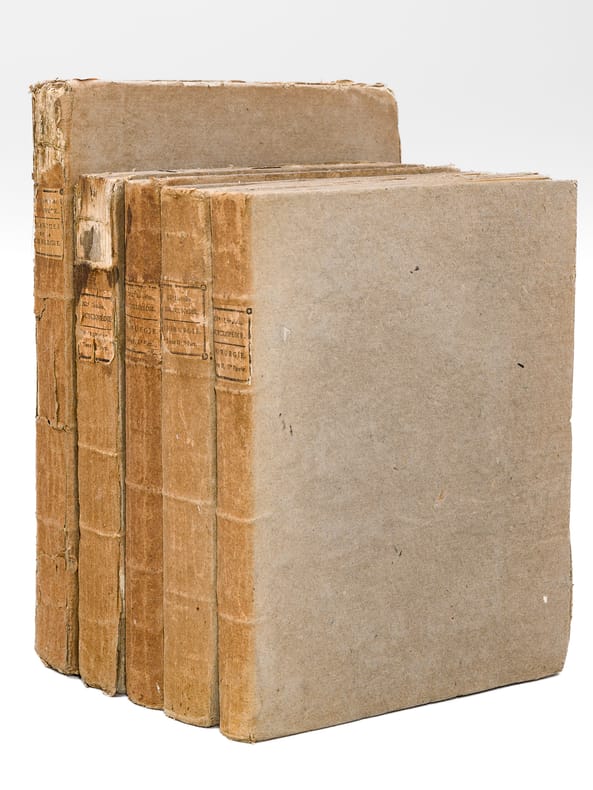
1790671515 vol. à savoir 2 tomes en 4 vol. in-4 cartonnage d'origine, Chez Panckoucke, à Paris, 1790 et 1792, 2 ff., 376 pp. ; pp. 377-712 ; 2 ff., 400 pp. ; pp. 401-566 et 144 pp. et 1 vol. in-folio cartonnage d'origine, Chez Agasse, Paris, An VII [ 1798 - 1799 ], 1 f. et 112 planches hors texte (dont 3 doubles)
176110491Dublin: G. Faulkner. Dublin G. Faulkner 1761. First edition first impression. Hardback. A good copy. First Dublin edition. An imaginary voyage ala Gulliver and a taproot for science fiction proto sf if you like. An important work presaging television and still photography in a manner; as important to the history of photography as to science fiction. An important book. There was a London edition too dated 1761 on the first part's title page and 1760 on the second part. The Dublin issue has 1761 on both title pages. That doesn't tell us much about which precedes. Contemporary calf heavily rubbed and worn. The endpaper has an inkstain with a collector's plate to the front pastedown. Prelims have some waterstaining but not too bad similar to the last few leaves. A nice copy overall. 10491 Hyraxia Books. . Good. Hardback. 1st Edition. 1761. G. Faulkner hardcover
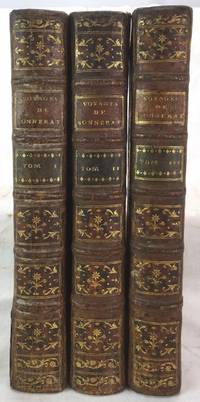
17821611170007A Paris chez l'auteur rue S. Andre-des-Arts vis-a-vis la rue de l'Eperon maison de M. Menissier marchand d'etoffes de soie. Froule libraire pont Notre-Dame. Nyon rue du Jardinet. Barrois le jeune rue du Hurepoix. M. DCC. LXXXII. Avec approbation et privilege du Roi 1782-01-01. Hardcover. Good. 3 tomes. 2nd ed. Octavo. XXII-340 p. 1 folding map 1 folding plate; 6-376 p. 2 folding plates; 6-362 p. 3 folding plates. Complete with 7 total folding plates. Bound in contemporary French mottled calf. Solid bindings. Gilt stamped spines. 5 raised bands. All edges red. Marbled end pages. Scattered minor dampstaining. Cordier Sinica 2102; Hill 578; Nissen IVB 886; Pritzel 8774. Lowendahl 631; Western Travellers in China 45. Engraved by Poissin. <br> "The French naturalist and explorer Pierre Sonnerat 1748-1814 was the nephew of the botanist Pierre Poivre. He made several voyages to Southeast Asia visiting the Philippines and Moluccas between 1769 and 1722 and India and China from 1744 to 1781. His work is considered a classic of natural history and discoveries in the Far East" Western Travellers in China. <br> <br> Full title: Voyage aux Indes Orientales et a la Chine: fait par ordre du roi depuis 1774 jusqu'en 1781. Dans lequel on traite des moeurs de la religion des sciences & des arts des Indiens des Chinois des Pegouins & des Madegasses; suivi d'observations sur le cap de Bonne-Esperance les isles de France & de Bourbon les Maldives Ceylan Malacca les Philippines & les Moluques & de recherches sur l'histoire naturelle de ces pays. <br> This is an oversized or heavy book that requires additional postage for international delivery outside the US. A Paris, chez l'auteur, rue S. Andre-des-Arts, vis-a-vis la rue de l'Eperon, maison de M. Menissier, marchand d'etof hardcover
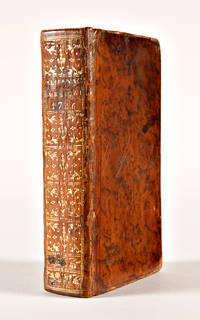
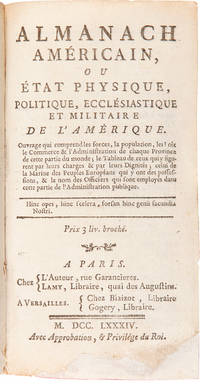
1786WRCAM31033Paris 1786. 4386683pp. 12mo. Contemporary mottled calf spine gilt. Hinges expertly repaired. Internally tight and very good. A long and comprehensive French-language almanac of America Asia and Africa and the European colonies there. Of special interest are several lists giving the names of the colonial administrators and military officers of numerous French colonies in the Caribbean and South America. Also included in this edition is the text of Poncelin's RECUEIL DIPLOMATIQUE. which collects laws and arrets pertaining to European colonies in the Americas. "It appears by a note on the back of the title that this work was edited by M. Poncelin de la Roche-Tillac sic. It was continued annually" - Sabin 1783 edition. Sabin notes that he saw none dated later than 1787 but that it may have been continued until 1791. OCLC locates only two copies of this edition both in French institutions and Echeverria and Wilkie add only the British Library and John Carter Brown Library. Scarce. BEINECKE LESSER ANTILLES COLLECTION 370. ECHEVERRIA & WILKIE 786/54. SABIN 941 note. CIORANESCU XVIII 50984. OCLC 25612843. unknown books
179929728AB1799. Second Edition. Two Volumes complete set. Dublin Printed by William Porter 1799. Small-Octavo 115 cm x 175 cm. Volume I: 269 pages / Volume II: 326 of 329 pages 3 pages missing at the end. Hardcover / Modern very decorative half-leather bindings with replicated spinelabels in the style of the 18th century. Both Volumes in protective Mylar and now housed in a bespoke Solander Box. Name of Richard Meade of Ballymartle on titlepage of both Volumes. Minor lesion and tear to titlepage of Volume II. Overall very good ! Extremely scarce publication in first or second edition ! Regina Maria Roche 17641845 is gauged as a minor Gothic novelist who wrote in the shadow of the pioneering Ann Radcliffe. However she was a bestselling author in her own time. The popularity of her third novel The Children of the Abbey rivalled that of Ann Radcliffe's The Mysteries of Udolpho. Born Regina Maria Dalton in Waterford Ireland in 1764. Her father was a Captain in the British 40th Regiment. Her family moved to Dublin and after her marriage to Ambrose Roche in 1794 she moved to England. Her first two novels were published under her maiden name before the success of The Children of the Abbey and Clermont. Both these were translated into French and Spanish and went through several editions. However after her fifth novel The Nocturnal Visit appeared in 1800 Roche suffered financial difficulties having fallen afoul of a duplicitous solicitor and she did not write again until 1807 when she received aid from the Royal Literary Fund. She then wrote 11 more novels most of them set in the rural Ireland but none matched her earlier successes. After her husband's death in 1829 she returned to Wexford. After bouts of depression she died in relative obscurity in the town of her birth at the age of 81. Roche's obituary in The Gentleman's Magazine remembers her as a "distinguished writer who had retired from the world and the world had forgotten her. But many young hearts now old must remember the effect upon them of her graceful and touching compositions." The Children of the Abbey a sentimental Gothic Romance was one of the period's most popular novels of the 1790s. Her book Clermont was Roche's only full attempt at writing a truly Gothic novel. It has a decidedly darker in tone than anything else she wrote. Both novels went through several editions and were translated into both French and Spanish. Clermont was one of the Northanger Horrid Novels satirized by Jane Austen in her novel Northanger Abbey. Wikipedia hardcover
178017626Amsterdam et Paris, Nyon, 1780 ; in-8, broché ; 52 pp. , 3 pp. d'Explication des planches, 2 planches hors-texte gravées sur cuivre et couverture.
17898436Imprimerie Impériale / Chez Pillet / Delaunay / J.C. Cotta / Poussielgue / Asselin / Gaultier - Laguionie 13 x 20,5 1789 Petit in-8, reliure à la bradel pleine toile bleue moderne, titre "France 1789-1815" doré au dos, réunissant 8 pièces rares, parues entre 1789 et 1840, concernant l'histoire de la période qui s'étend de 1789 à 1815. I./ La galerie des Etats-Généraux, 1789, 204-[1] pp. Ecrit à plusieurs mains (Luchet, Mirabeau ?), la "Galerie" est une succession de portraits (31) satiriques des hommes de 1789, de Narsès (Necker) à (Francus l'archevêque de Vienne/Lefranc de Pompignan, affublé chacun d'un nom codé, dont la clé figure sur la dernière page. L'ensemble compte 3 volumes, il s'agit ici du seul premier volume. II. Notice abrégée sur la vie, le caractère et les crimes des principaux assassins aux gages de l'Angleterre qui sont aujourd'hui traduit devant le Tribunal de la Seine, Paris, Imprimerie Impériale, An XII, 1804, 72 pp. Notice à charge, attribuée à l'agent de Napoléon Roques de Montgaillard, qui dresse la biographie des hommes autour de Cadoudal qui fomentèrent le complot de 1804. III. Procès de M. Marie Chamans de Lavalette, accusé de complicité dans l'attentat qui a ramené l'usurpateur en France et condamné à mort le 21 novembre à la peine de mort, précédé d'une notice historique sur la carrière civile et militaire de M. de Lavalette, Paris, chez Pillet, 1815, 50 p. IV. Mémoire de M. le Maréchal Masséna duc de Rivoli, prince d'Essling, sur les événements qui ont eu lieu en Provence, pendant les mois de mars et d'avril 1815, suivi de pièce justificatives et d'une carte géographique, Deuxième édition; Paris, Delaunay, 1816, 89 pp. Réponse du maréchal d'Empire (1758-1817) aux accusations des Ultras de ne pas avoir voulu arrêter Bonaparte à son retour lors de sa traversée de la Provence en mars 1815. V. Projet de pétition au Parlement d'Angleterre par le comte de Las Cases, Stuttgart, dans la librairie de J.G. Cotta, 1818, 51 pp. Page de titre en allemand également (Entwurf einer Bittschrift an das brittische Parlament vom Grafen de Las Cases) et texte allemand et traduction française page à page. Après Waterloo, Las Cases (1766-1842) accompagne Napoléon à Sainte-Hélène. Pétition que Las Cases aurait transmise lors de son arrivée au Cap de Bonne Espérance, après avoir laissé Napoléon à Longwood. VI. Appel à tous les Français contre les calomnies par lesquelles on a cherché à flétrir la conduite du comte de Bourmont en 1815, Paris, Imprimerie de Poussielgue, 1840, 40 pp. Plaidoyer de Charles de Bourmont lors du retour d'exil de son père le maréchal d'Empire. VII. Documents inédits sur la campagne de 1815 publiés par le duc d'Elchingen, Paris, 1840, Asselin - Laguionie, 87 pp. Défense de la mémoire de Ney maréchal d'Empire, par son fils Michel Ney (1804-1854), duc d'Elchingen, qui avait réuni d'importants documents sur la bataille de Waterloo et sur le rôle joué par son père. Mais carte dépliante absente. Ce texte est suivi par une note du général Jomini (pp. 265-280), adressée à Michel Ney en septembre 1841. VIII. Relation de la campagne de 1815, dite de Waterloo, pour servir à l'histoire du maréchal Ney, par le colonel Heymès, son premier aide de camp, témoin oculaire, Paris, imprimerie de Gaultier-Laguionie, Paris 1829. Exemplaire de bibliothèque avec ses cotes au dos, très bon état de cet ensemble de pièces peu fréquentes. Ex-libris gravé sur le premier contre plat du collectionneur et prêtre californien Joseph M. Gleason (1869-1942) et petit ex-libris récent.(B56). PHOTOS NUMERIQUES DISPONIBLES PAR EMAIL SUR SIMPLE DEMANDE-DIGITAL PHOTOGRAPS MAY BE AVAILABLE ON REQUEST
17898436Imprimerie Impériale / Chez Pillet / Delaunay / J.C. Cotta / Poussielgue / Asselin / Gaultier - Laguionie 13 x 20,5 1789 Petit in-8, reliure à la bradel pleine toile bleue moderne, titre "France 1789-1815" doré au dos, réunissant 8 pièces rares, parues entre 1789 et 1840, concernant l'histoire de la période qui s'étend de 1789 à 1815. I./ La galerie des Etats-Généraux, 1789, 204-[1] pp. Ecrit à plusieurs mains (Luchet, Mirabeau ?), la "Galerie" est une succession de portraits (31) satiriques des hommes de 1789, de Narsès (Necker) à (Francus l'archevêque de Vienne/Lefranc de Pompignan, affublé chacun d'un nom codé, dont la clé figure sur la dernière page. L'ensemble compte 3 volumes, il s'agit ici du seul premier volume. II. Notice abrégée sur la vie, le caractère et les crimes des principaux assassins aux gages de l'Angleterre qui sont aujourd'hui traduit devant le Tribunal de la Seine, Paris, Imprimerie Impériale, An XII, 1804, 72 pp. Notice à charge, attribuée à l'agent de Napoléon Roques de Montgaillard, qui dresse la biographie des hommes autour de Cadoudal qui fomentèrent le complot de 1804. III. Procès de M. Marie Chamans de Lavalette, accusé de complicité dans l'attentat qui a ramené l'usurpateur en France et condamné à mort le 21 novembre à la peine de mort, précédé d'une notice historique sur la carrière civile et militaire de M. de Lavalette, Paris, chez Pillet, 1815, 50 p. IV. Mémoire de M. le Maréchal Masséna duc de Rivoli, prince d'Essling, sur les événements qui ont eu lieu en Provence, pendant les mois de mars et d'avril 1815, suivi de pièce justificatives et d'une carte géographique, Deuxième édition; Paris, Delaunay, 1816, 89 pp. Réponse du maréchal d'Empire (1758-1817) aux accusations des Ultras de ne pas avoir voulu arrêter Bonaparte à son retour lors de sa traversée de la Provence en mars 1815. V. Projet de pétition au Parlement d'Angleterre par le comte de Las Cases, Stuttgart, dans la librairie de J.G. Cotta, 1818, 51 pp. Page de titre en allemand également (Entwurf einer Bittschrift an das brittische Parlament vom Grafen de Las Cases) et texte allemand et traduction française page à page. Après Waterloo, Las Cases (1766-1842) accompagne Napoléon à Sainte-Hélène. Pétition que Las Cases aurait transmise lors de son arrivée au Cap de Bonne Espérance, après avoir laissé Napoléon à Longwood. VI. Appel à tous les Français contre les calomnies par lesquelles on a cherché à flétrir la conduite du comte de Bourmont en 1815, Paris, Imprimerie de Poussielgue, 1840, 40 pp. Plaidoyer de Charles de Bourmont lors du retour d'exil de son père le maréchal d'Empire. VII. Documents inédits sur la campagne de 1815 publiés par le duc d'Elchingen, Paris, 1840, Asselin - Laguionie, 87 pp. Défense de la mémoire de Ney maréchal d'Empire, par son fils Michel Ney (1804-1854), duc d'Elchingen, qui avait réuni d'importants documents sur la bataille de Waterloo et sur le rôle joué par son père. Mais carte dépliante absente. Ce texte est suivi par une note du général Jomini (pp. 265-280), adressée à Michel Ney en septembre 1841. VIII. Relation de la campagne de 1815, dite de Waterloo, pour servir à l'histoire du maréchal Ney, par le colonel Heymès, son premier aide de camp, témoin oculaire, Paris, imprimerie de Gaultier-Laguionie, Paris 1829. Exemplaire de bibliothèque avec ses cotes au dos, très bon état de cet ensemble de pièces peu fréquentes. Ex-libris gravé sur le premier contre plat du collectionneur et prêtre californien Joseph M. Gleason (1869-1942) et petit ex-libris récent.(B56). PHOTOS NUMERIQUES DISPONIBLES PAR EMAIL SUR SIMPLE DEMANDE-DIGITAL PHOTOGRAPS MAY BE AVAILABLE ON REQUEST
1784WRCAM51647Paris 1784. 25111pp. 12mo. Contemporary mottled calf spine gilt rebacked with original spine laid down all edges stained red. Bookplate on front pastedown. Light tanning otherwise internally tight and very good. A long and comprehensive French language almanac of the Americas Africa Asia and the European colonies there expanded from previous editions. Of special interest are several lists giving the names of the colonial administrators and military officers of numerous French colonies in the Caribbean and South America. Also contains a description of each American state as well as lists of military officers and members of Congress. Writing of the 1783 edition Sabin says "It appears by a note on the back of the title that this work was edited by M. Poncelin de la Roche-Tillac sic. It was continued annually." He also notes notes that he saw none dated later than 1787 but that it may have been continued until 1791. Poncelin de la Roche-Tilhac 1746-1828 was a French lawyer and counsel for the French admirality who maintained correspondence with several important American figures including Benjamin Franklin. BEINECKE LESSER ANTILLES COLLECTION 358. ECHEVERRIA & WILKIE 784/83. SABIN 941 note. CIORANESCU XVIII 50984. unknown books
1759262724Amsterdam: Arkstee & Merkus 1759. hardcover. very good. 2 parts bound in 1 volume 2 paginations xii 244 iv 294pp. Copperplate frontispiece with astrological globe.Part I Visions of Ibraim Arab Philposopher; Part II Travel to Limbo. 12mo full contemporary calf gilt spine chipped at the top front hinge dry. Amsterdam & Aleipssick: Arkstee & Merkus 1759. First Edition. Very good .<br/> <br/> The text highlights the interest in the occultist and naturalist in the second half of the 18th century and the authors interest in the Kabbalah and hermeticism. Bookplate and small neat handwriting on fly-leaf.<br/> <br/> Arkstee & Merkus unknown
1759262724Amsterdam: Arkstee & Merkus 1759. hardcover. very good. 2 parts bound in 1 volume 2 paginations xii 244 iv 294pp. Copperplate frontispiece with astrological globe.Part I Visions of Ibraim Arab Philposopher; Part II Travel to Limbo. 12mo full contemporary calf gilt spine chipped at the top front hinge dry. Amsterdam & Aleipssick: Arkstee & Merkus 1759. First Edition. Very good .<br/><br/> The text highlights the interest in the occultist and naturalist in the second half of the 18th century and the authors interest in the Kabbalah and hermeticism. Bookplate and small neat handwriting on fly-leaf.<br/><br/> Arkstee & Merkus unknown books
176015332A Paris, Chez Claude-Jean-Baptiste Bauche, 1760. In-8 de (4)-IV-300-(4) pp., veau marbré, dos orné à nerfs, pièce de titre en maroquin havane, tranches rouges (reliure de l'époque).
17895941Sans lieu, , 1789. 2 tomes de VIII-130-(2) pp. (2)-172-(4) pp.La Galerie des Dames françaises, pour servir de suite à la Galerie des Etats-Généraux, par le même auteur. A Londres, 1790. 207-(2) pp.Ensemble 3 tomes en 2 vol. in-8, demi-basane havane à coins, dos orné à nerfs, tranches rouges (reliure de l'époque).