29 résultats
1796WRCLIT66869London: Printed for G. G. and J. Robinsons and J. Cottel Bookseller Bristol 1796. xvi1884pp. Small octavo. Full crimson morocco by Bedford raised bands spine gilt extra gilt inner dentelles t.e.g. others largely untrimmed. Near fine with the half-title errata and advert leaf. First edition of Coleridge's first published collection of poetry preceded by the rare verse-play THE FALL OF ROBESPIERRE several prose tracts and THE WATCHMAN. Although their presence is not noted on the title four of the sonnets are by Lamb and are signed at their conclusion "C.L." They constitute his first publication in book form. HAYWARD 206. WISE COLERIDGE 8. TINKER 678. ESTC T125613. NCBEL III:215. LIVINGSTON LAMB pp.3-10. Printed for G. G. and J. Robinsons, and J. Cottel, Bookseller, Bristol hardcover books
17109656London: Printed for Abel Roper and sold by John Morphew near Stationer's Hall 1710. Octavo 19 x 12 cm. 12 127 12 12 pages. 35 plates mostly folding. The final unnumbered pages include bills of fare and bookseller's advertisements. All edges marbled. FIRST EDITION published a year after the great chef's death. Maclean describes an additional printing of the first edition printed for and sold by Maurice Atkins. "Lamb brought a touch of French snobbery to traditional English recipes for an increasingly prosperous group of wealthy merchants urban professionals and rural gentry. His recipes show a preference for French-style stewed and braised dishes over the boiled staples of seventeenth century England" Anne Willan The Cook Book Library page 197. As cook to five kings and queens of England "few others could possibly afford to emulate the vast spreads of exotic and costly foods which Lamb so often called for in his book of Royal recipes." Eric Quayle Old Cook Books. ~ Internally sound pages a bit darkened throughout. Some plates with browning to some creases or with an early and neat reinforcement at creases. In later full brown calf blind- and gilt-paneled and compartmented with gilt-titled red morroco spine label. New endpapers. Binder's ticket of Period Binders of Bath England pasted-in at rear. OCLC records eighteen copies of this Roper printing and five of the Atkins printing; Bitting page 271 calling for 34 plates only; Cagle 809; Maclean page 88; Pennell page 144; Simon 939 the third edition of 1731; Vicaire page 490; ESTC T91554. Printed for Abel Roper and sold by John Morphew, near Stationer's Hall unknown
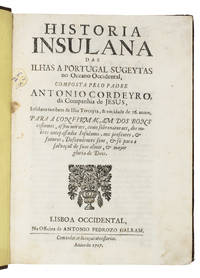
1717ABC_48313Lisboa occidental 1717. Small folio ca. 28 x 21 cm. Na officina de Antonio Pedrozo Galram Gold-tooled brown calf from the first half of the 19th century with the title and year of publication lettered in gold on the spine red pseudo-marbled paper sides yellow end papers. With a woodcut printer's device on the title-page woodcut decorated initials and woodcut head- and tailpieces. 1 1 blank 14 528 pp. First edition of a history of the collection of four archipelagos in the North Atlantic off the coasts of Africa and Europe called Macaronesia and the Azores in particular written by a native of Terceira. The work describes each island separately focussing on its history discovery natural resources and inhabitants. It also gives important information on prominent Azorean families including the author's own. These parts are preceded by shorter parts about the history of Portugal the Canaries Cape Verde and Madeira with references to Brazil and the Americas. This work rarely appears on the market.Antonio Cordeiro 1641-1722 was a Jesuit priest born on Terceira. He based his work on one of the most important pre 17th-century sources on Macaronesia Saudades da terra by historian Gaspar Frutoso ca. 1522-1591. Until its publication the manuscript was kept in the library of the Jesuit College of Ponta Delgada on the island São Miguel in the Azores where Cordeiro probably found it. Cordeiro's work closely follows the structure of the Saudades. Furthermore he used is as a main source for the 16th-century history of the region including the description of the sugarcane industry in Madeira. After sugarcane was introduced there in the 1430s Madeira soon became the most important location for the production of sugar for the Portuguese producing 20000 arrobas a unit of measure similar to 10-15 kg's of the finest grade sugar per year. Unfortunately due to diseases in the sugarcane crops the industry started to decline in the second half of the 16th century. Initially neighbouring islands took over before the production of sugar was eventually moved to Brazil.With a manuscript number on the front pastedown "6770" a round sticker underneath "66" and remnants of a paper label. The edges and corners of the boards are somewhat scuffed and creased. The binding is somewhat scratched with some loss of material on the back board. The first few leaves are slightly browned. Otherwise in very good condition.l De Backer/Sommervogel II 1436; Innocencio I pp. 114; Leclerc 632; Porbase 765570 10 copies; Sabin 16759; Schäffer Portuguese exploration to the West p. 14; not in USTC. ABE CAT Anthropology & Ethnography hardcover
17102092902141700914Not Available 1710. Soft Cover. Fine. Volume: 1 Not Available paperback