POLI Giuseppe SaverioMareMagnum

2 012 résultats
In folio max. (mm. 495x330), 2 volumi, p. pergamena coeva (picc. restauri), fregi e tit. oro su due tasselli al dorso, stemma reale impresso in oro su tassello ai piatti. Il primo volume, 3 cc.nn., X,90,50 pp., 1 c.nn., 74 pp., 1 c.nn., LXXIII pp. (Indici e spiegazione succinta delle tavole, in italiano e in francese) // Il secondo, 1 c.nn., da 75 a 264, LXXVI pp. (Indici e spiegazione succinta delle tavole, in italiano e in francese); ornati da alcune pregevoli testate incise, per lo più di vedute. L’opera è illustrata da complessive 78 bellissime tavole, ciasc. con numerose figure di molluschi bivalvi e multivalvi: 39 sono a contorno e 39 in finissimo chiaro-scuro. Sono incise in rame da Brun, Scarpati, Ottaviano, Zaballi e Cesarano, su disegni di Morelli, Lo Manto, Casanova, Cava, Navarra e La Vega. Al ns. esempl. manca il terzo volume che apparve, trent’anni dopo, sotto la cura di Stefano delle Chiaje in 2 parti (1826-27), con 36 tavole di illustrazioni, ed è dedicato ai gasteropodi, ai cefalopodi e agli scafopodi. "Edizione originale". di questo celebrato studio sui molluschi e sulle conchiglie siciliani. Cfr. Caprotti “L’illustrazione malacologica”, p. 56: “Si tratta di una importantissima opera in 3 parti.. E’ l’opera malacologica italiana più importante della seconda metà del ‘700. E’ inoltre un capolavoro d’arte grafica” - Brooks,426: “Opera classica nel suo genere che è difficile trovarsi completa - Nissen,3213 - Cat. British Library,III, p. 1592 - Brunet,IV,777. Primo vol.: solo lievi picc. aloni su 6 cc. e qualche traccia d’uso altrimenti fresco e ben conservato. Secondo vol.: 1 c. (pp. LXI / LXII), mancante, è stata anticamente trascritta a mano in modo perfetto, 2 tavv. restaur. per strappo, altrimenti buon esemplare. "Giuseppe Saverio POLI (Molfetta 1746 - Napoli 1825), medico e naturalista, prof. di fisica al Collegio medico degli Incurabili a Napoli. Viaggiò in diversi paesi d’Europa e raccolse materiale naturalistico costituendo un museo. Pubblicò varie memorie di fisica, meteorologia, geologia e zoologia, ma rese particolari servizi alla zoologia con la sua descrizione dei Testacei delle Due Sicilie, che contiene preziosi contributi alla faunistica e all’anatomia comparata”". Così Diz. Treccani,IX, p. 560.
In-folio, Serie di tavole incise e colorate a mano (numerate 1-30, 23x18,5 firmate da Geve, per un totale di 362 illustrazioni di conchiglie) già facenti parte dell’opera di Nicolaus G. Geve e Johann D. Schultze, Belustigung im Reiche der Natur, Amburgo, Herold, 1790. Legatura in mezza pergamena. Le tavole XIX, XXIV, XXIX portano la nota incisa del nome del sovvenzionatore dell’incisione stessa. Nicolaus Georg Geve (1712-1789) pittore ed illustratore danese, studiò a Copenhagen sotto la direzione del pittore ufficiale di corte Johann Salomon Wahl. Johannes Dominicus Schultze (1751-1790) dottore e naturalista tedesco, portò a termine l’opera di Geve appena prima della morte. In folio, Series of copper engraved and hand colored plates (numbered 1-30, 23x18.5 signed by Geve, for a total of 362 shell illustrations) formerly part of the work of Nicolaus G. Geve and Johann D. Schultze, Belustigung im Reiche der Natur, Herold, 1790. Half calf binding. Plates XIX, XXIV, XXIX bear the note of the name of the donor of the engraving itself. Nicolaus Georg Geve (1712-1789) Danish painter and illustrator, studied in Copenhagen under the direction of the official court painter Johann Salomon Wahl. Johannes Dominicus Schultze (1751-1790) German doctor and naturalist, completed Geve's work just before his death.
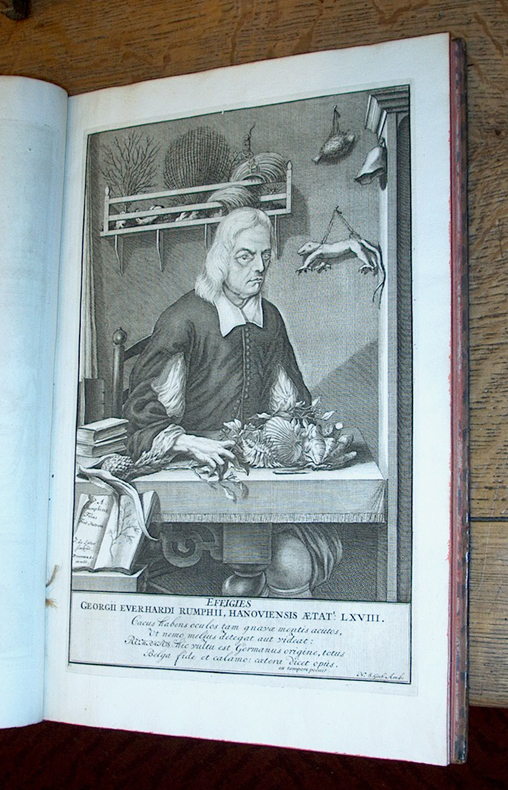
1711002657Lugduni Batavorum (Leide, Leyde), Apud Petrum Van der Aa, Bibliopolam, 1711 In-folio (41 x 27 cm), (1) ff., 15 pp., (8) pp., veau marbré, dos à six nerfs orné, pièce de titre de maroquin rouge, triple filet à froid entourant les plats, double filet doré sur les coupes, tranches rouges (reliure d'époque). Illustré d'un frontispice, un portrait de l'auteur, 1 vignette de titre, 4 vignettes dans le texte, et 60 planches gravées. Première édition en latin du "Cabinet des raretés de l'île d'Amboine" (Amboinsche Rariteitkamer), publié en hollandais en 1705 ; l'auteur, atteint de cécité, est ici représenté dans son cabinet. Précieux exemplaire provenant de la famille de Charles de MONTESQUIEU, de la bibliothèque du Château de la Brède, avec l'ex-libris des Secondat, barons de la Brède et de Montesquieu, "Virtutem Fortuna Secondat, Ex Bibliotheca Bredanense", et les initiales C. M. à l'encre. Bel exemplaire. // Folio (41 x 27 cm), (1) ff., 15 pp., (8) pp., marbled calf, spine tooled raised on six bands, red morocco title label, triple blind fillet borders on covers, double gilt fillet on turns-in, red edges (contemporary binding). Illustrated with a frontispiece, a portrait of the author, 1 vignette on title, 4 vignettes in the text, and 60 engraved plates. First edition in latin of the "Ambonese Curiosity Cabinet" (Amboinsche Rariteitkamer), first published in german in 1705 ; the author, blind, is here depicted in his office. Precious copy from Charles de MONTESQUIEU family, from the "Château de la Brède" library, with the book-plate of the Secondat, barons de la Brède et de Montesquieu "Virtutem Fortuna Secondat , Ex Bibliotheca Bredanense", and initials C. M. hand-written. Fine copy (Nissen ZBI 3520)
In 8, cm 16 x 22, pp. (16) + 270 + (10) + (2) con 2 antiporte incise e ripiegate, 3 frontespizi incisi (1 per ogni classe di conchiglie), 7 tavole fuori testo presenti nella prima parte del testo (alcune stampate su foglio in formato ridotto), 134 tavole fuori testo (407 conchiglie e 5 composizioni antropomorfe realizzate con conchiglie ed elementi naturali). Restauro al margine superiore di 2 cc. e rifilatura al margine esterno della seconda antiporta. Ottimo esemplare. Piena pergamena settecentesca. Ex libri al contropiatto. Edizione originale latina pubblicata dopo quella in italiano. Quest'opera viene considerata la prima guida pratica per la collezione malacologica e testo fondante la concologia. Particolarmente siginificativo viene considerato lo sforzo dell'autore di rendere attraverso le tavole le caratteristiche morfologiche delle conchiglie anche se, a causa dei problemi legati alla stampa calcografica, molte delle spirali risultano raffigurate in senso contrario. Proprio con quest'opera si scateno' la polemica contro coloro che negavano la generazione spontanea tra questi Malpighi, Redi e Marsili e l'autore, per sostenere le sue tesi, produsse osservazioni realizzate attraverso un microscopio a 3 lenti di sua costruzione. Bonanni, gesuita, fu anche il curatore della collezione di antichita' di Athanasius Kircher e nel 1709 pubblico' il Musaeum Kircherianum.
In-4 gr. (mm. 357x 235), 2 parti in 1 volume, mz. pelle mod. con ang., dorso a cordoni con filetti e titolo oro su tassello, piatti in cartonato coevo, pp. (2),XII,302; 82,LVIII,(14), frontespizio con titolo in rosso e nero, illustrato da 41 tavole fuori testo inc. in rame, di cui la prima con bellissima raffigurazione allegorica. Ogni tavola contiene numerose figure di tipi diversi di conchiglie (di mare, d'acqua dolce, terrestri e fossili), per un totale di 650, suddivise per specie, tutte disegnate dal vero, accompagnate da dettagliate descrizioni e note su ogni Famiglia. L'opera tratta "von den Schnekken, Muscheln und Schaalthieren, welche in der See, in suessen Wasser und auf dem Lande gefunden werden nebst der Zoomorphose, oder Abbildung und Beschreibung der Thiere, welche die Gehaeuse bewohnen". In appendice: "Elenchus alphabeticus verborum abstrusiorum, tam latinorum quam e graeco idiomate desumtorum quae saepius in auctoribus occurrunt: cum eorum teutonica versione.." e gli Indici. Cfr. Nissen,ZBI,147. Il naturalista francese Antoine Joseph Dezallier D'Argenville (1680-1765) pubblicò per la prima volta, nel 1742, l'"Histoire naturelle éclairci dans deux de ses parties principales: la lithologie et la conchyliologie", famosissima opera, illustrata in modo mirabile, in cui riunì le conoscenze del tempo sulla mineralogia e la conchiliologia (l'A. fu il primo ad usare questo termine). Lo stesso Linneo si basò su queste illustrazioni per il suo "Systema naturae". Con alone margin. sulle ultime 6 carte; solo qualche lieve uniforme arross. alle pagine di testo, altrimenti esemplare ben conservato.
In-4 p. (mm. 290x207), mz. pergamena ottocentesca con ang., fregi e tit. oro su tassello al dorso, pp. (8),230, 1 carta numer. *230 (dopo la pag. 230) di “Addition”, 1 c.nn., pp. da 231 a 491,(1). L’opera è molto ben illustrata da 33 tavole inc. in rame f.t., compresa la bella antiporta allegorica incisa da Chedel su disegno di Boucher: 4 raffigurano tipi diversi di rocce e 28 sono dedicate alle conchiglie (ciascuna con numerose figure); tutte portano una didascalia con il nome del personaggio che contribuì alle spese per la loro realizzazione. La seconda parte è un importante “Traité général des coquillages de mer, de la rivière et de terre, dans lequel on trouvera una nouvelle méthode accompagnée de tables latines & françoises, pour distribuer ces coquillages suivant leurs caractères génériques dans les classes qui leur conviennent. Avec des remarques sur chacune de leurs familles, des figures en taille-douce des plus belles coquilles dessinées d’après nature, avec leurs explications”. In appendice una “Table alphabetique des mots difficiles, tant Latins que dérivés du Grec, dont se sont servis la plupart des Naturalistes, & dont la plus gande partie ne se trouve point dans les Dictionnaires. Avec leurs traduction Françoise dans le sens propre à l’Histoire Naturelle des Minéraux, des Végétaux & des Animaux”. Rara "edizione originale". “Splendida e famosissima opera prima del naturalista francese Antoine Joseph Dezallier D'Argenville (1680-1765), illustrata in modo mirabile, in cui riunì le conoscenze del tempo sulla mineralogia e la conchiliologia (l'A. fu il primo ad usare questo termine). Lo stesso Linneo si basò su queste illustrazioni per il suo ‘Systema naturae’". Così Cat. Mostra "Il libro naturalistico-malacologico illustrato dal '400 al '700", Mantova, 1975, n. 49. Cfr. anche Nissen,ZBI,144 - Cat. of The British Museum (Natural History),III, p. 1203 - Caprotti,I, pp. 40-41 - Brunet,II,522. Testo con uniformi ingialliture più o meno lievi, per la qualità della carta, e con qualche piccola macchia, ma certamente un buon esemplare.
Cassel, Theodor Fischer, 1845-1851, tre volumi in-4° (cm. 28 x 21,5), legatura cartonata coeva con tasselli in carta ai dorsi, pp. 204-(8) + 231-(8) + 81-138-(6) con 143 (di 144: manca la prima del vol. II) tavole litografiche colorate a mano; ca. 900 le specie illustrate. Cfr. Schierenberg, Holland : "The German (later Chilean) conchologist Rudolf Philippi (1808-1904) initiated and edited this series, but he was not its only author. Contributors include various specialists such as Dunker, Koch, Pfeiffer, a.o. Philippi made several other contributions to conchology, this being the largest and most important one. Genera treated include, for instance: Pecten, Haliotis, Trochus, Solen, Littorina, Venus, Natica, Helix, Bulimus, Achatina, Nerita, Strombus, etc., etc. The Veneridae, Arcidae, Helicidae (s.l.), Melaniidae, Trochidae, Bulimidae, Unionidae, Tellinidae, and Fasciolariidae are particularly well represented. As are the Littorinidae. The fine plates were printed by the famous "lithographische Anstalt von Th. Fischer in Cassel" and most probably all drawn by Philippi himself. In each volume, the important index of shells is present. The plate numbering is erratic, the page numbering even more so. Some text a bit foxed, or more uniformly tanned, as usual. [...] Spotting and tanning are frequent in copies of this series". Anche qui, in effetti, bruniture diffuse; manca la prima tavola nel vol. II. Ma buon esemplare di questa fondamentale opera malacologica, completa dei suoi tre volumi. Caprotti, p. 210; Nissen, ZBI, 3154.
In-4°, (8), 492pp (c 230* come Addizione), 33 tavole in rame (di cui la prima come antiporta disegnata da Boucher e incisa da Chedel), ciascuna con la didascalia riportante il nome del personaggio che contribuì alla sua realizzazione. Frontespizio in rosso e nero. Iniziali e testate xilografate. Tagli in rosso, legatura in pelle contemporanea, titolo in oro su tassello, fregi in oro e nervature. Ottimo stato, prima edizione. In-4 °, (8), 492pp (c 230 * as Addition), 33 copper engraved plates of which the first one as frontispiece designed by Boucher and engraved by Chedel. Each plate has a caption with the name of the person who contributed to their creation: title page in red and black, woodcut initials and head pieces, red edges, gilt title on the spine on a label, gilt friezes, bands. Contemporary full calf binding. Very good condition. First edition.
1857ML258401857-1860 12 papers in two. Numerous text pages, 157 fine lithographed plates, royal 4to, new half cloth over marbled boards. Printed paper label on spine. One page with lower (blank) margin chipped, otherwise a very good set with very clean plates.Isaac Lea (1792-1886) was by far the most prolific 19th century American writer on fresh water molluscs. His American and other fresh water molluscan papers are numerous, diverse, and notoriously difficult to collate. The number of new species is sheer endless. The papers mainly come in three versions. (A). The original very short Latin descriptions in many small papers in the Proceedings of the Academy of Natural Science of Philadelphia (ANSP) (8vo size, without illustrations). (B). The expanded illustrated descriptions in the Journal of the ANSP (4to); C. The offprints of (B), with additional title pages, etc., titled ''Observations on'' (4to). The latter were combined, usually in pairs, into Volumes. There are 13 such volumes in all. Priority in many cases has not been established. All papers are listed and separately numbered in Scudder, the bibliographer of Lea. (Scudder 150, 170, 215, 222, 245, and 259).
First edition of this highly important study of shipworms, of which several editions were published in various languages during the 18th century. Shipworms, mollusks scientifically known as teredines, were a major threat to mercantile societies like that of the Low Countries. Illustrated with 2 large folding plates by Wijdom, each in two states: hand-colored and uncolored (four plates in all). Many copies are lacking the colored plates. 4to. Contemporary vellum. Light soiling to binding but practically no wear. Internally bright and fine. An excellent copy of a rare book.
Paris, De Bure, 1757, due parti in un volume in_4to (cm. 28,5 x 21), legatura coeva in piena pelle bazzana, dorso a cinque nervi, tassello con titoli dorati e compartimenti con decorazioni fitomorfe in oro, tagli rossi, fogli di guardia in carta marmorizzata, pp. XXII_394, con testate, capolettere e finali xilografati e 32 tavole in rame fuori testo, di cui una allegorica in antiporta + (2)_84_CVIII (indici), con testate, capolettere e finali xilografici e 9 tavole in rame fuori testo. Seconda edizione accresciuta (la prima è del 1742), con alcune tavole originali, di quest’opera sconfessata dal progresso delle scienze naturali ma storicamente importante, sia per l’utilizzo di una nomenclatura binomiale (già nel 1742) sia perché il Linneo la utilizzò per organizzare la propria collezione. Spellature alle cerniere (con strappi di pochi cm. alla testa e al piede di quella anteriore), abrasioni agli angoli, cuffie sgualcite con piccole mancanze; errore d’impaginazione delle tavole 9 e 10, mancanza all’angolo bianco di p. 79/80, lavoro di tarlo al margine interno, bianco, di alcune carte centrali; leggera e sporadica brunitura. Nel complesso un buon esemplare, completo di tutte le tavole, celebri per la loro ottima fattura (anche se spesso errate nei contenuti). Nissen, ZBI, I, 145.
1904MM256881904-1913 34 [12 (i), 21] p., 110 [45, 65] plates with explanatory text leaves, folio (32.0 x 25.0 cm). Original printed wrappers.Rare complete set in the original wrappers of this famous atlas of Eocene molluscs (and brachiopods) from the Paris Basin. Mainly from Lutetien, Bartonien and Cusien stages, these faunas are known to be extremely rich and well preserved. A few species are introduced here as valid names, in particular on the last plate of volume 1 "supplément". Around 1900, the French palaeontologist and malacologist [Alexandre Édouard] Maurice Cossmann (1850-1924), was the leading expert on the Eocene Mollusca. He had an enormous amount of material at his disposal which accounts for the quality of the photographed specimens. Pissarro was responsible for the fine photographs. A smaller, printed leaf, "Avis aux souscripteurs" has been added. A few short tears in the wrapper edges, otherwise a very good, clean set.
1962MJ254881962-1996 37 volumes in issues. Large 8vo. All in original printed covers. Leading international malacological periodical containing contributions in all fields of malacology, including several major revisions, also of the higher systematics. A long run from the start of the series. Lacking are 1(4), 2(4), 4(2-3), and 27(1). A few with stamps on front covers, but generally clean and in a good state.
1992MG435781992-1900 1576 p. (384, 327, 370, 297, 198), 1165 text figures, large 8vo (25.5 x 16.7 cm, uniform dark blue cloth with gilt author/title on the spines. Speckled edges.A rare uniformly bound set of this important contribution to the malacofauna of France. Written by the French malacologist and 'Nouvelle École' adept, Étienne Alexandre Arnould Locard (1841-1904). Many new species are included. The first three volumes (1892, 1893, 1894) are richly illustrated. The last two volumes, published much later (1899, 1900), seem to be the rarest. The freshwater and deep-water volumes have the original printed wrappers bound in. From the library of the American malacologist Richard Irwin Johnson (1925-2020) with his stamp on the top margin of the front free endpapers, front wrappers and half-titles. A few spots only, a great set.
In-4 gr. (mm. 345x245), mz. tela coeva, pp. (2),124, con 24 tavole fuori testo in litografia. Rara monografia. In buono stato (good copy).
1855MG259361855-1870 685 p., 64 lithographed plates. Contemporary blind half cloth over marbled boards. Rare, if not unique collection on palaeontology and micropalaeontologie of this famous Austrian geologist. Some foxing, mainly to the first few leaves and the rear end-paper and adjacent plate verso, otherwise a very good clean set.Mainly on Foraminifera but also including many new descriptions of Mollusca and some other groups (e.g. Cirripedia). Contains: Ueber Koprolithen im Rothliegenden Böhmens / Beiträge zur Charakteristik der Tertiärschichten des nördlichen und mittleren Deutschlands / Ueber die geognostischen Verhältnisse des Rakonitzer Beckens in Böhmen / Ueber kurzschwänzige Krebse im Jurakalke Mährens / Die Foraminiferen des westphälischen Kreideformation / Ueber fossile Lepadiden / Die Foraminiferen des norddeutschen Hils und Gault / Entwurf einer systematischen Zusammenstellung der Foraminiferen / Die fossilen Mollusken der tertiären Süsswasserkalke Böhmens (includes new terrestrial molluscs) / Ueber die fossile Gattung Acicularia d'Arch. (on fossil Clausiliidae) / Beiträge zur Kenntniss der tertiären Foraminiferen-Fauna / Die fossile Fauna der Steinsalzablagerung Wieliczka in Galizien (with well-preserved new marine gastropods and bivalves, including genera like Alvania, but also Pectinidae) / Zur fossilen Fauna der Oligocänschichten von Gaas / Les Foraminiferes du Crag d'Anvers.
MG435401824 (2nd ed.) Five volumes (complete). 336, 326, 287, 263, 228, cxxxvi p., 44 engraved plates of which most are hand-coloured, 12mo, paperbound (in contemporary pink paper covers). Some wear on covers. Uncut. Volume 5 with previous owner’s stamp.This is one the of the much scarcer hand-coloured sets in a “reliure d’attente” (simple paper-covered bindings awaiting to be bound).
1862ML258331862-1863 Title page, 77 p., 12 finely hand-coloured plates, 4to (28.0 x 21.2 cm, wrappers somewhat larger), partly loose in original printed wrappers.Rare part of the largest and longest-running malacological series, started by the German malacologist Heinrich Carl Küster (1807-1876, also the author of this part) in 1837 and abandoned in 1920. According to the front wrapper, this is the Limnaeacea, or Liefung I. 17. According to the collation given in "2400 years of Malacology" (Annex 2: p. 19) this is the complete part I(17)(b). It contains the descriptions and illustrations of the then known species of Lymnaeidae, including many that were new. Many of these were attributed to other authors, but are actually manuscript names and the true validations date from this work. Small label with the handwritten text "388/Bibliothek/Prof. A. Mousson" in the lower inner corner of the front wrapper verso. Johann Rudolf Albert Mousson(1805-1890) was a French-born, Swiss malacologist. Species described by him are included in this work. Some very slight foxing in the text, but plates very clean, a good copy. Nissen ZBI, 2723.
1962MJ061631962-1983 Vols 1-24. Vols 2-4 & 6-7 cloth, remainder paperbound as issued. Including the scarce and out of print volumes 17 and 18 (= Proceedings of the Sixth European Malacological Congress, Amsterdam).
18551264331855 Paris, Chez J.-B. Baillière, Librairie de l'Académie Impériale de Médecine - 1855 - Complet en 2 tomes et 1 Atlas - In-8, demi-chagrin, plats percaline, dos à 5 nerfs portant titre et tomaison en doré, tranches mouchetées rouges - 416 + 646 + 92 pages et 54 planches hors texte en N&B
2005MM26117ca. 1910-2005 Large part of the reprint collection of Dr. Malcolm Edmunds. Another large part of his reprint collection is offered separately in this catalogue as ''smaller collections'' by separate author. This collection includes all the remaining authors (and some of the doubles from the ''smaller collections''). Several papers with author's dedication to Dr. Malcolm Edmunds.
In-4 gr. (mm. 345x200), 2 volumi in un tomo, cartonato coevo, pp. 56 e 7 tavole in litografia; pp. 47 e 7 tavole in litografia, sempre fuori testo. Heinrich G. Bronn fu professore di Zoologia ad Heidelberg. Qualoche fioritura nelle pagine di testo ma complessivamente ben conservato (some foxing otherwise in good condition).
1847ML340151847-1852 xxi, 737 p., 31 lithographed plates, 1 folded table, 4to, paperbound in six parts as issued (original printed covers). One spine worn, uncut. Some scattered foxing. With author’s dedication to A. carbonneau on all six parts.[couvertures grises imprimées de l'éditeur. Bon état, couvertures défraichies avec un dos fendu, non coupés, brunissures et rousseurs affectant certaines planches, envoi de l'auteur à A. Carbonneau sur les 6 fascicules].
Auch, 1847/1852, sei vol. in-4° br. pp. XXXI-733 con 31 tav. lit. f.t. (intonsi, stato di nuovo). Rara opera.
1758EG203061758 xl, 673 p., 1 vignette, 35 (of 36) folded engraved pls, 1 folded table, small 4to, contemporary full marbled calf, spine gilt. Extremities somewhat worn, joint weak. Waterstain in the upper margin of the first few pages (not affecting the text). Plate 22 (depicting caterpillar anatomy) is missing.Published as volume V in the series: Collection Académique, composée des mémoires, actes ou journaux des plus célèbres Académies & Sociétés Littéraires Étrangères.... The present volume contains the first French translation of Swammerdam's famous ''Biblia Naturae''. The Biblia Naturae is one of the finest collections of microscopical observations ever produced by one worker. The book is consulted by naturalists to this day, and some of the figures have never been excelled. Although most of the objects studied were insects (depicted on 25 plates), Molluscs were also well represented (depicted on 8 plates), and especially the anatomical research of Helix pomatia and Sepia officinalis are remarkable. A further 3 plates depict the anatomy and stages of the frog.