20th Century FoxABAA

881 résultats
WALTER-FILM000093No binding. Very Good. Fine Art Print Vintage original 41 x 81"" 102 x 202 cm. three sheet poster style A USA. Ronald Colman Joan Bennett Colin Clive Nigel Bruce Montagu Love dir: Stephen Roberts; Twentieth Century Fox. The title for the film originated in the popular 1892 song of the same name. This is the story of Paul Gallard Colmen a once artistocratic Russian prince called White Russian displaced during World War I who is living in Paris and earns his living driving a taxi. Traveling to Monte Carlo he gambles with money supplied to him by his compatriots. Fortunately he wins breaking the bank. The casino loves the publicity it could bring them particularly should he return to the tables but instead he warns the public of the hazards of gambling. The film was highlighted by Colin Clive's villainous performance. Film was made at the time of the merger between Twentieth Century and Fox Pictures. Stunning portraiture of Coleman and Bennett with scenario of Coleman at the gambling table. On linen NEAR FINE. unknown books
WALTER-FILM000325No binding. Very Good. Fine Art Print Vintage original 41 x 27 103 x 68 cm. one sheet poster USA. Gene Tierney Clifton Webb Dana Andrews Judith Anderson Vincent Price dir: Otto Preminger; Twentieth Century Fox. One of the rarest and most desirable of all posters for this classic film noir one of the finest and best remembered of the genre. Perhaps the most romantic and one of the most haunting of all noir posters. Story of a beautiful girl in a painting who is believed to have been murdered the police investigator who falls in love with her image and her jealous Svengali. Lovely portrait of the iconic Tierney. On linen there has been touch-up to the fold lines and touch-up to one tiny tear near the right edge middle fold near Vincent Price shoulder. Immaculate colors a really clean copy ABOUT FINE. unknown books
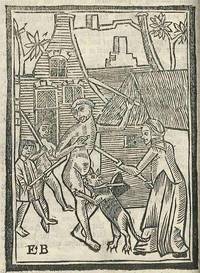
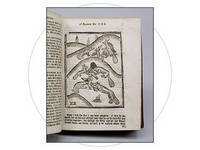
1684WRCLIT66732London: Printed by T.J. for Edward Brewster . and Thomas Passenger . 1684. Three parts bound in one volume. 80 leaves A-U4; 56 leaves A-O4; and 8160pp. Quarto. Modern blind paneled calf raised bands gilt label. First two parts illustrated with spirited woodcuts. Occasional foxing and mild spotting marginal smudges to first title usual tanning lower forecorners of E2-3 in first part torn away and replaced with a few letters and a few words in the sidenote in ms a few upper margins dust-soiled last three gatherings in third part supplied from another copy and trimmed slightly shorter at lower margin; a good sound copy neatly bound. First edition of the third part. An omnibus gathering of these three separately printed editions each with independent register and with the title of the first part taking into account the presence of the latter two. The terminal advert leaf to the first part is present. Wing attributes the text of the first part to John Shirley and that for the third is occasionally attributed to the publisher Edward Brewster. The first part is illustrated with 62 woodcut illustrations signed 'E.B.' of which 23 are repeats; the second part includes 15 woodcuts all of which appear as well in the first part. The first part was first printed in this form in 1667 and the second in 1672; the first part was reprinted again in 1701. Among the most widely adapted of the beast fables the tales of Reynard the Fox originated in the 12th and 13th centuries with early versions in French Dutch Latin and German being notable. Caxton printed a translation based on a Flemish text in 1481. The character of Reynard an anthropomorphic fox and trickster has since become almost an archetype in the literatures of several languages. ESTC R24532 & R218371 & R40614. WING S3513 & M2912 & S3436. BRUNET IV:1228. LOWNDES VII:2076. Printed by T.J. for Edward Brewster ... and Thomas Passenger ... hardcover books
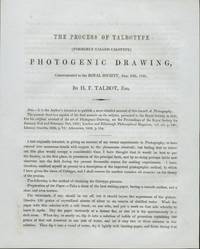
184152094London: Printed by J. & H. Cox Brothers 74 & 75 Great Queen Street Lincoln's-Inn Fields 1841. First edition. 4to. 4 pp. Aside from a few faint pinpoint spots of foxing this is a fine as new copy. Housed in a custom made cloth chemise and slipcase titled in gilt along the spine. Shortly after the presentation of his paper before the Royal Society on 31 January 1839 Talbot at his own expense printed the text as a pamphlet of 14 pages; "Some Account of the Art of Photogenic Drawing."became the world's first separate publication on photography. Through this process an ordinary piece of writing paper was immersed in a sensitizing solution dried placed in a camera and exposed in daylight to a subject for upwards of an hour or longer. Upon examination a tonally reversed rendering of the subject was visible. It was then soaked in a solution of salt and washed and dried then the process was essentially repeated exposing the first print to the new sensitized sheet reversing the tones to produce an image with the tonality as in nature. Through a series of further experiments over the next months Talbot discovered that a "latent" image always existed and that through chemical development it could be brought to life. This allowed for speeding the exposure in the camera to be cut to a mere 30 seconds and the enriched chemical solutions would produce a sharper and tonally richer image. This process he first called the Calotype from the Greek kalos - beautiful. <br/><br/>On June 10 1841 Talbot presented the Calotype process at a meeting of the Royal Society and at his own expense he published a four page description of his process. Unlike his earlier publication on Photogenic Drawing here he states in detail the full process. <br/>Upon the urging of John Herschel and David Brewster he began to call his process the Talbotype rather than Calotype. His intention was to license this process and likely this printed description was printed to distributed to potential licensees. <br/><br/>Aside from changing the name from Calotype to Talbotype in the title of this publication and the slight alteration in the printer's imprint the text of the two issue are identical - the word Calotype remains in the body of the text This is the foundation stone of the negative-positive process that has been in use since it was first published.<br/><br/>This printing is much rarer than the Calotype variant with WorldCat locating only Harvard University - Houghton Library and Cornell University. Gernsheim Incunabula No. 655 listing only the Calotype variant. Roosens and Salu No. 10285 listing only the Calotype variant. Weaver HENRY FOX TALBOT SELECTED TEXTS AND BIBLIOGRAPHY No. 87 listing only the Calotype variant. <br/><br/> Printed by J. & H. Cox, Brothers, 74 & 75, Great Queen Street, Lincoln's-Inn Fields hardcover books
00654London: Printed by T. Ilive for Edward Brewster 1701. Early English Edition of the Reynard Fables<br/><br/>REYNARD THE FOX. The Most Delectable History of Reynard the Fox. Newly Corrected and Purged from all grossness in Phrase and Matter. Augmented and Enlarged with sundry Excellent Morals and Expositions upon every several Chapter. To which may now be added a Second Part of the said History: As also the Shifts of Reynardine the Son of Reynard the Fox Together with his Life and Death &c. London: Printed by T. Ilive for Edward Brewster 1701.<br/><br/>Bound together with:<br/><br/>REYNARD THE FOX. The Most Pleasant and Delightful History of Reynard the Fox. The Second Part. Containing Much Matter of Pleasure and Content. Written For the Delight of young Men Pleasure of the Aged and Profit of all. To which is added many Excellent Morals. London: Printed by A.M. and R.R. for Edward Brewster 1681.<br/><br/>And:<br/><br/>REYNARD THE FOX. The Shifts of Reynardine The Son of Reynard the Fox Or a Pleasant History of His Life and Death. Full of Variety &c. And may fitly be applied to the Late Times. Now Published for the Reformation of Mens Manners. London: Printed by T.J. for Edward Brewster and Thomas Passenger 1684.<br/><br/>Three parts in one small quarto volume 7 5/16 x 5 9/16 inches; 186 x 141 mm. 156 2 table of contents 2 publisher's advertisements; 111 1 publisher's advertisements; 8 160 pp. Mostly black letter with titles and side notes in roman letter. Sixty-two woodcuts in the first part printed from thirty-nine blocks and fifteen woodcuts in the second part five repeated all repeats from the first part. Most cuts signed "E.B." Edward Brewster. Woodcut on C1 recto Part I printed upside down.<br/><br/>Contemporary sprinkled sheep. Covers ruled and decoratively tooled in blind spine decoratively tooled in gilt in compartments with two red morocco gilt lettering labels. Minor restoration to covers. Some browning occasional light dampstaining and soiling. Part I with tiny puncture marks in the lower blank margin through gathering I just touching one letter in the imprint on the title-page six small holes in I3 and one tiny hole in I4 causing loss of a couple of letters. Part III with paper flaw in the upper blank corner of A3 and A4 tiny tear 1/4 inch in the lower blank margin of F4 and paper flaw in the lower blank corner of I2 none affecting text. Armorial bookplate of Gloucester on front free endpaper. Bookplate of Hugh Cecil Lowther 5th Earl of Lonsdale 1857-1944 on front pastedown his sale 12 July 1937 lot 445. An excellent copy. Housed in a quarter morocco clamshell box.<br/><br/>Reynard the Fox "hero of several medieval European cycles of versified animal tales that satirize contemporary human society. Though Reynard is sly amoral cowardly and self-seeking he is still a sympathetic hero whose cunning is a necessity for survival. He symbolizes the triumph of craft over brute strength usually personified by Isengrim the greedy and dull-witted wolf. Some of cyclic stories collected around him such as those telling of the wolf or bear fishing with his tail through a hole in the ice are found throughout the world; others like that of the sick lion cured by the wolf's skin are derived from Greco-Roman sources. The cycle arose in the area between Flanders and Germany in the 10th and 11th centuries when clerks began to forge Latin beast epics out of popular tales. The main literary tradition of Reynard the Fox descends from the extant French ‘branches' of the Roman de Renart about 30 in number nearly 40000 lines of verse. The facetious portrayal of rustic life the camel as a papal legate speaking broken French the animals riding on horses and recounting elaborate dreams all suggest the atmosphere of 13th-century France" Merriam-Webster's Encyclopedia of Literature.<br/><br/>"Caxton's immediate successors as printers of the Historye of Reynart the Foxe Wynkyn de Worde and Richard Pynson both published illustrated editions using the same woodcuts. Although neither a de Worde nor a Pynson edition survives intact there are fragments and there is circumstantial evidence to show that a Wynkyn de Worde edition of about 1495 or earlier was illustrated by a series of 43 woodcuts.apparently newly made for that edition.The earliest nearly complete fully illustrated History of Reynard the Fox to come down to us probably dates from the period 1560-1586. It survives in a unique copy.sometimes described as the ‘Anonymous' edition because it lacks the first few and the last few pages were we would expect to find the name of the printer and the place of publication. It contains 39 of the 43 Wynkyn de Worde cuts. To judge by their worn state.they had been much used since they were first made. This Anonymous edition also contains a series of 19 smaller artistically inferior pictures.They too are quite worn and may date from soon after the earliest illustrated editions.I have ascribed this Anonymous edition to the period 1560-1586. It is therefore just possible that it is either the lost William Powell edition of 1560-1561 or the lost Edward Allde edition of 1586 for both of these are mentioned in the Stationer's Register but neither survives" Kenneth Varty Reynard Renart Reinaert and Other Foxes in Medieval England: The Iconographic Evidence Amsterdam: 1999 pp. 98-99.<br/><br/>"From William Caxton's first edition 1481 to Thomas Gaultier's only edition 1550 the story is divided into 43 chapters. This may explain why the Wynkyn de Worde picture cycle contained 43 vertical cuts though in fact some chapters were not illustrated and some were illustrated with more than one picture. In the period before the appearance of the Anonymous edition we know.of only three illustrated editions: the one by Wynkyn de Worde sometime before or in 1495 and the other by him c. 1515; and the one by Richard Pynson somewhere between 1501 and 155. In the Anonymous edition between 1560 and 1585 the story is divided into 58 chapters. This may account for the frequent repetition of the vertical cuts as space-fillers and even for the introduction and occasional repetition of the smaller horizontal cuts. For most of the seventeenth century the story now short-titled The Most Delectable History of Reynard the Fox is divided into 25 chapters but this does not result in any noticeable reduction in the number of cuts used of either the vertical or the horizontal kind nor in the introduction of new illustrative material. In short the same cuts go on in much the same order apart from space-filler repetitions illustrating the same episodes. The first seventeenth-century edition to continue this picture cycle tradition is Edward Allde's 1620 followed by Elizabeth Allde's 1629. It continues in the two editions published in 1640 by Richard Oulton one for John Slater and the other for John Wright; also in the editions published by Jane Bell in 1650 1654 and 1656; and in the first edition published by Edward Brewster in 1662. By this date the Wynkyn de Worde blocks had become so worn and damaged that it is not surprising to discover a totally new set closely modelled on them and on the sixteenth-century horizontals and that this set should appear in an edition made for the publisher who last owned the de Worde blocks; that is in Edward Brewster's second edition in 1671 of The most Delectable History of Reynard the Fox.The forty different cuts which illustrate this edition all prominently display his initials EB. He published further illustrated editions in 1676 1681 1694 and 1701. In 1671 Brewster gave a new lease of life to the old picture cycle and in 1672 he grafted new life onto the old story with A Continuation Or Second Part Of The Most Pleasant and Delightful History of Reynard the Fox.In due course this new story about Reynard was to attract new illustrations but in this volume Brewster makes do with a sprinkling of fifteen cuts from his new cycle bearing the initials EB and he uses them again in his 1676 edition of the old story now called Part One and in his 1681 edition of both Part One and Part Two.In 1684 Brewster marketed a further sequel to this Continuation. Since Reynard was dead the chief role in this new story is given to one of his sons the one called Reynardine. It is entitled The Shifts of Renardine The Son of Reynard the Fox.Edward Brewster was not the only late seventeenth-century publisher of the Beast Epic to feel the need to renew it. His contemporary John Shurley sometimes spelled Shirley also felt that need and in 1681 he published his Most Delightful History of Reynard the Fox in Heroic Verse.Unlike other earlier renovations of the story it was never reprinted perhaps because the verse form was unpopular and because the illustrations were poor and few" Varty pp. 254-257.<br/><br/>Brunet IV cols. 1228-1229. Lowndes p. 2076. Varty Appendix Three: "A Short-Title List of All Extant Illustrated Histories of Reynard the Fox from Wynkyn de Worde c. 1495 to A. Soulby c. 1800 which are kept in United Kingdom libraries based on H. Menke Bibliotheca Reinardiana" 24 18 and 21. Wing S3512 Part II and S3436 Part III. London: Printed by T. Ilive, for Edward Brewster, 1701 unknown books
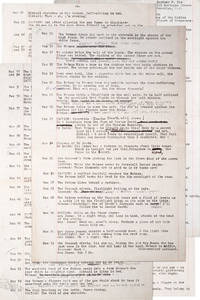
19392DC Comics 1939. none. Very good. Original hand corrected typescript. The complete story from Detective Comics no. 30 here titled "The Batman and the Diamonds of Death" the title was changed when it was published to "The Return of Dr. Death". 6 pages on 5 leaves 8" X 13" 1500 typed words plus 196 words of handwritten ink and pencil changes additions deletions and corrections including a rewrite of the final scene on the last page accompanied by a pencil drawing of a gliding Batman. Very good condition no mending tape or repair. This is Dark Knight incunabulum and as rare as a one ended stick. No other Batman manuscripts from this vintage or even from near this vintage is known. In fact any and all DC superhero manuscripts before 1945 except this one are impossible. Ex-Bob Kane. Ex-Mario Sacripante part of a dispersal of Kane's abandoned papers that included some page proofs and sketches but only this one manuscript. And by the way the printed Detective Comics no. 30 with our story in it sold for $19120 at auction in 2012. And the world record at auction for any issue of Detective Comics May 1939 graded 7 is $1500000 HA 2020 and for any Batman comic Spring 1940 graded 9.4 is $2220000 HA 2021 4 times the price of the most expensive imaginable hardbound 20th century 1st edition so something big and real is going on here. And both those prices are for a single comic of which dozens are known making our unique manuscript seem not to be very expensive and the chances of finding something even vaguely like it are the same as the chances of sitting in a chair with your mouth open and having a nicely roasted duck fly into it. Batman is the model for all modern superheroes without superpowers. Fueled by his superior intellect and powered by his fabulous toys he first showed up in Detective Comics no. 27 in a story written by Bill Finger and illustrated by Bob Kane. Finger also wrote the second story. When DC noticed its popularity they called in Gardner Fox who took over and wrote the next 4 including this one. Finger and Fox collaborated on the 7th story Detective Comics Nov. 1939 then Fox wrote the 8th one alone. Then with the exposition settled he turned it back to Finger and moved on to a long and influential career at DC co-creating Flash The Sandman Hawkman and the first superhero team-up with The Justice Society of America forerunner of The Justice League and it was Fox who conceived the Multiverse and introduced it to DC in 1961. First of all don't doubt it for a minute comic books are books. And this is the only early manuscript from the 2nd most valuable run in all of 20th century books Superman is the most valuable his debut in Action comics no. 1 selling for $3200000 2014 the world record for any 20th century book. Our manuscript will be looked back on in 10 years with regret captured in the thought "Why didn't I buy that" The answer is because there were no comps comparables or price points and only the most experienced enlightened and self-reliant collectors can calculate value without comps. From a more general perspective collector insight changes. Collector taste changes. The clues that point direction are only obvious in reflection. Some more stubborn booksellers continue holding to their view of what is in demand from a generation ago while other more cunning booksellers strategize to direct the insight and taste that drives demand towards obscurities that they can buy for cheap so as to extract large profit margins but the best collectors are immune to both the illusion of market rigidity and the deceit of bookseller manipulation because the savviest among them know that the market isn't static and watch carefully as the deck is shuffled and then focus on the center of the new radar. Whichever is the cause all but the nimblest booksellers get ambushed and in the confusion and isolation ensuing from their own folly they blame their disorientation on the collapse of enthusiasm for book collecting Book Code. DC Comics unknown books