Darwin, Charles und Francis DarwinAntiquariat.de

1 008 résultats
18931212041Stuttgart; E. Schweizerbart'sche Verlagshandlung (E. Koch), 1893. IV; 385 Seiten; graph. Darst.; 23,5 cm; fadengeh. Orig.-Pappband.
188440145BBStuttgart, Band 1-5: Schweizerbart (E. Schweizerbart'sche Verlagshandlung) / Band 6: Fines Mundi, 1884 - 1886 (Bde. 1-5) / 2017 (Bd. 6). Sechs Bände. Mischauflage (Bände 1,3,4 und 5: 2. Auflage, Band Bände 1-5: Mit goldener Titelprägung versehene Ganzleinenbände der Zeit / Band 6: Originaler Hardcoverband (Unveränderter Faksimilereprint der Ausgabe Schweizerbart, 1876.). Besitzer-Etikett (Ex Libris) auf vorderer Cover-Innenseite aller Bände. Textseiten der Original-Bände altersbedingt leicht gebräunt. Die Bände 4 und 5 durchgehend etwas stockfleckig. Keine Anstreichungen! Keine handschriftlichen Besitzervermerke! Bindunge (Charles Darwin - ).
1873NAT2147aStuttgart, Schweizerbart 1873. gr.-8°. VIII, 462; VIII, 553 S.; mit 43 Holzschnitten im Text, HLn. d. Zt., schwach gebräunt. (= Gesammelte Werke; 3. u.4.Bd.)
188937860ABLondon John Murray 1889. 2. Aufl. XVI/693 S., m. Illustr. O.-Leinen, verg. Rü.-Tit. Original cloth. Gilt title on spine. Einbd. leicht berieb. u. bestoss., Gelenke gelockert, die ersten 3 Bl. lose, Seitenbl. gebräunt, innen stellenw. minim. fl., ansonsten sauber u. gut erhalten, Besitzereintr. a. Vors. Rubbed and bumped. joints loose, 3 pages loose, slightly stained and browned, entry on flysheet. Nice copy. 2
18995140628London; John Murray 1899. XVI, 693 pages. Ca. 80 figures (woodcuts) in the text. 8° (19,5 x 14 cm). Green gilted and blind-stamped original cloth.
1880S11074Leipzig:: Ernst Gunther's Verlag 1880-1889 1880. 7 vols. 8vo. Various paginations. Jahr. I Bands. I & II: Contemporary quarter gilt-stamped calf over blue cloth Jahr. II Band. IV: Contemporary quarter gilt-stamped calf over pebbled maroon cloth Jahrs. IV-V: Contemporary gilt-stamped half calf over marbled paper-backed boards; worn corners showing Jahr. I Bands. I & II front hinges cracked spine heads torn Jahr. I Band. I rear hinge cracked. Jahr. I Band. I ownership signature of Afracukes 1877 Jahr. II Band. IV free front end-paper library label. Good. All volumes are sold complete. Some articles are unattributed—authorship is offered where provided. The pieces by or relating to Darwin include: Jahr. I Band. I: "Biographische Skizze einer Kleinen Kindes" by Darwin 367-376 pp. "Offene Briefe und Antworten" by Darwin 173-178 pp. "Lamarck und Darwin" by Arnold Lang 132-142 243-250 408-417 510-533 pp. "Martnrer der Darwin'schen Theorie" by Ernst Krause 78-80 pp. "Du Bois-Renmond Darwin versus Galiani Review" by Friedrich von Barenbach 359-365 pp. "Darwin's Werk: 'Uber die Wirtungen der Kreuzung und Gelbstbetruchtung im Plfanzenreich' und seine Bedeutung fur unter Berstandnik der Blumenwelt Review" by Hermann Muller 57-67 457-458 pp. Jahr. I Band. II: "Dr. Francis Darwin's Versuche an insektenfressenden Pflanzen" 565-567 pp. "Karl Ernst von Baer und seine Stellung zur Darwin'schen Theorie" by S. Gunther 71-92 pp. "Zur Darwin-Literatur" by Wilhelm Obers Focke 93-94 pp. "Darwin Ch. Ueber die verschiedenen Bluthenformen bei Pflanzen der namlichen Art Review" by Hermann Muller 297-294 pp. Jahr. II. Band. IV: "Das salzfreie Urmeer und seine Consequenzen fur den Darwinismus" by Otto Kunke 33-46 pp. "Faust's Schatten an Ch. Darwin poem" by A. Fitger 335-338 pp. "Charles Darwin. Eine biographische Stizze" by W. Preyer 339-350 pp. "Das versohnende Element in der Darwinistischen Weltanschauung" by the editors 351-359 pp. "Erasmus Darwin. Der Grovater und Borganger Ch. Darwin's" by Ernst Krause 327-424 pp. "Philosophie Mnstik contra Darwinismus" by Otto Busch 425-429 pp. "Das salzfreie Urmeer und seine Consequenzen fur den Darwinismus" by R. Hornes 430-437 pp. "Die den Darwinismus beruhrenden Bortrage der KI. Bersammlung deutscher Naturforscher und Aerzte" 210-224 pp. "Zur Darwin-Literatur II. Review" by Georg Seidlik 232-248 pp. "Kramer Dr. Paul Theorie und Erfahrung. Beitrage zur Beurtheilung des Darwinismus Review by Frick Muller 495-502 pp. "Fortschritte die des Darwinismus 1875-1878 Review 509 p. Jahr. IV Band. VII: "Die geschlechtlichen Farbungen gewisser Schmetterlinge" by Darwin 72-74 pp. "Fruchtbarkeit von Bastarden zwischen der gemeinen und chinesischen" by Darwin 77-78 pp. "La Teoria di Darwin Criticamente exposta da Giovanni Canestrini Review" by Ernst Krause 403-404 pp. "Darwin Ch. und Krause E. Erasmus Darwin und seine Stellung in der Geschichte der Deszendenztheorie" by Hermann Muller 236-238 pp. Jahr. IV Band. VIII: "Ch. und Fr. Darwin's Beobachtungen uber das Bewegungsvermogen der Pflanzen" by Hermann Muller 258-271 pp. "Darwinismus und Asthetik" by Fellner von Feldegg 273-282 pp. "Linne als Darwinist" p. 60. "Eine neues Buch von Charles Darwin Review" p. 160. "Ch. Darwins Gesammelte Werte. Autorisirte deutsche Ausgabe. Aus dem Englischen uberfekt von F. Bittor Carus. XIII. Band. Stuttgart. E. Schweizerbartsche Verlagsbuchhandlung E. Koch. 1881 Review" p. 408. Jahr. V Band. IX: "Krankheitsanlage und Immunitat vom Darwinistischen Standpunkte" 67-71 pp. "Eine Theorie der Schutzpocken-Impsung aus Darwinistischer Basis" by Wilhelm Obers Focke 322-324 pp. "Kleinere Mittheilungen und Journalschau: Vererbung" by Darwin 458-459 pp. Jahr. V Band. X: "Der Darwinismus in Talmud und Midrasch" 61-66 pp. "Die parasitischen Gewohnheiten von Molothrus Review" by Darwin 301-302 pp. Kosmos was a "well-known German scientific journal" founded by Krause in 1877 with Charles Darwin's endorsement Krause & Darwin p. iii. Krause "explicitly based the journal on 'the theory of evolution in connection with Charles Darwin and Ernst Haeckel.'. . . Furthermore it was in the pages of Kosmos that the bitter argument between Haeckel and Rudolf Virchow over the political meaning of Darwinism in Germany was played out" Browne p. 439. There were nineteen issues of Kosmos issued from 1877-1886. Not in Freeman. Ernst Gunther's Verlag, 1880-1889 hardcover
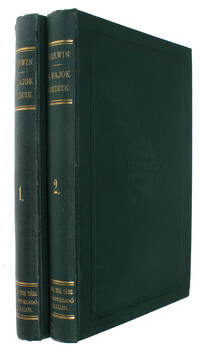
187460158Budapest Kiadja a Természettudományi Társulat Academy of Sciences 1873 & 1874. 8vo. In two contemporary embossed full cloth bindings with gilt letter- and numbering to spine. Bindings with light wear primarily affecting hindges. Previous owner's stamp to half title and title page in both volumes. Light occassional brownspotting primarily affecting first and last leaves. An overall nice copy. XVI 2 303 1; VII 1 361 1 pp. 1 leaf of Advertisement 2 plates A frontiespiece of Darwin and one listing the evolution of the different generations. <br/><br/><em>The exceedingly rare first Hungarian translation of Darwin's "Origin of Species". Together with the Serbian and the Spanish the first Hungarian translation of the "Origin" is arguably the scarcest of all the translations of the work and very few copies of it are known. The Hungarian public was introduced to Darwinism early on when Ferenc Jánosi reviewed The Origin of Species in the Budapesti Szemle Budapest Review half a year after it first appeared in English. Darwin's principal works were first published in Hungarian translation by the Royal Hungarian Natural Science Society Királyi Magyar Természettudományi Társulat. Translator Dapsy László had been actively working to make Darwin and his idea known in Hungary. Through his articles he consistently presented Darwinism as a possible model for the type of progressive society that Hungary should attempt to achieve thus being one of the very earliest to apply Darwin's theories to human society and politics in general. "Dapsy's translation inspired by liberal ideals of progress increasingly became part of the conservative discourse of Hungarian politics reinterpreted and appropriated according to the nationalist agendas merging in Hungarian Society". Mund The Reception of Charles Darwin in Nineteenth-Century Hungarian Society.Prior to his translation in 1872 Dapsy wrote Darwin: "I am sorry to say that as yet here such tendencies are received with a good deal of aversion but I believe that by-and-by they will accept it and it would be a great advancement for our political life too". Dapsy to Darwin 12 June 1872. Darwin's response is not known. "It is characteristic of the enlightened spirit of the country in this period that Darwin received academic recognition earlier in Hungary than in England. Although Cambridge did not honor Darwin until 1879 he was elected an honorary member of The Hungarian Academy of Sciences in 1872 the same year on this occasion the renowned Hungarian zoologist Tivadar Margó visited him at Down.Historical circumstances played a major role in this quick appearance of Darwinism and its popularity in Hungary. The failure of the 1848-49 revolution and war of independence seemingly put an end to progressive political discourse signaling an ideological crisis among the intelligentsia. In this context the natural sciences with their 'eternal truths' promised a way out inasmuch as science's promised objectivity might well serve as a politically neutral expression of progressive values" Mund The Reception of Charles Darwin in Nineteenth-Century Hungarian Society.The present book was one of four scientific works published between 1872 and 1874 by the Hungarian Academy of Sciences the others being Bernhard von Cotta's Geologie der Gegenwart 1865 Huxley's Lectures on the Elements of Comparative Anatomy 1864 and Tyndall's Heat Considered as a Mode of Motion 1863. An advertisement for these books occurs on the final leaf of vol. II.During Darwin's lifetime 'Origin' was published in eleven different languages some of them in more than one edition: The first foreign translation was the German 1860 followed by a Dutch 1860 French 1862 French 1862 Italian 1864 Russian 1864 Swedish 1869 Danish 1872 Hungarian 1873 Spanish 1877 and Serbian 1878 the last three by far being the rarest. OCLC locates only three complete copies: Paris Mazarin Library University Library of Szeged and The Huntington Library CA. Staatsbibliothek zu Berlin only hold volume 1. Freeman 703. </em> hardcover
18901381582London United Kingdom: John Murray 1890. Reprint. Hardcover. Octavo 500 pages. In Good condition. Faded dark evergreen spine with gilted lettering. Boards have mild shelving wear mild staining moderate wear along edges moderate wear along corners mild wear along spine and moderate wear along spine head and tail. Textblock has splitting to gutter from page 3 - 80 81 - 160 and 177 - 288 many pages bound together at the head denting along some pages splitting along front hinge between front pastedown and end-page moderate age-toning along edges and mild wear along edges. Shelved ND-A. 1381582. FP New Rockville Stock. John Murray hardcover
188938420London: John Murray 1889. Hardcover. x 519pp 4pp of publisher's advertisements. Green cloth stamped in gold. Wear to spine ends hinges are weak especially in the front contemporary inscription on front free endpaper. A good copy. ; Octavo. John Murray hardcover
189748564London: John Murray 1897. 8vo xi 1 500 pp. Frontispiece portrait tissue guard foxed with some offsetting. Original gilt titled dark green cloth a couple of faint marks otherwise an excellent copy. "It is impossible to overrate the influence of the voyage on Darwin's career: it was both his education and his opportunity" DNB. Freeman 83. London: John Murray unknown
18793523jJohn Murray 1879. Hardcover. Poor/No Jacket. Fourteenth thousand. Internally the book is in good condition however the boards are in poor state with rubbing fraying marking and wear all over. Internally there is an ex-libris plate under the front board and mild age-related tanning and marking throughout but the pages remain legible. The binding is sound. JK. Our orders are shipped using tracked courier delivery services. John Murray hardcover
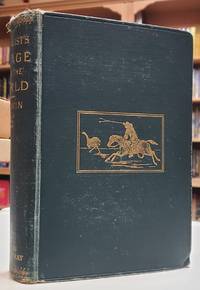
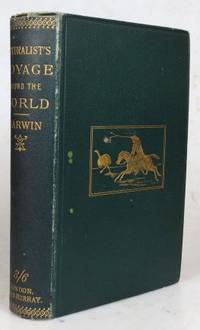
188950410London: John Murray 1889. 8vo x 519 1 4 advertisement pp. Frontispiece portrait. Original dark green cloth gilt vignette to upper cover some rubbing to spine and extremities. "It is impossible to overrate the influence of the voyage on Darwin's career: it was both his education and his opportunity" DNB. Freeman 49. London: John Murray unknown
189028113London: John Murray. Near Fine with no dust jacket. 1890. Hardcover. Half-title leaf not present. Previous owner's initials in pencil. Small 6mm split to leather at head of front joint. Some rubbing and minor abrasions to leather on spine and joints.; 1890 edition. iii-xi 1 500 pages portrait frontispiece. Half-title leaf absent. Contemporary blue full calf binding. Fine binding by George Robertson. Binder's name in gilt letters on front dentelle "GEO. ROBERTSON'S BINDING". Possibly this is the Australian bookseller George Robertson of Melbourne Brown leather lettering piece on spine. Gilt decoration to spine gilt borders to boards gilt tooling to edges of boards and dentelles. Page dimensions: 178 x 119mm. Marbled endpapers. All page edges gilt. Gilt spine title: "A / NATURALIST'S / VOYAGE / DARWIN". Freeman 59 - "Postscript now incorporated in text." . John Murray hardcover
1889ZZ4166John Murray 1889. Two gutters reinforced with barely visible archive tape at front of book. Original green cloth gilt boards rubbed and slightly marked wear to extremities. Pencil inscription: "Richard Carline Dec 1961 belonged to John Dupuis". Slight crack to endpaper on gutters. Text unmarked. Slight separation at pp192-93. Robust packaging. Tracking is always added to USA orders. It can be added to other overseas orders on request. Used books are exempt from USA tariffs. . Good/No dustwrapper. x 519pp. John Murray Hardcover
188249970London: john murray 1882. Later Printing. Hardcover - as published. VG no foxing very mild browning cloth is very good gilt lettering is very bright and readable. Binding is tight hinges are very good. Green cloth 513pp plus ads. Later printing Originally published by Henry Colburn in 1839. john murray hardcover
1845311707London: Ward Lock & Co 1845. 2nd edition. Hardcover. Previous owner's signature. Very good copy in the original gilt-blocked cloth. Title within ornamental borders. Frontispiece accompanied with a guard sheet. Spine bands and panel edges somewhat dulled and rubbed as with age. Remains quite well-preserved overall. Date is suggested. Physical description: 492p. illustrated. Notes: Includes publishers ads in the end. Includes index. Subjects: Beagle Ship: Natural history -- South America.Natural history -- Oceania. Natural History. Genre: Illustrated. London: Ward, Lock & Co hardcover
188223050291882. 15th thousand. very good. 15th thousand edition. Book very good paper tape to gutter of 1st and 2nd front free end papers some foxing mostly to front and rear papers former owner's name and date on 2nd front free end paper some bubbling to verso of front free end paper. unknown
1889138396London: John Murray 1889. 2nd edition 20th thousand. Very Good. octavo. hardback in original cloth 615pp. frontis. index Boards rubbed slightly shaken 4pp. torn without loss & tender hinges o/w a very good reading / reference copy of an early printing John Murray hardcover
189048293John Murray. 1890. New Ed. pp.xi 500. 8vo. Hardback. One crossed through signature on half-title. Original boards. A vg. copy. Freeman 58. John Murray. hardcover
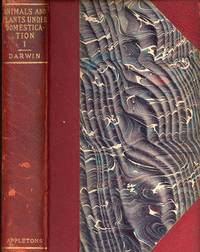
18978794New York: D. Appleton and Company 1897. 1897 Edition. Hardcover. Very good. Octavo. 5 x 8 in. xiv 473 x 495 pp. Volume one is occasionally illustrated with black & white reproductions of various animals. Very good in original half red morocco over marbled boards gilt lettering to spines still bright top edge gilt else some spots of rubbing to extremities with volume one having light cracking to leather along spine. and some discoloration to leather. A printing of the 2nd edition from 1897 considered the "authorized edition" edited by Darwin's son Francis Darwin. D. Appleton and Company hardcover
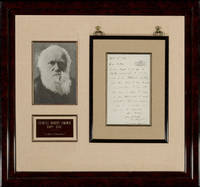
187932820659<p>One page. Original folds. Very good condition. Nicely framed.</p><p><strong>Darwin discusses the hereditary transmission of behavior and a vivid example of the phenomenon from the opening chapter of <em>The Expression of the Emotions in Man and Animals.</em></strong></p><p>In this letter Darwin thanks Fanny Kellogg for "communicating the curious case of an habitual gesture like that which I have described as inherited. I may add that since I wrote the action has been transmitted to another generation. Your case shall be sent to Mr. Galton who gave me the information."</p><p>In <em>The Expression of the Emotions in Man and Animals</em> 1872 Darwin had discussed the heritability of habitual gestures. There he cited at length a remarkable case related to him by his cousin Francis Galton. Galton a distinguished scientist in his own right was keenly interested in the inheritance in humans and the two men often shared findings and theories. Darwin quoted Galton in <em>The Expression of the Emotions</em> on page 33:</p><p>"A gentleman of considerable position was found by his wife to have the curious trick when he lay fast asleep on his back in bed of raising his right arm slowly in front of his face up to his forehead and then dropping it with a jerk so that the wrist fell heavily on the bridge of his nose. The trick did not occur every night but occasionally and was independent of any ascertained cause. Sometimes it was repeated incessantly for an hour or more. The gentleman's nose was prominent and its bridge often became sore from the blows which it received. At one time an awkward sore w as produced that was long in healing on account of the recurrence night after night of the blows which first caused it. His wife had to remove the button from the wrist of his night-gown as it made severe scratches and some means were attempted of tying his arm."</p><p>Galton went on "Many years after his death his son married a lady who had never heard of the family incident. She however observed precisely the same peculiarity in her husband but his nose from not being particularly prominent has never as yet suffered from the blows. The trick does not occur when he is half-asleep as for example when dozing in his arm-chair but the moment he is fast asleep it is apt to begin …" Galton further noted that the behavior had been passed down to the son's daughter. Darwin's letter offered here reveals that he learned after the publication of <em>Expression of Emotions</em> that yet another generation has acquired the remarkable habitual behavior!</p><p>This fascinating letter demonstrates the lengths to which Darwin went gathering data and telling examples for his writings. His published books reached a wide audience producing additional correspondence with yet more evidence for his theories.</p><p>The letter is also noteworthy for being signed in full "Charles Darwin" instead of the more usual abbreviated "Ch. Darwin."</p>
1869315466Down Beckenham Kent 1869. 3 pp. Bifolium of Down Bromley Kent stationery with "Bromley" crossed out and corrected to Beckenham. 1 vols. 8vo. Fine. 3 pp. Bifolium of Down Bromley Kent stationery with "Bromley" crossed out and corrected to Beckenham. 1 vols. 8vo. Unpublished.<br /> <br /> Charles Darwin 1809-1882 writes to Charles Layton London agent for Appleton about bringing out a revised and expanded second American edition of On the Origin of Species. The letter is a reply to Layton's of the day before in which he'd inquired after stereotyped plates of the English edition. In part:<br /> <br /> "The last or 5th Edit. of the Origin was printed off some months ago & it is impossible to supply stereotypes. I hope that you will inform Mr. Appleton of what I have said of the increased size of this last & 5th Edit. As 2000 copies of this Edit were printed there will not be a new Edit. for a considerable time . If Mr. Appleton will reprint this 5th Edition . I will pledge myself to endevour to persuade Mr. Murray to supply stereotype plates of my new book on the Descent of Man; but as I never before heard of such such a scheme I have no idea whether he will comply. At any rate I will please myself on the above conditions & on the terms suggested in your letter to send over the sheets as printed & stereotype casts of the woodcuts. But please remember my new book will not got to press for many months."<br /> <br /> Appleton had published the first American edition of Origin in 1860 from Murray's second English edition. In keeping with the terms of the present letter Appleton published the second American edition based on the 5th English edition in 1870 followed by the first American edition of The Descent of Man in 1871.<br /> See Darwin Correspondence Project DCP-LETT-7003 for Layton to Darwin 22 November 1869. unknown
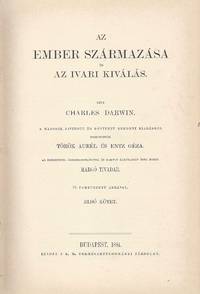
18841293Budapest: Kiadja a M. K. Természettudományi Társulat 1884. First Hungarian edition. In publisher’s red buckram with gilt title on spine and front panels blind stamped in two volumes. With bookplates and contemporary bookseller’s vignette on inner front panels. Covers are slightly rubbed at extremities. Endpapers reinforced at joints. Overall in very good condition. First Hungarian edition. In publisher’s red buckram with gilt title on spine and front panels blind stamped in two volumes. LXXI 1 1–542 2; VII 5 1–436 p. <p><br /> First Hungarian edition of Darwin’s 1871 book on human evolution and sexual selection “The Descent of Manâ€.<br /> <p><p><br /> Tivadar Margo 1816–1896 was a biologist the author of Darwin’s biography written for this edition and one of the earliest Hungarian Darwinists who wrote the first Hungarian zoological book that based on Darwin’s idea about the evolution. Margo had the chance to meet Darwin personally in 1875 he describes this meeting in the introduction of this book and also in the memorial lecture he held after the death of Darwin his fellow member of the Academy of Sciences Darwin was Honorary Fellow of the Hungarian Academy of Sciences as early as 1872.<br /> <p><p><br /> Aurél Török Géza Entz and Margo the translators and contributors of this book are among the most important figures to spreading Darwinism in Hungary.<br /> <p>. Kiadja a M. K. Természettudományi Társulat unknown
188453520Budapest Kiadja A. K. M. 1884. 8vo. In the publisher's original two embossed full red cloth bindings with gilt lettering to spine. Small vague stamp to both half-titles. Hindges loose on volume i. A fine fine and clean copy. LXXI 1 542 pp.; VII 5 436 pp. <br/><br/><em>The exceedingly rare first Hungarian translation of Darwin's The Descent of Man. "Compared with the original and with a biography by Margó Tivador" Freeman. The Hungarian public was introduced to Darwinism early on when Ferenc Jánosi reviewed The Origin of Species in the Budapesti Szemle Budapest Review a half year after it first appeared in English. Darwin's principal works were first published in Hungarian translation by the Royal Hungarian Natural Science Society Királyi Magyar Természettudományi Társulat. The Origin of Species translated by László Dapsy was published in 1873; The present work in 1884 and a few years later in 1897 the latter work was translated anew and published by László Seress. "It is characteristic of the enlightened spirit of the country in this period that Darwin received academic recognition earlier in Hungary than in England. Although Cambridge did not honor Darwin until 1879 he was elected an honorary member of The Hungarian Academy of Sciences in 1872 the same year on this occasion the renowned Hungarian zoologist Tivadar Margó visited him at Down.Historical circumstances played a major role in this quick appearance of Darwinism and its popularity in Hungary. The failure of the 1848-49 revolution and war of independence seemingly put an end to progressive political discourse signaling an ideological crisis among the intelligentsia. In this context the natural sciences with their 'eternal truths' promised a way out inasmuch as science's promised objectivity might well serve as a politically neutral expression of progressive values" Mund The Reception of Charles Darwin in Nineteenth-Century Hungarian Society."Darwin wrote in the preface to the second edition of 'the fiery ordeal through which this book has passed'. He had avoided the logical outcome of the general theory of evolution bringing man into the scheme for twelve years and in fact it had by that time been so much accepted that the clamour of the opposition was not strident. He had also been preceded in 1863 by Huxley's Man's place in nature. The book in its first edition contains two parts the descent of man itself and selection in relation to sex. The word 'evolution' occurs for the first time in any of Darwin's works on page 2 of the first volume of the first edition that is to say before its appearance in the sixth edition of The origin of species in the following year." Freeman.Freeman no. 1084. </em> hardcover
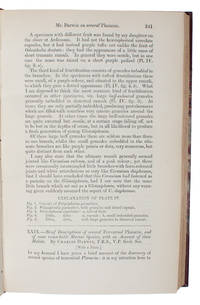
184456991London Taylor and Francis 1844. 8vo. In a nice later half morocco binding with five raised bands and gilt lettering to spine. Blind stamped to upper outer corner of first leaf of table of contents. In "The Annals and Magazine of Natural History" volume 14. A very fine and clean copy. Darwin's paper pp. pp. 241-251. Entire volume: vii 1 - 472 12 plates. <br/><br/><em>First edition of Darwin's paper on flatworms collected by him during the Beagle voyage one of the important early papers by Darwin on invertebrates originally intended for publication in The Zoology of the Voyage of HMS Beagle. This is Darwin's first publication on taxonomy: illustrated with a plate drawn by Darwin it describes a new genus and 15 new species of flatworm. Extremely rare on the market."The paper on flatworms . was Darwin's first venture into taxonomy. In it he described a new genus and 15 new species; most of the latter are still recognised as valid. He took a great deal of interest in these animals making extensive notes on their morphology and behaviour" Porter Darwin's Sciences.Previously familiar only with marine species Darwin was astounded to discover two new species of flatworm living on dry land in Brazil. He was intrigued by their close resemblance to snails and evolutionary questions may well lie behind his strong interest in them. PROVENANCE: From the collection William Pickett Harris Jr. 1897 - 1972 pencil note on p. iii. American investment banker and biologist. Following a career in banking Harris was appointed Associate Curator of the Museum of Zoology at the University of Michigan in 1928. "Harris played a highly important role in developing mammalogy and systematic collections of mammals at the University of Michigan" Hooper p. 923.Freeman 1669 </em> hardcover