DARWIN, Charles RobertBiblio.com
1 161 résultats
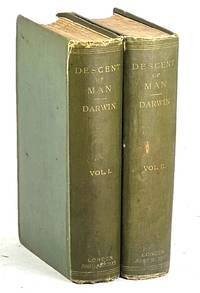
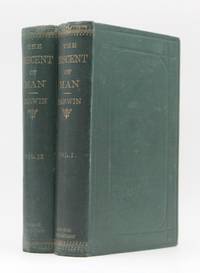
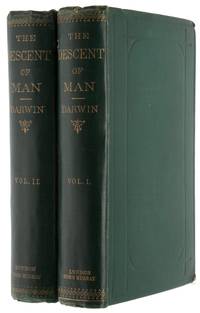
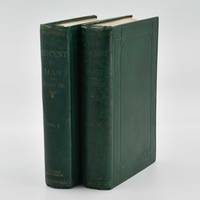
187121219841871. London: John Murray. 1871. 8vo. Original green cloth covers embossed in blind spines titled in gilt; pp. 423 16pp. adverts. and pp. 475 16pp. adverts. with 76 wood-engraved illustrations; cloth a little mottled light foxing to prelims and ads previous owner's pencilled signature to half-titles otherwise very clean hinges strong very good.First edition first issue with Murray's advertisements at the end of each volume dated ""Jan. 1871"". Vol. I p. 297 starts with ""transmitted"". Vol. II has the inserted postscript and has errata on the verso of the title-page. Freeman points out that ""the word evolution occurs for the first time in any of Darwin's works on page 2 of the first volume.""In this work Darwin expounded fully his theory of sexual selection and discussed at length the link he recognised between human and ape lineage. This piece further enhanced Darwin's fame - if not his popularity - and is one of the most significant works in the evolutionary debate. It addresses the issue of human evolution in terms that Darwin had shied away from in On the Origin of Species knowing how controversial his ideas would be. By 1871 he had the confidence and stature to publicise this crucially important part of his theory of natural selection.Freeman 937. hardcover
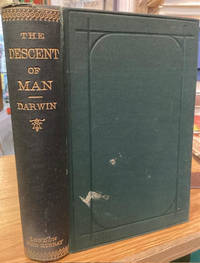
189475300London: John Murray 1894. 8vo. xvi 693 32 pp. Second edition revised and augmented. 31st thousand. Publisher's dark green cloth with gilt lettering to spine. Wear to head of spine and a little towards its tail otherwise extremities a little rubbed. Two white marks to upper board. Previous owner's name in ink to first blank and endpapers foxed otherwise clean. Black and white illustrations. Index at rear. . Very Good. Publisher's Cloth. Second Edition. 1894. John Murray 1894 hardcover
187147694New York: D. Appleton & Company. Fair. 1871. Hardcover. Regular shelf wear; Bumping to corners and edges; Both edges of spine are missing about 1/4 inch on top ; While binding is holding for the most part the book lays flat when open due to wear pages are beginning to separate; 409 pages . D. Appleton & Company hardcover
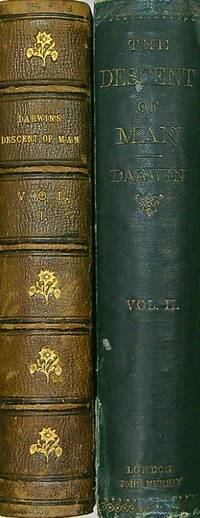
1871355490725007London: John Murray 1871. First Edition. Hard Cover. London: John Murray Albermarle Street 1871. First Edition FIRST ISSUE. VOLUME ONE ONLY. viii 2-423 pages. 16 pp Publisher's Catalogue not present. This is the First Issue with 'transmitted' being the first word on page 297 and the misprint 'kaola' on page 27. Half-title often missing is present in this volume. One of only 2500 copies published on 24 February 1871. Contemporary half-leather over marbled boards with green end-papers. 5 raised bands to the spine. Title in gilt to second compartment. Author and Vol. 1 in gilt to the fourth compartment. The Descent of Man was the first of Charles Darwin's works to include the word 'evolution' on page 2 of this volume. It next appeared in Darwin's sixth edition of 'Origin' published in the following year. Illustrated with in-text wood-engraved illustrations. A very good copy. Edges of spine and corners rubbed. No previous owner inscriptions. Clean interior. Rare on account of the small print run and being first issue. Quite uncommon to find Volume One - in First Issue - on its own. Further photographs available upon request. John Murray hardcover
1870018309London: John Murray 1870. 1st Edition 2nd Printing. Hardcover. Very Good. The Descent of Man 2 volumes 1st edition 2nd issue London: John Murray 1871 half-titles 16 pp. publisher's advertisements dated January 1871 at rear of each volume wood-engraved illustrations to text spotting to preliminaries and advertisements of both volumesend papers spotted ink ownership signature dated 1950 to upper margin of both half-titlesspine ends rubbed dark blue-black endpapers original green cloth gilt 8vo. Freeman 938. 2500 copies of the first issue were published in February 1871 and 2000 of the second issue published in March. The word 'evolution' occurs for the first time in any of Darwin's works appearing on page 2 of volume one of the first edition. <br/> <br/> John Murray hardcover
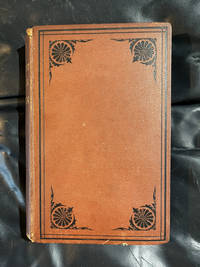
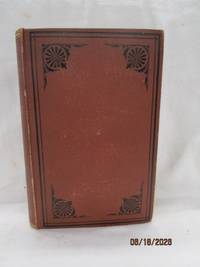
187255430New York: D. Appleton and Company 1872. Early American Edition. Hardcover. Good condition. Octavo. vi 409 2 v 3 436 12pp. Original brown cloth with black decorative border on covers gilt lettering and ruling on spines. Yellow endpapers. With printed postscript in volume two correcting error relating to the sexual differences of animals on pp. 287-289 of the first volume. With two pages of advertisements for Herbert Spencer publications in volume one extensive index plus twelve pages of advertisements for Appleton publications at rear of volume two including title by Spencer Darwin and others. Binding with some light wear along edges and lightly rubbed. Spines sunned. Light smudging of front free endpaer of volume one. Inscriptions of R. D. Maxwell inked to free endpaper of both volumes. Block lightly age-toned. D. Appleton and Company hardcover
1891106031New York: John Murray. 1891. Two volumes. Second edition revised and augmented twenty-third thousand. Large octavo original green cloth boards with gilt titles to spine pp xvii 507; viii 528. Vol. I has a long slanting faintly orange-coloured line of fading across the upper board. Rubbed to the head and foot of spines and corners. The stamp of a Bombay bookseller A.J. Combridge to upper edge of front free endpapers otherwise clean. Good condition. Ground-breaking considerations on the origins of humankind covering evolutionary development the brain and the role of sexual selection in species differentiation. Darwin examine birds fish insects and mammals including humans. This book contatins the first use of the word 'evolution' by Darwin preceeding its appearance in the 6th ed of 'Origin of Species'. 2nd Edition. Cloth Boards. John Murray hardcover
1871chd05acLondon: John Murray. G: in good condition. Volume I - Cover lightly scuffed with some light damp staining on lower edge with minimal impact on contents. Aeg. Volume II - Cover lightly rubbed with some wear at spine ends. Browning to eps and to catalogue. Ownership details on prelim page dated 1873. 1871. First Edition first issue. Volume I- Green Morocco gilt with dentelles; Volume II - Green cloth cover. 190mm x 130mm 7" x 5". viii 423pp; viii ii 475pp 16pp catalogue. Illustrated. Issue Points: Volume I has 'kaola' misprint on page 27 and 'transmitted' as first word on page 297; Volume II has Errata page on verso of title and a Postscript page after page viii; also 16pp. catalogue at end of volume. Volume I bound by Seton & Mackenzie. Heavy item - shipping supplement may apply for overseas. . John Murray hardcover
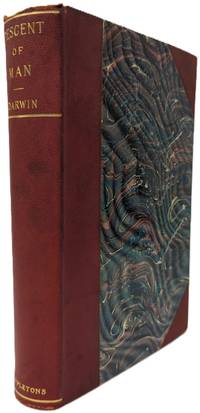
1871chd05aaLondon: John Murray. G : in Good condition without dust jacket. Rebound with marbled endpapers. Lacking rear advertisements. Cover rubbed with wear to spine and scuffing to leather. Area of wear with loss to marbled paper to front pastedown. Endpapers lightly foxed. March 1871. First Edition second issue. Green gilt embellished hardback half-leather cover. 190mm x 130mm 7" x 5". viii 423pp. B/w vignettes. First edition second issue. Issue points: 'When variations occur. and are transmitted' - first sentence on p.297 rather than 'Transmitted as in first issue'; Use of the term 'evolution' on p.2 - 'Descent' was the first of Darwin's works to utilise this term; both half title and title page are present. This rebound copy lacks the 16pp. advertisements originally present in each volume. . John Murray hardcover
1871376128London: John Murray 1871. First edition first issue with errata on verso of vol. II title-leaf. viii 423 1; viii ii 475 1 pp. 1 vols. 8vo. Publisher's green cloth. Light wear to covers expertly recased. Bookplate. First edition first issue with errata on verso of vol. II title-leaf. viii 423 1; viii ii 475 1 pp. 1 vols. 8vo. Darwin's Descent of Man created an uproar second only to his Origin of the Species; however "contrary to popular error prevalent now as well as then Darwin never said that man was descended from apes let alone monkeys; what he claimed was that man's ancestors if alive today would have to be classified among the Primates" De Beer Charles Darwin pp. 210-1. ODNB further clarifies "The Descent understood by Darwin as a sequel to the Origin was written with a maturity and depth of learning that marked Darwin's status as an élite gentleman of science" Freeman 937 John Murray unknown
189672392New York: D. Appleton & Company. VG. 1896. Leather Bound. Hardback in Very Good condition without dust jacket. 8vo 8" - 9" tall. 688 pages. Bound in 3/4 leather. Some uncut pages . Quick shipping excellent customer service. All books carefully packaged in boxes and ship with tracking information . D. Appleton & Company hardcover
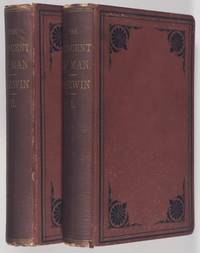
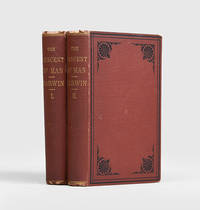
1871191570New York: D. Appleton and Company 1871. Darwin's most controversial theory arrives in America First US edition later issue without errata. First published in the UK earlier that year it was in this work that the word "evolution" appears for the first time preceding its appearance in the sixth edition of the Origin of Species the following year. Darwin had hoped that one of his supporters might tackle the thorny question of human evolution but was forced to face the logic of his own theory himself. Darwin deviated from his ostensible subject of mankind to describe sexual selection in the animal kingdom enabling him to answer those who saw peacock tails as an expression of divine aesthetics. Darwin also set out a definite family tree for humans tracing their affinity with the Old World monkeys and laid out his views on the evolutionary origins of morality and religion. "The Descent understood by Darwin as a sequel to the Origin was written with a maturity and depth of learning that marked Darwin's status as an élite gentleman of science" ODNB. "In discussing man's ancestry Darwin did not claim that man was directly descended from apes as we know them today but stated simply that the extinct ancestors of Homo sapiens would have to be classified among the primates; however this statement as misinterpreted by the popular press caused a furore second only to that raised by the Origin" Norman. 2 vols octavo. Wood-engravings within text. With 2 pp. of publisher's advertisements at rear of vol. I 12 pp. at rear of vol. II. Original red cloth spines lettered in gilt boards panelled and decorated in black light yellow endpapers. Relevant contemporary newspaper clipping loosely inserted. Pencil ownership inscription of one J. Edwin Everett of Manchester 1850-1893 New Hampshire dated 1871 on front free endpapers. Wear to extremities with a little loss to head of spine cloth cockled else clean inner hinges starting but firm occasional spotting to contents. Very good. Freeman 942; Norman 599 UK edition. hardcover
1871hist 1852<p>First Edition presumed. Good- no jacket. Spine ends are brittle and rubbed down. Corners are rounded but not very much. Edges are toned but evenly so. Original owners signature on ffep dated 1871. No other writing pages are clean. Binding is tight and book is square. Gilt titles are still there. See photos. Shipped boxed.</p> D. Appleton and Company hardcover
18746679London: John Murray 1874. Second edition. <p>First edition first issue of the book in which Darwin finally gave his public account of two ideas he had withheld from the Origin: the descent of Homo sapiens and - his more original contribution - the mechanism of sexual selection. On page 2 of Volume I the word evolution appears the first appearance of the word in any Darwin work a year before the sixth edition of the Origin. The descent of man made him famous. Sexual selection made him lonely: it required his readers to credit birds fishes and insects with something like aesthetic judgment - that females choosing generation after generation had driven ornament that natural selection alone could not explain. Wallace would not accept it and the community followed him. Sexual selection remained a neglected corner of Darwinism for a century until Trivers 1972 Zahavi 1975 and Hamilton and Zuk 1982 vindicated female choice and placed it at the centre of evolutionary biology. The delay tells its story: Darwin had seen further than his readers who had simply refused to follow.</p>. What Darwin Left Out of the Origin. <p>First edition first issue of the book in which Darwin finally gave his public account of two ideas he had withheld from the Origin of Species: the descent of Homo sapiens from pre-existing forms and - his more original and more contested contribution - the mechanism of sexual selection. The Origin had deliberately excluded man from its argument "light will be thrown on the origin of man and his history" and had mentioned sexual selection only briefly as a special case within natural selection. Twelve years later with the evolutionary argument secured in the scientific literature and the public polemics largely past Darwin set out the two positions he had kept in reserve. The first made him famous; the second neglected for a century is now recognised as one of the most powerful explanatory frameworks in evolutionary biology.</p> <br /> <p>The twelve-year delay was not accidental. Darwin had been collecting notes on human descent since the Beagle years of the 1830s but had withheld them for strategic reasons. He had written to Wallace in December 1857 that he would avoid the subject of man as surrounded by too many prejudices even while admitting that it was the highest and most interesting problem for the naturalist. By 1871 the climate had changed. Huxley's Evidence as to Man's Place in Nature 1863 had done much of the defensive work; Lyell's Antiquity of Man 1863 had established deep human prehistory; and Haeckel's Generelle Morphologie 1866 had pushed the evolutionary argument onto the Continent and drawn the first explicit phylogenies of the human line. The Descent therefore arrived not as an opening salvo but as the master's own statement delivered at a moment when the main resistance had already been absorbed. The storm that had greeted the Origin did not repeat itself in 1871; Darwin wrote to a friend that he was surprised to find everyone talking about the book without being shocked and took this as a measure of the increasing liberality of the age.</p> <br /> <p>The first volume opens with a page that would prove diagnostic. On page 2 in the introduction Darwin refers to the principle of gradual evolution - the first appearance of the word evolution in any of his published works a year before its appearance in the sixth edition of the Origin. The word had hitherto belonged to embryology and to Herbert Spencer; Darwin had avoided it in the Origin in favour of descent with modification and natural selection partly because evolution still carried its older sense of the unfolding of a preformed germ and partly because Spencer's usage had given it metaphysical baggage Darwin preferred not to inherit. That he now allowed the word onto his own page marks a small but real shift in nomenclature: from 1871 forward the subject would be called evolution and the Descent is where Darwin formally joined the convention he had helped to make inevitable.</p> <br /> <p>The first volume and the opening chapters of the second are devoted to the argument for the descent of man from a pre-existing form. The strategy is cumulative: no single piece of evidence is decisive but each addition narrows the space of alternative explanations. Darwin begins with the homologies of bodily structure between man and the other mammals - the bones of the hand the arrangement of the viscera the musculature - arguing that these resemblances are inexplicable except as the signature of common descent. He proceeds to embryonic development where he reproduces the famous side-by-side comparison of a human embryo with that of a dog the Ecker-Bischoff figure Vol. I p. 15 arguing that in their early stages the two are practically indistinguishable and that embryology therefore preserves in miniature the shared ancestry of the vertebrate body plan. He turns to rudimentary organs - the vermiform appendix the musculus auricularis the coccyx the tubercle on the outer edge of the ear - as fossil evidence carried in the living body structures that make sense only on the assumption that they once served a function in a remoter ancestor. And he finally addresses the mental faculties arguing from comparative psychology - the affection of dogs the jealousy of birds the rudimentary reason observable in the higher apes - that there is no unbridgeable gap between human and animal cognition but rather a difference of degree. The argument leans on his cousin Francis Galton's Hereditary Genius 1869 which had established to Darwin's satisfaction that mental and moral qualities were inherited along the same channels as physical ones and could therefore be brought within the selective argument. The conclusion to the first part is stated with characteristic caution: that man is descended from some less highly organised form and that the grounds upon which the conclusion rests will Darwin writes never be shaken.</p> <br /> <p>A long chapter on the races of man mounts an argument against the polygenist position - then widely held particularly in the American anthropological literature after Morton and Nott - that the human races constitute separate species with separate origins. Darwin argues from the fertility of crosses from shared mental and moral characteristics and from the continuous rather than discrete distribution of racial traits for a single origin of Homo sapiens. His ethnographic scaffolding carries the prejudices of its period; his conclusion however is monogenist and anti-polygenist and in the politics of nineteenth-century race science that was the liberal position decisively opposed to the scientific racism then institutionalised in the American schools.</p> <br /> <p>The moral sense receives its own treatment. Against those who held that conscience and altruism must be divinely implanted because they could not be derived from self-interest Darwin argues that the social instincts - present in rudimentary form throughout the higher animals - provide a natural foundation for ethics. An animal that lives in a group is selected for behaviours that sustain the group; over generations those behaviours become internalised as moral feelings. It is the earliest sustained naturalistic account of ethics in the evolutionary literature and it is precisely the argument that Wallace a recent convert to spiritualism refused to accept.</p> <br /> <p>With the descent of man established Darwin turns in the remainder of the second volume to his second and originally his primary subject: sexual selection. This is the book's most sustained theoretical innovation. Darwin had been troubled since the 1850s by a class of biological traits that natural selection could not easily explain - elaborate male ornament ornate plumage antlers display behaviours bright colours - which often appeared to reduce the bearer's chances of survival rather than enhance them. The peacock's tail had become his standing example of the problem. Writing to Asa Gray in April 1860 only months after the publication of the Origin Darwin confessed that "the sight of a feather in a peacock's tail . makes me sick." The remark is only half a joke. It identifies the precise class of phenomena that resisted the argument of the Origin and it locates the theoretical problem that would occupy him for the next eleven years. The solution developed in the Descent was that a second mechanism distinct from natural selection was at work: selection not for survival but for reproductive success acting through mate choice and intrasexual competition.</p> <br /> <p>Sexual selection in Darwin's formulation has two components. The first - male-male combat - accounts for weapons and body size: antlers horns spurs large canines the fighting armature of rival males. The second - female choice - accounts for ornament: song colour display behaviour elaborate plumage. The implication was radical. Female preference exercised generation after generation was sufficient to drive the evolution of male traits that would otherwise be selected against. Darwin was asking his readers to believe that birds fishes and insects were in effect making aesthetic judgments and that those judgments had consequences at the species level. The comparative tour that occupies the bulk of Volume II - insects Chapters X-XI fishes amphibians and reptiles Chapter XII containing the arresting figure of Plecostomus barbatus a South American siluroid catfish in which the male's mouth and interoperculum are fringed with a beard of stiff scale-like hairs of which the female shews hardly a trace birds Chapters XIII-XVI by far the longest treatment taking in courtship display vocal performance plumage and the geographical distribution of ornament and mammals Chapters XVII-XX - is in effect a six-hundred-page argument that this aesthetic mechanism is real widespread and responsible for most of the secondary sexual characters in the animal kingdom.</p> <br /> <p>Wallace would not accept it. The disagreement had been building for years. Darwin and Wallace had corresponded intensively through 1867 and 1868 about the coloration of female birds the selective meaning of sexual dimorphism and - the point that eventually separated them - whether animals were capable of the kind of preference that Darwin's theory required. Wallace's 1868 Westminster Review essay on ornament already hedged: he would allow that bright colour could indicate vigour but not that it could be chosen for beauty alone. In his 15 March 1871 Academy review of the Descent he broke with Darwin publicly and in the papers that followed through the 1870s he argued that apparent ornament was really cryptic colouration or species recognition misread and that female choice - which required crediting animals with something like aesthetic sense - was implausible. Most of the scientific community followed Wallace. Sexual selection remained a neglected and faintly embarrassing corner of Darwinism for most of a century mentioned in textbooks as a historical footnote but rarely taken up as a research programme. It was resurrected only in the 1970s when Robert Trivers's 1972 parental-investment paper gave female choice a rigorous economic foundation Amotz Zahavi's 1975 handicap principle explained why costly ornaments could function as honest signals of genetic quality and W. D. Hamilton and Marlene Zuk's 1982 Science paper connected ornament to parasite resistance. Sexual selection is now one of the central research programmes in evolutionary biology and Darwin's six hundred pages are read as a founding document rather than a historical curiosity. The delay tells its own story: Darwin had seen further than his readers and his readers had simply refused to follow for a hundred years.</p> <br /> <p>Darwin's eldest daughter Henrietta Emma Darwin had read the manuscript and suggested corrections of style; in a letter of 28 March 1871 Darwin called her his very dear coadjutor and fellow-labourer and the book's argumentative clarity owes something to her editorial hand. The wood-engraved illustrations were drawn from life by the zoological artist T. W. Wood whose earlier work for Alfred Russel Wallace's Malay Archipelago 1869 had made him the best-placed draughtsman in England for the natural-history figures the Descent required; his economical diagnostic style suited the comparative method of the second volume where the illustrations carry much of the argumentative weight. The corrected proofs went to Murray on 15 January 1871 and the first issue of 2500 copies appeared on 24 February priced at £1/4/- the two-volume set. Demand was immediate: within three weeks a reprint had been ordered and by the end of March 1871 some 4500 copies were in print earning Darwin close to £1500. The religious press was hostile - the Edinburgh Review the Dublin Review and the Quarterly Review all published long attacks - but the scientific periodicals took the book more or less on its own terms. The most damaging review was the Quarterly's published anonymously in July 1871: Darwin guessed correctly that the author was St George Jackson Mivart Huxley's disillusioned former pupil whose own On the Genesis of Species January 1871 had already mounted a Catholic-metaphysical critique of natural selection. Mivart argued that the Descent would unsettle half-educated classes and licence moral relativism; Darwin felt the sting told Huxley that he expected to be viewed as the most despicable of men and was relieved when Huxley counter-attacked in the Contemporary Review that autumn. The episode permanently soured the Darwin-Mivart relationship and figures prominently in the 1874 second edition where Darwin silently corrected several of Mivart's specific objections without naming him. Translations appeared quickly: German Carus 1871 the two-volume Stuttgart edition that Darwin came to regard as authoritative and used when correcting his own text for later editions Dutch Hartogh Heys van Zouteveen 1871-2 French Moulinié 1872 Italian Russian and Swedish all within three years of the first printing. By the time Darwin died in 1882 the Descent had reached a wider international readership than any of his other works with the sole exception of the Origin itself. Two further English issues of the two-volume edition appeared in April and December 1871 the seventh and eighth thousands each incorporating small textual corrections; a second edition followed in 1874 in a single volume rearranged into three parts with sexual selection in relation to man split off as Part III a supplementary note on the brains of man and apes supplied by Huxley pp. 199-206 a five-line errata slip and extensive textual revisions throughout Freeman 944. Darwin had initially intended Wallace to help him prepare the new edition but his wife Emma intervened; the editorial assistance came from their son George Darwin instead and Darwin wrote an apologetic letter to Wallace explaining the reassignment.</p> <br /> <p>The present copy is the first issue of February 1871 distinguished from the second issue March 1871 2000 copies by four diagnostic features in Volume II all of which are present and correct. First the verso of the title leaf carries the printed errata list - seventeen corrections for Volume I and eight for Volume II - replaced in the second issue by a list of nine other works by Darwin. Second a separately tipped-in Postscript leaf paginated pp. ix-x and inserted after the Contents on which Darwin acknowledges "a serious and unfortunate error" in his argument on sexual selection affecting Volume I pp. 297-9 and Volume II pp. 161 and 237. Darwin had realised too late to correct the printed text that he had conflated two distinct phenomena: the coincidence between the onset of sexual maturity and the appearance of secondary sexual characters which he had attributed to sexual selection and which he now recognised was better explained by natural selection operating at a correspondingly late life-stage. The Postscript does not rewrite the passages; it flags them. Third the verso of the Volume II half-title carries the printer's note William Clowes and Sons Stamford Street and Charing Cross blank in the second issue. Fourth the first word on p. 297 of Volume I - the opening of the passage Darwin apologises for - is transmitted replaced by When in the second issue after the pages had been entirely reset. Both volumes retain the sixteen-page inserts of Murray's advertisements dated January 1871. The first-issue leaves are therefore witnesses to Darwin's thinking in the act of correcting itself and their collective presence is the signature of a copy printed in the earliest state.</p> <br /> <p>Institutional copies of the first issue are securely held at Cambridge University Library Darwin's own copy in the Darwin Archive the British Library the Bodleian the American Museum of Natural History the Linda Hall Library the Huntington and the Norman Library lot 599 in the 1998 Christie's dispersal; auction appearances of complete first-issue sets in publisher's green cloth are not common at the better grades with the standard reference points the Garden 1989 Sotheby's catalogue the Norman 1998 Christie's sale and the Nordmann 2006 Christie's Paris dispersal. Census coverage in WorldCat returns several hundred holdings for the 1871 imprint as a whole but does not distinguish issue by record; Freeman's four-feature collation remains the operative test for assigning a given copy to the first issue rather than to the second. The present copy carries all four features and an indistinct pencil monogram apparently EH at the head of the Volume I half-title the only ownership mark in either volume; the marginal annotations and underlinings are the unsigned hand of a careful contemporary reader who worked through both volumes and who paused with particular attention at the bird and mammal chapters of Volume II.</p> <br /> <p>References: Freeman 937 - Garrison-Morton 170 - Norman 599 - Printing and the Mind of Man 169 - R. B. Freeman The Works of Charles Darwin: An Annotated Bibliographical Handlist 2nd ed. Folkestone 1977 pp. 128-31 - van Wyhe ed. The Complete Work of Charles Darwin Online F937.</p> <br /> <br /> <br/> <br/> <p>Two volumes 8vo 191 × 125 mm. Vol. I: pp. viii 423 1 16 pp. publisher's advertisements dated January 1871; Vol. II: pp. viii ii: errata on verso of title leaf and tipped-in Postscript leaf 475 1 16 pp. publisher's advertisements dated January 1871. Numerous wood-engraved illustrations in the text. Publisher's original green diaper-pattern vertical-rib cloth spines lettered and decorated in gilt with foliate ornaments at head and foot "LONDON / JOHN MURRAY" at the foot of each spine blind-stamped panelled boards yellow endpapers. Faint pencil ownership monogram at the head of the Vol. I half-title indistinct. Occasional pencil underlinings and small marginal annotations throughout - the marks of a careful contemporary reader who worked through both volumes. Rubbing and light wear to extremities and spine caps; minor chipping to a few leaf edges; foxing to text block edges and occasional light internal foxing; text block of Vol. II split at p. 161 - the page Darwin apologises for in the Postscript - but holding and entirely unrestored. A good honest copy in original cloth read and annotated rather than merely shelved.</p> . John Murray unknown
1889RDARDES00drpD. Appleton and Company 1889. Very Good. Darwin Charles. The Descent of Man and Selection in Relation to Sex. NY: D. Appleton and Company 1889. 688pp. Indexed. Illustrated. 8vo. Book condition: Very good with bumping and fraying. Some penciling on some pages and rear pastedown without obstructing text. The illustrations are very well done and detailed showing even the minutest details of insect wings and other creatures. D. Appleton and Company unknown
187557931NY: D. Appleton & Company. 1875. new edition. Hardcover. Very Good. Publisher's cloth stamped in gilt and black yellow eps. Edges rubbed points gently bumped. Minor penciling to eps.; 8vo 8" - 9" tall; xvi 6884 pages . D. Appleton & Company hardcover
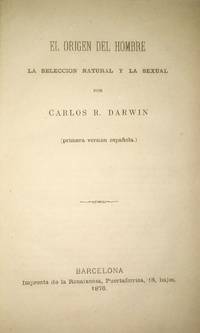
18761701Barcelona: Imprenta de la Renaixensa 1876. First Spanish edition. In contemporary half leather. Marbled endpapers. Spine with small damage to the head wormholes at joints. Corners slightly bumped. Pages yellowed due to aging. Last pages with wormholes. Overall in very good condition. First Spanish edition. In contemporary half leather. Marbled endpapers. XI 2 14–322 2 p. First Spanish edition of Charles Darwin’s 1871 groundbreaking book on human evolution and the sexual selection “The Descent of Manâ€. Imprenta de la Renaixensa unknown
187130691New York: D. Appleton and Company 1871 Hardcover in gilt-stamped heavy red-brown cloth 1st American Ed with postscript to vol 1 and 1871 date to title page yellow endpapers no text markings NOT ex-lib edge wear & soil to boards corners & spine ends slightly rounded with the beginnings of fraying pages clean & without foxing hinges tight nice copy of the first issue of Volume Two; 8vo; 436pp indexed & illus; 12pp ads. First Edition. Hard Cover. Very Good. New York: D. Appleton and Company hardcover
1871000010496New York: D. Appleton and Company 1871. First American edition. Hardcover. Good. 2 vol. 8vo. 3 iv-vi 1 2-409 1 2 pages of publisher's advertisements 2; 3 iv-v 4 2-436 6 pages of publisher's advertisements 2 pp. Orange-red cloth with black decorations on the boards and gold lettering on the spines. Yellow coated endpapers and pastedowns. With several in-text illustrations. Freeman 129-131. Oxford DNB Adrian Desmond James Moore and Janet Browne "Darwin Charles Robert 1809–1882". With the postscript in volume two both versos of our title pages are blank. Both title pages dated 1871. These volumes contain the first appearance of the word evolution and a verbal description of humanity's ancient ancestors which was no doubt distrubing to Victorian sensibilities. Darwin painted human ancestors as hairy tree dwellers. The majority of the book however focuses on sexual selection among other animal species. The first print run was very popular selling 5000 copies right away. A landmark work in biological science a paradigm shift in the way the animal kingdom's history was understood. Both volumes have been rebacked within the past 40 years with strips of the original spine cloth laid down later endpapers placed before and after the originals in each volume. A few leaves reattached and realigned to the gutters with archival tape. D. Appleton and Company hardcover
1890104666D. Appleton 1890-01-01. Second Edition. Hardcover. Very Good. 0x0x0. 1871 Appleton first American edition 2 volume set both with 1871 on title page volume two has postscript and errata for volume 1. Vol 2 also has advertisement for the new edition of Origin of the species tipped into front and 12 pages of advertisements in the rear. Tight bindings light amount of pencil small bump and loss to the heads and toes of the spines. oversized and overweight. A72 Please email for photos. D. Appleton hardcover
1896054879London: John Murray 1896. Book. Fair. Hardcover. vi-xvi 693pp; illustrated; foxing to eps.; green cloth boards gilt title to spine; edgewear and scuffing; 2nd edition revised and augmented. Size: 12mo - over 6¾" - 7¾" tall. John Murray Hardcover
187561119Appleton. 1875. 2nd. New Rev. & Aug. Ed. pp.xvi 688 with figs. 8vo. Hardback. Contents fine. Original illustrated boards lightly rubbed to extremities o/w. nr. fine. Freeman 946. A very pleasing copy of the second edition which was extensively revised and ‘contains a note on the brains of man and apes by T.H. Huxley at pp.199-206’ Freeman. Appleton. hardcover
187160999John Murray. 1871. 1st. Ed. 7th. Thou. Two volumes. 8vo. Hardbacks. Contents nr. fine. Contemporary half-calf over marbled boards some rubbing to extremities o/w. thor. vg. Both volumes benefited from more recent spines retaining original end-papers all in fine condition. With heraldic bookplate of Arthur Byrom Gordon to front-paste down of both volumes. Freeman 939. The first issue of ‘The Descent of Man’ had a print-run of just 2500 copies. It was published in February 1871 closely followed in March 1871 by the second issue printing of a further 2000 copies. There were two further issues of the two volume English edition in April and December 1871 the seventh and eighth thousands. Controversially received like ‘Origin of Species’ before it the word ‘evolution’ occurs here for the first time in any of Darwin’s works. It can be found on page 2 of the first volume. John Murray. hardcover
1874A38223London: John Murray 1874. xvi 688 78 woodcuts in text. . HB. 8vo in 12s 190x120mm orig. green cloth rubbed minor wear to corners a few ink spots to rear board; short tear to front endpaper orig. owner's name erased to verso; later owner's name to pastedown; small ink smudge to outer margin of title; occasional light foxing; one gathering working loose with stitching tender; small marginal stain to lower outer corner of 20 pages. A good copy. Without the Errata slip mentioned by Freeman. 2nd edition tenth thousand. This edition was issued as a single volume the first edition 1871 is in two volumes and the text is divided into three parts rather than two in the first edition with sexual selection in relation to man being separated off as the third part. This edition has ben extensively revised and contains a note by T.H. Huxley 'On the Resemblences and Differences in the Structure and the Development of the Brain in Man and Apes' pp 199-206. Freeman 944. John Murray hardcover
187327329NY: D. Appleton & Company. Very Good with no dust jacket. 1873. First American Edition; Second Printing. Hardcover. As noted this is only volume 2 of a 2 volume set. ; 8vo 8" - 9" tall; 436ads pages . D. Appleton & Company hardcover